10 Best Practices for Documentation in Logistics
Apply best practices for documentation to improve dispatch accuracy, route consistency, audit readiness, training, and compliance in middle-mile logistics.
September 28, 2026
At 1:40 a.m., a driver reaches a distribution center and finds that the handoff note doesn't mention a dock change. Dispatch has the old door assignment, the operations team can't confirm whether the trailer was inspected, and the customer sees only that the arrival is late. A missing inspection record or undocumented facility delay can turn a routine overnight lane into a chain of calls, guesses, and avoidable risk.
Documentation isn't paperwork for its own sake. It's the shared operating record that tells the driver what to do, gives dispatch the facts needed to respond, helps operations identify recurring problems, and gives customers evidence of what happened. The United Nations guidance on statistical best practices treats complete, versioned, sourced, and regularly updated documentation as a control for transparency, reproducibility, and error reduction. The same principle applies to recurring middle-mile lanes.
The following 10 best practices for documentation connect dispatch records, inspections, driver logs, route procedures, incident reports, delivery proof, performance data, compliance files, training records, and communication history into one safety-first operating system for Peak Transport teams.
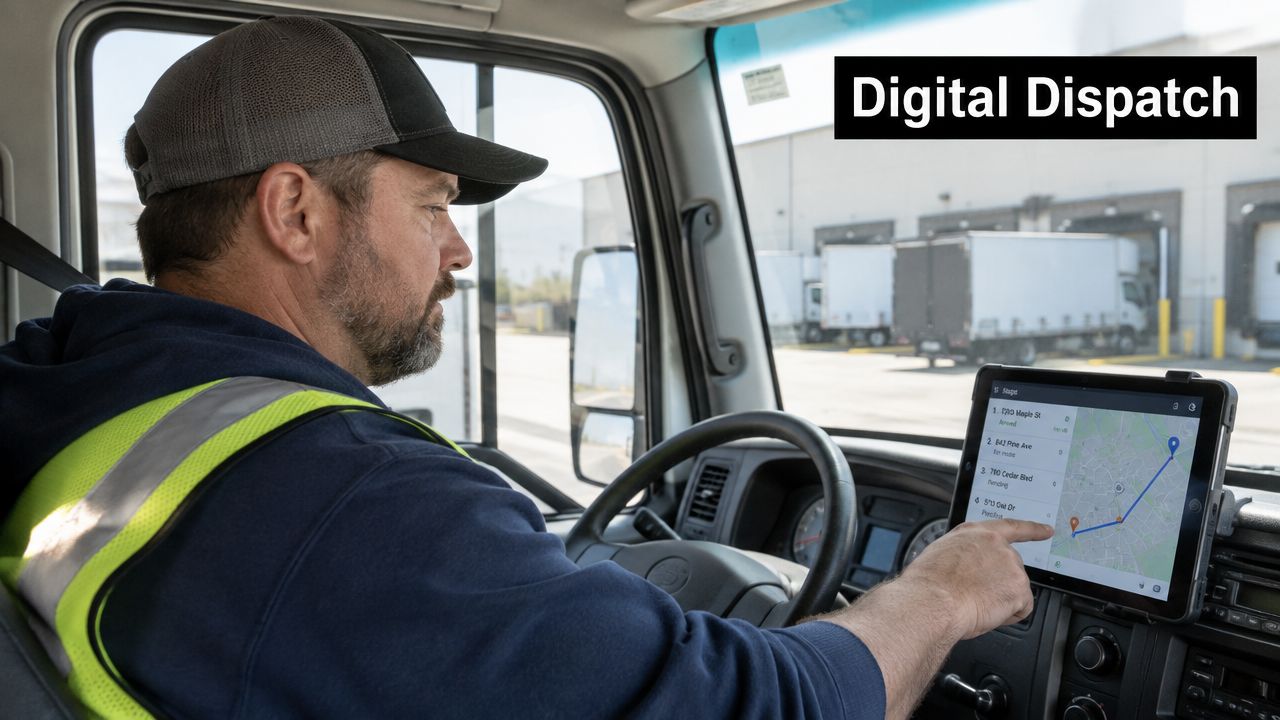
1. Standardized Digital Dispatch Documentation
A dispatch record should answer the operational questions that matter before a truck leaves and while it's moving. Which driver is assigned? Which lane and facilities are involved? What are the planned pickup and delivery times? Has the driver confirmed the assignment? What changed after departure?
A consistent digital form gives drivers, dispatchers, operations leaders, and compliance staff access to the same current record. It also prevents information from being trapped in paper notes, personal text messages, or an inbox that the next shift can't access. One industry summary reported that 45% of small and midsize businesses still relied on paper records for customer, contact, and vendor data, while 11% had no document-management system. The same business document-management statistics reported that knowledge workers spend 2.8 hours per week searching for or requesting information, and employees waste 5.3 hours per week when important institutional knowledge is unavailable or lost.
Build the record around the lane
Use a mobile-first platform that works offline and syncs when connectivity returns. The driver's workflow should be short enough to complete safely, with required fields for:
- Assignment confirmation: Record the driver, vehicle, lane, facilities, and planned schedule.
- Milestone updates: Capture departure, arrival, loading, departure from facility, and delivery completion.
- Exception notes: Record the time, location, issue, action taken, and person notified.
- Closeout evidence: Attach delivery proof, inspection references, and unresolved follow-up items.
Train drivers on the process during paid onboarding, not through an informal message before a shift. Set alerts for incomplete entries, then conduct weekly spot-checks with drivers to distinguish a confusing form from a missed requirement. Peak Transport's digital record-keeping guide can support a consistent approach to capturing, classifying, retaining, and retrieving lane records.
2. Pre-Trip and Post-Trip Inspection Reports
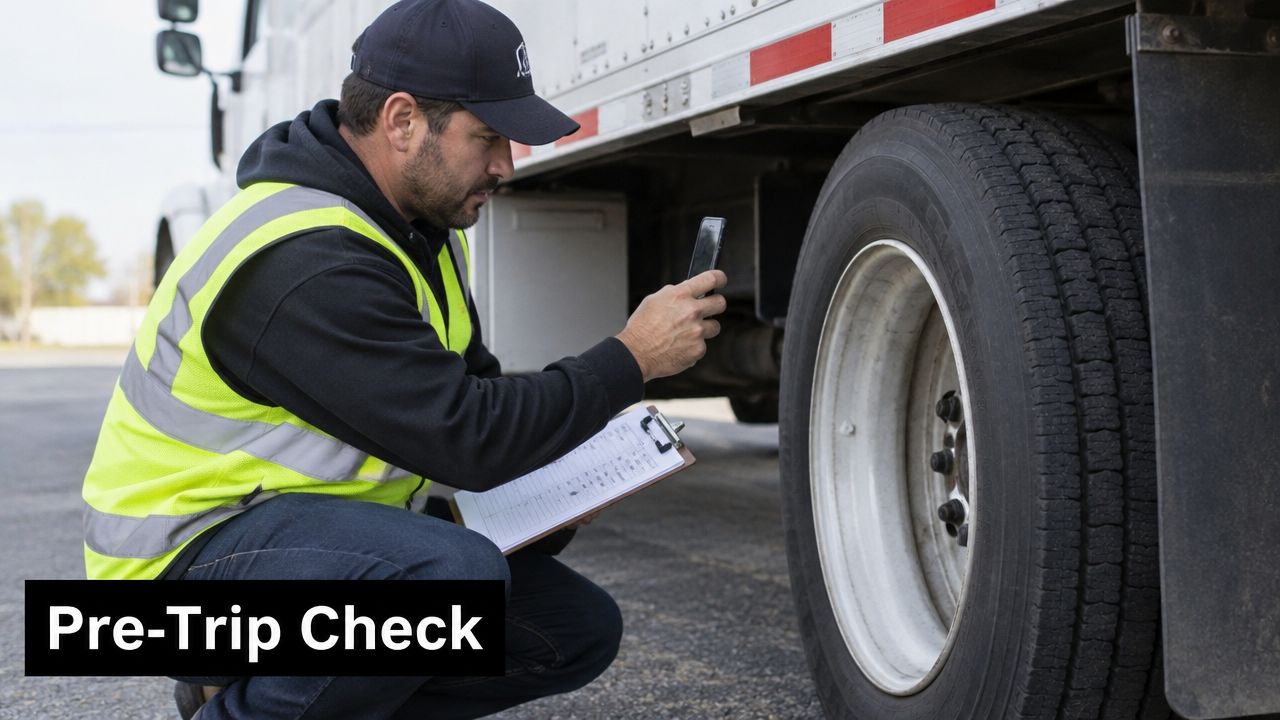
At 1:00 a.m., a driver finds a damaged tire before leaving a recurring middle-mile lane. The inspection record should let dispatch hold the truck, maintenance assess the defect, and the next shift see what happened without relying on a phone call.
Record the vehicle's condition before and after each run, including mechanical concerns, safety equipment, tires, lights, mirrors, cargo security, and defects that could affect safe operation. A completed form has value only when its findings lead to an accountable decision.
Route each finding to an owner
Set the status and next action before the record is closed:
- Green: The vehicle is safe to operate, with no unresolved defect affecting the run.
- Red: Hold the vehicle for review or repair before dispatch.
- Follow-up: Permit operation only after an authorized reviewer documents the decision, restrictions, and required repair.
The driver owns accurate observation and timely submission. Dispatch owns the operating status. Maintenance owns diagnosis and repair. A maintenance queue or dispatch hold prevents a reported defect from disappearing into a completed form.
Require photographs for defects when the driver can capture them safely. An image can show the location and severity of damage more clearly than a short note, particularly when overnight operations and maintenance work different shifts. Build inspection time into the route plan so schedule pressure does not encourage rushed checks.
Each week, a supervisor should review open findings with drivers and maintenance. Look for repeated tire, lighting, cargo-security, or equipment issues, then connect those patterns to lane planning, vehicle assignment, and corrective work. Peak Transport's truck inspection checklist from Peak Transport offers a practical starting point for consistent records.
The inspection trail supports the wider control system: dispatch records show the planned run, inspection records confirm safe equipment, and follow-up entries prove that exceptions received attention.
3. Hours of Service and Driver Log Documentation
A late dock release can turn a legal route into an impossible one before the driver leaves the facility. HOS documentation should give dispatch a current view of driving time, on-duty work, off-duty periods, delays, and changes to the original plan.
For box-truck operations, ELD records belong in the dispatch control loop. Treat them as a driver-protection record, not surveillance. An accurate log can show that the driver reported a delay, followed the approved process, and stopped rather than extending the route beyond safe or legal limits.
Manage time risk during the run
Build each recurring lane with realistic allowances for dock waits, traffic, weather, fueling, and other HOS pressure points. The right allowance depends on facility behavior and local conditions. A plan that works only when every handoff is immediate will create late escalations.
Dispatch owns the response when available time starts narrowing. Drivers should receive paid-hours training on ELD use, delay annotations, and escalation steps. Keep entries factual and specific:
- Facility delay: Arrival time, dock status, contact, and release time.
- Traffic or weather: Location, observed impact, and dispatch notification.
- Mechanical concern: Vehicle status, action taken, and whether the route continued.
- Schedule change: Authorizer and effect on the revised lane plan.
A supervisor should review HOS reports weekly with dispatch. Repeated violations, vague annotations, or late escalations indicate a planning or training gap that needs correction. Link the review to the wider record: dispatch explains the intended run, driver logs show actual execution, and audit entries document how exceptions were handled.
4. Route Documentation and Standard Operating Procedures
At 1:40 a.m., a driver arrives at a recurring dock and finds that the staging area has moved. A usable route SOP gives the driver the approved entry point, contact sequence, loading order, and escalation path without relying on memory or an urgent call to dispatch.
Build each SOP with experienced drivers and dispatchers. They can identify details that generic templates miss, such as a backing approach that changes after dark, a contact required before dock release, or equipment that must remain in a particular position. Connect the SOP to the dispatch record so the planned route, actual execution, and exception notes remain traceable.
Keep the operating instructions easy to scan from the cab. Use plain language, short steps, and clear ownership:
- Facility contacts: Names, roles, phone numbers, and escalation order.
- Site instructions: Entry points, staging areas, dock procedures, backing expectations, and equipment placement.
- Cargo requirements: Loading sequence, securement instructions, and unloading constraints.
- Contingencies: Actions for weather, traffic, mechanical problems, access issues, and missing freight.
- Revision history: What changed, who approved it, and when the change took effect.
Add photos or a short video walkthrough for complex staging areas, while keeping safety and operating instructions in writing. The lane owner should update the SOP when a driver reports a change, a facility changes its process, or dispatch records a recurring exception. Stable routes can receive a quarterly review; high-change facilities need earlier checks.
Training records should show that assigned drivers reviewed route-specific changes. Audit entries should link approval, publication, and acknowledgement.
Practical rule: If a driver must call to explain a repeatable step, the SOP needs revision or the driver needs route-specific training.
5. Incident and Accident Documentation Systems
Incident records should capture more than the final outcome. They should preserve the sequence of events, conditions at the location, people involved, vehicle status, damage, photos, notifications, and actions taken. That information supports insurance and regulatory needs, but it also gives operations teams a way to improve the process that allowed the event to happen.
Include accidents, near-misses, vehicle damage, cargo damage, unsafe facility conditions, and other hazards. A near-miss at a dock can reveal the same risk that would later contribute to a serious event, particularly on a dark overnight operation.
Investigate without hiding the facts
A no-blame culture doesn't mean avoiding accountability. It means separating the event from the investigation and asking whether the route design, facility layout, training, equipment, communication, or scheduling contributed to what happened.
Require prompt reporting with supporting photos or video when safe. Categorize the event by cause and handling path, such as driver behavior, external condition, mechanical issue, facility condition, or an unknown factor pending review. Then document the resolution, coaching, repair, procedure change, or escalation.
Schedule individual coaching when the review identifies a preventable behavior. Share anonymized lessons with the driver team so one person's experience improves the lane for everyone. Also track repeated locations and event types. If backing incidents or cargo damage cluster at one facility, the appropriate response may be a revised SOP, facility conversation, or route change rather than repeated individual coaching.
6. Delivery Proof Documentation and Customer Accountability
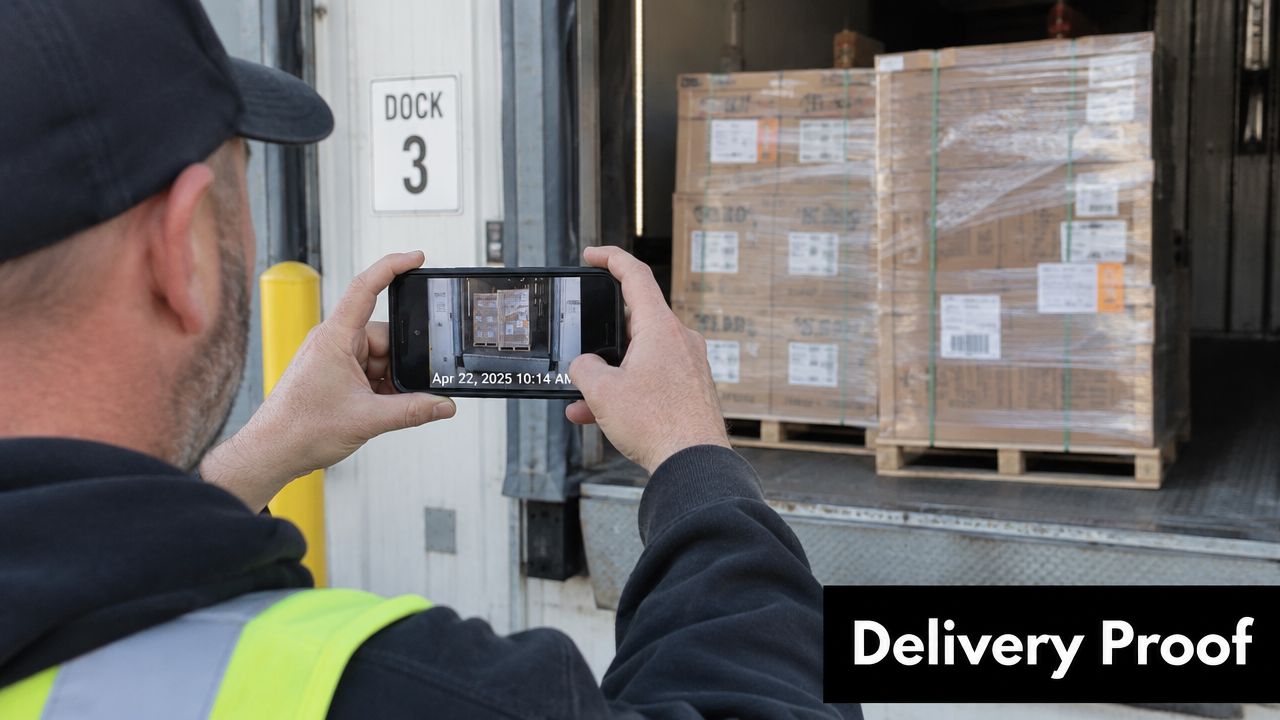
Proof of delivery should make service completion understandable to someone who wasn't present. Depending on the customer and facility, that may include a signature, timestamp, photograph, recipient acknowledgment, delivery attempt record, or an approved exception note.
The record needs to show what was delivered, where it was left or received, when the handoff occurred, and who accepted responsibility. A blurry image or a photo of an unidentified pallet doesn't provide much protection during a dispute.
Define evidence standards before the dispute
Give drivers a simple standard for acceptable photographs:
- Visible goods: The freight can be identified without guesswork.
- Identifiable location: The facility, dock, staging area, or delivery point is clear.
- Useful framing: The image isn't obstructed, excessively dark, or focused on the wrong object.
- Recorded timing: The system preserves the relevant timestamp.
- Documented exception: If a signature isn't possible, the driver records why and follows the approved alternative.
Train drivers on lighting and framing, then review image quality weekly. Use the review for coaching rather than treating every poor image as misconduct. If after-hours deliveries frequently lack signatures, create a defined exemption process instead of forcing drivers to improvise.
7. Performance Metrics and Data-Driven Documentation
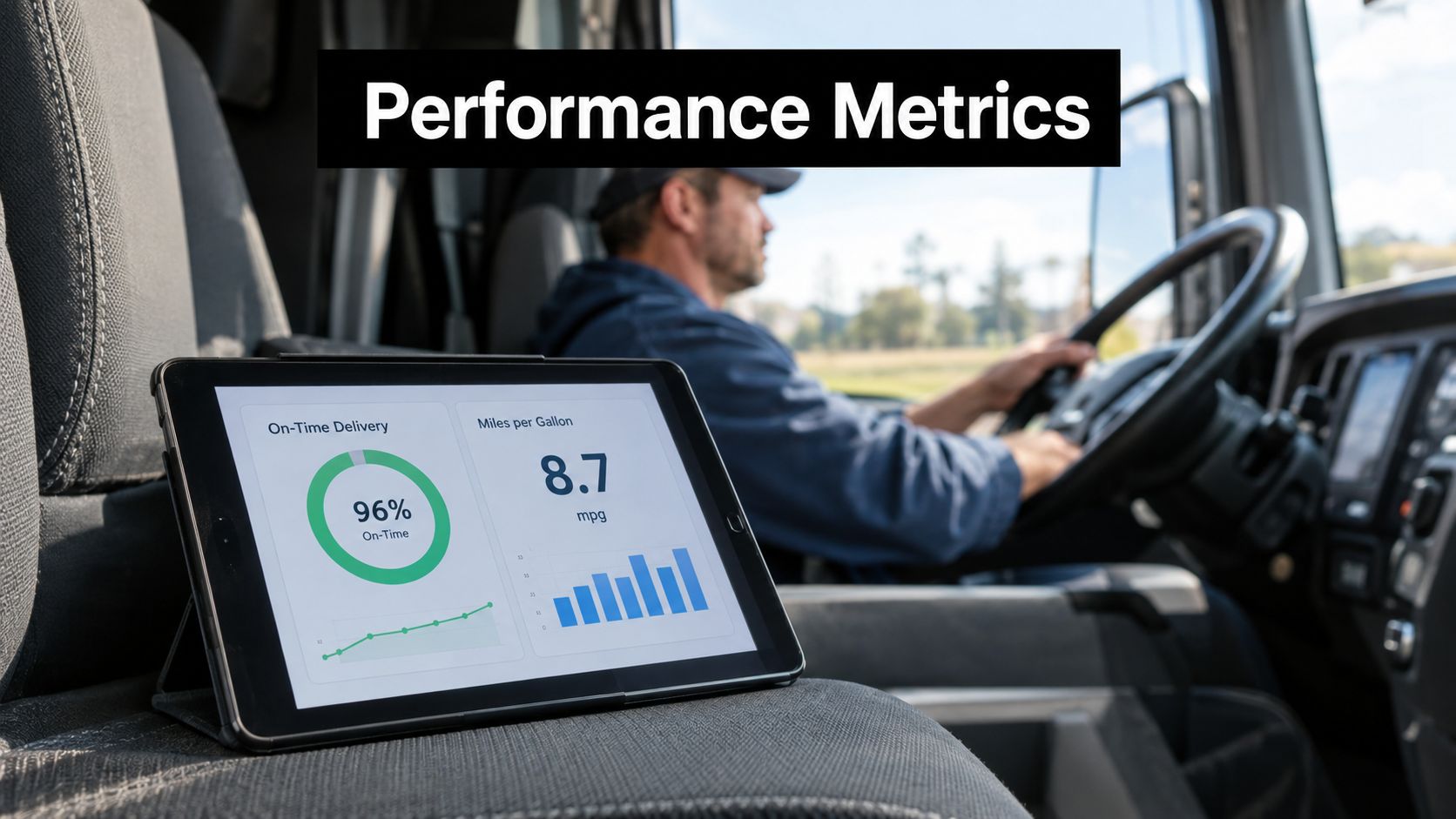
Performance data becomes useful when it explains operations rather than merely ranking drivers. A lane record can combine on-time execution, incidents, HOS compliance, delivery accuracy, mileage, fuel use, inspection findings, and facility delays. The value comes from connecting those signals to the conditions in which the work occurred.
A driver who runs a difficult urban route shouldn't be compared casually with a driver on a straightforward highway lane. The comparison may create the appearance of poor performance while hiding different facility, traffic, or loading conditions.
Measure the system, then coach the person
Build dashboards that drivers can understand and supervisors can use during regular conversations. A practical review asks:
- What happened: Was the route late, and at which milestone?
- Why it happened: Was the cause traffic, dock congestion, loading, equipment, communication, or planning?
- What can change: Does the solution belong to the driver, dispatcher, facility contact, maintenance team, or SOP owner?
- What evidence supports it: Do the dispatch, HOS, inspection, and communication records agree?
Use metrics in coaching conversations, not as a substitute for investigation. Share anonymized practices from strong performers when those practices can transfer to similar lanes. Review the data with operations leadership regularly to identify systemic problems such as recurring facility delays or route assumptions that no longer match reality.
Documentation quality also needs its own measures. Recent research argues that quality should include organization, clarity, accuracy, and utility, rather than only whether a record exists. The research on multidimensional documentation quality and AI-generated notes also highlights the need to check factual integrity, not just completeness.
8. Compliance and Regulatory Documentation Audit Trails
Compliance records should be centralized, searchable, access-controlled, and organized around expiration and review responsibilities. For a carrier, that can include driver qualification files, licenses, medical certifications, training records, background checks, vehicle registrations, inspections, maintenance records, drug and alcohol program records, and operating-authority documents.
A shared folder is only useful when people can locate the right file and verify that it's current. Use a consistent naming convention such as FIRSTNAME_LASTNAME_DOCUMENTTYPE_EXPIRATIONDATE, while keeping sensitive records restricted to authorized personnel.
Assign ownership, not just storage
Create a separate driver qualification file for each driver and assign one person responsibility for the compliance register. That person should monitor expiration dates, send reminders early, document renewals, and escalate missing records before an inspection or customer review exposes the gap.
Cloud storage can improve access, but it doesn't replace governance. Configure permissions, preserve versions, and record who approved or changed an important document. For electronic approvals, maintain e-signature security and audit trails so the record shows the document history and approval activity.
Peak Transport's compliance tracking software guide offers a useful framework for grouping compliance documents and tracking their status. Generate regular internal audit reports, then resolve gaps with a named owner and due date rather than placing them on an undifferentiated list.
9. Training and Competency Documentation
Training records should show more than attendance. They need to establish what the driver learned, which equipment or route the training covered, who delivered it, when it occurred, and how the driver demonstrated competency.
For a new box-truck driver, the record might include vehicle operation, backing, dock procedures, load securement, route SOPs, safety expectations, compliance requirements, dispatch workflows, and delivery-proof standards. A signed acknowledgment can confirm that training occurred, but a hands-on demonstration gives the supervisor stronger evidence that the driver can perform the task.
Connect training to operating records
Use the driver file as a living competency record. Add route-specific modules when a driver moves to a new lane, and record refresher training after an incident, repeated documentation error, equipment change, or SOP revision.
A practical onboarding record includes:
- Instruction completed: Topic, material version, trainer, date, and driver acknowledgment.
- Demonstration observed: Task performed, evaluator, result, and corrective instruction.
- Authorization granted: Vehicle, route, equipment, or responsibility the driver is cleared to handle.
- Follow-up required: Additional ride-along, coaching, or review date.
Training should happen during paid onboarding and include realistic overnight conditions where possible. Maintain a review cadence for recurring safety and compliance topics, while adding targeted instruction when the records show a specific gap. A one-point lesson can support focused instruction, such as the reliability team training example from Forge Reliability.
10. Customer and Stakeholder Communication Documentation
Communication logs explain the decisions that dispatch records alone can't show. They should capture interactions with customers, distribution centers, facility representatives, dispatchers, and operations leaders about delays, access problems, damage, changed instructions, delivery attempts, and resolutions.
A useful entry is factual and chronological: arrival time, facility contact, issue, instruction received, action taken, departure time, and people notified. “Facility delayed” isn't enough. “Arrived at the facility, reported to the dock contact, waited for an assigned door, notified dispatch, and departed after release” gives the next shift something they can act on.
Use one communication record
Drivers should report exceptions immediately through an approved channel, while dispatch or operations staff should enter the interaction into a shared log. Don't rely on a personal text thread that disappears when a dispatcher changes shifts.
Require each entry to identify:
- People involved: Driver, dispatcher, customer, or facility contact.
- Time and location: The relevant arrival, call, message, or departure time.
- Issue: What prevented normal execution.
- Decision: Who authorized the next step.
- Resolution: What happened and what remains open.
- Follow-up: Owner and required action.
Review communication logs with dispatch each week. Repeated facility delays may require a customer conversation or revised appointment assumptions. Repeated communication breakdowns may require a clearer escalation tree, better driver training, or a change to the dispatch platform. The log is most valuable when it turns individual frustrations into visible operating patterns.
10-Point Documentation Best Practices Comparison
| Documentation Type | Implementation Complexity 🔄 | Resource Requirements ⚡ | Expected Outcomes 📊 | Ideal Use Cases 💡 | Key Advantages ⭐ |
|---|---|---|---|---|---|
| Standardized Digital Dispatch Documentation | Medium, integrate GPS/ELD, mobile apps, offline sync | Moderate, platform subscription, tablets/phones, training | Single authoritative dispatch record; fewer disputes; better on-time visibility | Multi-stop overnight box-truck lanes, real-time lane assignments | Reduces communication errors; audit-ready; lowers admin overhead |
| Pre-Trip and Post-Trip Inspection Reports | Low–Medium, checklist apps, photo capture, defect workflows | Low, mobile device, brief driver time, maintenance budget | Fewer breakdowns; clear evidence for claims; proactive maintenance alerts | Daily fleet checks, safety-first operations | Protects against liability; prevents mechanical failures |
| Hours of Service (HOS) and Driver Log Documentation | Medium, ELD integration, regulatory logic, annotations | Moderate–High, ELD hardware/subscriptions, training, scheduling changes | Regulatory compliance; reduced fatigue risk; audit-ready logs | Drivers subject to FMCSA HOS limits; scheduled routes | Avoids fines; enforces rest; simplifies inspections |
| Route Documentation and Standard Operating Procedures (SOPs) | Medium, document creation, updates, driver input loops | Low–Moderate, time to write, photos/videos, SOP owner | Consistent route execution; faster onboarding; fewer missed windows | Recurring/dedicated routes and facility-specific lanes | Enables independent drivers; reduces errors and turnover impact |
| Incident and Accident Documentation Systems | Medium–High, investigation workflows, root-cause analysis | Moderate, reporting tools, investigators, coaching resources | Faster claims processing; trend identification; corrective actions | High-risk operations; safety improvement programs | Legal protection; data-driven coaching; fewer repeat incidents |
| Delivery Proof Documentation and Customer Accountability | Low–Medium, photo/signature capture, customer portal integration | Moderate, mobile devices, slight per-stop time increase | Eliminates delivery disputes; improved shipper visibility | Proof-sensitive drops, customer-facing handoffs | Defensible proof of delivery; fewer CS inquiries |
| Performance Metrics and Data-Driven Documentation | High, data pipelines, dashboards, analytics models | High, telematics/analytics platforms, data expertise | Objective coaching; route optimization; capacity planning | Scaling fleets, contract KPIs (e.g., Amazon performance) | Reveals inefficiencies; supports evidence-based decisions |
| Compliance and Regulatory Documentation Audit Trails | Medium, centralized DQFs, expiration tracking, version control | Moderate, document management system, admin ownership | Avoids penalties; rapid inspection response; streamlined onboarding | Regulated carriers; audit-heavy contracts | Reduces regulatory risk; audit-ready records and alerts |
| Training and Competency Documentation | Medium–High, curriculum design, assessments, tracking | Moderate–High, trainers, paid training hours, LMS or logs | Consistent driver competency; fewer incidents; career development | New-hire onboarding, specialized skills (docking, equipment) | Demonstrates duty-of-care; defensible training evidence |
| Customer and Stakeholder Communication Documentation | Low–Medium, centralized logs, consistent protocols | Low–Moderate, CRM/shared logs, discipline to record interactions | Faster dispute resolution; pattern detection; clear accountability | Middle-mile coordination, facility exceptions and delays | Prevents miscommunication; creates audit trail for issues |
Turn Documentation Into a Dispatch Advantage
Peak Transport teams don't need to create a massive documentation project before improving a lane. Start with one recurring overnight route and establish a single digital source of truth. Link the assignment, vehicle, driver, facility milestones, inspection status, HOS context, exception notes, delivery proof, and closeout record so the next person can reconstruct the run without guessing.
Standardize the highest-risk records first. Dispatch and inspection documentation should come before lower-priority administrative refinements because they affect route execution and safety directly. Then add communication logs and delivery proof, followed by compliance, training, incident, and performance records. The sequence matters because each record should feed the next operational decision.
Assign an owner to every record type. Dispatch owns the completeness of route milestones. Drivers own timely and accurate field entries. Maintenance owns defect follow-up. Compliance owns expiration and audit readiness. SOP owners maintain route instructions. Operations leadership reviews patterns and removes barriers that individual drivers can't solve.
Training determines whether the system works in practice. Teach drivers how to complete records during paid onboarding, use realistic route examples, and explain why the information protects them. A driver who understands that an accurate delay note can show why a schedule changed is more likely to document the event than a driver who sees the ELD or dispatch form only as surveillance.
Use review habits that match the risk. Dispatch, inspection, HOS, and communication records deserve weekly spot-checks. Incident and performance trends should be reviewed with operations leadership on a recurring basis. SOPs, compliance files, and training records need scheduled maintenance, with earlier updates whenever a facility, vehicle, regulation, or process changes.
Storage alone doesn't create knowledge management. A 2026 benchmark reported that shared drives and general repositories were used by about 78% of remote teams, but only 31% rated them effective for knowledge management. Dedicated wikis were used by about 47% and rated effective by 44%, while satisfaction increased when documentation had explicit ownership and maintenance responsibility, according to the 2026 knowledge-management benchmark. For a middle-mile operator, the lesson is direct: name the owner, control versions, make records searchable, and review them on a defined cadence.
Documentation also needs quality checks beyond completeness. Ask whether a record is clear, accurate, consistent with other records, traceable to its source, and useful for the next decision. A complete but contradictory dispatch note can be worse than a shorter record that clearly states what happened and who acted.
Peak Transport can use this operating system to protect W-2 drivers, improve recurring overnight lanes, identify facility problems, support compliance reviews, and prove reliable execution to distribution partners. The records should help the business explain not only whether a route was completed, but how it was completed and what the team learned.
Begin with one lane this week. Compare its dispatch record, pre-trip and post-trip inspection, HOS notes, communication log, delivery proof, and compliance references. Mark every missing owner, conflicting timestamp, unclear instruction, and unresolved exception. Fix those gaps, train the people who use the records, and only then expand the standard across additional lanes.
Peak Transport provides structured overnight middle-mile box-truck operations across the Twin Cities metro and surrounding areas, with clear dispatch communication, route documentation, safety compliance, and W-2 driver employment. Visit Peak Transport to discuss dependable middle-mile execution or explore career opportunities for professional box-truck drivers in Minnesota.