Compliance in Logistics: A Practical Guide for Middle-Mile
Learn how compliance in logistics actually works for middle-mile fleets. Covers FMCSA, HOS, audits, and risk practices without the legal jargon.
September 27, 2026
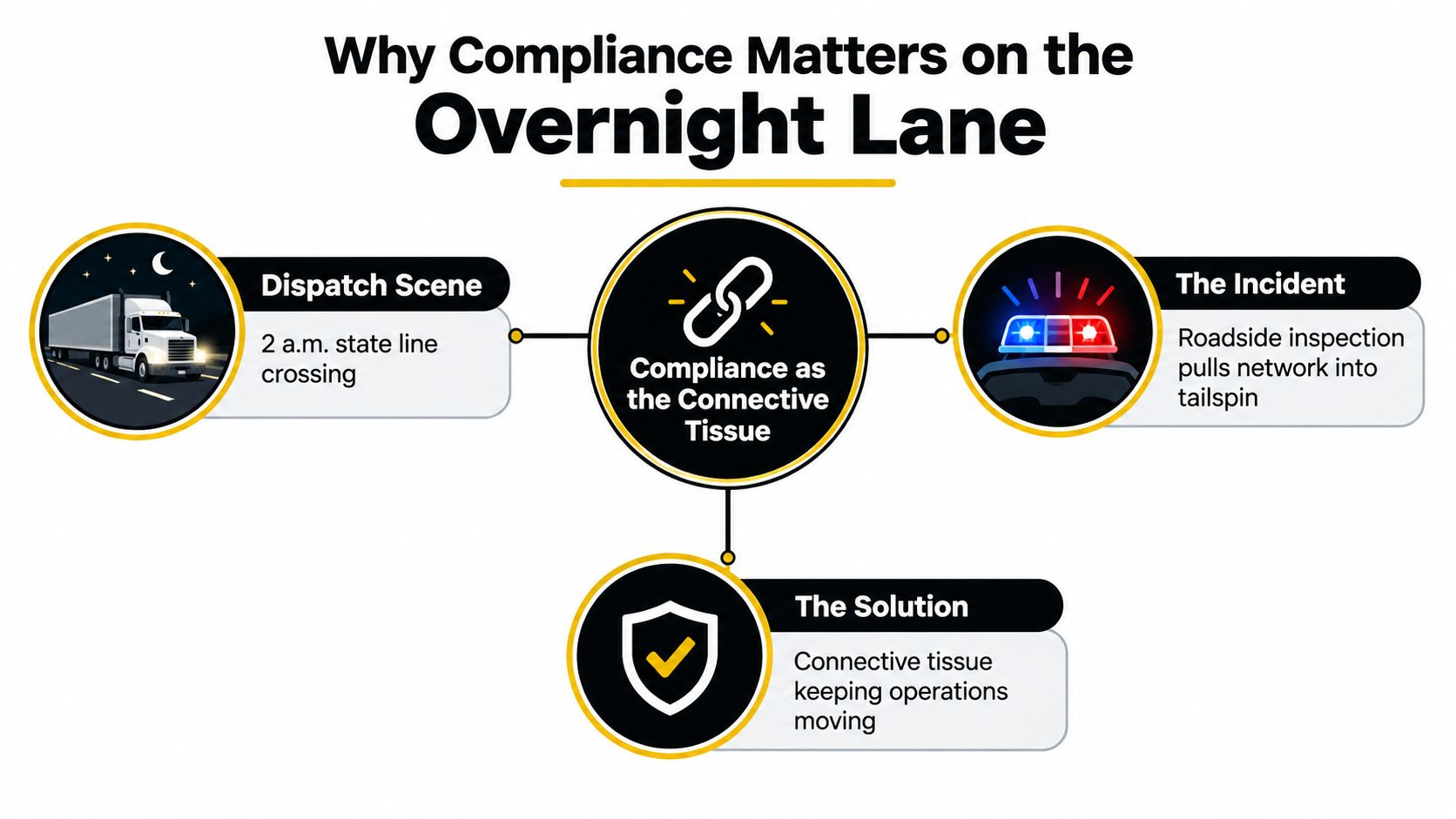
At 2 a.m., a middle-mile driver crosses a state line while the next hub is already building the morning sort. A roadside inspection stops the truck, the dispatcher starts searching for records, maintenance checks whether the trailer defect was repaired, and the customer waits for an arrival that no longer has much schedule margin. One missing record can turn a routine handoff into a network problem.
That's why compliance in logistics should be treated as an operating system, not a stack of permits. Federal requirements, state rules, driver credentials, vehicle records, electronic logs, shipment data, and audit procedures all have to agree with one another. When they do, dispatch can make decisions quickly. When they don't, a small exception can move from the roadside to the dock, the customer account, and the next shift.
Why Compliance Matters on the Overnight Lane
The overnight lane leaves little room for improvisation. A driver may be legal to depart at the start of a run, but a delayed pickup, a long wait at a gate, or a defect found during a stop can change the plan before dawn. Dispatch needs reliable records to know whether the driver can continue, whether another qualified driver must take over, and whether the truck should be held.
A single hours-of-service violation can trigger more than a correction in the log. It may lead to an inspection finding, additional scrutiny, safety-management work, and a missed service commitment. An expired medical certificate can create a similar problem, because driver availability depends on credential status rather than the dispatcher's assumption that the person is scheduled. A missed defect report can leave maintenance and operations working from different versions of reality.
The operational ripple
Think of the route as a chain of handoffs:
- Driver status: The person assigned to the run has the required qualification and current medical documentation.
- Vehicle status: The tractor, box truck, and trailer are safe to operate, with defects documented and addressed.
- Time status: The driver's available hours match the planned route, stops, and recovery options.
- Record status: Dispatch can produce the relevant logs and supporting documents when an inspector or customer asks.
If one link fails, the dispatcher may have to rebuild the route while freight is moving. That's why a practical resource on SMB supply chain security can be useful alongside transportation rules. Physical movement, access controls, information handling, and incident response increasingly overlap.
Practical rule: If a compliance record can change whether a truck moves tonight, dispatch should be able to see its status before assigning the load.
Compliance also protects the morning handoff. Accurate records help the next facility understand what happened, maintenance can act on real defects, and managers can explain an exception without reconstructing the shift from texts and memory. The sections that follow connect federal standards, state requirements, ELD records, driver files, and audits into one system built for continuity.
The Regulatory Landscape Explained Simply
Start with one mental model. The Federal Motor Carrier Safety Administration is like an air-traffic controller for commercial trucking. It establishes and oversees a federal safety framework. Hours-of-service rules are the flight-time limits, and the ELD is the onboard record that captures what happened during the trip.
The analogy helps because each part has a different job. HOS rules limit how a driver's working and driving time is managed. ELDs record key events and vehicle information so the carrier, driver, and inspector can compare the planned trip with the actual record. The system exists to reduce reliance on handwritten reconstruction after a problem occurs.
For a dispatcher, the practical question is not “Is the driver available?” It's “Is the driver qualified, within the applicable time limits, assigned to a compliant vehicle, and supported by records that can be produced?” The hours-of-service rules guide can serve as a reference when route planning and exception handling.
The main categories to watch
The Compliance, Safety, Accountability program organizes safety information into BASIC categories. Middle-mile teams commonly pay close attention to:
- Hours of Service Compliance: Whether the driver's record reflects lawful working and driving time.
- Driver Fitness: Whether the driver is properly qualified and medically fit under the applicable requirements.
- Vehicle Maintenance: Whether inspection, repair, and defect records support safe operation.
FMCSA sets the federal framework, but state enforcement personnel commonly conduct roadside inspections. That distinction matters during an overnight incident. The driver may need to work with the inspecting officer at the roadside, while dispatch contacts the company's safety or compliance lead, and maintenance handles a vehicle issue.
Key FMCSA HOS Limits at a Glance
| HOS Rule | Limit | Practical Meaning |
|---|---|---|
| Driving time | 11 hours | A route plan must leave the driver within the applicable driving limit. |
| On-duty window | 14 hours | The driver's workday window controls more than wheel time alone. |
These limits aren't a dispatch promise that a route will finish on schedule. Traffic, gates, fueling, loading, and inspection delays consume operational capacity. Build the plan around the driver's available time, then define an escalation path before the route approaches its limits.
Federal and State Rules Working Together
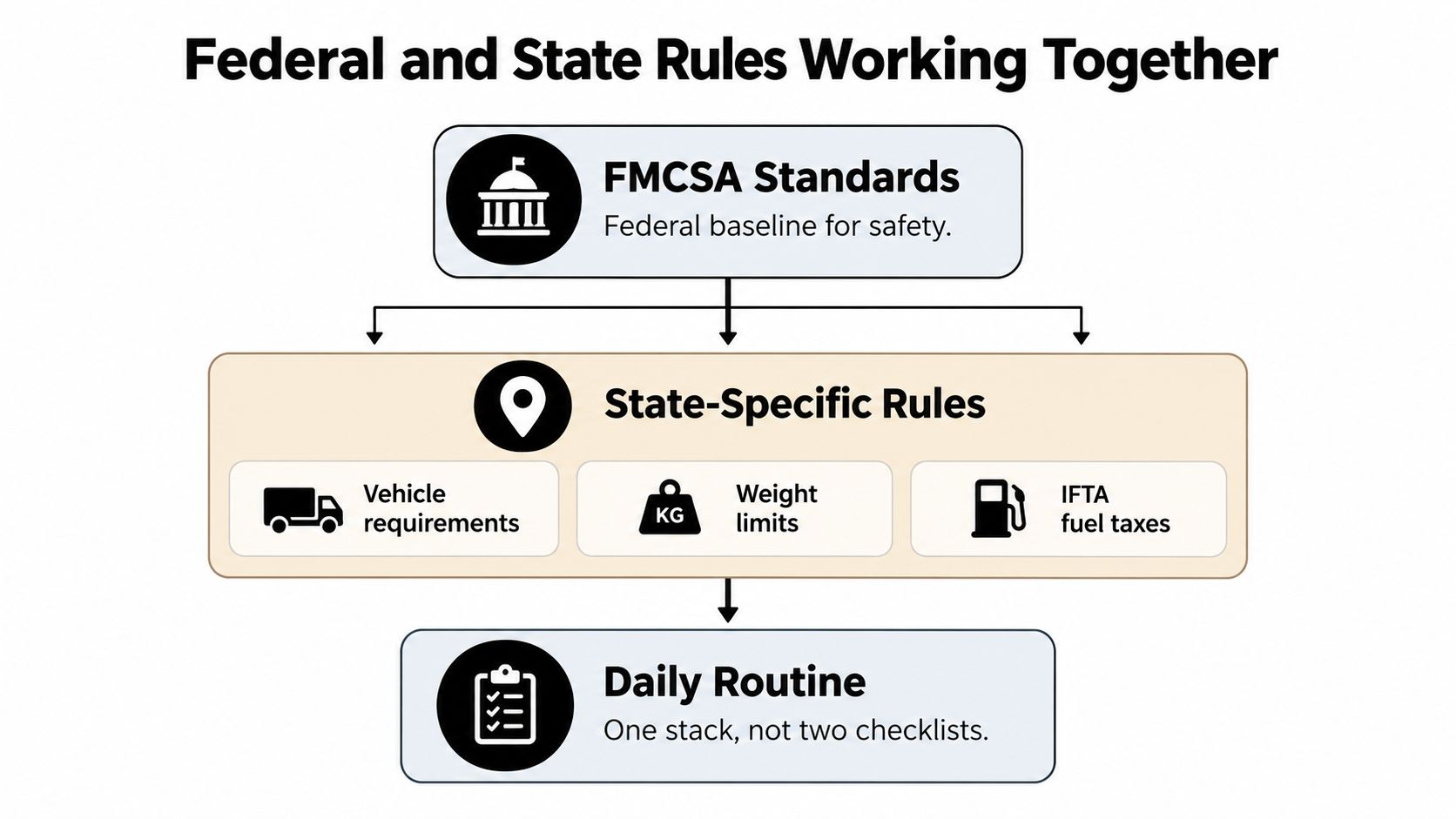
A middle-mile operator doesn't run one federal checklist and one state checklist separately. The practical routine is a stack of requirements applied to the same trip. Federal standards govern areas such as driver qualification, hours of service, and vehicle safety, while state rules can affect inspections, weight, registration, fuel-tax administration, emissions, and idling.
Consider an overnight run from a distribution center to a regional hub. Before departure, the driver completes the required vehicle inspection process and reports a lighting defect. The dispatcher shouldn't treat that report as a formality. The truck's movement depends on whether the defect is safe to operate with, can be repaired before departure, or requires a different vehicle.
At the next yard, the trailer and its load may also need to satisfy applicable state weight and registration requirements. A route that crosses state lines can therefore involve several authorities and operational checks, even though the driver experiences one continuous trip.
Assign the rule to the trip
Dispatchers should establish the operating status before assigning the route:
- Interstate movement: Freight or the vehicle's movement crosses state boundaries, bringing federal requirements and applicable state enforcement into the planning picture.
- Intrastate movement: The operation stays within one state, but state requirements still apply and may differ from the rules used for interstate work.
- Mixed network: A driver or asset may perform both types of work, so the system must preserve the correct context for each assignment.
The point isn't to make dispatchers memorize every state statute. It's to create a reliable handoff to the right owner. A weight concern goes to the responsible operations or safety contact. A fuel-tax reporting question goes to the compliance or finance team. A driver qualification issue goes to safety or HR.
Routine integration also improves customer communication. When a load is delayed because a truck needs inspection or repair, the carrier can document the reason and provide a controlled recovery plan instead of offering an unsupported estimate.
ELDs and Driver Files as a Live System
An ELD, driver qualification file, and DVIR shouldn't live as unrelated binders. Together, they describe whether a person was authorized to operate, what the vehicle did, and what condition the equipment was in during the shift.
An ELD automatically synchronizes with the vehicle engine and records driving time. It also captures the date, time, location, engine hours, vehicle miles, and driver identification, as described in FMCSA's ELD provider training guidance. That creates a machine-generated record that dispatch and safety teams can use when reviewing a route or preparing for an inspection.
Build the record around triggers
A useful workflow links each event to an owner:
- Before dispatch: Confirm the driver's qualification and medical documentation are current, and verify that the assigned vehicle is available for the route.
- During the run: Monitor ELD status and respond to warnings before the driver reaches a limit or loses the ability to complete the planned movement.
- At arrival: Capture the DVIR and route exception details, then send defects to maintenance with a clear status.
- After a change: Update the relevant records when a driver leaves, a vehicle is replaced, or a repair closes an open defect.
FMCSA guidance says carriers subject to HOS recordkeeping must use ELDs, retain ELD records and backup data for six months, and keep a backup copy on a device separate from the original data store. The same guidance describes on-demand transfer through telematics or local methods, so inspection readiness includes both retention and the ability to deliver the record.
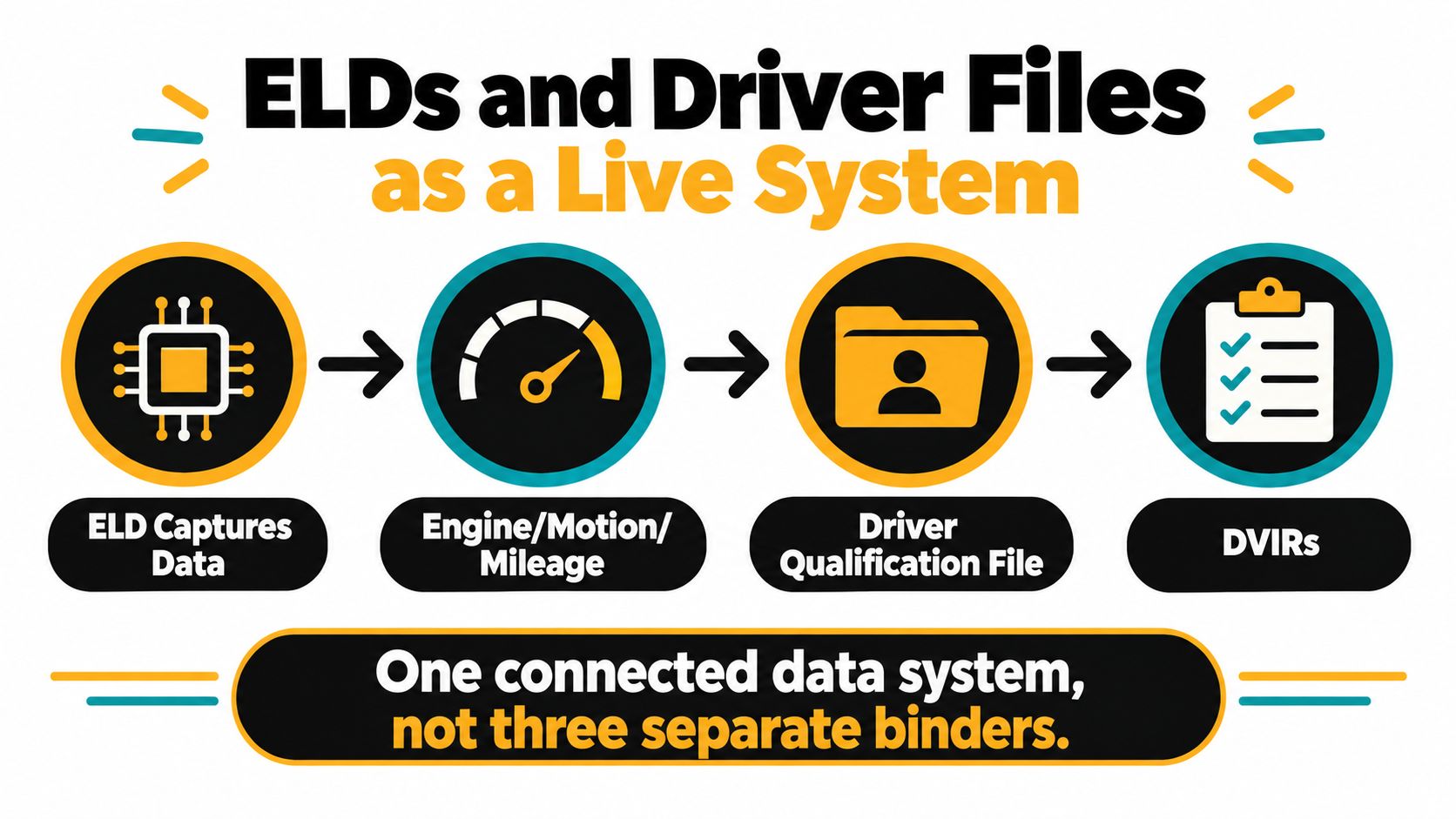
The right objective is not to collect more files. It's to prevent conflicting files. If the ELD shows one event, the dispatch record shows another, and the DVIR sits in an unmonitored inbox, the team can't explain the shift confidently. A connected record lets safety, maintenance, HR, and operations act from the same facts.
This video can supplement the system view with a practical visual explanation:
When Compliance Becomes a Dispatch Problem
Compliance is often assigned to a back-office team, but recent driver-qualification and roadside-enforcement changes show why dispatch needs a working operational understanding. A driver can appear available in a scheduling tool and still be unavailable for a lawful assignment.
The change may begin in recruiting, credential verification, or medical-data transmission, but its consequence appears at the dock. If a credential cannot be verified, a required language-compliance check raises a concern, or medical information hasn't reached the relevant system, dispatch may need to hold the assignment, find a replacement, or redesign the route.
Compliance Changes That Hit Dispatch First
| Rule Change | What It Requires | Dispatch Impact |
|---|---|---|
| Non-domiciled CDL eligibility and verification procedures | Stronger attention to whether the driver's credential status meets current requirements | A driver's availability must be verified, not assumed from the roster. |
| English-language-proficiency enforcement at roadside inspections | Drivers must satisfy applicable communication requirements during an inspection | A roadside finding can remove the driver from service and interrupt the route. |
| Medical certification transmission through the National Registry | Medical certification information is transmitted into the federal record system | Dispatch needs a current status before assigning work that depends on the driver's qualification. |
The recent CDL regulation summary describes these changes and the operational concern they create for carriers. The important lesson is not to treat each update as a legal memo disconnected from planning. Add a visible status to the dispatch workflow, define who clears exceptions, and make replacement capacity part of continuity planning.
A practical overnight decision might look like this: the driver is scheduled, the truck is ready, and the freight is staged. Before release, the system shows an unresolved qualification alert. The dispatcher shouldn't send the truck and ask safety to fix the record later. The dispatcher should pause the assignment, contact the designated compliance owner, and activate the backup plan if clearance won't arrive in time.
Building an Audit-Ready Operation
Audit readiness starts before an auditor calls. The operation should be able to identify what happened on a route, who approved the decision, which records support it, and whether a defect was corrected.
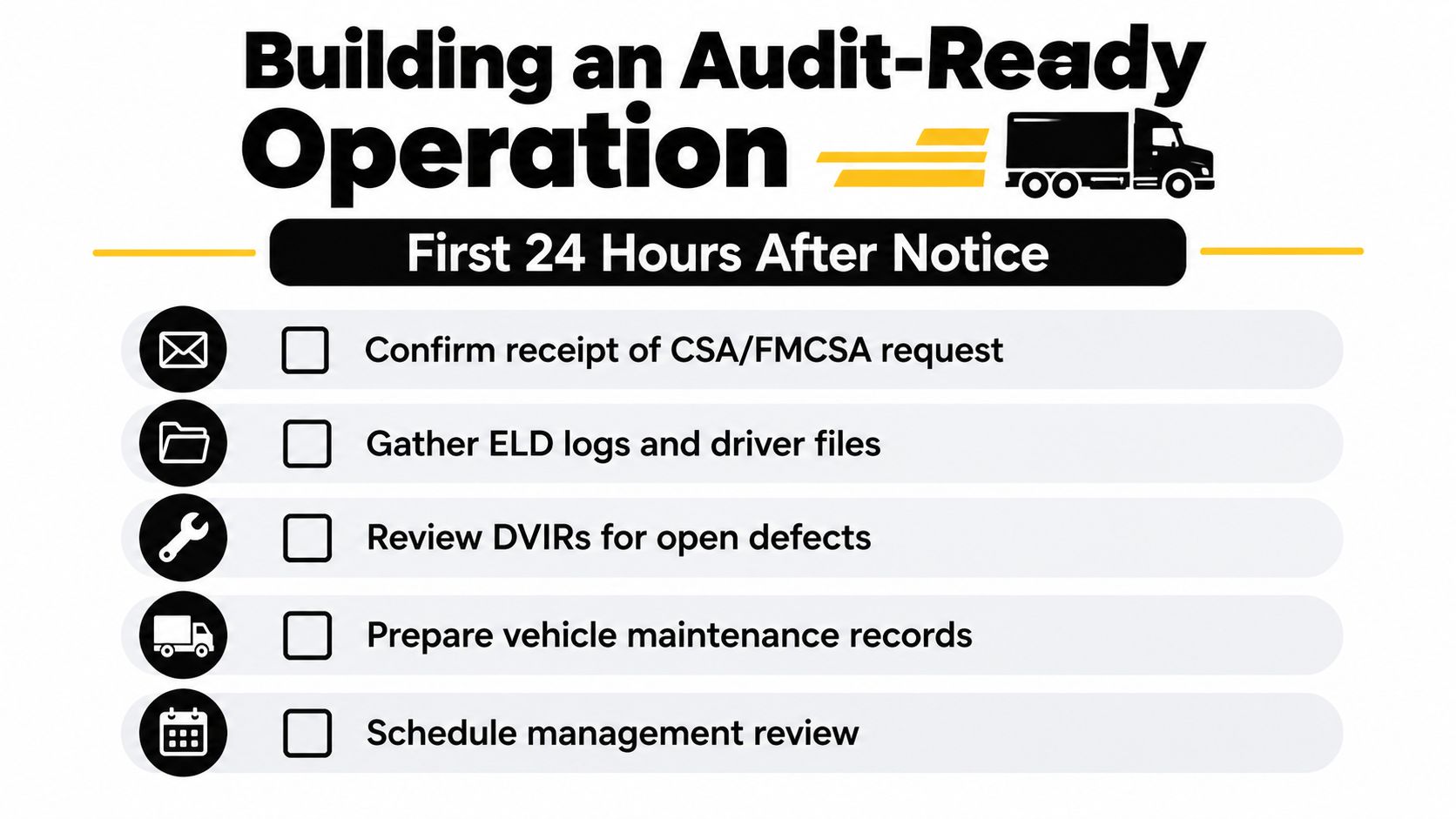
When a CSA or FMCSA request arrives, assign one person to control the response. That person should confirm the scope, deadline, requested drivers or vehicles, and acceptable delivery method. Multiple people can gather documents, but one owner should maintain the index and prevent duplicate or contradictory submissions.
The first response
Use the first working period after notice to create control:
- Confirm scope: Save the request, identify the covered period, and record the response deadline.
- Gather core files: Pull the relevant driver qualification files, ELD records, and supporting records.
- Check vehicle evidence: Review DVIRs, open defects, repair orders, and maintenance documentation.
- Reconcile records: Compare the dispatch event, ELD record, inspection report, and repair history for obvious gaps.
- Control communication: Route questions through the assigned contact and preserve a record of what was submitted.
Quality matters more than volume. A timestamp should make sense, a repair receipt should connect to the reported defect, and an ELD record should match the route narrative. A large folder full of unexplained files doesn't demonstrate control.
Teams that want a broader view of controlled documentation can also review these auditable finance operations insights, particularly the emphasis on ownership, traceability, and consistent evidence. In transportation, the same principles apply to driver, vehicle, and route records.
Use compliance documentation practices for transportation teams to formalize naming, access, review, and retention rules. Then maintain a recurring cadence, including routine DQ file checks, ELD data reviews, and roadside inspection score monitoring. The exact schedule should fit the fleet and legal obligations, but the principle is constant: surface weak records before an external reviewer does.
The New Compliance Architecture
Modern logistics compliance has several layers, and they now share the same operational data. Driver and vehicle records remain the foundation. Route telemetry and ELD events provide the operating picture. Customs records, security controls, customer requirements, emissions reporting, and supply-chain due diligence add external accountability.
Customs systems illustrate why structured data matters. A customs technical specification for logistics declarations requires identifiers such as the logistics provider code and name, conveyance reference number, and waybill number. Some fields must be unique within a six-month window and may be up to 60 characters long, according to the specification. These requirements support deterministic matching, audit trails, and automated screening.
Four layers of control
Regulatory records establish the legal baseline, including driver qualification, medical certification, HOS records, inspections, customs entries, and required shipment references.
Operational telemetry shows what happened. ELD events, vehicle location, mileage, engine activity, dispatch changes, and arrival records can help explain a delay or exception.
Security governance protects the information and the physical movement it describes. Access permissions, vendor controls, incident procedures, and reliable backups matter because corrupted or exposed records can become operational problems.
External reporting turns controlled internal data into customer audit responses, customs submissions, emissions information, and due-diligence evidence.
PwC's transportation and logistics findings describe preparedness gaps involving cloud threats, software supply-chain compromises, and GenAI misuse. The same source reports that 49% of respondents have difficulty quantifying cyber risk because of data-quality and legal concerns. That reinforces a practical point: compliance teams can't govern data they can't identify, trust, or connect.
A compliance tracking software approach can help teams monitor expiring documents, missing DVIRs, unresolved alerts, and vehicle records in one workflow. The technology isn't the architecture by itself. The architecture comes from defining ownership, data fields, escalation rules, and evidence across dispatch, safety, maintenance, customs, security, and reporting.
Your Practical Compliance Checklist
A useful checklist assigns one action to one owner. Run it before the shift, during movement, after arrival, and during the management review.
Before departure
- Dispatcher: Confirm the driver's qualification and medical status are clear for the assignment.
- Driver: Complete the pre-trip inspection and report defects before leaving the yard.
- Safety lead: Review any unresolved driver or vehicle alert that could change dispatch eligibility.
- Operations lead: Confirm the route's interstate or intrastate context and any applicable state requirements.
During the route
- Dispatcher: Watch HOS proximity warnings and start recovery planning before the driver reaches a limit.
- Driver: Report inspection activity, delays, defects, and route changes through the approved channel.
- Maintenance contact: Decide whether a reported defect requires repair, replacement equipment, or controlled continuation.
- Compliance owner: Escalate missing or inconsistent records instead of allowing the shift to continue on assumptions.
After arrival
- Driver: Complete the post-trip DVIR and identify any new defect clearly.
- Dispatcher: Match the route outcome to the dispatch record and document material delays.
- Maintenance: Close the repair loop with a work order or an explicit status.
- Safety: Preserve records that may be needed for an inspection, customer question, or internal review.
Weekly review
- Compliance coordinator: Review expiring credentials, medical records, missing DVIRs, and unresolved alerts.
- Fleet manager: Examine inspection findings and recurring maintenance patterns.
- Dispatch supervisor: Check whether route plans repeatedly push drivers toward HOS limits.
- Management: Decide whether an issue needs coaching, a truck hold, process correction, or legal advice.
Use clear decision thresholds. Coach when the record shows a correctable behavior and no immediate safety concern. Pull the truck or driver from service when qualification, medical status, vehicle safety, or legal operating authority is unresolved. Escalate to counsel when the matter involves a serious inspection finding, disputed regulatory interpretation, injury, enforcement notice, or potential disclosure obligation.
Peak Transport applies structured dispatch, route documentation, driver qualification, vehicle maintenance, and safety processes to overnight middle-mile operations. If your network needs a dependable compliance-minded transportation partner, visit Peak Transport to discuss your lanes, handoffs, and operating requirements.