Dispatch Communication System: A Middle-Mile Guide for 2026
Learn how a dispatch communication system optimizes middle-mile logistics with real-time tracking, driver coordination, and route updates for faster deliveries.
September 25, 2026
At 1:40 a.m., a driver is leaving a distribution center when the route changes. The dispatcher sends an update through one app, calls the cab when there's no response, and writes the new stop sequence on a whiteboard. The driver is watching traffic, managing a box truck, and trying to determine which instruction is current. By the time everyone agrees on the plan, the lane has already lost time.
That kind of confusion isn't a driver problem. It's a dispatch communication system problem. Overnight middle-mile operations need fast instructions, documented handoffs, clear escalation rules, and a fallback when cellular coverage disappears. They also need restraint. Adding every available channel can create more noise than control, especially when drivers are W-2 employees who expect a stable, professional operating environment rather than a different process on every shift.
The Modern Dispatch Communication System Explained
Dispatch communication started as a public-safety function long before logistics platforms placed maps and status messages on a shared screen. In 1852, Boston introduced telegraph-based fire alarm boxes, an early milestone in organized emergency communication. The United States introduced the 911 emergency number in 1968, and by the end of the twentieth century, 911 service was available to more than 90% of Americans, according to this history of EMS communications milestones. The pattern is familiar to transportation operators: a local, manual alert becomes a coordinated network, then a software-supported operating layer.
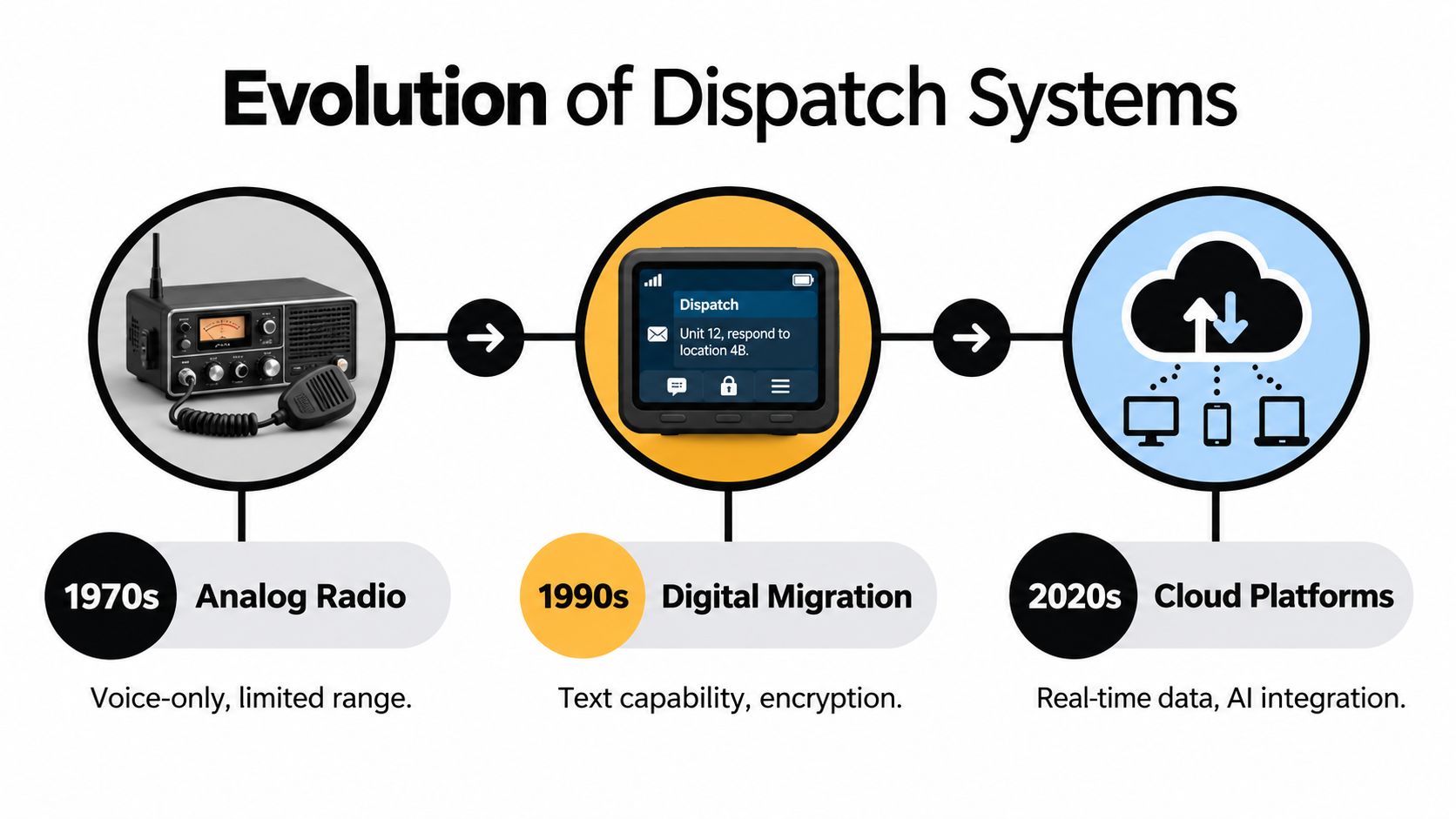
A modern system isn't just a radio replacement. It combines driver messaging, dispatcher-to-driver calls, route and stop information, location data, exception handling, response records, and escalation paths. In a middle-mile box-truck operation, the system must help a dispatcher answer practical questions quickly:
- Which driver has acknowledged the route revision?
- Which truck is delayed, and why?
- Did the driver receive the updated facility instruction?
- Has a missed handoff been escalated?
- What information should the next shift trust?
That shared operational picture is why transportation teams evaluating broader technology stacks may also review resources such as CloudOrbis Inc. transport solutions. The useful question isn't whether a platform has the longest feature list. It's whether the platform preserves one current version of the truth when vehicles, facilities, dispatchers, and managers are working at different speeds.
Why fragmented communication breaks down
Communication volume becomes difficult to control even in a modest fleet. One dispatcher study reported 2–3 communications per hour per truck, which scales to roughly 120–180 communications per hour for a 60-truck operation. The figures are documented in this dispatch communication workflow analysis. At that level, paper notes, personal phones, scattered text threads, and verbal updates make accountability fragile.
The problem isn't only volume. It's context switching. A dispatcher who is monitoring arrivals, answering a driver safety question, and updating a facility exception can easily send a correct instruction to the wrong thread or overlook a response. A driver may also receive an update without knowing whether it replaces the previous route version.
The practical response is to engineer communication around the lane. Define the primary channel, set response expectations, identify the fallback, and document route changes in one place. Peak Transport's communication protocols for drivers and dispatch reflects that same operating principle. The channel matters, but the discipline around the channel matters more.
How to Select the Right Platform for Overnight Operations
A platform that looks impressive during a daytime demonstration can fail on an overnight lane. The right test is not whether the interface is attractive. It's whether a tired dispatcher and a moving driver can use it correctly during a late facility change, a missed appointment, or a coverage gap.

Start with the communication spine. A centralized shared inbox or dispatch hub should show the current conversation, route identifier, driver, truck, urgency, and acknowledgment status. A dispatcher shouldn't need to search a personal phone, a group chat, and a TMS note to reconstruct what happened. The platform should also make it easy to separate urgent issues from routine updates, because treating every message as urgent trains people to ignore urgency.
Features that reduce overnight friction
Look for these capabilities during a live workflow test:
- Short, actionable messages: The dispatcher should be able to send an instruction such as “Use door 14, check in with guard desk, confirm arrival” without burying the action inside a paragraph.
- Urgency-based routing: Safety issues, breakdowns, and missed handoffs need a different path from fuel receipts or routine status updates.
- Explicit acknowledgment: The system should show whether the driver received and accepted a critical instruction, not merely whether a message was sent.
- Route-version control: Drivers need a clear indication that a new stop sequence replaces an earlier version.
- Searchable records: Supervisors should be able to review the timeline without relying on memory or handwritten notes.
- Offline or fallback behavior: The vendor must explain what remains available when the primary data connection fails.
A useful demonstration uses a real overnight scenario. Give the vendor a route with a facility change, a driver who doesn't respond, a dispatcher handoff, and a temporary loss of connectivity. Watch how many screens the team must open, how the system marks urgency, and how the driver confirms the final instruction.
Industry reporting describes a broader migration toward software-driven dispatch. It cites around 68% of emergency agencies adopting digital dispatch platforms, 61% integrating GIS mapping, 57% deploying mobile data terminals, and 52% using automated incident management tools. The same computer-aided dispatch market reporting projects the command and dispatch system market to increase from USD 36.69 billion in 2025 to USD 51.75 billion by 2035, with a 3.5% CAGR. Those figures show the direction of the market, but they don't tell a middle-mile fleet which features drivers will use.
A dispatch integration can be worth reviewing when it connects the communication layer to the systems already used by operations. For example, managers can browse the Dispatchex integration while assessing whether a proposed workflow reduces duplicate entry instead of adding another dashboard.
The right platform should feel boring during a normal run. That's a strength. If drivers need extensive training to send a status or find the current route, the system is too complicated for the job.
For related evaluation criteria, see Peak Transport's guidance on cloud-based TMS software.
Implementing a Structured Rollout Strategy
Technology adoption fails when leaders install the software before deciding how communication should work. Drivers then create their own shortcuts, dispatchers use multiple channels, and managers blame the platform for a policy problem.
Begin with a written operating policy. Keep it short enough to use during a shift, but specific enough to remove guesswork. The policy should define the primary channel, what requires an acknowledgment, what counts as an emergency, and what happens when a driver can't connect.
Practical rule: Every critical instruction needs one owner, one current version, and one visible acknowledgment.
Build the workflow before issuing devices
Use a route change as the first design exercise. Write the exact sequence:
- The dispatcher records the change against the active route.
- The dispatcher sends one concise message with the required action.
- The driver acknowledges receipt when safely stopped or otherwise able to respond.
- The dispatcher records the response and updates the route status.
- If no acknowledgment arrives within the defined window, the dispatcher uses the fallback channel.
- If the fallback also fails, the escalation contact takes ownership.
This workflow separates delivery, acknowledgment, and resolution. A sent message isn't proof that a driver understood it. Acknowledgment isn't proof that the issue is resolved. Those distinctions matter during shift handoffs and post-incident reviews.
Keep urgent and routine traffic apart. A safety concern, breakdown, facility closure, or missed handoff should trigger a defined escalation path. A routine document request can remain in the standard queue. If dispatchers hear constant calls for low-priority updates, they lose the capacity to recognize a genuine exception.
Train around real overnight decisions
Training should use the situations that create friction, not a generic product tour. Practice a route-version change, an address discrepancy, a vehicle issue, a facility that won't accept the load, and a driver who reaches a dead zone. Have dispatchers practice handing an open issue to the next shift without forcing the new dispatcher to read an entire message history.
Provision hardware with the road in mind. A rugged phone or tablet should be easy to operate with gloves, readable in dark and bright conditions, and mounted without blocking visibility. Drivers shouldn't need to handle a device while moving. If a device fails, the driver needs a known replacement and a known way to report the failure.
Use a limited pilot before expanding. Choose a lane with ordinary work and predictable exceptions, then observe where people leave the system. If drivers still call personal numbers because the official channel is slow, fix the workflow rather than adding more alerts. If dispatchers copy every message into several applications, examine the integrations and remove duplicate work.
A proper rollout also protects driver retention. W-2 employees need consistent expectations across supervisors and shifts. When one dispatcher demands radio check-ins, another uses a private text thread, and a third changes the process without notice, drivers experience operational disorder as unnecessary stress. Clear rules, paid training, maintained equipment, and respectful escalation make the communication system part of a professional workplace rather than another source of friction.
Navigating Connectivity Challenges and Multi-Modal Systems
A midnight route can leave a driver in a cellular dead zone at the exact moment a facility changes its receiving process. That makes a single-channel plan unsafe from an operational standpoint. Cloud convenience helps when coverage is strong, but it can't substitute for a fallback that drivers understand and dispatchers can monitor.
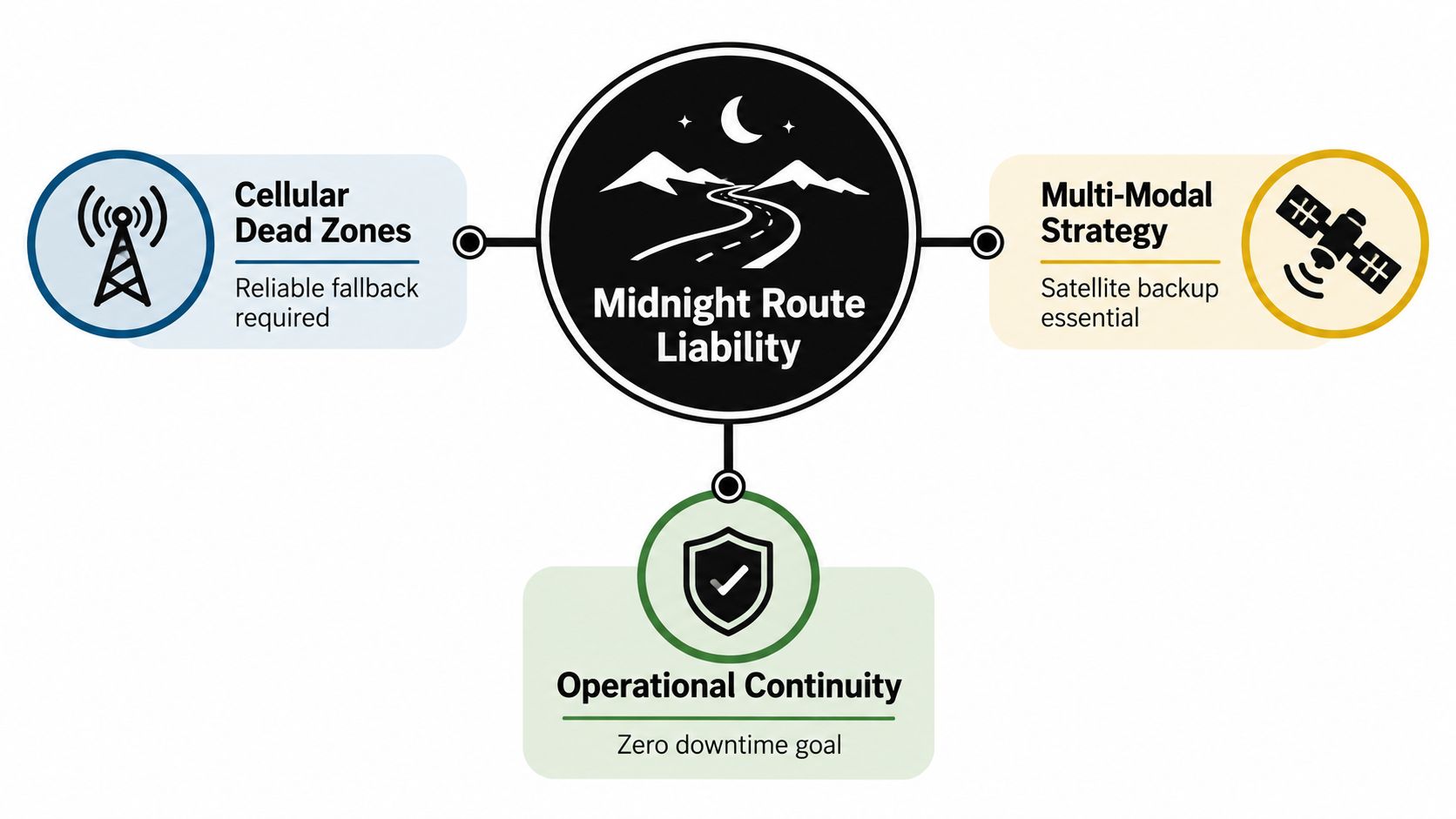
Design redundancy by message type, not just by device. A routine status can wait for a queued sync. A safety event needs a channel that can attract attention immediately. A route change needs a method that preserves the instruction and allows later verification.
A practical hierarchy may include:
- Primary app or platform: Use it for dispatch records, route updates, acknowledgments, and searchable history.
- Push-to-talk over cellular: Use it when a short voice exchange is faster than typing and coverage supports it.
- SMS fallback: Reserve it for concise alerts when the main application isn't reachable.
- Voice fallback: Use a designated dispatch number for issues that require conversation or clarification.
- Satellite or off-network option: Consider it for lanes where coverage gaps are predictable and operational consequences are serious.
The fallback policy must specify when to switch. “Try another method” isn't a procedure. State what the driver should do after an unacknowledged critical message, who the driver contacts, and how the dispatcher records the event after service returns.
More channels create new failure points
Adding channels improves reach, but it also creates reconciliation work. A driver may answer a phone call while the official app still shows no acknowledgment. A dispatcher may send an SMS that never gets copied into the route record. An overnight supervisor may see the update but miss the voice decision made by the prior shift.
Redundancy only works when the team knows which record becomes authoritative after service is restored.
Recent market coverage describes growing interest in cloud-connected and broadband dispatch, push-to-talk over cellular, AI-driven analytics, and off-network capability. It projects push-to-talk growth from USD 47.45 billion in 2026 to USD 77.53 billion by 2031, and cites a June 2026 development involving off-network device-to-device push-to-talk, messaging, and file sharing in this push-to-talk market forecast. Those capabilities may improve resilience, but operators still need to validate coverage, device compatibility, battery demands, and the process for synchronizing records.
Test the failure mode during training. Turn off the primary connection, send a simulated urgent instruction, complete the fallback exchange, and restore service. Then ask a second dispatcher to reconstruct what happened. If the timeline is ambiguous, the system isn't ready for a route where missed communication can cascade into delays, safety concerns, or detention.
Measuring Performance with Clear KPIs
A dispatch communication system earns its place by reducing uncertainty, not by generating more activity. Measure whether drivers receive the right instruction, whether dispatchers can see the response, and whether unresolved issues move to the correct owner.
The first useful metric is critical-message acknowledgment. Track whether urgent route changes, safety events, and facility exceptions receive a recorded response. Don't treat a delivery receipt as an acknowledgment. The driver needs to confirm the instruction or explain why it can't be followed.
Next, examine time to resolution. A message can be answered quickly while the underlying issue remains open. Separate the time from dispatch notification to acknowledgment from the time to a confirmed operational resolution. This distinction reveals whether the team is communicating or actually clearing exceptions.
Metrics that expose workflow friction
Use a small dashboard that dispatchers can act on:
| KPI | What it reveals | Operational response |
|---|---|---|
| Critical-message acknowledgment | Whether urgent instructions reach the driver | Review channel, wording, and fallback rules |
| Time to first response | Whether the shift can identify an active issue | Rebalance queues and escalation coverage |
| Time to resolution | Whether communication leads to a completed action | Assign clear ownership for exceptions |
| Route-version accuracy | Whether drivers are working from the current plan | Simplify update format and confirmation steps |
| Unresolved handoffs | Whether open issues survive shift changes | Require a written owner and next action |
| Duplicate messages | Whether the system creates avoidable noise | Consolidate channels and remove redundant alerts |
Communication volume deserves context. The cited dispatcher study found 2–3 communications per hour per truck, or roughly 120–180 communications per hour for a 60-truck operation. That workload makes fragmented systems difficult to manage reliably, as described in the analysis of dispatch communication volume. A high message count isn't automatically bad. A high count of duplicated, unanswered, or contradictory messages is.
Review the dashboard with drivers and dispatchers, not just managers. Drivers can identify instructions that arrive without enough context. Dispatchers can identify alerts that interrupt more important work. For a broader measurement framework, Peak Transport's resource on key performance indicators provides a useful starting point for connecting operational activity to accountable outcomes.
Balancing Automation with Human Judgment
Automation should handle repetitive observation, routing, reminders, and data capture. It shouldn't decide every escalation on an overnight lane.
Market coverage projects the dispatch console market to grow from USD 2.16 billion in 2026 to USD 2.70 billion by 2031, and identifies real-time monitoring as the fastest-growing function at a 4.64% CAGR, according to this dispatch console market analysis. Geofencing, sensor data, live video, and automated alerts can give a dispatcher better visibility. They can also increase integration complexity, training demands, and dependence on IP connectivity.
A good system flags an unusual stop dwell, a route deviation, or a missed check-in. A trained dispatcher decides whether the cause is congestion, a facility issue, a mechanical problem, a safety concern, or a harmless GPS irregularity. The system can recommend action, but the escalation rule should preserve human review when the consequence affects safety, employment, customer commitments, or legal compliance.
That balance matters especially in a W-2 operation. Drivers should know when they're expected to respond, when they must stop safely before using a device, and which supervisor owns a difficult decision. Dispatchers should have authority to escalate without hiding behind an automated workflow.
Peak Transport applies this principle to overnight box-truck operations through structured route communication, documented status expectations, and defined escalation rather than relying on a single app or improvised calls. Leaders evaluating their own lanes can review Peak Transport to see how a middle-mile carrier connects disciplined dispatch practices with dependable execution and W-2 driver operations.