Dispatch Rules That Protect Hours and On-Time Runs
Dispatch rules decide the next load by hours, priority, and proximity so overnight freight stays legal and on time. See the hierarchy, templates, and KPIs.
November 2, 2026

“Send the closest truck” is useful advice only after dispatch has answered the harder question: Can this driver finish this load legally and meet the facility commitment? A short deadhead doesn't compensate for a duty clock consumed by yard delays, and a hot appointment doesn't create more available hours.
Good dispatch rules aren't route scripts. They're a driver-protection system that tells dispatch what to release, what to hold, and when to take an assignment back. For overnight middle-mile work, the right decision can mean passing over the nearest trailer to protect both the driver and the committed arrival.
How a Rule Picks the Next Load
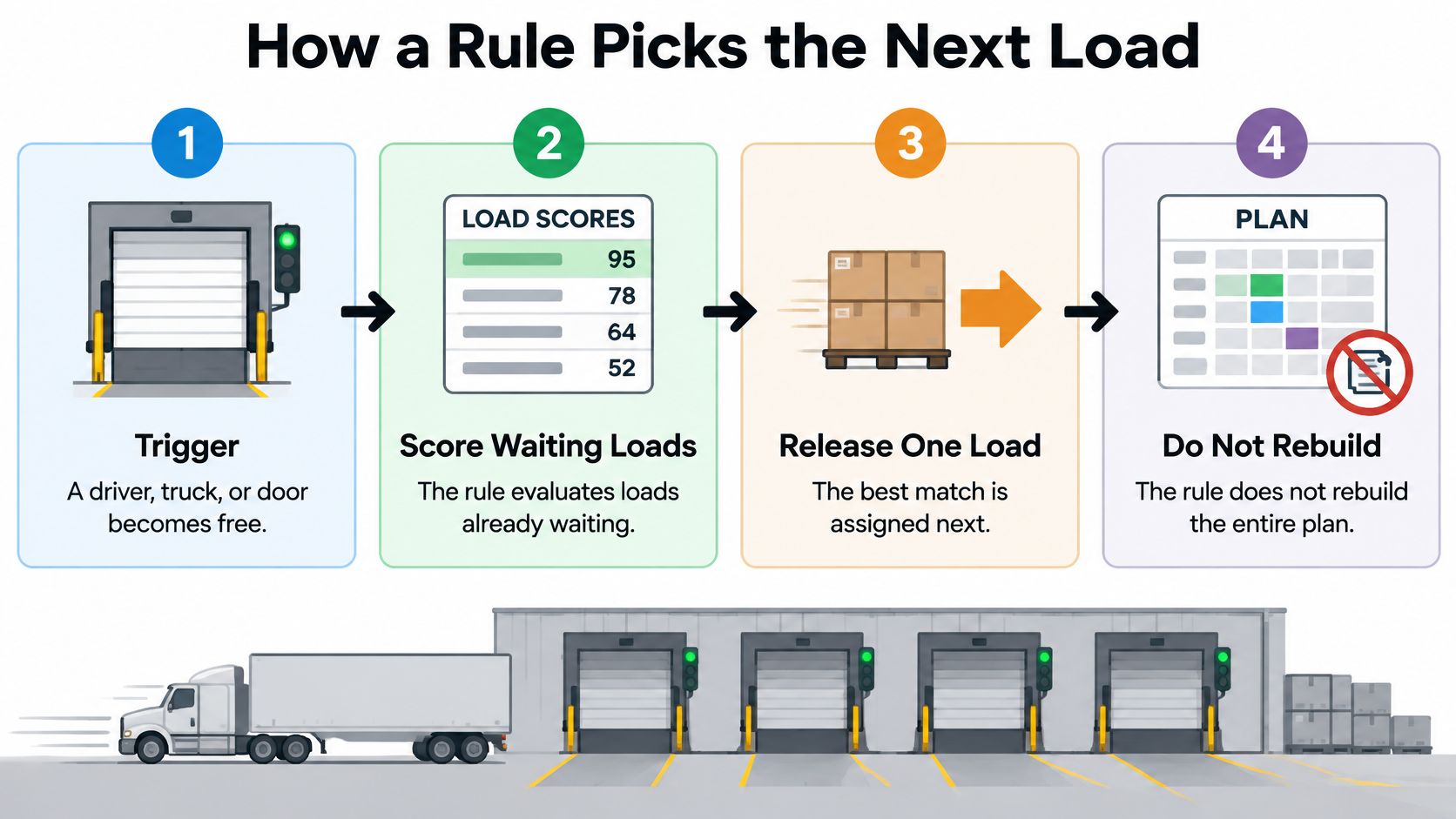
Think of a dispatch rule as the signal at a busy dock door. A driver checks in, a truck becomes available, or a door opens. Dispatch evaluates the waiting loads and releases the best eligible match rather than rebuilding the entire night.
In operations-research terms, whenever a resource becomes available, a dispatch rule assigns priority values to waiting jobs and selects the next job for processing. The dispatching-rule study in the International Journal of Production Economics describes practical scheduling approaches built around processing time, due dates, and combined priorities, including familiar benchmarks such as SPT, EDD, and FIFO.
Say a driver becomes available while an outbound trailer is still loading. Another trailer is ready but has a later hub commitment. The original schedule may favor the unfinished trailer; the live decision needs to account for what the driver can take now.
The familiar rules behind the board
Software labels can make simple choices sound complicated. These benchmark rules answer different questions:
- Shortest Processing Time, or SPT, favors the job that finishes soonest. In transportation, its analogue is the shortest remaining work cycle, including handling and handoff rather than road time alone.
- Earliest Due Date, or EDD, favors the nearest commitment. On a middle-mile board, that might be the earliest committed arrival or downstream hub cutoff.
- First In, First Out, or FIFO, favors the job that has waited longest. Its freight equivalent is the trailer that has been ready at origin longest.
Don't confuse shortest processing time with the driver who has the least time left. One measures the work; the other measures available capacity. A short load still needs a full feasibility check.
Why a fixed schedule isn't enough
A static schedule is useful for reserving capacity and coordinating facilities. Once a trailer arrives late or a receiving queue grows, though, dispatch needs a current decision rather than blind adherence to an outdated sequence. Earliest-deadline ordering also needs capacity awareness: it becomes less dependable when competing commitments crowd the board.
Network-level load-balancing algorithms address how work is distributed across resources. A dispatch rule answers the immediate question of which waiting load goes next.
Explicit priorities make that choice repeatable. A lead can inspect the inputs after a missed commitment, identify why dispatch selected a load, and change the rule rather than argue about whose judgment was better.
The Order Dispatch Rules Fire
The first job of a dispatch rule is to refuse infeasible work, not find the shortest path. If the system gives every load a blended score before checking legal capacity, enough mileage savings or customer urgency can conceal a hard failure.
Use separate gates instead. The FMCSA hours-of-service compliance guidance advises carriers to prevent assignments drivers can't complete within available hours and recognizes an adverse-driving-conditions provision allowing up to two additional hours under qualifying circumstances, not as routine planning capacity.
Dispatch decision order from hard stop to tie-break
| Tier | Rule | Pass test | If it fails |
|---|---|---|---|
| 1 | Hours of service | Available driving time, the duty window, required breaks, and the applicable weekly limit cover the full assignment | Reject the assignment |
| 2 | Facility window | Planned arrival and departure meet the hub or DC appointment without compressing a required break | Reject or re-time before any score is applied |
| 3 | Late-arrival risk | Among feasible loads, this one has the lowest expected miss given travel time, historical dwell, weather, and buffer left | Hold it and offer a feasible lower-risk load |
| 4 | Miles and utilization | Fewer empty miles and better truck use than other loads that already passed the earlier gates | Use only to break a tie |
The hours test needs the whole work cycle. Report time, loading, yard delay, driving, fueling, terminal handoff, and any planned return all belong in the estimate. A map's drive-time result isn't a duty plan.
Facility windows are a separate gate because legal driving capacity doesn't guarantee a workable appointment. A driver may have time available while the receiving building has no door. Dispatch must obtain a revised window before treating that load as feasible.
Why mileage comes last
Consider competing routes to a regional hub. The shorter route crosses a congested interchange and enters a receiving queue with little recovery room. The longer alternative provides a more dependable handoff and preserves room for an ordinary delay.
Choosing the shorter route solely for mileage can make the entire assignment worse. Dispatch may save road distance but spend the driver's remaining duty capacity waiting outside the building.
For feasible alternatives, compare predicted travel, terminal dwell, weather exposure, and buffer consumption. Buffer is the usable room between expected completion and the binding deadline, whether that deadline comes from the facility or the driver's clock.
An exception isn't a substitute for that room. Don't accept a load on the assumption that adverse conditions will make extra time available later.
The release instruction should follow a strict sequence: pass every hard gate, compare service risk, then consider efficiency. Dispatchers shouldn't need permission to reject a failed gate, and an urgent customer request shouldn't turn that rejection into a negotiable score.
Assignment Priority Hours and Proximity
Assignment, priority, hours, and proximity often appear together on a dispatch screen. They shouldn't all have the same authority. If dispatch blends them into an unrestricted score, a nearby load can outrank a driver-hours failure.
Keep each family responsible for a different decision. Assignment establishes operational eligibility; hours establishes legal feasibility. Neither should be mistaken for customer importance.
What each dispatch rule family is allowed to decide
| Family | Decides | Typical signal | Must not decide |
|---|---|---|---|
| Assignment | Whether this driver and truck are operationally eligible for the lane | Equipment match, current origin, return-to-base or relay | Hours legality or customer rank |
| Priority | Which feasible load goes first | Delivery commitment, hub cutoff, exception severity | A shorter deadhead or extra driving time |
| Hours | Whether the load is legal to start and finish | Remaining drive time, remaining on-duty time, break placement, planned dwell | Service priority |
| Proximity | Which feasible load wastes less repositioning | Deadhead miles and expected delay at the next facility | An hours exception or a missed-cutoff waiver |
Assignment should reject a truck that can't handle the freight or a driver positioned for a different handoff. Passing this check means the combination is operationally suitable, not that dispatch has permission to release it.
Priority answers a sequencing question. A load protecting an outbound hub connection may deserve attention before a flexible transfer, but its importance can't extend the driver's clock.
Read the signal without expanding its authority
Hours calculations need current duty information, not an availability label left over from the start of the shift. A driver can still show driving time available while earlier loading and yard work leave too little elapsed duty window for the assignment. Keep those clocks distinct in the dispatch screen and in your hours-of-service rules training.
Location tools help establish where work occurs. Faberwork LLC's example of custom geofencing software for fleet operators is a useful reference when considering facility-boundary events as operational inputs. Treat a geofence arrival as location evidence, not proof that unloading has started or that the driver is off duty.
Proximity belongs after those checks. A short deadhead into a jammed receiving yard can be worse than a longer reposition to a clean handoff. Count the expected next-facility delay, not just the distance to its gate.
When loads have equal commitments and comparable service risk, proximity can sensibly break the tie. On a split overnight assignment, however, dispatch must assess the later leg using capacity remaining after the earlier handoff, including any delay there, rather than the driver's report-time availability.
The misuse to stop is simple: neither priority nor proximity may override an hours failure.
How to Score One Overnight Load
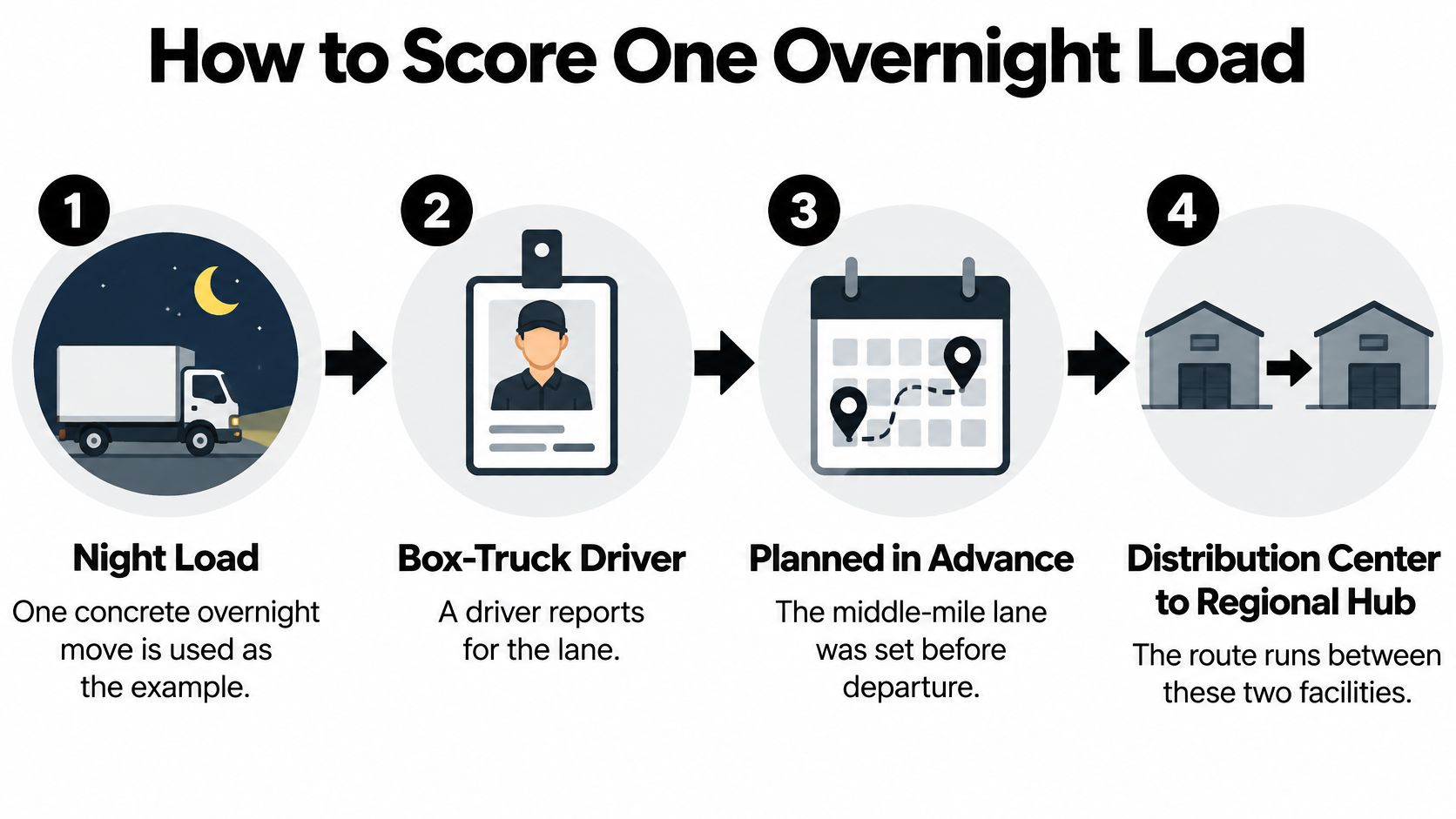
Take a planned middle-mile move from a distribution center to a regional hub. At Peak Transport, our driver routes are scheduled between facilities and planned in advance, not assembled from random residential stops. Our box-truck drivers load and unload with pallet jacks, document deliveries, and perform pre- and post-trip inspections.
For property-carrying operations subject to these requirements, the FMCSA summary of hours-of-service regulations generally permits 11 driving hours after 10 consecutive hours off, prohibits driving beyond the 14th consecutive hour after coming on duty, requires a 30-minute interruption after 8 cumulative driving hours, and applies 60/70-hour on-duty limits according to the carrier's operating schedule.
Work through the live assignment
Read the latest hours check-in before offering the load. Use current available drive time and duty-window capacity. Confirm that the weekly limit doesn't create an earlier restriction.
Map the full duty line from report through completion. Include inspection, pallet-jack loading and unloading, yard delay, driving, fueling, delivery documentation, terminal handoff, and the planned return to base.
Place the required break deliberately. Choose a location and timing that fit the driving sequence. Don't mark a live unload as a break by assumption; confirm the actual activity and whether it qualifies.
Reject the offer if expected dwell and work leave insufficient time to complete the driving legally. A route with apparently manageable wheel time can fail because the driver has already spent too much of the duty window at the origin.
If competing loads pass, compare expected late arrival before distance. Give a dependable receiving process more weight than a small mileage saving that leaves no recovery room.
Write the release record. Record available drive hours, available on-duty hours, planned dwell allowance, break placement, and the delay escalation trigger. These are operating inputs, not fields to reconstruct after delivery.
Complete the trip-file workflow. The driver performs the pre-trip before departure, records the delivery, and completes the post-trip; dispatch reconciles material timing changes with the assignment record.
Dispatch record template
Driver: [name]
Lane and report time: [details]
Available drive hours: [current balance]
Available on-duty hours: [current balance]
Planned dwell allowance: [facility allowance]
Break placement: [location and timing]
Commitment: [appointment]
Escalate if: [delay threshold or changed condition]
Scheduled facility work makes this calculation manageable because dispatch knows the intended stops and handling activities before release. Adding an unplanned stop changes the assignment and requires a fresh check, not an informal addition to the radio instruction.
The pass condition is concrete: the driver leaves with a clear assignment, a workable break, and a written point at which dispatch must reconsider the plan. The record should preserve the capacity and assumptions that supported release.
When Dispatch Must Re-Plan
Tracking a truck isn't the same as pressuring its driver. The distinction is what dispatch does with the information. The FMCSA guidance on ELD harassment permits real-time tracking for legitimate business purposes while explaining the regulatory treatment of carrier conduct involving electronic information that the carrier knew, or should have known, would cause an hours violation.
Tracking may improve the plan. It must not be used to override legal capacity.
A location update should prompt a better estimate, a receiving-facility call, or a recovery decision. It shouldn't prompt an instruction to make up time that the driver's available hours no longer support.

Can dispatch ask the driver to continue after a delay?
Only after checking that the revised work still fits the driver's legal capacity and that the driver can proceed safely. Recalculate from the current position, including the changed queue, remaining handling, break needs, and onward driving.
If the assignment still fits, document the revised estimate and notify the receiver. If it doesn't, arrange a feasible alternative rather than repeat the original instruction more forcefully. A driver raising fatigue concerns needs an escalation response, not an argument about the map.
Who documents a missed appointment caused by detention?
Dispatch should record the facility timeline and attach the driver's supporting information. Capture arrival, queue entry, door assignment, release, and the resulting appointment change where those events are available.
Classify detention as facility time rather than automatically recording a driver failure. Preserve the original commitment alongside the revised one so the trip file explains what changed.
ELD records retain original entries when permitted edits occur. That audit trail matters because a later reviewer can compare the duty record with dispatch instructions rather than rely on memory.
When does re-planning become mandatory?
Build explicit triggers into the operating policy:
- Insufficient capacity: Remaining driving and duty capacity no longer covers the revised work.
- Fatigue concern: The driver reports being unable to continue safely.
- Severe weather: Conditions undermine the approved route or completion estimate.
- Failed appointment test: The commitment now requires an hours breach.
A later door, a qualified relay, or recovery in a subsequent operating cycle can replace the failed assignment. Record who approved the change and what the driver is now expected to do.
Don't turn adverse-condition provisions into a standing recovery assumption. A compliant initial release doesn't authorize an infeasible continuation.
The proper outcome is visible: dispatch changes the board, the record explains why, and the driver isn't left to invent an exception.
KPIs That Prove the Rules Work
If empty miles fall while lateness and hours violations rise, don't celebrate the mileage result. Investigate whether dispatch is applying the efficiency preference before clearing the hard gates. An attractive cost metric can conceal an assignment policy that spends capacity the driver doesn't have.
No classic priority rule is universally best. The dispatch-rule comparison published in Scientific Reports illustrates why scheduling methods need evaluation against defined objectives, rather than selection by name alone. For transportation, keep the objective visible beside the scoreboard: legal completion first, committed arrival next, mileage last.
KPI scoreboard and the tier each metric tests
| Metric | Tier tested | Reading rule |
|---|---|---|
| On-time departure | Tier 2 facility window | Low values warrant checking whether release and facility assumptions were workable |
| On-time arrival and minutes late | Tier 3 late-arrival risk | Rising lateness with stable legal compliance warrants reviewing risk scoring |
| Mean flow time, dispatch to empty | Tiers 2 and 3 | Long waits warrant checking priority clarity and facility capacity |
| Detention minutes | Facility time | Separates facility delay from driving-related causes |
| Share of loads rejected for hours before assignment | Tier 1 hours of service | A permanent absence of rejections on pressured nights warrants auditing the feasibility gate |
| Hours-of-service violations | Tier 1 hours of service | No violations is the operating target; investigate failures at system level |
| Empty-mile ratio | Tier 4 miles and utilization | Improvement counts only when service and compliance remain protected |
| Miles or fuel per completed lane | Tier 4 miles and utilization | Use as an efficiency comparison among feasible choices |
Review the decision, not just the driver
Review these key performance indicators by lane and operating night, not only by driver. A recurring hub queue can make every driver assigned there appear unreliable. Flow time and departure performance are diagnostic signals, not proof of a particular cause.
Adopt a release policy with a named dispatch lead accountable for each night's records. Compare ELD edit logs with dispatch instructions weekly, and log instructions that contradict an hours or facility-window failure as system incidents.
Make the consequences explicit in the written policy: suspend hard-stop override authority pending retraining, and don't discipline drivers for refusing hours-infeasible assignments. These are recommended controls, not substitutes for investigating why the override occurred.
Run a monthly record sample to verify that current capacity, dwell allowance, break placement, and escalation conditions were documented before movement. A completed delivery doesn't prove the original release was sound.
Write the Rule Card Before the Next Shift
Leave the planning meeting with a usable rule card, not another general promise to communicate better. Keep it short enough for a dispatcher to consult during a live call and clear enough for a driver to recognize when an instruction conflicts with it.
Use the card to define decision authority. State who may release work, who handles a failed feasibility check, and who communicates a changed appointment to the receiving facility. Keep supporting calculations in the dispatch record rather than crowding the card with every possible exception.
Test it against a live decision
Brief dispatch and drivers together using an actual planned lane. Ask the dispatcher to explain the release decision and the driver to identify the condition that would require a new instruction. Any disagreement is a policy gap to fix before departure.
- Make inputs visible: Show where current hours, facility timing, and dwell assumptions come from.
- Record the outcome: Save the approved assignment and the person responsible for release.
- Test a disruption: Add a hypothetical receiving delay and confirm who takes ownership of recovery.
For a middle-mile partner review, examine whether the proposed operating plan accounts for handling and facility time rather than presenting mileage alone. For drivers, the practical question is whether dispatch publishes a workable assignment and an escalation condition before departure.
Write the one-page rule card today and use it to score a live load before the next shift. File the decision before the truck moves.
Peak Transport offers planned overnight middle-mile box-truck routes between warehouses, hubs, and distribution centers, with route optimization that uses data modeling to reduce mileage and fuel consumption. Visit Peak Transport to discuss facility-to-facility transportation built around structured planning, clear dispatch communication, and driver-hour protection.