Dispatch Schedule Guide for Reliable Overnight Routes
Build a predictable overnight dispatch schedule for middle-mile box trucks. Learn route assignment, HOS compliance, templates and on-time metrics.
September 16, 2026
At 1:45 a.m., the schedule can look perfect on paper. The truck has a lane, the appointment has a time, and the driver received the load details before leaving the yard. Then a trailer sits in the dock, a driver calls out, or a hub takes longer to unload. Suddenly, the departure time, arrival commitment, and assigned driver no longer fit together.
That's the operating reality behind a reliable dispatch schedule. Overnight middle-mile work between Twin Cities distribution centers and Amazon Relay nodes doesn't fail because planners aren't working hard. It fails when routing, timing, and assignment get treated as one decision. A stable plan separates those decisions, tests how they interact, and gives the overnight team a clear way to handle exceptions without rebuilding the entire night.
Why Overnight Dispatch Schedules Fail Even When They Look Right
A schedule might show a truck leaving an MSP-area facility at a reasonable time and arriving at the next hub before its appointment. The route may be familiar, the box truck may be available, and the driver may have acknowledged the load. Yet the plan can still unravel before the first handoff.
The usual cause is hidden dependency. The departure time assumes loading starts on time. The arrival time assumes the driver assigned to the lane has enough available hours. The driver assignment assumes the return leg won't consume the hours needed for the next commitment. Each assumption may look harmless by itself, but the schedule depends on all of them holding at once.
Practical rule: A dispatch schedule isn't stable because every line has a time. It's stable when the plan still works after a normal operational delay.
Dispatch has been treated as a formal operations problem since at least 1971, when G. F. Newell's work on transportation dispatching showed that vehicle flow and passengers served per vehicle should respond dynamically to changing passenger arrival rates, rather than follow a fixed timetable alone. Newell's Transportation Science paper established a principle that still matters in logistics: dispatch responds to demand, capacity, and service objectives.
For overnight middle-mile operators, that means a departure list isn't enough. The plan must account for dock readiness, lane commitments, driver hours, equipment capacity, and communication after the daytime office has gone home.
The failure usually starts before departure
Consider a box truck scheduled to leave a distribution center after loading. A dock delay pushes departure back, but nobody changes the arrival expectation. The driver then faces a choice between rushing, arriving late, or calling dispatch for instructions. If dispatch also has to find coverage for another lane, an isolated delay becomes a sequence of missed handoffs.
This is why a schedule should protect predictable lanes, usable driver hours, and clear ownership. Planners need a repeatable structure. Hub leaders need visibility into what is moving. Drivers need instructions that distinguish the committed appointment from the fallback plan.
A reliable overnight operation doesn't eliminate every exception. It makes exceptions visible early and limits their effect on the rest of the network.
Understanding Dispatch Schedule Versus Route Timing and Driver Assignment
Routing, scheduling, and assignment answer different questions. Confusing them is one of the fastest ways to create a plan that looks correct but fails during execution.
Routing defines the path
Routing determines where the truck goes and how the lane is structured. In a Twin Cities middle-mile network, that may mean connecting a distribution center to an MSP-area hub, choosing the approved road sequence, and identifying where the load transfers or returns.
Routing should be locked before timing is added. If planners change the path after publishing departure times, every arrival assumption changes with it. A consistent lane also gives the team a more dependable operating history. Drivers learn the facilities, dock patterns, gate procedures, and recurring problem areas. Dispatchers can compare actual performance against the same lane instead of mixing route changes with driver performance.
Route timing defines when movement happens
Route timing places the movement inside the service commitment. It covers the planned departure window, expected arrival window, loading time, unloading time, and any required handoff. Timing is not just the travel duration copied from a map.
A map can provide a useful reference, but overnight planners must account for realistic road speeds, weather exposure, facility access, and dwell. The Transportation Research Board notes that scheduling systems depend on accurate data for items such as average road speeds, mapping, fleet capacity, and system exchanges. It also identifies database and data-transfer errors as recurring obstacles to scheduling performance. The TCRP synthesis on demand-responsive transportation is useful background for understanding why clean operational data matters.
Driver assignment defines the resource
Driver assignment answers who operates the lane and shift. It includes availability, qualifications, current hours, required breaks, and whether the driver can legally and practically complete the planned work.
A correct route with the wrong driver is still a failed plan. For example, a driver may be available for the outbound trip but lack enough hours for the return leg. A call-out may leave a replacement driver available but unable to meet the original appointment. Assignment must be checked against the whole work period, not just the first departure.
Use this order when building the plan:
- Lock the lane: Confirm origin, destination, approved route, equipment, and handoff points.
- Set the commitment: Define the appointment and service windows that cannot move.
- Test the timing: Add loading, unloading, travel, and recovery time.
- Validate the driver: Check hours, availability, and return-leg requirements.
- Publish the exception path: State who must be contacted and what happens if the plan slips.
The schedule holds when the path, the clock, and the person are each valid on their own before they're combined.
How to Build a Predictable Overnight Dispatch Schedule
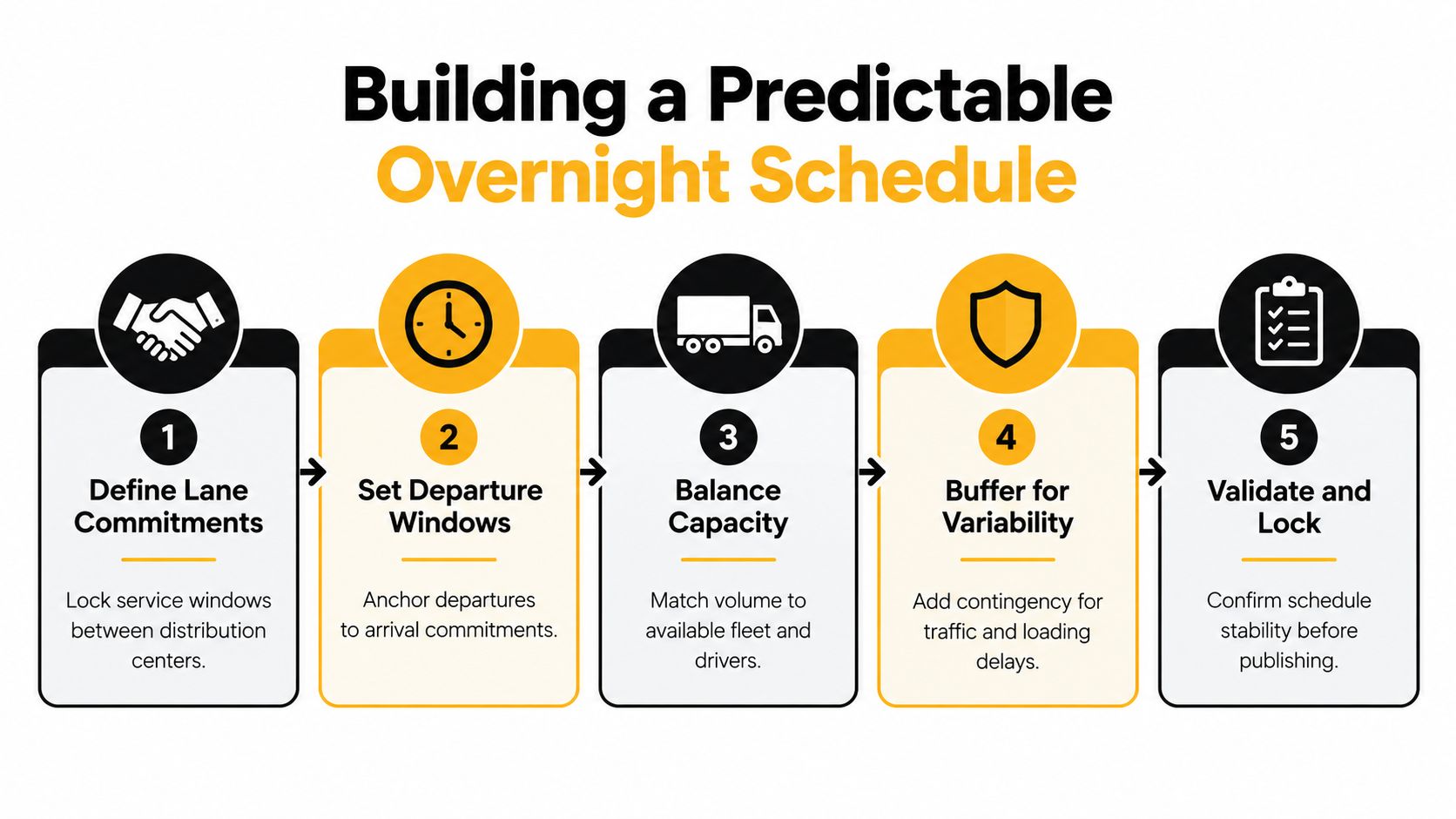
Start with the lane commitment, not the driver roster. Identify the distribution center, destination hub or Amazon Relay node, appointment window, equipment requirement, and any return movement. A planner who starts by filling available drivers may create a roster that looks efficient but cannot protect the customer commitment.
Write each lane as an operating record. Include the origin, destination, route reference, planned departure window, arrival commitment, loading expectation, unloading expectation, return requirement, and escalation contact. Keep this record consistent from night to night unless the facility or customer changes the commitment.
Anchor departure to the arrival commitment
Work backward from the required arrival window. Set the departure window only after accounting for loading and the expected route duration. For MSP-area lanes, document the facility's actual cut-time behavior rather than relying on a generic assumption. An appointment discipline problem at the origin can become an arrival failure at the destination.
Separate scheduled departure, actual departure, planned arrival, and actual arrival in the operating record. Those fields let the team identify whether the issue came from loading, route timing, or execution. A single “departure time” field hides too much.
For planners who need a reusable structure, the weekly schedule with times format can support a consistent driver-facing plan. The schedule should be easy to scan on a phone and detailed enough that a driver doesn't need to call for basic instructions.
Add dwell and a controlled buffer
Dwell belongs in the plan as its own activity. Loading, gate access, check-in, staging, unloading, paperwork, and proof of delivery all consume operating time. If those activities are buried inside an optimistic travel estimate, the schedule will show a late truck without showing why it became late.
A buffer should protect the service commitment, but it shouldn't become an excuse to make every departure unnecessarily early. Too little buffer creates constant escalation. Too much buffer can reduce usable capacity and make the driver's shift longer than necessary. Review the difference between planned and actual dwell by facility, then adjust the lane record based on observed conditions.
Assign W-2 drivers against the full shift
Assign the driver only after the lane timing is stable. Check the outbound trip, expected dwell, return leg, required breaks, and the next scheduled work period. Hours-of-service limits are not a final compliance checkbox. They shape which assignments are feasible.
The assignment record should show:
- Driver name and contact method: Use one current source of truth.
- Vehicle identifier: Confirm the equipment matches the load and lane.
- Shift start and release expectation: Give drivers a realistic view of the whole work period.
- Outbound and return movements: Don't leave the return leg implied.
- HOS review status: Record who validated available hours.
- Exception owner: Identify the dispatcher responsible after the handoff.
When a driver calls out, don't move the load to the first available person. Recalculate the full shift. If no replacement can protect the appointment and remain compliant, escalate the commitment early rather than asking a driver to absorb an impossible plan.
Publish one version and require acknowledgment
Publish the schedule through a system that records changes. A text message can deliver an update, but it shouldn't be the only place where the final plan exists. Drivers should see the lane, times, facility instructions, contact path, and exception rule together.
For operations with several overnight stakeholders, the same principle applies to emergency coordination. A structured campus emergency coordination platform illustrates the value of centralized alerts, clear ownership, and documented acknowledgments when people need dependable information outside normal office hours.
Require acknowledgment before the shift begins. If the driver doesn't acknowledge, the dispatcher should treat the assignment as unconfirmed and resolve it before the truck reaches the yard. That practice prevents silent handoff failures, especially when an overnight dispatcher inherits work from the evening shift.
Communication Workflows That Keep Overnight Lanes on Time
A published schedule can still fail if communication depends on whoever happens to see a text. Ad-hoc messaging works for a simple confirmation, but it breaks down when a dock delay, call-out, or route change affects several people.
A structured workflow assigns the right channel to the type of message. Routine information should be predictable and easy to acknowledge. Exceptions should be visible, time-stamped, and owned by a specific dispatcher.
| Situation | Channel | Timing | Owner |
|---|---|---|---|
| Upcoming assignment | SMS or email with schedule details | Before the shift, with acknowledgment requested | Assigned dispatcher |
| Routine departure confirmation | Dispatch system status update | At release from the yard | Driver and dispatcher |
| Dock or loading delay | Direct call plus recorded system note | As soon as the delay threatens the window | Dispatcher |
| Driver call-out | Direct call to the coverage lead, followed by written update | Immediately after notification | Shift dispatcher |
| Appointment or route change | Dispatch system update, then direct confirmation | Before the driver acts on the change | Dispatcher |
| Proof-of-delivery issue | Documented message with the missing item identified | At handoff or discovery | Driver and receiving lead |
Routine communication should reduce calls
Send the complete assignment before the driver reports. Include the lane, departure window, destination, appointment information, equipment, return expectation, and the person to contact after hours. Ask for a clear acknowledgment rather than assuming that message delivery means understanding.
Digital time and attendance records can also support overnight control by giving managers a consistent view of hours and shift activity. That matters when the schedule must be checked against available driver time, not just vehicle location.
Peak Transport's communication protocols are a useful reference for turning expectations into repeatable handoffs. The practical standard is simple: drivers shouldn't have to chase dispatch for information that belongs in the assignment record.
Exceptions need a different channel
A dock delay that threatens an appointment deserves a direct call, not a message buried in a group thread. The dispatcher should record the event, identify the affected commitment, and state the next decision point. If the driver is waiting, the driver needs to know whether to remain staged, contact the facility, or hold for revised instructions.
A call-out follows the same logic. The dispatcher confirms the absence, checks viable coverage against hours and equipment, and communicates the replacement plan to every affected facility. The team should never rely on a driver discovering a change by opening an old message.
Good overnight communication is not constant chatter. It's a controlled flow of information that keeps routine work quiet and makes exceptions impossible to miss.
Measuring and Improving On Time Performance Without Guesswork
Dispatch quality should be measured through operating records, not memory. A late arrival may result from a poor departure plan, excessive dwell, a capacity mismatch, or a driver assignment that was never feasible. The right KPI set helps managers locate the cause without blaming the person closest to the delay.
Transportation research has used measures such as delayed transports, operating time, driving time, and transports after 17:00 to compare dispatch strategies. In one modeled comparison set, transports after 17:00 changed from 14.17 to as low as 5.07 per day, while total operating time changed from 143.28 to about 119.52 minutes. The dynamic driver-management study demonstrates how dispatch performance can be evaluated with operational measures rather than anecdotes.
Use OTIF as a control signal
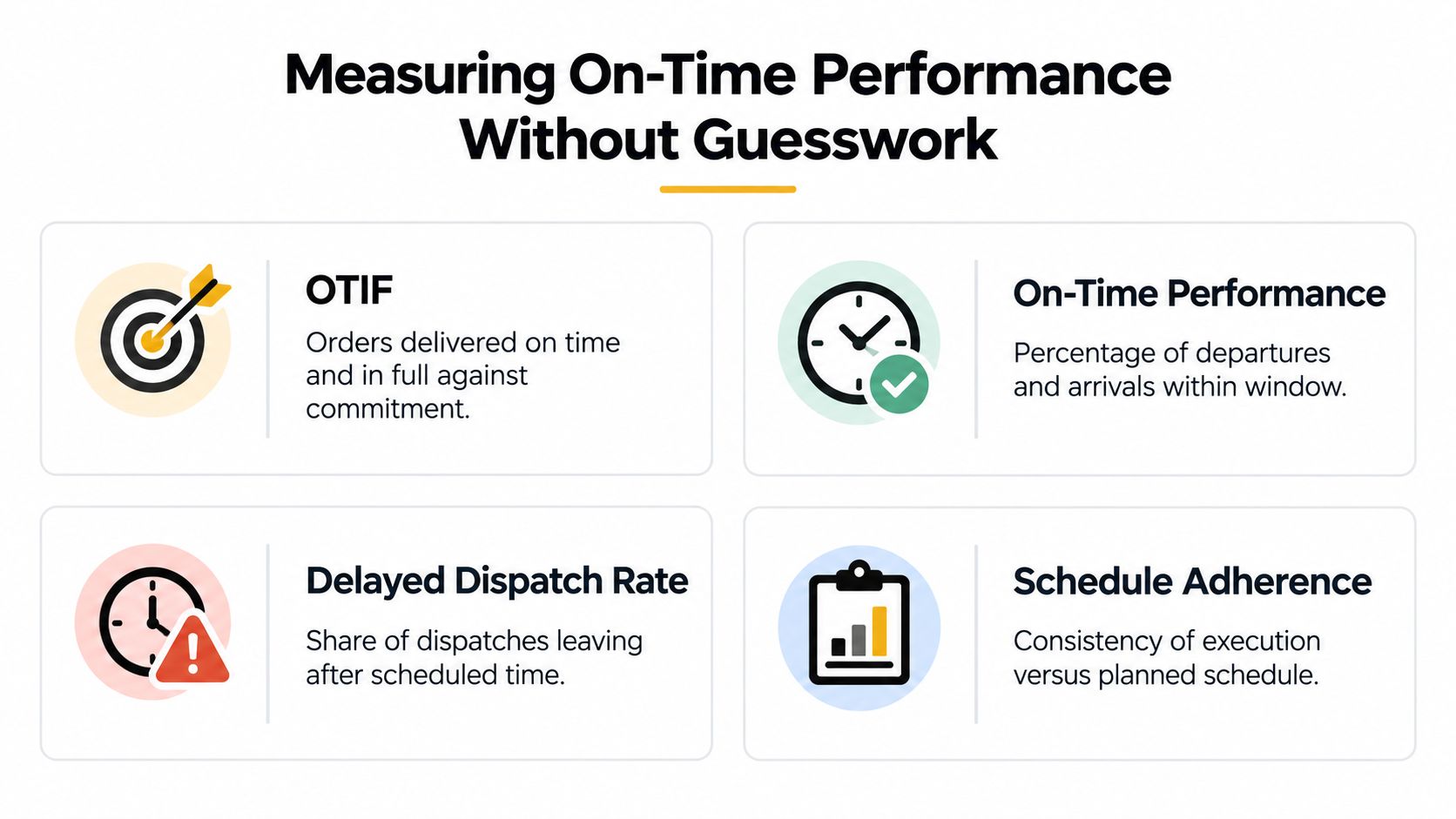
OTIF, or on time in full, connects dispatch execution to the customer commitment. A practical benchmark from dispatch performance analytics is that an OTIF rate below 95% typically points to systemic problems in route planning, capacity allocation, or dispatch sequencing. Locus's dispatch performance guidance presents OTIF as a control metric rather than a one-off score.
A low OTIF result doesn't automatically mean drivers need to move faster. Compare the result with:
- Departure adherence: Did trucks leave inside the planned window?
- Dwell duration: Did loading or unloading consume the available margin?
- Driving time: Did actual movement differ from the route assumption?
- Assignment feasibility: Did the driver have enough hours and equipment support?
- Exception frequency: Were delays isolated or repeated at the same facility?
Track the full order-to-delivery cycle
Measure order-to-proof-of-delivery cycle time alongside arrival performance. This captures dispatch processing, hub dwell, loading, transit, receiving, and documentation in one view. A truck can arrive on time and still create a poor operational result if proof of delivery is delayed or the receiving handoff remains incomplete.
Teams working on estimated arrival reliability may also benefit from a practical data observability delivery time perspective. The useful lesson is to monitor the quality and timeliness of the data feeding delivery expectations, not just the final arrival timestamp.
Review daily statistics, then look for patterns by lane, facility, shift, and assignment type. If one lane repeatedly leaves late, fix the release process. If departures are on time but arrivals slip, review route timing and road-speed assumptions. If only certain assignments fail, check hours, training, equipment, and handoff quality before changing the entire schedule.
A deeper look at on-time delivery performance can help teams connect these measures to broader service control. The best review ends with a process correction, not a reprimand.
Keeping Your Dispatch Schedule Consistent Week After Week
Consistency comes from maintenance, not from publishing one strong plan. Lane records should be reviewed regularly for changes in facility behavior, appointment expectations, road conditions, equipment availability, and return-leg requirements. A schedule that worked last month may need adjustment if the operating inputs changed.
Keep a short weekly review cadence:
- Review lane results: Compare planned and actual departure, arrival, dwell, and proof-of-delivery times.
- Check capacity: Confirm available box trucks, trained drivers, planned leave, and likely coverage gaps.
- Audit assignments: Verify that the roster protects hours and return movements.
- Inspect communication records: Look for missing acknowledgments, unclear changes, and unresolved exceptions.
- Hold stable lanes steady: Don't change a dependable plan without evidence that the change solves a real problem.
The right response to a recurring delay is usually a controlled adjustment. Change the departure window when the commitment or facility process requires it. Change the route when the approved path no longer supports reliable timing. Change the assignment when availability, hours, or equipment make the original plan unworkable.
What doesn't work is changing all three at once and then trying to determine which decision caused the result. Keep the lane stable while testing timing, or keep timing stable while testing coverage. That discipline gives managers a clearer operating history and gives drivers confidence that their weekly plan won't shift without a reason.
For brands, the result is dependable middle-mile execution and cleaner handoffs. For drivers, predictable overnight work means fewer surprise calls, clearer expectations, and a schedule that respects the full shift. Peak Transport applies this structured approach to overnight box-truck operations across the Twin Cities, with W-2 employment, paid training, benefits options, maintained equipment, and documented dispatch communication.
If you're a Twin Cities logistics manager looking for dependable overnight middle-mile coverage, visit Peak Transport to discuss structured lane execution. Professional box-truck drivers seeking consistent W-2 overnight routes, paid training, and clear dispatch expectations can also explore current opportunities there.