Driver Safety Incentive Programs: A Practical Playbook
Build driver safety incentive programs that actually move the needle. A practical playbook for designing, measuring, and scaling rewards
September 17, 2026
At 2:00 a.m., a box-truck fleet can look perfectly safe from the office dashboard. Drivers leave on time, dispatch messages are brief, and the morning report shows no claims. Then a driver clips a barrier at a yard entrance, avoids an injury, and records the event as a minor note in the dispatch log. By sunrise, the operation appears clean, even though the next similar mistake could become a claim, an inspection issue, or a serious injury.
That gap is where driver safety incentive programs either earn their place or fail. A useful program doesn't pay drivers to hide bad news. It makes safe habits, near-miss reporting, coaching, and professional judgment visible inside a broader compensation structure. For W-2 box-truck fleets, the bonus is only one part of the operating system. Base pay, paid non-driving work, benefits, route design, supervision, and trustworthy data shape the result just as strongly.
When the Dispatch Radio Stays Quiet and What That Reveals
The radio stays quiet after the barrier strike. The overnight dispatcher hears that the driver is unhurt, confirms that the truck is still roadworthy, and moves the run forward. No claim is filed. No supervisor reviews the yard approach. No one asks whether poor lighting, a tight turn, or schedule pressure contributed to the contact.
That incident doesn't prove the driver is careless. It proves the fleet's safety process has no reliable path from near miss to learning. If reporting creates embarrassment or threatens a bonus, drivers and supervisors have a reason to keep the event small. The operation then measures only the failures that become impossible to conceal.
A structured program changes the conversation. The driver reports the contact, the system records the location and circumstances, and a safety lead separates a yard-only event from a public-road event before assigning a score. The driver may lose points for a preventable maneuver, but timely reporting remains protected. A coaching session follows while the details are fresh, and the fleet can check whether the same entrance creates problems for other routes.
What the quiet log is hiding
The Federal Motor Carrier Safety Administration's safety-culture review documented that carriers already used cash bonuses, recognition items, and accident-free mileage awards to encourage safe driving. In the same review, 80% of surveyed Ontario drivers said their companies offered some type of safe-driving incentive, while a separate U.S. carrier study identified 23 motor carriers using a bonus or incentive program. Those findings, reported in the FMCSA safety-culture review, show that incentive programs have long been part of trucking management, not a novelty.
The practical lesson is simple: don't confuse a clean claims report with a healthy safety culture. Build communication habits that let drivers report hazards without feeling that honesty automatically costs them. A documented approach to improving team communication helps dispatch, safety, and drivers work from the same facts.
Even visible safety culture details matter. Consistent PPE, clear site expectations, and branded equipment can reinforce that the company treats safety as an operating standard, not a seasonal campaign. Fleets reviewing options for choosing a logo hard hat should treat the item as part of a broader site-safety message, not as a substitute for training or supervision.
Practical rule: Protect near-miss reporting from the scoring penalty. Score the preventable behavior, then reward the judgment required to report it.
The rest of this playbook addresses the operating manual that should exist before the first bonus announcement: what to measure, how to clean the data, how to structure pay, how to catch gaming, and how to decide whether the program deserves expansion.
Designing the Reward Structure Before You Pick the Rewards
The first mistake is choosing a reward before defining the behavior. A gift card, cash payment, or recognition item can't rescue a program with vague eligibility rules. Start with the scorecard, then decide who carries the risk, how long drivers must qualify, and how often the company will pay.
Use a small set of KPIs that drivers can influence and managers can verify. A box-truck program might include preventable harsh-braking events, speeding context, seatbelt compliance, inspection completion, near-miss reporting quality, training participation, and documented vehicle defects. Keep customer-service or delivery metrics separate unless the program clearly explains how safety takes priority over speed.
Decisions that need a written answer
| Decision | Option A | Option B | Trade-off |
|---|---|---|---|
| Score ownership | Individual score | Team or group score | Individual scoring feels direct, while group scoring builds peer accountability and shares exposure to route differences |
| Qualification | Short eligibility window | Longer qualifying period | Short windows create quick feedback, while longer periods discourage one clean week from outweighing a recurring problem |
| Payment logic | Threshold bonus | Tiered bonus | Thresholds are easy to administer, while tiers stretch motivation but can encourage metric chasing |
| Reward format | Cash or payroll bonus | Recognition, points, or privileges | Cash is clear, while choice and recognition can reach drivers who value flexibility or visibility |
| Accountability | Individual consequence | Group-contingency rule | Individual rules feel fair for personal conduct, while group rules can expose unsafe norms that affect the whole operation |
A threshold structure works well during a first launch. For example, a driver qualifies after meeting the published score and completing required coaching, with clear exclusions for preventable serious violations. A tiered structure can recognize improvement as well as top performance, but it needs guardrails against drivers taking easier routes or avoiding legitimate work.
A team pot has value in overnight operations because drivers share yards, handoff points, and dispatch processes. It also creates a risk: one driver's unsafe choice can affect colleagues who had no control over it. Use team rewards for shared actions, such as complete defect reporting or hazard documentation, and keep personal driving conduct in an individual component.
A points model can give drivers more choice, especially when the fleet offers recognition items, gear, or time-off preferences alongside cash. A customer points program illustrates the mechanics of transparent earning and redemption, although a fleet must adapt the rules to payroll, safety, and employment requirements.
Write the policy in plain language and have drivers test it before launch. A clear KPI framework for fleet operations can help managers define measures that connect daily behavior to business objectives.
Choose KPIs first, payment frequency second, and reward amount third. Reversing that order turns the program into a purchase instead of a management system.
Wiring Telematics and Driver Data into the Program
A score is only as credible as the data behind it. In a connected fleet, the safety lead needs a defined route from raw event to approved payout. That route should identify the source, clean the record, apply the rule, allow review, and then pass the approved result to payroll.
Geotab, Samsara, and comparable systems can provide event codes for harsh braking, speeding, acceleration, seatbelt use, and other signals. The code alone isn't enough. Pair the event timestamp with the dispatch log and route geography so the system can distinguish a public-road event from a yard maneuver, loading activity, GPS drift, or a vehicle being repositioned by another employee.
Fuel-card records can support idling analysis, but they shouldn't replace vehicle data. HRIS exports should verify tenure, employment status, leave status, and eligibility. The safety team should also maintain an exception queue for missing trips, vehicle swaps, sensor failures, and events that require dashcam review.
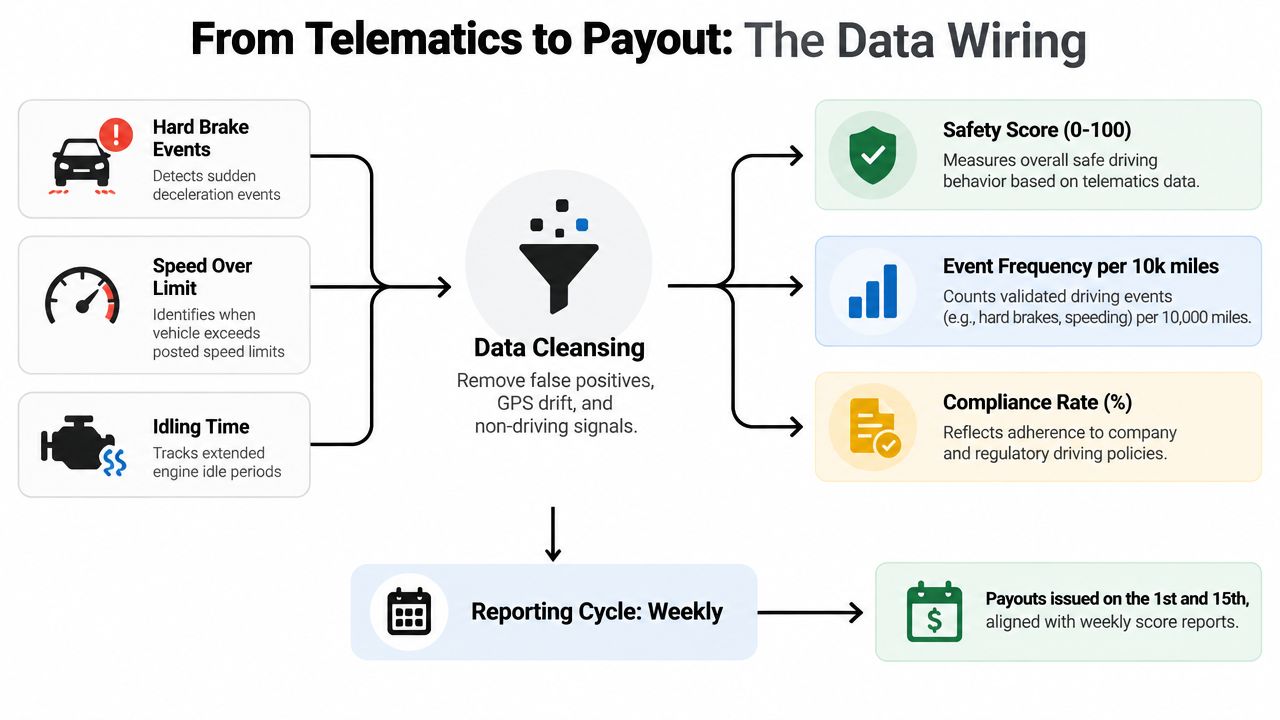
A workable scoring and payout flow
- Collect the feeds. Import telematics events, dispatch timestamps, route assignments, fuel-card activity, HRIS eligibility fields, and relevant dashcam clips.
- Clean the record. Remove false positives, match the truck to the driver, exclude non-driving activity where the policy allows it, and flag gaps for review.
- Apply the scorecard. Convert verified events into the published KPI scores. Don't change weights mid-cycle.
- Publish the dashboard. Give drivers a weekly view of their score, events, exclusions, and coaching status.
- Approve the payout. A supervisor or safety lead reviews exceptions before the payroll or ACH batch runs.
A concrete example makes the workflow easier to audit. If a driver earns 92 points against a 90-point threshold, the dashboard can show the qualifying result, the events included, and the manual review status. Weekly dashboards and bi-weekly payouts can work together, but the payout file shouldn't run until the team resolves truck swaps, disputed events, and leave records.
Connected-vehicle systems can support this architecture when managers define ownership for each feed. The operational context behind connected vehicle technology matters more than the volume of data. A safety lead needs a reliable exception process, not a screen crowded with unexplained alerts.
What the Research Actually Says About Effectiveness
The evidence supports a qualified conclusion. Incentives can reinforce safer driving, but cash alone doesn't create a safety culture. Results depend on the reward's size and fairness, the quality of the measurement, the role of coaching, and the compensation environment surrounding the driver.
A Canadian commercial-vehicle study reported that 70% of interviewed carriers had an incentive program, with benefit-cost ratios often greater than 2:1. The same research reported 65% reductions in insurance claims, workers' compensation claims, and crashes after programs were introduced. Those figures appear in the fleet incentive evidence summary, which also describes academic findings linking a safety bonus with about 9% fewer crashes, or roughly three fewer crashes for the average carrier, and linking a 10% increase in compensation with a 9.2% decrease in crashes.
Those findings shouldn't become a promise in a sales presentation. They describe associations and reported program outcomes across different designs and operating environments. A box-truck fleet should use them to set a disciplined test plan, not to guarantee a particular result.
Translating the evidence into management expectations
| Study Type | Incentive Design | Reported Crash Reduction | Best Use Case |
|---|---|---|---|
| Canadian commercial-vehicle research | Structured safety incentive programs | 65% reported reduction in claims, workers' compensation claims, and crashes | Assessing whether a mature program justifies its operating cost |
| Academic carrier study | Safety bonus presence | About 9% fewer crashes | Testing whether a bonus belongs in a broader safety system |
| FMCSA-linked compensation analysis | 10% increase in average compensation | 9.2% fewer crashes | Reviewing total compensation before adding a bonus |
| Road-safety guidance | Proportionate rewards, group contingency, coaching, and scoring | Mixed, including no impact or negative impact from incentives alone | Designing controls against rushed driving and gaming |
The road-safety guidance in the workplace safe-driving incentive review is especially useful because it addresses failure modes. Some incentive studies found no effect, and some found negative effects when rewards encouraged drivers to protect a metric instead of making a safe decision. More promising designs use proportionate financial rewards, group-contingency rules, and larger rewards shared by fewer drivers. The same guidance describes coaching combined with driver scoring and incentives as a stronger operating pattern, with small fleets in one industry report showing median insurance savings of 5% to 8%.
Why base pay changes the meaning of the bonus
A safety bonus sits on top of the pay model. Recent research summarizes a general consensus that pay based on work performed is associated with worse safety outcomes than time-based pay, while higher overall compensation and payment for non-driving tasks are associated with better safety. The same trucker-pay and safety research reports that a 10% rise in mileage rate reduced estimated crash probability from 13.8% to 10.86%.
That relationship changes how a manager should interpret a weak incentive program. If a driver is paid primarily for miles or completed work, receives little or no pay for loading, inspections, delays, and paperwork, and sees a small safety bonus as the only route to better earnings, the program may create pressure rather than protection.
A $50 quarterly safety bonus has limited psychological weight for a driver earning $22 per hour with no overtime after 50 hours. Those figures are a worked example, not a universal pay recommendation. The diagnostic is broader: if annual driver turnover exceeds 70%, repair the compensation and working-time structure before expecting a bonus to solve the problem.
For a simple total-rewards check, divide the annual incentive opportunity by annual total compensation, then compare that ratio with the value of health coverage, paid time off, retirement matching, tenure differentials, and paid non-driving tasks. A bonus that represents a thin layer of total compensation won't offset unstable schedules or unpaid work. A proportionate reward, paired with coaching and fair base pay, can reinforce the behaviors the operation already values.
Don't judge a pilot only by whether crash frequency falls immediately. If crashes flatten while reporting improves, coaching completion rises, and unsafe-event trends become easier to manage, the program may be building the leading indicators needed for a later reduction. Review those signals together, then adjust the design rather than declaring the incentive wasted.
Closing the Loopholes Drivers Will Find
Assume that someone will optimize the scorecard. That isn't an accusation against drivers. It is a design requirement. Any program that pays for a narrow metric invites people to protect the metric, especially when route difficulty, weather, vehicle condition, or dispatch pressure varies across the fleet.
One common pattern is coached event suppression. A driver pulls to the curb or stops abruptly to clear a hard-brake event, then resumes the route. The detection signal is a cluster of zero-event periods around known stopping zones, followed by route behavior that doesn't match the driver's normal pattern.
Metric cherry-picking is subtler. A high-performing driver receives clean trucks and easier runs during scoring windows, while rough routes or problem vehicles go to someone else. Compare route assignments, vehicle assignments, mileage, time of day, and site mix against each driver's baseline before treating the score as comparable.
Build the controls into the policy
- Watch the telematics heartbeat: Gaps in ELD, J1939, or device communication during scoring periods need review before eligibility is approved.
- Match identities to movement: Login overlap on geofenced events can reveal buddy-pair behavior, including one driver recording safe miles under another driver's account.
- Use two evidence sources: Compare ELD events with dashcam footage, dispatch records, and location data before assigning a preventable event.
- Require meaningful exposure: A minimum event-count or mileage threshold prevents a driver from qualifying because the system captured too little activity.
- Use rolling windows: Include unscored periods so drivers can't wait for a favorable week or manipulate the edges of a payout cycle.
- Document consequences: State the integrity clause, investigation steps, appeal rights, and graduated consequences before launch.
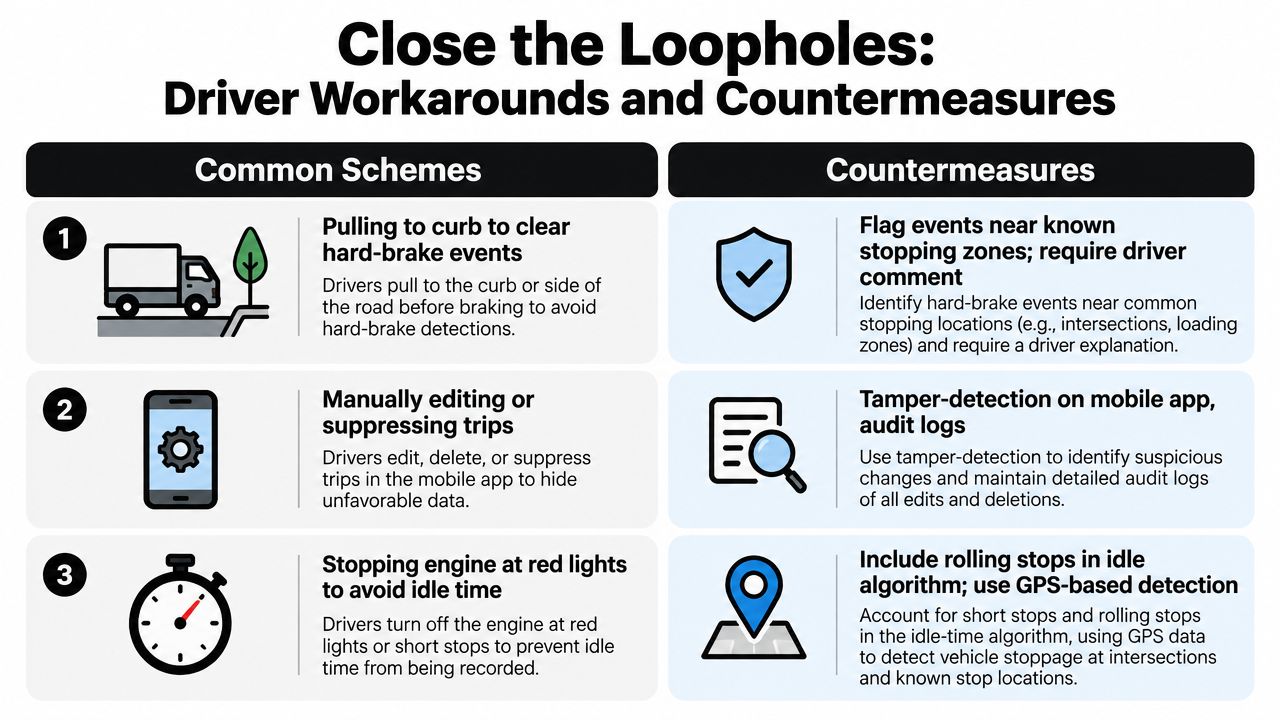
The policy should also distinguish deliberate tampering from equipment failure. A dead device, a truck swap, or a poor GPS signal deserves correction and documentation, not an automatic fraud finding. A driver appeal process protects the program's credibility because drivers need a fair way to challenge an event that the data got wrong.
Communication helps here. Use short dispatch messages, recurring reminders, and clear examples of what counts as a reportable issue. If your operation uses high-ROI text marketing campaigns for internal reminders, keep the messages factual and link them to the full policy rather than reducing safety to a leaderboard notification.
Launching, Communicating, and Measuring the First 90 Days
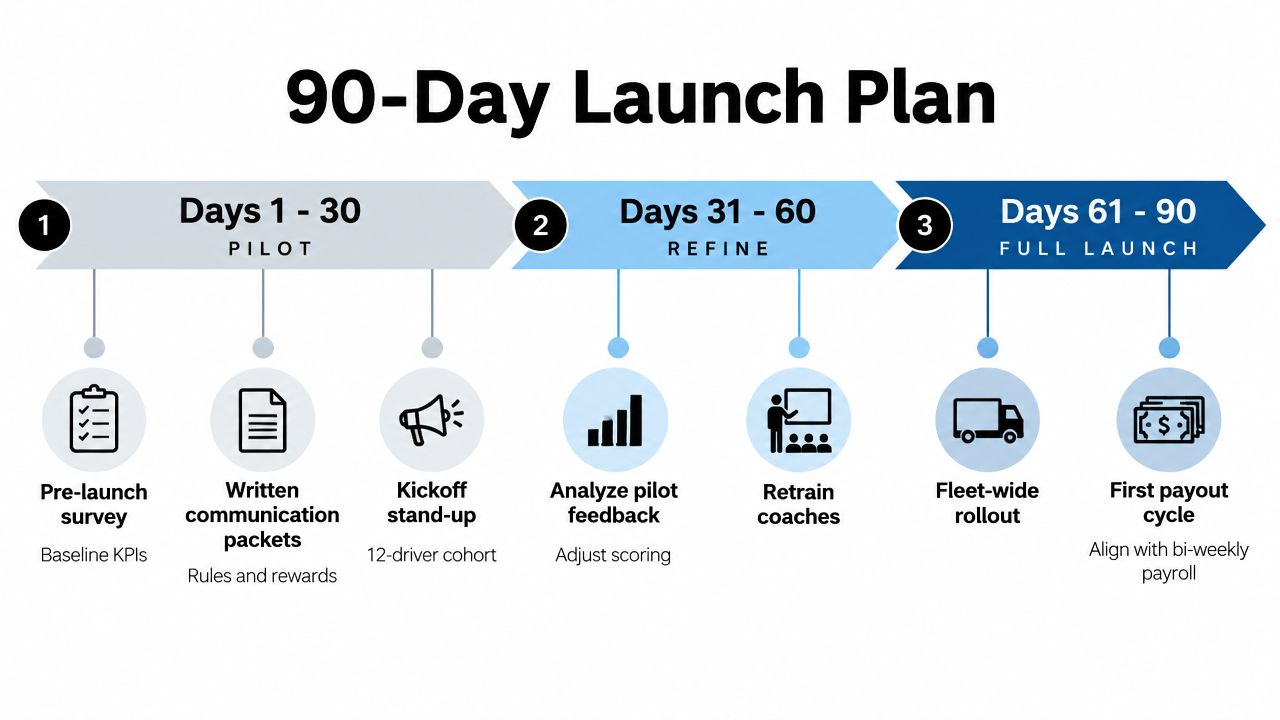
A pilot should be large enough to expose route and driver differences, but small enough for the safety lead to review every exception. A 12-driver cohort gives the team a controlled starting group for the first 30 days, provided the fleet records route assignments, vehicle changes, baseline events, near misses, coaching activity, and driver feedback before the first score is published.
Start with a written packet. It should show the KPIs, formulas, exclusions, appeal path, qualifying period, payout calendar, and examples of events that require coaching rather than punishment. Add a pre-launch survey that asks drivers whether they understand the rules, trust the data, and believe the rewards reflect the work.
Days 1 through 30
Hold a kickoff stand-up with the cohort, dispatcher, supervisor, and safety lead. Demonstrate a sample score from raw event through review, then explain how a driver can dispute a record. Send a weekly scorecard email showing current points, verified events, excluded events, and the next coaching action.
Schedule a mid-cycle check-in for every driver trending below the threshold. The conversation should focus on one or two observable behaviors, such as approach speed at yards or following distance, and should end with a documented action.
At the end of the cycle, recognize safe reporting and improvement, not just the highest score. A certificate can read, “Recognized for consistent hazard reporting and completed coaching actions during the pilot period.” A text reminder can say, “Your weekly scorecard is available. Review verified events and submit any appeal before the stated deadline.” A bulletin-board notice can list the cohort's most improved drivers without displaying sensitive personal details.
Days 31 through 60
Use pilot feedback to adjust confusing definitions, data-cleaning rules, and reward choices. Retrain supervisors who apply the policy inconsistently. The 60-day expansion gate should require evidence that the telematics feed is stable, drivers understand the score, appeals receive consistent treatment, and the reward isn't encouraging rushed work or underreporting.
Days 61 through 90
Expand only after the gate passes. Track three dashboards from the first week:
- Per-driver KPI trends: Show score movement, verified events, coaching completion, and route context.
- Cohort economics: Compare reward payouts with changes in crash and claim indicators, while recognizing that a flat crash rate can still accompany better reporting and coaching.
- Early warnings: Flag coached-event clusters, route or vehicle cherry-picking, telematics gaps, and reward complaints.
At day 90, audit feed health, payout fairness, rule comprehension, appeal outcomes, and driver NPS. A short review with operations, payroll, HR, and drivers will reveal problems that a dashboard can't.
A practical rollout also benefits from a short training video that supervisors can use during the kickoff and refresher sessions.
A One-Page Implementation Checklist for Safety Leaders
A COO shouldn't have to decode a reward spreadsheet to understand the decision. Put the implementation plan on one page, assign an owner to every item, and make the approval conditions visible.
Pre-launch
- Finalize KPIs: Define the safety score, thresholds, exclusions, review rules, and the behaviors the fleet wants to reinforce.
- Lock the data feeds: Verify telematics, ELD, dashcam, dispatch, fuel-card, and HRIS connections before scoring begins.
- Review wage rules: Ask employment counsel or HR to review state wage-and-hour treatment for W-2 incentive pay, overtime interaction, payroll timing, and deductions.
- Set the budget envelope: Model the maximum payout, administrative time, recognition costs, and contingency for disputed records.
- Write the communication kit: Include the policy, FAQ, sample scorecard, appeal process, and examples of reportable near misses.
Launch
- Select the pilot cohort: Use a representative group rather than only the safest or most experienced drivers.
- Run the kickoff: Explain why the program exists, how data is cleaned, what coaching looks like, and how the company protects honest reporting.
- Publish the calendar: State scorecard dates, review deadlines, payout dates, and recognition moments.
- Review the first dashboard: Operations, safety, payroll, and HR should inspect the same approved data and resolve exceptions together.
Sustain
- Audit the rules quarterly: Look for zero-event clusters, route assignment differences, device gaps, login overlap, and unusual appeal patterns.
- Recalibrate KPIs annually: Retire measures that no longer reflect preventable risk, and add measures that drivers can influence without rushing.
- Benchmark responsibly: Compare trends with relevant peer operations only when route mix, vehicle type, and data definitions are sufficiently similar.
- Maintain an appeal path: Document who reviews disputed telematics events, what evidence they use, and when the driver receives a decision.
- Pair every reward with coaching: Recognition should reinforce a conversation about the behavior, not replace it.
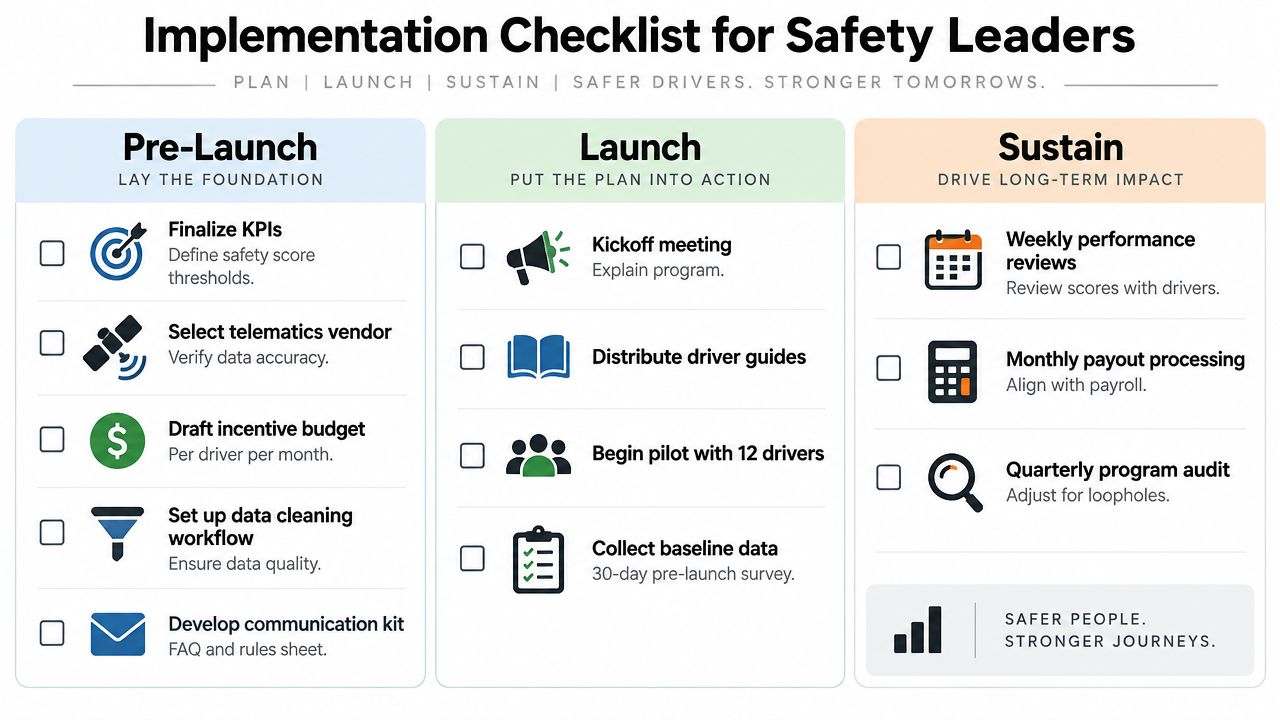
Three guardrails deserve leadership approval before launch. Never tie more than 20% of total compensation to a single metric, always pair rewards with coaching, and require independent data-source validation before a payout clears. These rules limit the pressure to chase one number and give the safety team a defensible process when data, pay, and driver behavior conflict.
For fleets that want to connect incentive design with dependable overnight execution, Peak Transport offers structured middle-mile box-truck operations, documented dispatch processes, W-2 driver employment, and safety-focused performance practices. Visit Peak Transport to discuss reliable transportation partnerships or career opportunities in the Minneapolis, St. Paul area.