How Does 401k Company Match Work: A Clear Guide
Learn how does 401k company match work, from common match formulas and vesting schedules to real dollar examples and tips for capturing every dollar your
October 13, 2026
A 401(k) company match is employer money added to your retirement account based on a percentage of your own contributions. The amount you keep if you leave depends on the plan's vesting schedule.
You might be looking at a new W-2 driving or warehouse job, comparing benefits between employers, or checking a pay stub and wondering why the retirement deduction is smaller than the company's promised contribution. The phrase “401(k) with company match” sounds simple, but three separate rules determine its value: the match formula, the timing of deposits, and vesting.
For a logistics worker, that distinction matters. A match can add meaningful money to retirement savings, but an account statement can show employer dollars that aren't fully yours yet. The practical question isn't only, “What percentage does the employer match?” It's also, “How much must I contribute, when will the employer deposit it, and how much can I take with me if I change jobs?”
What a 401(k) Company Match Actually Is
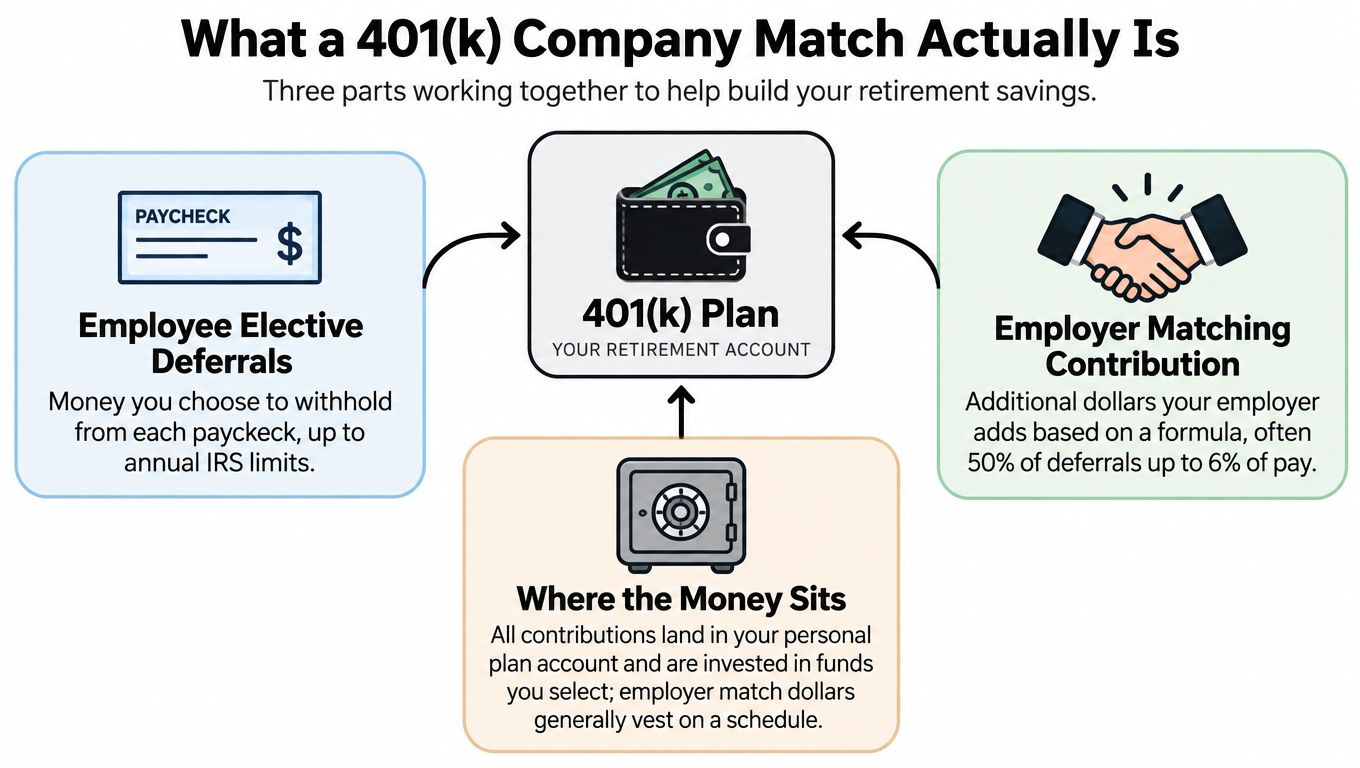
You start a warehouse or driving job, choose to save part of each paycheck, and then see a second contribution appear in your retirement account. That second deposit is the 401(k) company match, employer money tied to your own salary deferrals.
Your contribution is an elective salary deferral. Payroll withholds the percentage you select and sends it to the 401(k), usually before you receive your paycheck. The employer contribution is separate. It does not replace your deduction, lower the amount you save, or increase your take-home pay.
Consider a plan that matches 50% of your contributions up to 6% of pay. With $60,000 in annual pay, contributing at least 6% means you defer $3,600. The employer adds up to $1,800, which equals 3% of your pay. The $3,600 came from your wages; the $1,800 came from the employer under the plan's rules. That distinction matters if you later compare the account balance with the amount you can keep after leaving.
The money's path from paycheck to account
The process usually follows four steps:
- You elect a contribution rate. Payroll withholds the selected percentage from your wages.
- The plan receives your deferral. Your contribution enters your individual 401(k) account.
- The employer calculates its match. The plan applies its formula to eligible pay and your deferrals.
- Both amounts are invested. Contributions generally follow the investment choices you make.
Eligible compensation may differ from your regular hourly rate. Overtime, bonuses, shift differentials, and other pay may or may not count, so read the Summary Plan Description rather than relying on a recruiting headline.
Matching is common, though plans do not all offer it. Approximately 87% of defined-contribution plans with more than 100 participants offered a match in 2023, and Vanguard reported matching in roughly 95% of the plans it administered in 2023, according to Vanguard's 2023 plan-sponsor research on matching prevalence. If you are comparing a W-2 logistics role, review transportation and logistics salaries alongside the retirement benefit.
The headline match is only part of the decision. Check the formula, deposit timing, eligible pay, and vesting rules before treating employer dollars as money you will definitely take with you. If you change jobs, you can also find 401k rollover guides to compare possible next steps.
Common Match Formulas and How the Math Works
A match formula has two parts: how much of each dollar the employer contributes, and how much of your pay is eligible for that match. The phrase “matches 50% up to 6%” doesn't mean the employer contributes 6% of your pay. It means the employer contributes half of your deferrals, counting only deferrals up to 6% of pay.
Assume an annual salary of $60,000.
Formula one, 50% up to 6% of pay
Six percent of $60,000 is $3,600. If you contribute at least that amount, the employer contributes 50% of it, or $1,800.
If you contribute only 3%, your deferral is $1,800 and the employer match is $900. If you contribute 10%, your own retirement savings increase, but the employer match generally remains capped at $1,800 because the plan only matches the first 6% of pay.
Formula two, 100% up to 3% of pay
This formula matches your first 3% dollar for dollar. On a $60,000 salary, you need to contribute $1,800 to receive the full employer contribution of $1,800.
Contributing above 3% still builds your account, but it doesn't increase the match under this formula. A worker who contributes 5% saves more personally than a worker who contributes 3%, while both receive the same employer amount.
Formula three, 100% on the first 3% plus 50% on the next 2%
This two-tier formula requires 5% employee contributions to capture the full match. The first 3% produces a dollar-for-dollar contribution, and the next 2% produces a contribution equal to half of that second tier.
For the $60,000 example, you defer $3,000 and receive $2,400 from the employer. The Department of Labor presents this same calculation for the formula, with the employer contribution equal to 4% of pay (Department of Labor).
| Match Formula | Employee Contribution Needed | Employer Contribution Received | Notes |
|---|---|---|---|
| 50% up to 6% of pay | $3,600, or 6% | $1,800, or 3% of pay | Contributions above 6% generally don't increase the match |
| 100% up to 3% of pay | $1,800, or 3% | $1,800, or 3% of pay | The employer matches the first 3% dollar for dollar |
| 100% on first 3%, then 50% on next 2% | $3,000, or 5% | $2,400, or 4% of pay | The full match requires reaching both tiers |
Read the formula from left to right. First identify the contribution percentage you need to receive every available employer dollar. Then set your payroll election at that percentage, provided the deduction fits your budget.
Vesting Schedules and What You Actually Keep
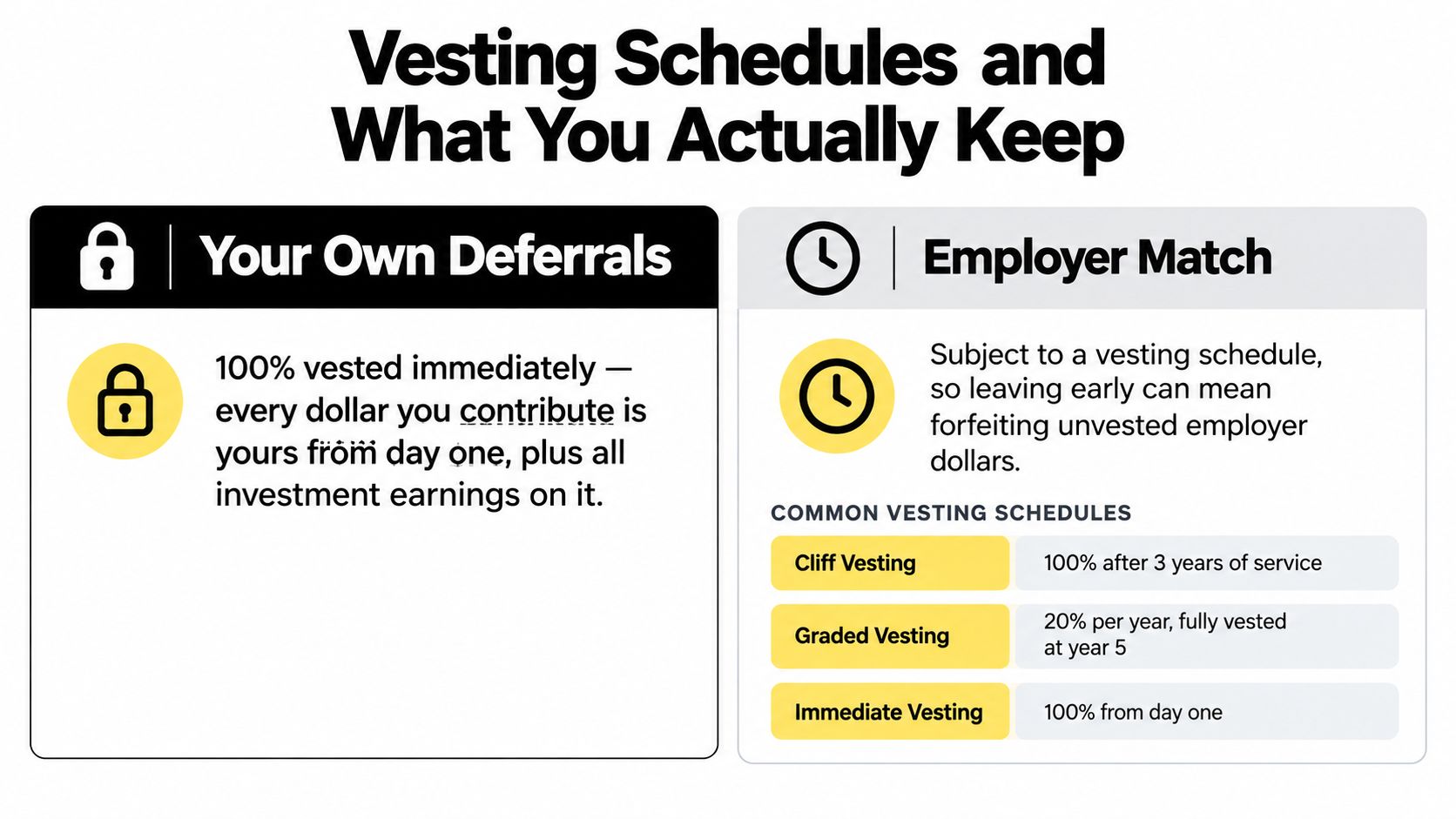
The most important distinction after the formula is vesting. Your own elective salary deferrals are generally 100% vested immediately, which means you don't lose those contributions when you leave. Employer matching dollars may follow a vesting schedule, so the amount shown in your account can be larger than the amount you ultimately keep.
A vested balance belongs to you. An unvested employer contribution is conditional on meeting the plan's service requirements. If you leave before the required point, the plan can forfeit the unvested portion, while your own contributions and their associated investment gains or losses remain yours.
The two common schedules
Under a three-year cliff schedule, none of the employer match becomes vested until you complete the required three years of service. At that point, the entire eligible employer balance becomes vested.
Under a six-year graded schedule, ownership increases over time. The IRS describes a schedule rising from at least 20% after two years to full ownership after six years (IRS 401(k) qualification requirements).
| Years of Service | Three-Year Cliff | Six-Year Graded |
|---|---|---|
| Less than 2 years | 0% | 0% |
| 2 years | 0% | At least 20% |
| 3 years | 100% | At least 40% |
| 4 years | 100% | At least 60% |
| 5 years | 100% | At least 80% |
| 6 years | 100% | 100% |
Someone at month 18 usually hasn't reached the two-year point under the common graded schedule and hasn't reached the cliff vesting milestone either. But the exact service-year definition matters. Plans may count service using rules stated in the plan documents, and rehire treatment can affect the result.
Why safe-harbor wording matters
Some safe-harbor arrangements generally require employer contributions to be immediately 100% vested. Certain automatic-enrollment safe-harbor arrangements can permit vesting after no more than two years. Don't assume either rule applies to your plan. Look for the specific vesting language in the Summary Plan Description.
Practical rule: Treat the match percentage as potential money until you've checked the vesting schedule.
Vesting can affect a job-change decision, but it shouldn't be the only factor. Compare the money you can keep with wages, schedule stability, healthcare costs, commute, and the likelihood that you'll remain employed long enough to reach the next vesting milestone.
A Worked Example Across Three Years on the Job
Take a worker earning $50,000 who contributes 3% of pay to a plan with a dollar-for-dollar match up to 3%. The worker contributes $1,500 each year, and the employer adds $1,500 each year, assuming the worker meets the plan's eligibility and allocation rules. The Department of Labor's retirement guidance uses this same dollar example when explaining how vesting affects ownership (Department of Labor retirement guidance).
After three plan years, the account contains the worker's own $4,500 in contributions and the employer's $4,500 in matching contributions, before considering investment gains or losses. Under a three-year cliff schedule, leaving after completing the required third year can make the employer-funded balance fully vested.
Leaving after year two creates a different result. The account statement may show $3,000 from the worker and $3,000 from the employer, but the employer balance could be entirely unvested under a three-year cliff. The worker takes the $3,000 of personal contributions, adjusted for investment performance, while the unvested employer amount may be forfeited.
That is the difference between an account balance and a portable balance. The first reflects money currently recorded in the account. The second reflects the portion you own under the plan rules.
The same worker under six-year graded vesting would own at least 20% of the employer balance after completing two years. On $3,000 of employer contributions, that would represent at least $600 of vested employer money, before investment gains or losses. The remaining employer amount would still be subject to the schedule.
The comparison isn't an argument that one schedule is always better. Cliff vesting may give you nothing from the employer contribution before the milestone, then everything after it. Graded vesting gives you partial ownership earlier, but it can take longer to reach full ownership. Check the plan's definition of service before making a decision based on a statement balance.
Payroll Timing, Tax Treatment, and 2026 Contribution Limits
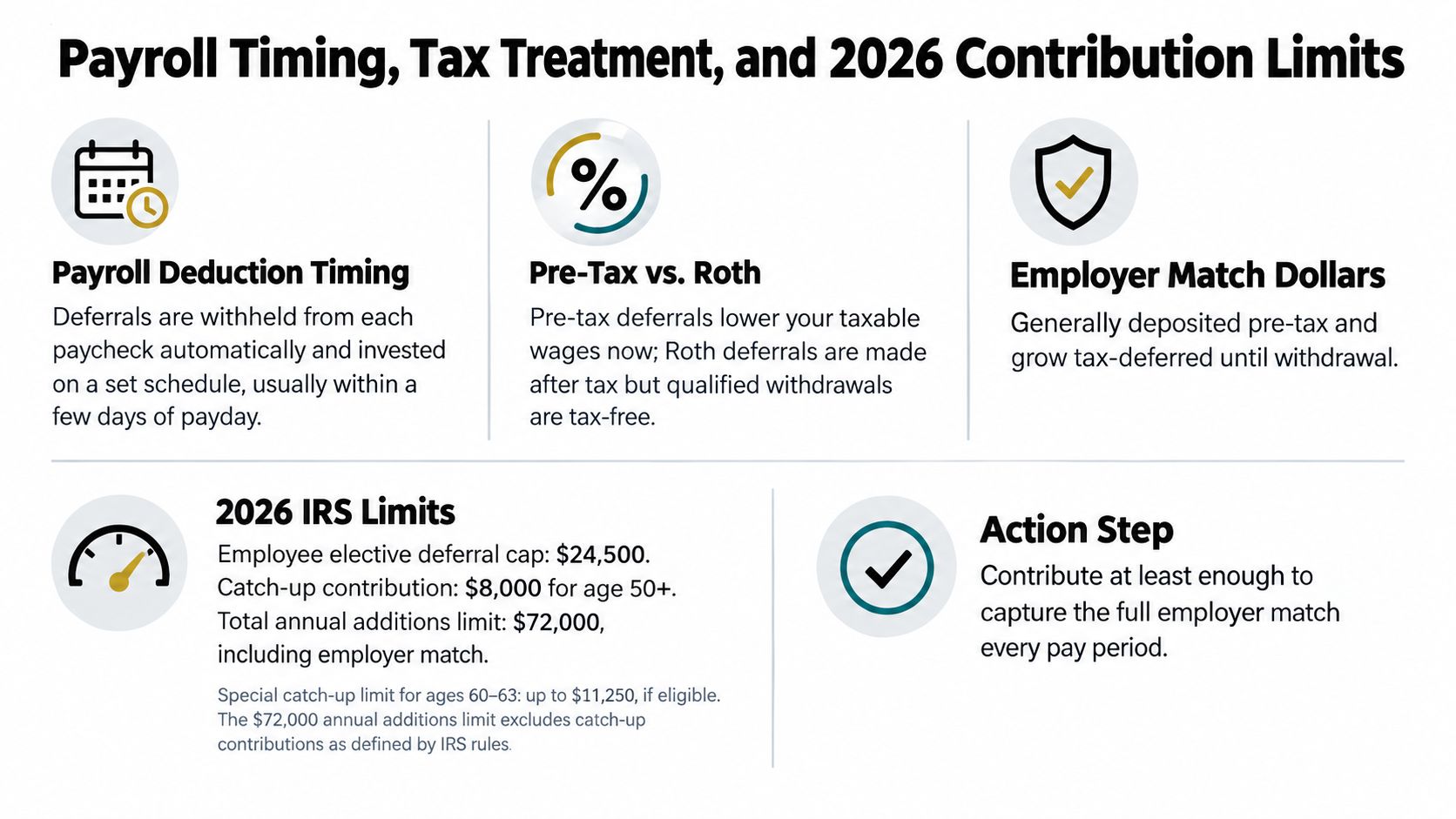
Your contribution begins as a payroll election. Each paycheck sends the selected amount into the 401(k), reducing current take-home pay. The tax effect depends on whether you choose a traditional pre-tax contribution or a Roth contribution.
A pre-tax deferral generally reduces taxable wages now, while taxes are generally paid later when money is withdrawn. A Roth deferral is made after tax, so it doesn't reduce current taxable wages, but qualified Roth withdrawals can be tax-free. Employer match dollars are generally deposited on a pre-tax basis and grow tax-deferred until withdrawal. For a broader explanation of the traditional and Roth choice, The Money Maniac explains 401(k) choices.
Why payroll timing can change the result
Some plans calculate the match each paycheck. If your contribution percentage falls during a week with unexpected fuel, rent, medical, or vehicle expenses, that paycheck may produce a smaller match. A worker who contributes heavily early in the year and then stops after reaching the employee limit can also stop receiving matching deposits if the plan doesn't reconcile the calculation annually.
Other plans use an annual calculation or provide a year-end true-up. A true-up compares what you received during the year with what the full-year formula says you earned, then deposits an additional amount if the plan provides for it. The plan document controls whether a true-up exists.
Your first-week enrollment checklist should include:
- Confirm eligibility: Find the date you can begin contributing and receiving any match.
- Read the formula: Identify the percentage of pay you must contribute to capture the full employer amount.
- Ask about timing: Confirm whether matching is calculated per paycheck or reconciled annually.
- Review eligible pay: Check whether overtime, bonuses, and differentials count.
- Choose investments: Confirm that both your deferrals and employer contributions are invested according to your elections.
- Check your payroll setup: Make sure the selected percentage appears correctly on your pay statement.
The Department of Labor states that for 2026, the employee elective-deferral limit is $24,500 for most participants, while the combined employee-and-employer contribution ceiling is generally $72,000 or 100% of compensation, whichever is lower (Department of Labor 2026 limits). The employer match doesn't reduce your separate employee deferral limit, but it does count toward the combined ceiling.
If you're also reviewing wage records, deductions, and payroll classifications at a transportation employer, Peak Transport's wage and hour compliance information provides related workplace context.
Balancing the Match Against Real-Life Cash Flow
A full match can look like free money on a benefits sheet. For a driver, though, the same paycheck may need to cover a truck repair, fuel, rent, or a medical bill. A warehouse worker may need cash available between paydays. The right contribution rate is the one that captures valuable employer money without leaving the household unable to handle the next bill.
Vanguard reported that 37% of U.S. adults lacked enough cash for a $400 emergency, while 45% of surveyed 401(k) participants had less than $2,000 in emergency savings (Vanguard emergency savings research). Participants with emergency savings contributed more to retirement accounts and made fewer withdrawals in the same research. Accessible cash and retirement saving can reinforce each other.
Use this order as a starting point:
- Capture the full match if the deduction is affordable. Set your contribution at the percentage required by the formula.
- Build a starter emergency reserve. Keep money available for a near-term problem instead of relying on a retirement withdrawal.
- Raise the retirement rate gradually. Increase contributions after your schedule, pay, or household cash flow becomes steadier.
Employer matches also vary. Vanguard's How America Saves 2025 match analysis reported an average promised match of 4.6% of pay in 2024, a median of 4.0%, and formulas ranging from 3% to 6.99% of pay (Vanguard's How America Saves 2025 match analysis). Your plan may offer more or less. Its vesting rules determine how much of that employer contribution you keep if you leave.
Healthcare deductions affect the same decision. Review health insurance for truck drivers with the retirement plan, since the affordable match contribution depends on the whole paycheck.
How to Capture Every Dollar of Your Match
Start with the Summary Plan Description, not the job advertisement. Find the eligibility date, eligible compensation definition, match formula, payroll frequency, vesting schedule, service-year definition, and true-up language.
The plan document contains the governing provisions, while the quarterly statement helps you confirm what has been deposited and how much employer money is vested. If the statement shows an account balance without a clear vested balance, ask the plan administrator for clarification.
Use this first-90-days process:
- Set the initial election: Choose at least the percentage required to receive the full match, if your budget allows.
- Verify the first deposit: Compare your pay statement with the 401(k) account after the first matching cycle.
- Test the timing rule: Ask whether a fluctuating contribution rate can reduce the match and whether the plan provides an annual true-up.
- Review your cash flow: Set a contribution target that you can maintain through slower weeks and unexpected expenses.
- Schedule an annual check: Confirm your vested percentage, total employer deposits, and remaining contribution capacity.
Watch for a long eligibility waiting period, per-paycheck calculations without a true-up, or graded vesting that takes six years to reach full ownership. Those details don't make the benefit worthless, but they change its practical value.
Peak Transport offers W-2 box-truck driver positions with consistent overnight routes, paid training, health insurance options, and a 401(k) with company match. If you're looking for structured middle-mile work in the Twin Cities and want to review the full benefits picture, visit Peak Transport.