Logistics Documentation: Mastering Middle-Mile Operations
Master logistics documentation for middle-mile operations. Learn essential documents, Amazon Relay compliance, record-retention rules, and driver workflows.
September 21, 2026
Documentation errors hit the budget fast. A wrong freight class can cost about $1,200, an incorrect weight declaration about $800, and missing hazmat classification $15,000+, so document precision is an operating control, not office busywork (bill of lading error cost examples).
If you're running overnight middle-mile routes, you already know the feeling. It's 2 AM, the truck is at the gate, the driver is tired but still on plan, and then the dock clerk spots a mismatch between the load details and the paperwork. Nobody cares that the route was clean up to that point. The load sits, the delivery receipt doesn't get signed the way dispatch expected, and your driver burns time doing phone-tag instead of turning to the next stop.
That is what logistics documentation looks like in real life for Amazon Relay and box-truck operations. It isn't theory. It isn't just a compliance binder in a back office. It is the handoff system that keeps freight moving between facilities, protects claims when freight arrives damaged, and keeps dispatch from rebuilding a route in the middle of the night.
Middle-mile work exposes every weak process because the timing is tight and the windows are unforgiving. On overnight lanes, paperwork mistakes don't wait until month-end to hurt you. They show up at check-in, at unload, at closeout, and later when finance tries to reconcile what happened.
Why Documentation Accuracy Defines Middle-Mile Success
At 2:07 AM, a box truck reaches the gate on time, the driver has the route loaded in Relay, and dispatch expects a quick handoff. Then the receiver compares the shipment details to the paperwork and finds a mismatch. The truck is parked, but the load does not move. One bad field is enough to turn an on-time overnight run into a delay, a missed follow-on appointment, and a shift full of avoidable calls.
That is why documentation accuracy decides whether middle-mile runs stay profitable.
For Amazon Relay carriers and other overnight box-truck operations, paperwork is part of execution. If the BOL, delivery receipt, facility reference numbers, piece count, or weight details do not match what the dock expects, the driver becomes the person standing still while dispatch tries to sort out facts that should have been confirmed before departure. On a daytime route, that may cost some flexibility. On an overnight lane with tight appointment windows, it can break the rest of the schedule.
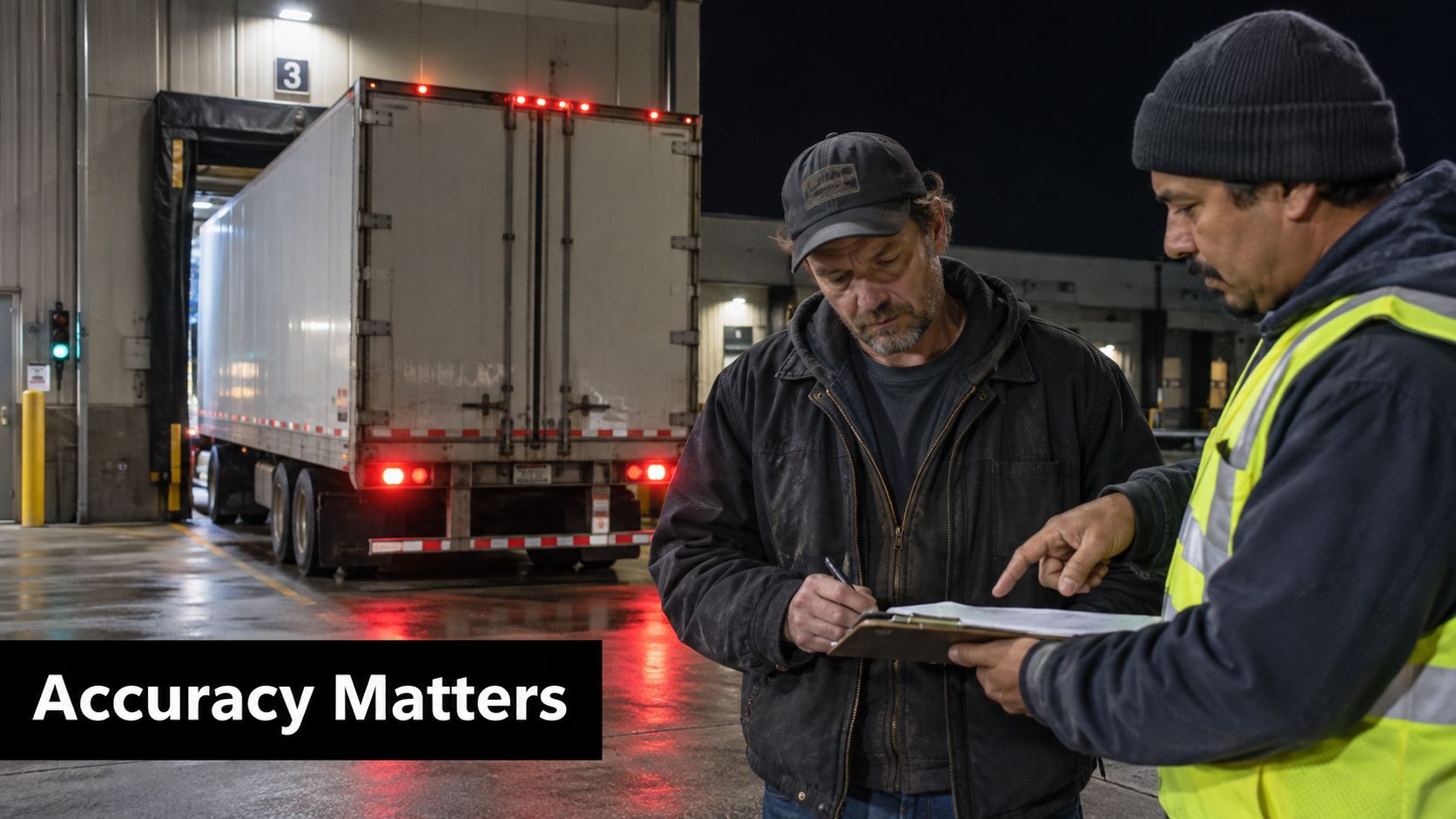
What actually breaks when the document is wrong
The failure usually starts with something small. A wrong consignee name. A piece count that does not match the freight on the floor. A hazmat field left blank. A driver arrives with a paper packet that says one thing and a digital load record that says another.
In middle-mile work, those are not back-office errors. They change how the facility handles the truck.
On Amazon Relay freight, bad documentation often causes four immediate problems:
- Check-in delays: Gate or dock staff stop the handoff until someone confirms what the load is.
- Driver detention: The driver waits on site while dispatch, the shipper, or the broker corrects missing or conflicting details.
- Broken route sequencing: One held load pushes the next stop late, especially on multi-stop overnight runs.
- Weaker claims support: If freight shows up short or damaged, unclear records make it harder to prove condition and custody.
Facility teams notice patterns fast. Carriers that arrive with clean paperwork usually get through the conversation faster. Carriers that show up with recurring errors create more scrutiny on every visit.
Practical rule: If a document field can stop a load at the gate or delay a signature at unload, it belongs on the same pre-departure check as lights, securement, fuel, and route notes.
Why drivers care as much as dispatch
New office staff sometimes treat documentation like an admin task that starts after pickup and ends at billing. Drivers on overnight routes know better. They are the ones standing at the window when the reference number is wrong, when the delivery receipt is missing a signature line, or when the dock lead asks why the paperwork shows a different quantity than the freight in the box.
Paper and digital records both matter here. Many middle-mile carriers run a hybrid workflow because that is what the job requires. The driver may check load details in an app, carry a printed packet for the facility, text photos back to dispatch at pickup, and still need a wet signature before closeout. If those records do not match, the problem does not stay in one system. It follows the load through pickup, linehaul, delivery, and billing.
The better overnight operations train drivers and dispatchers to treat documentation as part of load control. Clean records protect time, reduce arguments at the dock, and give the office a usable trail when something goes wrong.
The Core Components of Logistics Documentation
Middle-mile documentation works best when you treat it like information architecture. Every document tells the next party what the freight is, who has custody, what condition it was in, and what should happen next. If one part is missing or vague, the whole handoff gets softer.
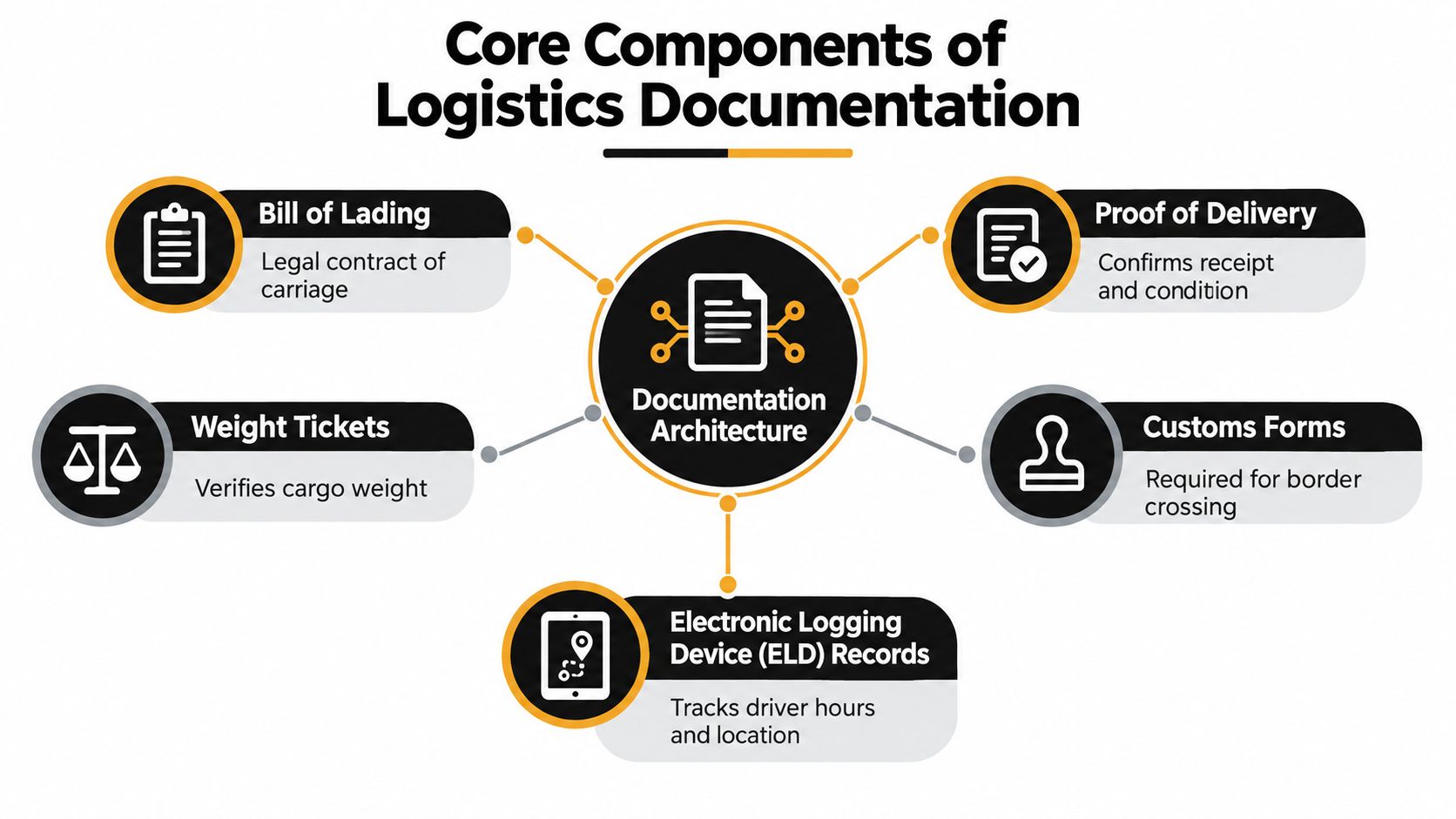
Three groups that matter on middle-mile routes
For overnight box-truck work, most logistics documentation falls into three practical buckets:
| Document group | What it does in operations | Typical examples |
|---|---|---|
| Transport records | Authorizes and describes the movement | Bill of lading, freight bill, delivery receipt |
| Compliance records | Proves the load can legally move as tendered | Hazmat paperwork, weight ticket, facility instructions |
| Operational records | Shows what actually happened during execution | POD, timestamped photos, ELD events, dispatch notes |
That breakdown keeps teams from making a common mistake. They focus only on the bill of lading and forget the records that prove condition, timing, and custody.
Chain of custody matters more than document count
The strongest claims file is not the biggest file. It is the clearest chain of custody. Claims are strongest when the record includes the bill of lading, delivery receipt, signed inspection forms, timestamped photos or video, and supporting WMS or TMS event logs. In practice, the most useful evidence is time-ordered and machine-verifiable, including device timestamps, GPS traces, sensor logs, and inventory records showing when custody changed (data-backed cargo damage documentation and claims evidence).
That matters for middle-mile because box-truck routes often involve quick handoffs with limited dock conversation. If freight shows damage later, the team that can show a clean pickup photo, a sealed handoff, and a documented unload condition is in a much better position than the team relying on memory.
The goal is to turn a dispute into a sequence of recorded events, not an argument between two stressed people after sunrise.
What each document is really signaling
A bill of lading is not just freight details. It signals what was tendered.
A delivery receipt is not just a signature line. It signals whether the receiving party accepted the freight clean, accepted it with exceptions, or refused part of it.
An ELD event log is not just a compliance artifact. It can support timing when dispatch needs to show arrival, delay, dwell, or route deviation tied to a handoff problem.
Operators who understand these signals build tighter processes. Operators who treat documents as isolated forms usually end up improvising when something goes wrong.
Essential Documents for Overnight Box-Truck Routes
Most overnight box-truck failures are predictable. The load moves without the right version of the paperwork, nobody notices until the handoff, and then the driver gets stuck proving basic facts that should have been settled before departure.
For Amazon Relay and similar middle-mile lanes, every driver and dispatcher should know which documents are mandatory, who owns them, and what a clean version looks like.
Pickup-side documents
Start with the bill of lading. It needs to match the actual shipment being loaded. Shipper and consignee details, commodity description, piece count, weight, special handling, and any hazmat information have to line up with the freight on the truck. If the document is vague, dispatch should correct it before the vehicle leaves the origin.
Then check any appointment and facility instructions tied to the route. On Amazon Relay work, facility-specific check-in notes matter because the driver may need a reference number, scheduled appointment confirmation, or exact load handling instructions to get processed without delay. If your system stores these separately from the BOL, bundle them into the same driver packet.
A practical pickup packet usually includes:
- Primary movement record: The current bill of lading, not yesterday's version and not a draft.
- Facility access details: Appointment confirmation, gate notes, reference numbers, and check-in instructions.
- Exception tools: A standard way to record overages, shortages, seal problems, or visible damage before departure.
In-transit and delivery-side documents
The next critical document is the delivery receipt. Many teams get lazy, especially on overnight routes when everyone wants a fast unload and a fast release. Don't accept an unreadable scribble if the load had an issue. If there is damage, shortage, or a count exception, it needs to be written clearly at delivery.
The proof of delivery, or POD, should close the loop. Depending on the workflow, that may be a signed paper receipt, a scanned copy, or a digital capture in a mobile app. What matters is that the final record is legible, timestamped, and tied to the right stop.
If the route includes regulated freight, the hazmat paperwork must travel with the load and match what is on board. If the operation relies on weight-controlled facilities or the commodity tends to trigger questions, a weight certificate or supporting weight record should be accessible to dispatch and the driver.
What drivers should confirm before they move
A good pre-departure document check is short enough to use at 1 AM and strict enough to prevent rework:
- Match the load to the BOL: Piece count, commodity description, destination, and special handling.
- Confirm stop sequence: Make sure the driver has the right appointment and facility notes for each leg.
- Check signature readiness: If there is an issue at pickup, note it before the wheels turn.
- Secure the closeout path: The driver should know exactly where to send PODs, photos, and exception notes after delivery.
If a team can't answer those four points consistently, the operation isn't document-controlled yet.
Compliance Requirements and Record-Retention Rules
Compliance on overnight routes sits in two lanes at the same time. One lane is regulatory. The other is contractual. A carrier can satisfy a facility enough to get unloaded and still have a weak file for an audit, a dispute, or an internal review.
That is why retention rules and storage discipline matter. If the document exists but nobody can retrieve it quickly, it may as well not exist.
Federal compliance and private-network expectations
Drivers and dispatchers usually feel the private-network rules first. Amazon Relay facilities, large distribution centers, and regional hubs often expect documents to be legible, complete, and available fast when exceptions happen. If a delivery receipt is missing, if a pickup exception isn't documented, or if route records are scattered across texts and personal phones, the operation looks unreliable even when the freight physically moved.
The regulatory side is different. It asks whether records are being maintained in the proper places, whether driver and equipment records are organized, and whether supporting documents can be produced during review. Peak's guidance on compliance documentation for middle-mile carriers is useful here because it frames recordkeeping as an operational retrieval problem, not just a legal requirement.
What to retain and how to store it
For box-truck operations, build retention around document families rather than random folders:
- Route execution file: BOL, facility instructions, appointment references, POD, delivery receipt.
- Exception file: Photos, delay notes, shortage or damage notation, communication log.
- Driver support file: Trip-related hours records, dispatch messages that changed execution, closeout confirmation.
- Load-specific compliance file: Hazmat and any other regulated movement support.
Use one naming convention and keep it boring. Date, route ID, stop, and document type. The teams that struggle most are usually creating records in five different places with three different naming habits.
Store documents where dispatch can retrieve them during a live issue, not just where accounting can find them two weeks later.
A simple review calendar
Most overnight carriers don't need a fancy system to start. They need cadence. Use a recurring internal review rhythm:
| Review point | What to check |
|---|---|
| Daily closeout | Missing PODs, unsigned receipts, unreadable scans |
| Weekly review | Repeat error types by driver, lane, or facility |
| Monthly audit | Retrieval speed, storage consistency, exception documentation quality |
That rhythm catches drift early. Compliance failures usually don't arrive as one dramatic event. They stack up as small retrieval and accuracy failures until someone external asks for proof.
Digitizing Your Documentation Workflow
The shift from paper to digital didn't start yesterday. The first major attempt to digitize bills of lading dates to 1983, and the commercial Bolero registry launched in September 1999, yet trade-document systems still face slow adoption because interoperability and legal recognition remain hard problems (history of electronic bills of lading and long-running adoption barriers). That long history matters because it explains why middle-mile carriers are still living in hybrid mode instead of flipping one switch and becoming paperless overnight.
Ocean shipping shows the same pattern at scale. Carriers issue about 45 million bills of lading each year, but electronic bills of lading were only 1.2% of total issuance in 2023 and roughly 5.7% by January 2025 in one industry estimate. In a separate survey, overall eBL adoption across respondents rose from 33.0% in 2022 to 49.2% in 2024, while dual-format use increased from 28.0% to 41.7%, which tells you the-world operating model is transition, not universality (shipping-industry adoption data for paper and electronic BOL workflows).
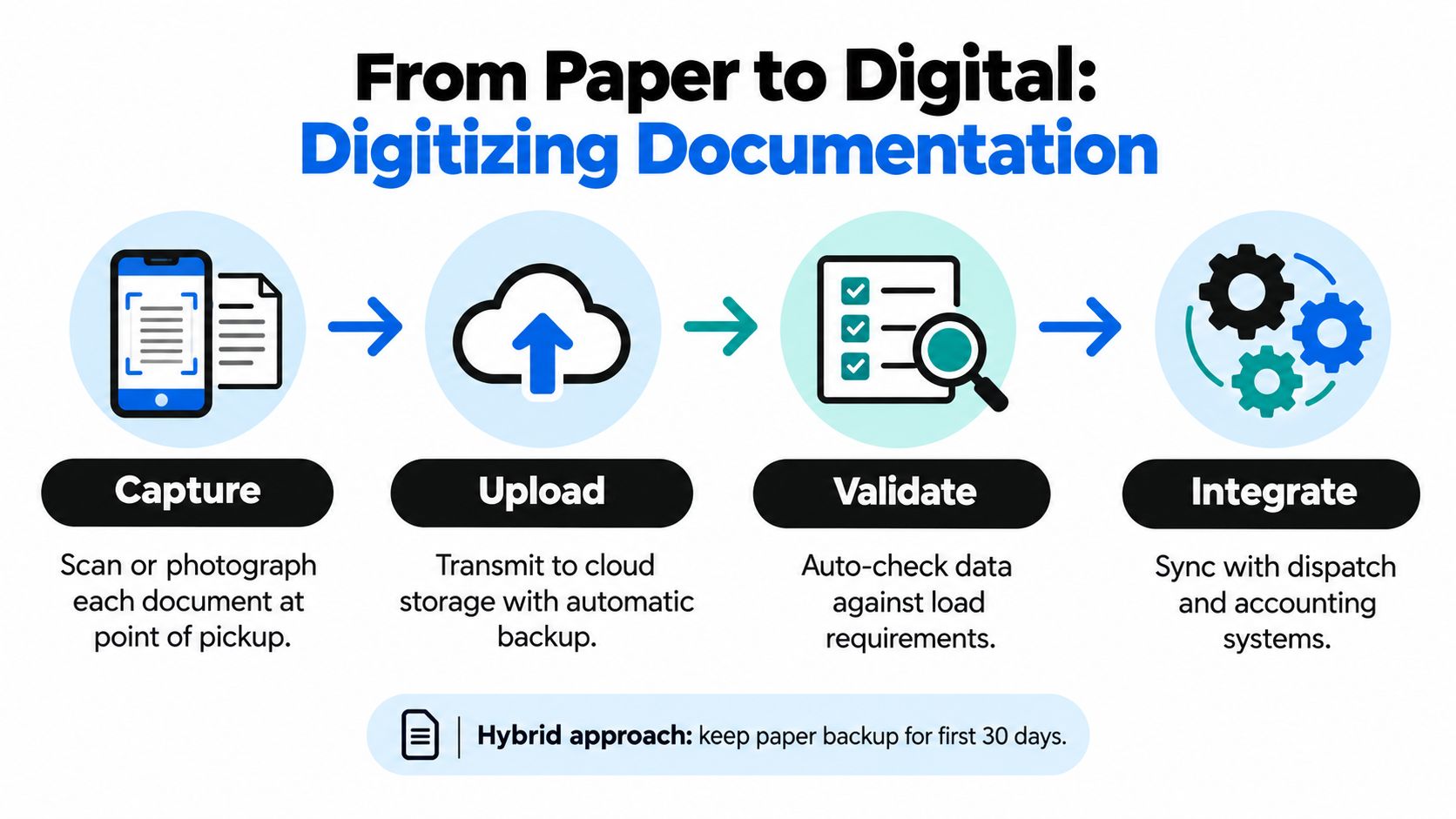
What hybrid looks like on an overnight box-truck lane
In middle-mile operations, hybrid usually means this: the shipper still hands over paper at pickup, the driver captures scans or photos on a phone, dispatch checks those images against route requirements, and the office stores both the image and any physical original required for backup or billing.
That workflow works if you standardize it. It fails when teams assume digital capture will fix a bad original. It won't. A blurry photo of an incomplete delivery receipt is still an incomplete delivery receipt.
For overnight routes, the practical stack is usually:
- Capture tool: Phone camera or scanning app that drivers can use in low-light dock conditions.
- Storage layer: Shared cloud folder or TMS attachment system with route-level access controls.
- Validation step: A dispatcher or automated rule checks whether the right documents are present before closeout.
- System handoff: Accounting, safety, and operations can retrieve the same record without asking the driver again.
A useful reference is Peak's article on digital record keeping for middle-mile logistics, especially for route-to-closeout retrieval discipline.
Here is a visual walkthrough of the workflow in action:
What works and what doesn't
What works is capturing at the point of handoff. The driver gets the signature, checks legibility, takes the image immediately, and dispatch confirms receipt before the truck is too far down the road to correct a problem.
What doesn't work is end-of-shift batching from memory. That is how teams lose sequence, forget exception notes, and mix one stop's photos into another stop's file.
If your digital process still depends on the driver remembering details hours later, it isn't digital control. It's delayed paperwork.
Templates, Checklists, and Process Flows
The best documentation templates are the ones night crews will use. That means short, repeatable, and tied to handoff points on the route. Fancy forms don't save middle-mile operations. Clear decision points do.
A paper-first workflow and a digital-first workflow can both work. The difference is usually in error prevention and retrieval speed.
Side-by-side workflow choices
| Workflow style | What it does well | Where it usually breaks |
|---|---|---|
| Paper-first | Easy for dock signatures, familiar to drivers and warehouse staff | Lost copies, unreadable handwriting, slow retrieval |
| Hybrid | Preserves paper when required and gives dispatch real-time visibility | Duplicate work if naming and upload rules are weak |
| Digital-first | Faster closeout, easier search, cleaner audit trail | Struggles if facilities still insist on physical originals |
For most Amazon Relay box-truck operations, hybrid is the realistic answer right now. Not because paper is better, but because the network around you may still expect it at some points in the route.
Field-ready checklists that actually help
Use three checklists instead of one giant packet:
- Pre-trip document check: Match route ID, pickup location, destination, appointment details, BOL version, and any special instructions.
- Handoff check: Confirm count, inspect visible condition, get a readable signature or exception notation, capture photos when needed.
- Route closeout check: Verify POD submission, attach exception notes, and confirm the file is stored under the right route name.
If you want to tighten the process further, connect documentation habits to your broader driver-facing admin workflows. Teams that already use structured HR and benefits checklists often adapt faster because they aren't asking people to learn discipline from scratch. That same mindset can help streamline benefits with Benely while reinforcing a culture of complete, auditable records.
One process flow to standardize this week
Pair your document checklist with your vehicle inspection routine. A clean way to do that is to add a documentation block to the same dispatch closeout rhythm you use for safety. Peak's truck inspection checklist guide is a good example of how structured checklists reduce missed steps when people are moving fast.
The main rule is simple. Don't leave document quality to memory. Put it on the same repeatable track as equipment checks and route release.
Best Practices for Accuracy and Driver Communication
Tight documentation comes from communication habits, not just better forms. If dispatch speaks loosely, drivers record loosely. If exception reporting is inconsistent, the file becomes inconsistent too.
The fix is operational discipline that drivers can follow under fatigue, time pressure, and dock noise.
Five practices that prevent most avoidable errors
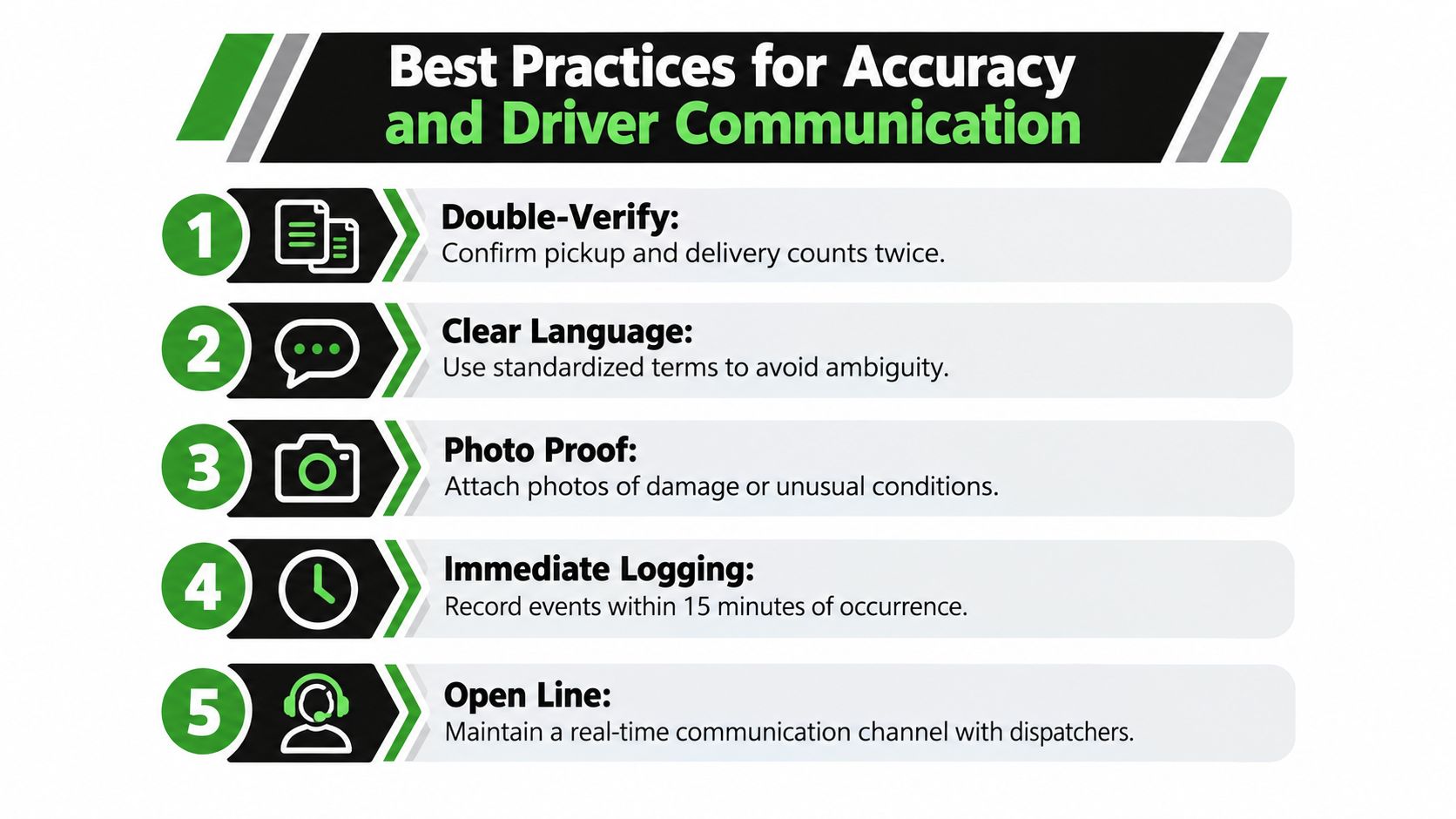
- Double-verify pickup facts: Drivers and dispatch should both confirm count, destination, and special handling before departure.
- Use standard language: Pick one term for each event type, such as refused, short, damaged, resealed, or overweight, and use it every time.
- Capture proof immediately: If the freight, seal, or unload condition looks wrong, take timestamped photos on the spot.
- Log events while they're fresh: Record the exception when it happens, not after the next stop.
- Keep one communication channel active: Drivers should know exactly where to send documents and who answers overnight when a dock pushes back.
A workable 30-day rollout
Week one, lock the naming convention. Every route file should look the same.
Week two, train drivers and dispatchers together, not separately. Most documentation problems happen at the handoff between those two roles.
Week three, audit closeouts from actual overnight runs. Check for missing signatures, unreadable scans, and weak exception notes.
Week four, review repeat issues by facility and by lane. If one location keeps producing the same paperwork problem, build a route-specific instruction instead of reteaching the entire fleet.
Clean communication beats heroic recovery. Most document disputes are preventable before the truck ever reaches the gate.
The teams that improve fastest don't chase perfection first. They remove ambiguity. They make it easy for a tired driver at 3 AM to know what to send, when to send it, and how to label it so the office can act on it fast.
Peak Transport runs Minnesota middle-mile box-truck routes with the kind of structured dispatch, route documentation, and compliance discipline this work demands. If you need a carrier or want to work for a team that takes documentation accuracy seriously because it protects on-time service, safety, and driver time, visit Peak Transport.