Logistics Risk Management for Overnight Box-Truck Routes
Learn logistics risk management for overnight box-truck operations: five risk types, a lane assessment framework, KPIs, and role-based actions.
October 24, 2026
The truck is ready, but the distribution center hasn't released the load. Dispatch can see the delay on a screen. The driver is waiting for instructions, the receiving facility is expecting an overnight arrival, and the next scheduled move still assumes an on-time handoff.
That's where logistics risk management has to become a decision, not another alert. Someone needs authority to revise the plan before the driver leaves, while there's still a safe, workable recovery option.
Why Overnight Middle-Mile Freight Needs Structured Risk Control
Consider a representative overnight box-truck lane between a distribution center and a regional hub. A late load release pushes departure beyond the planned window. The driver reaches the hub after the receiving team has reassigned the dock, and unloading now conflicts with the next outbound movement.
The receiving supervisor must choose between interrupting another load and holding the arriving truck. Either choice changes someone else's work. By morning, a staffing plan built around staggered arrivals may no longer match the freight waiting outside.
Manage the connection, not just the truck
Calling the driver for an updated arrival estimate doesn't resolve that conflict. Dispatch needs to know which connection remains feasible, whether the receiver can accept a revised arrival, and whether the driver can complete the changed assignment safely.
The useful unit of control is therefore the complete lane and its dependencies, not the vehicle's location. Treat a late release as a possible handoff failure, not merely an origin delay.
The World Bank's 2023 Logistics Performance Index evaluated 139 countries and reported an average container journey of 44 days, with a 10.5-day standard deviation, between export-port entry and import-port exit. Those international movements aren't benchmarks for a Minnesota overnight route, but they illustrate the distinction between average transit time and uncertainty around it.
Practical rule: Build the overnight promise around a repeatable operating window, not the fastest trip someone has completed.
Define what must remain predictable
For an overnight lane, predictability means knowing when freight will be ready, who accepts it, what constitutes a completed handoff, and what happens when the original plan becomes unworkable. A broader review can help you identify vulnerabilities across your supply chain, especially where a carrier's responsibility meets a facility's responsibility.
Start that review with concrete questions:
- Origin readiness: Who confirms the load is physically available, rather than merely tendered?
- Receiving commitment: Who can approve a changed arrival or alternate staging arrangement?
- Downstream dependency: Which scheduled movement depends on this freight arriving?
- Recovery boundary: When does saving the original commitment require an unacceptable safety or compliance compromise?
A structured process answers those questions before the night shift has to improvise. The objective isn't to eliminate every delay. It's to prevent a manageable exception from becoming an uncontrolled sequence of decisions.
The Five Risk Types Behind Every Overnight Run
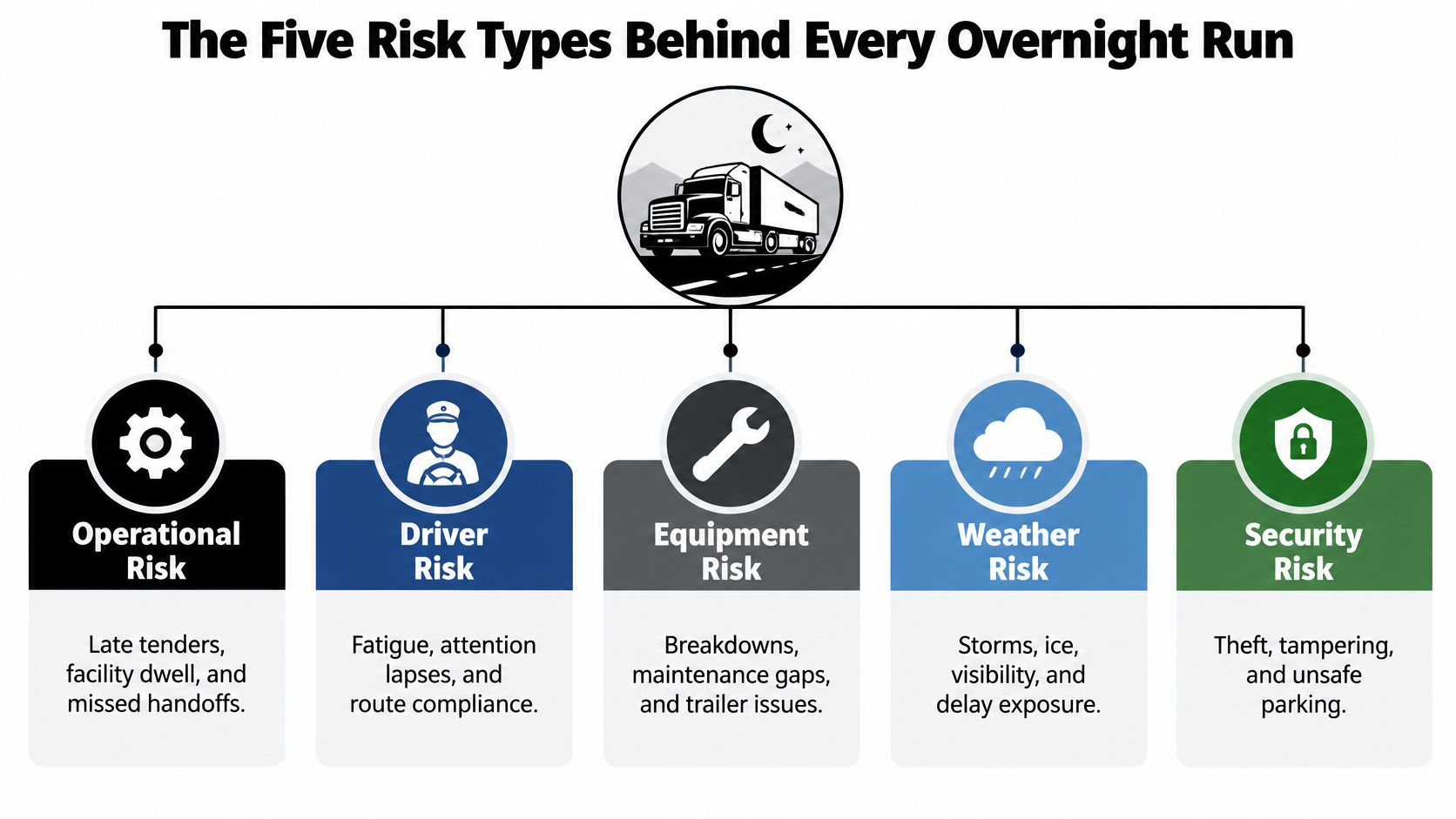
Use categories that tell dispatch which kind of intervention is needed. For lane management, separate operational, safety, compliance, capacity, and network disruption risk. These are working categories, not exclusive labels. A vehicle defect can create safety exposure, remove capacity, and threaten a downstream connection at the same time.
The diagram provides a hazard-level view of the same overnight operation.
Separate the trigger from the consequence
Operational risk begins when the planned work doesn't happen as expected. On a box-truck lane, that might be a late tender, an unavailable dock, or a load identifier that doesn't match the paperwork. The trigger is a broken process assumption, so the response usually starts with the facility or dispatch desk.
Safety risk requires a different response. A driver reporting fatigue, a vehicle defect, or deteriorating road visibility needs a safety decision, not pressure to recover the schedule. Weather and equipment belong in this review even when neither has yet caused a delay.
Compliance risk appears when the proposed assignment, duty-status record, or required documentation no longer supports compliant execution. Dispatch shouldn't treat an incomplete record as an administrative task to fix after the movement.
The remaining categories concern available resources and connected commitments:
- Capacity risk: The assigned truck becomes unavailable, and the proposed replacement driver can't cover the actual overnight assignment. A name on a backup list isn't usable capacity until availability and suitability are confirmed.
- Network disruption risk: The delayed arrival threatens freight moving on another route. The trigger is no longer just lateness on the first lane, but loss of a workable connection.
Inspect the handoffs closely
The World Bank's shipment-tracking research used event-to-event lead times and measures of dispersion, including the interquartile range, to assess reliability. It identified ports, transshipment hubs, and inland checkpoints as important concentrations of unpredictability.
For a regional operation, apply that measurement approach to the yard gate, loading dock, receiving desk, and delivery confirmation. Don't assume the highway is the only place worth investigating.
A documented hazard-identification process should capture the initiating condition and its possible consequences. Recording “late delivery” alone won't distinguish a loading problem from an unsafe schedule or an unavailable receiver.
Building a Risk Assessment Framework for Each Lane
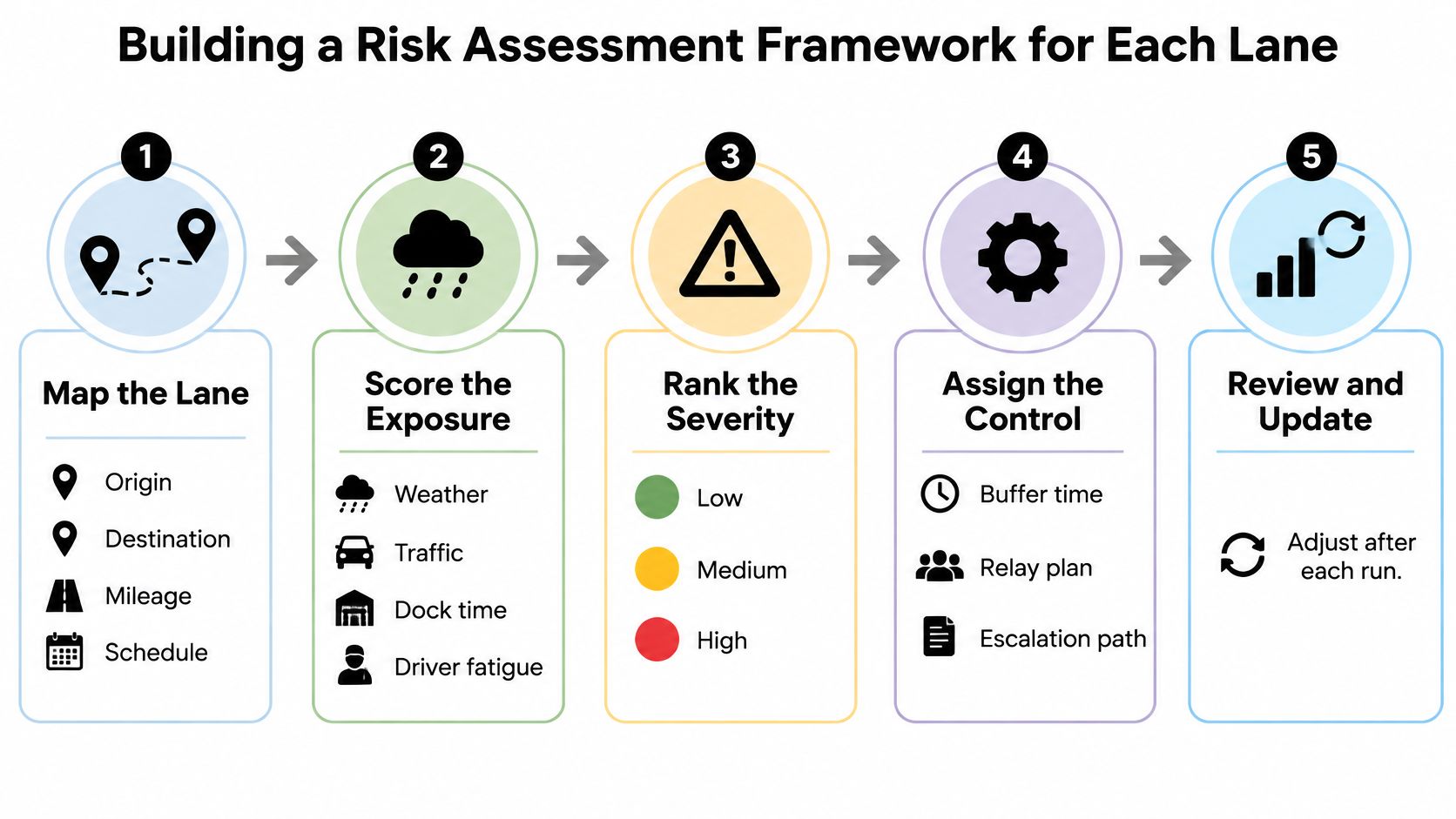
A lane assessment should produce instructions a night dispatcher can use, not a score that stays in a spreadsheet. Begin with the actual movement and work toward a documented release, hold, or recovery decision.
NIST defines supply-chain risk management as systematically identifying susceptibilities, vulnerabilities, and threats across activities that include handling, storage, and transport, then developing mitigation strategies. Applied to overnight freight, that means examining what happens before departure and after arrival as carefully as the drive itself.
Map the work before scoring it
Trace the assignment from distribution-center release through yard movement, loading verification, linehaul, arrival, unloading, and proof of delivery. Record the planned timing, responsible contact, and evidence of completion at each point.
Then attach hazards to the relevant stage. Late tender belongs at release; load discrepancy belongs at verification; a communications outage may affect several stages. Include vehicle failure, severe weather, accessorial delay, and documentation error without treating them as interchangeable causes.
Use a risk register with these fields:
- Probability: How credible is the event on this lane, based on available records?
- Operational impact: Which safety obligation, facility commitment, or downstream movement would be affected?
- Detectability: How early could the assigned owner recognize the problem?
- Recovery time: Could the operation recover before the next dependent commitment?
Use defined qualitative ratings where reliable measurements don't exist. Don't manufacture precision by assigning a probability to a hazard nobody has tracked.
Turn the rating into a control
For a late-release hazard, the control might be a readiness confirmation before truck assignment. The owner could be dispatch, with the facility's release message as evidence. For a communications outage, the control might be a tested backup contact method and a documented procedure for continuing or holding the movement.
Record both the control and its limitations. An alternate staging location isn't a recovery option until access, suitability, and authorization have been checked.
When evaluating AI tools for assessing delivery risks, ask vendors to demonstrate how an output changes a lane decision. Require an explanation of the inputs, uncertainty, and human approval process rather than accepting a risk score alone.
Review the register quarterly and after meaningful incidents or near misses. Compare the original assessment with what happened, then change the control, ownership, or lane design where the evidence warrants it.
Ranking Mitigation Strategies by Impact and Effort
Protect the driver's workable schedule before buying another dashboard. A polished tracking screen won't make a compressed turnaround reasonable or create legal driving time after an extended loading delay.
The FMCSA hours-of-service fact sheet reports that 13% of commercial motor-vehicle drivers in serious crashes were considered fatigued and describes an hours-of-service framework intended to reduce excessive duty time and protect alertness. That supports treating schedule design as a safety control rather than a staffing convenience.
Fund controls in operational order
Start with release decisions that protect legally compliant driving and on-duty limits. Review prior duty exposure, cumulative weekly hours, available sleep opportunity, and the effect of an extended shift on the next assignment.
Then address controls that are relatively straightforward to implement: clear inspection instructions, verified facility contacts, backup communications, and written exception rules. They still require training and testing, but they don't necessarily require a new platform.
More resource-intensive controls include reserve equipment, relief-driver coverage, and alternate staging arrangements. Prioritize them where the lane assessment shows severe consequences and few practical recovery options.
A backup plan is worth funding when dispatch can activate it safely during the shift, not merely list it during a review.
Match each control to evidence
Primary controls mapped to each risk type
| Risk type | Primary control | Evidence to track |
|---|---|---|
| Operational | Confirm load readiness and receiving arrangements | Release confirmations, dwell records, accepted arrival changes |
| Safety | Protect recovery time and inspect equipment | Duty reviews, fatigue reports, inspection findings and resolution |
| Compliance | Validate applicable hours and required records | Log reviews, corrected discrepancies, assignment approvals |
| Capacity | Verify usable backup coverage | Equipment readiness and driver-availability confirmations |
| Network disruption | Approve a downstream recovery arrangement | Receiving acceptance and revised connection records |
These records demonstrate whether staff performed the control. They don't, by themselves, prove that risk has fallen. Compare them with lane outcomes and investigate cases where the control was followed but the movement still failed.
The trade-off in route optimization for logistics is similar. A shorter route may be a poor overnight choice if its access conditions, staging options, or receiving constraints leave no usable recovery margin.
Don't remove every buffer to improve planned utilization. Equally, don't add blanket padding that disguises a recurring loading problem. Put recovery time where the lane evidence shows it can protect the assignment, and address the underlying facility issue separately.
Monitoring Lanes With KPIs and Decision-Ready Data
A useful alert changes what someone does next. If dispatch receives a dwell warning but can't authorize a hold, contact the receiving supervisor, or revise the assignment, the system has delivered information without an operating response.
A 2025 PwC supply-chain survey found that 82% of supply-chain leaders had some level of real-time visibility, while 24% had predictive capabilities; 82% also said real-time data without actionable insights is ineffective. For an overnight desk, the practical response is to define fewer, clearer decision rules.
Set thresholds around feasibility
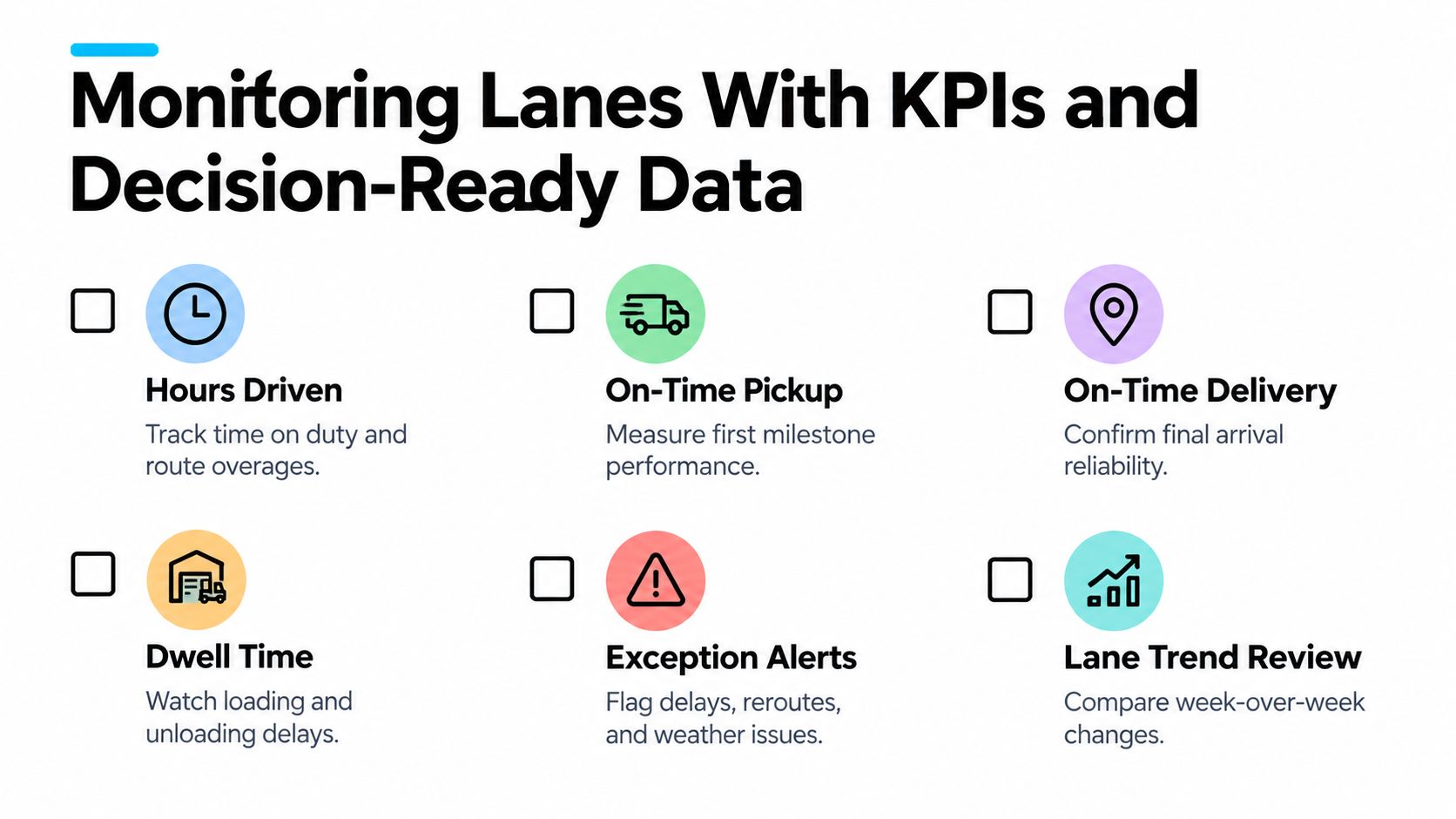
Use leading indicators to identify when the current plan is becoming unworkable. Route slack is the time remaining between a realistic completion estimate and the next required commitment, after accounting for the work still to be done.
A threshold needn't be an invented universal dwell limit. It can be a lane-specific condition with a clear owner and response deadline.
| Signal | Decision threshold | Owner and required response |
|---|---|---|
| Facility dwell | Remaining loading and travel no longer fit the accepted arrival window | Dispatch obtains a revised receiving decision before release |
| Driver-hours remaining | The revised assignment won't fit applicable limits | Dispatch holds or reassigns before authorizing further work |
| Weather exposure | Conditions breach the operation's approved safe-service criteria | Duty manager decides whether to delay, reroute, or suspend |
| Missing check-in | The required milestone confirmation hasn't arrived | Dispatcher verifies status before treating the handoff as complete |
| Incomplete delivery evidence | Required confirmation is missing at closeout | Assigned reviewer resolves the discrepancy before closing the load |
Keep the scorecard small enough to operate
Track hours driven before stops, post-midnight schedule extensions, unplanned hours-of-service exceptions, and check-in compliance as early warnings or process checks. Pair them with on-time performance, proof-of-delivery completeness, and preventable incident outcomes.
Use a consistent mileage basis for incident comparisons, and keep the underlying exposure visible. A quiet lane with little activity shouldn't automatically look safer than a heavily used lane.
A practical logistics KPI review should follow the shift:
- Before dispatch: Validate readiness, hours, conditions, and unresolved restrictions.
- During movement: Review exceptions that threaten safe completion or an accepted commitment.
- At handoff: Confirm receipt and required evidence.
- After closeout: Record the decision, result, and any unresolved corrective action.
Suppress duplicate notifications and distinguish acknowledgment from resolution. An alert marked “seen” still needs an owner until the operational question is answered.
Role-Specific Actions for Dispatch, Drivers, and Operations Managers
Write responsibilities around decisions, not department names. “Operations notified” doesn't establish who can change the departure or who must tell the receiver.
The coordination requirement extends from the dispatch desk to the driver and the facility contact.

Dispatch and drivers during the shift
Dispatch owns the executable plan. Before release, the dispatcher validates the assignment, confirms facility instructions, reviews late-night departures, and checks whether unresolved exceptions affect completion. During the run, dispatch owns exception calls and the record of any authorized change.
For example, if loading consumes the remaining arrival margin, dispatch should obtain a receiving decision rather than ask the driver to recover time on the road. If a backup staging plan is needed, dispatch confirms that the site can accept the truck.
Drivers own accurate observations and timely reporting. Their responsibilities include pre-trip inspection, required check-ins, accurate documentation, and reporting fatigue, delay, or changing road conditions when those issues appear.
A driver who finds an equipment defect before departure should report the condition and await its documented disposition. The driver shouldn't have to decide whether a customer commitment justifies accepting an unresolved safety concern.
Operations managers set the boundaries
Managers own quarterly lane reviews, threshold changes, and service decisions that exceed dispatch authority. They should also establish who can stop work and how that decision is communicated without penalizing a driver for reporting a genuine concern.
For a Minnesota winter forecast, evaluate the full assignment rather than just the outbound road. An earlier departure may be useful only if freight is ready, receiving access is confirmed, and the change preserves adequate rest.
Use the following video as a prompt for a team discussion about decision ownership and handoff expectations.
A planned delay may be the more responsible service choice when conditions make the original promise unsafe. Managers should authorize that choice explicitly and give customers a revised commitment rather than leave dispatch to defend an unrealistic arrival.
Handoff standard: Transfer the current condition, the decision already made, the next required action, and the person accountable for completing it.
At shift change, include the latest confirmed location, remaining work, receiving status, driver-hours constraint, and next review point. Ask the incoming dispatcher to acknowledge ownership of unresolved exceptions, not merely receipt of the shift notes.
Choosing a Middle-Mile Partner and Your Next Step
Compare prospective partners using the decisions they can demonstrate. A tracking portal is useful, but it doesn't tell a distribution-center leader whether the overnight dispatcher can resolve a missed release or authorize a safe service change.
Ask for a walkthrough of a representative lane exception. Use a late load release or weather-related access problem, then follow the decision from detection to customer communication and closeout.
Compare operating evidence
| Evaluation area | Insufficient answer | More useful evidence |
|---|---|---|
| Dispatch communication | Someone is always available | Named escalation roles and documented exception handling |
| Route planning | Routes are optimized | Facility instructions, constraints, and recovery options |
| Driver support | Drivers follow the rules | Training expectations and a clear fatigue-reporting process |
| Performance | Deliveries are dependable | Defined milestones and lane-level exception records |
| Weather response | Drivers use their judgment | Stop-work authority and customer notification responsibilities |
For brands and hub leaders, the fit depends on the actual operating requirement. Compare a dedicated overnight arrangement with flexible coverage based on schedule consistency, available recovery capacity, and how each provider handles changed commitments.
For Twin Cities drivers, evaluate predictability beyond the advertised start time. Ask what happens after prolonged dwell, who approves an assignment change, and whether the next shift is reconsidered after an extended night.
The Minnesota-based operation described here runs overnight box-truck routes between Amazon facilities and regional hubs, including MSP-area nodes. Its operating model includes data-informed route planning, consistent lane structures, documented dispatch communication, and W-2 drivers receiving paid training.
Those are concrete features to evaluate alongside other providers or employers. The next useful step is a lane review built around an actual origin, destination, release window, receiving requirement, and recovery constraint, not a general discussion about reliability.
Peak Transport offers structured overnight middle-mile service in Minnesota, with documented routes, dispatch support, and W-2 driving positions with paid training. Visit Peak Transport to discuss a lane risk review for your freight or ask about open box-truck positions in the Twin Cities.