Logistics Route Planning Software for Middle-Mile Operations
Discover how logistics route planning software reduces mileage, protects driver hours, and improves on-time performance for overnight box-truck operations.
October 9, 2026
At 5 PM, the dispatch board can look manageable until the late order arrives, a facility window changes, or a driver calls about a restriction that wasn't in the route notes. One route gets rebuilt from memory, another gets a familiar highway added without checking overnight conditions, and a third leaves with instructions spread across a text thread, a spreadsheet, and a printed manifest. By the time the trucks roll, the plan may already be working against driver hours, dock commitments, and the realities of the road.
That's why logistics route planning software should be treated as an operating system for middle-mile execution, not as a faster version of consumer navigation. The useful question isn't whether an algorithm can produce a shorter route. It's whether the recommendation can be trusted, communicated clearly, and repeated safely when facility data, travel times, and operating constraints change.
The Hidden Cost of Improvised Route Planning
Improvised dispatching rarely fails in one dramatic moment. It creates small compromises that appear harmless at the desk and become expensive on the road. A dispatcher may assign a stop sequence based on distance, assume a facility will accept an early arrival, or send a driver through a familiar corridor without accounting for the time of night. Each decision can make the next decision harder.
For an overnight box-truck operation, the consequences spread quickly. A late departure compresses the available driving window. A poorly sequenced hub visit adds backtracking. An inaccurate transfer assumption leaves the driver waiting at a dock while the rest of the schedule continues to move. The route may still look reasonable on a map, but the driver is now managing uncertainty instead of following a stable plan.
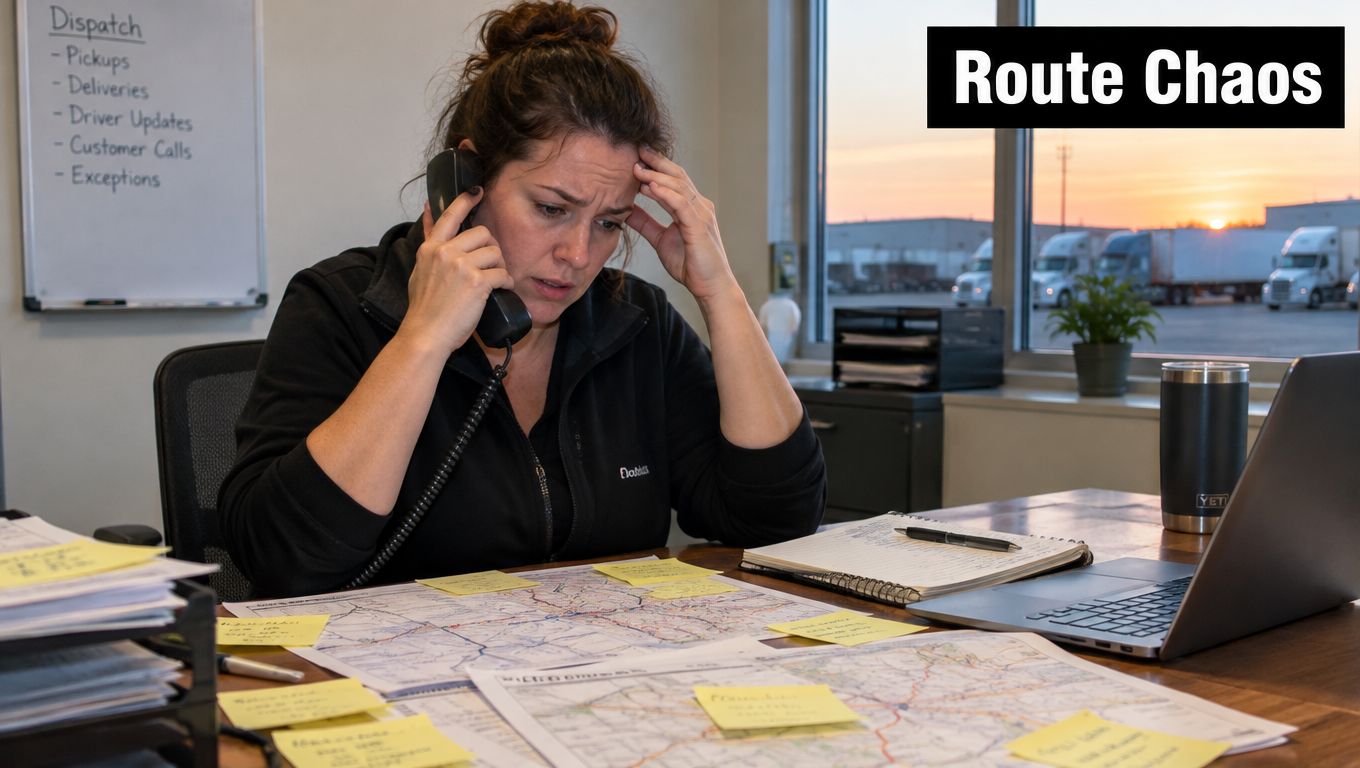
Why manual decisions compound
Manual planning also makes it difficult to see network-level waste. One dispatcher focuses on a particular truck, while another protects a different appointment. Without a shared view of routes, overlapping corridors, depot limitations, and vehicle restrictions, the team can unintentionally create unnecessary deadhead or uneven workloads.
The compliance risk is less visible but more serious. If planners don't account for available driving time and realistic dwell, a route can be legal on paper and impractical in execution. The driver then absorbs the gap through rushed work, a late arrival, or an avoidable exception. A useful overview of broader cost-control thinking is available in Peak Transport's guide to logistics cost reduction.
Operational rule: A route isn't ready because every stop has an address. It's ready when the sequence, timing, vehicle, driver, and facility assumptions can survive a real shift.
What structured planning changes
Software gives dispatchers a repeatable place to encode those assumptions. Orders can enter through a consistent workflow, stops can carry service constraints, and planners can compare a proposed route with the actual operating conditions before assigning it. Drivers receive one clear plan instead of a series of corrections.
That structure doesn't remove judgment. It moves judgment to the right point in the process, before departure, where the team can test alternatives without asking a driver to discover the problem at a facility gate. The best result is often not the shortest route. It's a route that protects hours, respects the handoff sequence, and behaves predictably enough for drivers and customers to rely on it.
From Vehicle Routing Problem to Modern Software
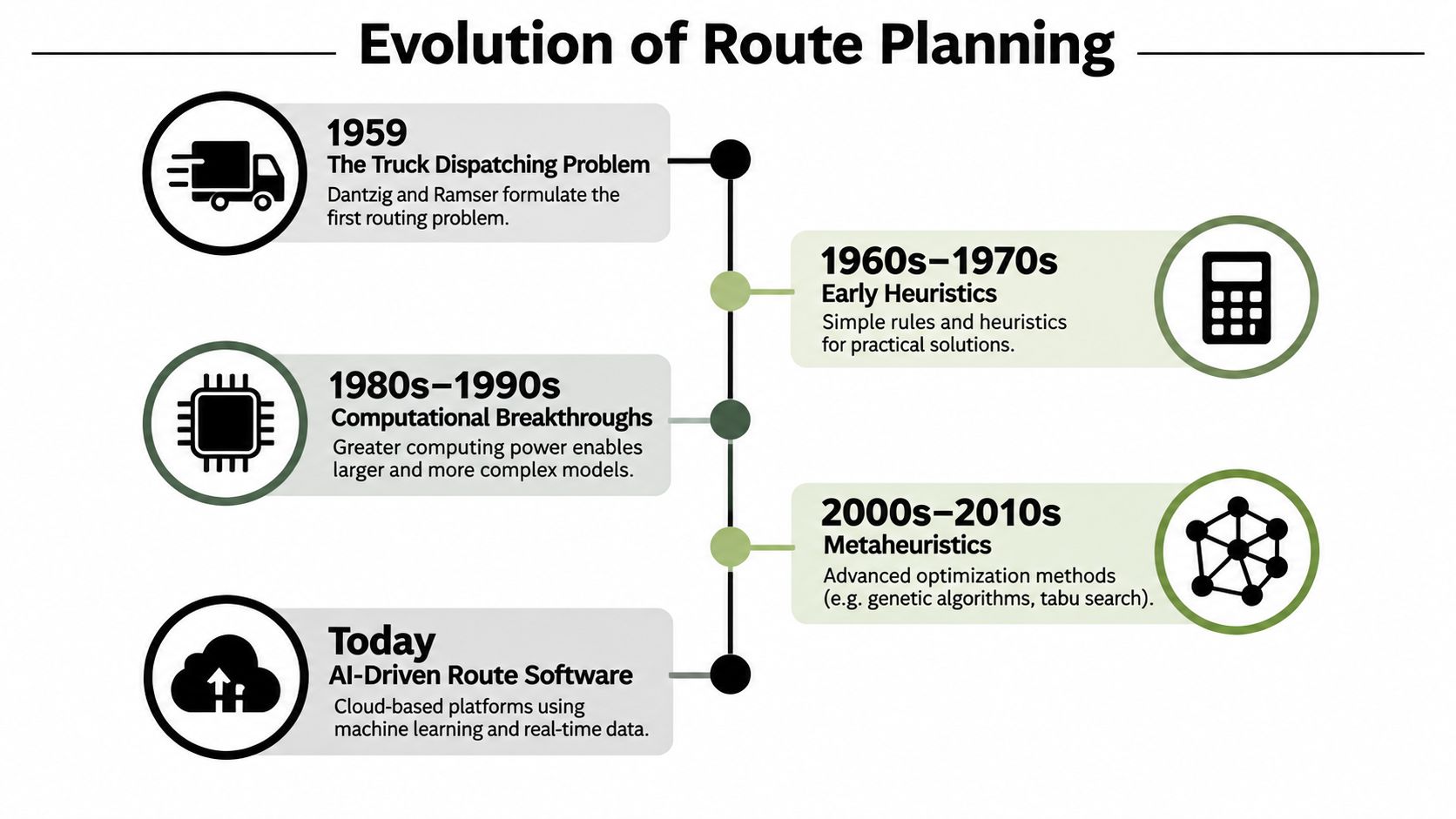
The intellectual foundation of logistics route-planning software is the Vehicle Routing Problem, or VRP. It describes how a fleet should serve geographically dispersed customers while minimizing total cost and respecting constraints such as capacity, delivery sequence, and operating time. George Dantzig and John Ramser formally introduced the problem in 1959 through “The Truck Dispatching Problem,” which addressed gasoline deliveries from a central depot to service stations, as documented in the historical overview of vehicle-routing research.
That origin matters because it frames route planning as a coordination problem, not a point-to-point navigation task. A navigation app can suggest a path between two locations. A fleet optimizer must decide which vehicle serves which sequence, whether the load fits, whether the driver can complete the work legally, and whether each facility will accept the arrival at the proposed time.
Why the history still matters
In 1964, Clarke and Wright introduced a widely used savings heuristic. The approach evaluates whether combining two delivery legs can reduce total travel, which is close to the practical question dispatchers ask when deciding whether two assignments should share a lane or vehicle. Exact mathematical algorithms expanded substantially in 1981, while modern metaheuristics became prominent during the 1990s, giving software more ways to search difficult combinations without checking every possible arrangement.
Modern systems inherit this progression. They may use exact methods, heuristics, metaheuristics, or combinations of approaches to balance service quality with computational practicality. The output is only as useful as the constraints supplied, however. A capable solver can optimize the wrong facility hours just as efficiently as the right ones.
For an overnight carrier, the modeled details can include:
- Vehicle capacity: The route must reflect usable cargo space and payload limits.
- Time windows: Appointment commitments need to distinguish firm cutoffs from preferred arrival periods.
- Depot constraints: The plan must account for where equipment starts, returns, or transfers.
- Driver hours: The schedule needs realistic travel and dwell assumptions, not only calculated road distance.
- Sequence logic: Hub handoffs and facility order can be more important than a marginal mileage difference.
A useful validation input is GPS tracker route data, because historical movement can reveal where planned routes differ from actual paths, where drivers wait, and which turns or access roads create recurring exceptions. That evidence helps planners improve the model instead of treating the algorithm's first answer as operational truth.
The following video provides additional context on route-planning concepts and their development:
Core Capabilities That Transform Overnight Operations
Basic GPS navigation answers, “How do I get from this location to that location?” Professional route planning answers a harder question: How should the entire fleet move through a time-dependent network while meeting service, vehicle, and driver constraints?
Time-dependent travel modeling is the first capability to examine. The Federal Highway Administration's National Performance Management Research Data Set provides truck-relevant speeds and travel times for highway segments at five-minute intervals across the full day and week, as described in its freight-planning discussion of truck travel-time data. That level of detail lets planners compare departure times, identify recurring congestion, and build reliability into an overnight schedule rather than relying on a distance-only ETA.
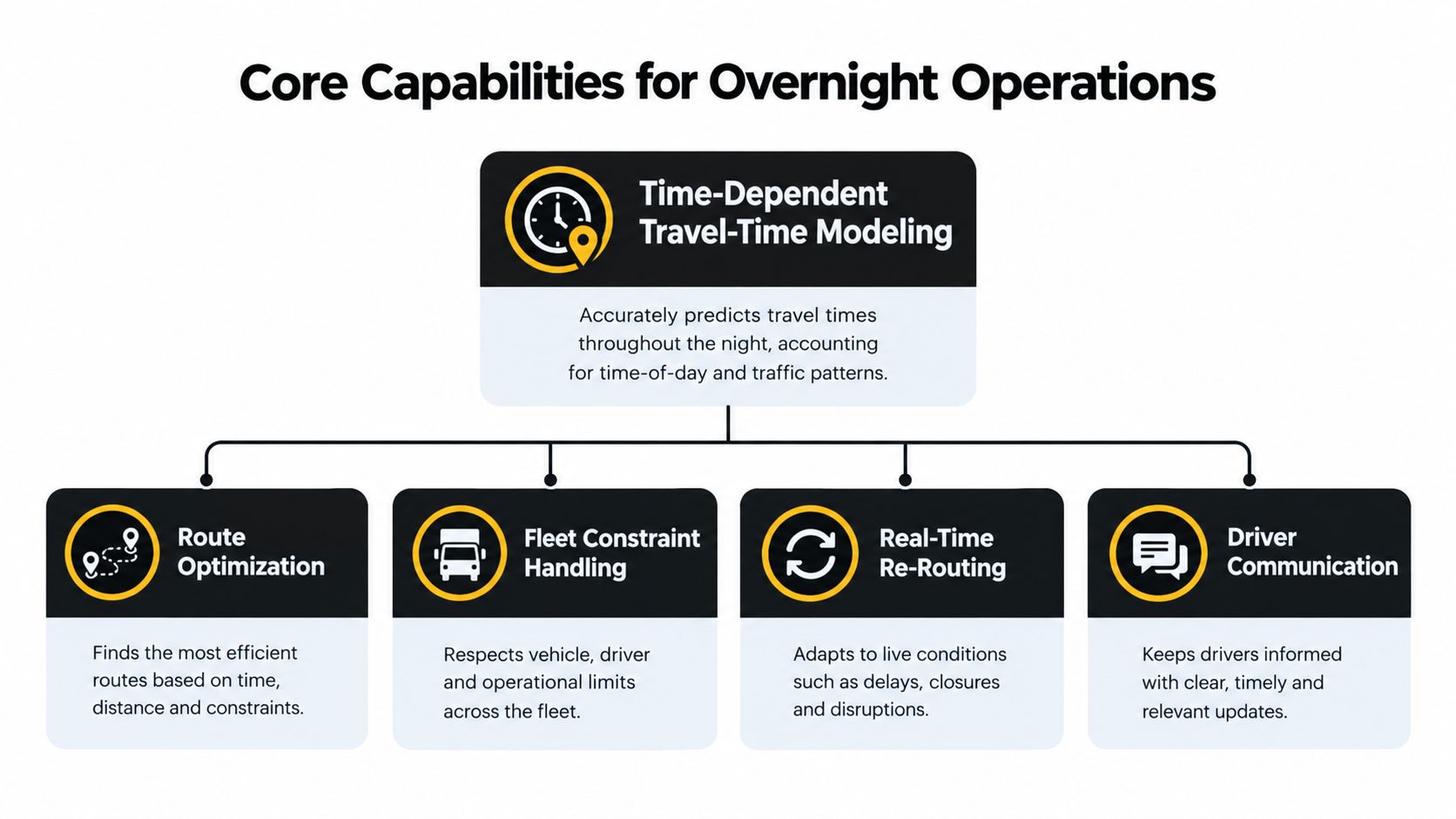
Model the clock, not just the map
For Twin Cities lanes, a useful configuration optimizes expected arrival time while separately constraining a high-percentile arrival scenario. FHWA describes the planning-time index and the ratio of 95th-percentile to median travel time as ways to evaluate reliability, along with truck-hours-of-delay metrics for converting recurring congestion into an operating cost. The practical lesson is simple: a nominally fastest route may be a poor choice if it repeatedly produces late hub arrivals.
The software should also distinguish different types of time. Driving time, loading time, security processing, dock waiting, and transfer work shouldn't collapse into one optimistic assumption. If the facility handoff is firm, the system needs a hard constraint. If the requested arrival is flexible, the planner can assign a penalty for lateness and let the optimizer compare service risk with added mileage.
Treat delivery windows as design variables
Window design can change the route itself. The World Business Council for Sustainable Development's Road Freight Lab reports that automated fleet-route optimization could reduce energy use and emissions by an average of 12.5% in the examined evidence base, and that expanding a delivery window from one hour to five hours could reduce mileage by approximately 25%. The same report describes savings of roughly 6% for each additional hour up to a four- or five-hour window, as detailed in its Road Freight Lab analysis.
Those findings don't mean every facility should receive a broad appointment range. Security rules, labor availability, dock schedules, and downstream handoffs may make a deadline genuinely fixed. They do show why planners should separate hard constraints from soft preferences.
A practical model might use:
| Constraint type | Software treatment | Operational purpose |
|---|---|---|
| Security or labor cutoff | Hard constraint | Prevent an infeasible arrival |
| Hub handoff deadline | Hard constraint | Protect network continuity |
| Preferred arrival period | Penalty cost | Allow mileage and service trade-offs |
| Driver comfort or stability preference | Planning preference | Avoid unnecessary disruption |
The right system makes these choices visible. It doesn't hide every trade-off behind a single “optimal” score. For more context on how route-planning tools differ from basic navigation, see Peak Transport's comparison of the best route planning app.
Why Sophisticated AI Doesn't Guarantee Better Routes
A polished AI recommendation can still be wrong for the operation. If the facility closes earlier than the database indicates, the dock entrance sits on a different street, or a truck restriction is missing, the optimizer may produce a route that is mathematically efficient and operationally unusable.
Research published in 2025 reports that AI routing can reduce kilometers traveled by about 15% and CO₂ by 10–12%, but those results come from modeled or structured operating conditions rather than proof that every commercial deployment will achieve comparable gains, as described in the study on AI routing, data quality, and supply-chain adoption. Another 2025 study found estimated fuel and emissions improvements ranging from 10–30% depending on data maturity and quality. Those figures are evidence of potential, not a guarantee for a carrier starting with inconsistent operational records.
Start with data readiness
Before selecting an algorithm, audit the inputs that shape the recommendation. The most important questions are practical:
- Facility records: Are hours, entrances, dock instructions, and appointment rules current?
- Vehicle records: Does the system know dimensions, capacity, equipment restrictions, and applicable certifications?
- Lane assumptions: Do planned transfer times resemble actual drive, dwell, and loading behavior?
- Road restrictions: Are construction limits, access rules, and vehicle-specific restrictions represented?
- Exception history: Can the team identify why a route failed, rather than only seeing that it was late?
A route model shouldn't receive a clean bill of health because its map looks precise. Planners need to compare recommendations with actual drive time, dwell time, driver-hour use, documentation accuracy, and service failures. That creates a feedback loop between the model and the operation.
Validation standard: Judge route quality by safe, repeatable execution. Shorter distance matters only after the route meets the service and compliance requirements.
Use a route scorecard
A useful scorecard combines efficiency with execution. Track whether the route arrives within the required window, whether the driver has sufficient legal hours, whether paperwork matches the movement, and how often dispatch intervenes. A route that requires constant manual correction may be inferior to a slightly longer plan that drivers can follow without confusion.
AI can support this process, but it shouldn't replace operational ownership. Peak Transport's material on AI route optimization is relevant to the efficiency discussion, but any operator should still test recommendations against the conditions its drivers and facilities actually face. The goal is not to make dispatchers subordinate to the model. It's to give them better evidence for deciding when the model deserves approval.
Must-Have Features and Critical Integrations
A vendor demo often emphasizes the map and the optimization button. A carrier should spend more time examining what happens before and after that button. The strongest platform is the one that receives reliable orders, models the true operation, communicates a usable plan, and records what transpired.
Separate foundational features from optional polish
Time-dependent travel modeling belongs near the top of the list for overnight middle-mile work. The system should compare departure times and account for recurring congestion instead of treating every road segment as constant.
Constraint handling is equally fundamental. The platform should support vehicle capacity, facility windows, depot rules, driver availability, appointment penalties, and route-specific restrictions. If planners can't inspect or change those assumptions, they'll end up exporting the route to a spreadsheet and rebuilding it manually.
Exception management determines whether the software helps after dispatch. Look for alerts that identify material service threats, not a stream of minor changes that encourage constant intervention. Dispatchers need to know why a recommendation changed and what trade-off the system made.
Integration requirements deserve their own review:
| Integration | What to verify | Why it matters |
|---|---|---|
| TMS | Order ingestion, stop updates, status synchronization | Prevents duplicate entry and stale assignments |
| Telematics | Location, movement history, fuel and vehicle signals | Compares planned behavior with actual execution |
| ELD | Hours-of-service availability and schedule impact | Helps prevent infeasible assignments |
| Facility systems | Appointments, dock status, handoff data | Keeps windows and operating assumptions current |
| Driver communication | Route delivery, acknowledgments, exception reporting | Gives the field one dependable instruction channel |
Test the operational handoff
Ask the vendor to demonstrate a changed appointment, an unavailable vehicle, and a driver who reports a facility problem. Watch whether the platform preserves the route history, updates the right downstream systems, and gives the driver a clear instruction. If the workflow depends on a dispatcher copying details between applications, the integration is incomplete no matter how advanced the optimization engine appears.
Communication also needs to work for frontline teams, not only managers. A dedicated option such as frontline team messaging software can help centralize driver instructions, acknowledgments, and exception context when the routing platform's messaging tools aren't sufficient.
For carriers handling regulated freight, HAZMAT certification tracking should be evaluated alongside route constraints. The system needs to identify whether the assigned driver and equipment are eligible before dispatch, not after a route has already been built. That kind of preventive check is more valuable than an extra visualization layer because it protects execution at the point where a bad assumption becomes a failed handoff.
Implementation Best Practices for Middle-Mile Carriers
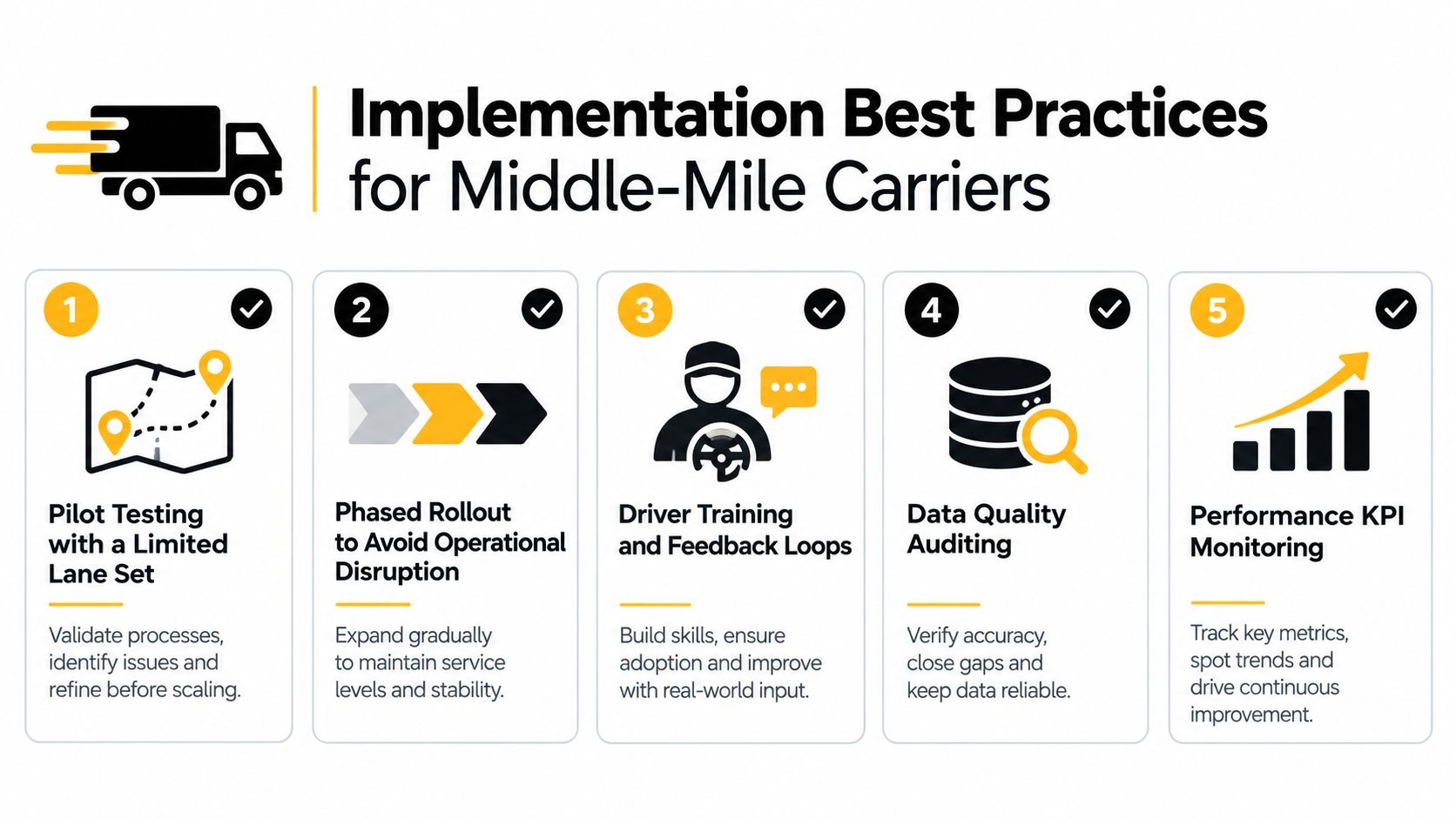
Implementation fails when a carrier treats route-planning software as a switch instead of a controlled operating change. The first objective isn't maximum optimization. It's learning whether the system's assumptions match the lanes, facilities, drivers, and exceptions that define the network.
Begin with a controlled lane
Choose a limited group of difficult lanes rather than deploying everywhere at once. Include the kinds of work that expose weak assumptions, such as strict hub handoffs, variable facility access, recurring congestion, or complex driver-hour limits. Keep the current planning method available as a comparison, and record the reasons planners accept or reject each recommendation.
A pilot should compare the plan with actual operations, including:
- Drive time: Did the predicted movement resemble what the driver experienced?
- Dwell time: Did loading, security, and dock activity fit the schedule?
- Service performance: Did the truck meet the required handoff and arrival commitments?
- Compliance: Did the assignment preserve available driver hours?
- Exceptions: Did dispatch need to intervene, and why?
This evidence is more useful than a vendor's generic efficiency promise. It tells the carrier whether the model understands its own network.
Protect stability with event triggers
Dynamic rerouting has a place, but it shouldn't become a reflex. For fixed Amazon and regional-hub lanes, dispatchers should preserve the planned route during ordinary congestion when the driver can still meet the service commitment. Consider a new route for a major closure, severe weather, a safety hazard, or a material threat to an appointment.
Frequent changes carry hidden costs. Drivers must recheck instructions, revise documentation, learn unfamiliar facility approaches, and make decisions while operating an overnight shift. Repeated changes can also weaken familiarity with safe parking and handoff procedures. A slightly longer route may be the better operating decision if it's predictable, compliant, and repeatable.
Driver-first principle: Reroute when the operational risk is greater than the disruption. Don't trade a stable plan for a small theoretical saving.
Build feedback into the rollout
Train drivers on what the route plan means, how to report inaccurate facility information, and when to contact dispatch before deviating. Give dispatchers authority to override the system, but require a reason code so the override becomes useful data instead of an undocumented workaround.
Review performance with operations and drivers together. On-time arrival, hours compliance, documentation accuracy, exception frequency, driver experience, and sustainable mileage reduction should all influence the decision to expand. Peak Transport provides structured dispatch and data-informed route planning for overnight box-truck middle-mile operations, connecting distribution centers and regional hubs. Visit Peak Transport to discuss a middle-mile operating model built around dependable routes, clear communication, and safe execution.