Managed Logistics Services: A Practical Guide for 2026
Explore managed logistics services in 2026, from 3PL and 4PL models to middle-mile execution, KPIs, and a vendor checklist built for shippers and drivers.
September 29, 2026
At 9 p.m., a distribution center can look ready for the night while the transportation plan is already coming apart. Trailers are staged for Amazon and big-box drop-offs, dock appointments are fixed, and dispatchers are still working across broker boards while trying to confirm which owner-operator will take each run. A late truck at this point doesn't just create a missed delivery. It can disrupt the next handoff, the next driver's hours, and the entire morning schedule.
That operating reality is why shippers consider managed logistics services. The value isn't outsourcing a phone call or finding a truck for one load. It's putting planning, execution, compliance, and exception handling under an accountable operating model that can run the same lanes consistently.
What Managed Logistics Services Actually Mean for Shippers
Managed logistics services are a contracted operating model in which a third-party provider plans and executes transportation movements against agreed cost, service, and compliance requirements. The provider may coordinate carriers, operate equipment, manage dispatch, monitor shipments, handle exceptions, and report performance through a defined scope of work.
That differs from transactional freight brokerage. A broker may source capacity for an individual shipment, often at a spot rate, but the shipper still carries much of the planning burden. The broker's immediate objective is covering the load. A managed provider's responsibility is broader, it must make the lane work repeatedly, document what happened, and improve the operating pattern over time.
The difference between buying loads and managing lanes
An in-house fleet gives the shipper direct control over trucks, drivers, maintenance, and dispatch. It also requires the shipper to carry the capital, management, recruiting, safety, and compliance workload. A dedicated carrier commits equipment and drivers to the shipper, while a managed logistics provider may combine dedicated operations with a vetted carrier network.
The distinction matters most on overnight middle-mile routes. Suppose a box truck leaves a distribution center for an Amazon node. The work includes more than assigning a vehicle:
- Planning: Match freight, equipment, driver availability, and appointment windows.
- Execution: Confirm the driver, complete the pre-trip process, monitor departure, and manage the handoff.
- Control: Track delays, hours-of-service limits, route changes, claims, and documentation.
- Improvement: Review recurring failures and adjust schedules, routing, staffing, or carrier allocation.
Practical rule: If the provider can't explain who owns each decision after a load is tendered, you aren't buying managed execution. You're buying capacity assistance.
Shippers usually start looking for this model after volatile capacity, missed appointments, compliance exposure, or supervisor overload becomes normal. The hidden cost is often the time spent chasing confirmations, locating late trucks, reconstructing delivery records, and deciding whether a failure belongs to the carrier, the warehouse, or the shipper's plan.
The broader 3PL market illustrates the scale of this operating shift. It was valued at about USD 1.26 trillion in 2025 and is projected to reach roughly USD 2.50 trillion by 2033, with a projected 9.1% CAGR from 2026 to 2033, according to Grand View Research's third-party logistics market analysis. Managed logistics is therefore not a niche support function. It has become an operating layer for shippers coordinating transportation, distribution, and fulfillment across multiple nodes.
3PL, 4PL, Dedicated Carriers, and Managed Lanes Compared
The label on a proposal matters less than the operating authority behind it. Two providers may both call themselves 3PLs, yet one may only broker loads while the other plans routes, operates equipment, manages drivers, and owns the performance review.
A 3PL generally executes a defined logistics scope. That can include transportation management, warehousing, carrier coordination, distribution, or a combination of those services. A 4PL sits above several providers and acts as the network orchestrator, usually owning technology coordination, strategic design, and consolidated KPI governance.
A dedicated carrier commits assets and drivers to one shipper. This can provide stronger lane familiarity and control than spot capacity, but the shipper still depends on the carrier's operating discipline and may have less flexibility when volume changes. A managed lane is narrower. The provider plans and runs specific repeat routes while the shipper retains broader sourcing and network decisions.
| Model | Who Owns Assets | Best Scale Fit | Primary Use Case |
|---|---|---|---|
| 3PL | Provider, contracted carriers, or a mixed network | Shippers needing outsourced execution across multiple functions | Transportation, warehousing, fulfillment, and carrier coordination |
| 4PL | Multiple providers may own assets, while the 4PL orchestrates the network | Complex networks with several logistics partners and systems | Network design, technology management, and strategic KPI ownership |
| Dedicated carrier | Carrier owns or commits trucks and drivers to the shipper | Stable, repeatable freight with predictable lane requirements | Consistent capacity and dedicated operational coverage |
| Managed lanes | Provider or selected carriers operate defined lanes | Shippers with repeat routes but internal strategic capability | Planned middle-mile or regional routes with centralized execution |
A shipper with repeat overnight box-truck routes may not need a full 4PL. It may need a managed-lane partner that understands dock timing, driver availability, handoff documentation, and recovery planning. Conversely, a shipper with multiple warehouses, parcel networks, international freight, and several 3PL contracts may need a 4PL to remove fragmented accountability.
For a closer look at how dedicated operations differ from broader managed models, review dedicated transport services. The useful procurement question is simple: what decisions will the provider own every day, and what decisions remain with the shipper?
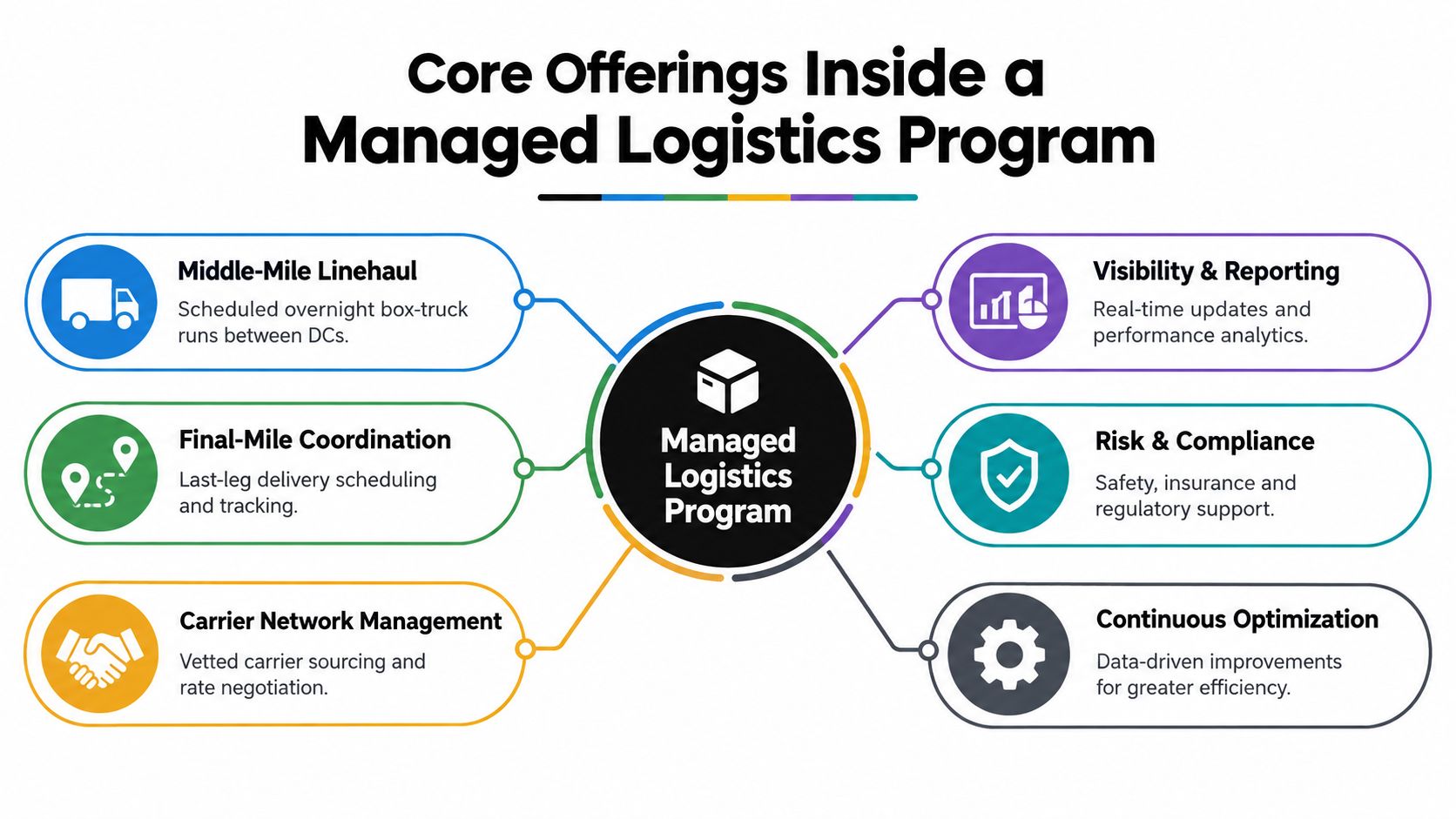
Core Offerings Inside a Managed Logistics Program
A credible managed logistics program has an operational backbone. It isn't just a dashboard layered over outsourced freight.
Middle-mile execution
The core service is often scheduled linehaul between distribution centers, regional hubs, and final-mile nodes. On overnight box-truck routes, the provider needs to understand whether a load is drop-and-hook, drop-trailer, or live-load, because each pattern changes dwell time, equipment positioning, and driver sequencing.
Route planning then turns orders and appointments into a workable dispatch plan. A strong plan accounts for stop sequence, available equipment, return freight, driver hours, weather, and recovery options. It doesn't just assign the shortest map route.
Compliance and safety control
Compliance should be visible in daily operations. Depending on the operating model, that includes FMCSA hours-of-service awareness, ELD integration, DOT recordkeeping, and customer-specific requirements such as Amazon Relay or SCOT processes. The provider should explain which party audits records, who responds to violations, and how documentation reaches the shipper.
Safety controls include driver qualification, motor vehicle record monitoring, training, inspection routines, and incident response. The details matter because an overnight operation can fail without warning until a collision, claim, or compliance audit exposes weak ownership.
Workforce design
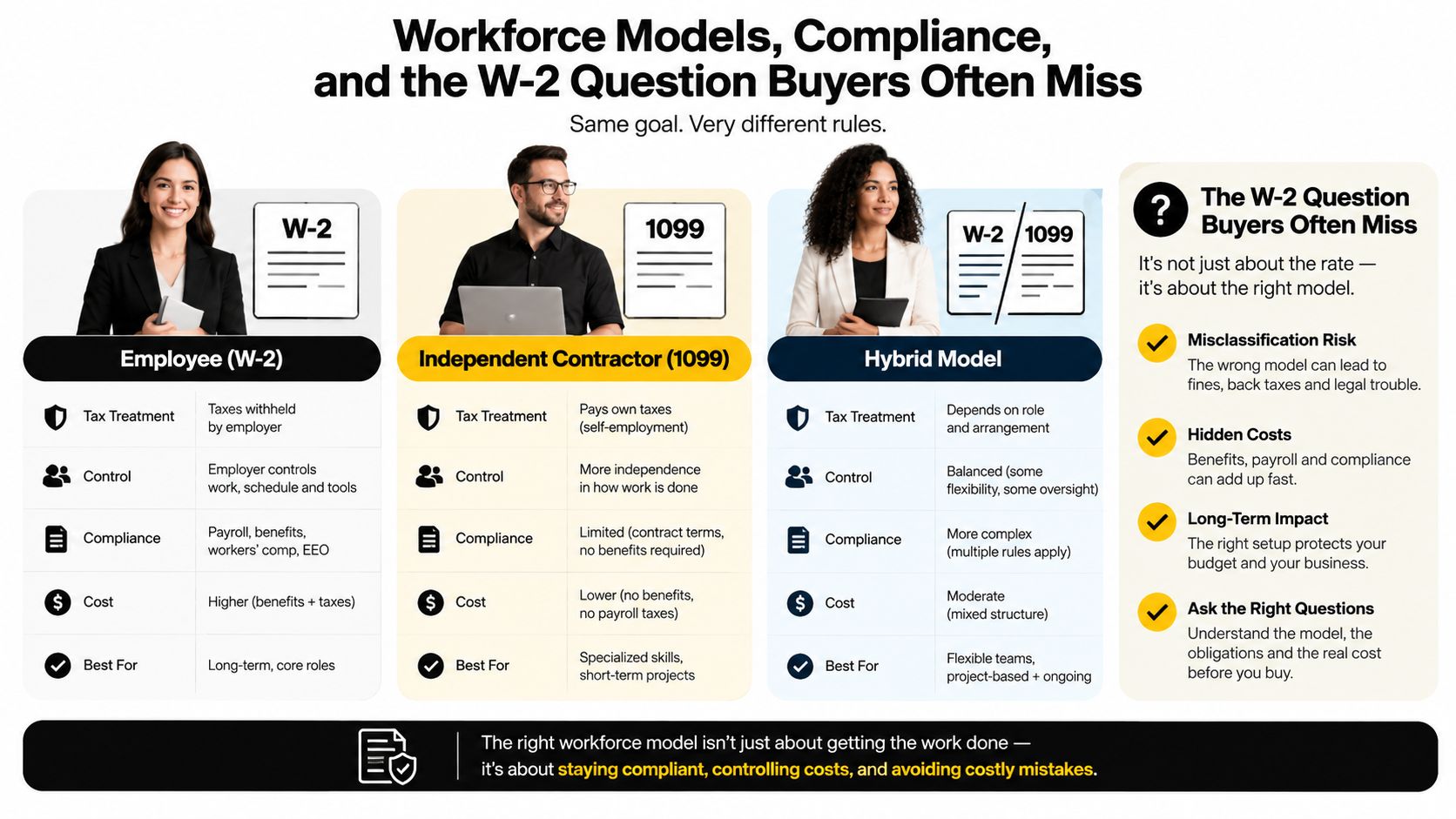
The workforce model changes the consistency a provider can control. W-2 drivers are employees of the operating company, so training, scheduling, supervision, and performance management sit closer to the lane. Contractor-heavy models can add flexibility and capacity, but they require stronger controls over onboarding, insurance, documentation, and service consistency.
A managed program works when the provider manages the conditions that create reliable execution, not merely the load tender.
Ask for the actual workflow. Who checks the truck? Who confirms the driver? Who watches the ELD? Who calls the receiving dock after a delay? Those answers reveal more than a sales presentation about visibility.
Business Benefits and KPIs That Prove the Model Works
A managed logistics program earns its budget when it produces evidence that operations leaders can defend. Start with a baseline, then connect each promised improvement to a specific operating lever, such as dispatch discipline, route planning, dock coordination, or exception handling.
Useful measures include cost per mile, on-time delivery, dock-to-dock transit time, shipment accuracy, inventory accuracy, dwell time, empty miles, claims, and exception resolution. Report them together, not as isolated figures. A useful scorecard identifies the lane, explains the variance, assigns the corrective action, and shows whether the problem recurred.
Industry 3PL benchmarking commonly targets 95% to 98% on-time delivery, 99% or higher order accuracy, 99.5% or higher inventory accuracy, dock-to-stock within 24 to 48 hours, and complaint resolution within the same day or 24 to 48 hours, as outlined in DCL's guide to evaluating a 3PL partner. These are broad reference points, not guarantees for every middle-mile operation.
Build a scorecard that matches the operation
Overnight box-truck lanes often need tighter, lane-specific definitions than a general 3PL benchmark. A buyer can make dock arrival, shipment accuracy, claims, dwell, empty miles, and exception response contractual measures. The operating agreement should also define the timestamp, data source, audit method, and owner for each KPI.
| KPI | What It Measures | Benchmark |
|---|---|---|
| On-time delivery | Arrival against the agreed appointment window | 95% to 98% in common 3PL benchmarking |
| Order accuracy | Correct freight, quantity, and documentation | 99% or higher |
| Inventory accuracy | Alignment between system records and physical stock | 99.5% or higher |
| Dock-to-stock time | Speed from receiving to available inventory | Under 24 to 48 hours |
| Complaint resolution | Time to acknowledge and close a service issue | Same day or within 24 to 48 hours |
The 13 KPI per la logistica resource can help teams build a broader scorecard when finance, warehouse, and transportation managers need shared definitions.
For middle-mile work, financial results need the same discipline. Route planning can reduce unnecessary mileage when shipment, route, and telematics data are reviewed together. Penske Logistics explains how real-time supply-chain visibility connects transportation, warehouse, order, routing, and analytics data. Separate variable cost reduction, such as lower mileage, from cost avoidance, such as fewer supervisors, emergency capacity moves, claims, and service failures. That distinction shows whether the managed model improved the operation or only shifted expense to another line.
Middle-Mile and Overnight Box-Truck Operations in the Twin Cities
A practical Twin Cities lane might leave a Fridley or Eagan distribution center at 19:00, run through an overnight handoff, and reach an Amazon node in Shakopee, Mendota Heights, or a regional sort facility in St. Paul. The route looks short on a planning screen. The operating window is not.
The dispatch team starts before departure. Freight is checked against the manifest, the truck is assigned, the driver completes the pre-trip inspection, and the receiving appointment is confirmed. If the load is live-loaded, the plan must allow for dock variability. If the trailer is staged, the provider must make sure the right equipment is at the right building before the driver arrives.
Sequence the night before the night goes wrong
A disciplined playbook treats each handoff as a control point:
- Release the load: Confirm freight, paperwork, equipment, and appointment details.
- Dispatch the driver: Verify readiness, route, hours, contact information, and special instructions.
- Monitor the movement: Track departure, route progress, dwell, and emerging delays.
- Protect the handoff: Confirm the receiving site can accept the freight and preserve delivery records.
- Recover the exception: Re-sequence stops, redirect equipment, or escalate before the next appointment fails.
Twin Cities operations also face practical friction. Winter conditions can affect I-35W and I-94, construction can alter travel time, and tight receiving windows leave little room for informal recovery. Routes crossing state lines must also respect driver-hour requirements and the operating limits recorded through the driver's compliance systems.
A managed provider can consolidate returns or coordinate multiple stops, but consolidation only works when the route still protects appointment windows and driver hours. Adding one more stop to fill a truck may appear efficient until it creates dwell, a missed handoff, or a late return to the originating facility.
Overnight freight doesn't need heroic dispatching. It needs a plan that identifies the likely failure points before the truck leaves.
Peak Transport describes its regional operation around structured overnight box-truck routes, W-2 drivers, route planning, dispatch communication, and middle-mile movement between distribution centers and regional hubs. Its Twin Cities logistics overview provides useful local context for evaluating a provider that works within this operating pattern.
Vendor Selection Checklist and Implementation Roadmap
Select a managed logistics provider by testing its operating system, not its presentation. Ask finalists to explain how they would run one of your actual lanes, including the dispatch timeline, driver assignment, escalation path, proof-of-delivery process, and response to a missed appointment.
Score the provider before discussing the final rate
Use a weighted scorecard that reflects your risk. Assign greater weight to the factors that can stop your operation, then score every finalist against the same evidence.
- Network coverage: Can the provider cover your repeat lanes with credible backup capacity?
- Workforce mix: What share of the operation uses W-2 employees, contractors, dedicated carriers, or spot capacity?
- Technology access: Can its TMS integrate with your systems, and will you receive ELD visibility, API access, timestamps, and exception records?
- Compliance posture: Who audits driver files, hours, insurance, inspections, and customer-specific requirements?
- Claims handling: Who investigates damage, preserves evidence, communicates with the consignee, and funds the response?
- Financial stability: Can the provider maintain staffing, equipment, insurance, and supplier payments during volume or market changes?
- Regional execution: Does the team understand your facilities, appointment patterns, weather exposure, and recovery options?
Don't let a polished portal substitute for usable data. A buyer should be able to export the records needed for a quarterly business review and audit the definition behind each KPI. Guidance on improving vendor governance and automation can help procurement formalize onboarding, ownership, and documentation controls.
Move from discovery to live operations
A practical implementation sequence looks like this:
- Discovery, weeks 1 to 2: Document facilities, freight profiles, appointment rules, current carriers, pain points, and escalation contacts.
- Lane mapping and baseline, weeks 3 to 4: Map routes, stops, dwell, mileage, exceptions, claims, and existing service performance.
- Pilot, weeks 5 to 8: Run a limited set of repeat lanes, such as two or three representative routes, with daily review.
- Cutover, weeks 9 to 12: Transfer the agreed scope, activate reporting, and establish the weekly operating cadence.
The MSA should define data ownership, service levels, payment terms, claims responsibility, insurance requirements, audit rights, transition assistance, and termination rights. Include an exit clause that gives the shipper access to shipment history, lane documentation, and operational records if the relationship ends.
Common transition risks include incomplete master data, untested integrations, unclear appointment ownership, and a provider that treats the pilot as a special project rather than a normal operating shift. The pilot should expose those weaknesses before the full network depends on them.
Workforce Models, Compliance, and the W-2 Question Buyers Often Miss
At 2 a.m., a box truck reaches a Twin Cities distribution center and the dock is closed. The buyer needs to know who owns the missed appointment, who calls the facility, records the cause, and assigns the driver's next move. That answer depends on more than the 3PL's service promise. It depends on who drives the truck, and who controls the work.
A contractor-heavy model can provide flexible capacity, but procurement should verify how the provider manages onboarding, insurance, driver qualification, drug testing, ELD accountability, training, and incident response. A W-2-operated network puts drivers on the operating company's payroll, giving that company more direct control over scheduling, supervision, training, and performance follow-up.
The workforce model does not determine service quality by itself. It determines where operational control sits. Ask whether the same team that dispatches the overnight lane also supervises the driver, reviews exceptions, and owns recovery when a handoff fails.
Questions procurement should ask
- Driver ownership: Is the driver a W-2 employee, an independent contractor, or supplied by another carrier?
- Insurance: Which entity carries the required coverage, and can the buyer verify current certificates?
- Compliance audits: Who reviews DOT records, ELD data, inspections, MVRs, and qualification files?
- Safety response: What happens after a collision, preventable incident, roadside violation, or missed inspection?
- Service recovery: Who pays for recovery capacity after a late delivery, and how is the root cause recorded?
- Accountability: Can the provider identify the person responsible for each dispatch, handoff, and exception?
Connect those answers to the lane-level KPIs defined earlier, including on-time arrival, dwell, and exception response. Staffing and supervision affect whether a driver receives accurate instructions, whether a delay is escalated before the appointment is lost, and whether the cause is documented well enough to prevent a repeat. Use the earlier benchmark discussion as context, not as a substitute for reviewing the provider's actual lane results.
For classification and wage-and-hour questions, procurement teams should review wage and hour compliance with qualified legal and compliance advisers. A contractor-heavy model may show a lower visible freight cost, yet create additional exposure through inconsistent training, incomplete records, claims, missed appointments, or repeated supervision by the shipper. The practical choice is the level of control and accountability the lane requires.
Peak Transport provides structured overnight box-truck operations for middle-mile freight between distribution centers and regional hubs, with route planning, dispatch support, documented handoffs, and W-2 drivers. Twin Cities shippers can visit Peak Transport to discuss lane requirements and workforce accountability.