7 Middle Mile Logistics Companies to Compare
Compare 7 middle mile logistics companies by coverage, equipment, service model, and Twin Cities fit, including Peak Transport’s overnight specialization.
September 6, 2026
The popular advice is to choose the biggest carrier available. That's often the wrong starting point. Middle-mile transportation spans scheduled distribution-center-to-hub routes, retail replenishment, palletized LTL, cross-dock networks, and dedicated contract carriage. A national name may offer broad coverage, but a regional specialist can be a better fit when the requirement is a repeatable overnight box-truck lane in the Twin Cities.
This comparison uses the same decision lens for every provider: service model, equipment, geographic coverage, shipment profile, schedule requirements, visibility, and MSP-area fit. The list includes national networks, asset-based operators, LTL carriers, retail-consolidation specialists, technology-led platforms, and a Twin Cities-focused provider. Peak Transport serves as the regional reference point for structured overnight box-truck execution, while the other companies address different combinations of scale, consolidation, dedicated capacity, and multi-node coordination.
1. Peak Transport
National coverage is not automatically the right answer for a repeatable overnight lane. Peak Transport targets a narrower operating requirement: scheduled overnight middle-mile movement across the Twin Cities metro and surrounding Minnesota. The Minnesota-based company connects distribution centers, regional hubs, and Amazon Relay nodes with box trucks on planned routes, rather than treating each shipment as a separate dispatch. That model fits brands and distribution teams that prioritize consistent facility-to-facility execution over residential delivery flexibility.
Middle-mile logistics connects commercial facilities, commonly moving pallets, trailer loads, or containers instead of individual consumer orders. The category's defining issue is coordination between hubs, warehouses, and distribution centers, so departure windows, handoff accuracy, and route documentation carry more weight than broad delivery optionality. Peak's operating model uses structured dispatch and data-informed planning to control mileage, protect driver hours, and support consistent on-time performance.

Where Peak fits best
Peak fits lanes that begin and end at a warehouse, hub, distribution center, or Amazon Relay node, particularly when the schedule runs overnight. Contracts with major brands and integration with Amazon Relay nodes provide evidence of commercial operating experience. Maintained equipment and defined dispatch procedures also matter for shippers that need the same lane performed repeatedly, not just covered once.
The company's employment model affects capacity as well. Peak employs W-2 box-truck drivers instead of depending on a 1099 contractor structure, and its hiring materials list starting box-truck pay of $25.75 to $28 per hour. Paid training, paid sick time, health insurance options, and a 401(k) with company match are part of the stated offering. For shippers, these details may indicate a more structured labor model. For drivers, they provide a basis for comparing schedule control, benefits, and employment stability.
The trade-off is geographic and operational focus. Peak is not positioned as a national long-haul, residential-delivery, or flexible daytime provider. Its value rises when a shipper needs a defined overnight box-truck lane in the MSP area and falls when freight requires broad multi-region coverage or highly variable service windows.
For background on what middle-mile logistics means for warehouse-to-hub transportation, see the linked explanation.
Pros
- Engineered routing: Data-informed planning supports mileage control, fuel discipline, and consistent timing.
- Driver stability: W-2 employment, paid training, benefits options, and structured overnight work support retention.
- Operational control: Route documentation and dispatch procedures reduce last-minute uncertainty.
- Commercial credibility: Major-brand contracts and Amazon Relay integration support repeatable lane execution.
Cons
- Focused footprint: Operations center on the Twin Cities metro and surrounding Minnesota.
- Limited service profile: Scheduled overnight middle-mile work does not target residential delivery, long-haul routes, or flexible daytime runs.
2. Warp
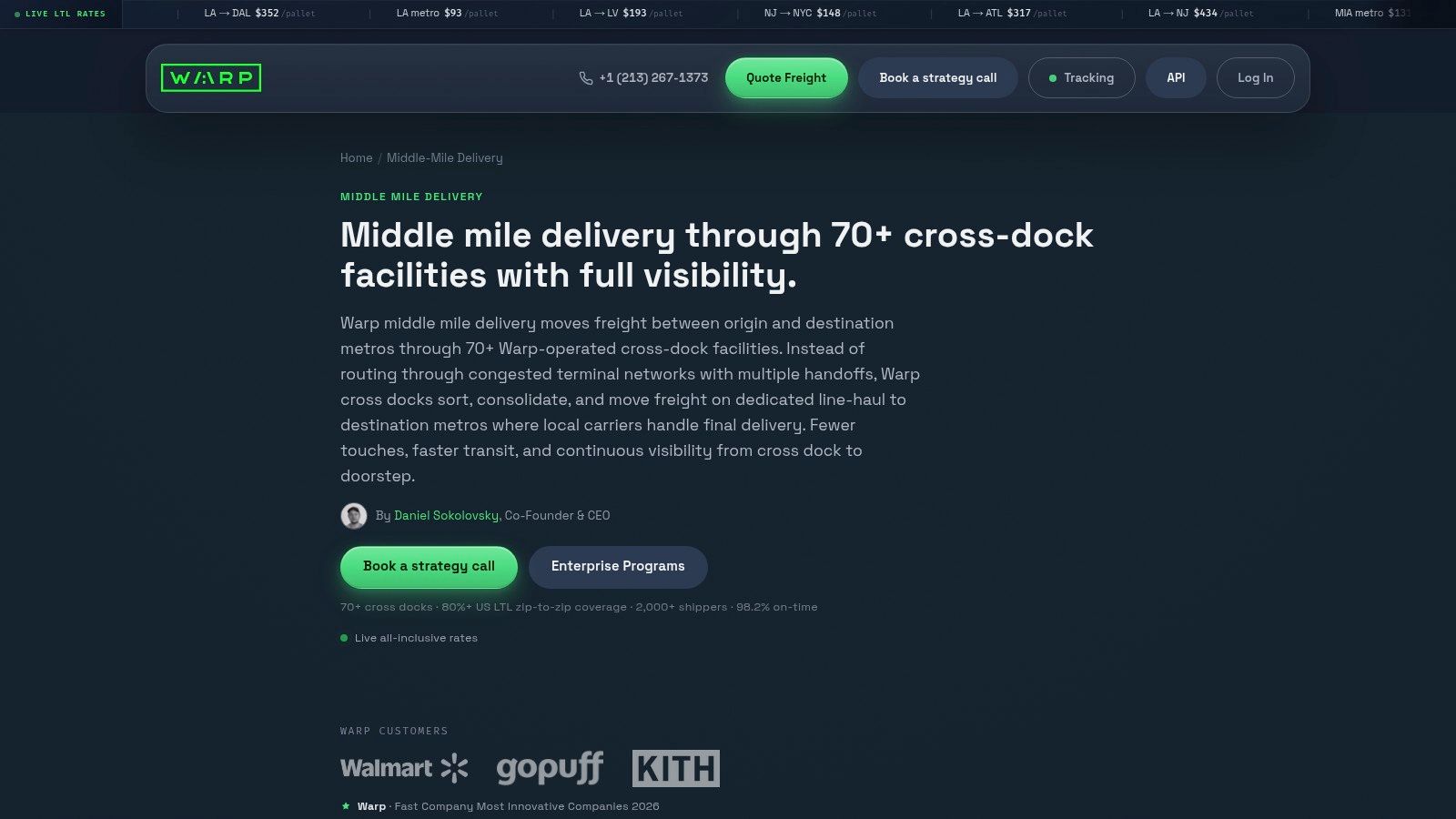
Warp is best evaluated as a technology-led network, not as a conventional fleet owner. It combines cross-docks, linehaul, cargo vans, box trucks, LTL, and FTL through one operating platform. For retailers and e-commerce operators, that combination can support palletized freight moving through regional nodes before reaching stores, parcel networks, or final-mile providers.
The operating model fits pool distribution, zone skipping, store replenishment, and cross-dock consolidation. Live ETAs, instant rating, and network-level routing visibility give shippers one place to coordinate movements that might otherwise involve several carrier relationships. The practical test is lane-specific: network density in the origin and destination markets must support the schedule, and each additional partner handoff must be weighed against the platform's coordination benefits.
A network choice, not a fleet substitute
Warp's strongest use case is a logistics team seeking fast quoting, centralized tracking, and one operating layer across multiple equipment types. Its cross-dock structure can consolidate palletized retail freight before regional delivery or parcel injection. Per-pallet LTL pricing also gives shippers a basis for comparing selected lanes with traditional LTL service.
That flexibility comes with less direct control than an asset-based provider may offer. Capacity and execution can vary by market, particularly where partner coverage is thinner. Warp is therefore more naturally aligned with palletized, parcel-adjacent flows than with heavy or specialized freight requiring a dedicated local fleet. It may also suit multi-node retail programs better than a single overnight box-truck lane in the Twin Cities, where a locally controlled operator can offer clearer dispatch accountability.
Pros
- Unified orchestration: Cross-docks, linehaul, and downstream handoffs can run through one platform.
- Retail utility: Pool distribution and store routes support repeatable multi-node replenishment.
- Visibility: Live ETAs and routing views help teams monitor freight across handoffs.
- Commercial speed: Instant ratings and quotes shorten early lane comparisons.
Cons
- Market variability: Capacity and network density differ by geography.
- Partner dependence: Some lanes rely on outside carriers rather than directly controlled assets.
- Freight profile: Heavy, irregular, or specialized freight may fit less naturally than palletized flows.
Explore Warp's middle-mile platform
3. AIT Worldwide Logistics Middle Mile Network

National scale is not automatically the deciding advantage in middle mile logistics. AIT Worldwide Logistics is more relevant when a shipper values coordinated services over instant spot pricing, particularly across ground distribution, warehousing, contract logistics, and international freight. Its Middle Mile Network connects expedited ground transportation with those broader capabilities.
AIT's operating model is network-based and contract-oriented. It can coordinate scheduled ground movements, including weekend linehaul segments to key cartage cities, while a unified transportation management system provides visibility across modes. That design may suit a shipper managing air, ocean, storage, and ground freight through one governance structure. It is a different proposition from an asset-based carrier with direct fleet control, an LTL provider built around terminal density, or a Twin Cities-focused operator optimized for overnight box-truck lanes.
Fit depends on program complexity
AIT's strongest case is coordination across a planned transportation program. Combining warehousing, ground middle mile, and expedited alternatives under one provider can reduce handoffs between logistics teams. Air and ground options may also give planners a fallback when a time-sensitive movement slips, although adding that flexibility can create a more involved commercial process.
The trade-off appears at the buying stage. AIT's programs are generally contractual, with quote-based pricing rather than the instant rating associated with technology-native networks. That makes the model better suited to recurring, multi-service transportation than to irregular spot work or a narrowly defined MSP-area lane where dispatch control and simple pricing may matter more than modal breadth.
Best fit
- Multi-mode programs: Ground middle mile can operate alongside air, ocean, warehousing, and contract logistics.
- Time-sensitive schedules: Weekend and expedited ground linehaul can support tighter appointment requirements.
- Shared accountability: One provider may simplify oversight across transportation and storage.
- Planned network design: Contract arrangements fit repeatable flows better than occasional capacity requests.
Trade-offs
- Less on-demand buying: The contract emphasis may not suit shippers seeking immediate spot capacity.
- Quote-based evaluation: Comparing commercial terms may take longer than using an instant-rate platform.
- Scope mismatch: Smaller regional operations may not need AIT's broader service portfolio.
Review AIT's U.S. logistics services
4. RJW Logistics Group
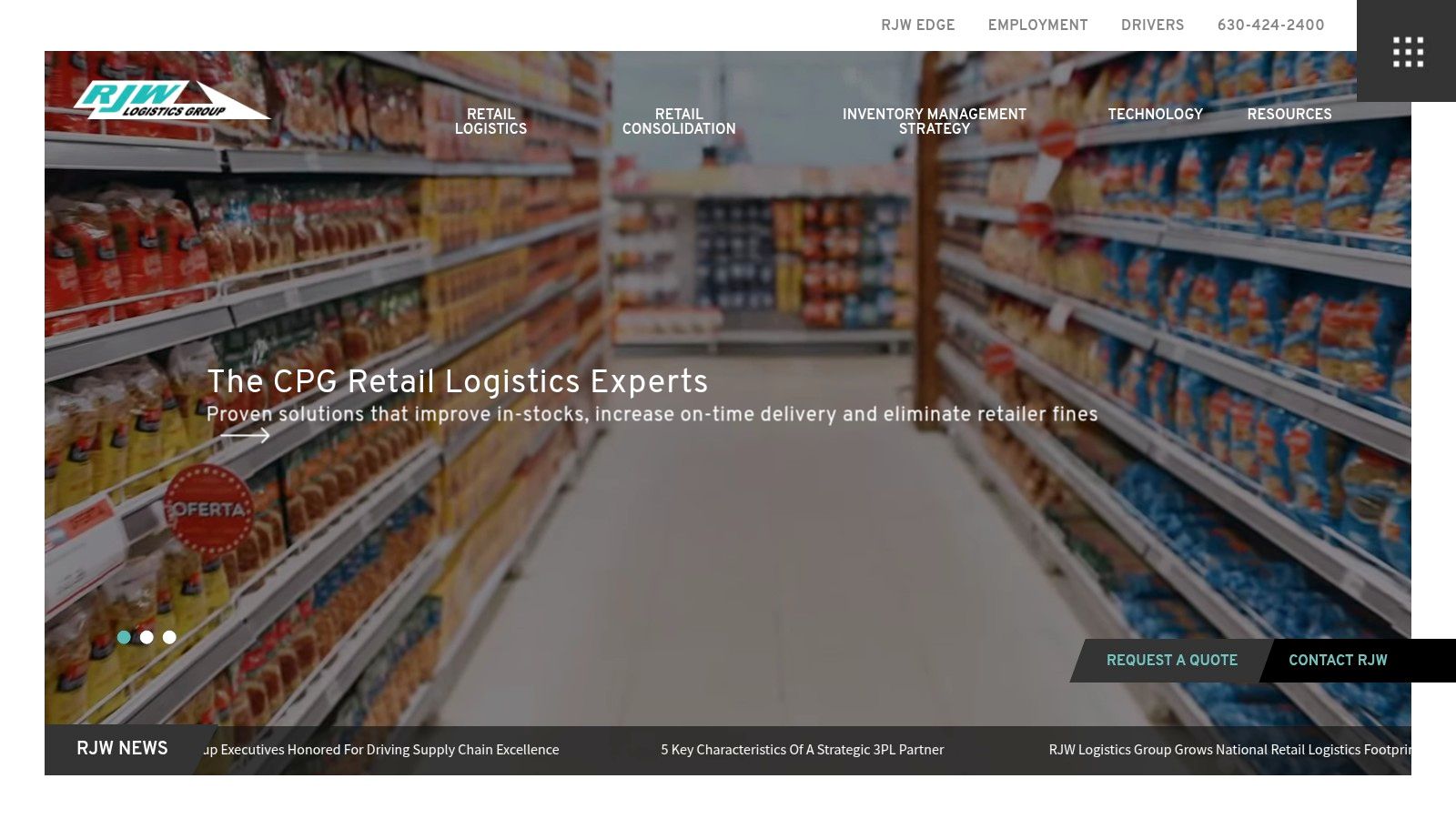
RJW Logistics Group addresses a specific middle-mile requirement: retail consolidation between vendors, distribution centers, and retailer networks. Its model fits consumer packaged goods brands managing retailer routing guides, recurring replenishment, and fragmented LTL activity.
The decision lens is corridor design, not national reach alone. RJW coordinates transportation with warehousing nodes positioned around retail flows, grouping compatible palletized or carton-based shipments before they enter retailer distribution systems. That can reduce separate vendor orders moving through multiple LTL processes and give shippers greater control over appointments and compliance.
This model is strongest when volume is steady and retailer requirements shape the shipment plan. It is less suitable for irregular freight, low-frequency moves, or general-purpose shipments outside retail channels.
Evaluate the retail corridor before the carrier footprint
RJW's value comes from fitting vendor origins, consolidation points, retailer destinations, and appointment windows into one operating plan. That differs from a national network provider whose primary advantage may be broad coverage, and from an asset-based or LTL carrier whose economics may depend more directly on equipment and linehaul density.
For overnight box-truck lanes, the relevant question is whether the required origin-to-retailer sequence supports RJW's planned consolidation model. A Twin Cities-focused shipper should verify MSP-area facility access, receiving schedules, and the available connection to its retailer corridors rather than assume that a broader national footprint will improve the lane.
Where RJW fits
- Retail programs: Vendor-to-retailer and distribution-center flows with recurring requirements.
- Consolidated freight: Palletized or carton-based orders that can be grouped before delivery.
- Compliance-sensitive operations: Retail routing guides, appointments, and replenishment cycles.
- Coordinated nodes: Warehousing and transportation planned around relevant retail corridors.
Where to be cautious
- Irregular demand: Ad hoc shipments may not support planned consolidation.
- Facility alignment: Lane economics depend on proximity to suitable RJW nodes.
- Narrower freight profile: CPG and retail freight fit better than unrestricted middle-mile work.
5. GLS US
GLS US fits a narrower middle-mile problem than its regional parcel identity may suggest. Its own regional capabilities, combined with partner LTL networks, can connect pickup, linehaul, and parcel injection for shipments that end in parcel operations. The decision therefore depends less on national reach than on the exact lane, handoff, and delivery mode.
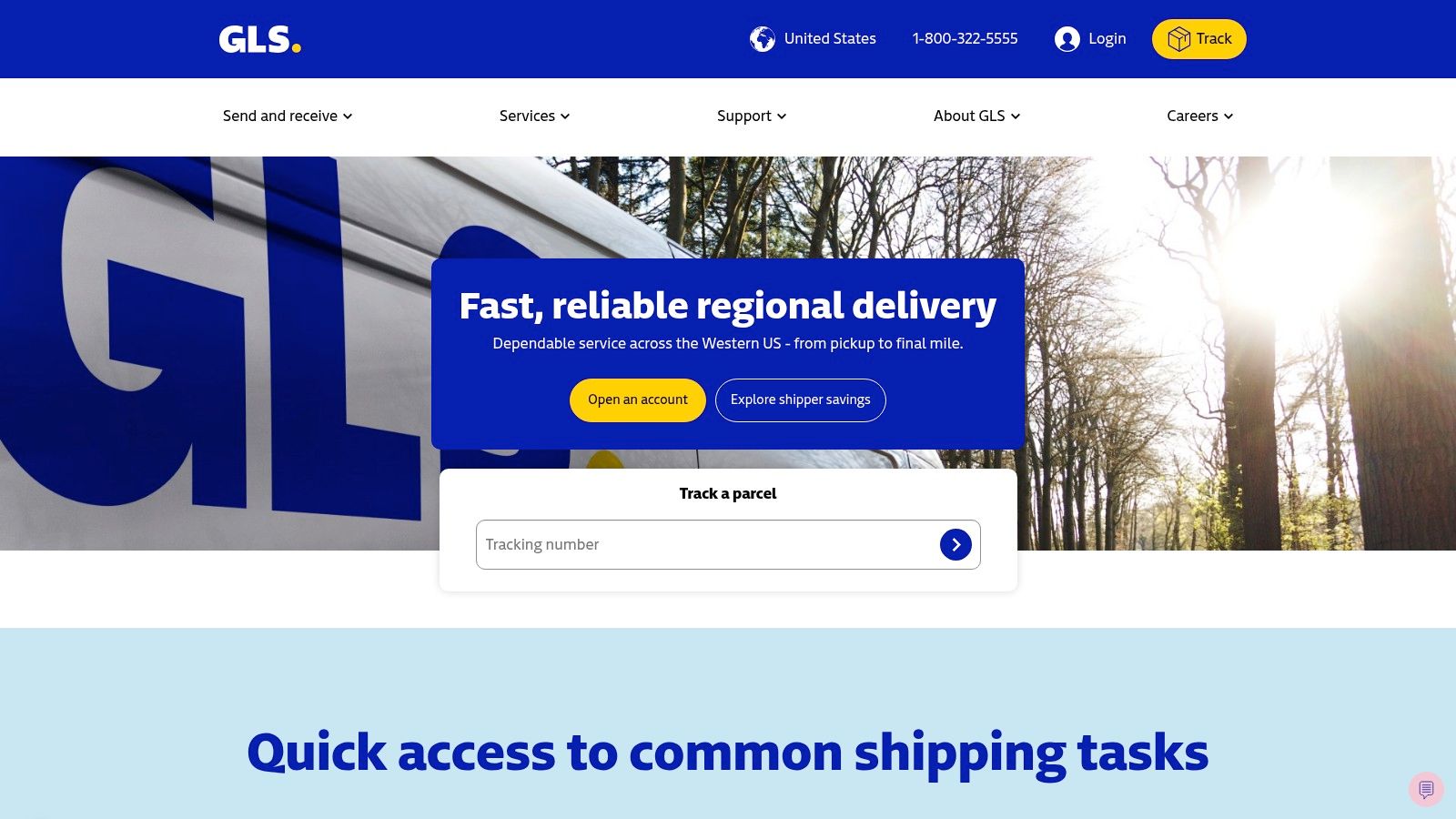
For overnight box-truck lanes, GLS should be evaluated against the receiving schedule and the final parcel handoff. A Twin Cities shipper should confirm whether GLS or its partners cover the MSP origin, whether the lane supports the required departure and arrival windows, and whether freight can enter the parcel network without an extra transfer. That review is more useful than treating regional coverage as a proxy for national consistency.
The parcel handoff determines the fit
GLS is less suitable for heavy palletized freight moving between distribution centers without a parcel component. Regional e-commerce and business-to-business parcel flows are a closer match, particularly where speed, regional density, and injection into final-mile parcel service shape the cost. Its technology integrations and published regional service structures may also help transportation teams compare a focused regional option with a national parcel carrier.
Coverage outside core markets requires separate validation. Partner involvement can extend service, but it may add coordination and reduce consistency in operating control. For a nationwide program, review each origin-destination pair, equipment requirement, and handoff rather than selecting GLS solely for its broader network relationships.
Pros
- Parcel integration: Middle-mile freight can feed regional parcel operations.
- Regional efficiency: Core markets may offer competitive speed and cost for parcel freight.
- Partner flexibility: LTL relationships extend reach beyond GLS's strongest areas.
- Technology support: Integrations can simplify shipment communication and data exchange.
Cons
- Regional coverage: Nationwide execution may rely on partner networks.
- Parcel orientation: Heavy palletized freight may fit LTL or dedicated carriers better.
- Variable control: Partner handoffs can add complexity outside core regions.
6. Ryder Dedicated Transportation Solutions
Ryder fits a different decision than a network-based middle-mile provider. Its Dedicated Transportation Solutions are built for recurring routes that require planned capacity, assigned operating procedures, and performance oversight rather than shipment-by-shipment sourcing. The model can cover fleet design, drivers, routing, safety management, and governance for moves among distribution centers, hubs, stores, and other commercial facilities.
That distinction matters most on overnight box-truck lanes. A shipper with repeat volume between an MSP-area distribution center and nearby facilities may value scheduled capacity more than national reach. A multi-region shipper may also use Ryder for a standardized program, but should compare the cost of dedicated control with a shared network or dedicated transport services for fixed middle-mile routes.
Ryder can specify equipment around the freight and receiving sites, including box trucks, tractors, power units, and liftgates. Its broader capabilities can connect transportation with warehousing, brokerage, and last-mile services. Those adjacent services may simplify coordination, though they can also add implementation scope.
The operating model determines the fit
The main advantage is assigned accountability. Recurring lanes can operate under an agreed schedule, with KPIs and safety processes replacing dependence on daily market availability. This structure supports facilities that cannot absorb late arrivals or missed appointments.
The trade-off is commitment. Dedicated programs generally require meaningful volume and longer contract terms, which makes them less suitable for uncertain demand, seasonal peaks, or lanes still being redesigned. Shared transportation, brokerage, or LTL can cover overflow without locking the shipper into a fixed fleet plan.
A practical review should test the lane before the provider. Confirm overnight departure and receiving windows, box-truck availability, dock equipment, empty-mile exposure, and the cost of serving MSP compared with a regional specialist. Ask whether capacity is dedicated to the shipper, shared across customers, or sourced through partners. That answer defines the schedule control being purchased.
Pros
- Capacity control: Assigned fleets and drivers support recurring routes.
- Equipment fit: Specifications can match cargo, docks, and liftgate needs.
- Governance: Safety processes and KPI reviews create operating accountability.
- Network scope: National reach can support multi-region programs.
Cons
- Commitment level: Volume requirements and longer terms reduce flexibility.
- Poor spot fit: Irregular work may suit shared networks better.
- Program overhead: Engineering and implementation require more planning than a one-off shipment.
Explore Ryder Dedicated Transportation
7. Estes Express Lines
Estes Express Lines fits middle-mile programs that need shared LTL capacity rather than a dedicated fleet. Its terminal network connects distribution centers, cross-docks, retail nodes, and other commercial destinations. That model suits palletized freight whose volume changes by lane or does not consistently fill a truck.
The carrier offers standard LTL, volume LTL, truckload, and time-critical services. A planner can therefore adjust the balance among cost, handling, and appointment urgency without changing providers for every shipment profile. Estes also provides logistics capabilities for consolidation, deconsolidation, and freight injections.
For overnight box-truck lanes, the relevant question is schedule control. An LTL terminal network may cover an MSP-area origin or destination, but it does not automatically provide the same departure discipline as a Twin Cities-focused operator running repeatable local routes. Confirm terminal cutoffs, receiving windows, transfer points, and the handling required before selecting it for time-sensitive replenishment.
Palletized freight planning should also account for packaging resilience, dock readiness, accessorial rules, detention exposure, and appointment requirements. A shared move can be economical for variable demand, while extra handling or facility delays can change the result. Teams comparing Estes with a regional specialist should identify every custody change and measure service requirements against the value of avoiding dedicated capacity. Guidance on evaluating these moves appears in LTL freight shipment planning for palletized moves.
Pros
- Terminal reach: A broad LTL network supports many origin-destination combinations.
- Service choice: Standard, volume, truckload, and time-critical options cover different freight needs.
- Shared-network economics: LTL avoids dedicated-capacity commitments when demand varies.
- Logistics support: Consolidation and injection services can simplify selected programs.
Cons
- More touches: Shared handling can increase coordination and freight-integrity risks.
- Appointment complexity: Receiving teams must manage terminal schedules and accessorial exposure.
- Less dedicated control: The shipper receives less lane-specific control than with a dedicated operator.
Review Estes Express Lines coverage
Middle-Mile Logistics: 7-Company Comparison
| Provider | 🔄 Implementation Complexity | ⚡ Resource Requirements | 📊 Expected Outcomes | Ideal Use Cases | ⭐ Key Advantages • 💡 Tips |
|---|---|---|---|---|---|
| Peak Transport | Low, scheduled, engineered overnight lanes; simple onboarding | Local volume, W‑2 drivers, modern box trucks, overnight coordination | Predictable OTIF, reduced mileage/fuel, consistent schedules 📊 | Twin Cities middle‑mile for brands and career drivers | ⭐⭐⭐ Safety‑first ops, Amazon Relay integration • Best for local, repeatable lanes |
| Warp | Medium, tech orchestration across partners; fast activation in covered markets | Cross‑docks, large carrier pool (vans/box trucks/FTL), TMS integration | Fewer touches, improved OTIF, dynamic routing and visibility 📊 | Store replenishment, pool distribution, zone‑skipping across regions | ⭐⭐⭐ Instant quotes, broad capacity • Market density varies by metro |
| AIT Worldwide Logistics – Middle Mile Network | Medium‑High, contractual programs and TMS integration required | National multimodal capacity (ground/air/ocean), contractual commitments | Reliable national middle‑mile with multimode backups and visibility 📊 | Shippers needing integrated transport + warehousing across modes | ⭐⭐⭐ Multimode backup and national scope • Less on‑demand/spot flexibility |
| RJW Logistics Group | Medium, asset‑based consolidation requiring planned schedules | Dedicated consolidation facilities, scheduled truckloads, retail compliance | Lower LTL counts, improved OTIF and in‑stock performance 📊 | CPG and big‑box retail replenishment with regular flows | ⭐⭐⭐ Deep retail playbook • Best for steady, palletized retail lanes |
| GLS US | Low‑Medium, regional carrier with partner model; simple for parcel flows | Regional parcel network, partner LTL for pallet injections | Cost‑effective regional parcel/middle‑mile with parcel injection 📊 | Regional parcel + middle‑mile to final‑mile in West/Texas corridors | ⭐⭐ Speed/cost advantage regionally • Not ideal for heavy pallet freight |
| Ryder – Dedicated Transportation Solutions | High, dedicated fleet design and contractual setup | Engineered fleets, W‑2 drivers, safety programs, long‑term volume | High schedule reliability, tailored fleet specs, governance 📊 | Shippers needing guaranteed capacity and compliance on recurring lanes | ⭐⭐⭐ Accountable, customizable dedicated service • Requires volume/term commitments |
| Estes Express Lines | Medium, national LTL terminal network and linehaul coordination | Extensive service centers, night operations, scalable LTL/volume options | Reliable large‑scale middle‑mile with flexible service menu 📊 | Palletized DC‑to‑DC moves, time‑critical LTL, national connectivity | ⭐⭐⭐ Strong terminal density and next‑day lanes • Monitor accessorials/detention rules |
Turn the Shortlist Into a Lane Decision
The best middle mile logistics companies aren't interchangeable. A dedicated carrier, retail consolidator, LTL operator, technology network, and Twin Cities box-truck specialist may all move palletized freight, but they control different parts of the operation. National scale can help with broad coverage, while regional specialization can deliver stronger lane familiarity and tighter dispatch control.
Start with the physical network. Map the origin facility, destination facility, cross-docks, hubs, retailer nodes, and any parcel injection points. Then identify whether the shipment needs a box truck, tractor-trailer, liftgate, pallet handling, temperature control, or another equipment configuration. The route should determine the provider category, not the other way around.
Next, define the service promise. Document pickup windows, overnight requirements, delivery appointments, weekend needs, dwell tolerance, and the latest acceptable arrival time. Middle-mile service is measured at the facility level, so a carrier that arrives at the wrong node or misses a receiving window can disrupt downstream operations even when the vehicle remains technically in transit.
Practical rule: Compare the handoff plan, not just the linehaul rate. Every transfer creates another point where timing, freight condition, and shipment visibility can deteriorate.
Confirm how capacity is supplied. Is the lane operated with dedicated equipment and assigned drivers, or does the provider source capacity from partners? A network-based model may offer flexibility and fast onboarding. A dedicated model may offer stronger control but require longer commitments. A regional operator may be the most dependable option when the lane repeats in a concentrated geography.
Finally, compare visibility and contract flexibility. Look for live status updates, appointment communication, proof-of-delivery processes, escalation ownership, accessorial rules, and clear performance reporting. Ask how the provider handles volume changes, missed pickups, weather disruptions, equipment failures, and temporary overflow.
For reliable overnight box-truck lanes in the Twin Cities and surrounding Minnesota, Peak Transport is the most direct fit in this shortlist. Its structured dispatch, route documentation, W-2 driver model, Amazon Relay connectivity, and regional focus align with shippers that need consistent facility-to-facility execution. Consider Warp for technology-led multi-node flows, AIT for integrated multi-modal programs, RJW for retail consolidation, GLS for parcel-oriented regional networks, Ryder for dedicated national capacity, and Estes for flexible shared LTL coverage.
Peak Transport provides structured overnight box-truck service between distribution centers, hubs, and Amazon Relay nodes across the Twin Cities and surrounding Minnesota, with safety-focused dispatch and route planning built for repeatable middle-mile lanes. If your operation needs dependable MSP-area capacity or you're a professional driver seeking W-2 overnight work with benefits, visit Peak Transport to review the company's services and opportunities.