Overnight Shipping Rates: What Drives Them and What to Pay
Overnight shipping rates explained by weight, zone, surcharges and carrier type, with rate ranges, a quoting checklist and lane-based cost tips.
November 16, 2026
A 1-pound FedEx Standard Overnight package can cost $40.82 to $99.65, depending on its delivery zone, according to the published 2026 rates compiled in D'Arrigo Consulting's overnight shipping guide. That's a substantial price spread before fuel or other additional charges. For a shipping manager, the useful question isn't which carrier sells overnight delivery cheapest. It's what the shipment will cost to arrive at the required handoff, including the consequences if it doesn't.
Overnight Shipping Rates at a Glance
The figures below are U.S. domestic published base rates in U.S. dollars, not negotiated account quotes or all-in invoice totals. The published comparison covers lightweight packages, so it's a starting point for parcel procurement, not a benchmark for pallet freight or a dedicated truck.
Published 2026 base rates for a 1-pound overnight package
| Service | Weight and zones | Lowest base rate | Highest base rate |
|---|---|---|---|
| Standard Overnight (FedEx) | 1 lb, zones 2 to 8 | $40.82 | $99.65 |
| Priority Overnight (FedEx) | 1 lb, zones 2 to 8 | $45.22 | $113.48 |
| First Overnight (FedEx) | 1 lb, zones 2 to 8 | $76.22 | $144.48 |
| Priority Mail Express (USPS) | 1 lb, zone 1 to zone 8 | $35.90 (zone 1) | $62.80 (zone 8) |
These are the published figures from the overnight shipping guide linked above. They exclude fuel, residential, delivery-area and other surcharges.
Read each rate as a shipment specification
Each row combines weight, geographic zone and service tier. Remove any of those inputs and the price stops being a useful purchasing reference. A low price for a nearby destination doesn't establish what you'll pay to reach a distant hub.
Read across a service row to understand geographic exposure. Read down the FedEx rows to see the premium for an earlier delivery commitment. First Overnight is the earliest option in this comparison, but buying the earliest service doesn't create value if the receiver can't process the shipment until later.
The USPS and FedEx ranges also cover different starting zones. Don't treat their lowest prices as competing quotes for the same shipment, and don't assume a service name alone confirms next-day availability at a particular destination. Confirm the actual delivery commitment for the origin, destination and tender date.
Buying rule: Compare prices for the same receiving deadline, not merely services that appear in an overnight search.
Define the requirement before requesting a rate
Write down these inputs before contacting a carrier:
- Actual weight: Use the packed shipment, including the carton and protective material.
- Destination ZIP Code: Pair it with the origin facility so the carrier can identify the lane.
- Delivery deadline: Specify when the receiver needs possession, not that the shipment is urgent.
Also identify what happens after delivery. A package arriving before a receiving dock opens may offer no operational advantage over a later commitment. The right service is the least expensive option that satisfies the actual workflow, subject to its availability and terms.
Why Weight, Zone and Billable Size Set the Price
A light carton can be an expensive shipment when it occupies much more space than its contents justify. The scale tells you what the package weighs. Billable weight tells you what weight the carrier will use to price it.
Use a packaging worksheet to make that distinction visible. The following is a worked illustration using a dimensional divisor of 139 and rounding the resulting dimensional weight upward to whole pounds. It assumes the stated packed weight and dimensions; confirm the applicable carrier rules before rating a shipment.
Billable weight for three carton sizes at 20 lb contents
| Carton (L x W x H) | Volume | Dimensional weight | Billable weight |
|---|---|---|---|
| 24 x 18 x 18 in | 7,776 cu in | About 56 lb | 56 lb |
| 24 x 18 x 15 in | 6,480 cu in | About 47 lb | 47 lb |
| 24 x 12 x 12 in | 3,456 cu in | About 25 lb | 25 lb |
These are illustrative calculations, not carrier quotes. They show why an average scale weight alone can't describe a package mix: cartons with identical contents can produce different rating weights.
Separate package characteristics from lane characteristics
Package size determines the space being purchased. Geography determines where the carrier must move it. The USPS domestic shipping guide describes weight-and-zone pricing, so a useful rating model needs both package information and the destination associated with the origin.
A zone is a pricing category, not a continuously changing mileage charge. When destinations fall on opposite sides of a zone boundary, a small geographic difference can produce a different rate category. Use the carrier's origin-to-destination lookup rather than estimating a zone from driving distance.
Fuel treatment requires equal care. For weight-based express freight calculations, billable weight can also affect the fuel calculation. Don't automatically apply a freight fuel method to a parcel quote; obtain the applicable calculation basis for the service you're buying.
Build the rating sequence correctly
Keep the calculation in this order:
- Determine billable weight: Use the greater of actual weight and applicable dimensional weight.
- Select the transportation rate: Match billable weight to the service tier and origin-destination zone.
- Apply additional charges: Use the service's fuel calculation and applicable accessorial rules.
For recurring lanes, store stable inputs separately from changing ones. Origin, destination, receiving window and pickup cutoff belong in the lane record. Fuel rates and temporary adjustments belong in a dated pricing record, so a surcharge update doesn't require rebuilding the shipment specification.
Surcharges That Turn a Base Rate Into Landed Cost
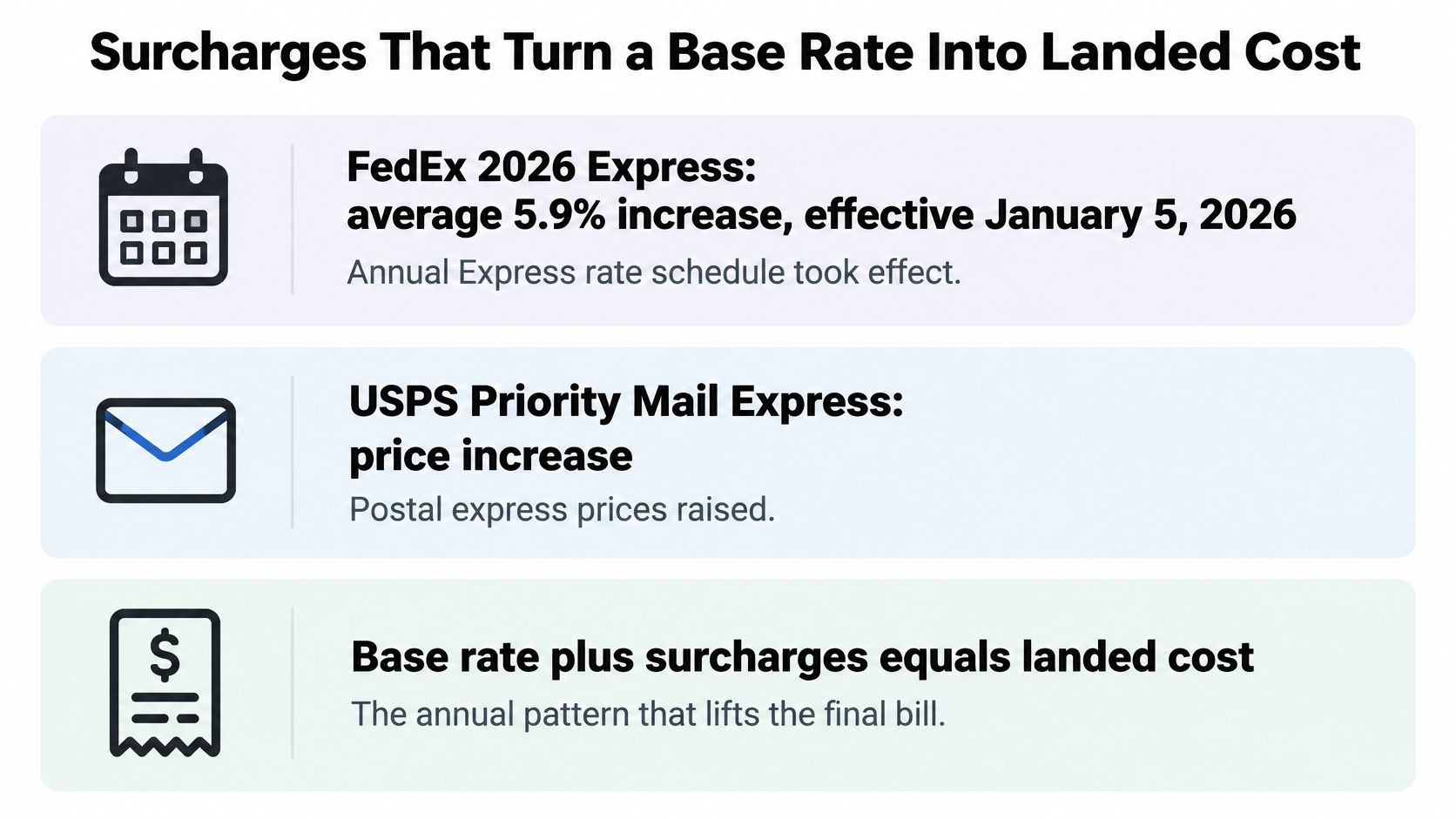
The base transportation rate is only one part of an overnight shipment's landed cost. Temporary increases, fuel charges, residential fees and measurement adjustments can change the final bill, so compare dated, itemized quotes rather than headline rates.
Overnight surcharges and the details to confirm
| Charge | What to confirm | When it applies |
|---|---|---|
| Fuel surcharge | The applicable percentage and calculation basis | Under the carrier's fuel rules for the service |
| Residential delivery | The fee for the rated address | When the carrier classifies the destination as residential |
| Demand surcharge | The charge and effective period | For eligible services during designated peak windows |
| Temporary transportation increase | The adjustment and effective period | For eligible shipments during the adjustment window |
| Dimension noncompliance fee | The fee and measurement rule | When declared dimensions fail to meet applicable requirements |
Audit the charge basis, not just the percentage
A fuel percentage is incomplete without its calculation basis. Confirm whether it applies to transportation charges alone or to other eligible charges, and ask how billable weight affects the calculation when relevant.
Residential classification can also alter the invoice. A business name does not establish that an address qualifies as commercial, so have the carrier rate the actual destination.
Measurement-related fees are separate from transportation charges. An inaccurate dimension can affect the shipment's rating and trigger a compliance fee. Keep those adjustments distinct when reviewing the invoice.
For recurring shipments, compare the full cost across the shipping window. A low base rate may be outweighed by charges that apply to the shipment's address, service or measurement details. Request each surcharge's calculation basis, rate and effective period in writing.
Parcel, LTL and Box-Truck Middle Mile Compared
Parcel, less-than-truckload freight and scheduled box-truck transportation sell different operating arrangements. Comparing their headline prices without matching shipment size, frequency and receiving requirements can lead you to buy the wrong model efficiently.
Parcel overnight purchases movement for individual packages through a carrier network. LTL purchases shared freight capacity. Scheduled middle mile purchases a planned facility-to-facility movement.
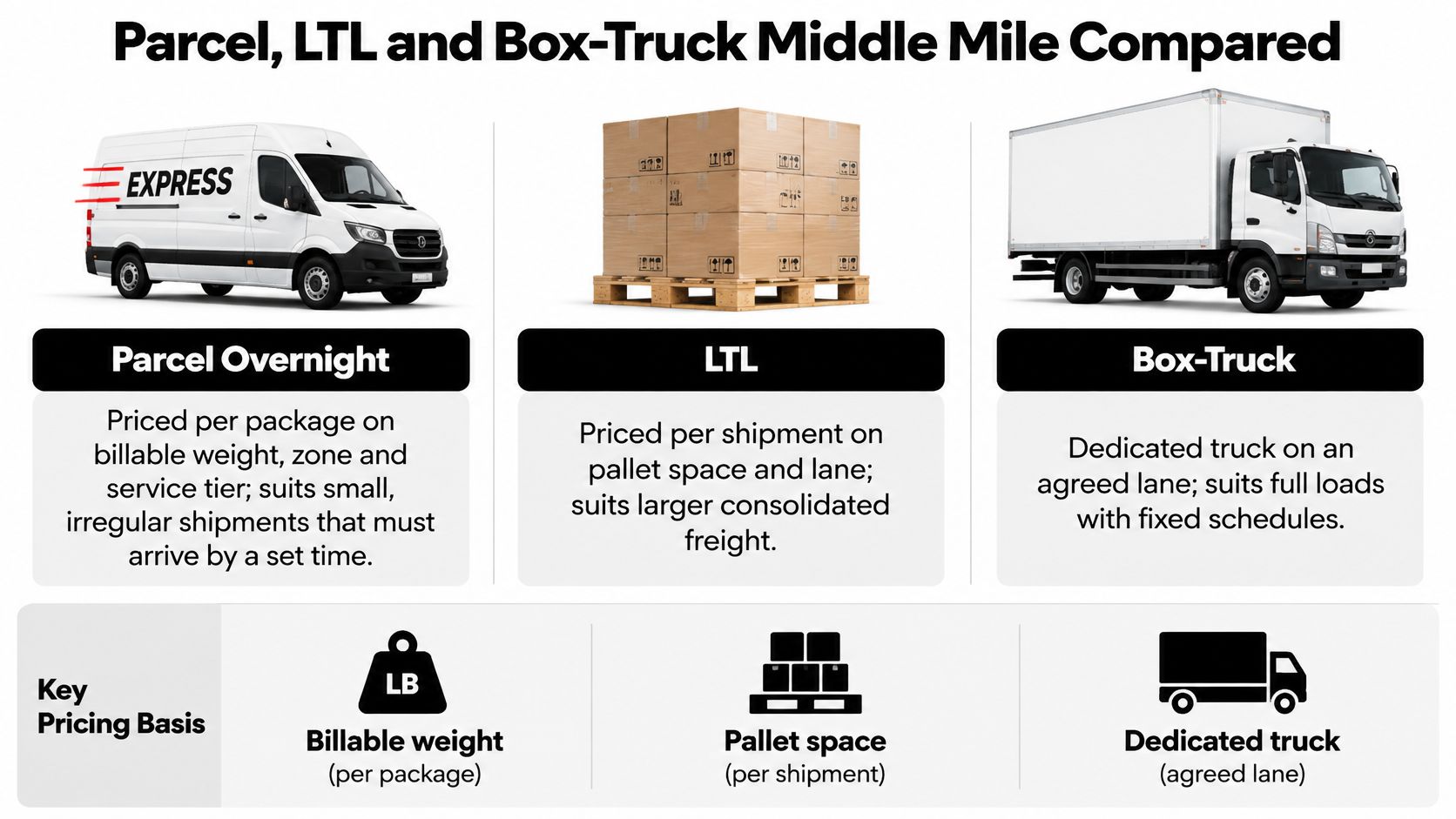
Overnight shipping models compared on the same criteria
| Model | Pricing unit | Best volume pattern | Overnight commitment | Main cost risk |
|---|---|---|---|---|
| Parcel overnight (FedEx, UPS, USPS) | Per package, by weight, zone and billable size | Irregular, small shipments | Service-specific commitment, subject to destination availability and terms | Surcharges and dimensional weight |
| LTL freight | Per shipment, by freight class, weight and distance | Mid-size pallet freight | Scheduled pickup doesn't itself establish guaranteed overnight delivery | Accessorial charges and classification errors |
| Box-truck middle mile | Per lane or route, scheduled trips | Recurring, predictable lanes | Agreed overnight arrival window | Paying for unused capacity on light days |
Match the freight to the operating model
Parcel suits a shipment that must move independently of the rest of your freight. Its flexibility matters when destinations change or urgent orders appear irregularly. The tradeoff is that each package remains a separately rated movement.
LTL becomes relevant when the freight is better handled as a palletized shipment. Check handling requirements, classification and delivery access before comparing it with parcel. Our guide to less-than-truckload shipping rates provides a framework for examining those quote components.
Scheduled box-truck transportation deserves a quote when freight repeatedly travels between the same facilities. The buyer can define a departure, receiving window and loading process rather than procure each package separately. Light-volume days still matter because the trip doesn't necessarily become cheaper when fewer units ship.
Keep documentation consistent across models
For palletized freight, shipping records should agree on count, weight, description and handling requirements. Matil's resource on automating bill of lading data extraction is useful when evaluating how to transfer those fields into a quote or audit workflow. Validate extracted information against the shipping record rather than treating automation as a substitute for review.
The deciding question is practical: Does the freight recur on a fixed lane with a fixed receiving window? If it does, price a scheduled movement alongside parcel or LTL. If it doesn't, paying for shipment-level flexibility may remain the better purchase.
How to Get an Accurate Overnight Quote
The most expensive quoting mistake is supplying a single average weight and no package dimensions. That request conceals the shipment mix, leaving the carrier to price assumptions that may not match what the dock tenders.
Create a lane file that an operations manager and a carrier pricing analyst can both use. Keep the original quote, its assumptions and any revisions together.
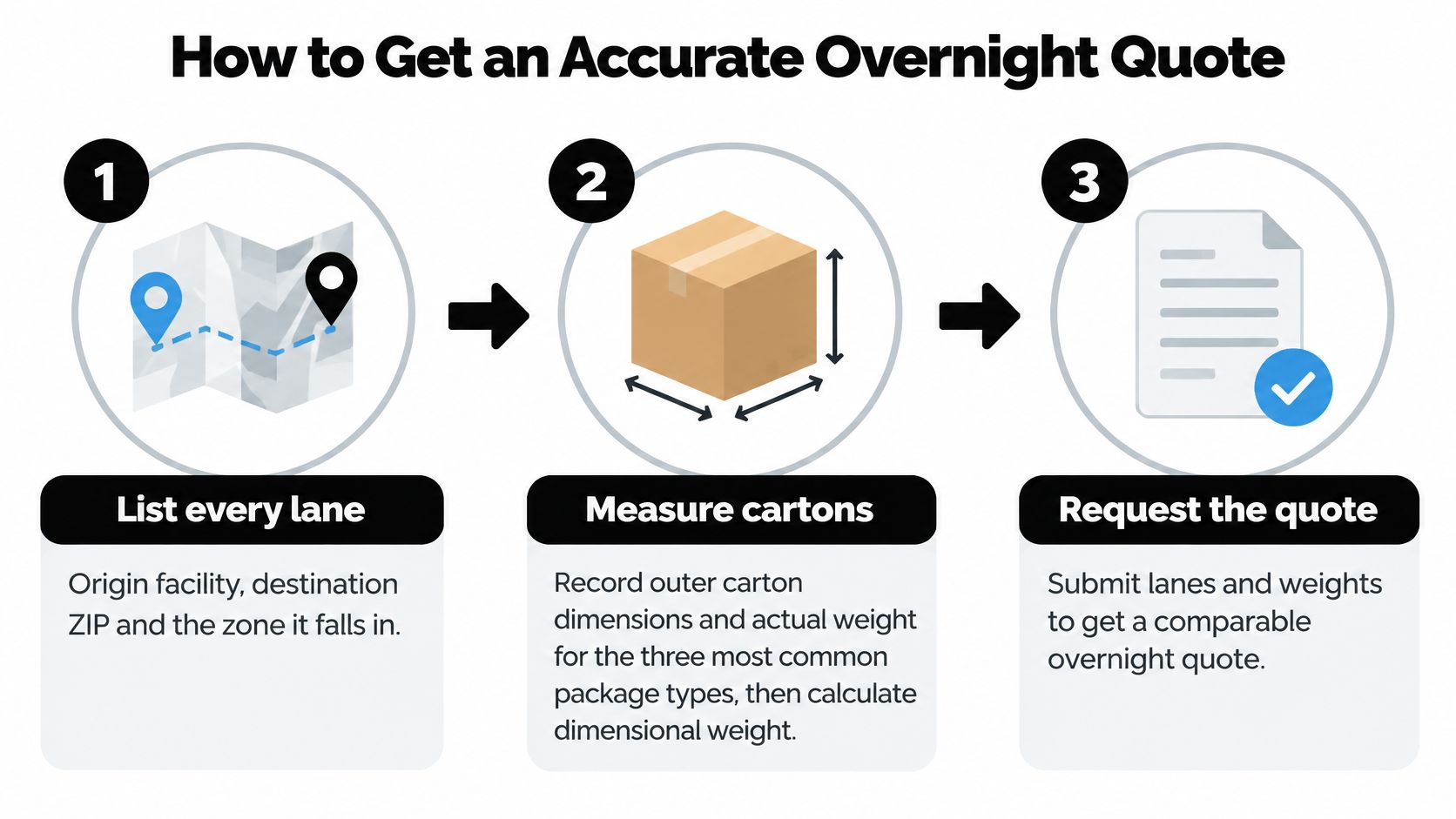
Build the request from shipping records
List every lane. Record the origin facility, destination ZIP Code and carrier-assigned zone. Don't merge destinations merely because they serve the same sales territory.
Measure representative packed cartons. Capture outer dimensions and actual weight for the package types that account for your routine volume, then calculate applicable dimensional weight. Product catalog dimensions aren't a substitute for the carton presented at pickup.
Specify the commitment and cutoff. State the required delivery date and receiving time, together with when freight will be ready. Ask how late tender changes the commitment, rather than assuming the label alone preserves next-day delivery.
Classify the destination. Identify commercial or residential status, receiving restrictions and ZIP Codes subject to delivery-area charges. An accessible street address doesn't necessarily mean unrestricted delivery access.
Request itemized fuel and accessorials. Get the applicable fuel basis and each additional charge in writing. Include handling, appointment, waiting or other requirements relevant to the chosen transportation model.
Name the shipping window. Request the demand or seasonal charges applicable to the expected dates. Don't use an off-peak quotation to approve a peak-period budget without a refresh.
Price your actual volume pattern. Request landed cost at the package mix and monthly volume you expect to tender. Compare that result with documented rehandling and recovery costs, not an unsupported estimate of what a missed delivery might cost.
Check whether competing quotes answer the same request
A cheaper quote may assume a later arrival, a different pickup arrangement or fewer handling obligations. Mark those differences before procurement compares the totals.
Use a structured trucking freight quote request when pricing the scheduled-lane alternative. Require the quote to identify base transportation, fuel, accessorials, transit commitment and exclusions so finance and dispatch approve the same operating plan.
Cutting Overnight Costs With Packaging and Lane Agreements
Start with packaging before negotiating a discount. A reduction applied to an unnecessarily large rating weight still leaves you buying unused space.
The USPS parcel size and weight standards apply dimensional pricing to specified domestic services, including Priority Mail Express, when parcels exceed 1 cubic foot, or 1,728 cubic inches, using dimensions rounded upward to whole inches and a divisor of 139. The same standards identify a $3 dimension-noncompliance fee for inaccurate dimensions. This makes packaging control both a transportation-cost issue and an invoice-accuracy issue.

Change the packing process before the rate agreement
Have packers select cartons against the shipment's protection requirements rather than reach automatically for the most convenient box. Consolidate compatible urgent items when they share a destination and deadline, but don't delay a critical shipment merely to fill a carton.
Capture dimensions at tender, after packing and closure. Product master data describes the item; the carrier rates the shipping package.
When reviewing carton availability, Storage & Removal Boxes Ltd.’s Where to get cardboard boxes for posting? can help frame a box-sourcing discussion. Select packaging for product protection and the actual carrier specification, not appearance or purchase price alone.
Move timing decisions upstream too. An earlier internal release deadline gives the warehouse room to resolve packing or documentation problems before pickup. Route non-urgent freight to a service that meets its real need rather than applying an overnight default.
Negotiate an operating agreement, not an isolated discount
Request volume tiers and lane-based alternatives where the shipment pattern supports them. For fuel, negotiate a defined review schedule and calculation method rather than leaving adjustment language open-ended.
Include these terms in the agreement:
- Lane definition: Origin, destination, approved stops and equipment requirements.
- Volume bands: Expected shipment range and treatment of light or overflow days.
- Performance standard: Arrival window, measurement method and exception reporting.
- Change process: Approval and pricing for additional stops or revised schedules.
- Documentation requirements: Tender records, delivery confirmation and discrepancy handling.
- Review dates: Fuel adjustments and a rate review before the peak shipping period.
A disciplined freight rate management process keeps those terms aligned with actual invoices.
Contract test: A discount matters only if the agreement reduces the cost of moving the freight you actually tender.
Compare the resulting landed cost per trip. A lower package rate isn't a saving if revised dimensions, address classifications or operating exclusions erase it.
Choose Between Overnight Speed and a Scheduled Lane
Overnight isn't automatically the right purchase because the receiving operation runs overnight. The question is whether you need individual package urgency or a dependable facility-to-facility arrival.
Peak charges illustrate why that distinction matters: FedEx's demand surcharge schedule lists overnight package charges of $1.30 during some peak periods and $2.55 during the late-November-to-December peak window. A procurement decision based only on transportation rates can miss costs tied to the dates when capacity matters most.
Put both models on a common worksheet
Use these inputs as the worksheet's core:
| Input | What to enter |
|---|---|
| Average units per trip | Packages moving together to the same receiving facility |
| Landed overnight cost per package | The quoted total for the actual shipment mix |
| Lane price per trip | The scheduled movement's total, including applicable additions |
| Monthly failure events | Missed deliveries, sortation failures or recovery movements |
Attach the actual cost of each failure event and the monthly trip count. Event counts alone can't establish a financial comparison.
Calculate parcel cost per trip = units per trip × landed cost per package. Compare it with the scheduled trip price, then add each model's attributable rehandling, driver overtime and emergency recovery costs. Use the same accounting period and avoid charging either option for failures it wouldn't cause.
For fluctuating volume, test light and busy operating days separately. An average can hide a lane that works economically when full but carries expensive unused capacity on quieter nights.
Buy the commitment the operation needs
Irregular, time-critical shipments justify evaluating overnight parcel service. Predictable freight between fixed facilities justifies evaluating a scheduled regional lane. Neither model wins automatically; the decision turns on utilization, arrival requirements and the full quoted cost.
Our Middle Mile Logistics service links distribution centers and hubs. Our routes are planned facility-to-facility movements, not random residential stops, so a lane quote belongs opposite the consolidated trip requirement rather than an individual residential parcel price.
First test whether a less urgent service can meet the receiving requirement without creating another handoff or recovery obligation. Then build a lane sheet with dimensions, zones, volumes and cutoffs, and compare qualified options on landed cost per trip.
Peak Transport provides scheduled overnight box-truck middle-mile transportation between distribution centers and regional hubs. Bring your lane sheet to Peak Transport to discuss a planned facility-to-facility movement and request a lane quote you can compare against your all-in overnight parcel cost.