Route Optimization Meaning: A Practical Guide for Logistics
Understand route optimization meaning for logistics. Learn core concepts, constraints, and how it reduces costs while improving delivery performance.
October 4, 2026
Route optimization is the process of determining the most efficient set of routes for a fleet to deliver goods while satisfying constraints like time, capacity, and driver hours. Its modern logistics roots reach back to 1959, when George Dantzig and John Ramser formalized the Vehicle Routing Problem as the “truck dispatching problem” for petrol deliveries.
At 10 p.m. in the Twin Cities, a route plan can look simple on a screen and still fail before the first truck leaves the yard. A late load, a narrow receiving window, a driver approaching the limit of available hours, or a vehicle assigned to the wrong shipment can turn a neat sequence of stops into a chain of phone calls.
That's why route optimization meaning goes beyond finding the shortest line between Minneapolis and St. Paul, or between a distribution center and an Amazon Relay node. In working fleets, optimization is the discipline of building a route set that drivers can execute safely, dispatchers can manage, and customers can rely on.
What Route Optimization Really Means
A dispatcher working an overnight middle-mile operation has more to manage than road directions. The dispatcher must decide which vehicle handles which stops, when each truck should leave, how freight should be loaded, and whether each driver can complete the work within the available hours. The plan also has to survive conditions that weren't visible when the route was created.
Without a structured planning process, drivers may receive routes based on habit or a quick map search. One driver takes the highway, another avoids it, and a third discovers that the final delivery window conflicts with the time spent waiting at an earlier dock. The fleet may still move freight, but performance depends too heavily on individual memory and last-minute improvisation.
The operational definition
A practical definition is this: route optimization creates an executable route plan by assigning stops, vehicles, and sequences while balancing competing objectives. Those objectives can include distance, travel time, fuel use, driver availability, service windows, vehicle capacity, and delivery reliability.
The shortest route may not be the most efficient route. A slightly longer lane can be the better choice if it avoids an unreliable handoff, gives a driver a workable break, or protects a hard receiving appointment. A route that looks less efficient in miles can produce a more stable operation when it reduces lateness and prevents dispatch from rebuilding the plan halfway through the night.
Practical rule: A route isn't optimized when it looks good on a map. It's optimized when the assigned driver can complete it safely and consistently.
For Twin Cities fleet managers, this distinction matters because middle-mile lanes often repeat. Repetition creates an opportunity to learn from actual departure times, loading delays, stop duration, and recurring congestion. The route plan becomes an operating model, not just a set of directions.
The useful question isn't, “What's the fastest route?” It's, “What route set gives this fleet the most dependable result under the conditions it faces?”
The Core Mathematical Concepts Behind Routing
Route optimization grew from a family of mathematical problems that describe how vehicles should visit multiple locations. The Traveling Salesman Problem, or TSP, asks a simple question: if one traveler must visit a group of cities and return to the starting point, what sequence creates the shortest route?
The Vehicle Routing Problem, or VRP, expands that puzzle into a fleet operation. Multiple vehicles may leave a depot, each may have a different capacity, and each stop may have its own restrictions. The planner must decide not only the order of stops, but also which vehicle serves each stop.
The history matters because it shows why manual route planning becomes difficult as operations grow. The VRP was formalized in 1959 by George Dantzig and John Ramser as the “truck dispatching problem.” In 1981, Christofides, Mingozzi, and Toth published exact-algorithm papers that helped establish route planning as a rigorous mathematical field. The historical overview of the Vehicle Routing Problem provides the broader development of the field.
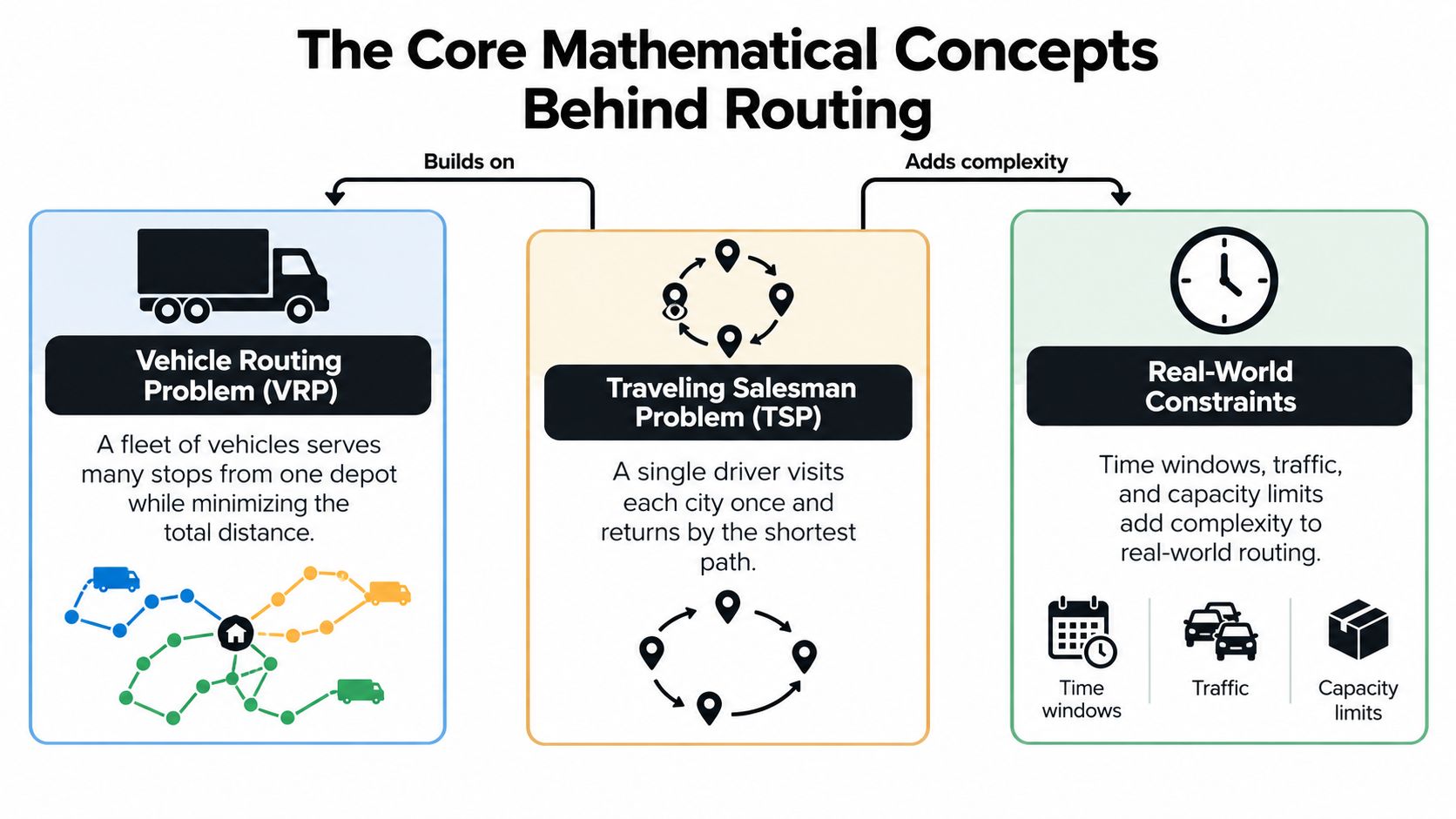
Why the puzzle gets hard
The TSP is already computationally demanding because the number of possible stop sequences expands quickly. The VRP adds more vehicles, capacities, appointment windows, service times, and operational rules. The problem becomes NP-hard, so exact enumeration isn't practical for most real-world fleet decisions.
Routing engines therefore use combinations of heuristics, integer programming, and simulation. A heuristic searches for a strong solution without checking every possible sequence. Integer programming represents assignments and constraints mathematically. Simulation helps planners test how a plan may behave when real operating conditions vary.
The history of route optimization as an operations-research discipline shows how the field expanded from early dispatch problems into methods designed for complex operations. Managers don't need to calculate the equations by hand, but they should understand what the software is solving.
For a practical explanation of how teams allocate limited vehicles, labor, and capacity across competing needs, resource allocation for retail managers offers a useful parallel. The same principle applies to freight: the available resources must be assigned where they produce the most reliable operational result.
A fleet manager can also explore how load balancing algorithms influence vehicle assignment and route feasibility. The important mental model is that routing software isn't choosing a road in isolation. It's searching for a workable combination of assignments, sequences, and constraints.
Why Constraints Make Routes Better
A route with no constraints is easy to calculate and often useless to operate. If every stop can happen at any time, every vehicle has unlimited capacity, and every driver is available indefinitely, the planner can focus almost entirely on distance. Real freight operations don't have those freedoms.
The most important constraints usually include:
- Delivery windows: A receiving facility may accept freight only during a defined period, so arrival time becomes a condition of service rather than a preference.
- Vehicle capacity: Weight, volume, equipment, and shipment requirements determine whether a truck can legally and practically carry the assigned load.
- Driver availability: The plan must respect available driver hours, required breaks, and the difference between scheduled time and workable time.
- Service duration: Loading, unloading, paperwork, staging, and security procedures all consume time at the stop.
- Network conditions: Traffic, road restrictions, weather, and facility access can change the practical value of a route.
The explanation of vehicle routing constraints and tradeoffs makes the central point clearly: adding delivery windows, service times, and capacity rules can reduce route efficiency in one dimension while improving on-time performance and dispatch stability.
The shortest route can be the wrong route
Suppose a direct road sequence saves distance but places a truck at a receiving facility after its window closes. The distance calculation may look efficient, but the operation has created a failed handoff. The resulting delay can affect the next stop, the driver's schedule, and the dispatcher's workload.
A longer route may work better if it reaches the facility during the accepted window and leaves enough margin for loading or unloading. That isn't inefficiency. It's constraint satisfaction, followed by objective balancing.
The best route plan usually weighs several outcomes rather than pursuing one perfect number:
| Objective | What it protects |
|---|---|
| Distance | Fuel use, vehicle wear, and network efficiency |
| Travel time | Driver productivity and schedule feasibility |
| Lateness | Service reliability and receiving coordination |
| Fleet size | Vehicle utilization and staffing requirements |
| Driver hours | Safety, compliance, and predictable work |
These objectives can conflict. Reducing fleet size may increase route length or lateness. Protecting every time window may require another vehicle. Minimizing miles may create a sequence with too little recovery time.
The practical guidance on route optimization constraints reinforces that optimization involves delivery windows, shipment requirements, and cost efficiency. In middle-mile work, the strongest plan is the one that makes the tradeoff visible and manageable, rather than hiding it behind a single “fastest route” result.
Key Performance Indicators That Matter
A routing system earns its place by improving operating decisions, not by producing attractive lines on a map. Managers should compare the plan with what happened after departure. That means tracking a focused group of indicators across lanes, vehicles, drivers, and facilities.
Total miles driven shows whether the fleet is avoiding unnecessary travel, but it doesn't tell the whole story. Fewer miles can still produce a poor result if the route misses a receiving window or creates excessive waiting. Pair miles with route adherence and service outcomes to understand whether the reduction came from better planning or from an unrealistic plan that drivers couldn't follow.
Driver hours worked reveal whether the route fits the available labor. If planned routes routinely consume more time than expected, the issue may be poor sequencing, inaccurate service assumptions, delayed loading, or an overfilled assignment. Reviewing actual hours helps managers distinguish a routing problem from a yard or facility problem.
On-time performance measures the result customers and hubs feel most directly. A route can be economical and still fail operationally if it arrives late. Managers should review on-time performance by lane and facility, because a fleet average can hide a recurring problem at one stop.
Use the indicators together
The useful analysis comes from relationships among the metrics:
- Miles fall while lateness rises: The plan may be favoring distance over service windows.
- Hours rise while route adherence remains strong: The planned route may be realistic, but departure or stop duration data may be wrong.
- On-time performance falls on one lane: A recurring facility, traffic, loading, or sequencing constraint may need attention.
- Drivers frequently alter the sequence: The software may lack operational rules that experienced drivers understand intuitively.
A manager tracking logistics key performance indicators can use these comparisons to move from anecdotal complaints to specific diagnosis. Drivers often know where a route breaks down, while dispatchers know when plans require repeated intervention. The KPI review should connect both perspectives.
A route plan becomes useful when the fleet can learn from the difference between planned performance and executed performance.
The goal isn't to maximize every indicator simultaneously. It's to decide which outcomes matter most for a lane, then monitor whether the route design supports those priorities without shifting hidden costs to drivers, facilities, or customers.
Beyond Navigation Software
Basic navigation answers a point-to-point question: how should one vehicle travel from its current location to a destination? Route optimization answers a fleet-level question: how should available vehicles, drivers, freight, stops, and time windows be arranged to produce a workable operating plan?
That distinction changes the type of decisions the system can support.
| Navigation software | Fleet route optimization |
|---|---|
| Guides one vehicle | Assigns work across multiple vehicles |
| Responds to a selected destination | Builds a stop sequence and route set |
| Focuses on travel guidance | Balances capacity, windows, hours, and cost |
| Helps a driver follow a route | Helps dispatch plan and adjust operations |
| Usually starts after assignment | Influences assignment before departure |
A navigation app may suggest the fastest road between two points. It typically won't decide whether the shipment belongs on that vehicle, whether the cargo can be loaded in the required order, or whether the driver has enough available time to complete the full sequence.
What modern systems consider
A broader optimization workflow can include:
- Vehicle assignment, matching stop requirements with vehicle capability and capacity.
- Loading sequence, arranging freight so the driver can access stops without unnecessary handling.
- Driver availability, aligning work with schedules, qualifications, and operational limits.
- Idle time, identifying delays at yards, docks, or stops that undermine the route plan.
- Live adjustment, resequencing or reassigning work when traffic, vehicle issues, or receiving changes affect execution.
Industry coverage from Descartes on the expanding meaning of route optimization describes the shift toward fleet-level planning and AI-powered optimization. The practical takeaway is straightforward: a route engine should support the operation around the trip, not just the driver during the trip.
Peak Transport is one example of a Minnesota-based middle-mile operator that uses structured route planning for overnight box-truck operations. Its workflow is relevant to this distinction because reliable middle-mile service depends on dispatch coordination, capacity planning, documentation, and compliance as well as road selection.
Route Optimization in Practice
Consider an overnight box-truck lane in the Minneapolis-St. Paul area. The dispatcher has freight moving between regional facilities, a receiving appointment that can't be missed, and a driver who needs a compliant break during the run.
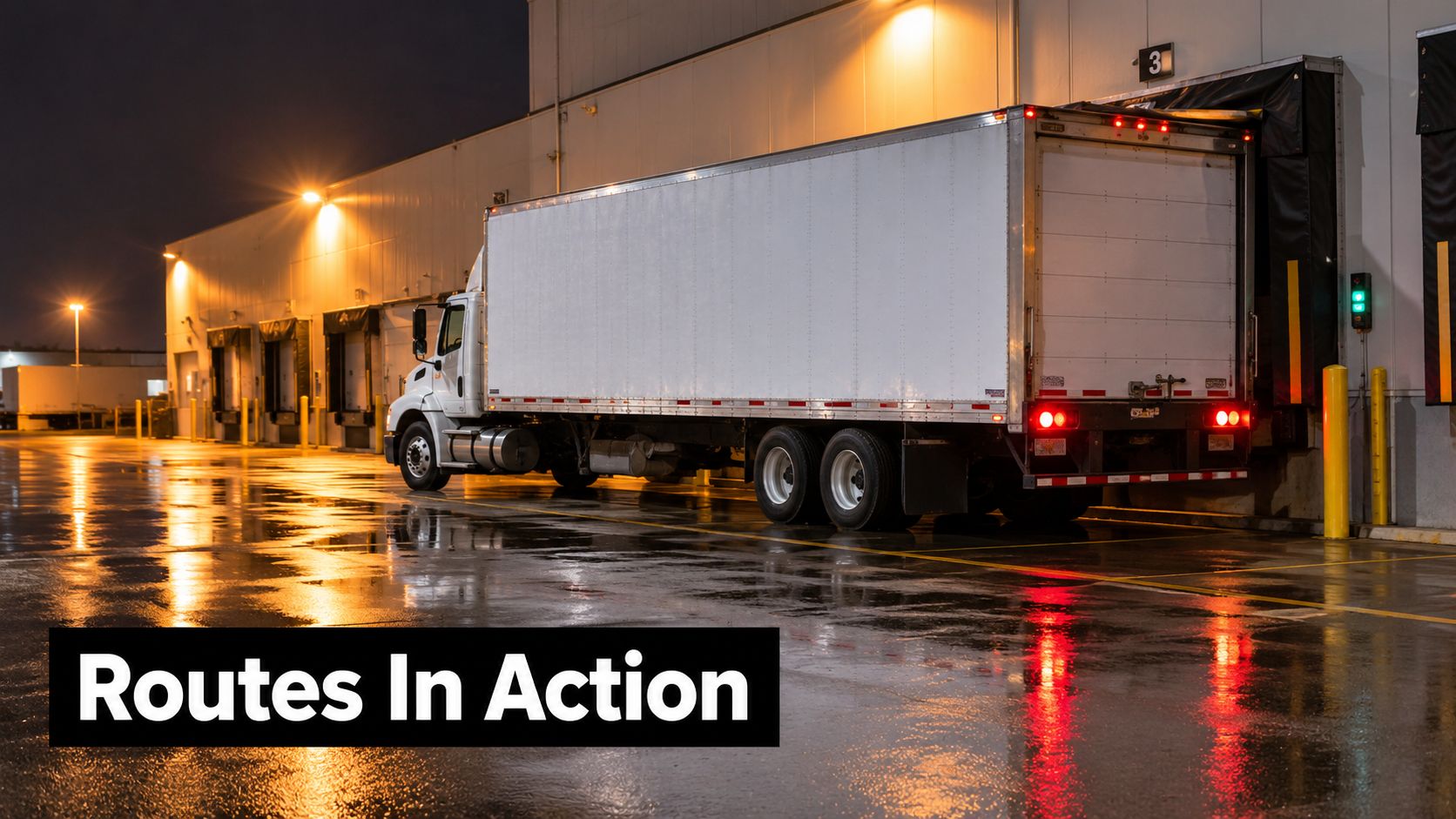
The dispatcher doesn't begin by asking which road is shortest. First, the dispatcher confirms the available vehicle, load requirements, departure readiness, stop windows, expected service durations, and driver availability. The system then tests possible assignments and sequences against those conditions.
How the plan gets built
The engine may reject a distance-efficient sequence because it arrives too early for a facility that can't receive freight, or too late for a window that closes before the truck arrives. It may assign a different vehicle because the first truck lacks the required capacity or because the load order would make the planned stops impractical.
The dispatcher then reviews the proposed route rather than accepting it blindly. If the plan leaves no recovery time after a delayed departure, the dispatcher can adjust the sequence, protect the hard appointment, or assign another resource. The objective is a route that remains executable when conditions are less than perfect.
After departure, the plan becomes a feedback loop. A loading delay at the origin affects every later stop. A driver or telematics system can report the delay, and dispatch can decide whether to resequence stops, notify a facility, or preserve the original order because a later appointment carries greater priority.
For teams working across multiple stops, learning how to optimize your canvassing route can also clarify the broader sequencing principle. The context differs, but the operational lesson is similar: stop order should reflect constraints and objectives, not just geographic proximity.
A visual explanation of the decision process can help teams align dispatch, drivers, and operations leaders:
The driver experience is where the plan proves itself. A workable sequence reduces unnecessary backtracking, gives the driver clearer expectations, and limits the confusion caused by last-minute changes. The dispatcher benefits too, because the team is managing exceptions against a structured plan rather than rebuilding the entire night from scratch.
Implementation Considerations
Buying routing software is the easy part. Implementation succeeds when the organization gives the system accurate inputs, connects it to daily operations, and earns the trust of the people who execute the plan.
Start with data quality. Confirm that stop addresses, receiving windows, service durations, vehicle capacities, departure times, and driver availability reflect reality. A powerful engine will still produce a poor route if it receives outdated or optimistic assumptions.
A practical implementation checklist
Audit the inputs. Compare planned departure and service times with actual operating records. Correct recurring gaps before judging the algorithm.
Connect the workflow. Make sure dispatch, yard operations, transportation systems, telematics, and driver communication share the information needed to make timely decisions. A route plan built without current departure status is incomplete.
Define priority rules. Decide which constraints are hard and which objectives can flex. A receiving window may be fixed, while distance may be optimized around it.
Test with dispatchers and drivers. Experienced operators understand facility behavior, loading realities, and access problems that a clean database may not capture. Their feedback can expose assumptions that need correction.
Measure execution, not software activity. Review miles, hours, lateness, route adherence, and exception frequency. The system should make performance easier to diagnose.
The guide to route optimization software can help teams evaluate capabilities before selecting a platform. The right tool still needs clear ownership. Someone must maintain the data, review exceptions, and decide when the model requires a change.
Adoption also depends on communication. Drivers shouldn't feel that an algorithm is being used to ignore field conditions. Dispatchers shouldn't be expected to trust a plan that repeatedly fails at the same facility. Build a process where people can report exceptions and the organization uses those reports to improve the next plan.
Summary of Key Takeaways
Route optimization is a planning discipline for balancing constraints and objectives across a fleet. It isn't just a request for the shortest route, and it isn't the same as opening a navigation app after a truck has already been assigned.
The Vehicle Routing Problem provides the underlying mental model. A fleet must serve multiple stops with limited vehicles, capacities, and time. Because the problem is computationally difficult, real systems use methods such as heuristics, integer programming, and simulation to find strong, workable solutions instead of testing every possible route.
The operational meaning becomes clearer when constraints enter the picture. Delivery windows, service durations, driver availability, vehicle capacity, traffic, loading sequence, and facility readiness can all change the value of a route. A plan that adds distance may still be the better plan if it protects on-time performance and keeps the driver's work within safe, practical limits.
Performance measurement turns the concept into management practice. Miles, driver hours, route adherence, lateness, and exception frequency show whether the planned route survives execution. Managers should examine those indicators together, because improving one can weaken another if the system's priorities aren't defined clearly.
Navigation software remains useful for driver guidance, but it doesn't replace fleet-level planning. Modern optimization can support assignment, loading, idle-time reduction, driver availability, and live route adjustments. That broader view is especially important for middle-mile operations, where repeat lanes and overnight schedules demand consistency.
The central lesson: Optimize for the route set your operation can deliver, not the route that wins a map comparison.
For Twin Cities logistics leaders, that means treating routing as part of a larger operating system. Dispatch, yard readiness, driver communication, compliance, and performance review all influence whether a mathematically sound plan produces a dependable freight movement. The technology helps, but disciplined execution makes the result real.
Peak Transport provides structured, safety-focused middle-mile transportation for brands and distribution networks across the Twin Cities, including overnight box-truck operations connected to regional hubs and Amazon Relay nodes. If your operation needs dependable lane execution, or you're a professional driver seeking a W-2 role with consistent schedules and benefits, visit Peak Transport to learn more.