Route Optimization Using Machine Learning: 2026 Guide
Discover how route optimization using machine learning cuts costs and improves delivery times for middle-mile fleets. Expert strategies for 2026.
September 30, 2026
A Tuesday night at a Twin Cities terminal rarely goes according to the plan approved earlier in the day. An inbound load arrives late, a dock door changes, and dispatchers rebuild the sequence while drivers wait for a departure decision. The problem isn't just finding the shortest path. It's protecting the overnight schedule when traffic, dwell time, receiving windows, vehicle capacity, and driver hours all change at once.
That's where route optimization using machine learning earns its place. Machine learning shouldn't replace the routing engine. It should forecast the uncertain inputs, then let a classical solver construct a feasible plan around hard operational rules. For middle-mile fleets, the largest gains often come from reducing late-departure risk, detention, and dispatch disruption rather than chasing a few additional miles of savings.
What Middle-Mile Operators Actually Need From Smarter Routing
Middle-mile operations have a different routing problem from doorstep delivery. A box-truck fleet may move freight between distribution centers, regional hubs, and relay facilities on structured overnight lanes. The schedule depends on whether a trailer is ready, whether a dock can receive the truck, whether the driver has enough hours remaining, and whether the route can absorb a delay without breaking the next handoff.
A shortest-path algorithm can't resolve that operational tension by itself. Vehicle routing and traveling-salesman variants are NP-hard, so exact optimization becomes difficult as networks grow and constraints multiply. A recent review of machine learning for routing research describes the field's growing taxonomy and the increasing use of hybrid methods that combine machine learning with operations research.
The overnight failure usually starts before the first mile
A route can look efficient in a static plan and still fail at departure. If the inbound trailer is late, the assigned vehicle may wait, the driver may lose usable hours, and the receiving facility may face a missed appointment. By the time the routing team reacts, the original sequence may no longer be workable.
Smarter routing must deliver three practical outcomes:
- Stable plans under disruption: The system should rework affected portions of a route without unnecessarily changing every stop.
- Credible arrival forecasts: Receiving distribution centers need ETAs that reflect traffic, historical dwell, and current operating conditions.
- Protection of driver limits: Hours-of-service rules, vehicle capacity, and appointment windows must remain hard constraints, not suggestions.
Machine learning supplies the missing forecast. It can estimate travel time by route segment, expected service duration at a facility, and the likelihood that a stop or departure will slip. The solver then uses those estimates to select a route that can survive the night.
Practical rule: If a routing system can't explain why it changed a departure, stop sequence, or driver assignment, dispatchers won't trust it during a disruption.
The business case is therefore broader than distance reduction. A reliable prediction layer can support fewer late departures, better receiving performance, and more predictable fuel use, with the value compounding when the same forecast informs dock scheduling and dispatch decisions.
How Machine Learning Fits Into the Routing Stack
An overnight middle-mile fleet can have a sound route plan and still leave late. The routing stack reduces that risk by separating prediction from decision-making. The transportation management system provides orders, stops, vehicle details, and appointment windows. Telematics supplies location and operating signals. Machine learning estimates what may happen next. A classical routing solver then turns those estimates into a feasible plan.
The solver remains the decision engine because large routing problems must satisfy many constraints at once. The 2025 routing review places learned methods alongside operations research rather than treating ML as a replacement. That distinction matters for fleets focused on late departures and detention. ML improves the inputs. The solver protects capacity, schedules, driver rules, and route feasibility.
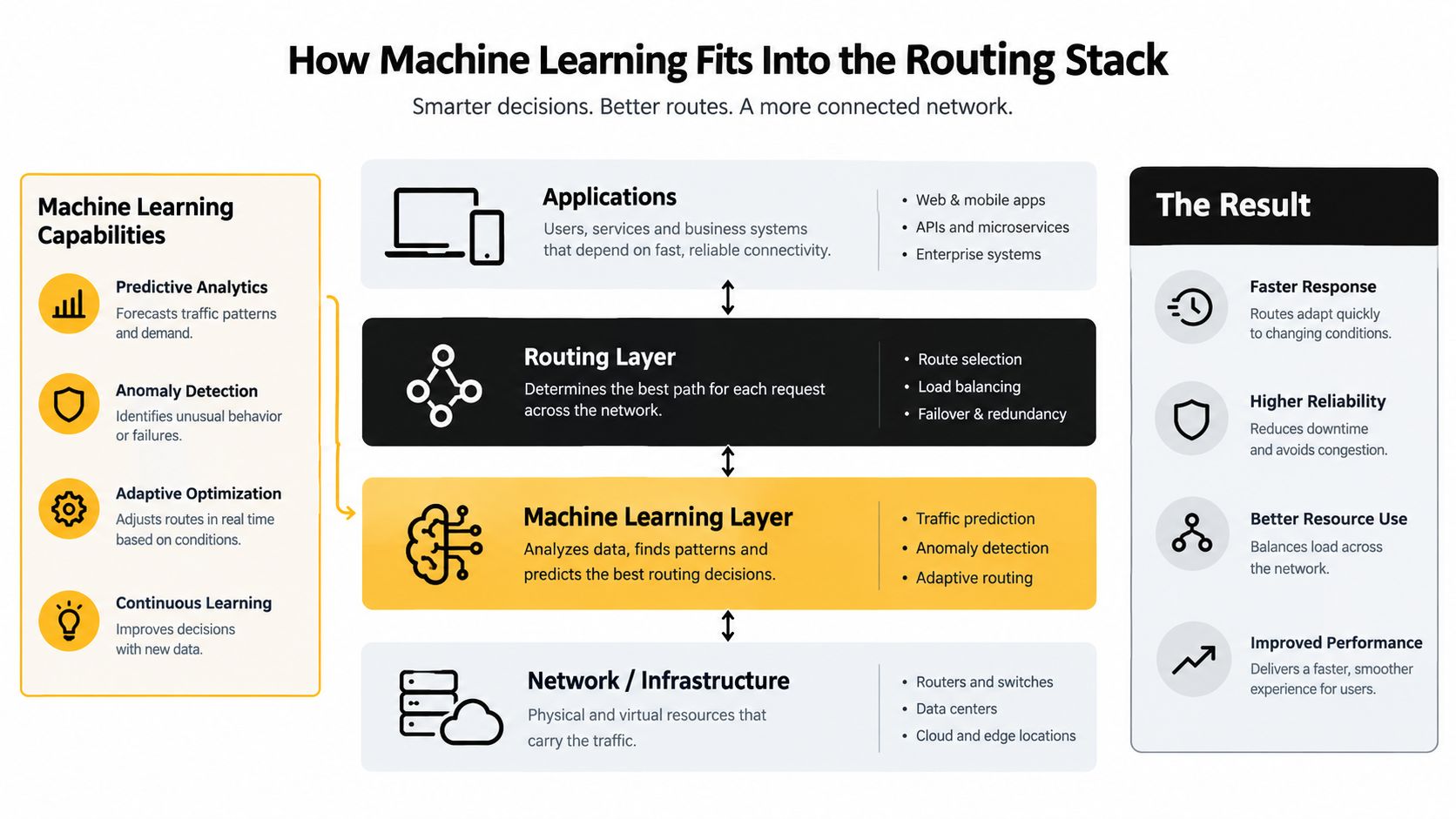
The stack in plain English
- Data ingestion: Collect GPS events, ELD status, route history, appointment records, stop timestamps, vehicle attributes, and order details in a consistent data layer.
- Feature preparation: Convert those events into signals such as time of day, day of week, facility, lane, weather context, historical dwell, and recent traffic.
- Prediction: Estimate travel time, service duration, delay probability, demand, or the likely effect of a disruption.
- Optimization: Send those forecasts to a vehicle-routing solver that assigns vehicles and sequences stops under capacity, appointment, and driver constraints.
- Execution and feedback: Compare planned events with actual outcomes, then use the differences to improve later predictions.
A gradient-boosting model fits structured travel-time features. An LSTM can capture sequence-level ETA behavior when preceding events affect the next estimate. Reinforcement learning can learn dispatch policies from changing state transitions, a use case examined in the 2026 survey of learning-based vehicle and robot routing.
Neural combinatorial optimization deserves attention, but carriers should not install it as a wholesale substitute for a production solver. For practical deployments, choose prediction layer plus constraint optimization. Teams reviewing model selection and machine-learning workflows can consult these RapidNative ML resources.
At a 2 a.m. departure, dispatchers need a route that is feasible, explainable, and resilient. ML earns its place by reducing uncertainty before the solver commits to the route.
The Business Case in Numbers
A late departure can cost more than a few extra miles. For an overnight middle-mile operator, the business case rests on reducing missed receiving windows, detention, and dispatch uncertainty. Published results support evaluation, but they do not guarantee the same outcome for every fleet. Managers must connect each result to their own baseline, data quality, and operating constraints.
A recent IEEE study of AI-driven smart-logistics route optimization reported stronger classification metrics for a PPO reinforcement-learning model than for DQN, including 0.91 accuracy versus 0.5154, 1.00 precision versus 0.5161, 0.81 recall versus 0.1441, and 0.89 F1 versus 0.2254. The PPO model ran in 0.4663 seconds, which the study presents as suitable for real-time decisions.
A separate deep-learning route optimization study reported up to 21% better delivery time, 13% lower fuel consumption, and 17% higher vehicle utilization compared with traditional heuristic methods. Its design combined LSTM traffic forecasting with a Deep Q-Network. That pairing reinforces the right architecture: ML predicts changing conditions, while a routing method converts those predictions into feasible decisions.
| Result to measure | Comparison to run | Overnight operating question |
|---|---|---|
| Delivery time | Planned versus actual arrival by lane, using the traditional heuristic route as the baseline | Did better forecasts improve receiving-window adherence and reduce late departures? |
| Fuel consumption | Fuel used under predicted-condition routes versus traditional heuristic plans | Did the solver choose lower-cost routes without increasing delay or constraint violations? |
| Vehicle utilization | Productive vehicle use across comparable assignments | Did improved sequencing reduce idle equipment and support steadier fleet planning? |
Treat these figures as benchmarks from specific studies, not as a guaranteed business case. Establish a local baseline, clean event timestamps, and a measurement plan before claiming improvement. Supply chain analytics consulting services can help carriers design KPIs or address data-engineering gaps when internal capacity is limited.
The strongest return may come from a route that departs on time, reaches the receiving window, avoids detention, and keeps the driver within operating limits. That is why overnight fleets should measure lateness and detention alongside miles, fuel, and utilization.
Algorithms and Approaches Worth Knowing
An overnight middle-mile fleet can select the wrong tool for the job before any model is trained. The routing engine still needs to enforce vehicle capacity, stop sequences, time windows, driver limits, and facility rules. Machine learning usually belongs above that engine, predicting travel time, dwell time, or disruption risk so the solver can build a plan that is more likely to depart on schedule and avoid detention.
Five families that matter
Classical solvers use methods such as nearest-neighbor construction or Clarke-Wright savings to create routes quickly. They are transparent and provide a dependable production baseline. Simple heuristics become less effective when many constraints and live disruptions interact, so test them against the actual operating rules.
Metaheuristics such as tabu search, simulated annealing, and adaptive large neighborhood search examine alternative plans without checking every possible combination. They suit complex vehicle-routing problems, but their settings require tuning. Operations teams must validate the resulting routes against dispatch rules and facility realities.
Supervised travel-time predictors learn from historical telematics and route events. Gradient boosting works well with structured features and can estimate changing conditions for the solver. This approach preserves the solver's constraint logic while improving the inputs used for sequencing and arrival estimates.
Reinforcement-learning policies learn actions from changing operational states. Use them for controlled experiments or narrow decisions, not as an automatic replacement for the routing engine. A policy trained on one corridor can propose infeasible actions on a new lane, so every deployment needs a safe fallback policy for cold-start routes.
Neural combinatorial optimization hybrids learn parts of route construction directly. They may suit research or specialized applications, but an overnight fleet should require proof of feasibility, explainability, and recovery behavior before making one the primary engine.
| Algorithm family | Training data needed | Cold-start behavior | Interpretability | Middle-mile fit |
|---|---|---|---|---|
| Classical solvers | Little or none | Strong | High | Production core and baseline |
| Metaheuristics | Little or none, tuning data helps | Strong | Moderate | Complex constraints |
| Supervised predictors | Historical travel and stop data | Requires fallback model | Moderate to high | Prediction layer above the solver |
| Reinforcement learning | Simulated or historical state-action data | Weak without a safe policy | Lower | Controlled experiments |
| Neural combinatorial hybrids | Substantial route and state data | Often difficult | Lower | Selective evaluation |
Use a practical route planning and optimization guide to define the operating problem before comparing model families. The right test is whether the system produces feasible routes, handles missing data, and gives planners a usable explanation. A neural network is not a routing strategy by itself.
Facility access can also defeat a mathematically sound plan. Research on overcoming venue navigation challenges highlights the final approach to difficult sites, where gate locations, restricted entrances, and site-specific instructions affect execution. Include those constraints in validation, especially when late arrival creates detention risk.
A Practical Implementation Roadmap
A six-to-nine-month rollout is realistic when the project starts with data and controlled testing rather than a platform purchase. The sequence below keeps the model accountable to dispatch outcomes.
Months one through three
Month one, establish the data foundation. Collect telematics, ELD events, TMS orders, planned routes, actual arrival and departure times, dock appointments, and manual route changes. Normalize facility names and timestamps. The exit criterion is a documented data-quality threshold agreed with operations, not a vague claim that the feeds are connected. Ask: Can we distinguish a planned delay from a data-capture failure?
Months two and three, measure the current system. Run the existing solver and dispatch process against a stable baseline. Define KPIs for departure reliability, ETA accuracy, receiving-window performance, fuel use, utilization, exceptions, and dispatcher workload. The exit criterion is a repeatable baseline report. Ask: What does improvement mean for this operation, and which metric has priority?
Months four through six
Months four and five, build and shadow. Train a travel-time and dwell-time model, then produce shadow routes without changing live dispatch. Compare predictions with actual outcomes and inspect errors by lane, facility, time period, and disruption type. The exit criterion is an agreed prediction-error target and a documented fallback when confidence is low. Ask: Does the model improve decisions across more than one operating pattern?
Month six, run a controlled pilot. Select a subset of lanes with reliable history and cooperative dispatch teams. Keep control lanes or control periods, record manual overrides, and review safety and service exceptions daily. The exit criterion is a measured operational lift without unacceptable compliance or driver-trust problems. Ask: Did the system improve the target KPI without creating a new failure mode?
Months seven through nine
Expand carefully. Integrate approved outputs with the TMS and dock scheduling process, retrain on new operational data, and add lanes only when the preceding group remains stable. The exit criterion is a production runbook covering monitoring, model refresh, rollback, ownership, and human approval. Ask: Who is accountable when the model is wrong at departure time?
A short route optimization software overview can help teams compare capabilities, but the implementation gate should always be an operational test. A polished demo isn't evidence that the data, constraints, and exception process will work in a live overnight network.
The project should also include a human-approval path. A dispatcher must be able to reject a recommendation, record the reason, and continue operating safely when the model is unavailable.
Why ML Supports the Solver Rather Than Replaces It
The popular idea that machine learning will replace route optimization solvers is wrong for most middle-mile fleets. A learned policy may recommend a promising action, but it still has to respect hours of service, dock windows, vehicle capacity, driver qualifications, and appointment rules. Those constraints need deterministic enforcement.
Classical vehicle-routing and constraint solvers are valuable because planners can inspect their inputs and rules. If a route changes, the team can identify the affected constraint, forecast, or cost assumption. That auditability matters when a driver, customer, regulator, or operations leader asks why the system made a particular assignment.
Let each system do the job it handles best
Machine learning handles uncertainty. It can estimate:
- Travel time by lane and operating period
- Stop duration based on facility history
- Delay or detention probability
- The likely effect of a traffic shock
- A strong starting solution for the optimizer
The solver handles feasibility. It decides which vehicle serves which stop, in what sequence, and under which hard rules. The result is a hybrid pipeline: ML supplies forecasts, preferably with uncertainty information, and optimization produces a defensible route.
This separation also improves governance. If regulations, labor rules, or facility policies change, the operations team can update the constraint layer without assuming the model will learn the change safely from future examples. The EU AI Act has made documentation, oversight, and risk management more important considerations for teams deploying AI-enabled operational systems, as discussed in recent fleet-management material on AI route optimization.
The strongest deployment isn't the one with the most autonomous model. It's the one that gives the solver better information while keeping critical rules visible and enforceable.
A carrier should reject any vendor pitch that treats explainability as an afterthought. In an overnight network, an understandable route that protects service and compliance is more valuable than an opaque recommendation that looks efficient until a driver can't legally complete it.
Integrating With Telematics TMS and Dock Scheduling
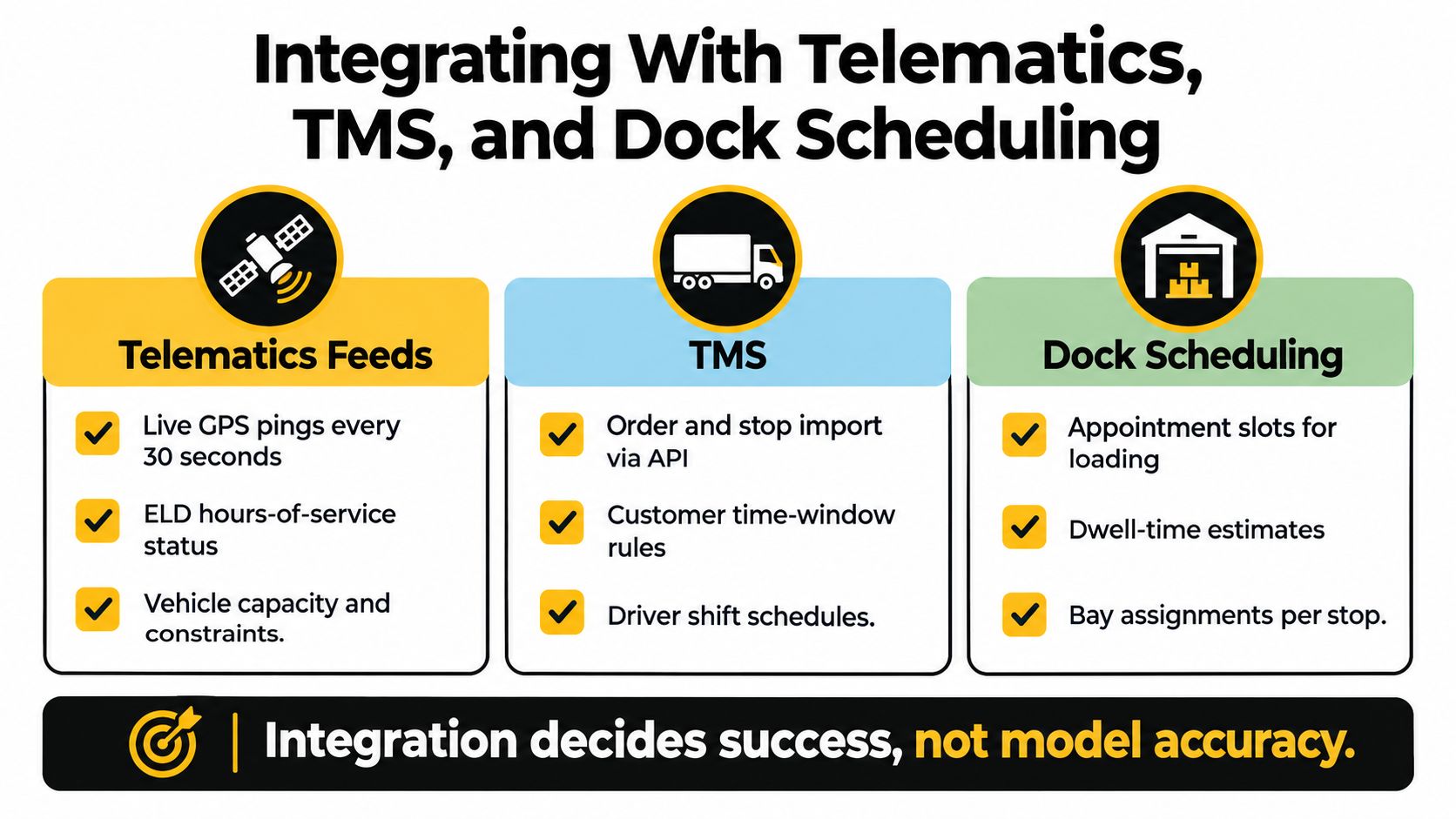
Implementation succeeds or fails at integration, not at model accuracy. A highly accurate prediction is useless if the TMS sends stale orders, the telematics feed uses inconsistent timestamps, or the dock system doesn't communicate appointment changes.
Connect the operational surfaces in a deliberate order
Start with telematics. Validate GPS event timing, ELD status, vehicle identity, capacity attributes, and vehicle-health signals. Confirm that the system can distinguish a vehicle stopped at a dock from a vehicle stopped in traffic. Map ELD event codes to route states before using them in model training.
Connect the TMS next. Verify bidirectional order and stop exchange, vehicle assignment, driver schedule data, customer time windows, and dispatch handoff. A route recommendation must return to the system where dispatchers work. Otherwise, the team will rekey decisions and create a second source of truth.
Add dock scheduling after the basic event flow is stable. Bring in appointment slots, bay assignments, loading status, arrival timestamps, and departure timestamps. Dwell predictions are only useful when the system understands which event marks the beginning and end of service.
Use a vendor-neutral checklist:
- API direction: Can each system both send and receive the events needed for execution?
- Timestamp standards: Do all systems use the same timezone, event definitions, and clock assumptions?
- Identity mapping: Does the same truck, trailer, driver, order, and facility retain a consistent identifier?
- Access controls: Can the integration use least-privilege permissions rather than broad administrative access?
- Exception handling: What happens when a feed pauses, duplicates an event, or sends an impossible sequence?
- Audit records: Can the team reconstruct which data and model version produced a route?
The trailer tracking system perspective is relevant because trailer status often determines whether a planned departure is possible. Validate every handoff with replayed historical events before allowing the model to influence live dispatch.
Pitfalls and How to Avoid Them
Machine learning route optimization usually fails for operational reasons, not because the algorithm lacks sophistication. A manager can spot most problems early by watching the right leading indicators during the pilot.
Five failure modes to diagnose early
Stale or sparse training data. The signal is a model that performs well in a dashboard but misses obvious changes in facility dwell or lane conditions. Dispatch shortcuts may hide the true sequence of events, leaving the model trained on incomplete history. Fix it by auditing raw events, separating planned from actual timestamps, and recording manual overrides as operational data.
Solver parameter drift. Driver behavior, facility rules, or dispatch priorities change, but solver settings remain frozen. The warning sign is a growing gap between recommended routes and the changes planners make before release. Fix it by reviewing route overrides, constraint weights, and planning policies on a defined cadence.
Feedback loops. The model's predictions influence the routes people choose, then those routes become the training data. A forecast may appear to improve while the system loses visibility into alternatives. Fix it by preserving control observations, logging rejected recommendations, and separating evaluation data from model-influenced outcomes.
Overfitting to one lane or season. A model performs strongly on a familiar overnight corridor and degrades elsewhere. The indicator is uneven error across facilities, lanes, weather conditions, or operating periods. Fix it with segmented validation, fallback logic, and an expansion rule that requires evidence beyond the original pilot group.
Change-management gaps. Drivers and dispatchers distrust routes they can't understand, so they work around the system. Look for frequent manual edits, late acknowledgments, repeated calls about route logic, or unsafe attempts to recover time. Fix it by showing the reason for major recommendations, giving dispatchers controlled override authority, and including drivers in route review.
Watch the overrides, not just the model score. Repeated human corrections often reveal a missing constraint, a bad event mapping, or an operational rule that the training data never captured.
Governance belongs in the pilot from the beginning. Keep model versions, input snapshots, route decisions, overrides, and incident reviews. Define who can pause automated recommendations and how dispatch returns to a known safe process. That discipline protects service, compliance, and trust while the system matures.
Peak Transport offers structured overnight middle-mile box-truck operations, data-informed route planning, and dispatch processes built around safety, documentation, and reliable execution. Visit Peak Transport to discuss a middle-mile partnership or explore stable W-2 driving opportunities in the Minneapolis, St. Paul area.