Safety Compliance in Middle-Mile Box Truck Operations
Learn what safety compliance means in middle-mile box-truck operations, the FMCSA and DOT rules that apply, and how to operationalize driver training and audit
September 15, 2026
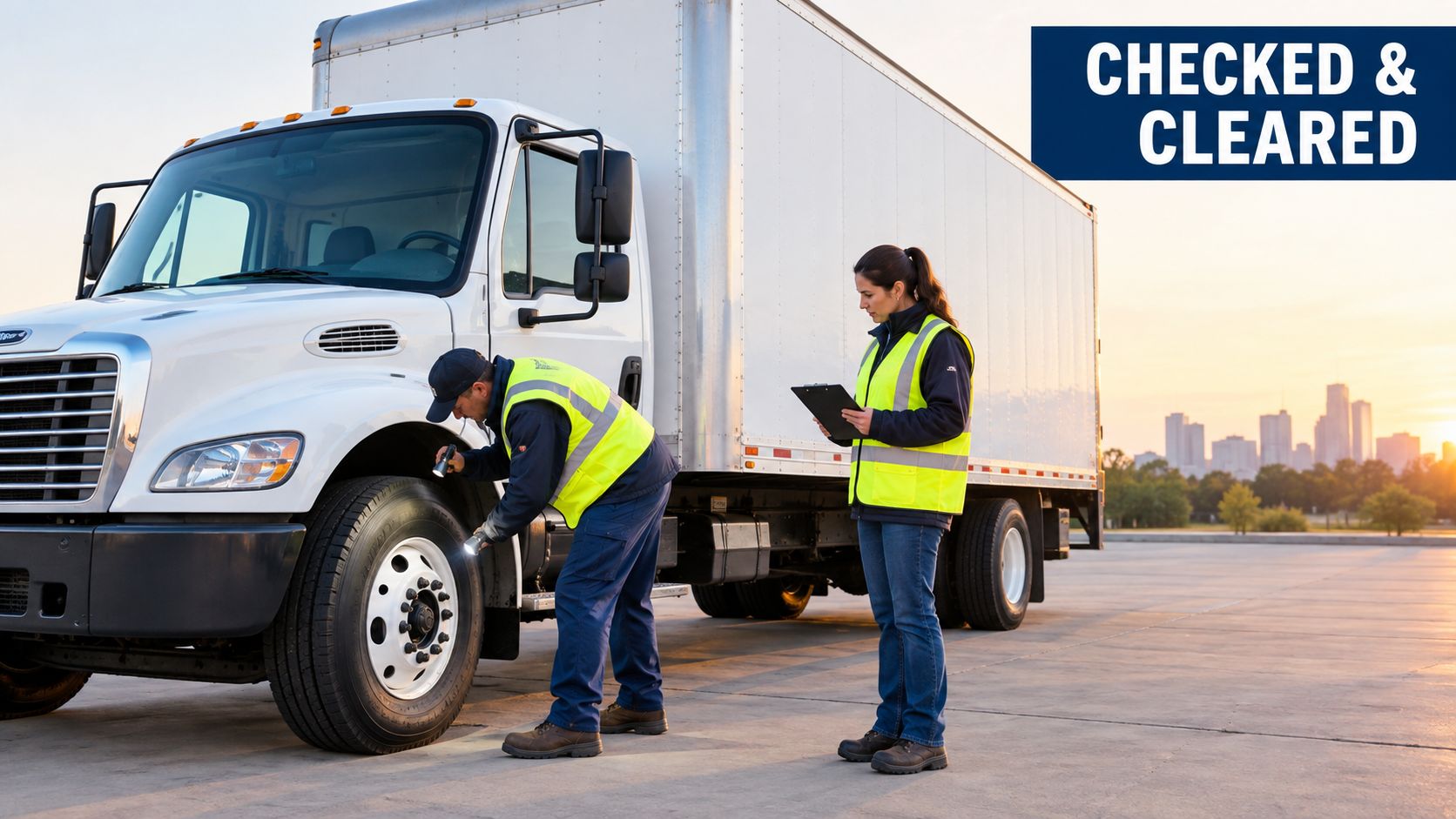
At 11 p.m., a middle-mile yard doesn't look like a compliance department. It looks like a dispatcher comparing an ELD screen with a linehaul plan, a driver walking around a box truck with a flashlight, and a supervisor asking whether the previous shift's defect report was closed. The pressure is practical: a trailer needs to reach a regional hub, a dock window is waiting, and weather may turn a clean schedule into a slower one.
That pressure is exactly why safety compliance has to live inside route design, dispatch habits, vehicle care, and driver conversations. OSHA reported 34,696 total federal inspections in fiscal year 2024, while its public data platform includes inspection, citation, injury, illness, severe-injury, fatality, and chemical-exposure records. OSHA's enforcement and reporting data shows the operating reality clearly. Compliance is a system of records and decisions, not a binder that appears only when an auditor calls.
What Safety Compliance Looks Like on a Middle-Mile Yard
At a Twin Cities yard, the overnight dispatch window is often when small decisions determine whether the route stays safe. A driver assigned to a 26-foot box truck starts with a walkaround, checking tire condition, visible damage, lights, mirrors, fluid leaks, and anything that could affect braking or steering. The inspection isn't ceremonial. A questionable tire or soft brake pedal can change the assignment before the truck leaves the gate.
Inside the cab, the dispatcher checks the driver's available ELD hours against the planned run to a regional hub. The route may look short on a map, but loading delays, winter weather, congestion, and the return leg all consume time. The driver and dispatcher discuss the departure window, expected conditions, and where a break can happen without forcing a rushed stop later.
The driver then checks the cargo area. Cartons, pallets, and rolling equipment must be positioned and secured so the load won't shift during braking or a sharp maneuver at a dock. A compliant truck with a poorly controlled load is still an operational risk.
The handoff matters
Before release, the supervisor verifies that the previous driver's post-trip DVIR has been reviewed and closed. If the prior driver reported a light issue, damaged mirror, unusual tire wear, or a braking concern, the next driver shouldn't inherit an unresolved question.
The paperwork trail needs to match the physical truck:
- Vehicle condition: The walkaround, defect notes, and repair status agree.
- Driver records: The license, medical documentation, qualification file, and duty status are current.
- Route timing: Dispatch has allowed room for lawful breaks, weather, and safe arrival.
- Load control: The cargo is positioned and secured for the actual route.
Practical rule: If the dispatcher can't explain why the driver, truck, load, and schedule are ready at release time, the lane isn't ready.
That rhythm repeats every night. Tire condition, brake feel, registration and insurance records, ELD entries, load securement, and a two-minute weather conversation may look ordinary. Together, they form the evidence that the operator is managing hazards before a roadside inspector, incident investigator, or customer asks questions.
Defining Safety Compliance for Middle-Mile Box Truck Operations
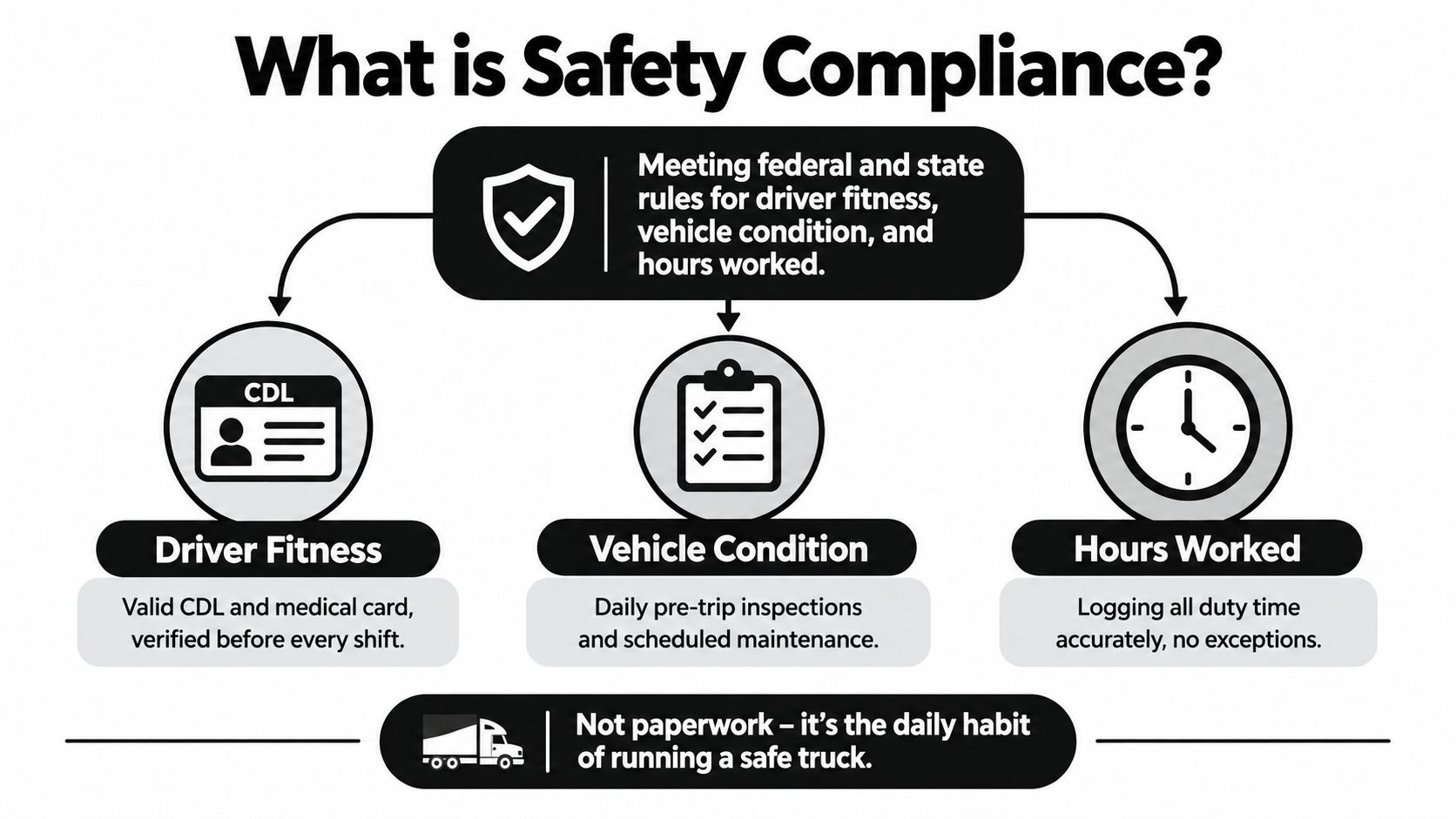
For a middle-mile box-truck operator, safety compliance means meeting the rules that govern who can drive, what condition the vehicle must be in, how long the driver can work, and what the company must record. It isn't a single certificate or an annual pass. It's the daily practice of assigning a qualified driver to a serviceable truck, operating within lawful hours, and preserving accurate evidence of those decisions.
The main federal frameworks include FMCSA rules for commercial motor carriers, Department of Transportation requirements covering drivers and vehicles, and OSHA requirements that apply to employees working around docks, warehouses, forklifts, and pedestrians. State enforcement agencies also apply roadside inspection standards on routes that operate under federal or state authority.
Three parts of the operating system
Driver fitness includes qualification records, licensing, medical status, drug and alcohol testing, training, and the manager's decision to keep a driver out of service when the person isn't fit to operate.
Vehicle condition includes pre-trip and post-trip inspections, DVIR handling, preventive maintenance, defect correction, and the discipline to remove a truck when a safety-critical issue can't be resolved.
Hours worked includes driving, on-duty work, loading, fueling, inspections, waiting, and other duty time that must be recorded correctly. A driver who spends time helping at a dock can't treat that period as invisible because the wheels weren't turning.
Safety culture overlaps with compliance, but the terms aren't interchangeable. Culture is how leaders and drivers respond when the schedule conflicts with a safe choice. Technology, such as an ELD or telematics platform, can expose a problem, but it can't decide whether a dispatcher will pressure a driver to continue.
The strongest system connects all three. A driver reports a defect, the supervisor acts on it, the shop records the repair, and dispatch adjusts the plan. That chain turns a rule into a repeatable yard habit.
Federal Rules That Actually Apply to Overnight Box Truck Routes
Overnight box-truck operations usually encounter a focused group of federal requirements. The challenge isn't memorizing every regulation. It's translating the rules into the records and release decisions that happen before a truck leaves the yard.
| Regulation area | CFR citation | Core requirement | Key record or form |
|---|---|---|---|
| Hours of service | 49 CFR 395 | Control driving, duty windows, breaks, and cumulative on-duty time | ELD record of duty status |
| Driver qualification | 49 CFR 391 | Verify driver qualifications and required supporting records | Driver qualification file |
| Vehicle inspection and maintenance | 49 CFR 396 | Inspect, maintain, repair, and document vehicle condition | DVIR and maintenance records |
| Drug and alcohol testing | 49 CFR 382 | Administer required testing and maintain program records | Testing and clearinghouse records |
| CDL requirements | 49 CFR 383 | Confirm the driver holds the appropriate commercial license | CDL and license verification records |
Where overnight operations carry exposure
Hours of service creates the most visible connection between route planning and compliance. An ELD can show a violation, but the underlying cause may be a late load, an unrealistic dock appointment, or a dispatcher assigning work after the planned driving window.
Vehicle maintenance generates another recurring stream of records. A defect that gets written down but doesn't reach the shop queue is a process failure, not a paperwork inconvenience. The next driver may receive a truck that has already been identified as unsafe.
Driver qualification and testing files are less visible on the yard but can create serious audit exposure. Missing or expired documentation can undermine an otherwise orderly operation.
OSHA enters the picture where employees perform warehouse and dock work. Forklift traffic, pedestrian paths, loading areas, and handoff procedures need controls that protect people before and after the truck moves. OSHA's reporting system includes records that make workplace injuries and illnesses visible at scale, and in 2023, workplaces submitted more than 890,000 injury and illness cases from more than 91,000 workplaces. The Department of Labor's OSHA release explains that the records include details such as the incident location, worker activity, causal event, injury type, and object or substance involved.
State inspectors can enforce applicable requirements during roadside inspections, even when the route is part of a larger federal network. Managers operating across jurisdictions may also benefit from understanding the Heavy Vehicle National Law, especially when comparing compliance responsibilities across transportation markets.
Driver Hours, Fatigue, and Route Design
A lawful schedule can still be a poor schedule. FMCSA's commercial motor vehicle schedule research found that crash risk rises as driving hours accumulate, with a stronger time-on-task effect late in a shift, while breaks reduce risk in the hour after the break. FMCSA's schedule and crash-risk research makes the dispatch implication direct. Fatigue exposure is shaped by when the route starts, where work is placed, and how much pressure the driver faces near the end.
The core HOS limits for the route plan are:
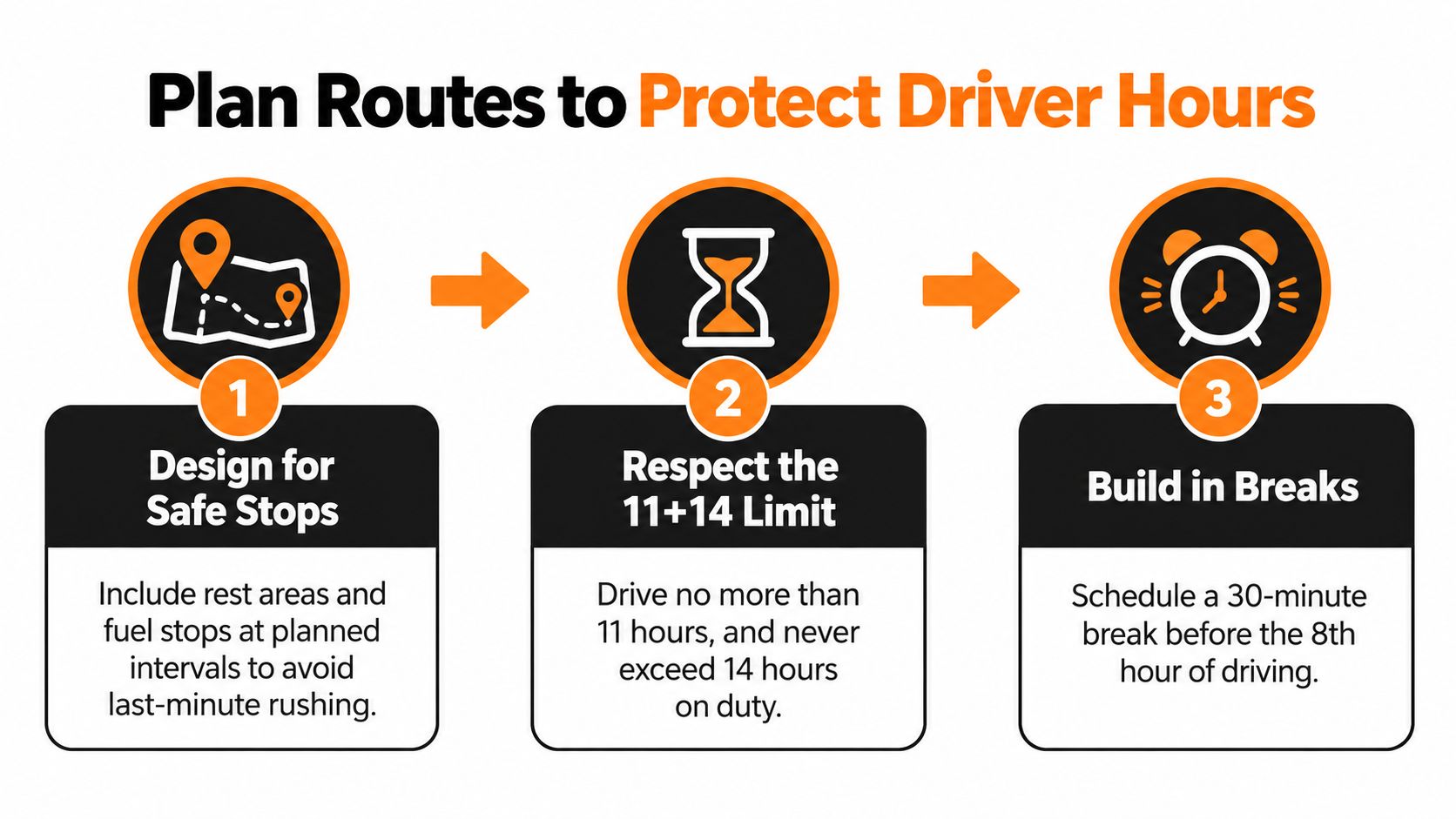
- Driving limit: A driver can drive up to 11 hours after the required off-duty period.
- Duty window: Driving and other on-duty work must fit within a 14-consecutive-hour window.
- Break requirement: A driver needs a 30-minute break after 8 hours of driving.
- Cumulative limits: The 60/70-hour rule limits total on-duty time across the carrier's operating cycle.
- Short-haul treatment: A driver operating within 150 air miles may qualify for a short-haul exception if the applicable conditions are met. Crossing that boundary can change the recordkeeping process.
FMCSA says the revised HOS rules were estimated to prevent about 1,400 crashes annually, save 19 lives, and avoid 560 injuries. The agency's HOS research page provides that estimate.
Dispatch decisions that reduce fatigue
A planner should build the break into the route rather than wait for a driver to find time. Fuel stops, rest areas, and handoff yards need to appear as deliberate schedule points. A driver who reaches the eighth hour while still trying to make a tight dock appointment may view the break as a delay instead of a control.
Before releasing a lane, review:
- Departure spacing: Can the driver leave after loading without compressing the legal window?
- Dock pressure: Does the appointment encourage speeding or skipped inspection work?
- Load density: Will repeated handling create physical fatigue before the driving leg?
- Recovery time: Is the next assignment reasonable after a late arrival or extended duty period?
- Relay options: Can a handoff protect the schedule without transferring a fatigued driver into another demanding shift?
The sleeper-berth provisions may matter for longer operations, although many middle-mile box-truck lanes use fixed overnight assignments instead. The correct choice depends on the actual duty pattern, equipment, and applicable rules, not on a generic template.
For a practical companion to this planning discipline, review fatigue risk management for transportation operations. The important operational question is simple: does the dispatch screen protect the driver's hours before the driver has to defend them at 2 a.m.?
Driver Training and Documentation Practices That Hold Up
A new W-2 box-truck driver should receive more than a policy packet and a key. The onboarding process needs to show how the assigned vehicle behaves, how the yard moves, how the route is dispatched, and what the supervisor expects when the schedule no longer matches reality.
A useful sequence starts with the driver's application and qualification review. The carrier completes required background and motor vehicle record checks, confirms licensing and medical documentation, conducts a road test, and provides orientation on the specific box truck and cargo-handling process. A first supervised lane lets the trainer observe mirror use, backing, dock positioning, load checks, ELD interaction, and communication with dispatch.
Training tied to actual work
Recurring training works better when it responds to the fleet's own events. A quarterly safety refresher can address repeated backing concerns or inspection omissions. An annual policy review keeps expectations current. Defensive-driving refreshers should use situations drivers encounter on overnight routes, including tight docks, low visibility, weather, and changing traffic patterns.
After an incident, remedial training should connect to the event data. If the driver missed a securement check, the corrective action should include a hands-on securement review and a documented follow-up, not merely a signature on a slide deck.
The daily file matters just as much:
- Inspection reports: Pre-trip and post-trip records should identify the truck and any defect.
- DVIR workflow: Driver notes must reach a supervisor or maintenance queue, with closure documented.
- Mileage support: Fuel receipts and mileage logs should make the operating record coherent.
- Maintenance write-ups: Repairs should connect the reported defect, work performed, and release decision.
W-2 employment changes the management conversation. Training hours are compensable, supervisors can require retraining, and the employer controls route assignments within one relationship. The human resources record system that supports wage compliance can also support the driver qualification file, provided the carrier defines ownership and access clearly.
A structured guide to compliance documentation for transportation operations can help managers connect these records instead of storing each one in a separate system. The test is whether a reviewer can follow one driver's path from hiring, to training, to dispatch, to inspection, to corrective action.
CSA Scores Roadside Inspections and KPIs That Matter
CSA is useful when managers treat it as an operating signal rather than a label. FMCSA's BASIC categories cover Unsafe Driving, Crash Indicator, Hours-of-Service Compliance, Vehicle Maintenance, Controlled Substances and Alcohol, Hazardous Materials Compliance, and Driver Fitness. Middle-mile box-truck fleets usually feel the sharpest day-to-day exposure in unsafe driving, HOS, maintenance, and driver fitness.
Roadside inspection violations enter the safety measurement system, and crash involvement can affect the analysis regardless of whether the carrier views the event as preventable. FMCSA's safety measurement material reports that carriers above the HOS Compliance BASIC intervention threshold had 6.97 crashes per 100 power units, compared with 4.00 for carriers below the threshold, a 74% increase. The same material reports that carriers with one or more BASICs above the intervention threshold had a 66% higher crash rate overall. FMCSA's violation-to-crash-risk material supports treating violations as leading indicators.
Weekly measures for an operations manager
| KPI | Target direction | Review cadence |
|---|---|---|
| Driver out-of-service rate | Downward | Weekly |
| Vehicle out-of-service rate | Downward | Weekly |
| Repeat inspection violations | Downward | Weekly |
| Preventable crashes per million miles | Downward | Weekly and monthly trend |
| HOS violation trend | Downward | Weekly |
| Maintenance write-up closure time | Shorter, with complete records | Weekly |
The fleet should look for patterns behind the KPI. A repeated light violation may indicate a maintenance inspection gap. A cluster of HOS exceptions on one lane may indicate an appointment problem. A new driver with repeated backing events may need supervised practice, not a generic warning.
FMCSA guidance also notes that all safety-based roadside inspection violations count, not only out-of-service violations. That means managers shouldn't wait for a truck to be placed out of service before acting. The same principle applies to CDL speeding tickets, which can signal a driver-management issue even when the immediate event appears isolated.
A percentile threshold should trigger a defined response. That response might include a file review, targeted coaching, a lane reassignment, maintenance escalation, or a mock inspection. It shouldn't be an automatic punishment disconnected from exposure, route type, or driver tenure.
Audit Readiness in a World of Continuous Monitoring
Annual audit preparation fails when it becomes a document-retrieval exercise. A middle-mile fleet operates every night, and electronic logs, telematics records, inspection reports, and roadside results create an ongoing picture of how the carrier runs. Independent transportation coverage reports that FMCSA and state partners conducted more than 3.1 million roadside inspections in 2025, with more than 23.5% of trucks placed out of service. DLA Piper's analysis of converging safety enforcement describes the shift toward ongoing verification, electronic records, and event-level data.
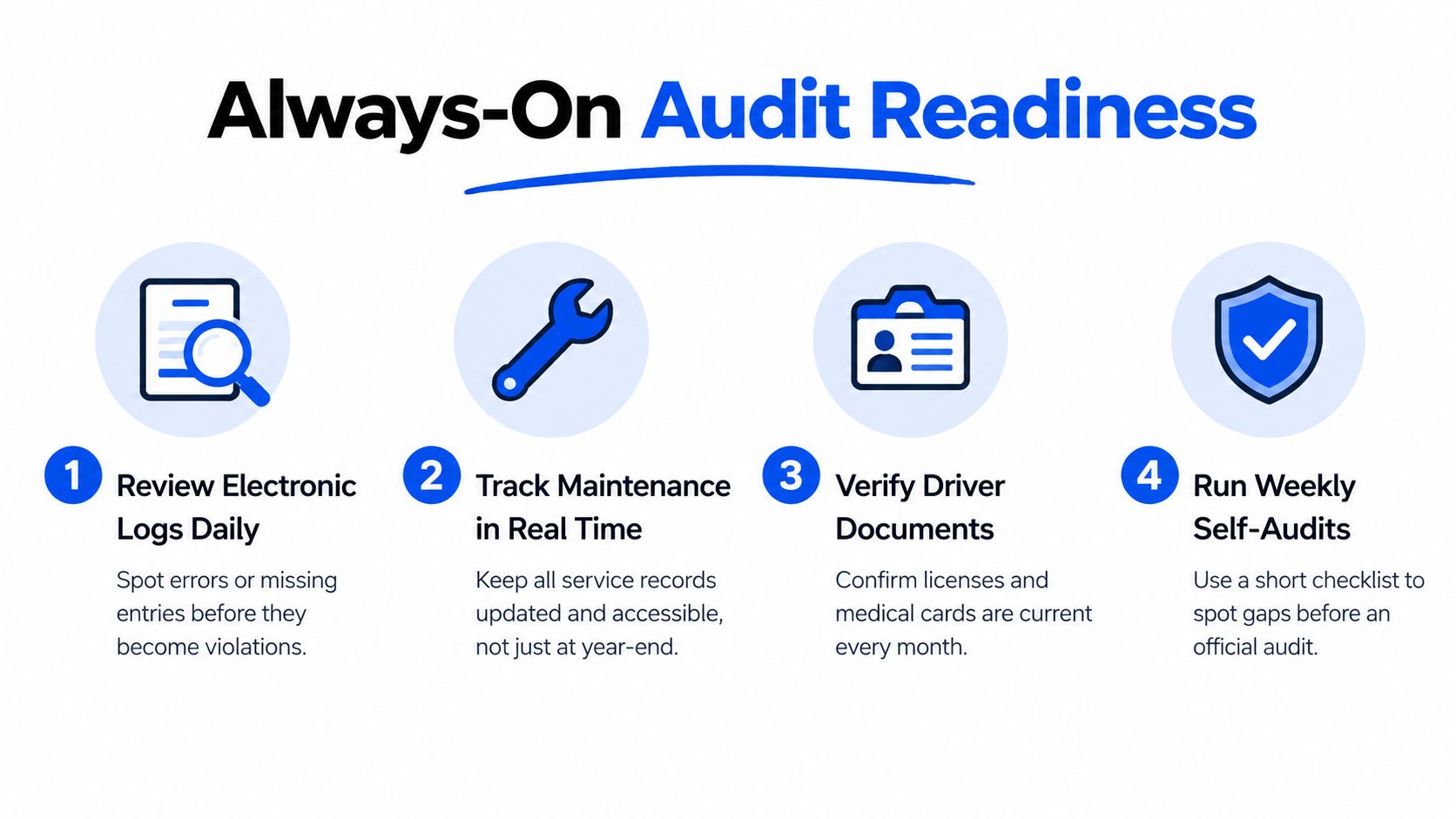
Continuous monitoring surfaces problems that quarterly reviews miss. ELD exceptions can identify repeated edits or unassigned driving. Telematics can expose fault codes before a maintenance complaint becomes a roadside violation. Inspection data can reveal that multiple drivers are reporting the same defect without a timely repair response.
The habits that keep records usable
Daily ELD reconciliation should happen while the trip is still fresh. The manager reviews missing entries, unidentified driving, and questionable edits with the driver instead of letting errors age into a larger file problem.
Weekly DVIR review should include the drivers who created the reports. They can explain whether a defect was resolved, misunderstood, or repeated because the repair didn't address the cause.
Monthly internal checks should compare maintenance records, driver files, inspection results, and CSA inputs. The purpose isn't to produce a decorative scorecard. It's to find mismatches, such as a truck marked available while a safety-critical repair remains open.
Quarterly mock roadside inspections should use the same practical sequence a state inspector might follow. Check documents, lights, tires, brakes, securement, ELD records, and the driver's ability to explain the route and duty status.
The phrase audit-ready security paperwork is useful beyond security operations because it captures a broader principle. Records must be accessible, current, internally consistent, and connected to the action they document.
Operations leaders can use compliance risk management practices to assign owners and deadlines for each gap. Every pre-trip, dispatch huddle, and post-trip debrief should be treated as an audit touchpoint. A regulator may ask for any operating day, not the day the company happened to prepare for inspection.
How Peak Transport Operationalizes Safety Compliance
Peak Transport's approach connects compliance to the way overnight lanes are built and staffed. The company uses W-2 drivers rather than an owner-operator lease model, which places training, discipline, route assignment, and performance expectations within one employer relationship. That structure doesn't remove management responsibility, but it gives supervisors a direct way to provide paid training, require retraining, and address unsafe decisions consistently.
The dispatch plan starts with HOS rather than adding hours checks after the lane is sold. Departure times, hub handoffs, break opportunities, weather conditions, and recovery time are considered before a driver receives the assignment. That matters on Twin Cities routes, where a late load or difficult dock can consume the margin that looked comfortable during daytime planning.
Records tied to operating events
The practical artifacts include:
- Weekly safety huddles: Managers discuss current defects, inspection observations, route conditions, and driver feedback.
- Monthly driver-file reviews: Supervisors check qualification documents, training records, and corrective actions.
- Quarterly lane reviews: Operations teams compare crash and violation trends with route design, timing, and driver tenure.
- Event-based training: Telematics and inspection events guide defensive-driving, backing, securement, or HOS refreshers.
- Documented handoffs: Pre-trip inspections, ELD transitions, roadside encounters, and post-trip reports remain available for review.
The W-2 culture becomes an operational lever. A driver can raise a concern before departure, and the company can change the assignment without treating that conversation as a contractor dispute. A supervisor can coach the driver on a specific event, schedule paid retraining, and confirm that the correction appears in the qualification and training records.
Compliance shouldn't be a department bolted onto a schedule that was designed without it. For a middle-mile operator, it's the operating system that connects a safe truck, a qualified driver, a realistic lane, accurate records, and accountable leadership from a Twin Cities yard outward. The result is a process built for repeatable overnight execution, not improvisation under deadline pressure.
Peak Transport offers structured overnight box-truck routes, W-2 employment, paid training, clear dispatch communication, and documented safety practices for drivers and logistics partners in Minnesota. If you need dependable middle-mile execution or you're a career-minded driver seeking consistent work in the Twin Cities, visit Peak Transport to learn more.