Supply Chain Visibility Made Clear for Middle Mile
Learn what supply chain visibility means, which KPIs and tech enable it, and how to improve it in the middle mile with Peak Transport examples.
September 19, 2026
A trailer can leave the building on time and still create a mess half an hour later.
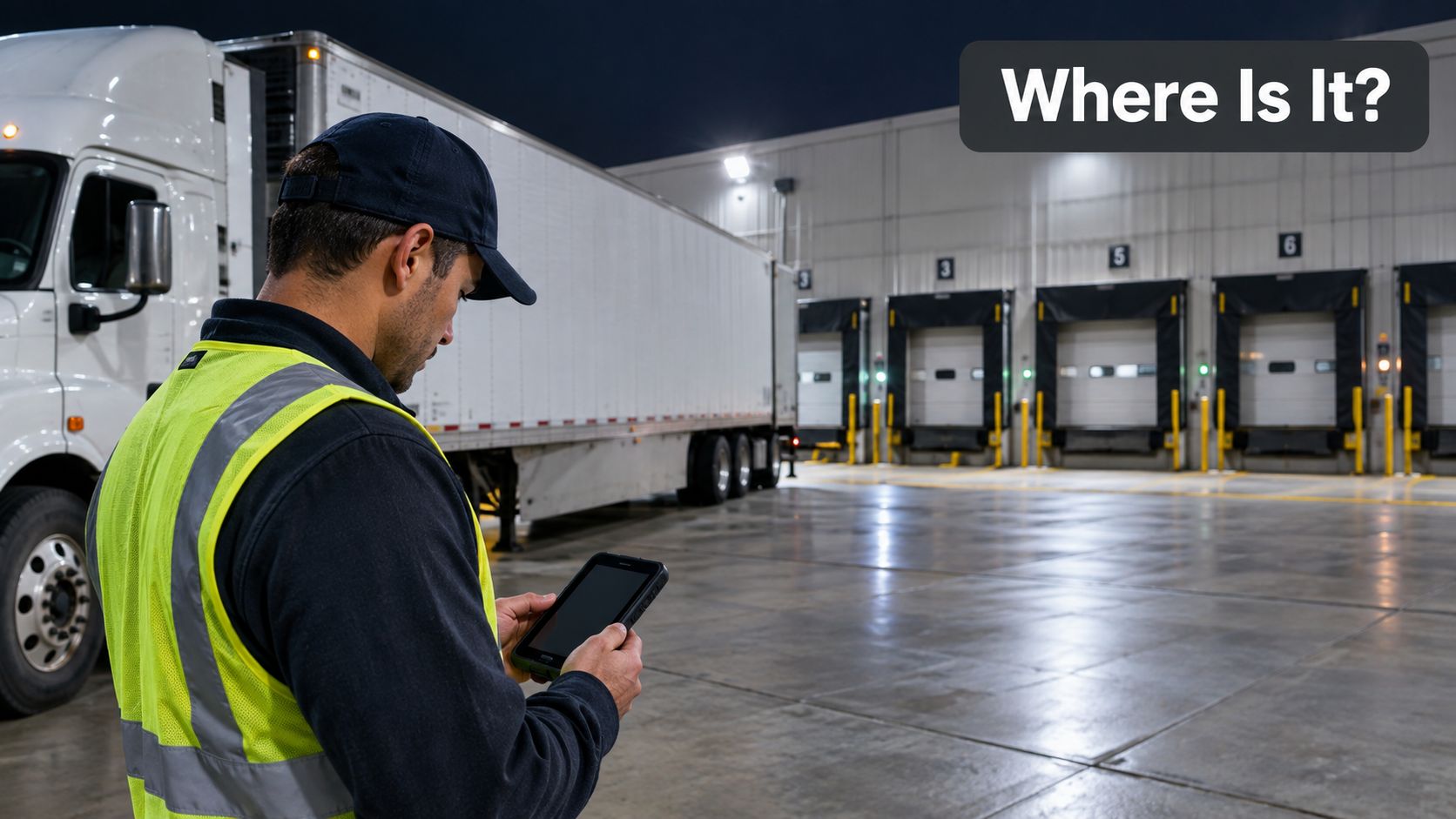
You've probably seen the sequence. The box truck departs the first facility, dispatch marks it as moved, and everyone assumes the handoff is under control. Then the next site asks a simple question: “Where is it, exactly?” Nobody has a clean answer. The driver is moving, but the ETA is fuzzy. The dock team waits. Labor gets reshuffled. A tight overnight plan starts slipping before anyone calls it a delay.
That's where most conversations about supply chain visibility fall short. They stay at the dashboard level. They talk about software screens, carrier maps, and control towers. But middle-mile teams know visibility is built much earlier than that. It starts with whether a driver departs with the right paperwork, whether dispatch logs the milestone correctly, whether scans are captured at the handoff, and whether a late arrival turns into an alert fast enough for someone to act.
For overnight operations, visibility isn't a nice reporting layer. It's the difference between a stable route network and a night full of phone calls. A missing update at midnight can create a missed dock window by 2 a.m., throw off unload sequencing by 3 a.m., and leave the morning team sorting out preventable confusion.
Introduction Why Visibility Breaks in the Middle Mile
The middle mile is where good plans either hold together or come apart.
A lot of freight operations have decent visibility at the start and end of the trip. The shipper knows when the load is tendered. The receiving facility knows when it's finally checked in. What happens in between is often much thinner. A planner might see that a truck was dispatched, but not whether the departure scan matched the actual departure time. A dock lead might know a truck is “en route,” but not whether it's on pace for the slot that labor was scheduled against.
Why the gap matters overnight
Overnight networks punish weak visibility faster than daytime freight does. There's less slack in the schedule, fewer people available to chase updates, and tighter handoffs between facilities. One late or missing milestone can ripple into dock congestion, route changes, and driver-hour pressure.
Practical rule: If your team learns about a delay from an angry receiver instead of from your own process, you don't have visibility. You have hindsight.
This is also why software alone doesn't solve the problem. A map pin can show movement, but it can't fix a bad departure timestamp, missing seal confirmation, or unclear exception note. The operation has to create clean events before the system can display them.
What usually breaks first
Middle-mile visibility tends to fail in a few predictable places:
- Departure documentation slips: A load leaves, but the actual departure event isn't captured cleanly.
- Handoff milestones get delayed: The receiving dock gets a broad ETA but not a usable arrival update.
- Driver communication turns informal: Texts and calls replace structured status events, so the record gets messy.
- Exception details stay vague: Teams hear “running behind” instead of the reason, impact, and revised plan.
Peak Transport's operating model reflects a simpler idea. Visibility works when overnight execution is engineered with disciplined routes, structured dispatch communication, and safety-first documentation habits. That's the throughline. Not a prettier dashboard. Better operations feeding the dashboard.
What Supply Chain Visibility Really Means
Hearing “visibility” often brings “tracking” to mind. That's only the first layer.
A truck can be visible on a map and still be operationally unclear. You might know roughly where it is but not whether the freight is intact, whether the route is still on plan, or whether the receiving site should keep labor in place. Real supply chain visibility answers the questions the next decision depends on.
Start with the headlights analogy
Think of the operation like driving a box truck on a dark regional route.
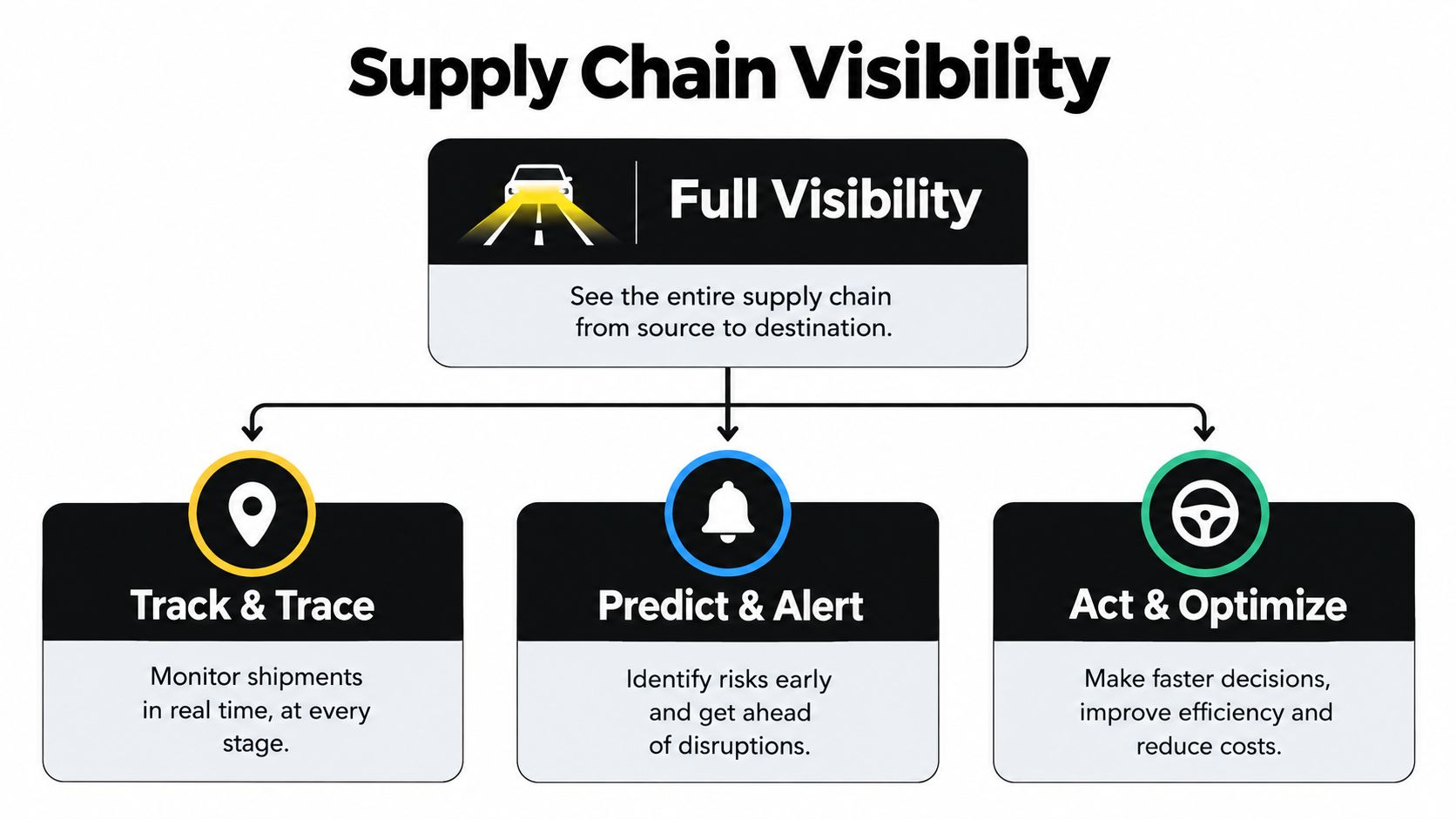
Headlights don't just prove the road exists. They show where you are, what's ahead, and whether you need to slow down, move over, or stop. That's what visibility should do for freight. It should tell you where the shipment is, what condition it's in, and when it's likely to arrive in enough time for someone to respond.
Basic tracking says, “The truck is moving.”
Useful visibility says, “The truck departed late, traffic added time, the ETA shifted, the dock should resequence unloads, and dispatch has already notified the receiver.”
The three layers people confuse
Teams often lump very different capabilities into one term. It helps to separate them.
- Track and trace: This is the base layer. It records milestones such as pickup, departure, arrival, and delivery.
- Predict and alert: This layer notices drift. The system or team sees that the plan is slipping and raises an exception before the miss becomes official.
- Act and optimize: Operations changes behavior. Labor gets moved, dock doors get reassigned, and route plans get updated.
Visibility isn't the screen. It's the combination of trusted events and usable decisions.
Why visibility thins out deeper in the chain
Visibility also drops as you move farther from direct control. A QIMA summary of a 2024 McKinsey Global Supply Chain Leader Survey reported that 60% of respondents had visibility of their tier-one suppliers, up by 10 percentage points for the second year in a row, while visibility into deeper tiers fell by 7 percentage points. That fits what operators see every day. Companies usually know their direct partners better than the sub-tier network behind them.
For middle-mile teams, the same logic applies at handoff depth. You may know your dispatch event, but if the receiving milestone depends on a partner's manual process, visibility weakens right where the risk starts.
A simple test at every handoff
At each transfer point, ask five plain questions:
- What moved
- When did it move
- Where is it now
- Is anything off-plan
- Who already knows
If your team can't answer those quickly without a phone tree, visibility is partial, not complete.
Business Benefits That Show Up on the Dock and on the Road
Operations leaders don't buy visibility because the term sounds modern. They want fewer surprises, steadier schedules, and cleaner handoffs.
That's why the value of visibility should be judged where the work happens. On the dock. In dispatch. In the cab. At the receiving window. If it doesn't help those moments, it's not doing much.
Better timing creates better labor use
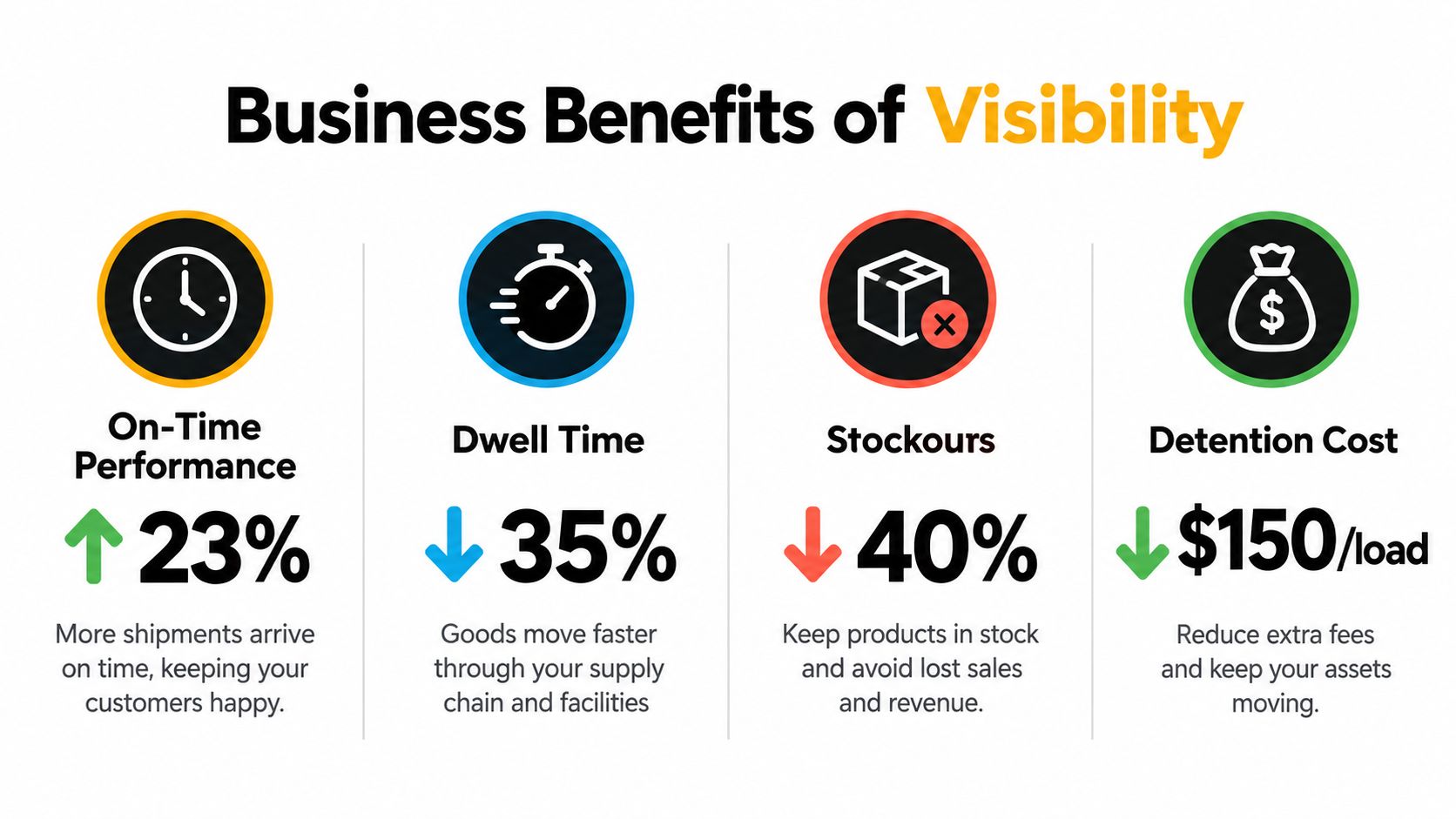
The first benefit is simple. Better visibility lets teams line up labor with actual arrivals instead of hopeful estimates.
When a receiving site knows a truck will hit the yard later than planned, it can reassign labor before people stand idle at the wrong door. When dispatch knows a truck is early, it can check whether the dock can absorb it or whether the driver should meter the approach. That's how visibility protects schedule discipline.
A useful benchmark for real-time architectures is roughly 1.2 to 3.5 seconds of end-to-end event latency for standard transactions and sub-second latency for priority alerts, according to research on real-time visibility systems. In plain terms, fast event flow gives planners a chance to intervene while the problem is still small.
Inventory gets less distorted
Visibility also matters inside the inventory record, not just on the road. If the system thinks a unit is available but it isn't physically where the record says it is, replenishment decisions start drifting.
Auburn research found that RFID-enabled visibility reduced retail inventory record inaccuracy by about 26% in field experiments. That matters because a cleaner physical-to-system match reduces phantom inventory and lowers the odds of stockouts caused by bad data.
Here's a quick explainer before the video:
The hidden cost is reactive work
Teams without visibility spend a lot of energy doing detective work. Calling drivers for status. Asking a receiver whether a truck checked in. Hunting for missing paperwork. Rebuilding the same timeline after the load is already late.
That labor doesn't show up neatly on a scorecard, but everyone feels it. The day gets noisier. Drivers get interrupted. Dock leads lose confidence in ETAs. Small issues take too long to verify.
- For planners: Visibility helps protect dock appointments before they're missed.
- For drivers: Clear milestones reduce the need for repeated status calls while they're trying to drive safely.
- For DC teams: Better event timing lowers the odds of labor waiting on freight that isn't close.
When operators say they want visibility, this is usually what they mean. They want fewer preventable surprises and more usable time.
KPIs and Data Sources That Make Visibility Measurable
You can't improve visibility by saying “we need more updates.” You improve it by deciding which events matter, how they're captured, and who trusts them.
New planners often make the same mistake. They open a dashboard with dozens of metrics, then struggle to tell which numbers help the night run better. A smaller set works better for middle-mile freight, especially if each KPI ties to a specific data source and action.
The KPI set that matters most
For overnight linehaul and box-truck operations, five measures usually tell the clearest story:
| KPI | What It Tells You | Primary Data Source |
|---|---|---|
| On-time arrival | Whether the load hit the planned receiving window | TMS milestone plus check-in event |
| Dwell time | How long the truck sat at a facility before turning | Yard timestamp, gate event, or dock scan |
| ETA accuracy | Whether predicted arrival times match actual arrivals | Telematics feed plus actual arrival milestone |
| Exception detection time | How quickly the operation notices off-plan movement | Alert engine, dispatch log, or milestone variance |
| Inventory accuracy | Whether the system record matches the physical item location | Scan events, RFID reads, or warehouse confirmation |
These KPIs work because they connect movement to decisions. If ETA accuracy is poor, planners can't trust the arrival board. If dwell time is fuzzy, route planning gets padded with guesswork. If exception detection takes too long, every downstream response starts late.
Where the data actually comes from
The source matters as much as the metric.
- Telematics: Best for truck movement, route progress, and location-based ETA logic.
- TMS events: Best for planned milestones, load tenders, departures, arrivals, and proof of completion.
- EDI and API messages: Best for sharing updates between shippers, carriers, and receiving systems.
- Scan events: Best for proving handoffs, pallet movement, barcode confirmation, and document-backed receipt.
- Driver documentation: Best for the details systems often miss, such as seal issues, damaged freight notes, or access delays.
A lot of teams invest in software before fixing event discipline. That flips the order. If drivers, dispatchers, and dock staff enter inconsistent timestamps or use free-form notes for everything, the dashboard will display messy truth faster.
Clean visibility starts with standard event definitions. “Arrived,” “checked in,” and “at dock” can't mean different things to different teams.
Trust comes from consistency
Data latency and data quality are different problems. One is about speed. The other is about correctness. You need both.
If you're building reporting views for planners, examples of smart ops dashboards can be useful because they show how operations teams turn raw events into actions rather than just charts. For shipment event discipline, Peak Transport's guide to real-time shipment tracking is also relevant because it focuses on how status updates support execution, not just customer-facing visibility.
A practical standard is to define one owner for each critical milestone. Dispatch owns dispatch and exception notes. Drivers own departure confirmation and in-trip communication. The receiving site owns check-in and unload confirmation. Shared ownership sounds cooperative, but it usually produces gaps.
Comparing the Technologies That Enable Visibility
No single tool gives full visibility across a middle-mile network. Each technology sees a different part of the trip.
That's why so many rollouts disappoint people. A company buys one platform and expects end-to-end clarity. Then it discovers the map is decent, but handoff confirmation is weak. Or the scan data is strong inside the building, but in-transit updates are patchy. The right question isn't “Which tool wins?” It's “Which blind spot does each tool reduce?”
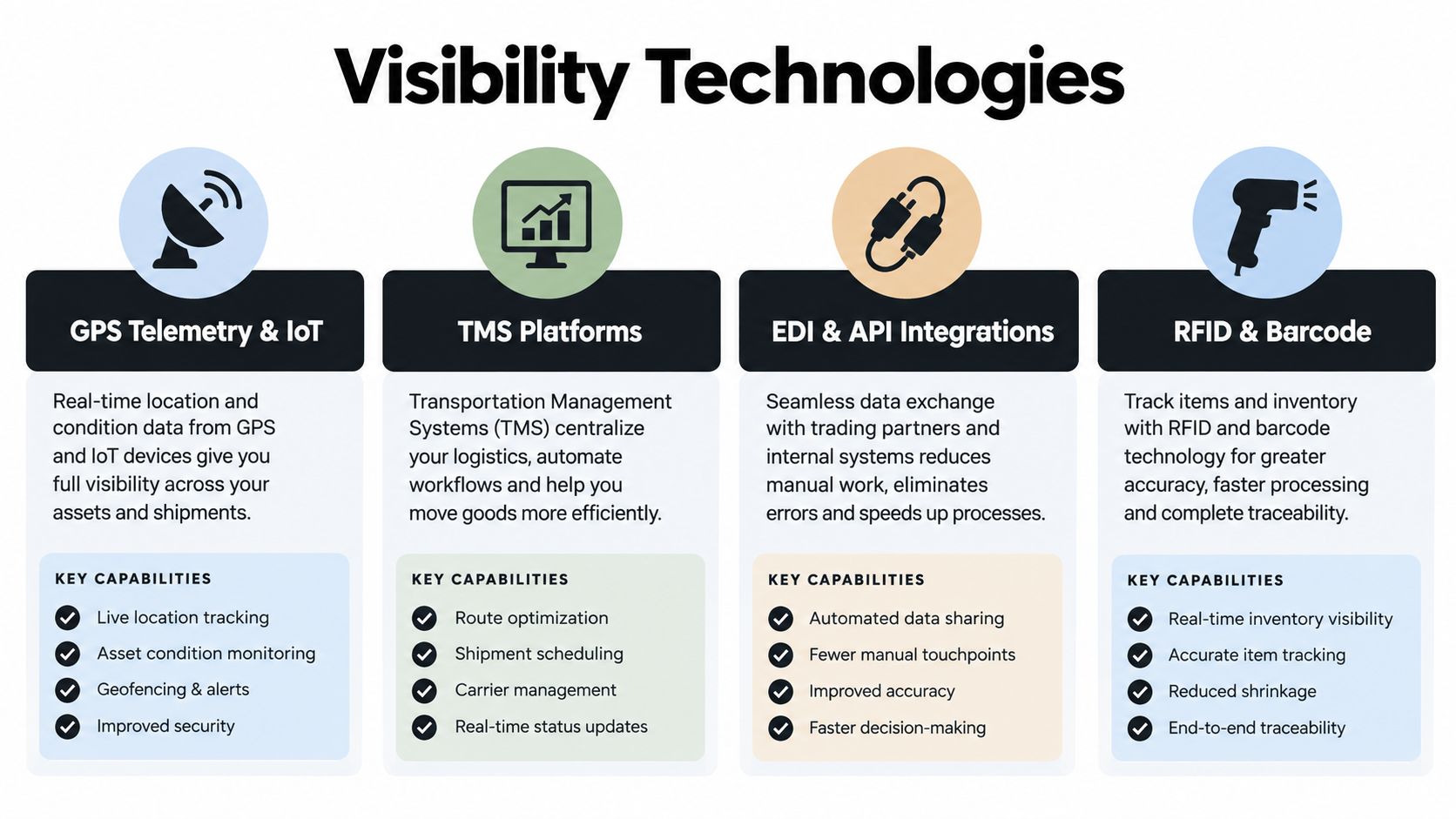
Side-by-side comparison
| Technology | What It Makes Visible | Coverage Limit | Integration Effort |
|---|---|---|---|
| GPS telemetry and IoT sensors | Vehicle location, route progress, sometimes condition data such as temperature | Only sees what the device can report, not every process handoff | Moderate to high |
| TMS platforms | Planned loads, status milestones, assignments, completion events | Depends on teams entering milestones correctly | Moderate |
| EDI and API integrations | System-to-system updates across partners | Only as good as partner participation and message quality | High |
| RFID and barcode scanning | Physical item or case movement at scan points | Doesn't show movement between reads | Low to moderate, depending on scope |
What the market is adopting
Adoption of device-based tracking has risen fast, but coverage is still incomplete. A 2024 Tive visibility survey found that IoT-based tracking adoption jumped from 25% in 2023 to 53% in 2024, and another 25% of respondents said they planned to adopt it within the next year. The same survey also found that only 24% had visibility into 75% to 100% of total shipments, while 45% had visibility into less than half.
That tells a familiar story. Companies are adding tools quickly, but many still don't have complete operational coverage.
How to combine tools without overbuilding
For most overnight box-truck networks, a layered stack works better than a giant all-in-one promise.
- Use telematics for movement: This gives dispatch live route progress and better ETA logic.
- Use TMS milestones for accountability: These define the planned sequence and record who did what.
- Use APIs or EDI where partner volume justifies it: High-repeat lanes benefit most from automatic status sharing.
- Use scans at handoffs: This anchors the record to a real physical event.
If you want a grounded operator view of telematics choices, Fleetalyse has a helpful guide to compare UK fleet visibility options. For vehicle-side connectivity in a middle-mile context, Peak Transport's article on connected vehicle technology is a useful companion because it focuses on the operational value of vehicle data rather than treating it like a gadget list.
One option in this space is Peak Connect Track, which provides shipment status monitoring through the shipment life cycle as carrier updates are received. In practice, tools like that are most useful when they sit on top of disciplined route execution and consistent milestone capture.
A Practical Roadmap to Improve Middle Mile Visibility
Most visibility projects stall because teams start with software selection instead of process cleanup.
That's backwards. If your overnight network has inconsistent departure logs, unclear exception codes, and handoff events that live in texts or calls, a new dashboard won't fix the core problem. It will only give everyone a cleaner view of bad inputs.
First 30 days
Start with event discipline.
Write down the exact milestones that define a successful middle-mile trip. Not broad ideas. Specific events. Dispatched. Loaded. Departed. Arrived at facility. Checked in. Unloaded. Released. Then assign one owner to each milestone and one approved method of capture.
Use a checklist like this:
- Standardize milestone names: Every site and dispatcher should use the same event labels.
- Tighten documentation habits: Drivers should know what must be recorded at departure, arrival, and exception points.
- Define exception codes: Late because of traffic is not the same as late because freight wasn't ready.
- Clean up dispatch communication: Move key updates into structured systems, not scattered messages.
Days 31 through 60
Connect what already exists before buying more.
Bring telematics and TMS data into the same operating view. Make sure the dispatch team can compare planned times, current location, and actual milestone completion without jumping across too many tools. If a facility sends arrival or unload confirmations electronically, connect those feeds next.
The fastest visibility win usually isn't a new sensor. It's removing one manual handoff in the status chain.
Trained W-2 driver operations can matter. When drivers run repeat routes with clear expectations, milestone capture becomes more consistent. Structured route familiarity often produces cleaner data than constantly improvising with unfamiliar labor.
Days 61 through 90
After the basics hold, automate outward sharing and build response rules.
Set alerts for the events that threaten the schedule. Late departure. Dwell beyond threshold. Missed arrival window. Missing check-in. Then decide who acts on each alert and what the first response should be. Visibility without an owner is just noise.
A strong roadmap at this stage usually includes:
- Automatic status sharing to customers or partner sites
- Exception alerts tied to real operating thresholds
- ETA logic tuned to recurring lane patterns
- Review meetings based on recurring misses, not one-off anecdotes
The payoff comes when the operation stops asking, “Can someone find out what happened?” and starts asking, “What response do we want to trigger now?”
Choosing a Visibility Ready Partner and Next Steps
The best visibility partner isn't the one with the flashiest screen. It's the one whose operation produces reliable events.
That means brands and DC leaders should ask practical questions during partner selection. How consistent are the lanes? How are overnight departures documented? What happens when a truck is running behind? How are drivers trained on milestones, paperwork, and exception notes? Is the carrier relying on an improvised labor model, or does it run with employed drivers, repeat routes, and stable dispatch habits?
Questions worth asking a carrier
- How do you confirm each handoff: Ask whether the process depends on memory, texts, scans, or system events.
- What does dispatch own: You want clear accountability for status accuracy and exception escalation.
- How do drivers document problems: A late load with a clear reason is much easier to manage than a vague update.
- How stable are the schedules: Repeat overnight patterns usually create better predictability than ad hoc routing.
- What does operational transparency look like: Peak Transport's article on operational transparency is a useful lens for evaluating how communication and accountability should work in practice.
What visibility-ready execution looks like
In middle-mile freight, the basics matter more than marketing language. Modern equipment helps. Clear dispatch communication helps. Consistent overnight routes between major facilities help. Respectful leadership helps because drivers are more likely to follow process when expectations are clear and support is real.
That's the reframing. Supply chain visibility is not just a digital overlay. It's an engineered operating capability built from route design, documentation accuracy, disciplined handoffs, and fast exception response.
If you're a planner, that means choosing a partner who can create trustworthy milestones. If you're a driver, it means working in a system where the route, paperwork, and communication standards don't change every night.
Peak Transport provides overnight middle-mile box-truck operations across the Twin Cities with structured dispatch communication, disciplined documentation, and route execution designed to support reliable visibility. If you need a carrier partner or you're a driver looking for stable W-2 overnight work built around consistency and accountability, visit Peak Transport.