Truck Driver Onboarding Process: Steps from Hire to Day 90
Learn the truck driver onboarding process for W-2 box-truck drivers: paperwork, paid training, supervised routes, pass gates and day-90 reviews.
November 10, 2026
Most fleets still treat driver onboarding as a race to course completion. Finish the modules, collect the signatures, and put someone on a route. That advice fails overnight middle-mile work.
A finished classroom day does not prove a driver can back a box truck into a tight dock after dark, keep electronic logs clean, or reach the right person when a scan fails at 2 a.m. I would not release anyone to solo until they show those skills on the lanes they will run. The truck driver onboarding process that holds up is a set of pass gates, plus an honest preview of the job before the offer is final.
Recruiting, Screening and Referral Sources
Hiring has to run every week, not once a quarter. The U.S. Bureau of Labor Statistics reported approximately 2.2 million jobs for heavy and tractor-trailer truck drivers in 2025, and employers are expected to face roughly 214,500 openings per year from 2025 through 2035. Those openings reflect growth and people leaving the occupation. BLS lists a postsecondary nondegree award as the typical entry education and short-term on-the-job training as the path to competency. Your gates only work if the front of the funnel keeps feeding them.
Where the names should come from
Referrals beat a cold posting. In 2024, 61% of transportation employers ranked employee referrals as their top recruitment channel, and 36% reported investing most in training and development, according to HireRight's 2024 Transportation Spotlight Report as summarized by BackgroundChecks.com. Put every referral in one tracked queue with a named owner. A strong name in a group text is not a pipeline.
The age of the workforce makes that queue more important. In 2024, the average U.S. truck-driver age reached 47, up from 42 in 1995, according to the American Trucking Research Institute, as reported by FreightWaves. Waiting only for seasoned applicants will thin the bench. A visible training path is how you replace people who leave or retire.
Screening has to be written down. In 2024, 57% of 100 motor carriers surveyed by ATRI had hired at least one person with a criminal record from the previous five years, CCJ Digital reported. Decide which findings disqualify someone for each route, and file the decision. A structured read on reliability and communication can sit next to the driving record. Transportation hiring insights from MyCulture.ai are a practical place to start if you want that screen before you spend a week of trainer time. How we source Twin Cities box-truck roles is spelled out in our notes on truck driver recruitment.
Four moves before anyone starts
- Post the job. Name the route type, the overnight schedule, and whether a CDL is required. Our box-truck roles need a valid driver's license and a clean driving record. A CDL is not required unless a specific route or vehicle says so in the posting.
- Route referrals to a queue. Same owner, same-week response, no side channels.
- Score the record against written criteria. Background check and driving record, matched to the route, not a gut call on a busy Friday.
- Attach the first-route plan to the offer. Hours, home time, and who answers at night are visible before acceptance.
Skip step 4 and every later gate is fighting a mismatch you already had in writing.
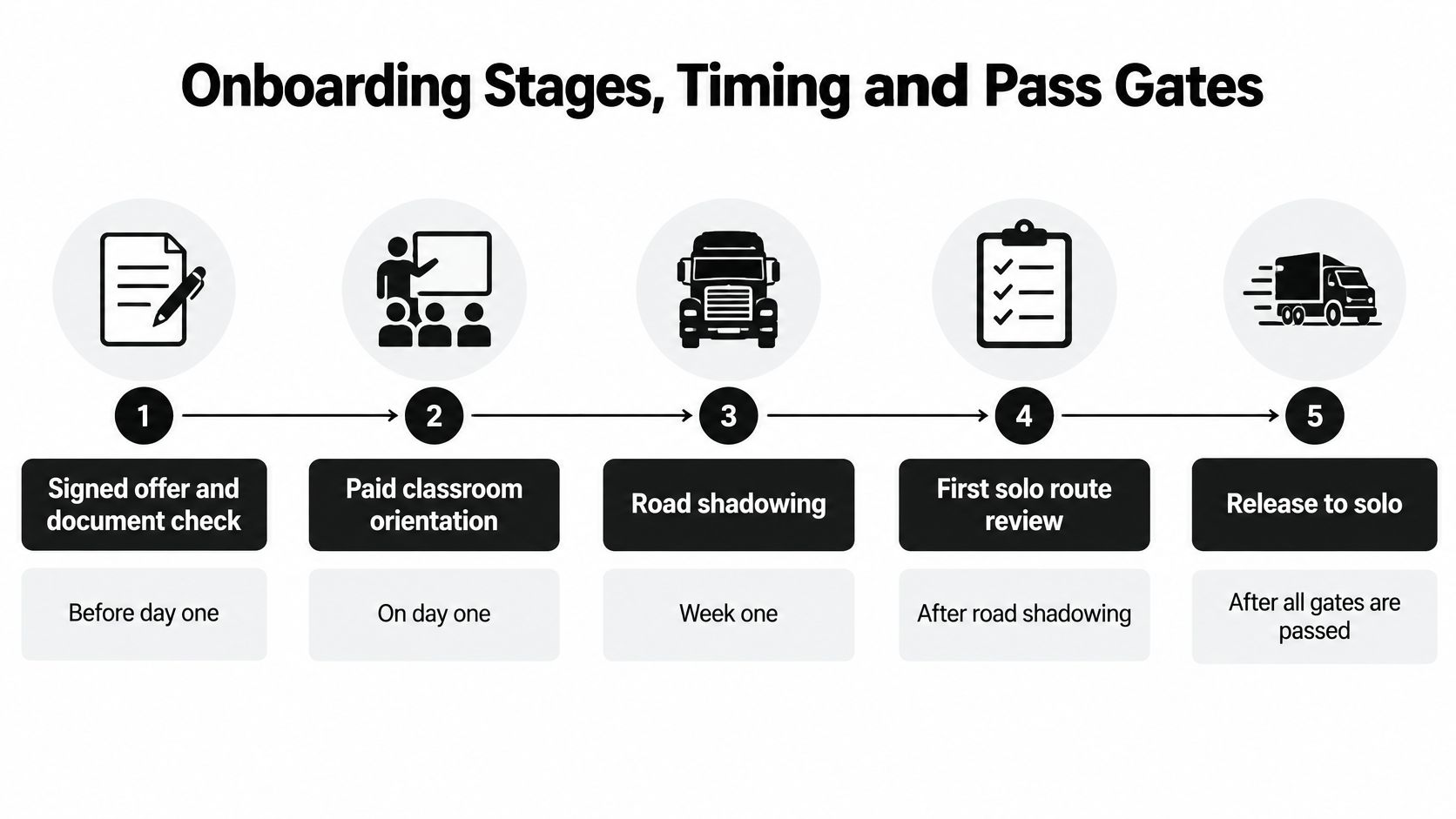
Onboarding Stages, Timing and Pass Gates
Dispatchers need a sequence they can follow without a meeting. The windows below are a planning cadence for a middle-mile box-truck operation, not a legal minimum. Nobody skips a gate because a lane is short-staffed.
| Stage | Typical timing | Pass gate | Owner |
|---|---|---|---|
| Offer and document check | Before day 1 | License, driving record and background check cleared | Recruiter and safety lead |
| Classroom orientation | Days 1-2 | Policies, hours-of-service and incident reporting assessed | Training lead |
| Vehicle inspection and maneuvering | Days 3-4 | Pre-trip inspection completed without prompts; backing shown | Yard trainer |
| Supervised night routes | Days 5-10 | Assigned lanes run with no unresolved defects or escalation misses | Route trainer |
| Release-to-solo decision | Days 10-14 | Logs, delivery records and escalation rules verified | Operations manager |
The FMCSA driver training synthesis describes the traditional structure as classroom orientation, controlled skills work off the road, and supervised driving in equipment and on routes like the assigned job. Classroom covers company policies, hours-of-service, cargo security, incident reporting, and documentation. The yard covers inspection and maneuvering. The road covers the overnight lanes. FMCSA also recommends judging curriculum, facility, vehicle match, trainer qualifications, certification, and actual driving-practice hours.
What each gate is for
Before day one, the file is either clear or the person does not start. License, driving record, background result, and medical or compliance clearance sit with the recruiter and the safety lead. A verbal "they're fine" is not a signature.
Days 1 and 2 are paid classroom time, not a video the driver watches alone in a break room. The training lead scores hours-of-service decisions, cargo security, incident reporting, and paperwork. Sitting through the session is not the pass.
Days 3 and 4 move to the yard. The trainer watches a full pre-trip, then the driver repeats it with no prompts. Backing and securement are demonstrated on the same equipment they will run. Familiarity with "a box truck" is not the same as this truck, this liftgate, and this pallet jack.
Days 5 through 10 are supervised night routes on the assigned lanes. The route trainer is looking for unresolved defects, missed escalations, and sloppy facility approaches. A short, easy lane does not waive the ride.
Around days 10 to 14, the operations manager signs release-to-solo only after logs, delivery records, and escalation rules check out. Coaching reviews still follow at 30, 60, and 90 days. Release is permission to run, not the end of supervision.
Pass rule: If the evidence is missing, the driver stays with a trainer. A full classroom roster is not competence.
FMCSA research found little variation in safety performance that could be explained by training-program duration alone. Longer classes do not buy you a safer driver. Evidence tied to the job does.
Give wet-surface stopping, braking-system behavior, stopping-distance changes from load configuration, and skid-control principles their own module. Those topics show up in FMCSA's recommended practices because load and pavement change how the truck stops, especially on a night run with a full box. The same idea of staged, documented gates shows up outside trucking in practical UK employee onboarding guidance. The trucking version ties each gate to a vehicle, a lane, and a named signer.
Licensing, Records and Requirements by Route
Our standard box-truck file is simpler than a CDL file, and it still has to be complete before day one. The role needs a valid driver's license, a clean driving record, the ability to run a pallet jack, and overnight availability. Box-truck experience is preferred, not a substitute for the checks. We collect employment history and driving-record details the applicant provides during the application, then we verify them. A signed note of what the person was told about shifts and routes goes in the same file. Without that note, a later dispute about nights and home time has nothing to stand on.
A CDL is not required for these driver roles. A valid license with a clean record is enough, unless a specific route or vehicle needs a CDL. When it does, that requirement is in the job posting before anyone applies.
Where a CDL route changes the file
| Requirement | Box-truck route | CDL route |
|---|---|---|
| Driver's license | Valid license with clean record | Valid CDL with required endorsements |
| Equipment skill | Pallet jack operation; box-truck experience preferred | CDL vehicle skills and endorsements named in the posting |
| Schedule | Overnight availability | Set by the job posting |
| Testing | Company assessment and paid training | Knowledge and driving tests, rules vary by state |
| Federal training | Not required for these roles | Entry-level training recorded in the Training Provider Registry |
Federal entry-level rules are the first gate for covered CDL applicants, not the whole process. The FMCSA Training Provider Registry became operational in February 2022. Certain new commercial drivers must finish minimum entry-level training before they take the applicable CDL skills or knowledge tests. As of the registry's displayed 2026 figures, it reported 2,073,337 drivers trained since February 2022 and 18,351 active providers. That volume means standardized entry-level training is now a normal part of the commercial pipeline.
The registry record does not replace company orientation or supervised road time. For a covered applicant you still document vehicle-specific instruction, pre-trip and post-trip standards, backing and loading, facility rules, electronic logging, incident escalation, and proof-of-delivery accuracy. Overnight middle-mile work adds distribution-center rules, local traffic, and the dispatch system on top of that baseline.
File check before day one
- License class and endorsements: Match the posting. A box-truck role stops at a valid non-CDL license with a clean record.
- Driving record and background result: Cleared against the written route criteria, not a sticky note.
- Overnight availability: Confirmed, because shift times can differ by route and we review options during hiring.
- Signed route acknowledgement: The driver has seen the first-route plan.
- Training record: Present for any covered CDL applicant. Blank for a standard box-truck hire is correct, not a miss.
How those documents stay current is covered in our guide to compliance documentation. If the posting and the file disagree, fix the posting or stop the hire. Do not "sort it out on the truck."
Set Expectations and Run the First Week
Early quits usually start before the first shift. CCJ Digital ties early turnover to mismatched expectations about pay, home time, routes, equipment, and the first weeks on the job. Unrealistic job expectations, weak supervisor support, thin benefits, and schedules that erase personal time show up the same way in research on why drivers leave. Faster online completion is the weaker bet. Slower alignment with the job produces a safer, more durable driver.
We hire for overnight shifts, full-time and part-time. Shift times vary by route, and we walk through options while someone is still a candidate. Middle-mile work here is local. Drivers go home after the shift. There are no long-haul overnight trips. Runs are scheduled between facilities, planned in advance, with no random residential stops. Drivers load and unload with pallet jacks, document deliveries, and complete pre- and post-trip inspections.
Before the offer is final, the candidate signs a first-route plan. It names the overnight window, facility check-in, dock parking and backing risks, the hub or Amazon Relay workflow, hours-of-service decision points, scanning and proof-of-delivery standards, and exactly who answers at 2 a.m. If they cannot picture that night, they should not accept.
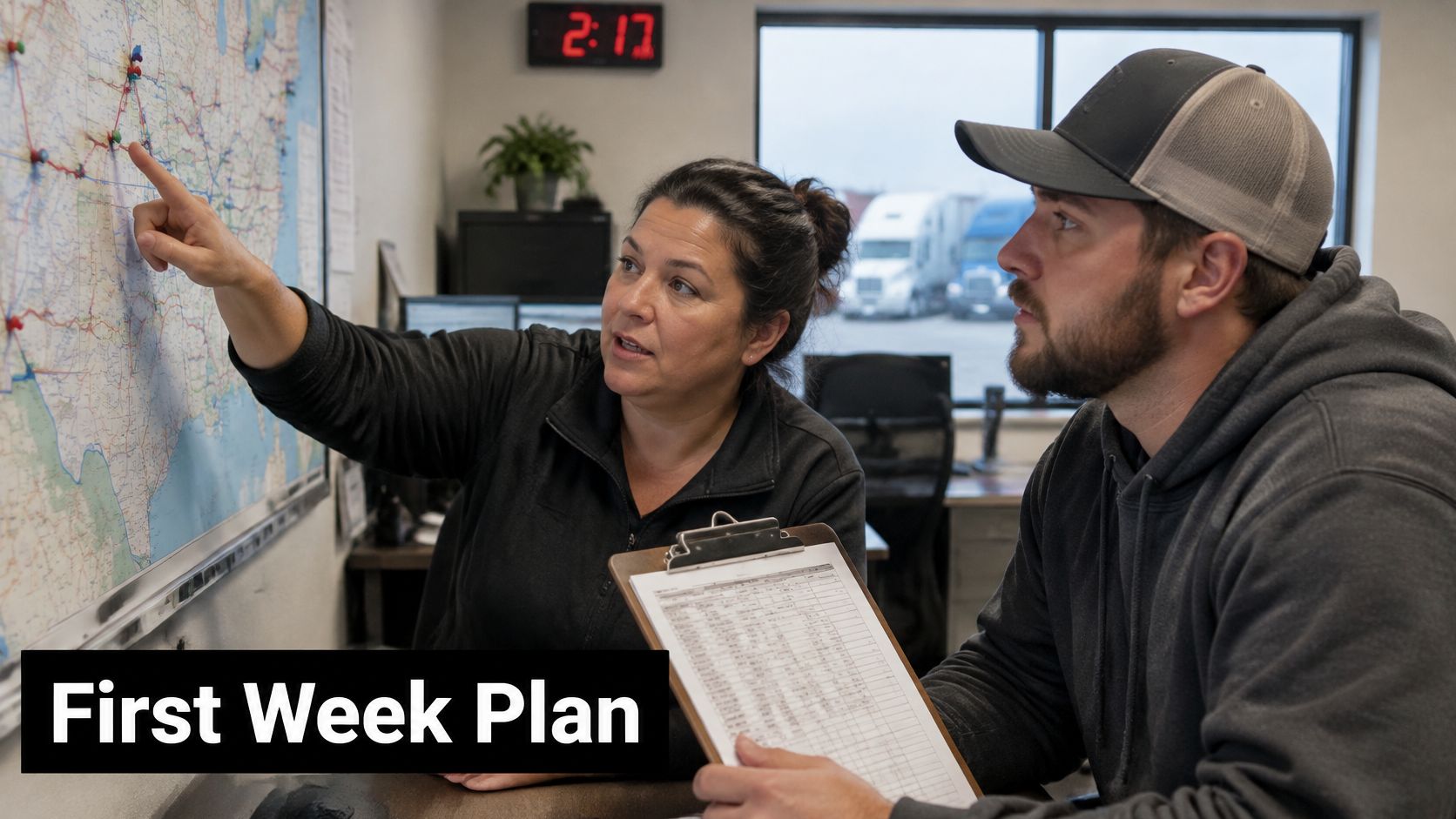
Paid training covers safety standards, routes, equipment such as pallet jacks, and company procedures before anyone works alone. The shape of that week is laid out in our notes on on-the-job training programs.
The first seven shifts
- Put pay, schedule, and route in writing. Confirm the paid training calendar, when pay starts, and which lane they are assigned. The common slip is a verbal "you'll be on nights" that does not match the posted window.
- Walk the truck with the trainer. Check the pallet jack, load securement, doors, and lift. People skip the walk-around once the model feels familiar. Night docks punish that shortcut.
- Run the pre-trip twice. Once with the trainer watching, then once with no prompts. That second pass is the first objective gate, not a courtesy.
- Practice backing and the dock approach in the dark. Clearance and sightlines change after sunset. A daytime yard loop does not show the light poles, the trailer next door, or the wet patch by the bumpers.
- Ride the lane, then drive it. Passenger first, trainer in the seat second. The driver should narrate check-in, the dock, and the departure so you hear the gaps before they are alone.
- Close logs and proof of delivery every shift. Incomplete records are the documentation failure that shows up first. Scan misses and half-finished delivery notes are coaching items the same night, not a surprise at day 30.
- Rehearse one after-hours failure. Write the escalation contacts, then run a missed appointment or an equipment defect. The driver should know who picks up, what they may decide alone, and what waits for a supervisor.
A driver who can name the 2 a.m. contact and the scan standard will outlast a driver who only finished more modules.
Watch a short walk-through of how that first-week handoff should feel before you build your own script.
The point of the week is transfer. Generic compliance training does not teach box-truck maneuvering, a distribution-center check-in, or a dispatch escalation on your lanes. If the signed plan and the week on the truck disagree, believe the truck and fix the plan before the next hire.
Day-30, Day-60 and Day-90 Checkpoints
The first 90 days are a risk window, not a graduation. A dataset of 17,004 new-entrant drivers analyzed for FMCSA contained 416 DOT-reportable crashes, 5,603 property-damage-only crashes, and 959 traffic convictions. About 71% had zero recorded safety incidents, while nearly 25% were in a property-damage-only crash, according to the FMCSA new-entrant analysis. Most new drivers are fine. A large minority are not, and the damage is often a dock, a bumper, or a facility approach rather than a highway event.
That split is why supervision stays tight on early route execution, backing, facility approaches, documentation, and dispatch talk. FMCSA notes that evidence linking formal entry-level training directly to reduced crash rates is limited, even though training improves performance and safety-related outcomes. Do not buy a longer class and call the risk handled. The same analysis associates structured safety-culture training and testing with fewer audit failures, roadside violations, and crashes, plus better retention and business survival. The difference is practice on the job, not more slides.
| Window | Action | Owner |
|---|---|---|
| Week 1 | Daily check-ins | Route trainer |
| Weeks 2-4 | Ride-along or telematics review | Route trainer |
| Weeks 2 to day 60 | Weekly scorecard | Operations manager |
| Day 90 | Formal qualification review | Operations manager |
What the scorecard is actually for
Track a short list and ignore vanity counts.
- Preventable incidents per 10,000 miles: Separates a bad dock week from a pattern.
- Late departures: Usually a check-in or pre-trip problem, not "traffic."
- Missed scans or delivery records: The error that makes a clean drive look like a failed stop.
- Inspection defects and log exceptions: Show whether the day-3 gate stuck.
- Coaching completion: A review that was never closed did not happen.
- Voluntary turnover: The retention readout. If people leave after a clean safety score, the job preview was wrong.
The common failure is weak transfer from the classroom to the night. Fix it with scenarios for fatigue, unclear dock instructions, route deviations, equipment defects, and missed appointments. Write the escalation thresholds and give feedback the same shift. Waiting for day 90 to mention a repeated late departure trains the driver to ignore you.
A data and coaching charter
Cameras and telematics blow up trust when nobody explains them. Survey reporting found that 45% of drivers' biggest concerns involved unclear use of data, while drivers who felt well prepared were far more likely to rate coaching technology as effective, 74% versus 19% among those with inadequate preparation, CCJ Digital's in-cab technology coverage reported. 30% said clear evidence that the technology protects rather than watches them would encourage them to stay. Real-time feedback lands differently from a delayed scolding.
Sign a plain-language charter during onboarding. It should state the purpose, who can see footage, what triggers a review, how long data is kept, whether a warning is coaching or discipline, how a false alert is challenged, and how good performance gets recognized. Hand the driver a copy. If you cannot answer those questions, you are not ready to turn the cameras on.
Build Your Onboarding Checklist This Week
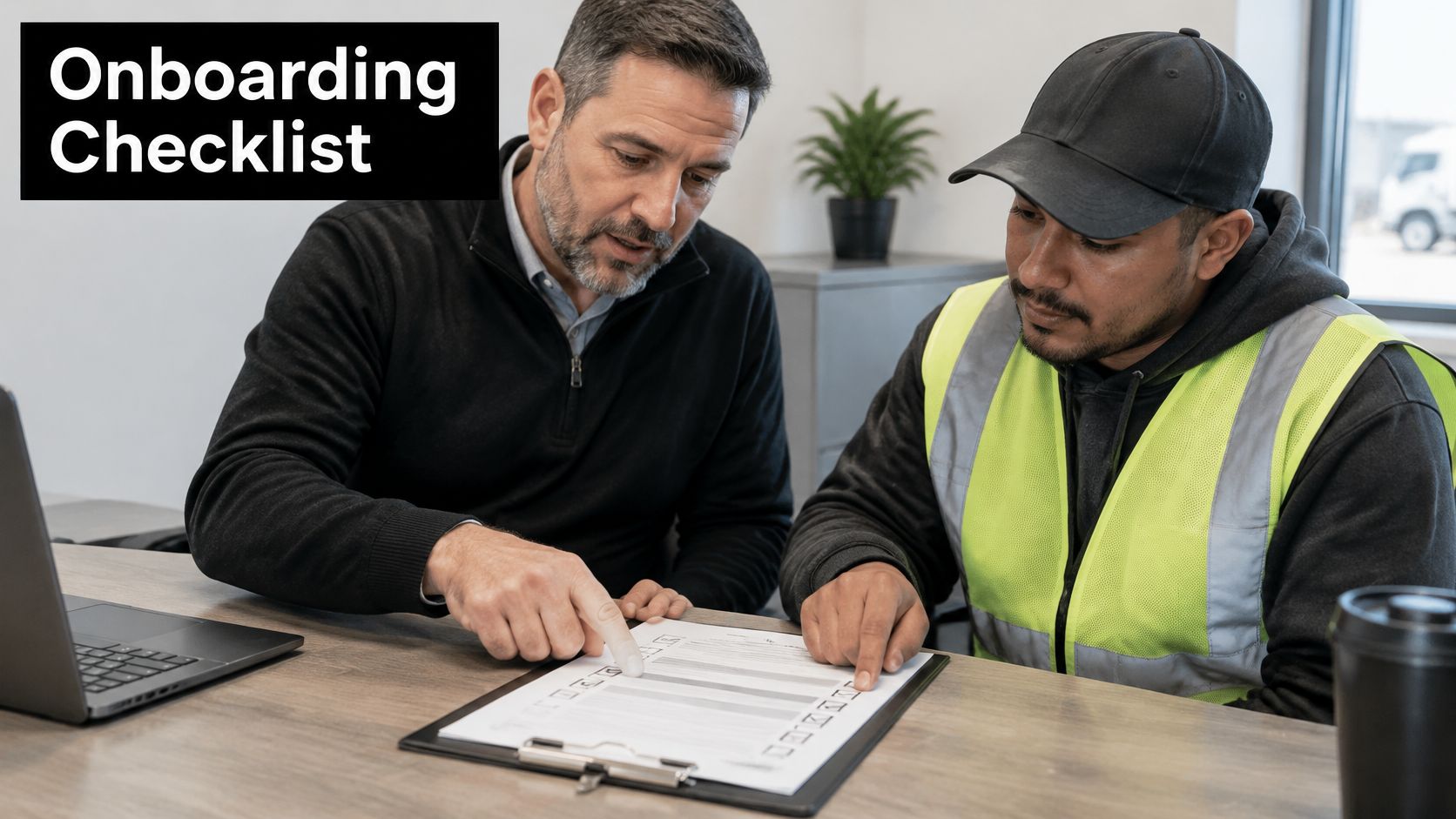
Copy this into the operations calendar before the next hire starts. Five lines, five owners.
- Name one owner for each gate in the stage table. If two people "share" release-to-solo, nobody signed it.
- Sign the first-route plan with every candidate before the offer is final.
- Put day-30, day-60, and day-90 reviews on the calendar the day they accept, not when something goes wrong.
- Name the metrics dashboard and its owner. Preventable incidents, late departures, missed scans, defects, log exceptions, coaching completion, voluntary turnover.
- Publish the data and coaching charter to every new driver, with a signature.
Turnover is why the list is an operating control. From 1996 through the first quarter of 2023, average annualized driver turnover was 92.7% at large truckload carriers and 77.6% at smaller carriers, according to a 2024 National Academies of Sciences, Engineering, and Medicine study reported by FreightWaves. At those rates, a sloppy first month is not an HR miss. It is an empty truck next week.
What actually keeps a new driver
The levers that matter on these lanes are boring on purpose. Predictable overnight routes. Consistent schedules. Paid training. Paid sick time. Health insurance options. A 401(k) with company match. Clear dispatch communication. Drivers here are W-2 employees, not 1099 contractors, so those terms are part of the job, not a bonus speech at day 90.
If the checklist and the offer letter describe different nights, the driver will believe the night they actually worked.
Candidates who want to hear the shift options before they apply can call 612-230-1292. Ask what the overnight window looks like on the lane you would run, who answers at 2 a.m., and when paid training starts. That call is the first-route plan, out loud.
Peak Transport runs overnight middle-mile box-truck routes between distribution centers and hubs, with paid training, structured dispatch, and W-2 roles rather than contractor gigs. If you want a truck driver onboarding process built around real lanes, clear gates, and a schedule you can plan a week around, see how we hire and run at Peak Transport.