What Is Asset Management and Why It Matters in Logistics
Learn what is asset management, how it works across the asset lifecycle, and why it drives ROI, safety, and on-time performance in middle-mile fleet operations.
October 17, 2026
Asset management is a lifecycle decision system for getting value from physical and operational assets while balancing performance, risk, and total cost. In a middle-mile fleet, that means deciding how to specify, maintain, use, and eventually replace a box truck so it can cover its routes safely and reliably.
A dispatcher watching a truck limp back to the yard at 2 a.m. with a brake warning isn't just facing a repair decision. The team has to work out whether the truck is safe to run again, how to protect the next departure, and whether the fault points to a wider maintenance or replacement issue. The answer depends on information gathered over the truck's working life, not just the warning light in front of them.
That's the practical meaning of asset management. It's more than an equipment register and broader than a maintenance schedule: it connects decisions about trucks, liftgates, tires, telematics, routes, and records to the service the fleet needs to deliver. The same idea applies in finance and engineering, where managers weigh what an asset does, what could go wrong, and what it costs over time.
For readers looking for a general introduction before applying the concept to fleet operations, Evright Industrial's asset management guide offers another perspective. Here, the focus is on translating the idea into everyday decisions involving trucks, routes, and drivers.
The Question Behind the Question
When a brake warning appears on a truck returning from an overnight lane, the immediate question is whether the vehicle can safely complete its next assignment. The harder question is why the issue surfaced when it did, whether earlier inspection or repair data could have flagged it, and how to keep the lane covered without creating a new risk.
Those questions reveal why “What is asset management?” matters to a fleet team. The answer isn't “keeping track of vehicles” or “fixing them on schedule.” It's making decisions that preserve an asset's value across its entire lifecycle, from choosing and setting it up to operating, maintaining, and retiring it.
Three things every decision must balance
A fleet manager is continually weighing performance, risk, and cost. A truck needs to meet its service role, such as covering an overnight route and arriving within the planned window. It also needs to be safe and compliant, and its purchase, maintenance, downtime, and eventual replacement all carry costs.
These factors can pull in different directions. Delaying a repair might preserve cash in the short term, but it can expose drivers and routes to failure. Replacing a truck early may reduce some operational concerns, but can discard useful service life and residual value. Asset management gives the team a way to compare those choices against service needs rather than making them in isolation.
Practical rule: Don't ask only, “What does this repair cost?” Ask, “What service does this truck support, what happens if it fails, and what does each available decision cost across the asset's life?”
The same logic helps a dispatcher decide whether to assign a vehicle to a demanding lane, a maintenance lead to prioritize a defect, and leadership to plan replacement timing. Each role sees a different part of the operation, but they're managing the same connected assets.
Where Asset Management Came From and Why Logistics Inherited It
A fleet budget works like an investment portfolio: money committed to one truck or repair is money unavailable elsewhere. That connection helps explain why asset management developed along both financial and engineering paths.
In finance, institutional investors turned to specialist managers to allocate pooled money under defined objectives. Those managers distribute capital across equities, fixed income, real estate, private markets, and cash. They then monitor whether those holdings meet the portfolio's performance and risk requirements.
At the end of 2023, the 500 largest global asset managers controlled approximately $128.0 trillion in assets under management, following annual growth of 12.5% after a $18 trillion decline in 2022, with equities and fixed income accounting for 77.3% of the total (Thinking Ahead Institute's global asset manager findings).
Those figures describe financial holdings; the useful connection for logistics is how managers allocate resources toward a shared objective.
From capital allocation to service levels
Engineering applies that discipline to physical assets. The question becomes how maintenance, repairs, and replacement support a required service level over an asset's life. The Federal Highway Administration connects transportation objectives with performance gaps, lifecycle costs, risk analysis, financial planning, and investment strategies (FHWA transportation asset management guidance).
For a middle-mile fleet, a truck's value includes the work it can reliably cover. A buyer considers its suitability for the routes. A dispatcher sees available capacity. A driver sees whether the equipment can complete the assignment safely. These perspectives need to inform the same investment decisions.
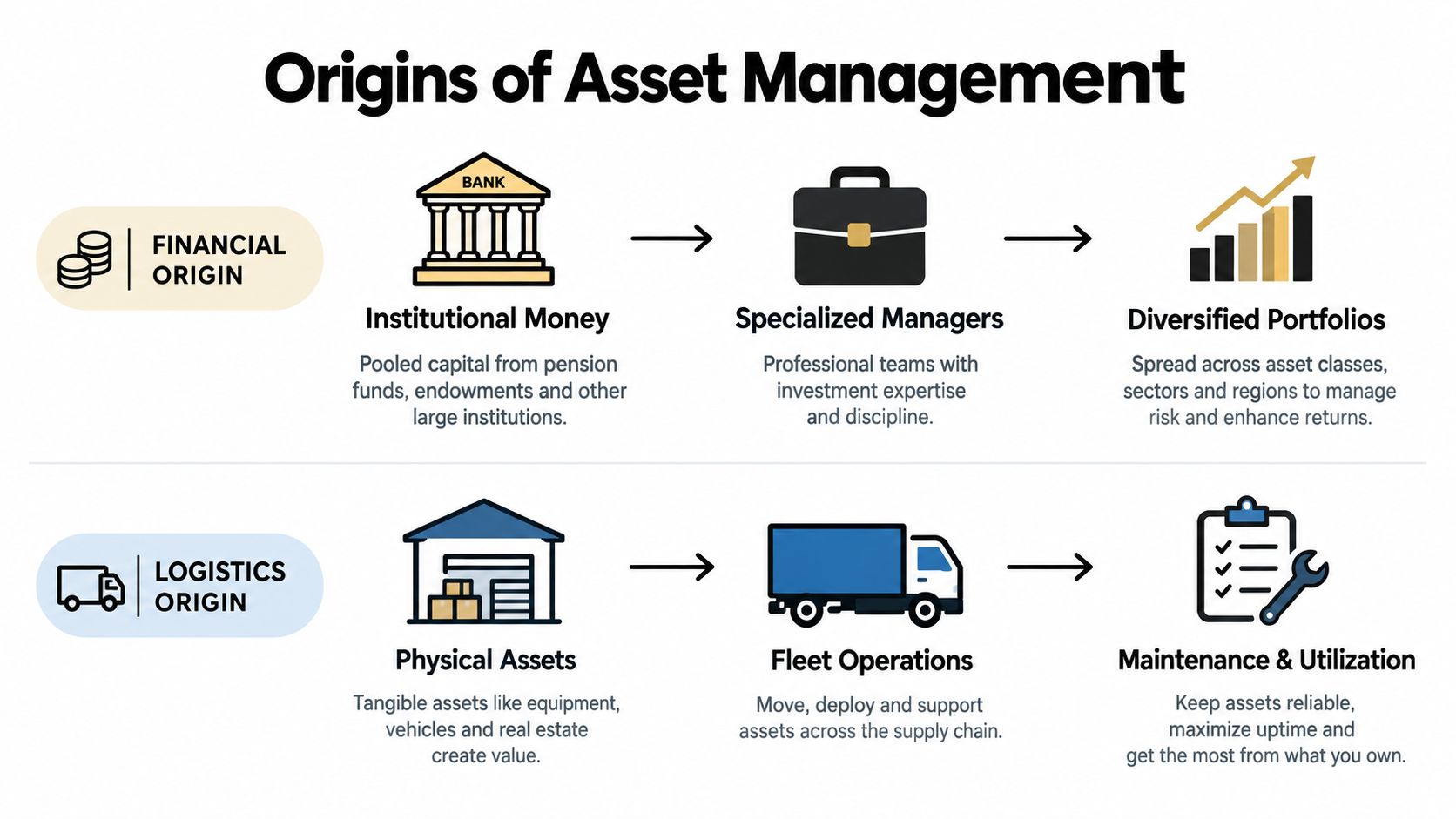
The two traditions share a practical discipline: Plan, monitor, and allocate them against clear objectives. ISO 55000 connects asset management with realizing value from assets through a lifecycle approach that balances performance, risk, and expenditure (ISO 55000 overview).
The fleet's portfolio extends beyond vehicles to liftgates, tires, telematics devices, maintenance records, route data, and connecting processes. Managing those together helps teams judge a repair, reassignment, or retirement by its contribution to reliable service, rather than by the truck's condition alone.
The Asset Lifecycle in a Middle-Mile Fleet
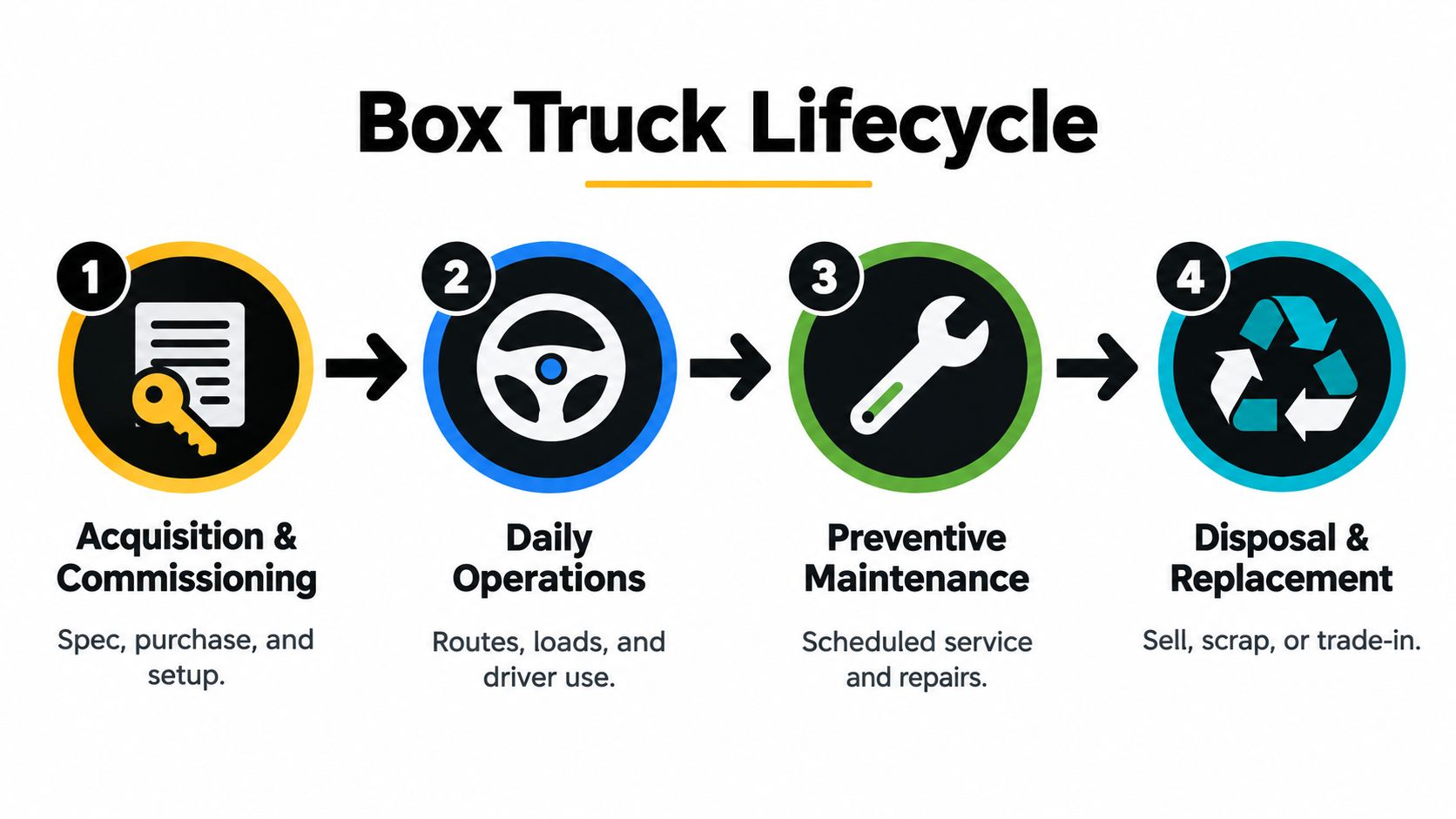
A box truck's lifecycle begins before it reaches a route and continues after it stops serving one. Looking at each stage together helps managers avoid optimizing one moment at the expense of the operation that follows.
Acquisition and commissioning
The first decision is what to buy and how to prepare it for its work. A truck assigned to overnight freight may need a particular body configuration, liftgate, tire setup, and telematics equipment. The purchase price matters, but so do the fit with the lane, the maintenance needs, and the information the truck can provide once it enters service.
Commissioning turns that specification into an operating asset. The fleet team records the vehicle, sets inspection and maintenance procedures, and makes sure dispatch and maintenance can identify it consistently. A missing record or unclear setup can make later decisions harder, even if the truck itself is sound.
Daily operations and planned maintenance
During operation, managers use mileage, engine hours, fault codes, preventive-maintenance compliance, and driver inspection reports to make decisions. A fault code, for example, may need a shop review before the truck is assigned to a demanding route. A history of recurring defects can make a scheduled inspection more urgent than the calendar alone suggests.
Maintenance planning should fit the vehicle's role. A repair that removes a truck from service has different consequences when it supports a busy overnight lane than when it's a spare. For practical guidance on organizing this work, see Peak Transport's fleet maintenance management resource.
Mid-life intervention and retirement
A truck in mid-life may need a major component replacement, refurbishment, or reassignment to a less demanding lane. The right choice depends on condition and service needs, not age alone. Retiring a vehicle also requires judgment: leaders weigh its expected reliability, downtime exposure, remaining value, and the operational requirements of the replacement.
This lifecycle view prevents three common mistakes: buying solely on purchase price, deferring maintenance to protect a short-term budget, or replacing a vehicle because a newer model exists. Each choice should be considered against the truck's full role and cost of ownership. For an example of how maintenance planning applies to other high-value vehicles, Approved Jets' business jet maintenance guide provides useful context.
Tracking the Things That Actually Move the Needle
A dashboard can show a truck's location, but location alone doesn't tell a manager whether it's being used productively, maintained well, or kept on a route that matches its condition. Tracking becomes useful when teams connect different records to specific decisions.

Four evidence streams for fleet decisions
Start with the information already available, then connect it in ways that answer operational questions:
- Telematics: GPS, engine diagnostics, idling, fuel information, and driving events can help teams investigate utilization, maintenance needs, or safety concerns. Route plans and dispatch changes are needed to interpret what the location data means.
- Maintenance records: Preventive service, repair history, parts use, and warranty information build a mechanical history for each vehicle. A recurring repair pattern may justify closer inspection or a change in assignment.
- Inspection and defect logs: Driver reports and shop inspections capture conditions that telematics might not reveal. A reported liftgate issue, for instance, can prompt a repair before the vehicle is dispatched for a load that depends on it.
- Route documentation: Planned and actual mileage, loading conditions, dock delays, weather, and dispatch changes help explain how work affects both vehicle condition and service performance.
Minnesota's 2025 public-sector telematics policy lists uses such as fleet operations, safety coaching, maintenance, cost analysis, mileage capture, complaint resolution, and investigations. It also describes telematics as supporting proactive maintenance and emergency response (Minnesota telematics policy).
Data needs rules and ownership
The same data can inform maintenance, dispatch, or safety, but only if teams agree on what triggers action, who reviews an exception, and how information is retained and used. Without those rules, a fault alert may sit unread or a driver event may be misinterpreted without route and weather context.
A trailer tracking system can provide useful operational visibility, but it doesn't replace the records needed to understand the full fleet picture. Peak Transport's trailer tracking system resource is relevant for teams considering how location information fits into their workflows.
Tracking is evidence, not the management system. The value comes from connecting records to a defined decision, with clear responsibility and an appropriate response.
KPIs and ROI That Prove the Program Is Working
An overnight truck misses departure after an unexpected repair. The repair bill captures only part of the cost: dispatch must find replacement capacity, the driver's assignment changes, and the customer's delivery window is at risk. A useful scorecard connects those consequences to vehicle condition and spending across the asset's life.
The FHWA planning elements connect performance measures with lifecycle costs, risk, and investment decisions. For a fleet, that means judging maintenance spending alongside the route coverage it supports.
Review the measures below weekly. Target direction indicates desired movement; set thresholds using route requirements, safety obligations, and operating history.
| KPI | What It Measures | Target Direction | Operational Lever |
|---|---|---|---|
| Preventive-maintenance completion | Scheduled service completed as planned | Improve completion; clear overdue work | Shop scheduling and vehicle availability |
| Mean distance between roadside failures | Distance traveled between failures away from the shop | Increase distance between failures | Repair quality and condition-based intervention |
| Vehicle availability | Trucks ready for assigned work | Improve readiness while completing needed service | Maintenance windows and spare planning |
| Unplanned repair hours | Time spent on unexpected repairs | Reduce avoidable hours | Fault review, inspection follow-up, parts planning |
| Cost per productive mile | Maintenance and operating costs per mile serving assigned work | Reduce cost while protecting service and safety | Lane assignment, utilization, replacement timing |
| Tire-related incidents | Tire problems affecting safety or operations | Reduce incidents | Tire checks, replacement, defect escalation |
| On-time departure and arrival | Performance against planned service windows | Improve consistency | Dispatch readiness and maintenance coordination |
Read the scorecard as a connected system
The scorecard works like a truck's instrument panel: readings need to be interpreted together. Fewer repair hours may look encouraging, but check whether overdue service increased. Lower availability can put departures under pressure. Brake defects require safety action regardless of assignment; a liftgate fault also threatens coverage when the assigned load needs it, while cosmetic damage may be less urgent.
ROI compares the benefit of an intervention with its cost. Compare maintenance or replacement spending with changes in repair costs, replacement-capacity needs, and completed lanes under comparable operating conditions. A cheaper truck can become expensive to keep if recurring disruptions consume the savings.
Are we protecting route coverage? Are we reducing the cost of disruption per completed lane?
Use those questions to connect finance's lifecycle view with dispatch's daily decisions. Peak Transport's fleet performance metrics guide provides a broader view of how operational measures fit together.
Software, Spreadsheets, and the Spectrum of Maturity
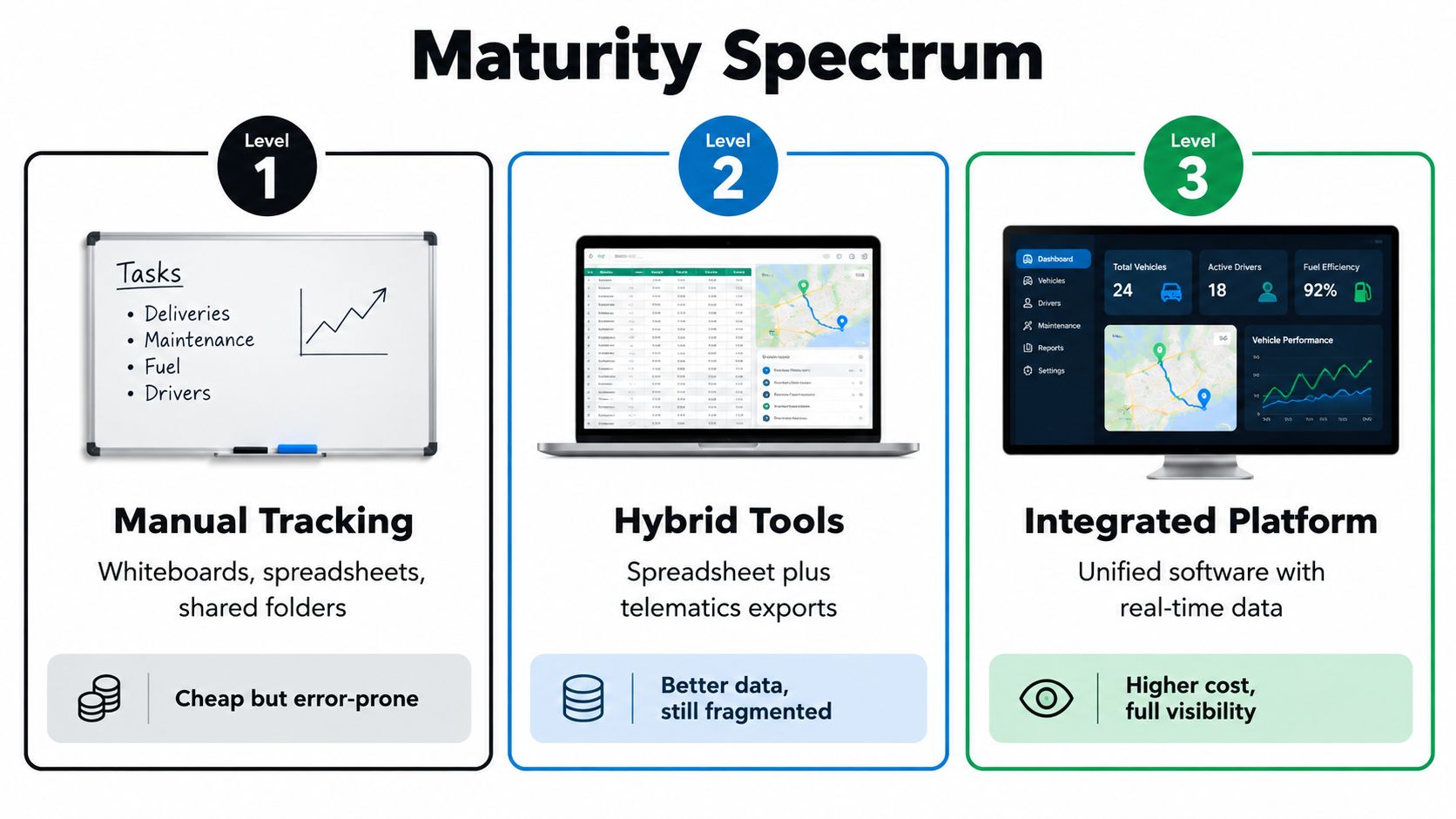
A fleet's tracking tools should match the decisions its people need to make. A spreadsheet may be enough to coordinate a manageable operation. As records spread across dispatch, maintenance, safety, and finance, the question becomes whether everyone can work from the same picture of each truck.
| Approach | Cost and Effort | Visibility | Main Limitation |
|---|---|---|---|
| Manual tracking | Low initial expense, substantial staff effort | Records spread across boards, spreadsheets, and folders | Missed updates can weaken lifecycle decisions |
| Software-assisted tracking | Configuration and ongoing upkeep | Easier access to telematics, maintenance, or inspection records | Separate systems may leave gaps |
| Integrated management | Greater planning and implementation effort | Shared records support coordinated decisions | Depends on clear ownership and reliable updates |
Move from records to coordinated decisions
Manual tracking works like a handover notebook: its usefulness depends on who updates it and who reads it. A dispatcher may have the assignment sheet while maintenance holds the repair history. Someone must connect those records to spot recurring faults or compare trucks consistently.
Software makes records easier to find. Coordination still requires a working handoff. A maintenance alert that never reaches dispatch can leave an unavailable truck on the assignment list. A route change that never reaches maintenance can leave service planning disconnected from the truck's actual work.
Integration connects vehicle selection, assignments, preventive maintenance, safety, compliance, downtime, and replacement decisions. For a logistics buyer, that means comparing equipment with its expected working life in view. Dispatchers need a dependable availability status, and drivers need reported defects to reach the people responsible for action.
Shared definitions matter more than the number of applications.
The ISO committee overview places asset management within an organizational discipline covering lifecycle operations, outcomes, risk, information, and maturity. Applied to a fleet, that perspective means assessing how reliably records support decisions before choosing a platform. The next improvement might be clearer inspection records or a connection between existing systems.
Financial asset management offers a separate technology context: PwC projects global assets under management reaching $171 trillion by 2028, with a 5.9% compound annual growth rate, reports about 80% of surveyed managers saw AI as supporting revenue growth, and projects technology-as-a-service increasing revenues by 12% by 2028 (PwC's asset and wealth management report).
Those figures describe financial-sector expectations, not fleet software returns. Fleet teams should judge technology by whether it connects truck records to decisions about routes, maintenance, and replacement.
What This Looks Like Inside an Overnight Box-Truck Operation
An overnight box truck is due to leave a distribution center for a regional hub when the driver reports a defect. The customer still expects arrival within the planned window. Dispatch needs a safe substitute, and maintenance needs enough information to assess the assigned truck.
That departure depends on decisions made long before tonight's inspection.
A lifecycle approach starts with selecting equipment suited to the lane and expected loads. The team records the vehicle setup and inspection requirements, then schedules service around the route's operating pattern. When a defect appears, those records help maintenance assess the repair and help dispatch choose an appropriate replacement. A backup truck works like a spare link in a chain: it must fit the load and route to keep the service connected.
Why the people around the truck matter
Drivers need clear inspection instructions and a reliable way to report defects. Dispatchers need to know which trucks are ready. Maintenance staff need accurate histories, while leaders weigh performance, asset-related risk, and total expenditure, the balance reflected in the ISO 55000 asset-management framework.
The financial and operational views meet in that decision. Repair costs matter alongside the truck's ability to cover its route safely and the disruption caused by taking it out of service. Route documentation, dispatch practices, inspections, and available drivers all affect the value the vehicle delivers.
For a middle-mile operator such as Peak Transport, structured dispatch, route documentation, safety workflows, and maintained equipment support the operating system around each truck. Clear expectations help drivers report problems in time for the team to assess safe route coverage.
Judge the payoff across the service. Dependable equipment can help protect delivery windows and reduce disruption-related overtime. Repair and route histories also support better-informed replacement decisions, connecting tonight's dispatch choices with the fleet's longer-term spending.
Building the Program Without Rebuilding the Operation
Start with a decision your fleet already makes: whether a truck with recurring faults should stay on its assigned route. Building the program around that decision connects repair spending with service needs. Expand the process as the team learns what information helps.
Name the portfolio and assign owners. List the trucks, liftgates, tires, telematics, route records, and supporting processes. Assign responsibility for keeping records current and acting on exceptions. A shared record works like a handoff sheet: each person should know what needs attention and who handles it.
Choose a small set of measures. Use information the team already collects to connect vehicle condition with route performance. Define what triggers a review and who follows up. Keep the measures usable during daily operations.
Review shared information together. Give dispatch, maintenance, safety, and finance a recurring opportunity to examine the same records. For a truck with repeated faults, agree on an action and an owner. Carry that decision into dispatch and maintenance planning.
Feed what you learn into future decisions. Bring repair and route histories into purchasing specifications, vendor reviews, lane assignments, and replacement timing. That closes the loop between tonight's operating choices and future fleet spending.
The ISO technical committee overview places asset management across lifecycle operations, risk, and organizational decision-making. Finance contributes the cost view; operations contributes the service consequences.
Keep the program close to the work so dispatchers can act, drivers can report concerns, and leaders can weigh cost, safety, and uptime together.
Peak Transport connects distribution centers and regional hubs through structured overnight box-truck operations across the Twin Cities area. Businesses evaluating a middle-mile partner can learn about its routes, safety practices, and dispatch approach at Peak Transport.