What Is Network Optimization for Middle-Mile Logistics
What Is Network Optimization. Understand what network optimization is for logistics. Learn how to optimize middle-mile routes, reduce costs, and improve
October 7, 2026
Shortest-route advice sounds sensible until the route reaches a closed dock.
A logistics manager can approve a plan with fewer miles, lower projected fuel use, and a clean sequence of stops, only to discover that the driver can't legally complete the run within available hours. A late arrival then misses a facility cutoff, creates waiting time, and pushes the next handoff behind schedule. The supposedly efficient plan costs more because it optimized distance while ignoring the operating conditions that make the route usable.
That tension explains what network optimization really means in middle-mile logistics. It isn't just routing software or a warehouse-location exercise. It combines mathematical models, facility constraints, vehicle capacity, driver-hour limits, schedule reliability, and accurate operational data. For professionals building broader technical knowledge, resources covering network certifications without a degree can also help explain how systems thinking applies across complex networked operations.
Introduction to Network Optimization

The practical question isn't, “Which route is shortest?” It's, “Which plan can a driver, vehicle, and facility execute safely and on time?” A middle-mile network may include recurring overnight lanes between distribution centers, regional hubs, and relay nodes. Each movement depends on more than road distance. The dispatcher must account for loading readiness, dock appointments, equipment availability, traffic exposure, service windows, and the driver's remaining hours.
A distance-first plan often fails at the handoff. A truck can arrive early and wait because a dock isn't ready, or arrive late because a sequence ignored congestion at the wrong departure time. The model may still report an efficient route, but the operation experiences overtime, missed cutoffs, extra communication, and a recovery plan that someone has to build manually.
The real operating question
Network optimization gives planners a structured way to make trade-offs before the truck leaves. It can compare lane structures, facility assignments, load combinations, and route sequences while enforcing constraints that dispatchers deal with every night. The output should make the dashboard clearer, not make the operation harder to understand.
Practical rule: A route isn't optimized until a qualified driver can complete it within the available hours and every required facility can receive it.
This guide treats optimization as an operating discipline. The mathematics matters, but so do the people entering facility rules, the dispatchers reviewing exceptions, and the drivers who know when a theoretical sequence won't survive real conditions. The strongest plans reduce unnecessary miles without sacrificing predictable arrivals, safe workloads, or reliable handoffs.
What Network Optimization Actually Means
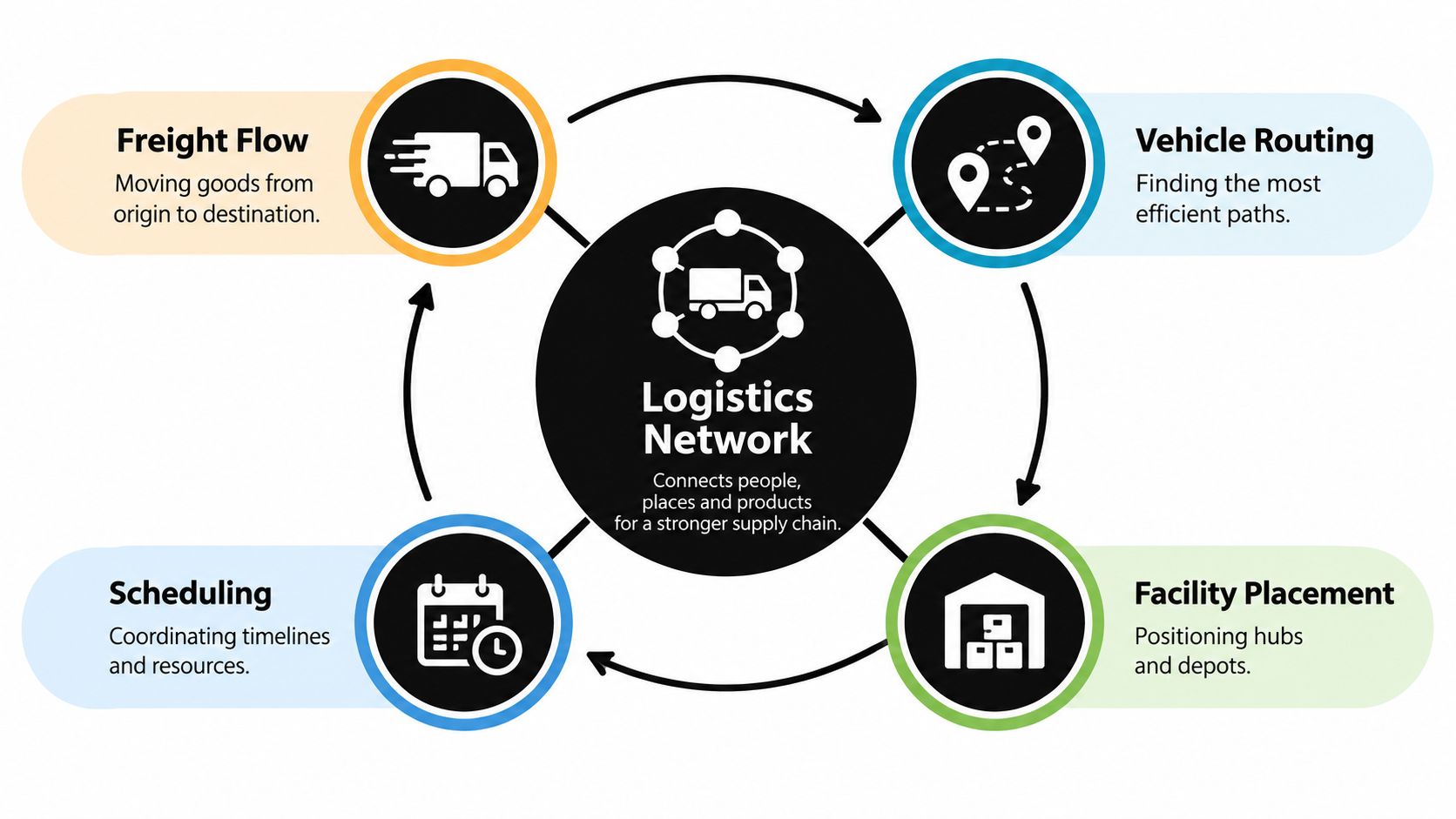
Network optimization is the mathematical design of how freight, vehicles, facilities, and schedules interact across a distribution network. A useful analogy is the circulatory system. Freight behaves like blood moving through the network, routes resemble vessels, facilities act as organs, and vehicles provide the capacity that keeps the system moving. Shortening a vessel without considering pressure, capacity, or organ health can damage the whole system. The same applies when a planner removes miles without checking driver hours or dock capacity.
A practical model often uses mixed-integer linear programming, or MILP. Continuous variables can represent shipment quantities, mileage, fuel, or operating time. Binary variables can represent decisions such as whether to activate a facility, use a lane, assign a vehicle, or select a route. The objective can minimize transportation, handling, inventory, and environmental costs while still enforcing capacity, timing, mode, and service constraints, as described in this overview of MILP in logistics network design.
Strategic design and daily execution
The first distinction is between strategic network design and tactical or operational optimization.
Strategic design answers questions such as:
- Which facilities should serve which regions?
- What capacity should each facility provide?
- Which lanes should exist between hubs?
- Which transportation modes fit the service promise?
- How should freight flow through the network?
Operational optimization answers a different set of questions:
- Which vehicle should carry each load?
- What sequence should the driver follow?
- Does the route fit capacity and arrival windows?
- Which lane should receive protection when equipment is scarce?
- What should dispatch change after a delay or closure?
A tool may be excellent at facility placement and weak at route execution. Another may sequence stops well but lack the strategic capability to compare hub structures. Buying software without identifying that distinction leaves a serious gap between the network plan and the dispatcher's screen.
Large networks also create a computational trade-off. As facilities, lanes, products, and time periods multiply, exact optimization can become difficult to solve within operational time limits. Systems may therefore use decomposition, branch-and-bound, branch-and-cut, or heuristic methods to produce high-quality plans quickly. The practical objective isn't mathematical perfection in isolation. It's a plan that respects service and safety constraints while remaining usable when the shift begins.
The Three Types of Logistics Optimization
Logistics optimization usually rests on three connected decisions: transportation, facility location, and inventory. Treating them as separate projects can produce local improvements that make the wider network worse.
Transportation optimization
Transportation optimization determines how freight moves through available lanes and vehicles. It considers route sequence, load assignment, mode selection, capacity, travel time, and service requirements. In middle-mile operations, the result may be a recurring lane template that gives dispatchers a dependable structure, with defined exception rules for congestion, equipment shortages, or late departures.
A practical route-planning reference such as route planning and optimization is useful because route decisions sit at the execution layer. The objective isn't merely to reduce road distance. It's to protect the handoff and make the plan repeatable.
Facility location
Facility-location optimization examines where hubs, depots, or distribution centers should sit and which demand points they should serve. Moving a facility changes the lanes around it, the expected transit times, the equipment pattern, and the workload assigned to each driver. A location with attractive building or handling economics may create longer or less reliable middle-mile movements.
Consider a distribution center decision in the Twin Cities metro. If freight is repositioned toward one regional hub, some overnight lanes may become more direct, while other origins may require additional repositioning or a different departure window. That decision then changes vehicle utilization and the amount of inventory that must be positioned near each service area.
Inventory optimization
Inventory optimization balances stock placement against service requirements. Holding more inventory closer to demand can support dependable fulfillment, but it also changes replenishment flows and facility workload. Holding less inventory may reduce carrying exposure while increasing the need for precise, reliable transportation.
These choices form a hierarchy rather than three isolated boxes. A facility move changes transportation. Transportation reliability affects where inventory should sit. Inventory placement changes shipment frequency and load patterns. Managers should therefore evaluate total network performance instead of approving a facility, routing, or inventory decision on a single cost line.
How Mathematical Models Drive Decisions
A dispatcher doesn't need to solve equations manually, but the dispatcher does need to understand what the model is protecting. At the route-execution level, network optimization often becomes a vehicle-routing problem with time windows, or VRPTW. The system assigns stops to vehicles and sequences each route while respecting capacity, service duration, and arrival-window constraints.
Consider an overnight box truck leaving an Amazon Relay node for a regional hub. The model doesn't just draw the shortest path between the two points. It considers whether the truck can be loaded before departure, whether the vehicle has enough usable capacity, how long the handoff takes, and whether the driver can reach the receiving facility during its accepted window. If another stop must be included, the system evaluates possible sequences rather than assuming that geographical order is operational order.
What the dispatcher sees
A useful model translates into controls that appear familiar on a dispatch board:
- Load assignment: The system matches freight to vehicle capacity and lane requirements.
- Stop sequencing: It places pickups and deliveries in an order that satisfies timing and service constraints.
- Departure validation: It checks whether the planned start time still supports every arrival window.
- Exception handling: It flags a late load, congestion exposure, unavailable equipment, or a driver-hour conflict.
- Plan comparison: It allows dispatch to compare planned miles and arrival times with actual performance after the trip.
This is why the best sequence may not be the shortest sequence. Waiting at a dock can erase a distance advantage. A lane that performs reliably at one departure time may experience materially different travel performance at another because of congestion and time-dependent travel conditions. Research on vehicle routing with time windows also shows that solution quality and computational speed vary with network structure, so planners should watch solver behavior alongside operating results.
The model needs a usable network
An exact model can still produce a poor plan if its inputs misrepresent the operation. Facility hours, service durations, route restrictions, equipment types, and driver-hour rules must reflect what happens on the floor and on the road. A planner should also distinguish a standard recurring lane from a one-off recovery move. Stable templates can reduce dispatch complexity, while constant route changes may increase handoff risk even when they appear efficient on paper.
For a deeper strategic perspective, supply chain network design provides useful context for connecting facility and lane decisions to daily transportation execution. The mathematical model is valuable because it makes trade-offs visible. Human operators remain responsible for deciding whether the assumptions are credible.
KPIs That Measure Optimization Success
Mileage and cost matter, but they don't tell the whole story. A middle-mile plan should be judged by whether it delivers freight reliably, uses driver time responsibly, and gives managers enough visibility to correct recurring problems.
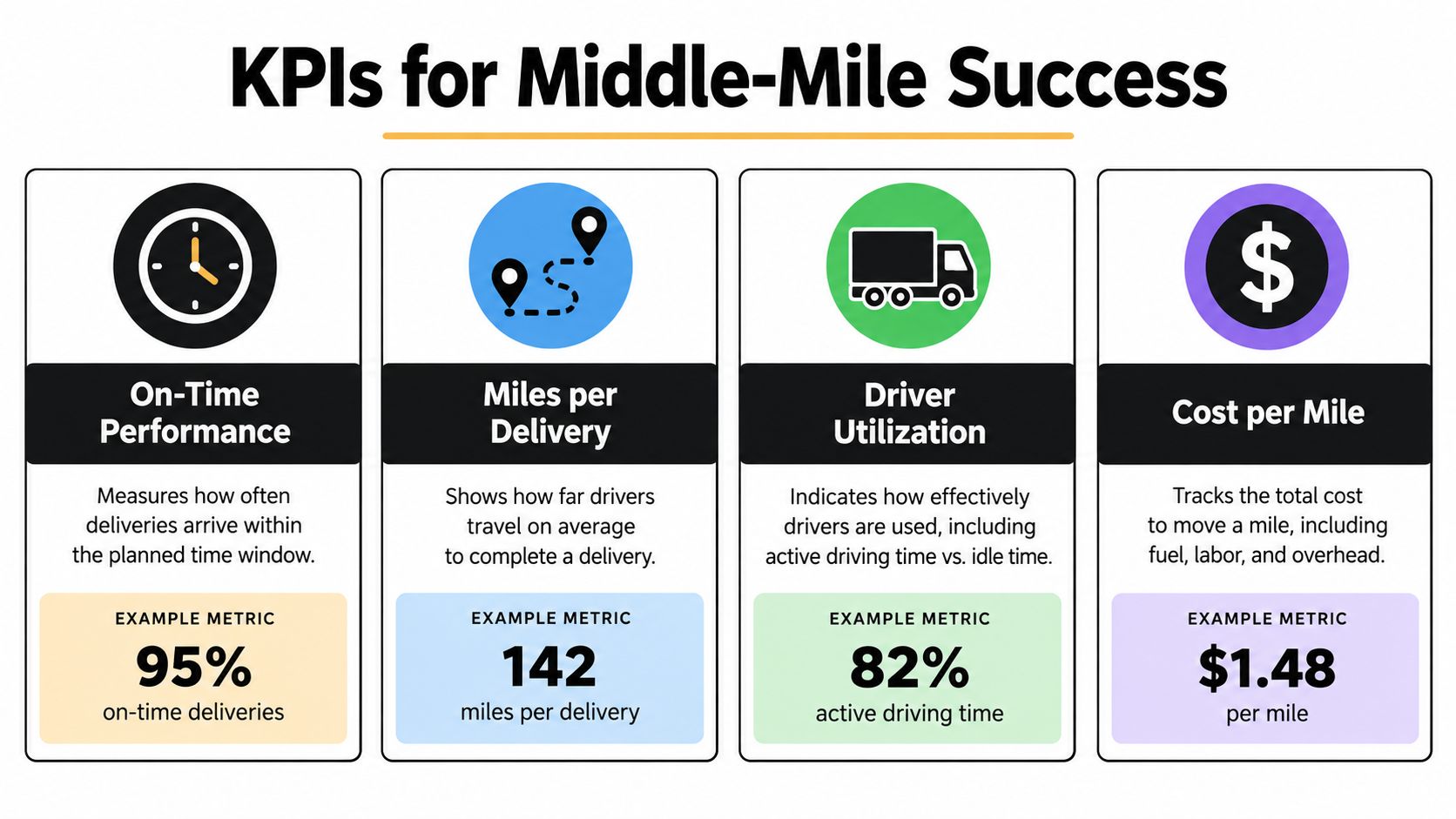
A useful comparison looks like this:
| Operating focus | Distance-minimizing plan | Reliability-focused plan |
|---|---|---|
| On-time performance | May weaken if the sequence ignores dock windows or congestion | Protects arrival windows and validates departure timing |
| Miles per delivery | Often performs well on the route summary | Accepts necessary miles when they protect service |
| Driver utilization | Can create an overloaded shift or unplanned waiting | Matches workload to legal and practical driver capacity |
| Cost per mile | May look attractive before delay, overtime, and recovery costs | Evaluates transport cost together with service and operating risk |
The table highlights an important distinction. A low-cost route can be an expensive operating decision if it causes missed handoffs, repeated dispatch intervention, or unsafe workload pressure. Conversely, a plan that adds some mileage may deliver better total performance when it protects a receiving appointment and avoids a failed transfer.
Measure planned versus actual
Dispatch systems should capture more than the final invoice. Track planned miles against actual miles, planned arrival times against actual arrivals, loading and unloading delays, driver-hour exceptions, equipment substitutions, and reasons for route overrides. Those fields reveal whether the model is wrong, the data is stale, or the operation encountered a condition that needs a formal exception rule.
The key performance indicators for logistics should support a balanced review rather than a single score. A route that improves miles per delivery while degrading on-time performance isn't a successful optimization. Managers need a scorecard that makes trade-offs visible to transportation planners, facility leaders, compliance teams, and drivers.
Watch the accompanying video for another practical way to think about operational performance:
Implementing Optimization in Your Operations
Optimization works best as a controlled operating change, not a software launch. Start with the information that the model will use, then introduce the model to one repeatable part of the network.
Begin with data hygiene
Create a verified master record for facilities, lanes, vehicle types, capacity rules, operating hours, service durations, and driver constraints. Document exceptions that dispatchers currently keep in their heads, including restricted dock access, unusual loading procedures, recurring congestion, and home-time preferences. If an exception affects feasibility, it belongs in the planning process.
Data rule: A sophisticated solver can't rescue an incorrect facility closing time or an undocumented driver constraint.
Select a fitting tool
Choose software based on the decisions you need to make. A strategic network-design application may be appropriate for facility and lane structure, while a routing engine may be better for daily stop sequencing. Some operations need both, but they shouldn't assume that one interface performs every layer equally well.
Then pilot the approach on a recurring lane with reliable shipment patterns. Compare the model's plan with dispatcher judgment and actual trip results. Record every override and ask why it occurred. The answer may identify a missing data field, an unrealistic service duration, or a rule that should be built into the model.
Train people around the workflow
Dispatchers should know what the system considers, what it doesn't know, and when an override is appropriate. Training should include how to validate a departure, review a driver-hour conflict, document a late load, and re-plan after a facility closure. Drivers need clear route documentation and a way to report conditions that the model cannot observe.
Roll out changes gradually. Review the pilot, update the data, revise exception rules, and test the next lane. Optimization is iterative because lanes, facilities, traffic patterns, equipment, and service expectations change. The model should support disciplined judgment, not replace it.
Why Data Quality and Resilience Matter More
Advanced AI can't compensate for bad operational inputs. A company can purchase an impressive optimization platform and still fail if its facility hours are wrong, transit times are stale, shipment attributes are incomplete, or exceptions remain undocumented. The software will calculate confidently from assumptions that the night shift knows are false.
This is why data governance often matters more than algorithmic sophistication. Assign ownership for facility records, require a process for updating lane assumptions, and preserve the reason for every manual override. A clean exception log can be more useful than another layer of automation because it turns tribal knowledge into a rule the planning team can test.

Optimize for disruption, not only averages
An average-cost plan may be fragile when a departure is late, a facility closes, traffic blocks a lane, demand surges, or equipment becomes unavailable. Resilience testing asks whether the network can preserve service and recover after those events. Useful measures include recovery time, service-level preservation, and the number of manual decisions required to restore the plan.
A 2025 transportation-network study reported that a reinforcement-learning approach reduced total travel time by up to 30% and improved recovery time by up to 33% in severe incident scenarios, but those results came from a modeled urban network and aren't a universal commercial-fleet guarantee. The finding supports testing dynamic methods, not skipping the groundwork. Managers should validate whether the same logic applies to their facilities, lanes, data quality, and operating constraints.
Structured planning beats improvisation because it gives people a known baseline and a documented response when conditions change. The best resilience process includes human override authority, clear escalation rules, and post-trip review.
Conclusion - Optimization as a Discipline
Network optimization is a multidimensional decision system. It connects freight flow, facility placement, vehicle assignment, route sequence, inventory position, driver availability, and service timing. The mathematical objective may include transportation, handling, inventory, or environmental cost, but the operating objective is broader: meet service commitments without creating unsafe or unworkable shifts.
The shortest route is only one candidate. A usable plan also protects driver hours, validates capacity, respects dock schedules, accounts for time-dependent congestion, and gives dispatch a clear recovery path. If the input data is wrong, a more advanced algorithm won't fix the outcome. If the plan can't be explained to a dispatcher or followed by a driver, it isn't ready for production.
Peak Transport applies this operating logic to middle-mile box-truck work through structured lane design, documented routes, and data-informed planning. Its approach connects recurring overnight movements with facility requirements while keeping driver-hour limits and on-time execution in view. That combination illustrates the larger lesson: optimization succeeds when people, data, and mathematics reinforce one another.
Start with one recurring lane. Audit its facility hours, service times, capacity assumptions, planned miles, actual miles, and arrival performance. Then document every exception and use the findings to improve the next plan. Optimization isn't a software feature you switch on once. It's a culture of measured decisions and continuous operational improvement.
Peak Transport offers structured middle-mile execution for brands that need dependable overnight box-truck routes, clear dispatch documentation, and service plans built around real operating constraints. Visit Peak Transport to discuss a reliable transportation partnership for your regional freight network.