Amazon Relay Requirements for Box Trucks: 2026 Guide
Amazon Relay requirements for box trucks in 2026: equipment specs, DOT and MC authority, insurance, HOS rules, and onboarding steps made simple.
November 4, 2026
You've bought a straight truck for overnight freight around the Twin Cities. The box is clean, the lift gate works, and you're ready to book loads. Then you discover that your operating authority is too new to apply. That's an expensive way to learn that Amazon Relay requirements for box trucks cover the carrier, not just the truck.
Treat qualification as a continuing operating system. Some requirements establish whether you can enter Relay; others determine whether a particular driver and truck should leave the yard tonight. Passing onboarding doesn't make an expired medical card, an insurance lapse, or an unresolved safety defect acceptable later.
Amazon Relay Requirements at a Glance
A carrier can clear onboarding and still be ineligible for a load if a driver document expires, a vehicle fails inspection, or safety performance slips. Keep two checks separate: the requirements used to qualify the carrier, and the operating checks that determine whether a truck is ready to dispatch.
Requirements stated in Amazon Relay's 2024 guidance
| Requirement | Figure or condition stated in the guidance | What it means for you |
|---|---|---|
| Carrier authority | Valid MC number | Verify your for-hire authority before applying |
| Interstate DOT number | Active for at least 180 days | Plan around the stated authority age before applying |
| Business classification | Carrier, authorized for property transportation for hire | Ensure federal filings match the applying entity |
| Eligible equipment | 16-foot or 26-foot dock-height straight truck | Cargo vans aren't accepted |
| Lift gate | Functional tuck-under lift gate | Check operation before accepting freight |
| DOT number display | Clearly visible outside, including rented trucks | Check identification before dispatch |
| Vehicle condition | Clean, without holes or debris | Inspect the body, floor, and cargo area |
| Loading tools | Pallet jack and load straps onboard | Have the required tools ready at the facility |
| CDL | Not necessarily required below 26,000 pounds gross vehicle weight | Check the vehicle configuration and applicable license requirements |
| DOT medical card | Valid medical card | Track each driver's expiration date |
| Cargo insurance | At least $100,000 | Verify the certificate and underlying policy |
| Auto liability | $1 million per occurrence | Confirm coverage for the dispatched unit |
| Commercial general liability | $1 million per occurrence, $2 million aggregate | Check both limits |
| Employer liability | At least $100,000 per occurrence | Verify the applicable policy section |
| Workers' compensation | Required wherever the company operates | Confirm coverage territory |
| FMCSA safety rating | Satisfactory, None, or Not Rated | Check the carrier's rating |
| Unsafe Driving BASIC | Below 60% | Review driver behavior and inspection findings |
| Hours-of-Service Compliance BASIC | Below 60% | Review logs and scheduling |
| Vehicle Maintenance BASIC | Below 75% | Close defects and document repairs |
| Controlled Substances/Alcohol BASIC | Below 75% | Maintain applicable testing controls |
| Driver Fitness BASIC | Below 75% | Keep qualification records current |
| Driver violation rate | At or below 35% | Review carrier-level driver inspection results |
| Vehicle violation rate | At or below 50% | Review carrier-level vehicle inspection results |
The 180-day authority requirement and valid MC number appeared in Amazon Relay's 2024 getting-started guidance. Amazon Relay's 2024 carrier guidance stated the cargo-insurance minimum, and the 2024 Relay website stated the driver and vehicle violation-rate ceilings. Treat these figures as requirements stated in that 2024 guidance, not as confirmation of current standards. Check Amazon Relay's current published requirements before applying.
Read the checklist by operating stage
Authority and entity details are checked during onboarding, but their status must remain valid. Equipment, insurance, and driver documents need dispatch controls. Safety performance calls for continuing review, so assign someone to check it regularly rather than waiting until an application or load is at risk.
Mark each row pass, unresolved, or fail for your fleet. An unresolved item is not a pass: a pending repair or unanswered broker email does not establish readiness.
Carrier Authority and Entity Setup Before You Apply
Think of authority as your permission to operate, the truck as your working equipment, and insurance as your financial protection. Buying the equipment doesn't establish the permission. Relay checks the business behind the truck.
Amazon Relay's box-truck load guide requires a valid MC number, an interstate DOT number active for at least 180 days, and a business classified as a Carrier authorized for property transportation for hire. Its equipment guidance also identifies approximately 26 feet long by 8 feet wide by 8 feet high of interior cargo space for applicable large-box-truck freight.
The MC number relates to operating authority; the DOT number identifies the carrier in federal safety records. Don't treat possession of either number as proof that every associated status is active and correct.
Verify the active date, not just the issue date
For a hypothetical calendar calculation, an active date of March 1 reaches the stated waiting period around August 28. That calculation is useful for planning, but the underlying record still matters: an issued number and continuously active qualifying authority aren't interchangeable.
Use the waiting period productively. Haul other freight you're authorized and insured to carry, establish inspection routines, and build complete driver and maintenance records. Don't buy equipment on the assumption that Relay approval or usable loads will arrive on a particular date.
A sole proprietor and an LLC both need consistent records. Your organizational structure doesn't replace the required carrier classification, and a trade name shouldn't obscure which legal entity holds the authority.
- Validate the MC number. Check its current status, not an old application receipt.
- Establish the active-authority date. Record the date you used and retain supporting documentation.
- Check entity classification. Confirm that the federal record identifies the business as a Carrier.
- Verify for-hire property authorization. Don't assume another operating category qualifies.
- Match identifying details. Compare the legal name, address, and contact information across filings, insurance, and the Relay application.
Rented equipment needs the same identity discipline. Before dispatch, verify that the displayed carrier identification represents the authority operating the truck, not an unrelated business whose decals remain on the door.
Application rule: Authority first, equipment second. A qualifying truck can't repair an ineligible carrier record.
Vehicle Specs and Pre-Dispatch Inspection Checklist
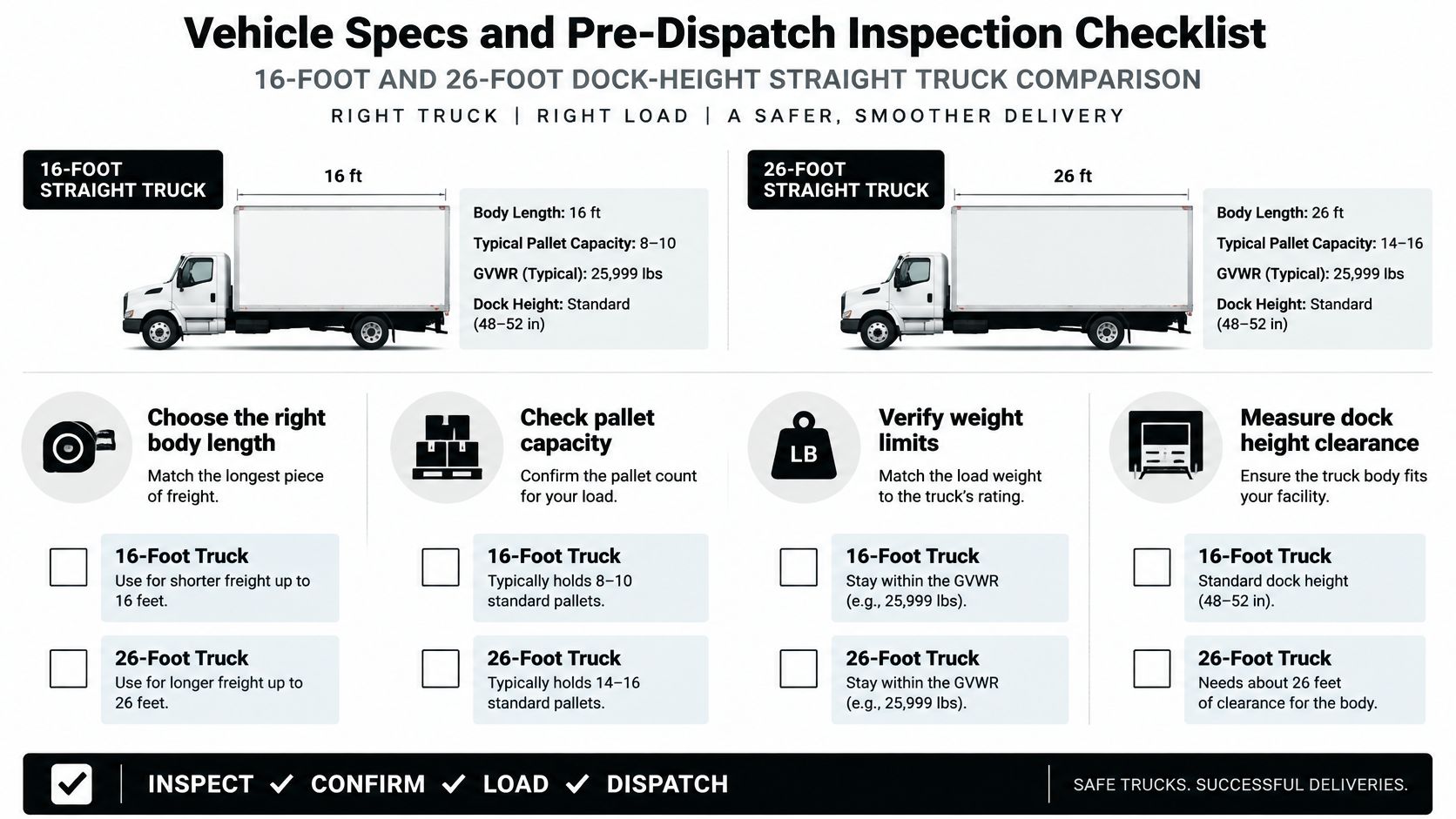
Choose body length by the freight you intend to move, not by the cheapest available rental. Check the longest shipment dimension, pallet layout, usable door opening, and payload allowance. A longer box doesn't automatically provide enough legal payload for a dense load.
Amazon Relay's truck requirements accept 16-foot and 26-foot dock-height box trucks with a functional tuck-under lift gate, exclude cargo vans, and state that a CDL isn't necessarily required below 26,000 pounds gross vehicle weight, although drivers still need a DOT medical card.
Dock height supports transfers at warehouse docks. The lift gate provides another handling method where a suitable dock isn't available. Neither feature makes an unsafe approach, unstable surface, or incompatible dock arrangement acceptable.
Use this visual as a starting point for comparing equipment and preparing a shift inspection.
Run a go-or-no-go inspection
- Cycle the lift gate. Raise, lower, stow, and secure it using the manufacturer's procedure. Watch for leaks, damaged controls, and uneven movement.
- Inspect the cargo body. Check walls, roof, door seals, and floor for holes, water entry, loose material, or damage.
- Clean the box. Remove debris and anything that could contaminate freight or obstruct pallet-jack wheels.
- Read the exterior identification. Make sure the DOT number is visible and matches the operating carrier.
- Verify handling tools. Locate the pallet jack and inspect load straps, attachment points, and ratchets.
- Check roadworthiness. Inspect lights, tires, fluid levels, and other items on the fleet's inspection form.
- Record defects before departure. Describe the problem clearly enough that maintenance can act without guessing.
Build these checks into a repeatable form, using our vehicle inspection requirements guidance to organize defect reporting and follow-up.
For damaged aluminum bodies or related equipment, Brothers Truck Trailer Repair and Welding Corp.’s aluminum welding for commercial trailers is a resource for understanding specialist repair work. A repair inquiry isn't a release to operate; maintenance must assess the actual defect and document the repair.
Stop, report, and swap the unit when necessary. Dispatch pressure doesn't make a defective lift gate functional, and a clean cargo van still doesn't become eligible equipment.
Insurance and Certificate Checks Before Dispatch
A carrier can have adequate auto liability and still fail the insurance check if its cargo coverage is below the required minimum. Each coverage line must meet its own threshold.
Amazon Relay's insurance requirements guide lists $1 million auto liability per occurrence, $100,000 cargo coverage, $1 million commercial general liability per occurrence with a $2 million aggregate, workers' compensation where the company operates, and at least $100,000 employer liability.
Understand what each line does
Auto liability addresses covered liability from crashes involving the truck. Cargo insurance addresses covered loss or damage to freight in your care. General liability addresses covered third-party injury or property-damage exposures outside the commercial auto policy's role.
Workers' compensation addresses covered employee injuries under the applicable system. Employer liability addresses certain employee-related liability exposures, subject to policy terms. These are plain-language distinctions, not guarantees that a particular claim will be covered.
The Australian overview of insurance for work utes and vans covers a different vehicle class and market. Use Relay's published requirements to assess a US freight carrier's coverage.
Prove coverage before releasing the truck
Compare the certificate against the policy and carrier record. Check the effective and expiration dates, named insured, limits, covered operations, vehicle schedules, and workers' compensation jurisdictions. A certificate summarizes insurance. It does not change a policy exclusion or add a truck the policy omits.
Set a renewal reminder and keep the current certificate in a controlled compliance folder. Use this guide to insurance requirements to organize the review.
Check for preventable mismatches:
- Different legal name. The insured entity does not match the authority holder.
- Unscheduled equipment. A replacement or added truck has not received the necessary policy update.
- Missing operating territory. Workers' compensation arrangements do not address an additional jurisdiction.
Hold dispatch if coverage has lapsed. Release the truck only after coverage is restored and verified.
Driver Documents and Eligibility Checks
The truck is the equipment assignment. The driver qualification file is the evidence that the person assigned to it is qualified. Keep those decisions separate: a ready truck doesn't make an unqualified driver ready.
Build a file that dispatch can verify without reading scattered text messages. Store clear copies, identify who checks them, and record when each review occurred. Sensitive medical and testing information needs appropriate access controls, not a shared folder available to everyone.
Build the file around usable evidence
- Current driver's license. Confirm the license class, restrictions, and expiration date against the assigned vehicle.
- DOT medical examiner's certificate. Verify that the document is current and that any applicable restrictions are understood.
- Motor vehicle record. Obtain the appropriate record before hire and establish a documented review schedule.
- Signed application and employment history. Resolve unexplained gaps or inconsistent entries rather than filing them unread.
- Applicable testing documentation. Include drug and alcohol testing records where the driver and operation fall within the relevant requirements.
- Handling and safety training. Document instruction on pallet jacks, load straps, lift-gate procedures, and company reporting expectations.
Don't apply a CDL testing program automatically to every non-CDL role. Determine which regulatory requirements apply to the actual driver and operation, then document that determination.
Match the driver to the actual truck
Read the manufacturer's gross vehicle weight rating plate, usually found around the driver's door area, rather than guessing from body length. Treat the rating as an input to the licensing review, not as the only possible factor. Vehicle combinations, cargo, and operating conditions can also affect which credentials apply.
An empty scale ticket doesn't change the manufacturer's rating. If dispatch substitutes a different truck, repeat the driver-to-vehicle check before releasing it.
For our Truck Driver – Box Truck role, we require a valid driver's license, a clean driving record, pallet jack operation, and overnight availability. Box-truck experience is preferred. A CDL isn't required for our driver roles; if a specific route or vehicle requires one, we state that in the job posting.
Consider a driver whose medical certificate expires during the operating month. Under a sound dispatch policy, that driver stays off the dispatch roster until the renewed document is verified and filed. A booked medical appointment isn't a replacement certificate.
Keep dated copies and a review history. When someone asks why a driver was released, the file should provide the answer.
ELD, Hours-of-Service and Safety Score Upkeep
Safety performance resembles credit history in one useful respect: you need to review the underlying entries, not just the headline result. The analogy stops there. Don't assume an isolated violation is harmless or that a worsening trend will take months to affect eligibility.
Make the safety review a working conversation between dispatch, maintenance, and the person responsible for driver compliance.
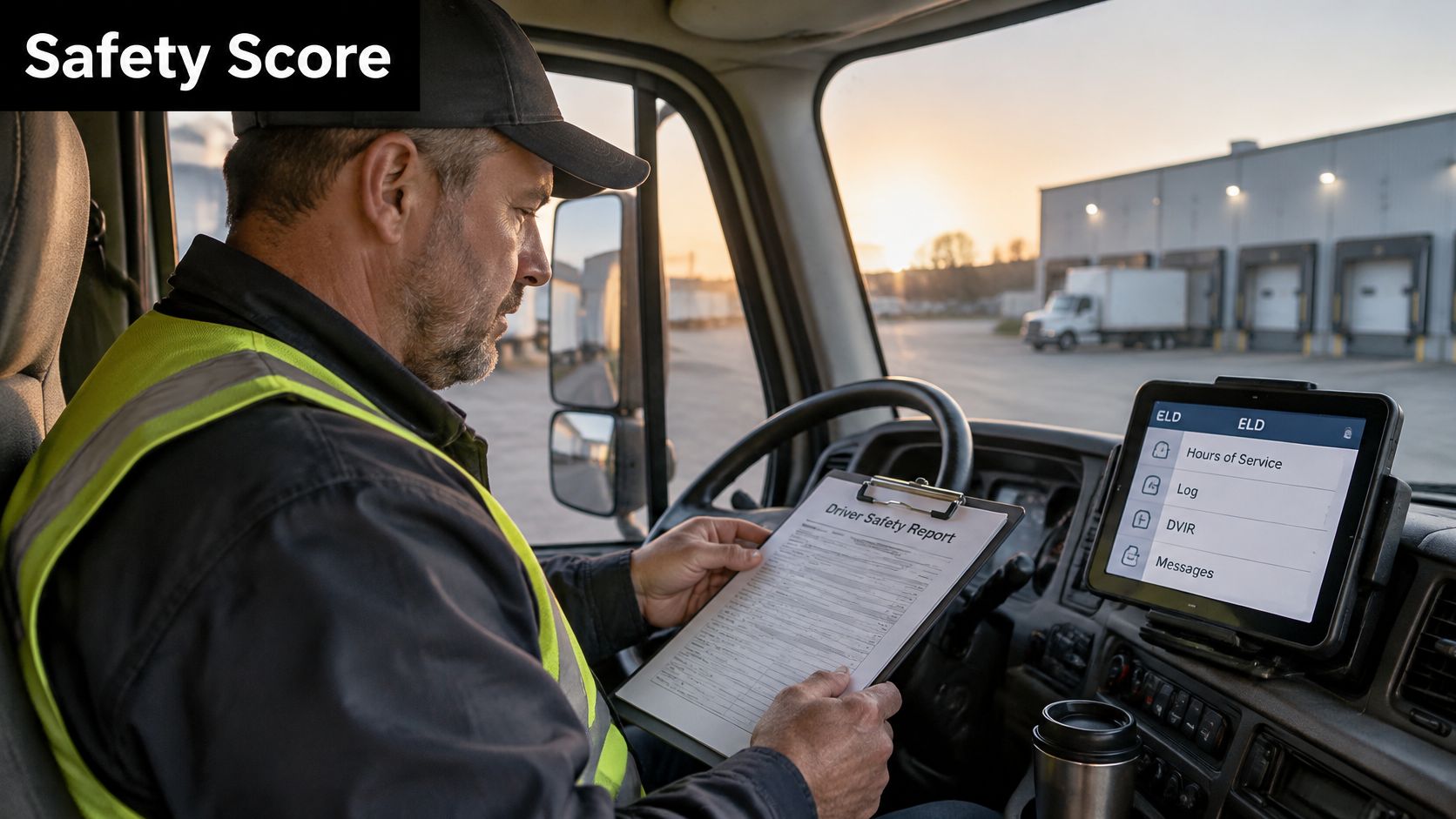
Amazon Relay's FAQ requires an FMCSA rating of Satisfactory, None, or Not Rated, BASIC results below 60% for Unsafe Driving and Hours-of-Service Compliance, and below 75% for Vehicle Maintenance, Controlled Substances/Alcohol, and Driver Fitness. It also specifies driver and vehicle violation rates at or below 35% and 50%, respectively.
Fix the operating cause behind the metric
An electronic logging device, where required, automatically records driving time and supports duty-status records. Drivers still need to make accurate entries and review their logs. Installing hardware doesn't make an impossible schedule compliant, and non-CDL work doesn't automatically settle whether an ELD exemption applies.
Plan driving, loading, unloading, inspections, and foreseeable delays within the applicable hours-of-service rules. Our hours-of-service rules guidance provides a practical starting point for that scheduling review.
Our routes are planned in advance between facilities, not assigned as random residential stops. Our Middle Mile work is local, so drivers return home after their shift and don't take long-haul overnight trips. That structure supports planning, but dispatch must still protect adequate rest and account for actual duty time.
Say a driver repeatedly exceeds available hours because loading delays consume the planned buffer. Investigate appointment assumptions, actual release times, and dispatch instructions. The corrective action may be a schedule change and documented coaching, not a different truck.
Use the following video alongside your written procedures, not in place of current requirements.
Establish a review rhythm
Review exceptions weekly and conduct a fuller carrier-record comparison monthly. Pull current safety information, investigate changes, assign corrective actions, and confirm closure. Don't estimate a BASIC movement from a raw violation count; the published result depends on more than simple addition.
- Late or incomplete log reviews. Find out whether the cause is training, device use, or scheduling.
- Open defect reports. Match each report to a repair decision and release record.
- Outside work affecting rest. Ask about additional duty and account for it where applicable.
Loading and Delivery Procedures on Each Relay Load
Bring a complete handling plan, not just an arrival time. Drivers need the truck's tools ready and shouldn't build the stop around borrowing a facility's pallet jack.
The procedure below is an operating template. Follow the specific load instructions, facility controls, equipment ratings, and your carrier's safety procedures whenever they impose additional restrictions.
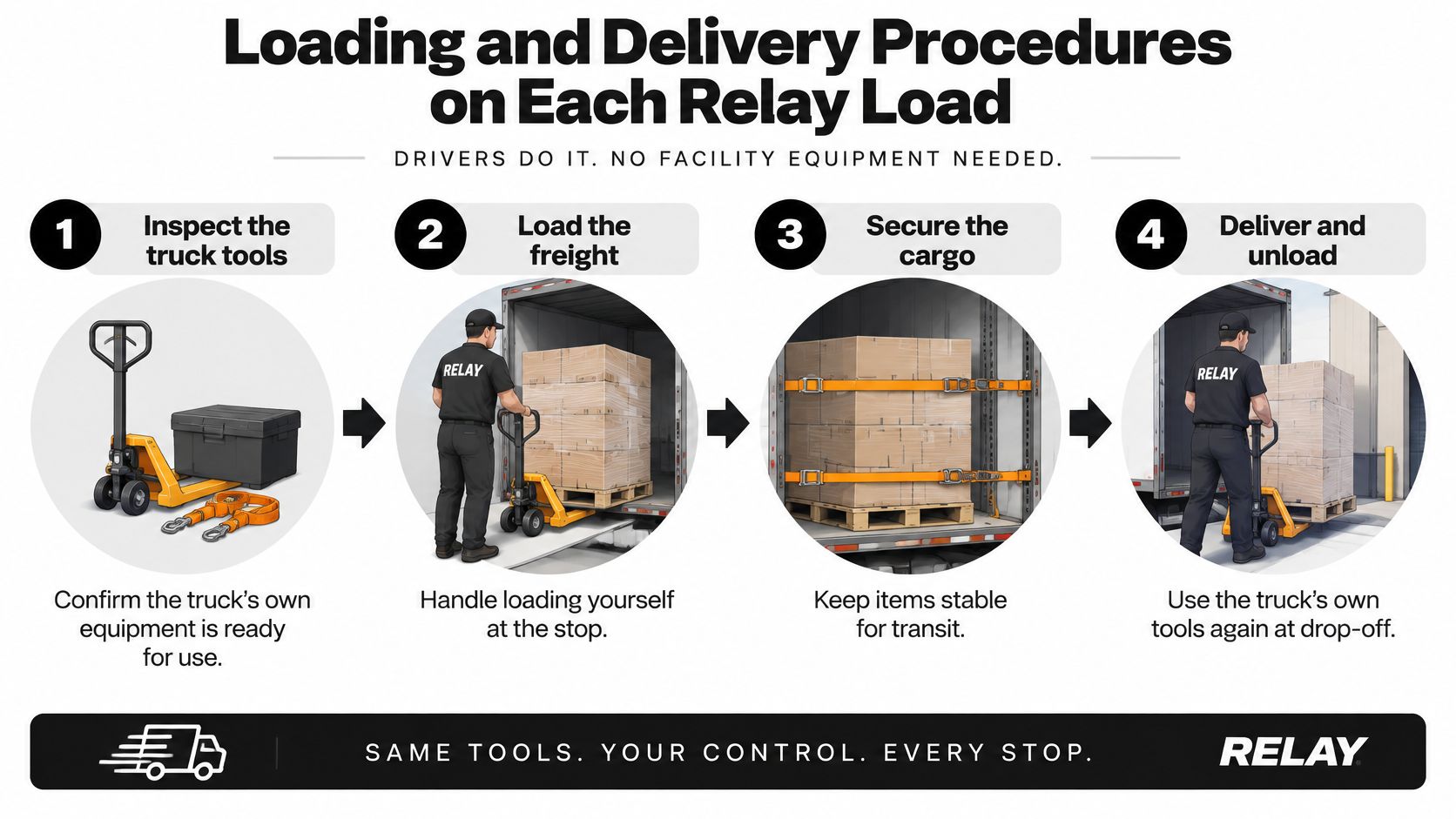
Follow the freight from check-in to signature
- Match the shipment identifiers. Compare the load number, piece count, and seal number where applicable against the paperwork. Resolve discrepancies before breaking a seal or moving freight.
- Inspect the approach and cargo area. Look for damaged freight, unstable pallets, wet floors, and obstructions. Photograph unusual conditions where facility rules permit.
- Set up the transfer point. Confirm that the lift gate or authorized dock equipment is correctly positioned and secured. Never bridge an unsafe gap or use an unstable surface.
- Move freight with controlled placement. Use the pallet jack within its rating and position freight according to the load plan. Distribute weight within axle and vehicle limits rather than pushing everything forward.
- Secure the load. Use suitable straps and rated attachment points. Check that the restraint arrangement won't crush packaging or leave pallets free to move.
- Record what loaded. Note shortages, visible damage, and count exceptions before departure. Get acknowledgment through the required process.
- Reconcile at delivery. Repeat the count and record exceptions before signing. Don't sign a clean receipt for an unresolved discrepancy.
- Unload with the same controls. Recheck the surface, equipment placement, and handling path. Stop if the delivery location can't support safe unloading.
Connect failed stops to preventable omissions
A count mismatch calls for better reconciliation at pickup and delivery. A missing strap calls for both a tool check before departure and a securement check after loading. A lift gate that can't safely serve the unloading location calls for a revised handling plan, not improvised curb access.
Our drivers load and unload with pallet jacks, document deliveries, and complete pre- and post-trip inspections. We provide paid training on safety standards, routes, equipment such as pallet jacks, and company procedures.
An exception recorded at the dock gives the carrier a contemporaneous record. A discrepancy reported later is harder to establish and resolve.
Confirm Your Relay Readiness Before You Apply
Ready now means you can produce evidence for every applicable requirement. Your authority record qualifies, the assigned equipment is eligible and serviceable, coverage is active, driver files are current, and safety results meet Relay's published criteria. Readiness doesn't guarantee approval or freight availability, but it removes preventable gaps.
Almost ready means a defined, correctable issue remains. Examples include authority that hasn't aged sufficiently, an insurance endorsement still pending, or a replacement medical certificate awaiting verification. Assign an owner and a completion condition before submitting.
Not ready means a foundational requirement is missing or incompatible. Examples include absent operating authority, cargo vans as the only available equipment, or a safety rating outside the accepted categories. Don't spend application time trying to explain away a clear eligibility failure.
Rehearse the onboarding sequence
- Verify carrier identifiers and active status. Retain the records supporting your authority review.
- Confirm entity classification. Make sure the applicant, authority holder, and insured business are the same legal operation.
- Approve each proposed unit. Check body configuration, lift-gate function, handling tools, identification, and maintenance status.
- Reconcile insurance documents. Compare certificates with policy details and resolve discrepancies through the broker or insurer.
- Complete driver files. Verify credentials, applicable testing records, and equipment training before assignment.
- Test duty-time controls. Confirm how drivers record time, how dispatch reviews availability, and who handles exceptions.
- Review carrier safety records. Investigate adverse entries and document corrective actions rather than relying on an old screenshot.
- Walk through a complete load. Rehearse check-in, freight handling, exception documentation, delivery, and post-trip reporting.
Make readiness visible to dispatch
Keep a single controlled readiness register with the driver, unit, document status, open defects, and release decision. Give each unresolved item a named owner. Dispatch shouldn't have to infer eligibility from a folder containing both expired and current documents.
Use monthly reviews to test the whole system, with weekly exception checks and pre-dispatch controls between them. Repeat checks whenever you change equipment, add an operating jurisdiction, renew insurance, or assign a driver to unfamiliar equipment.
Before submitting, verify every threshold against Relay's current published guidance. Then preserve the same discipline after approval. The operational question isn't merely whether your carrier qualified previously; it's whether today's driver, truck, documents, and schedule are ready for today's load.
Peak Transport offers structured overnight box-truck work with W-2 employment, paid training, and planned routes between facilities. If you want to apply these safety and documentation standards in a Maple Grove, MN-based driver role, visit Peak Transport. Our application takes less than 5 minutes to complete.