Insurance Requirements for Box-Truck Carriers
Understand insurance requirements for middle-mile box-truck carriers, from auto liability to cargo coverage, COIs, Amazon Relay, and Minnesota rules.
October 22, 2026
Your driver reaches a distribution center for an overnight appointment, but the gate clerk won't release a dock assignment. The insurance certificate is on file, yet the facility says the required additional-insured documentation is missing. In that situation, having an insured truck isn't enough. Dispatch needs an acceptable endorsement, the insurance agent needs clear instructions, and the freight still needs to move.
Why Insurance Requirements Matter for Middle-Mile Carriers
Treat that gate-delay scenario as a planning exercise, not an unusual paperwork problem. Before accepting the lane, someone should have compared the transportation agreement, facility instructions, and insurance documents. Discovering a mismatch after arrival leaves the driver waiting while people who aren't at the dock try to resolve it.
For a middle-mile carrier, insurance requirements are operating conditions. Federal financial responsibility determines whether the carrier meets the applicable regulatory floor. Customer agreements determine what coverage the carrier promises to maintain. Facility onboarding determines what evidence the receiving team expects before allowing service.
Those checks serve different purposes. Passing one doesn't prove that the others are complete.
Match coverage to the work
A useful insurance review starts with the actual movement: the truck, commodity, driver arrangement, custody transfers, and destination. A distribution-center shuttle carrying packaged merchandise presents different questions from household-goods transportation or a hazardous-material movement.
Organize the review around the exposure rather than around a certificate's layout:
- Vehicle operation: Identify the applicable auto-liability obligation and the vehicles performing the work.
- Customer inventory: Match cargo protection to shipment values and the ways freight could be damaged or lost.
- Business and workforce: Evaluate premises-related liability, employee injury arrangements, and employer obligations.
- Equipment ownership: Ask separately about protection for the carrier's own truck. Don't assume liability or cargo coverage answers that question.
Practical rule: Approve the insurance package for the lane you're accepting, not just for the business you operated when the policy began.
The trade-off isn't just cheaper coverage versus more expensive coverage. A carrier can spend more on a higher limit while leaving an operational exclusion unresolved. Conversely, buying every available coverage without checking the contract can add expense without addressing the customer's actual concern.
Assign ownership before the first dispatch. Operations should describe how the lane works, procurement should identify the contractual promises, and the insurance professional should confirm how the policy responds. That division of responsibility is more useful than asking dispatch to interpret insurance language during an overnight exception.
Federal Auto Liability Minimums Explained
Start with vehicle weight, freight classification, and regulatory applicability. The words “box truck” don't establish a universal federal insurance limit. Check the vehicle's gross vehicle weight rating, or GVWR, and determine whether the operation falls under the applicable interstate motor-carrier requirements.
For for-hire interstate property operations, FMCSA lists $750,000 in bodily-injury-and-property-damage coverage for non-hazardous property vehicles rated at 10,001 pounds GVWR or more, $300,000 for vehicles below that weight, and higher hazardous-material thresholds of $1 million for specified operations and $5 million for specified explosives, poison-gas, or radioactive-material operations, as detailed in its insurance filing requirements.
Read the classification before choosing the limit
The practical question isn't whether a truck looks heavy enough to need commercial insurance. It's what the equipment specifications say and what freight the carrier is authorized and contracted to transport.
Use the equipment record, not the dispatch nickname. Then examine the commodity description closely enough to identify whether hazardous-material requirements need specialist review. Don't apply an ordinary-freight assumption to a shipment merely because it fits inside the same truck.
The federal framework separates these factors:
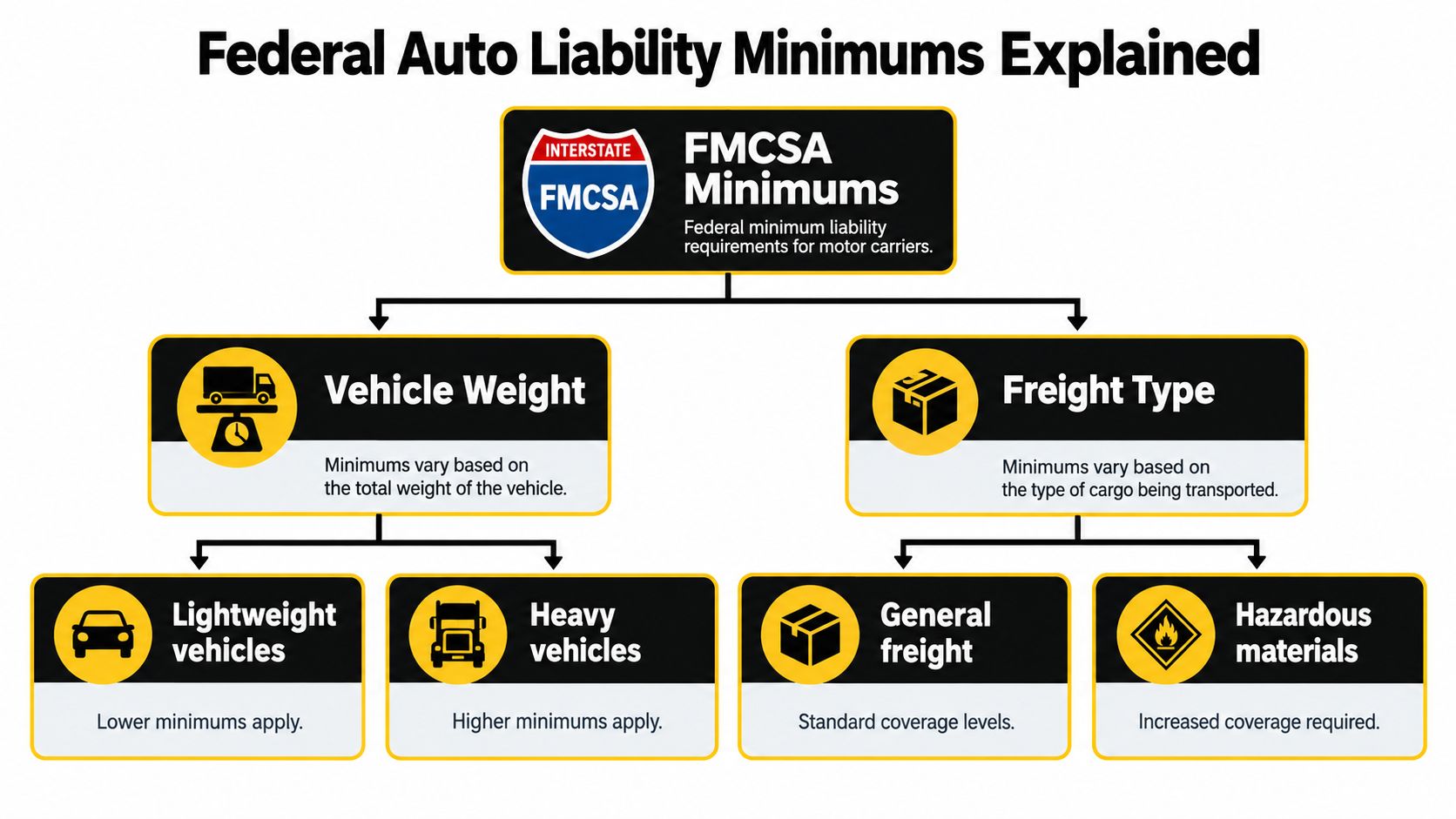
The diagram is a starting point, not a substitute for checking the applicable category. Where the commodity description is unclear, resolve that uncertainty before quoting the lane or promising that the existing policy is sufficient.
Confirm the filing, not just the purchase
Under the same federal framework, proof of financial responsibility must be filed through the applicable mechanism, such as BMC-91, BMC-91X, or BMC-82, before the carrier operates under the relevant authority. Paying the insurance invoice and satisfying the federal filing requirement are separate checkpoints.
Ask the insurance professional responsible for the filing to confirm that it matches the carrier's legal identity and intended operation. Keep that confirmation with the authority and equipment records, rather than relying on a certificate forwarded during a previous onboarding.
A workable logistics compliance process connects those records to dispatch approval. If a vehicle, commodity, or operating arrangement changes, the person releasing the load should know whether a fresh review is required.
The federal table also lists no separate cargo-insurance minimum for ordinary non-hazardous for-hire property carriers. That distinction matters: meeting the auto-liability floor doesn't establish that customer inventory is adequately protected.
Cargo Insurance and What It Actually Covers
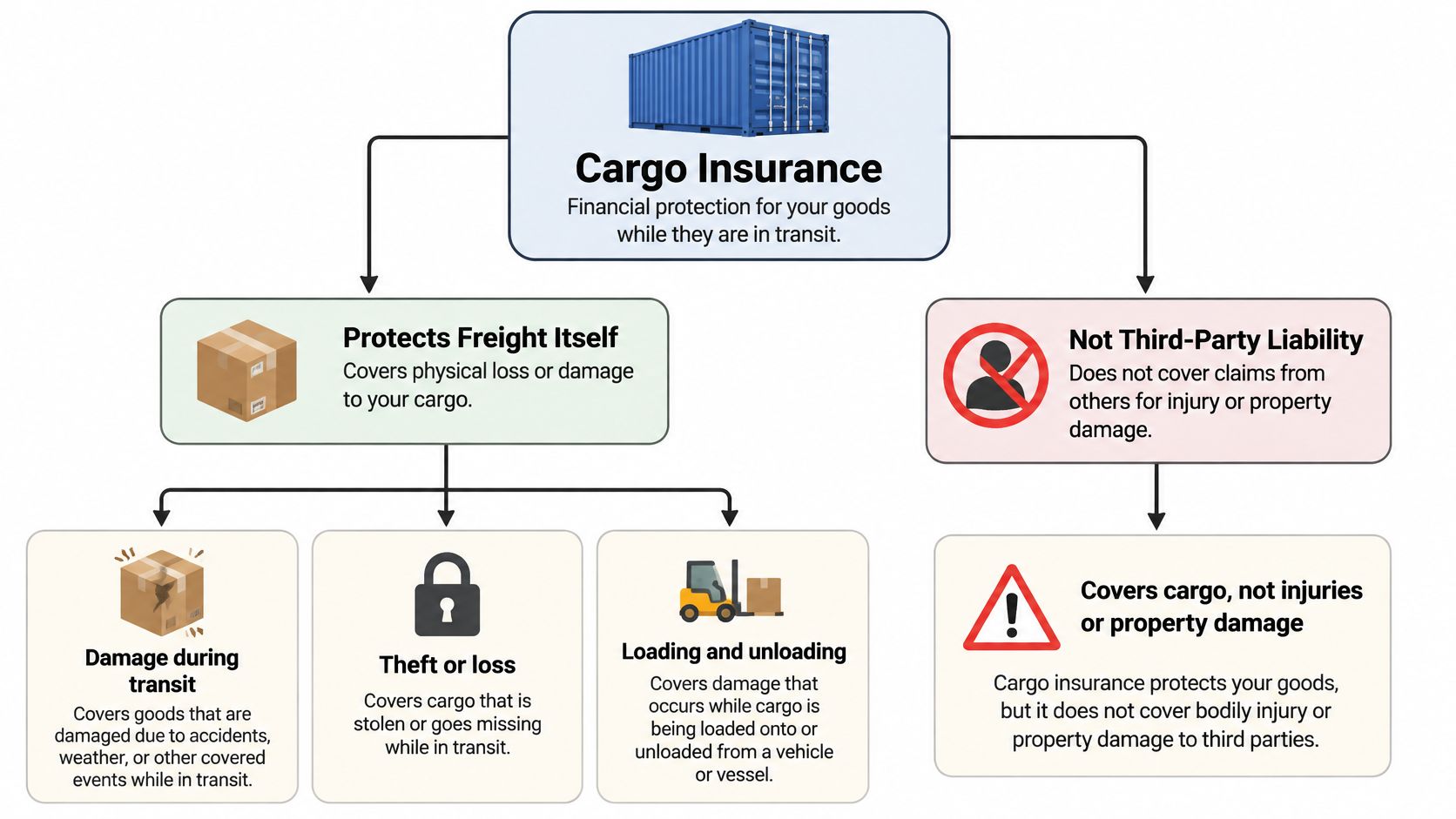
Cargo insurance addresses the freight itself, rather than the carrier's bodily-injury-and-property-damage liability. For ordinary distribution-center and e-commerce freight, the practical coverage obligation comes primarily from the transportation agreement and shipment exposure.
FMCSA distinguishes ordinary property transportation from household-goods operations: household-goods carriers and household-goods freight forwarders must maintain cargo insurance, with cited requirements of $5,000 for loss or damage on a motor vehicle and $10,000 for aggregate loss or damage at a time and place, while most ordinary-property carriers aren't subject to a federal cargo filing or prescribed minimum, according to its cargo-insurance guidance.
Use the coverage categories below as questions for the policy review, not as promises that every cargo policy covers them.
Test the loss scenario
Consider an overnight transfer where freight is collected, held while awaiting a receiving window, and delivered after a custody handoff. Ask the insurance professional to evaluate the whole sequence, including the waiting period.
The review should address:
- Maximum shipment value: Compare the limit with the most valuable load the carrier may accept, not merely the average shipment.
- Deductible responsibility: Establish who absorbs the deductible and whether the carrier can fund it without delaying a customer resolution.
- Theft conditions: Check unattended-vehicle, parking, locking, and security provisions against actual driver instructions.
- Handling and storage: Examine loading, unloading, terminal, temporary-storage, water, and temperature-related restrictions.
- Covered operators: Confirm how the wording treats employee drivers, substitute equipment, and any proposed subcontracting.
Federal motor-carrier financial-responsibility rules concern liability security; they shouldn't be treated as a substitute for evaluating freight protection, as reflected in the FMCSA financial-responsibility framework.
A larger cargo limit won't fix an exclusion for the loss scenario your customer is most concerned about.
Connect insurance to handling procedures
Request relevant policy wording and endorsements before accepting unusual commodities or custody arrangements. Have the insurance professional explain any uncertainty in writing, then compare that answer with the contract.
Pair that review with cargo damage prevention. Seal records, condition photographs, exception notes, and documented handoffs give the carrier a clearer account of what happened. Insurance review and operating discipline should support each other, rather than becoming separate files nobody reconciles.
General Liability, Workers' Comp, and Employer Obligations
A truck policy isn't a complete business-insurance plan. Ask the insurance professional to distinguish vehicle-related exposures from premises, loading-area, employee-injury, and benefits obligations, then document which policy is intended to address each.
Bring operations and workforce information to that discussion.
Separate business liability from employee obligations
For general liability, describe the activities drivers and staff perform away from driving: entering customer premises, using loading areas, and working around terminals. Ask how the policy addresses those activities and where auto-related exclusions or other limitations apply. Don't assume every dock incident belongs under the same coverage.
For workers' compensation, obtain a state-specific determination based on the actual workforce and operating arrangement. A carrier using W-2 drivers should make employee-injury coverage a formal review item, not assume that a customer's insurance package resolves it.
The contractor alternative also needs careful review. Worker classification isn't a premium-saving election. Have employment counsel assess the arrangement, and have the insurance professional evaluate whether the resulting coverage fits how drivers are managed.
Plan benefits before growth creates an administrative problem
The Affordable Care Act established a milestone effective January 1, 2015 for applicable large employers, generally organizations with at least 50 full-time or full-time-equivalent employees; an assessable payment may apply when qualifying coverage isn't offered and an employee receives an exchange premium tax credit, subject to the affordability and minimum-value conditions described in the employer ACA guidance.
Use that threshold as a prompt for specialist planning, not as a reason to make a quick classification change. Historical penalty illustrations aren't a substitute for a current calculation from benefits or tax counsel.
Before using training material to brief staff, connect it to the company's own policies and escalation contacts.
Give payroll, operations, and benefits administrators a shared change-notification process:
- New hires: Route employment status and job duties to the appropriate reviewers.
- Changed duties: Flag new warehouse, handling, or supervisory responsibilities.
- Expansion: Review benefits administration and employee-injury arrangements before entering a different operating area.
The useful outcome is a documented assignment of responsibilities. Drivers should know whom to contact after an injury, while management should know who verifies coverage and reporting obligations.
Certificates of Insurance and Additional Insureds
A certificate of insurance, or COI, is a verification document. Treat it as evidence to reconcile with the policy, not as a replacement for the policy or an amendment to its terms.
That distinction resolves the opening gate scenario. If the agreement requires additional-insured protection, adding the facility's name to a certificate field isn't the same verification task as confirming the applicable endorsement and its scope.
Keep the contract and insurance documents together during review.

Verify the role of each document
Use a document comparison rather than asking whether the carrier “has a COI.”
| Document or designation | What to verify |
|---|---|
| Named insured | The insured legal entity matches the contracting carrier |
| Certificate holder | The certificate identifies the intended recipient correctly |
| Additional-insured endorsement | The wording addresses the required party, activity, and coverage |
| Policy dates | The intended service falls within the applicable coverage period |
| Cancellation language | Any promised notice is supported by the actual terms |
Certificate holder and additional insured aren't interchangeable labels. Ask the issuing agent to explain the difference for the specific agreement, including whether an existing endorsement applies or another endorsement is needed.
For cancellation provisions, compare the customer's requested wording with what the insurer will provide. Don't let a transportation contract promise something the insurance documents don't support.
Resolve exceptions before dispatch
Send the agent the relevant contract language, not a vague request to “add the warehouse.” Include the exact legal entity, location where relevant, required coverage, and intended work.
If the agent identifies a limitation, return it to procurement for resolution. The choices may include changing the insurance, negotiating the agreement, or declining the exposure. Having dispatch accept the load while everyone hopes the certificate will be approved isn't a reliable alternative.
Document-control test: Could someone outside the onboarding conversation determine why this carrier was approved?
A structured logistics documentation process should preserve the answer: the reviewed agreement, supporting endorsements, approval decision, and unresolved restrictions. Keep outdated certificates clearly separated so an overnight dispatcher doesn't accidentally send the wrong document.
Amazon Relay and Distribution Center Expectations
Amazon Relay eligibility and distribution-center admission need separate checks. A carrier should neither assume that federal compliance guarantees platform eligibility nor treat platform acceptance as approval of every facility-specific condition.
Amazon's own guidance states, “Amazon Relay requires several types of trucking insurance.” Use its Relay insurance requirements guidance alongside the current account instructions when preparing an application or renewal. Don't rely on an old onboarding checklist for the current coverage schedule.
Compare the approval paths
| Review area | Amazon Relay review | Distribution-center review |
|---|---|---|
| Controlling instructions | Current platform requirements and account workflow | Applicable agreement and facility instructions |
| Submission destination | Designated platform verification process | Customer or facility compliance contact |
| Operational question | Is the carrier eligible for the intended work? | Is the carrier approved for this facility and movement? |
| Change management | Confirm account records reflect accepted updates | Confirm the facility has accepted revised documentation |
For a regional overnight operator, those paths may overlap on the same movement. A central transportation team may approve the commercial arrangement while a facility team controls local admission. Assign someone to confirm both rather than expecting the driver to mediate at arrival.
A broker packet can create another review path. Compare its requirements with the shipper's agreement and platform instructions instead of assuming the broker's acceptance settles every obligation.
Manage renewal as an operating change
Ask the agent what will change at renewal before circulating replacement certificates. An unchanged premium or familiar policy number doesn't answer whether endorsements, deductibles, exclusions, or insurer details have changed.
Build the renewal process around acceptance:
- Prepare the submission: Collect the updated documents and identify every required recipient.
- Resolve discrepancies: Investigate mismatched names, dates, coverage descriptions, or missing endorsements.
- Confirm completion: Retain evidence that the relevant reviewer accepted the update.
Check limits during the scheduled insurance review, but also trigger a review when adding equipment, changing commodities, or accepting different custody responsibilities. Those operational changes can matter between renewals.
The practical standard is verified readiness, not a folder containing recently issued PDFs. Before releasing a truck, dispatch should have an unambiguous approval status and a named escalation contact if the receiving team questions it.
Minnesota-Specific Rules for Carriers
For a Minnesota box-truck operator, the first state-level question is what movement the business is performing. A route between Twin Cities facilities shouldn't be classified solely by looking at whether the driver crosses the state line.
Have qualified counsel or the appropriate regulatory contact assess the transportation arrangement, including the shipment's broader movement and the carrier's role. Then obtain confirmation of the applicable Minnesota registration, insurance, and employment obligations. Don't substitute federal authority paperwork for that state-specific review.
Build a Minnesota verification file
Use a local operating file that answers the questions a reviewer would need resolved:
- Operating scope: Document whether the work has been evaluated as interstate or intrastate and who made that determination.
- Applicable state requirements: Obtain confirmation of the relevant Minnesota liability, registration, and filing obligations before service begins.
- Employee arrangements: Have the agent and employment adviser verify workers' compensation treatment for the actual driver workforce.
- Operating locations: Identify terminals, parking areas, and temporary freight-holding locations for coverage review.
Without that determination, quoting a supposed universal Minnesota minimum creates false confidence. The useful output is a written explanation tied to the carrier's equipment and activities, not a number copied from a national trucking summary.
Put overnight conditions into the review
For Twin Cities overnight routes, ask the underwriter how the policy treats the planned operating radius, parking arrangements, freight dwell, and backup procedures. Include winter interruption scenarios in the discussion rather than presenting the operation as uninterrupted point-to-point driving.
For example, consider a delayed receiving appointment that requires the driver to wait with freight. Operations should establish an approved waiting location, a communication procedure, and a decision-maker for extended delays.
Keep those instructions consistent with the cargo review described earlier. Minnesota-focused compliance works best when state applicability, employee arrangements, and actual route procedures are evaluated together, without assuming that any single approval covers the whole operation.
A Practical Compliance Checklist for Carriers and Shippers
Use a lane-release checklist that records evidence, an owner, and an approval decision. A checked box without supporting documents won't help the overnight team resolve a disputed requirement.
- Classify the operation: Confirm equipment specifications, commodity classification, and the applicable federal or Minnesota review.
- Verify authority-related filings: Obtain confirmation from the responsible insurance professional.
- Test cargo suitability: Compare the proposed shipment with the approved value, handling, storage, and security conditions.
- Review contractual promises: Have procurement resolve differences between the agreement and available coverage.
- Validate endorsements: Keep the required wording with the approved certificate and policy records.
- Confirm workforce arrangements: Route employee-injury and benefits questions to the responsible advisers.
- Check access approval: Verify the relevant platform, broker, and receiving-facility status.
- Assign incident duties: Identify who reports a loss, preserves evidence, contacts the insurer, and meets contractual deadlines.
- Control changes: Reopen approval when equipment, commodities, drivers' duties, locations, or lane arrangements change.
Shippers should request the supporting wording where coverage suitability remains uncertain. Carriers should document restrictions before accepting work, rather than leaving dispatch to discover them during service.
Insurance requirements need an owner after onboarding, too. Schedule periodic reviews and make operational changes a reason to reassess the file.
For brands evaluating middle-mile partners, Peak Transport offers overnight box-truck service across the Twin Cities metro and surrounding areas, using W-2 drivers and structured route documentation. Visit to discuss your distribution-center lanes, insurance documentation expectations, and onboarding requirements before service begins.