Box Truck Maintenance Costs: What to Budget Per Mile
Box truck maintenance costs run about $0.20 to $0.22 per mile. See line-item ranges, preventive schedules and cost-saving steps for Midwest fleets.
October 27, 2026
Budget about $0.20 to $0.22 per mile for box truck repair and maintenance, or roughly $12,000 to $13,200 annually at 60,000 miles, before tires, fuel, insurance and depreciation. Treat that as a planning allowance, not a vehicle-specific quote.
The larger budgeting problem is using yesterday's ownership costs to price today's routes. The National Private Truck Council's benchmarking findings, summarized by Penske, show that private-fleet equipment and maintenance costs per mile increased 76% between 2020 and 2024. That's a broader category than repairs alone, but it illustrates why an old annual allowance can leave a fleet underfunded.
For overnight middle-mile operations around Minneapolis and St. Paul, the useful question isn't just what a truck costs to maintain. It's what maintenance and lost availability cost per completed route.
Box Truck Maintenance Costs at a Glance
Box truck maintenance costs need a mileage-based starting point and a vehicle-specific adjustment. National trucking benchmarks provide the former. Your service records, equipment specifications and route demands provide the latter.
The Fleet Maintenance discussion of ATRI's operating-cost benchmarks provides the heavy-truck reference rates below, including $0.202 per mile for 2023, $0.198 for 2024, and an approximate update near $0.215. These aren't direct quotes for medium-duty box trucks.
Maintenance Cost Benchmarks per Mile and per Year
Annual amounts below are arithmetic conversions, not separate survey findings: rate per mile × annual truck-miles. The planning-band rows are budgeting assumptions, while the LTL comparison comes from the ATRI carrier-category findings discussed under downtime.
| Benchmark | Rate per mile | Annual at 60,000 miles | Annual at 100,000 miles |
|---|---|---|---|
| ATRI repair and maintenance, 2023 | $0.202 | $12,120 | $20,200 |
| ATRI repair and maintenance, 2024 | $0.198 | $11,880 | $19,800 |
| ATRI update, approximate reference | $0.215 | $12,900 | $21,500 |
| Box-truck planning band, low | $0.20 | $12,000 | $20,000 |
| Box-truck planning band, high | $0.22 | $13,200 | $22,000 |
| LTL carriers, 2024 | $0.222 | $13,320 | $22,200 |
Choose the reference that most closely resembles your operation, then multiply it by actual expected mileage. Don't choose the lowest row just because the vehicle is a box truck rather than a tractor.
A newer truck with documented service history may justify starting near the lower planning allowance. A truck with recurring cooling faults, heavy liftgate use or frequent stop-and-go work needs a reserve informed by those conditions.
Budgeting boundary: The repair-and-maintenance allowance isn't the truck's complete ownership budget. Keep tires, towing, fuel, insurance and depreciation identifiable rather than hiding them inside a single maintenance number.
The annual conversion also exposes a common comparison error. A lightly used truck can have a smaller annual repair bill but a higher maintenance cost per mile because calendar-based inspections and age-related repairs are spread across fewer miles.
What Pushes Your Cost Per Mile Up or Down
Think of a city bus and an intercity coach. Both move passengers, but their braking, stopping and door-use patterns are different. The same distinction matters when comparing a metro box truck with equipment running mostly uninterrupted highway miles.
Duty cycle matters as much as the odometer. A predictable hub-to-hub route and a stop-heavy delivery route shouldn't automatically receive the same maintenance allowance.
Separate the Sources of Wear
- Asset condition and age: Review corrosion, service history, component replacements and recurring defects. Age alone doesn't tell you whether expensive work has already been completed or is still approaching.
- Route pattern: Frequent braking, tight turns and loading-area maneuvering add different demands from steady cruising. Compare routes by stops and operating conditions, not distance alone.
- Payload and equipment use: Liftgate cycles, rear-door operation and repeated loading affect components that a highway-focused benchmark may not represent well.
- Maintenance sourcing: Dealer, independent-shop and in-house arrangements change labor charges, parts markups and access to service appointments.
Pricing pressure belongs in the calculation too. Heavy Duty Trucking's discussion of Decisiv and VMRS cost trends reports that combined heavy-truck parts and labor costs increased 27.4% from early 2020 through 2025. An unchanged service workload therefore doesn't guarantee an unchanged invoice.
Compare Conditions Without Inventing an Age Premium
For an illustrative comparison, take newer and older trucks covering the same annual mileage from the benchmark table. Start both with the same reference allowance, then add only the older truck's documented recurring repairs and quoted upcoming component work.
That produces a defensible adjustment. Automatically assigning a higher rate because a truck passed an arbitrary birthday doesn't.
Route planners can also evaluate route optimization benefits when comparing lane assignments. A truck's maintenance history may reflect the route it serves, not just its mechanical condition.
If the decision becomes repair versus replacement, Business Loan Warrior's trucking financing guide is a resource for exploring funding options. Keep financing payments separate from maintenance, then compare the alternatives on total ownership cost and available route capacity.
Line-Item Breakdown of Repair and Upkeep Spending
A useful repair budget records both what was purchased and why the truck needed it. Coding every invoice as shop expense hides whether spending comes from scheduled service, repeated diagnosis, or a component failure. That distinction matters for overnight middle-mile routes in the Twin Cities, where local repair history can make a per-mile reserve more useful than a broad annual allowance.
The benchmark has moved substantially: Fleet Maintenance's coverage of ATRI's operating-cost report records repair and maintenance rising from $0.143 per mile in 2019 to $0.202 in 2023, an increase of about 41%. A reserve based on the older rate may fall short before local equipment and route conditions are considered.
Know What the Category Includes
ATRI counts parts, labor and roadside service within repair and maintenance. Tires and towing or recovery are separate categories, so compare like with like when matching fleet records to the benchmark.
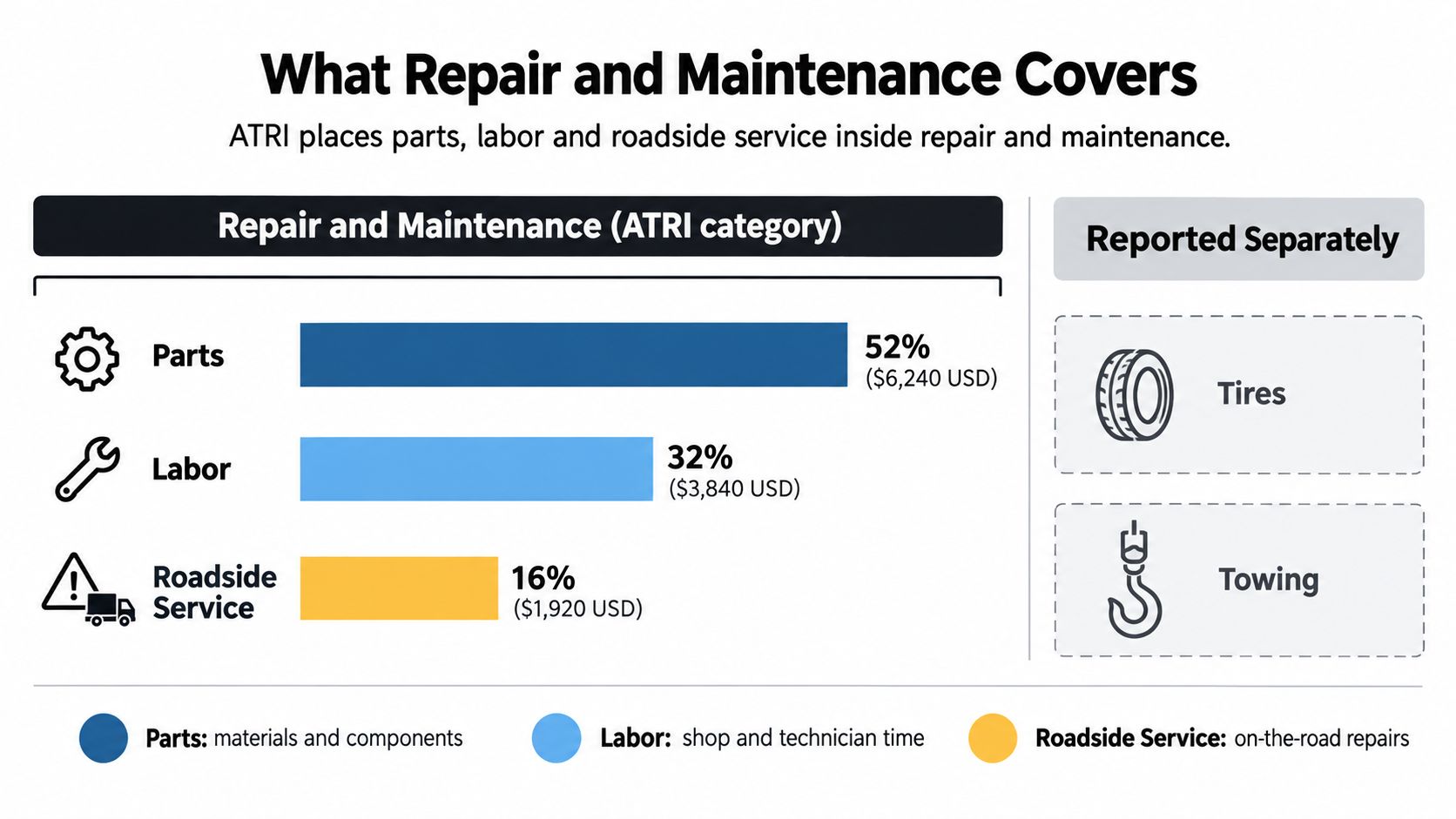
Use the illustration as a category guide, not as a measured allocation. The cited findings do not establish what share of spending goes to each component.
Typical Box Truck Maintenance Items and What Drives Their Cost
The available benchmark does not provide universal per-event prices. For a route-specific plan, compare written local quotes for the same truck, parts specification, and work scope. Track the service trigger alongside the invoice so recurring work can be planned per mile rather than spread across an assumed annual bill.
| Cost item | What drives it | How often |
|---|---|---|
| Engine oil and filters | Mileage interval, engine configuration, and oil specification | Manufacturer's mileage, time, or engine-hour interval |
| Brake pads, shoes, and drums | Stop frequency, payload, and measured wear | Inspect during scheduled service; replace at service limits |
| Tires, medium-duty | Load, scrub, inflation, alignment, and damage | Review by condition, tread measurements, and manufacturer guidance |
| Annual DOT inspection and alignment | Inspection requirements and steering or tire-wear symptoms | Track inspection due date; assess alignment separately |
| Liftgate and rear-door repairs | Cycle count, impacts, rollers, hinges, and hydraulic condition | Inspect routinely; repair identified defects |
| Cooling system and coolant | Coolant specification, leaks, heat, and corrosion | Test and service to the equipment specification |
| Electrical and lighting | Vibration, moisture, connector damage, and age | Inspect routinely; diagnose faults when identified |
| Roadside service and towing | Failure location, access, service time, and recovery needs | Unscheduled |
For oil service, check that a quote includes every required filter and the specified oil quantity. For brakes, separate inspection from replacement, and identify whether drums, rotors, hardware, or related components are included. The difference between those scopes can make two invoices look incomparable when they are not.
Liftgate quotes should distinguish diagnosis, hydraulic work, and structural repairs. Roadside agreements should break out the callout charge, technician time, parts, and towing. Those details help identify whether a route's service pattern is driving repeated callouts or planned shop work.
Practical rule: Budget predictable service by its actual trigger. Fund irregular repairs separately, using component condition and written estimates rather than dividing every possible failure into an assumed annual bill.
Keep reserve accounting separate from expense reporting. Money set aside for a future liftgate repair is a planning allowance, not a repair cost incurred this month.
Downtime Costs That Never Reach the Invoice
Suppose a driver finds a brake fault shortly before departure on an overnight Twin Cities hub route. The truck can't safely leave, the receiving dock has a narrow appointment window, and dispatch must locate replacement capacity.
The brake invoice is only part of the event. Without actual dispatch and shop records, you can't claim it's the smallest part, but you also can't assume it represents the total cost.
ATRI's operational-cost report reports an industry average of 38,249 miles between breakdowns or unscheduled repairs in 2024, compared with 37,700 in 2023; dividing 60,000 annual miles by 38,249 gives approximately 1.57 breakdown-equivalent events. That's a fleet-planning indicator, not a forecast for an individual truck.
The same report records 2024 LTL repair and maintenance at $0.222 per mile, the carrier-category comparison in the benchmark table. Terminal-oriented operations can provide useful context, but they still aren't a direct substitute for box-truck records.
Build an Event Cost, Not Just a Repair Total
Record these costs against the same breakdown identifier:
- Replacement capacity: Rental charges, substitute-carrier invoices or the incremental expense of deploying a spare.
- Driver disruption: Paid waiting time, reassignment time and additional dispatch coordination.
- Recovery: Towing and recovery charges that aren't already included elsewhere.
- Service consequences: Documented appointment penalties, redelivery expense or other charges tied to the interruption.
Don't count the same expense twice. A substitute-carrier invoice may already cover the replacement vehicle and driver, while a recovery invoice may include the roadside callout.
A deferred repair isn't a saving if the fleet later pays for the repair and an avoidable route interruption.
Track miles between unscheduled repairs by truck, alongside the fully documented cost of each event. Define an event consistently so a roadside stop and its follow-up shop visit don't become separate failures merely because they generated separate invoices.
Preventive Maintenance Schedule for Midwest Winters
| Interval or trigger | Task | Why it matters | Owner |
|---|---|---|---|
| Daily, before dispatch | Check lights, visible tire condition, brakes, liftgate and fluid leaks | Identifies defects before committing the truck to a route | Driver |
| Weekly operating review | Measure tire pressure and tread; check coolant level, belts and battery terminals | Finds developing wear or deterioration | Driver or shop |
| Before winter conditions | Load-test batteries; test coolant protection; check block heater, wipers and defroster | Prepares the truck for cold-weather operation | Shop |
| Manufacturer's coolant interval or adverse test result | Replace or correct coolant using the specified product | Maintains protection against freezing, corrosion and overheating | Shop |
| Inspection due date and alignment symptoms | Complete applicable inspection work; assess alignment separately | Keeps compliance and tire-wear work identifiable | Shop |
| Tire condition, tread or manufacturer age guidance | Review replacement needs and casing condition | Keeps replacement decisions tied to the actual tires | Fleet manager |
This is an operating template, not a universal manufacturer schedule or statement of legal intervals. Enter the exact mileage, engine-hour and calendar triggers from each truck's service information, then service it when the first applicable trigger arrives.
Prepare the Truck Before Cold Weather
Start with the battery and starting system. A load test helps the shop assess battery condition, while inspection of cables and terminals identifies poor connections that a simple voltage reading can miss.
Next, test coolant concentration with a suitable refractometer and confirm compatibility with the engine's coolant specification. Don't top up an unfamiliar system with whichever coolant happens to be available.
Check block-heater operation, cord condition and the connection used where the truck parks. Then verify wiper sweep, washer operation, defroster performance and exterior lighting before an overnight driver needs them in poor visibility.
Make Salt Exposure Part of the Work Order
After exposure to treated roads, include underbody cleaning and inspection of vulnerable fittings, brake components, wiring connectors and liftgate hardware. Washing isn't a substitute for inspecting corrosion or repairing damaged protective coatings.
T1A Auto's checklist on how to extend truck life through regular maintenance can help organize task categories. Use the truck manufacturer's instructions to set the actual service requirements.
Assign ownership through a fleet maintenance management process, not an informal understanding that someone will check it. Drivers need a clear defect-reporting channel, and dispatch needs confirmation that safety-related defects are resolved before release.
Review repeat defects and unscheduled-repair history when adjusting the schedule. Bring forward inspections for components that repeatedly deteriorate between planned visits rather than shortening every service interval indiscriminately.
Cost-Saving Strategies That Move the Number
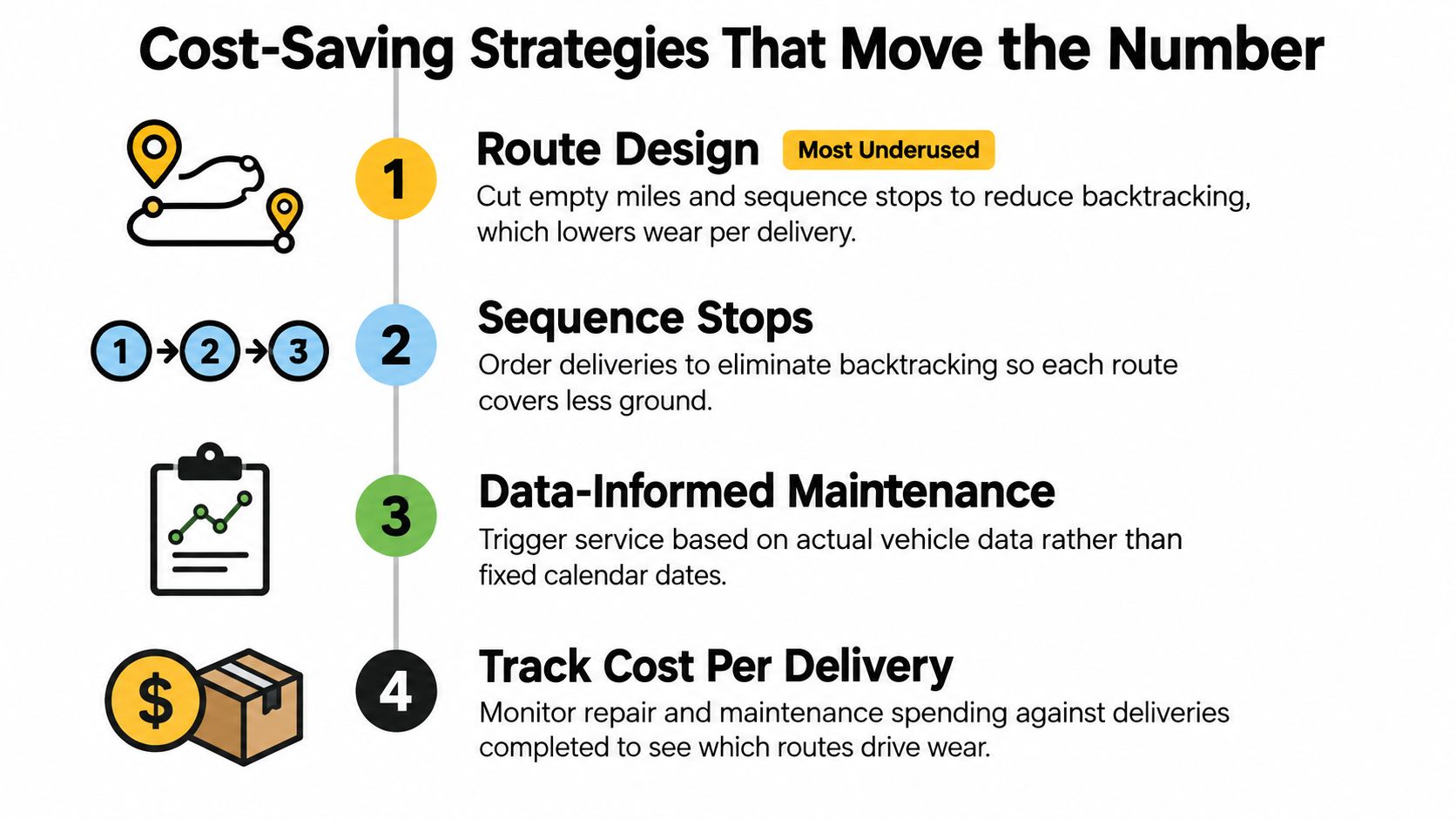
Start with route design, not a cheaper oil change. Removing unnecessary travel reduces the work the truck must perform to complete the same freight assignment. That's different from negotiating a lower price for maintenance after the wear has already occurred.
For overnight middle-mile lanes, evaluate the whole movement: departure terminal, receiving facility, return positioning and any empty repositioning. The shortest individual leg isn't necessarily the most efficient complete assignment.
Use Comparable Scope Before Comparing Prices
- Route design: Remove avoidable backtracking and test stop sequences against dock appointments, vehicle restrictions and realistic travel times. Evaluate maintenance expense per completed movement as well as per mile.
- Tire-vendor pricing: Request a written commercial tire schedule covering the selected tire, mounting, balancing, disposal and roadside support. A lower tire purchase price isn't necessarily a lower installed or supported price.
- Labor-rate sourcing: Agree on diagnostic authorization, hourly charges, parts pricing and after-hours terms before a truck fails. Compare expected completion time alongside the quoted rate.
Route changes need operational checks. A shorter route that introduces difficult backing, repeated curb contact or unreliable arrival timing may create costs elsewhere.
There's also a denominator trap: after removing empty mileage, maintenance cost per mile might rise because calendar-based costs are spread across fewer miles. Don't reject a useful route change solely because that ratio worsens. Check total expense and completed freight movements.
Negotiate the Service Package
For tires, standardize specifications where the equipment allows it. Give vendors the same load requirements, axle positions and service expectations so their proposals can be compared without hidden product differences.
Ask how the vendor handles unavailable stock and emergency substitutions. A fleet needs an acceptable replacement plan, not just an attractive price for a tire that isn't available when required.
For repair labor, request itemized estimates with a clear approval point for additional diagnosis. Specify whether the shop needs authorization before replacing related components, and require the final invoice to identify the cause, correction and parts installed.
A low hourly rate can be offset by extended diagnosis or a delayed completion date. Conversely, a higher-rate shop may be appropriate for a specialized fault when it has the equipment and expertise to resolve it. Judge the completed repair and return-to-service timing, not the rate sheet alone.
Don't book projected savings as achieved savings. Confirm them against invoices and completed route records after the change has been implemented.
Set Your Maintenance Reserve and Benchmark Quarterly
For a serviceable component, compare the expected cost of keeping it with the cost of preventive replacement:
Expected cost of keeping it = required repair price + probability-weighted downtime and recovery cost.
Include planned shop time in the replacement estimate. This comparison never justifies operating with an unsafe defect. Safety and compliance requirements come first. The federal Vehicle Inspection File distinguishes inspection violations from out-of-service conditions, so a defect that could ground a truck requires more than a repair-price comparison.
Calculate Expected Exposure Without False Precision
Build the estimate from repeat-failure records, technician findings and documented event costs. When the chance of failure is uncertain, test a plausible range instead of assigning an unsupported precise probability.
A backup truck can limit disruption, but it still has readiness costs and requires work to transfer the route. Include both in the estimate. Leave out speculative lost-customer revenue unless there is a defensible basis for calculating it.
Run the Quarterly Reserve Review
- Gather the trailing annual records. Collect repair, tire, roadside and recovery invoices, truck-mile records and documented downtime events.
- Calculate comparable cost per truck-mile. Divide repair-and-maintenance spending by actual miles. Keep tire and towing totals separate so the figure matches the benchmark category.
- Adjust for equipment and route. Compare the result with the planning band. Explain differences through vehicle condition, utilization and duty cycle.
- Add reliability and downtime. Show event costs and miles between unscheduled repairs alongside the invoice-based measure.
- Fund identifiable reserves. Set aside money for tires and major components based on condition assessments, quotes and expected service timing.
- Review the dashboard monthly. Flag repeat defects that are increasing and investigate their cause before raising the allowance.
Use one dashboard row per truck, with columns for mileage, repair spending, repair cost per mile, tire expense, recovery expense, downtime and repeat defects. A consistent fleet cost management process makes the figures useful for both maintenance and route-pricing decisions.
Reserve discipline: A quiet invoice month does not show that the allowance is too high. Compare accrued funds with known upcoming work before releasing the money for other uses.
Start with the worst-performing unit. Calculate its trailing annual costs, then identify whether expensive repairs, repeated interruptions or an unsuitable route assignment drive its result. Require a written action plan for that truck before changing the fleet-wide budget.
Peak Transport provides overnight middle-mile box-truck operations across the Twin Cities, with data-informed route planning, structured dispatch and maintained equipment. To discuss your hub connections, delivery windows and capacity requirements, contact Peak Transport through peaktransport.co to assess maintenance exposure alongside route reliability.