Cargo Visibility System: What Operators Need
A cargo visibility system tracks handoffs, not just trucks. See the four layers, middle-mile uses, and how to choose one.
November 9, 2026
A night planner rarely loses a trailer on the open highway. The load goes quiet at a dock, between a closed door and the next building's appointment. A cargo visibility system is supposed to turn those handoffs into a record someone can act on before a receiving hub starts holding a door for freight that has not left yet.
Why Cargo Still Disappears Between Hubs
In 2024, only 24% of surveyed supply-chain professionals had visibility into 75–100% of their total shipments, according to Tive's State of Visibility 2024 survey. That is the gap a night shift feels. Most of the network is still a guess once the trailer leaves one building and before it is accepted at the next.
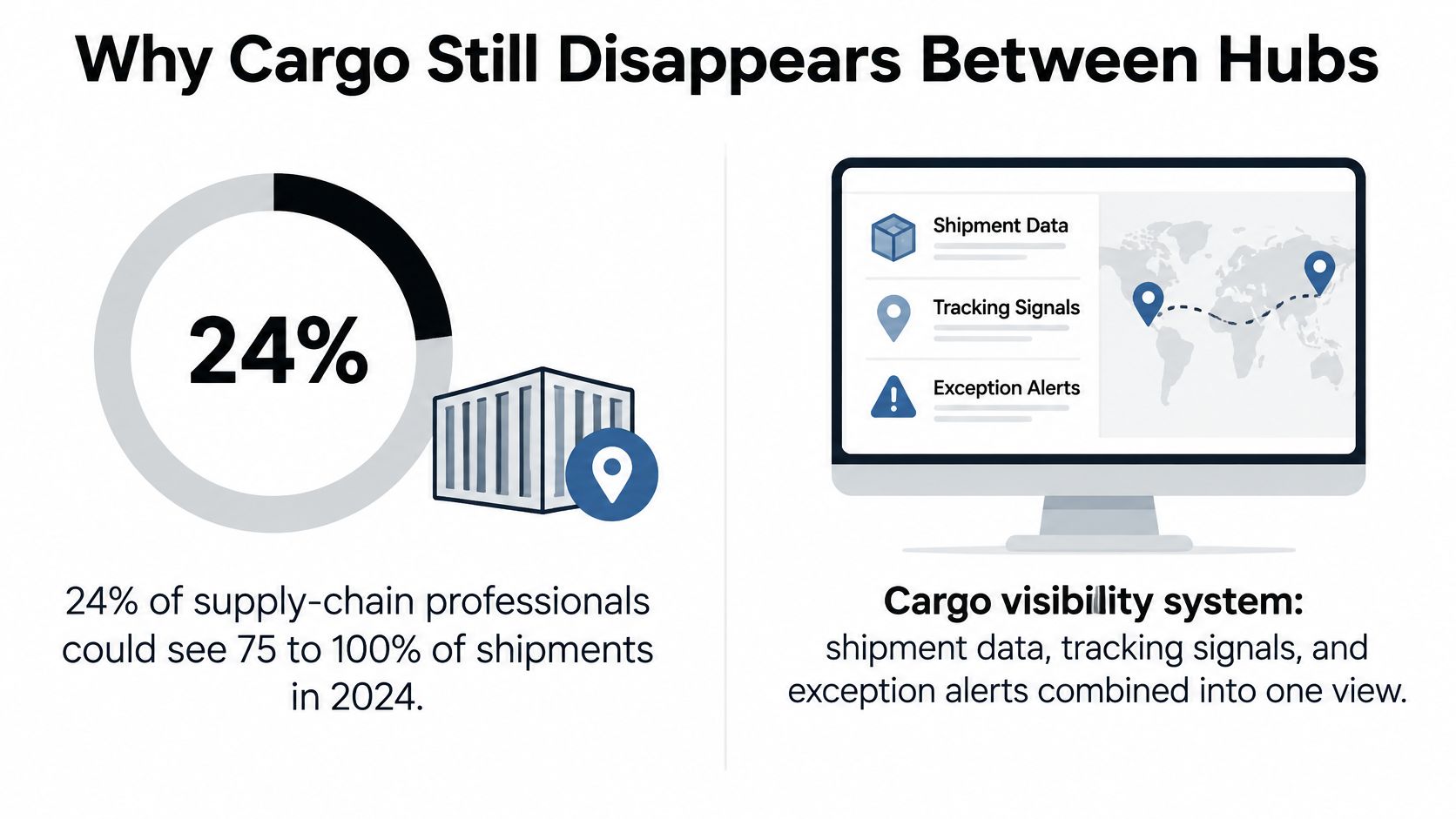
A cargo visibility system is the combination of scans, sensors, and shared software that turns physical freight events into a timeline partners can trust. A GPS ping only says where the power unit is. A milestone says something happened to the freight: trailer closed, departed, arrived, or handed off.
Treat an overnight box-truck lane like a relay. The baton is the trailer, not the dot on the map. If it drops at a 2 a.m. hub because nobody scanned the departure, the highway view still looks fine. The next distribution center only learns the truth when a door sits empty.
Who this is for
This is written for planners, hub leads, and brand logistics managers who move freight between facilities rather than to homes. The failure mode is a missed handoff, a trailer swap nobody wrote down, or a scan that lands after the next node has already guessed.
Practical rule: Test every vendor claim against whether required milestones are complete, not against how busy the map looks.
Work through four layers, the tracking chain that feeds them, what a middle-mile team gains, the data work that has to come first, two older lessons that still apply, and a short scorecard for demos. Teams building improving end-to-end supply chain visibility still lose nights when the middle of the trip has no proof of handoff. The same gap is where cargo theft prevention starts, because an unexplained dwell is both an operations problem and a security one.
Four Layers Inside a Cargo Visibility System
A device on a truck is not cargo control. A U.S. Government Accountability Office review, GAO-13-201, found unmet delivery standards, incomplete delivery data for many surface shipments, insufficient RFID information to track cargo into and within Afghanistan, and no common operating picture across transportation systems. The lesson for a regional lane is the same shape. Each transfer between a distribution center, a hub, a yard, and a vehicle opens a hole if dispatch, proof of delivery, scans, and exceptions never meet.
Read the layers in order. Stop at the first one your lane cannot answer.
| Layer | Question it answers | Typical signal | Who acts |
|---|---|---|---|
| Location | Where is the vehicle or trailer? | GPS or ELD ping | Dispatch |
| Condition | Is the cargo intact and in range? | Door, shock, or temperature sensor | Quality or claims |
| Milestone | Did the planned handoff happen? | Dock scan, geofence, seal, or proof of handoff | Hub lead and dispatch |
| Decision | Can the next node still be protected? | ETA versus appointment plus an owner | Planner or dispatcher on duty |
Location belongs to dispatch. An ELD or GPS ping places the power unit or trailer. It does not say the freight was accepted.
Condition belongs to quality or claims. A door, shock, or temperature sensor answers whether the load was opened, jolted, or held outside a set range. That record matters after the fact. It does not move the next appointment.
Milestone is the layer hubs run on. A dock scan, a geofence enter or exit, a seal check, or a proof of handoff says a planned event happened. Hub lead and dispatcher own it together. If either side assumes the other scanned it, the timeline breaks.
Decision is the only layer that protects the next building. Compare a fresh ETA with the appointment and name the person who can reroute, hold a door, or call the consignee. A system that stops at location is a tracking tool.
Name one milestone before you shop
Before a software demo, write one required milestone for every facility handoff on a live lane. "Departed origin" and "accepted at hub" are enough to start. Add dwell, missing scans, on-time arrival, and delivery-data completeness as the measures you will review. Standardized documentation is what turns separate pings into a picture both buildings can use.
A map with no handoff event is a picture of the truck, not of the freight.
How Tracking ETAs Geofences and Exceptions Work
These four features are one chain. Each one is useless until the next one consumes it. Configuration is the operator's job. The software does not invent the rules.
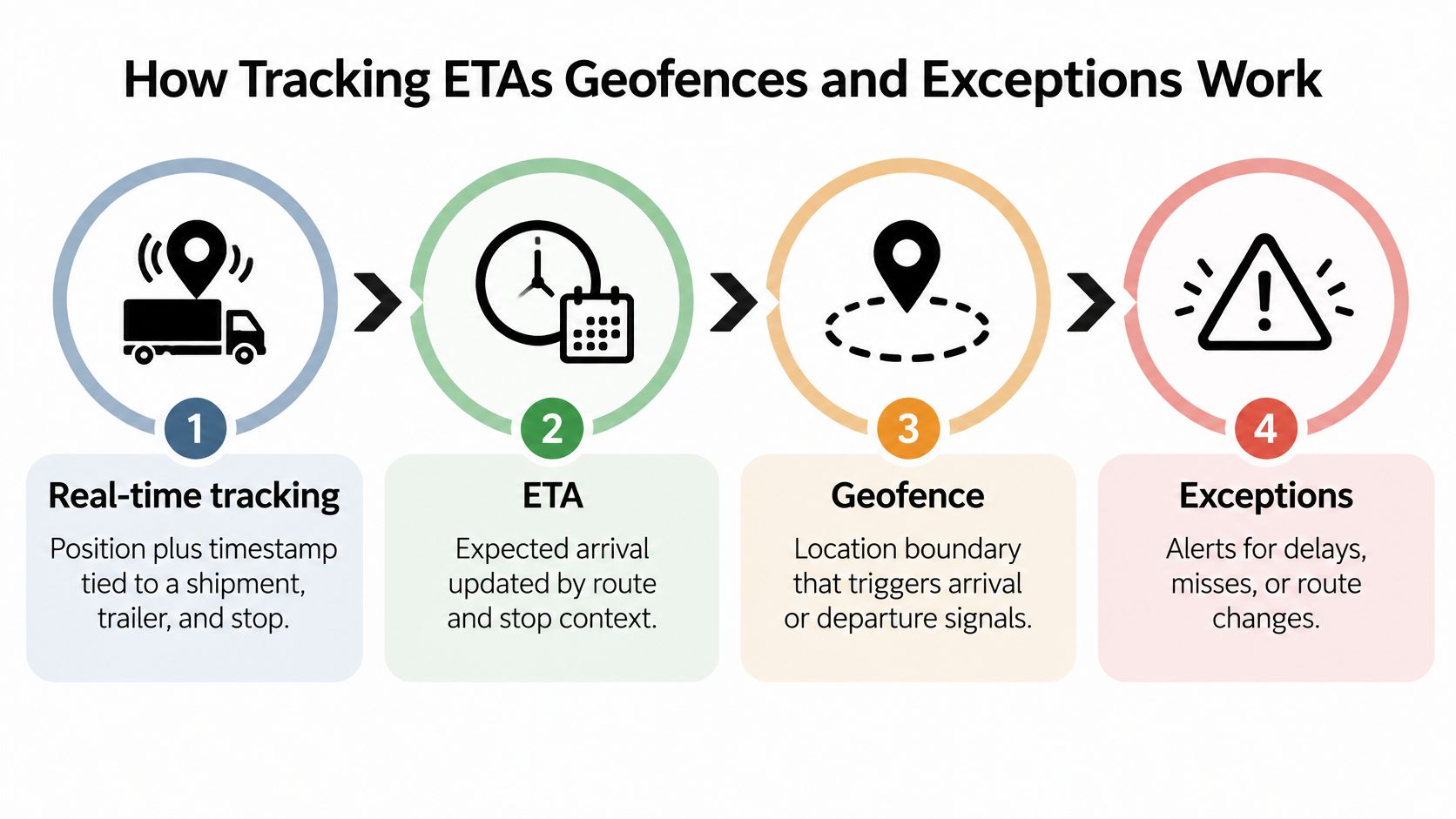
Real-time tracking is a position plus a timestamp. Tie that pair to a shipment, a trailer, and a stop, or it is only a vehicle breadcrumb. Dispatch cannot recover a load it cannot name.
The ETA should say what it is calculated from. Remaining miles, historical dwell at that hub, and the latest departure scan are the usual inputs. When a milestone is missed, the ETA has to move. An ETA that coasts on the original plan will keep promising an arrival the dock already missed.
A yard boundary that means something
A geofence is a yard boundary that records enter and exit. Two pairs are worth configuring on day one.
- Exit without a departure scan: the truck left, and nobody closed the load in the system.
- Arrival with no dock assignment: the trailer has been inside the fence for a set number of minutes and still has no door.
Exception management turns those signals into work. Name who is notified, after how many minutes, what proof closes the exception, and which alerts you suppress. A noisy yard that pings every few minutes will train people to ignore the board. Suppress the repeat. Keep the first breach.
Say a box truck is due out at 1:40 a.m. By 1:55 it has not crossed the exit geofence. Dispatch calls the driver before the receiving hub starts holding a door. That call is the product. The ping only started it.
These rules are configuration choices the operator owns, not magic inside the software.
Set the minute limits with the people who work the lane, then write them down next to the appointment. A threshold nobody agreed to becomes another alert in a stack.
What Middle Mile Teams Actually Gain
The blind spot sits between distribution centers, not on a parcel doorstep. A 2025 Tive industry survey found that 37% of companies still struggle to monitor cargo in transit, while 60% learned about shipment damage only after delivery, or never at all. IoT adoption in that research rose to 60%, up from 55% in 2024. More devices did not, by themselves, create action.
The moments that break a scheduled night
Three events do the damage on a fixed lane.
- A missed departure scan: the overnight transfer never shows as gone, so the next hub plans against a ghost.
- An unrecorded trailer swap: two companies touched the same box, and neither file matches.
- A late scan: the receiving team has already guessed, reassigned the door, or called a backup.
One missed departure idles a door, a driver, and a downstream appointment at the same time. Recovery has to happen while the load can still make the next node.
What you buy, when someone acts, is earlier recovery, fewer surprise shortages when the trailer does arrive, a shared proof of handoff when two companies touch the same trailer, and less of the night rebuilt from phone calls and texts.
A sensor does not unload a truck or rewrite a dock plan. The gain depends on a named person treating the alert as work. On a scheduled lane the only test that matters is simple. Did someone act early enough that the next facility was not surprised?
Integration Work Before the Dashboard Pays Off
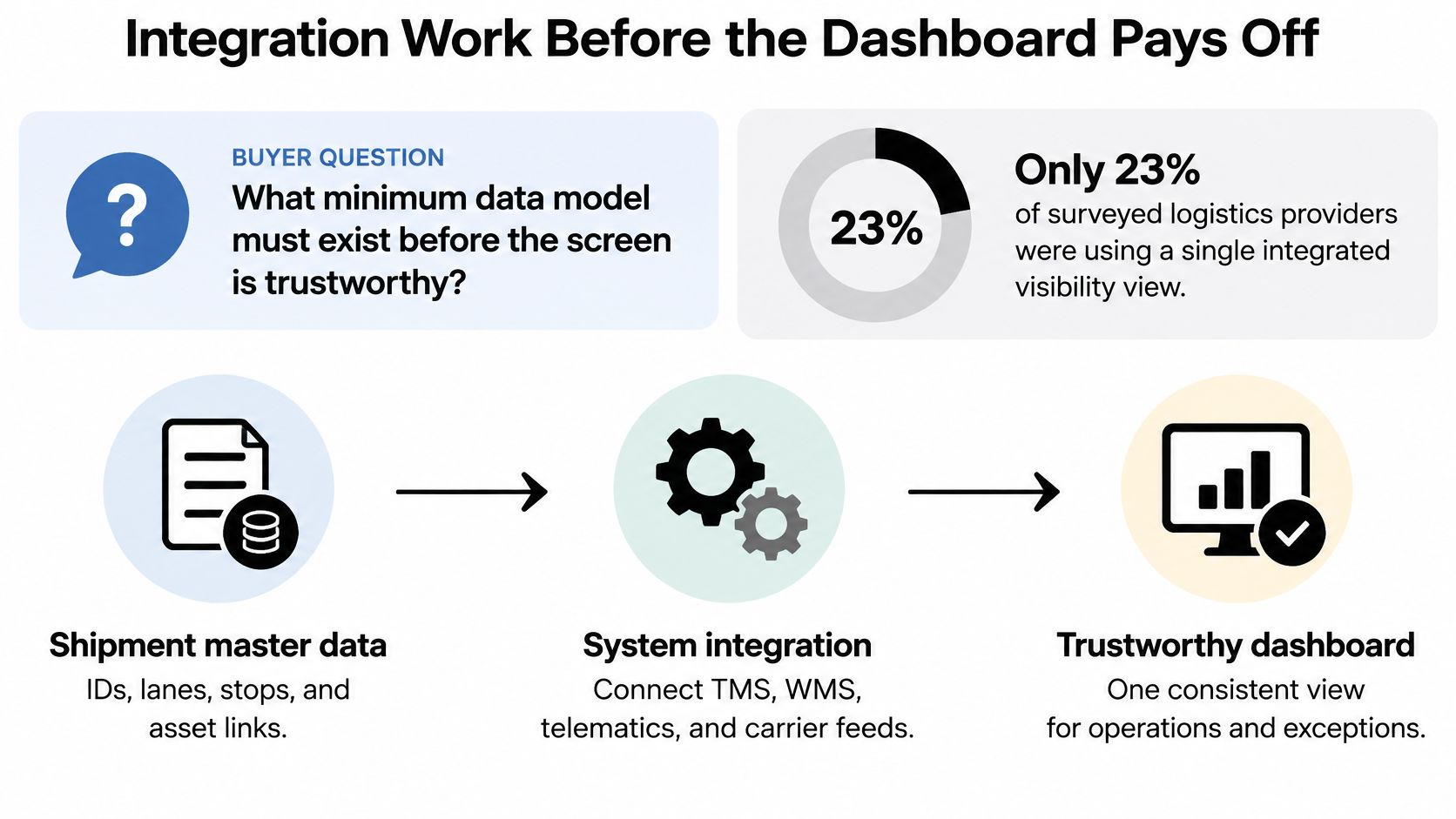
Feature lists skip the buyer question that decides whether the screen is trustworthy. What minimum data model has to exist first?
Among surveyed logistics providers, only 23% were using a real-time freight-visibility solution, while 51% named technology cost as the largest digitization obstacle, according to the State of the Industry Report 2025. Legacy-system integration affected 40%, lack of IT resources 37%, and resistance to change 35%.
| Measure | Share of respondents |
|---|---|
| Using a real-time freight-visibility solution | 23% |
| Technology cost as largest digitization obstacle | 51% |
| Legacy-system integration obstacle | 40% |
| Lack of IT resources obstacle | 37% |
| Resistance to change obstacle | 35% |
The minimum model
You need one shared identifier that survives the trip from order to trailer to stop. The TMS, WMS, ELD, dock system, and proof of delivery have to be talking about the same freight. If each system keeps its own reference, every "match" is a manual guess.
Assign an owner for a missing or conflicting event. Do not let both facilities assume the other scanned it. An API is the preferred path. A portal or a structured manual update is the fallback when a partner cannot integrate, and those manual events must be marked so nobody treats them as device reads. Keep the audit trail long enough to settle a claim or a missed appointment. Suppress repeat alerts from the same yard ping.
The same discipline shows up when retailers connect store and warehouse records. A practical walkthrough of integrating retail data for inventory decisions is useful context for why identifiers have to agree before a dashboard is believed. On the transportation side, supply chain integration fails in the same place, at the handoff between systems that were never built to share a stop.
A smaller system with complete milestones will outperform an advanced platform fed by inconsistent scans. Measure fewer avoidable exceptions, faster handoffs, and better on-time decisions. Do not measure widget count.
What the Program Costs and Returns
Buyers ask about cost after the demo. Price the whole program, not the license.
Cost components are platform fees, device hardware, integration labor, internal IT time, and the hours owners spend working exceptions. Benefit inputs already sit on the lane: late departures, minutes of door hold, unexplained scan gaps, detention or dwell minutes, and claims that could not be closed with proof of handoff.
Count it on one lane before you buy.
- Baseline the lane for two weeks before any purchase or configuration change.
- Log every exception with its owner, minute limit, and close-out proof.
- Count how many exceptions were caught before the next node.
- Price each avoided door hold, detention charge, or missed appointment using the carrier's own rates.
- Compare that monthly figure with total system and labor cost.
Say a lane has four late departures a week and the night team catches three before the 3 a.m. receiving hub. That lane avoided three door holds a week. The dollar value is the local rate you already pay, not an industry average. No savings percentage is assumed here.
If the benefit cannot be counted inside the trial, do not buy the system yet.
Tie the count to the key performance indicators you already review, such as on-time arrival and dwell, so the trial speaks the same language as the weekly ops meeting.
Pilots and Gaps That Still Teach Operators
The useful history is a handoff story, not a product launch. An EPCglobal pilot that concluded in March 2008 put 37 companies and organizations on one chain, as RFID Journal reported. Logistics providers, technology firms, and government agencies tracked tires, computers, and agricultural machinery from factories in China through the Port of Shanghai to the Port of Los Angeles and on to U.S. distribution centers.

The result that still matters was not a dot on a map. RFID reads at transportation and warehouse handoffs built a connected shipment history across organizations. EPC Information Services (EPCIS), ratified in April 2007, let trading partners share event data in near real time instead of keeping private records. The same account notes an ABI Research forecast that expected the cargo-tracking and security market to grow from $204 million in 2008 to $601 million by 2013. That forecast is context for early commercial interest. It is not a savings rate you can paste onto a regional lane.
What to copy on a short lane
Two principles came out of that pilot, and both still fit a night between two buildings.
- Capture the event at the physical handoff. A later status update cannot rebuild a scan that never happened.
- Make the record readable by the next party. Isolated proprietary files are not a shared history.
Do not invent a payback percentage from a 2008 ocean move. On a regional lane the return shows up as a complete event history, fewer unexplained gaps, and a handoff another company can audit. Score the tools you already run against that standard in the checklist that follows.
How to Choose a Cargo Visibility System
Take a pass-fail scorecard into every demo. Run it on a real lane, not a sample shipment the vendor staged.
| Criterion | What good looks like | Red flag |
|---|---|---|
| Milestone completeness | Every required handoff has a scan or geofence event | Map position with no departure or arrival event |
| Shared identifier | One ID links order, trailer, and stop | Each system uses a different reference |
| Exception ownership | A named person and a minute limit | Alerts with no owner or close-out proof |
| ETA method | Recalculated from latest departure and dwell history | Original plan that never updates |
| Integration path | API plus a marked manual fallback | Portal-only updates treated as device reads |
| Audit and noise | Retained event history and suppressed repeat pings | Alerts that cannot be audited or turned down |
A system that fails the first two rows will not be saved by extra sensors. Ask, in the room, whether the ETA is recalculated from the latest departure scan and historical dwell, or whether it repeats the plan. Prefer an API. Accept a portal only when manual events are marked, and confirm how long audit events are kept.
A two-week trial on one overnight lane
Our work is the link between distribution centers and hubs, on box trucks running scheduled routes between facilities that are planned in advance, not random residential stops. That is the kind of lane to trial. Pick one overnight run. For two weeks, count missing scans, late departures caught before the next hub, and appointments saved.
Score the tools you already have this week. Fix the weakest row before you add another dashboard. A complete milestone on a plain system beats a busy map fed by bad scans.
Peak Transport runs overnight middle-mile box-truck routes between warehouses, hubs, and distribution centers, with scheduled facility lanes and dispatch built around handoffs rather than last-minute residential stops. If your freight needs that kind of planned middle mile, with milestones your receiving team can trust, visit Peak Transport and tell us the lane you want covered.