Supply Chain Integration for Middle-Mile Logistics
Master supply chain integration for middle-mile logistics. Learn how data, APIs, and structured operations drive reliable overnight box-truck freight.
October 11, 2026
Buying another visibility dashboard is the most popular advice in logistics. It's also one of the fastest ways to create a more expensive version of the same blind spot.
A system can show a shipment as “in transit” while a trailer is waiting at the wrong gate, a driver is using an outdated appointment time, or a distribution center has no usable proof that the handoff occurred. Supply chain integration works only when the digital record matches the physical movement of freight. That requires shared definitions, accountable people, disciplined exception handling, and fallback procedures for the moments when technology or operations fail.
For middle-mile and overnight box-truck networks, the practical question isn't whether every system can connect. It's whether the right events arrive on time, mean the same thing to every partner, and trigger a decision before a missed handoff becomes a service failure.
The Visibility Illusion in Modern Freight Networks
A dashboard can display hundreds of shipments and still tell an operations team very little. Visibility becomes useful only when the information is accurate enough to act on, current enough to matter, and tied to someone who owns the next decision.
The gap between perceived and actual visibility is substantial. A 2025 survey found that 91% of U.S. supply-chain professionals believed their organizations were equipped to provide accurate visibility, while only 33% consistently achieved accurate, 360-degree, real-time inventory visibility (PwC's digital supply chain survey). The difference isn't usually caused by a complete absence of software. It comes from inconsistent timestamps, incomplete partner data, conflicting status codes, and physical events that never reach the system of record.
A dashboard can't repair a broken handoff
Consider an overnight box-truck lane. The warehouse marks a shipment ready, the transportation system assigns a route, the driver arrives, and the facility records a gate arrival. If the customer system interprets that event as dock arrival, the network may report progress that hasn't happened. The screen looks connected, but the operating team is working from a false timeline.
That's why a practical supply chain visibility framework must start with the operating event, not the dashboard. Teams need to define what “ready,” “arrived,” “loaded,” “departed,” “delivered,” and “exception” mean before they decide how those events should be displayed.
Practical rule: If an alert doesn't identify the event, the owner, and the required response, it's information, not integration.
Build the contract before buying the interface
An operational data contract should specify which party creates each event, which identifier connects it to the shipment or route, when it becomes valid, and who corrects it when the data is wrong. It should also define escalation ownership for missed departures, excessive dwell, inaccurate arrival estimates, and failed delivery confirmation.
More connectivity can make poor definitions travel faster. A narrower event stream with reliable timestamps and clear ownership often supports better execution than an ambitious “end-to-end” program filled with unverified updates. The physical operation remains the source of truth. Software should make that truth easier to coordinate, not replace it.
Defining True Supply Chain Integration
Supply chain integration is the coordinated management of processes, information, decisions, and performance across organizational boundaries. It includes internal departments, suppliers, distribution centers, carriers, regional hubs, and customers. A carrier isn't integrated merely because its transportation management system can send an API message to a shipper. The partners must also agree on what the message means and what action follows.
The history of the field reinforces that point. The Supply Chain Operations Reference model was created in 1996 by the Supply Chain Council, established by AMR Research and PRTM, to address inconsistent definitions for processes, performance measures, and improvement practices. Its original structure grouped activity into Plan, Source, Make, and Deliver, with Return and Enable added later. The model gave organizations a shared process language for comparing performance and coordinating internal and external partners (ASCM's SCOR reference).
That historical contribution still applies to middle-mile operations. Distribution centers, transportation providers, and hubs need a common vocabulary for appointments, loading completion, departures, arrivals, delivery confirmation, and exceptions. Without it, each company can report a technically valid status while the network remains operationally misaligned.
Integration has several layers
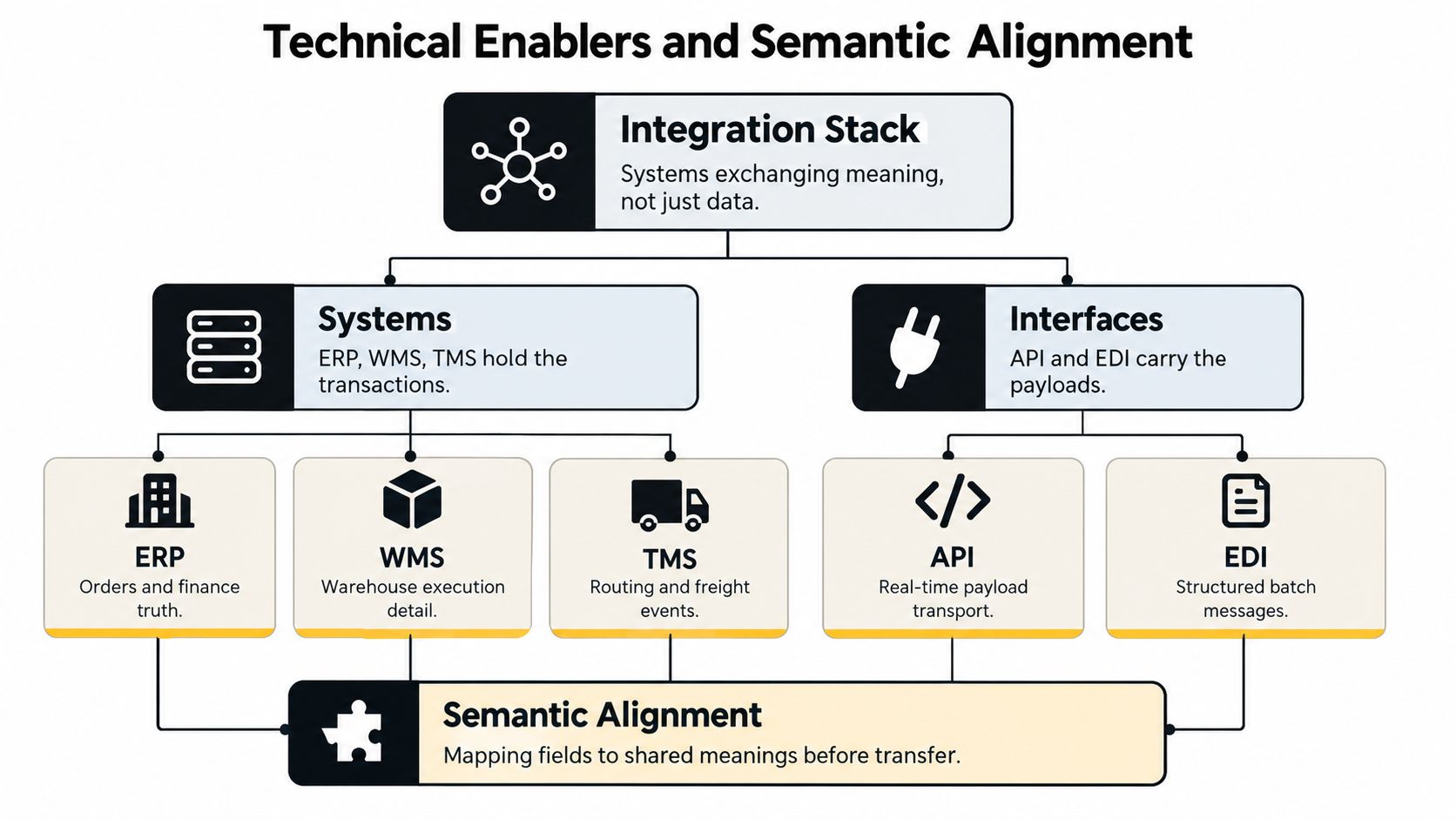
At the process level, partners coordinate planning, loading, transportation, receiving, and exception resolution. At the data level, they standardize identifiers, units, timestamps, status codes, and ownership. At the performance level, they measure whether coordination improves delivery, flexibility, quality, and cost rather than merely increasing message volume.
A published meta-analysis reviewed 86 peer-reviewed journal articles, 80 independent samples, and 17,467 total observations, finding a positive and statistically significant relationship between supply chain integration and firm performance (the meta-analysis in the Journal of Purchasing and Supply Management). The evidence examined internal, supplier, and customer integration, as well as operational dimensions such as cost, quality, delivery, and flexibility. It doesn't establish one universal improvement rate for every operation, but it does support integration as a measurable business capability rather than an IT preference.
Shared meaning matters more than shared software
A warehouse may use “arrival” for arrival at the property. A carrier may use it for arrival at the dock. A customer may treat it as the moment unloading begins. Those differences create false ETAs, duplicate alerts, and avoidable calls between dispatchers and facility teams.
The same principle applies when teams connect CRM and ERP systems. The connection becomes valuable only when customer, order, billing, inventory, and fulfillment records are mapped to consistent business meanings. In logistics, that mapping must extend to the physical events that prove freight moved.
Technical Enablers and Semantic Alignment
ERP, WMS, TMS, APIs, and EDI each handle a different part of the operating record. The mistake is treating them as interchangeable sources of truth.
An ERP typically holds order and financial transactions. A WMS captures warehouse execution, inventory movements, and loading detail. A TMS manages freight planning, route information, appointments, and transportation events. APIs can move messages quickly, while EDI can transmit structured business documents across established trading relationships. None of these tools can resolve a disagreement about what “departed” means.
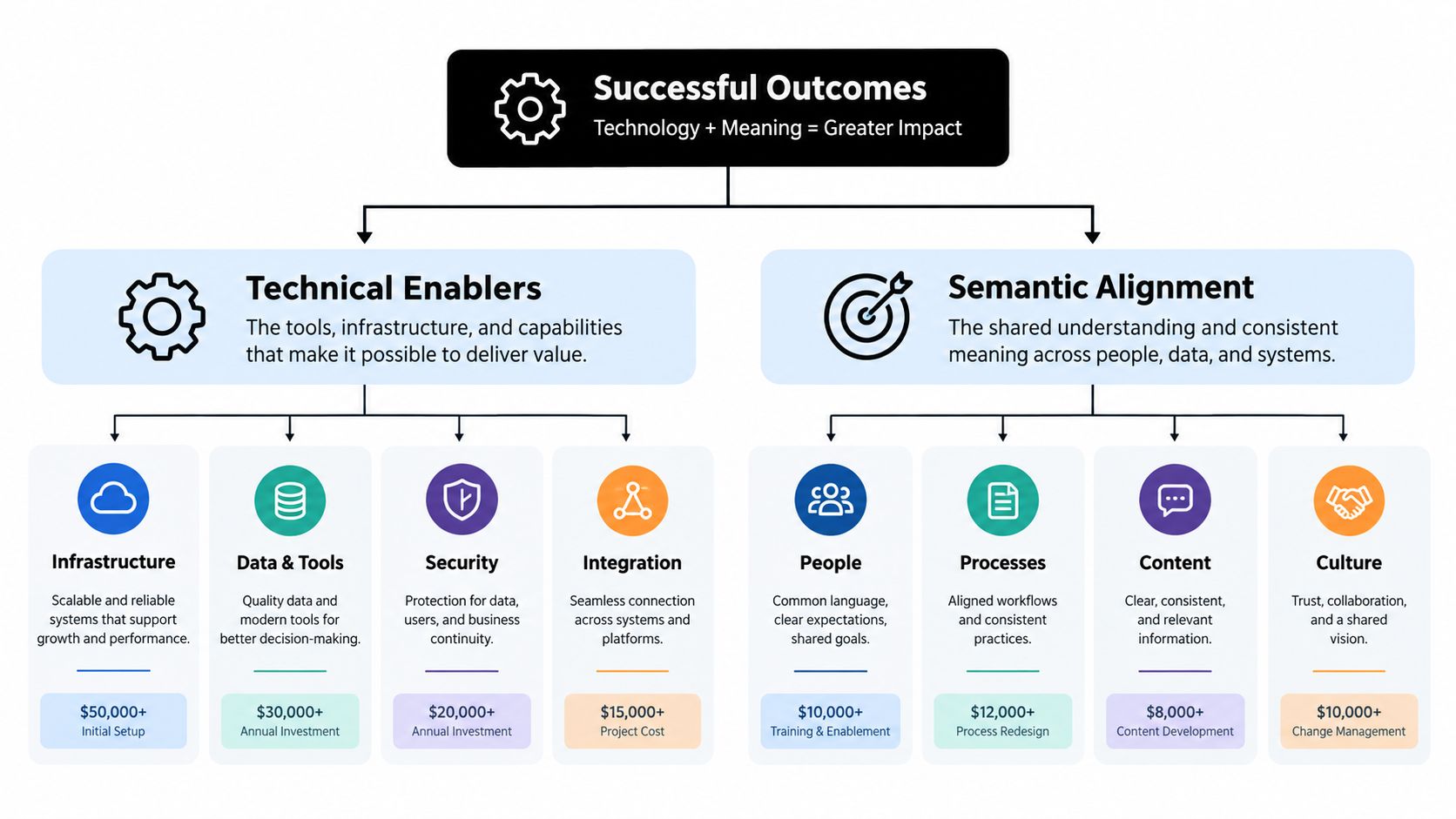
NIST describes logistics integration through standardized, nonproprietary specifications, interoperability testing, and semantic techniques that help systems exchange and interpret information consistently. Its guidance highlights a basic operational risk: an API can transmit data successfully while still producing errors when systems don't share the same meaning (NIST's logistics integration solutions).
Create a canonical event model
Start with the events the operation must manage, then map every system to those events. A practical middle-mile model should include:
- Entities: Facility, shipment, route, stop, vehicle, driver, appointment, and delivery record.
- Milestones: Ready, appointment confirmed, arrived at gate, arrived at dock, loading complete, departed, arrived at destination, delivered, and exception.
- Required fields: Shared identifiers, local and standardized timestamps, location, status code, source system, and correction history.
- Controls: Access rights, duplicate-event rules, missing-data handling, and ownership for corrections.
The canonical model should preserve the difference between scheduled time and actual time. It should also distinguish a driver's GPS event from a warehouse confirmation and a signed proof-of-delivery record. Those sources can reinforce one another, but they shouldn't be merged without explicit mapping when they represent different physical observations.
Test the integration like an operation
Conformance testing needs more than a successful connection. Send duplicate events, omit required fields, introduce a timezone mismatch, reverse the order of milestones, and test a facility that changes an appointment after dispatch. Then reconcile the resulting timeline against warehouse records, driver documentation, and signed delivery evidence.
For warehouse leaders, a useful companion is this data-driven warehouse design guide, because layout and data capture influence each other. A dock location, scan point, staging area, and departure process should make the required event easy to create accurately.
EDI remains relevant where partners depend on structured transaction exchanges, while APIs are useful for more immediate event delivery. The choice isn't ideological. Use the interface that fits the partner's operating maturity, then impose the same definitions, validation rules, and reconciliation standards on both.
For transportation teams, EDI express tracking is useful only when the messages represent verified movement and connect to a clear response process. Speed without semantic discipline accelerates confusion.
Designing Resilience into Integrated Operations
Integration can reduce improvisation, but it can also create a new concentration of risk. If dispatch depends on one cloud application, one network connection, or one inaccurate ETA feed, a technical failure can quickly become a missed appointment and a confused driver.
A resilient operation assumes that systems, facilities, labor availability, and road conditions can all diverge from plan. The response shouldn't be a return to informal phone calls and handwritten notes with no audit trail. It should be a documented fallback that preserves the essential operating facts.
Keep the physical operation moving
An overnight network should maintain offline-ready dispatch instructions containing the route, stop sequence, appointment details, contact information, equipment requirements, driver-hours constraints, and escalation path. Dispatchers need a defined alternate communication method when the primary platform is unavailable. Facility teams need a way to confirm loading and departure without waiting for a restored connection.
The fallback process should also state who can resequence a route. A planner may propose a change, but the person making the decision must account for driver-hours limits, safe parking, facility conditions, and actual road performance. Automated plans are useful inputs, not permission to ignore operational judgment.
Treat documentation as a resilience control
Structured documentation protects the network when a driver calls off, a facility becomes congested, or an ETA feed stops reflecting reality. The record should show what changed, who approved it, when the driver received the instruction, and which delivery or safety constraints shaped the decision.
This matters as labor capacity tightens. 2025 research identified workforce and talent shortages as a major industry trend for 35% of respondents, economic uncertainty for 37%, and supply-chain agility and resilience for 28% (MHI and Deloitte research reported by Business Wire). Those conditions make cross-training, clear escalation, and practical fallback procedures operational requirements rather than optional process improvements.
A resilient integrated network doesn't eliminate human intervention. It gives people a controlled way to intervene without losing accountability.
Middle-Mile Execution and Overnight Box-Truck Lanes
An overnight box-truck lane exposes weak integration quickly. The freight has a narrow window to leave the origin facility, travel to a regional node, complete the handoff, and remain within the driver's legal and practical operating limits. A vague status such as “in transit” won't tell a dispatcher whether the load is staged, whether the driver has reached the correct gate, or whether the receiving facility can still accept it.

Consider a regional carrier running overnight freight between distribution centers and Amazon Relay nodes. The minimum viable data contract shouldn't attempt to expose every possible system field. It should make the critical movement events dependable:
- Pickup readiness: The origin confirms that freight is staged, identified, and available for loading.
- Appointment record: The facility and carrier share the same scheduled window and location details.
- Arrival milestones: Gate arrival and dock arrival remain separate events.
- Loading completion: The warehouse confirms what was loaded and when the vehicle became ready to depart.
- Movement status: Dispatch receives actual departure, estimated arrival, and meaningful route exceptions.
- Delivery evidence: The receiving facility records delivery confirmation and preserves accurate proof of delivery.
- Exception ownership: A missed appointment, damaged freight, rejected load, or unavailable dock has a code and an assigned responder.
Narrow data beats noisy visibility
A trusted event stream can reveal more than a broad dashboard full of stale or contradictory updates. If the dispatch team knows that loading completed, the truck departed, the ETA changed, and the receiving site acknowledged delivery, it can manage the lane. If ten systems report different versions of those events, more screens won't solve the problem.
Driver structure affects data quality. W-2 employees, paid training, clear dispatch communication, and documented procedures create a stronger foundation for accurate scanning, hours-of-service compliance, inspection records, and delivery confirmation than a model that treats every trip as an isolated transaction. The driver remains responsible for safe execution, while dispatch and facility teams provide the information needed to make sound decisions.
Equipment and coverage decisions also belong in the operating model. Teams evaluating a carrier can compare box truck policies alongside dispatch practices, maintenance controls, driver training, and documentation standards. Insurance alone doesn't integrate a network, but weak risk controls can undermine every digital process built around it.
Peak Transport is one example of a middle-mile operator using structured overnight box-truck operations, W-2 drivers, route planning, and dispatch documentation to connect distribution centers with regional freight nodes. The relevant evaluation isn't the presence of a software logo. It's whether the partner can produce accurate events, follow the agreed exception process, and keep the lane moving when the plan changes.
Implementation Steps and Performance Metrics
A workable integration program starts with the movement of freight, not the inventory of software. The team should identify where a decision is delayed, where a status is disputed, or where people rekey information between systems. Those points reveal the data contract that deserves attention first.
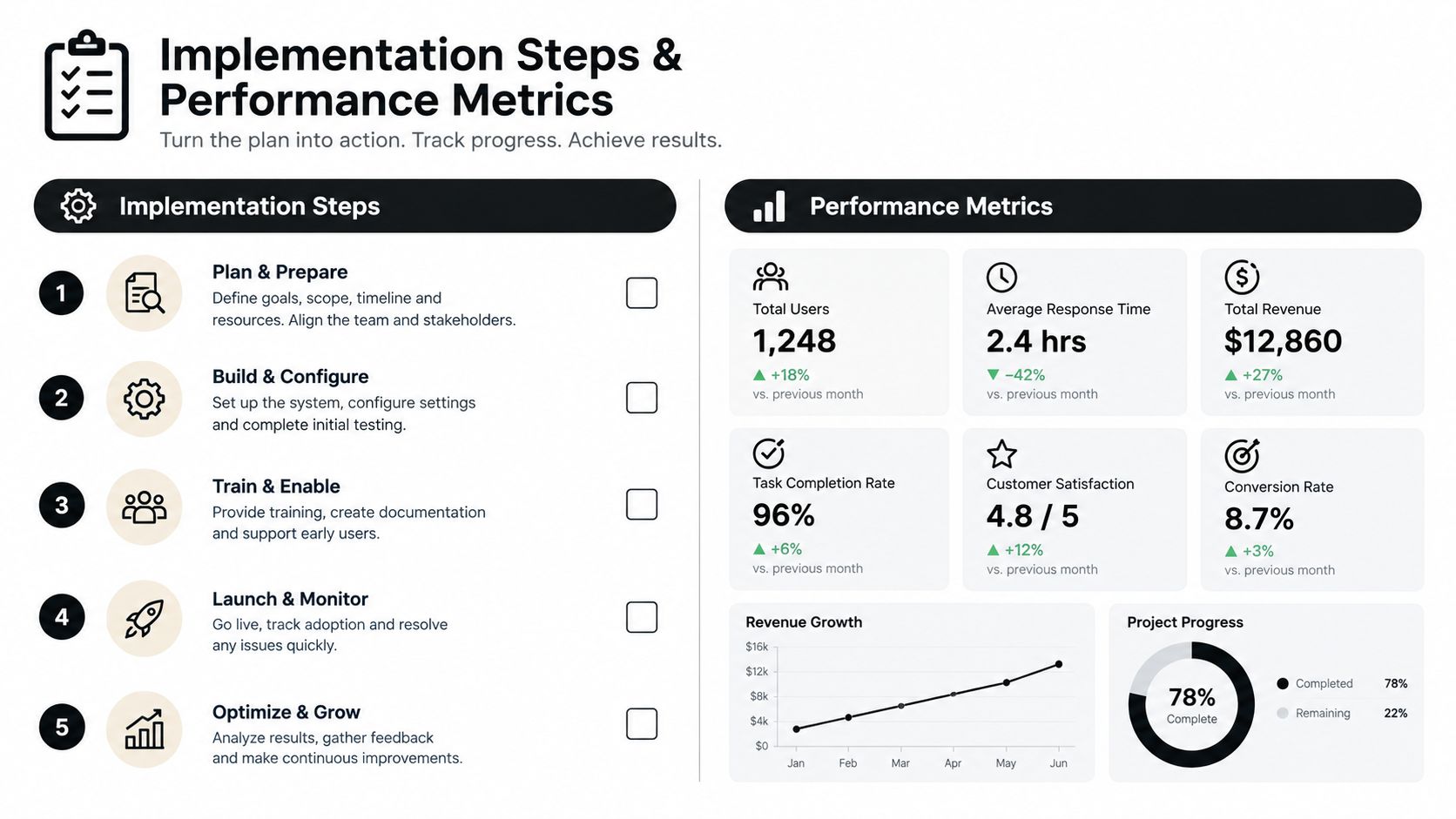
A practical sequence looks like this:
Map the physical lane. Document every handoff from pickup readiness through proof of delivery. Include the driver, dock worker, dispatcher, facility coordinator, and customer system involved in each event.
Define the canonical record. Establish shared identifiers, milestone names, timestamp rules, location requirements, exception codes, and source-of-truth rules. Decide whether a facility scan, telematics event, or signed record confirms each milestone.
Assign correction ownership. The person who creates an event should be accountable for its quality, but the contract must also identify who can correct it and how the change is logged. Silent edits create disputes later.
Automate meaningful alerts. Trigger alerts for missed departure, late arrival, excessive dwell, absent proof of delivery, and unresolved exceptions. Each alert should include an owner, deadline, and escalation path.
Review performance with partners. Compare the event timeline with warehouse records, driver documentation, appointment systems, and customer requirements. Remove fields that don't support a decision, then strengthen the fields that do.
Measure synchronization, not connection count
The right metrics show whether planning and execution agree:
- Forecast or volume-plan accuracy: Compare the expected freight profile with actual volume presented to the operation.
- On-time departure and arrival: Separate origin performance from destination performance so delays don't disappear inside one combined measure.
- Dwell time: Track the time between arrival, dock access, loading completion, and departure.
- Empty miles: Review route planning and repositioning decisions for avoidable movement.
- Exception-resolution time: Measure how long it takes to assign, investigate, and close an operational exception.
- Data completeness: Confirm that required identifiers, timestamps, statuses, and delivery records are present and usable.
A 2024 study of 300 organizations found a strong positive relationship between supply chain integration and operational efficiency, with r = 0.65 and statistical significance at p < 0.001 (the 2024 integration study). The reported relationship was associated with operational synchronization and accurate information exchange. It shouldn't be read as proof that integration alone creates every efficiency gain, because process discipline and partner relationships matter too.
Teams building a broader measurement system can use these key performance indicators as a reference, then tailor the measures to the lane, facility, freight type, and service commitment.
Engineering Logistics for Predictable Outcomes
The strongest supply chain integration programs don't begin with a promise of complete visibility. They begin with a clear operating agreement. The shipper, warehouse, carrier, hub, and driver know which events matter, what each event means, who records it, and what happens when the plan breaks.
That discipline changes how companies evaluate logistics partners. Ask how the provider handles a missed appointment, a stale ETA, a failed scan, a driver call-off, a cloud outage, or a facility that can't receive freight. Ask whether the carrier's documentation can be reconciled with warehouse and customer records. Ask how drivers are trained to capture accurate delivery evidence and how dispatchers escalate exceptions without creating unsafe pressure.
A reliable middle-mile model combines predictable lane structures, trained W-2 drivers, clear dispatch communication, safety controls, and a reconciled event stream. The technology supports the work, but the work still happens on the dock, in the cab, and at the handoff. Integration is successful when each participant can make the next correct decision from the same operational facts.
The best data contract is deliberately practical. It doesn't promise that every system will know everything. It ensures that the people responsible for moving freight can trust the few events that determine whether freight is ready, moving, received, and documented.
Peak Transport applies this middle-mile model to overnight box-truck operations connecting distribution centers and regional freight nodes. If your network needs structured schedules, disciplined handoffs, and a carrier partner that treats documentation and safety as operating controls, Peak Transport can discuss your lanes and service requirements.