Consistent Service Delivery in Middle Mile Logistics
Learn what consistent service delivery means in middle-mile logistics, why it matters, KPIs to track, and how Peak Transport delivers it nightly.
September 23, 2026
The trailer is loaded, the distribution center is ready to release it, and a downstream dock is holding a narrow appointment window. One missed handoff can push the next move behind schedule, leave a driver waiting, and force a hub team to rebuild the night's plan while freight is already in motion. By morning, a small departure issue has become a customer-facing service problem.
That's why consistent service delivery matters more than one impressive run. Shippers need a middle-mile partner that can repeat the same dependable outcome across lanes, shifts, drivers, and handoffs. Drivers need clear dispatch instructions, workable routes, sound equipment, and schedules that don't depend on last-minute heroics.
This guide treats reliability as an engineered operating system, not a matter of individual effort. It explains what consistency means, how to measure it, where it breaks, and how lane discipline, communication, maintenance, and ownership work together to protect every overnight move.
Introduction to Reliable Middle Mile Operations
A middle-mile operation often looks calm from the outside. Freight leaves a distribution center, travels to a regional hub, and arrives for the next scheduled movement. Inside the operation, however, every departure depends on several connected decisions: the load must be ready, the route must be realistic, the driver must have accurate instructions, the vehicle must be available, and the receiving location must know what to expect.
If one part slips, the next team inherits the problem. A late release compresses driving time. Compressed driving time reduces the margin for traffic or a check-in delay. A late arrival can disrupt dock sequencing, cross-dock throughput, and the next linehaul connection. The driver may still complete the trip, but the network no longer has the predictable rhythm it needs.
A single on-time delivery proves possibility. A repeatable pattern proves control.
For shippers, that distinction affects inventory flow, customer promises, appointment planning, and confidence in the transportation partner. For operations leaders, it determines whether the night can run from a standard plan or whether supervisors must constantly intervene. For drivers, it shapes whether a route feels professional and manageable or improvised and stressful.
Reliable middle-mile service doesn't require every night to look identical. Weather, traffic, volume, and facility conditions will vary. Consistency means the operation responds to variation through defined rules, clear escalation, and accurate updates instead of asking people to improvise independently.
The practical framework is straightforward:
- Define the promise: Agree on delivery windows, handoff requirements, documentation, and exception rules.
- Design the lane: Use repeatable route structures, stable assignments, and realistic timing.
- Communicate the plan: Give dispatchers and drivers the same operational information.
- Measure the outcome: Track performance against commitments, not vague estimates.
- Improve the system: Use exceptions to strengthen the process rather than normalize workarounds.
The result is a network that can absorb ordinary disruption without losing its operating shape.
What Consistent Service Delivery Means in Logistics
A commuter train illustrates the idea well. Passengers don't judge the service only by whether one train arrives quickly. They value knowing when it will arrive, where it will stop, and whether the same pattern will continue tomorrow. A middle-mile lane works in much the same way. The value comes from predictable execution over time, not from an isolated fast trip.
In logistics, consistent service delivery has four connected parts:
- Time: Freight arrives within the agreed delivery window.
- Location: The correct shipment reaches the correct facility or customer.
- Handoff: The next team receives the load, status, and documents it needs.
- Repeatability: The same operating pattern works across recurring service days.
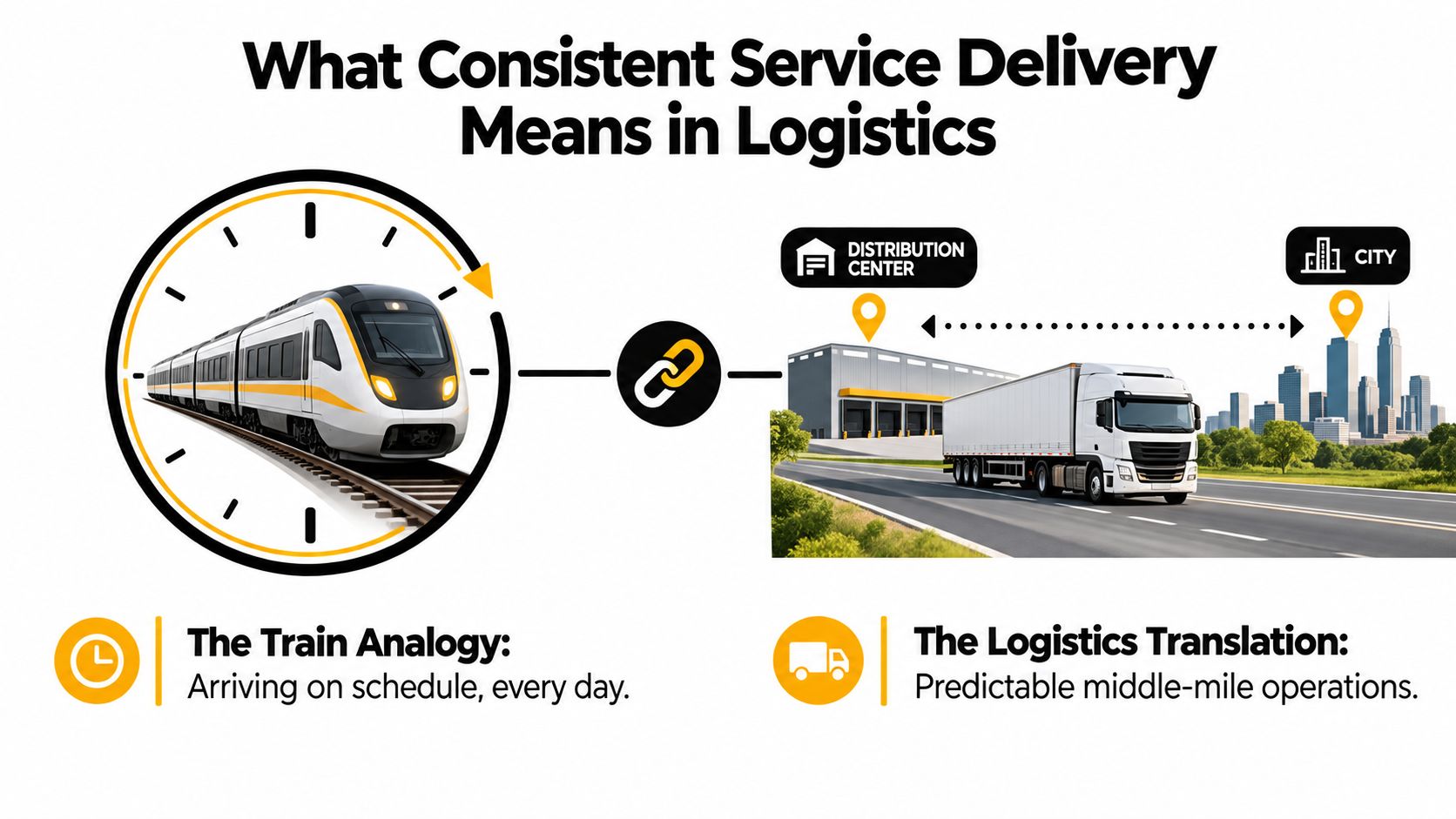
From speed to temporal consistency
One-off on-time delivery answers a narrow question: did this shipment arrive by its commitment? Consistency asks a broader question: can the operation produce that result repeatedly, with similar departure patterns, arrival timing, documentation, and communication?
A recurring lane may use the same driver for the same facilities and target approximately the same arrival time on each service day. Research on the consistent vehicle routing problem treats this pattern as a formal routing constraint. One study reported an average cost increase of 1.31% for consistent service across evaluated instances, with the premium ranging from 0% to 8.25% depending on the case. The trade-off is clear: a small amount of routing flexibility can support stronger predictability, fewer handoff errors, and easier dock planning. Research on consistent vehicle routing provides the technical foundation for treating consistency as a design decision rather than an informal preference.
Drivers also need the operating standards to be practical and compliant. Clear vehicle policies, documented inspections, and defined responsibilities support driver compliance for truck operators, especially when several people share responsibility for a recurring lane.
A simple nightly mental model
Think of a lane as a scheduled service, not an empty truck moving between two points. The dispatch team owns the plan, the driver owns safe execution and accurate status, the facilities own readiness and handoff, and the manager owns the rules that connect those roles.
A consistent lane therefore has a known departure process, a defined route, a realistic arrival window, a standard check-in method, and a documented response when conditions change. That pattern gives every participant the same reference point. When the route needs to change, the change is visible and authorized instead of being created separately by each person.
Why Consistency Drives Business and Operational Results
Consistency protects more than transportation efficiency. It protects the promise a brand makes to its customers and the operating capacity a distribution network needs to keep moving.
A dependable overnight arrival helps a receiving team plan labor, dock space, staging, and downstream departures. An unpredictable arrival forces that team to keep capacity open, reshuffle appointments, or wait for information. The cost isn't limited to the late truck. It can include idle people, missed connections, rework, and additional pressure on the next shift.
For e-commerce and retail networks, overnight and next-day expectations make this effect sharper. The service window is narrow, so a late middle-mile handoff has less time to recover before the freight reaches the final distribution step.
Reliability supports repeat business
Delivery consistency has become a commercial differentiator rather than a back-office metric. A fact-checked 2026 logistics industry summary reports that 90% of consumers say reliability is essential, while 80% are more likely to repurchase when deliveries arrive on schedule. Those figures connect operational performance directly to customer behavior, not just internal productivity. Logistics delivery statistics and market context support the case for treating reliable service as a revenue-protection practice.
Shippers should therefore evaluate transportation partners by more than rate and available capacity. Useful questions include:
- Can the carrier repeat the same lane pattern across service days?
- Does dispatch communicate before a committed window is at risk?
- Can the carrier explain exceptions with accurate timestamps?
- Are documentation and proof-of-delivery practices consistent?
- Does the carrier protect driver readiness and equipment availability?
Visibility also matters because a promise is easier to manage when every party can see the shipment's current state. Teams assessing their broader operating model can use this supply chain visibility resource to connect transportation status with planning and customer communication.
Operational rule: Reliability becomes a business asset when customers can plan around it and internal teams don't need to compensate for it.
The calm created by fewer surprises
A predictable lane reduces the number of urgent decisions that supervisors must make during the night. Dispatch can focus on real exceptions instead of searching for basic status. Drivers can follow a documented route instead of negotiating every stop from scratch. Facilities can prepare for an expected arrival instead of reacting to an uncertain one.
That calm has practical value. It helps teams protect capacity, maintain safety discipline, and preserve trust with shippers and receiving locations. Consistency doesn't remove every disruption. It gives the network a stable baseline from which to detect and manage disruption.
Key Performance Indicators That Prove Consistency
Reliable service needs a measurement system that distinguishes a genuine failure from normal transit variation. The anchor metric is on-time delivery, often abbreviated as OTD. It measures the share of deliveries completed by the agreed date or within the committed window.
The basic formula is:
OTD = on-time deliveries ÷ total deliveries × 100
Industry guidance commonly treats 95% to 98% OTIF or OTD as a strong benchmark, with world-class performers approaching 99%. These figures shouldn't be used as decorative targets. They show how a small percentage-point difference can represent a meaningful number of missed commitments on a busy lane. The OTD definition and benchmark context explains the calculation and its operational use.
At 1,000 deliveries per month, a lane operating at 97% on-time would miss 30 commitments, while a lane at 99% would miss 10, a 67% reduction in failures. Those values come directly from the stated operating example, not from an assumed improvement model.
Measure against the commitment
Estimated arrival time and committed delivery time aren't interchangeable. A vehicle can arrive close to an internal estimate and still miss the customer's agreed window. Conversely, a route can change its estimated arrival during transit and still meet the actual commitment.
On-time measurement should therefore use the promised window as the control point. Logistics literature places OTD within the broader perfect order concept, alongside completeness, condition, and documentation accuracy. For an overnight middle-mile operation, the team should pair OTD with exception frequency and documentation accuracy so it can see whether the issue is late movement, incomplete freight, damaged goods, or a failed handoff. This logistics service-quality research provides that broader context.
A practical KPI set
| KPI | What It Measures | Why It Matters for Consistency |
|---|---|---|
| On-time delivery | Arrival by the agreed date or window | Shows whether the core promise was met |
| OTIF | On-time and complete delivery | Separates punctuality from shipment completeness |
| Exception frequency | How often a route requires intervention | Reveals process instability before it becomes normal |
| ETA accuracy | Difference between communicated and actual arrival | Tests the quality of dispatch information |
| Documentation accuracy | Whether required records are complete and correct | Protects handoffs and reduces avoidable rework |
| Dwell time | Time spent waiting at a facility | Identifies readiness or dock-process constraints |
Managers can begin with one recurring lane and review the measures by service day, driver assignment, facility, and exception type. A key performance indicators guide can help teams create a wider measurement framework without losing the operational focus.
The objective isn't to produce a dashboard full of numbers. It's to answer three questions: did the operation meet the commitment, what interrupted it, and which owner can prevent the same interruption next time?
Common Failure Modes That Break Consistency
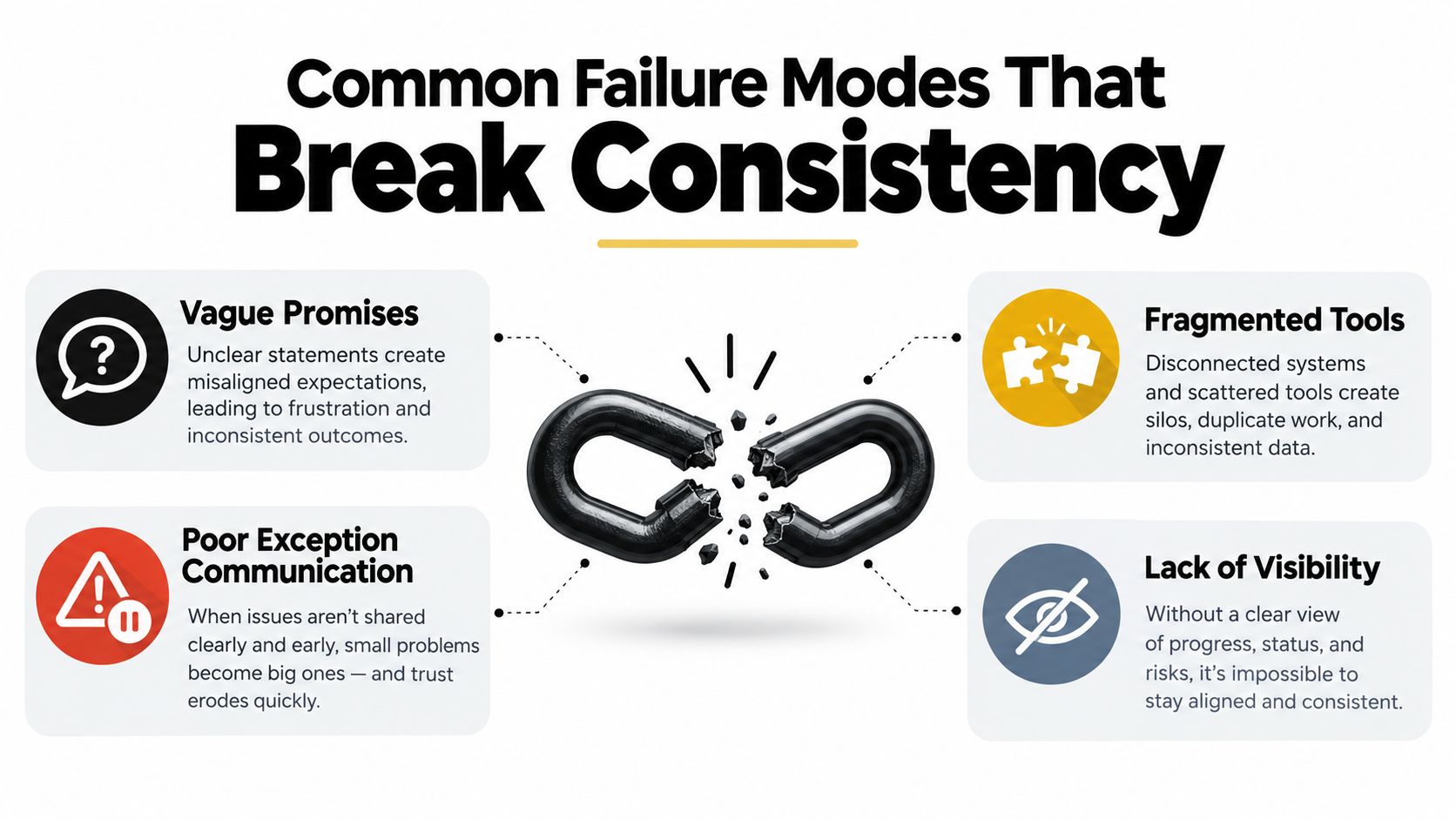
Most inconsistent service doesn't begin with a driver choosing to operate poorly. It begins earlier, when the promise is vague, the lane is poorly defined, or the information needed for a decision sits in a different system.
A customer may receive a delivery promise without a specific date. The facility may hold freight without a clear release signal. Dispatch may know a vehicle is delayed but lack a standard rule for notifying the receiver. Each gap looks small in isolation. Together, they create a service that feels unpredictable even before the truck arrives late.
Promises that can't be managed
A promise needs enough detail to guide action. “Fast delivery” doesn't tell a dispatcher when to release a load, a driver when to depart, or a facility when to prepare a dock. A committed window does.
A 2025 mystery-shopping study found that only 1% of brands provided estimated delivery dates, although 58% of consumers wanted them. The same study reported that 56% preferred SMS updates, while only 12% of brands met that baseline. It also found that 14% of brands failed to fulfill stated delivery promises by about 7 days on average. The 2025 mystery-shopping findings show why promise-setting and communication belong inside the operating model.
The problem isn't only that a shipment can be late. It's that an unclear or unsupported promise prevents everyone from managing risk early.
Fragmented tools and handoffs
Tool sprawl creates another failure path. A tracking platform may hold location data, a dispatch system may contain the route, a facility may use a separate appointment process, and a driver may receive critical changes through an informal message. If those systems don't share definitions and ownership, people become the integration layer.
That arrangement creates several risks:
- Duplicate updates: Two teams enter different statuses for the same event.
- Lost context: A handoff transfers an instruction without the reason behind it.
- Unclear authority: Nobody knows who can change the route or promise.
- Late escalation: Teams discover a missed window after recovery options have narrowed.
Adding another tool won't fix those problems by itself. Consistency improves when the organization first standardizes its handoff vocabulary, exception categories, and decision rights. Automation should reinforce that structure, not conceal its absence.
How to Engineer Consistent Service Delivery Every Night
The most reliable overnight operations use a repeatable playbook. Each role knows what information it receives, what decision it owns, and what evidence it must record. The system starts before dispatch and continues after proof of delivery.
Build the lane before optimizing the trip
Begin with the recurring service pattern. Define the origin, destination, facility sequence, appointment rules, preferred route, fueling expectations, contingency options, and documentation requirements. Historical departure and arrival data can then inform route planning, but the objective isn't just to find the shortest route. It's to protect a repeatable arrival pattern.
Assign stable drivers to recurring lanes where the operating model allows it. Familiarity with facility entrances, check-in procedures, staging areas, and common traffic points reduces unnecessary decisions. The assignment still needs to respect hours, qualifications, availability, and fair scheduling.
A route plan should also state what happens when the expected plan no longer works. Define who approves a reroute, who contacts the receiving site, which status code records the exception, and when the driver must stop and escalate rather than continue guessing. Teams can use this route planning and optimization guidance to structure those decisions.
Make dispatch communication predictable
A dependable dispatch rhythm is more useful than a stream of unstructured messages. At minimum, the operating record should capture load readiness, departure, arrival at key points, delay reason, revised ETA, customer notification, and final completion.
The message should answer four things: what happened, what it affects, what the driver should do, and who owns the next update. Drivers shouldn't have to interpret conflicting instructions from multiple people.
Equipment is part of the same system. A route cannot be consistent if vehicles repeatedly enter service with unresolved defects. A documented approach to preventive maintenance for HGV fleets helps operators schedule inspections and repairs before avoidable breakdowns interrupt a recurring lane.
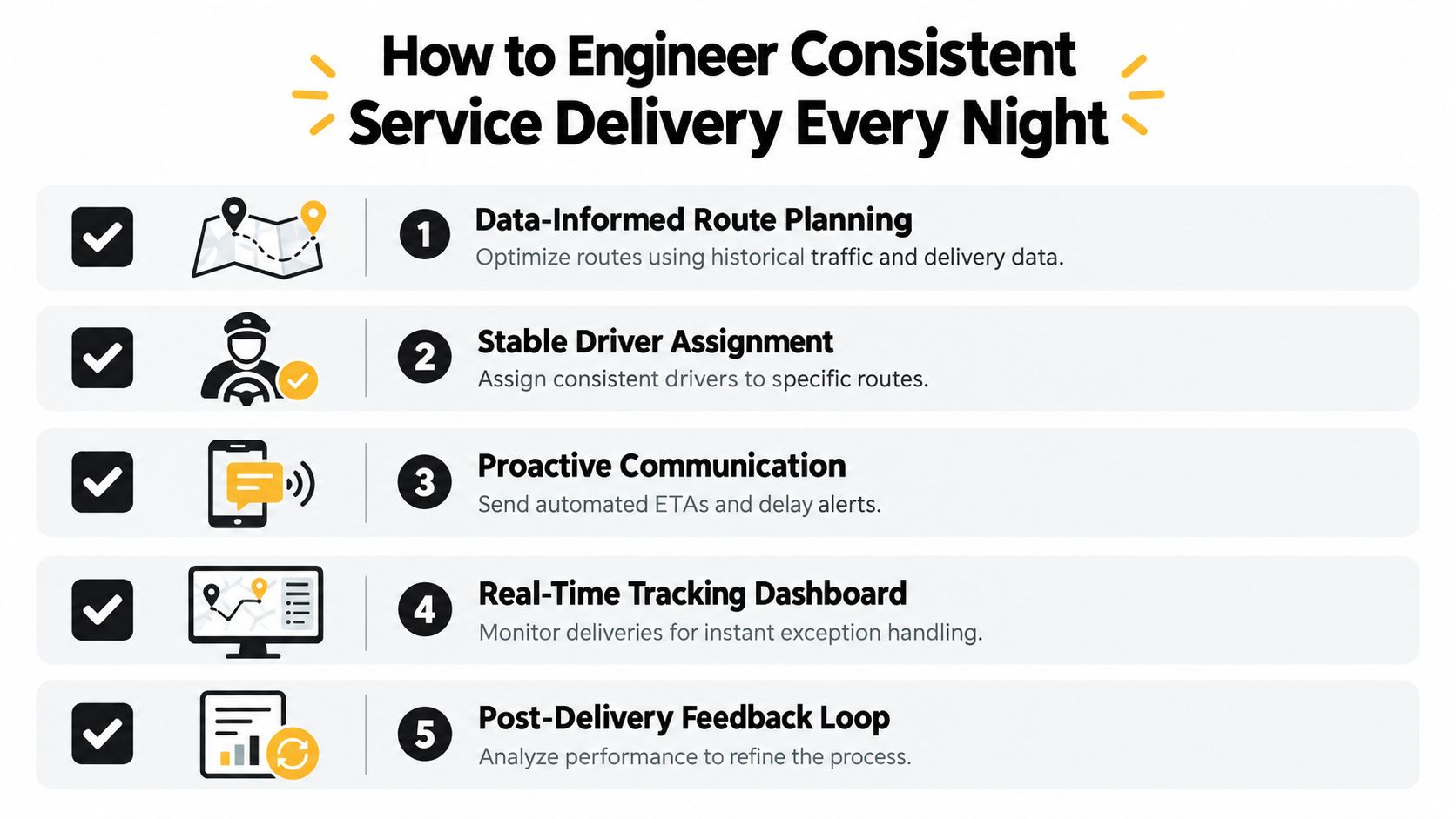
A practical nightly sequence looks like this:
- Confirm readiness: Verify freight, paperwork, equipment, driver assignment, and facility requirements before release.
- Dispatch one plan: Give the driver the route, committed window, escalation rules, and required status events.
- Monitor exceptions: Review departures, dwell, route progress, and changing arrival risk.
- Communicate early: Notify the affected party when a commitment is at risk, not after it has already failed.
- Close the loop: Record the actual outcome, classify the exception, and assign corrective action.
On-time delivery measures whether the correct product reaches the correct location within the agreed window. It also forms part of the broader perfect order concept, which includes completeness, condition, and documentation accuracy. The following video can help teams reinforce why those elements need to work together:
Improve the system, not just the score
A manager should review exceptions by root cause rather than ranking drivers. If several late arrivals begin at the same facility, the issue may be release readiness or dock dwell. If a route performs well only with one person, the process may depend too heavily on individual knowledge.
Use the data to refine lane timing, facility instructions, driver coverage, vehicle readiness, and communication rules. Automation can then handle repeatable status updates and alerts, while people retain responsibility for judgment, safety, and exception resolution.
How Peak Transport Delivers Consistency for Partners and Drivers
Peak Transport applies this engineered approach to Minnesota-based overnight box-truck operations across the Twin Cities metro and surrounding areas. Its recurring routes connect distribution centers, regional hubs, and Amazon Relay nodes through defined lane structures, documented dispatch practices, and data-informed planning.
For shippers and distribution leaders, the operating model centers on predictable departures, clear route standards, accurate handoffs, and performance visibility. The purpose is practical. A driver should know the route and expectations before leaving, dispatch should know which status requires attention, and the receiving facility should have a dependable arrival pattern to plan around.
The same structure supports the driver experience. Peak Transport employs W-2 box-truck drivers, rather than contractors, and offers consistent overnight routes, predictable weekly schedules, paid training, paid sick time, health insurance options, a 401(k) with company match, modern equipment, and clear dispatch communication. Those details matter because a stable schedule and well-supported vehicle give drivers a stronger foundation for safe, repeatable execution.
Professional drivers also need practical information about rest, connectivity, and route conditions. Resources covering best hotspots for truck drivers can help operators think through communication needs on the road, but the core requirement remains an organized dispatch system with clear ownership.
Peak Transport's model reflects a simple principle: middle-mile logistics should be engineered, not improvised. Lane discipline, accurate documentation, preventive maintenance, driver support, and measured performance work together. No single component can create consistency on its own.
For shippers seeking structured overnight middle-mile coverage, Peak Transport offers defined routes and operating support across its service area. For Twin Cities drivers seeking stable W-2 work, it offers a route-focused environment built around predictable schedules, training, benefits, and respectful leadership.
Peak Transport provides structured overnight box-truck operations for shippers that need dependable middle-mile execution and for Minnesota drivers seeking consistent W-2 routes with benefits. Visit Peak Transport to discuss your lane requirements or explore current driving opportunities in the Twin Cities metro.