Driver Compliance Requirements and How to Meet Them
Learn the driver compliance rules for box-truck fleets: hours of service, drug testing, DVIRs, records and CSA. Build an audit-ready program step by step.
November 14, 2026
Your overnight driver reaches the hub on time, but an inspector asks for records and the story changes. The log shows a different truck, the pre-trip report has an unresolved defect, and the license file hasn't been updated. The delivery went right. The compliance system didn't.
Driver compliance works when dispatch, maintenance and records agree before the truck moves. For overnight box-truck operations, that means checking more than whether a driver has hours available. Someone also needs to confirm that the vehicle is released, the driver is qualified, and the records can prove both.
What Driver Compliance Covers for Box-Truck Crews
An overnight box-truck schedule can create a compliance failure before a driver leaves the yard. If dispatch assigns a route without checking which rules apply, or maintenance releases a truck with an unresolved defect, accurate paperwork alone will not make the operation compliant.
Start by determining which requirements apply to the vehicle and trip. Federal rules generally govern covered interstate commercial operations, while Minnesota intrastate operations require a separate state-rule review. Vehicle weight ratings, configuration, cargo and the movement's interstate character all matter. A driver can stay within Minnesota on a leg of a trip that is part of interstate commerce.
A box truck that does not require a CDL may still be subject to federal safety requirements. Document the applicability decision for each truck and route, including any applicable logging exception. A single checklist can miss important differences.
Match each responsibility to a record
| Compliance area | What it governs | Records to keep |
|---|---|---|
| Hours of service | Driving time, duty status and required rest | Electronic records of duty status and backup data under the applicable retention schedule |
| Driver qualification | License class, driving history and medical qualification | Driver qualification file and renewal documentation |
| Drug and alcohol testing | Applicable pre-employment, random, post-accident and reasonable-suspicion testing | Testing program records and results, with restricted access |
| Vehicle inspection | Driver inspections and defect review | Required DVIRs and driver-review certifications |
| Repair and maintenance | Safety-defect correction and scheduled service | Repair certifications and maintenance history |
| Training and supervision | Routes, equipment, safety standards and company procedures | Completion records, assessments and sign-offs |
| Roadside and CSA data | Inspection findings and carrier safety performance | Inspection reports and documented corrective actions |
The record system should connect each assignment to the driver, vehicle and applicable requirements. Electronic records can make those connections easier to review. The FMCSA ELD Oversight Report found that driver inspections citing at least one covered HOS violation declined from 1.19% in December 2017 to approximately 0.77% in December 2021. Standardized records help, but they still need review.
For practical coaching ideas, see fleet safety tips for Atlanta employers. Keep that guidance separate from the Minnesota applicability decision, which depends on the vehicle and trip.
Practical test: Select a truck and its assigned driver. Can someone other than the usual dispatcher find a current record for every applicable row?
Run the test against an actual assignment. Gaps often point to unclear ownership between dispatch, maintenance and whoever maintains driver files.
Hours of Service Limits and Overnight Route Design
| Rule | Limit | Overnight route impact |
|---|---|---|
| Driving limit | Applicable property-carrier driving allowance after qualifying rest | Check available driving time, not just the scheduled shift length |
| Driving window | Applicable elapsed on-duty window | Late loads and hub dwell can consume time without adding mileage |
| Rest break | Required interruption after the applicable accumulated driving period | Plan a qualifying stop rather than hoping the final delivery comes soon enough |
| Weekly limit | Applicable rolling on-duty cap | Review prior work before assigning additional overnight runs |
| Restart | Qualifying consecutive off-duty period under the applicable rule | Confirm eligibility before treating accumulated hours as reset |
These controls operate together. Dispatch needs the driver's actual available hours, the applicable rule set and any valid exception, not a route template that assumes everyone starts with a fresh clock. Use our hours-of-service rules guide when building the lane-specific lookup sheet.
A driver's route review should happen before the freight assignment becomes a commitment.

Design around elapsed time, not mileage alone
Consider a hypothetical overnight assignment that includes loading, travel, a hub wait, unloading and a return movement. The mileage looks manageable, but the loading appointment slips. Dispatch then asks the driver to recover another shipment before returning.
The extra driving isn't the only issue. The original delay has already consumed elapsed time, and the driver may also have accumulated substantial on-duty time earlier in the work cycle. A route that fit at assignment can become infeasible before the truck leaves the yard.
A later departure doesn't necessarily mean a later legal finish. If the driver has already started work, dispatch must assess the clock that's running. Nor should a dispatcher assume that waiting at a facility qualifies as off-duty time; the duty status must reflect the driver's responsibilities.
Electronic logs make those constraints visible. An FMCSA-supported study published in the Federal Register found that equipped trucks had a 53% lower driving-related HOS violation rate and a 49% lower non-driving HOS violation rate than unequipped trucks after controlling for specified operating factors. The sample leaned toward larger for-hire carriers, so treat those results as benchmark evidence, not a promised outcome for a box-truck fleet.
The device records what happened. Dispatch still decides what happens next.
Make compliant work operationally possible
FreightWaves' coverage of the 2025 International Roadcheck reported that HOS violations represented 32.4% of driver out-of-service violations, while false logs accounted for 10.0%. Those findings don't establish the cause of each violation, but they support examining scheduling and recordkeeping together rather than relying exclusively on driver discipline.
Use these route-design changes:
- Budget for facility dwell. Build the schedule from actual loading, staging and unloading experience. An optimistic travel estimate can't compensate for a consistently slow dock.
- Choose the break location before release. Identify a safe, accessible stop and confirm that the planned activity qualifies under the applicable break rule. A delivery appointment isn't automatically a usable break.
- Protect recovery capacity. Assign rescue work only after reviewing the receiving driver's remaining daily and rolling availability. An empty truck isn't proof of available capacity.
- Define handoff authority. Give dispatch a clear way to reassign freight, change an appointment or stop the movement when the original plan no longer fits.
Release a route only when the planned work fits the driver's actual availability with a reasonable operating margin.
That margin has a cost: it may reduce nominal truck utilization. The alternative is selling capacity the driver can't legally deliver.
Electronic Logs, Records and Backup Plans
A registered ELD isn't a permanent guarantee of compliance. Providers can lose registration, devices can fail, and a driver can discover a transfer problem only when an inspector requests records.
The FMCSA ELD frequently asked questions establish that carriers must retain electronic records of duty status and backup data for six months. Device registration and record continuity therefore belong in the same control process: keeping yesterday's logs doesn't solve today's malfunction.
Digitization can create a single point of failure. If access depends on a functioning tablet, an available vendor and a dispatcher who remembers the password, the backup plan isn't ready.
Post a driver-facing fallback procedure
- Verify device status. Before release, confirm the device's registration status through a maintained carrier check and verify that no unresolved vendor notice affects its use.
- Test driver access. The driver should log in, confirm the correct vehicle and duty status, and know how to display and transfer records.
- Escalate the failure immediately. Record the malfunction, discovery time and affected vehicle. Notify dispatch and use the fallback method permitted for that situation, rather than improvising a substitute.
- Preserve the evidence. Save available logs, malfunction messages, support correspondence and unresolved edit information. Don't erase the problem by resetting equipment before preserving accessible records.
- Reconcile after the trip. Review the fallback record against vehicle activity, resolve discrepancies through the proper certification process, and send remaining exceptions to the compliance owner.
A revoked device, a temporary malfunction and a forgotten password aren't interchangeable events. The manager's procedure should identify the governing response for each, including any replacement deadline, rather than giving every driver the same blanket instruction.
Keep retention responsibilities separate
ELD retention shouldn't be folded into a generic employee-folder policy. For the broader personnel schedule, managers can find HR document retention schedules through an outside resource, then maintain a separate transport-record schedule with its own access controls.
The dashboard should show device status, backup-log completion, unresolved edits and unassigned driving. Assign an owner to every exception. A warning that nobody must acknowledge is only a notification, not a control.
Vehicle Inspections and Maintenance Holds
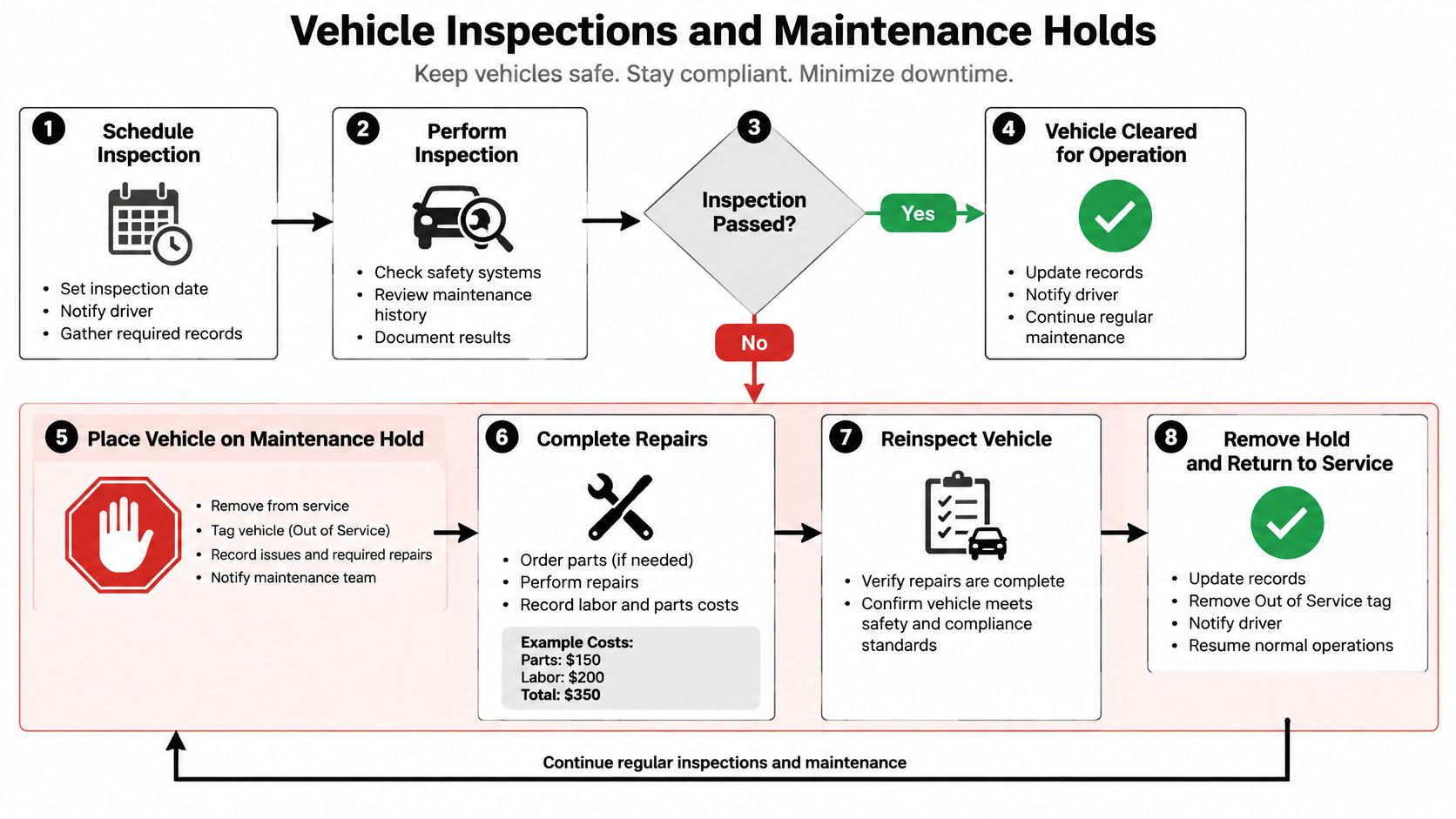
A safety-related defect must be repaired or formally certified as not requiring repair before redispatch. An out-of-service vehicle must remain stopped until the disqualifying condition is corrected.
The FMCSA Safety Planner's inspection and repair guidance specifies returning the roadside inspection report within 15 days to verify correction and retaining the original DVIR, repair certification and driver-review certification for three months. Treat the roadside response and the internal maintenance record as related but separate tasks.
For property-carrying operations, distinguish the duty to inspect and report defects from any applicable exception to submitting a no-defect DVIR. Don't teach drivers that an exception to paperwork eliminates the inspection itself.
The release process should be visible to the people assigning equipment.
Connect each action to evidence
- Capture the defect. The driver records the affected component, symptoms and vehicle identifier during the post-trip process. A photograph can help maintenance distinguish a damaged light housing from a failed lamp.
- Classify the condition. A designated, competent reviewer determines whether it affects safe operation. Uncertain safety conditions stay on hold pending evaluation.
- Block assignment. A safety-related defect triggers a dispatch hold against the vehicle identifier. Put the restriction in the assignment system, not solely in a message thread.
- Document the disposition. Maintenance records the repair or the basis for certifying that repair isn't necessary. A verbal statement that the truck is fine isn't the closure record.
- Authorize release. Clear the hold only after the required certification and driver review are recorded. Dispatch checks release status before assigning the truck.
At Peak Transport, our vehicles are inspected regularly for safety and reliability. Our box-truck drivers also perform pre- and post-trip inspections, load and unload with pallet jacks, and document deliveries. Those duties make it important to check both roadworthiness and the equipment used at the dock.
Don't let urgency override the hold
The difficult moment comes when freight is waiting and the replacement truck isn't. A supervisor needs a documented release, not permission to reinterpret a safety defect because the lane is late.
Start escalation rules with brakes, tires, lights, steering, securement equipment and liftgate systems. Use our vehicle inspection requirements guide to organize the vehicle-specific inspection checklist. Keep the checklist detailed enough to guide an inspection without making it so repetitive that drivers tap through it.
Driver Qualification, Testing and Training Records
At Peak Transport, drivers are W-2 employees, not independent contractors. We own the scheduling, instruction and recordkeeping responsibilities that come with our operating model. Employment status doesn't eliminate a carrier's safety obligations under other arrangements, but it makes our supervisory relationship clear.
The qualification file should answer a practical question: Is this person authorized and prepared to operate this vehicle on this assignment? A hiring approval alone can't answer that after a license expires or an assignment changes.
Separate licensing from other safety obligations
Our box-truck roles require a valid driver's license and a clean driving record; a CDL isn't required for the standard role. If a specific route or vehicle requires a CDL, we state that in the job posting.
Don't use the job title as the legal classification. Review vehicle ratings, configuration, cargo and operating jurisdiction before deciding which licensing, qualification, medical and HOS rules apply. A non-CDL role can still carry commercial-driver obligations.
Build the driver qualification file around verified documents, review dates and assignment restrictions. Keep equipment proficiency records alongside the training evidence so dispatch can distinguish someone hired to drive from someone cleared to use the assigned equipment.
Apply testing and training to the right population
- Testing coverage. FMCSA drug and alcohol testing generally concerns drivers operating vehicles that require a CDL. Don't automatically place every non-CDL box-truck driver in the federal program.
- Program requirements. For covered drivers, address applicable pre-employment, random, post-accident and reasonable-suspicion testing. Check current agency requirements rather than copying another carrier's testing calendar.
- Other obligations. Minnesota law and customer contracts may create separate requirements. Label those accurately instead of describing every company test as federally mandated.
We provide paid training on safety standards, routes, pallet jacks and company procedures. Document the topic, trainer, completion and demonstrated understanding, not just attendance. LeaveWizard's practical compliance training guide for SMEs can help structure the employee-training process without replacing transport-specific instruction.
Use video as a discussion aid, followed by a task demonstration and documented assessment.
Audit Readiness and CSA Monitoring
Total violations and serious violations can move in different directions. A lower inspection count doesn't establish that a fleet's exposure has improved, particularly when more findings can remove drivers from service.
The FMCSA report comparing periods before and after the 2020 HOS changes provides the following comparison. These are historical inspection measures, not a prediction for an individual carrier.
| Measure | Before change | After change |
|---|---|---|
| Average monthly inspections | 260,343 | 233,439 |
| Inspections with at least one HOS violation | 5.6% | 6.3% |
| Inspections with an out-of-service HOS violation | 2.6% | 3.5% |
| Out-of-service HOS share of monthly driver violations | 9.1% | 10.8% |
Track out-of-service findings separately. Otherwise, a dashboard can show fewer total findings while hiding more disruptive failures.
Make the monthly review a retrieval exercise
Use this checklist to test whether records are usable, not merely present somewhere.
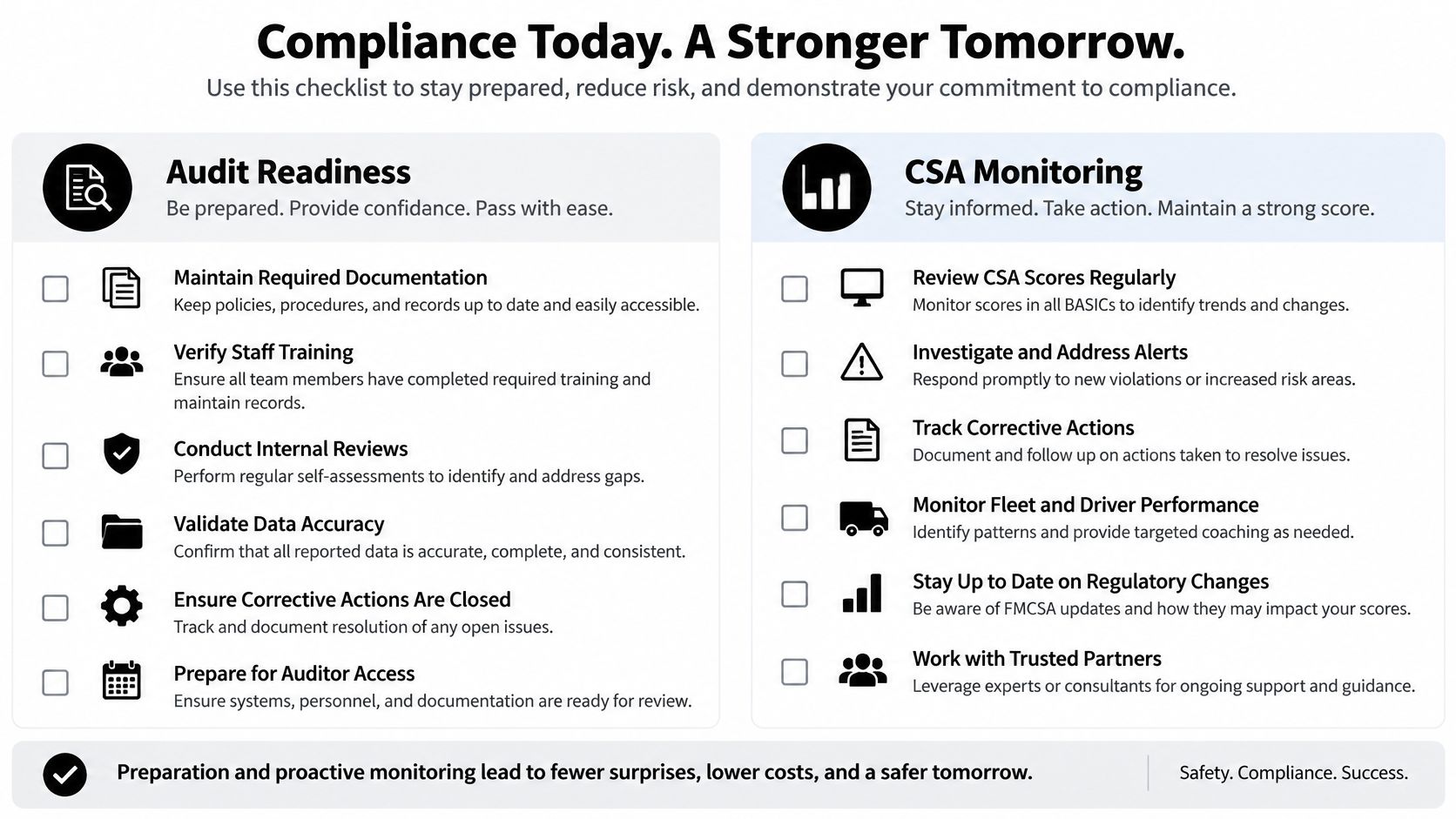
- Driver files. Confirm current documents for everyone assigned to active routes, including relief drivers.
- Logging evidence. Retrieve duty records, backups and explanations for unresolved exceptions.
- Vehicle records. Match reported defects to repair dispositions and release documentation.
- Training evidence. Verify completion and assessment for the equipment and tasks assigned.
- Corrective actions. Record the finding, owner, due date, completion evidence and effectiveness check.
- Inspection review. Compare roadside results with internal findings and confirm that recurring issues have an operational response.
CSA isn't a single universal pass-or-fail score. Review relevant Safety Measurement System categories, including Unsafe Driving, HOS Compliance, Driver Fitness, Controlled Substances and Alcohol, and Vehicle Maintenance. Interpret category information with inspection history and exposure rather than treating a displayed measure as a complete safety assessment.
Monitor what happens before an inspection
Review late dispatch changes, dwell by facility, repeated log edits, unassigned driving, missed inspections and approaching credential expirations. Investigate patterns rather than punishing every exception equally: a cluster of duty-status corrections on the same lane may indicate unclear instructions.
An inspection finding tells you what was discovered. A leading indicator helps you decide where to intervene next.
Give each checklist item a named owner and escalate overdue work to the operations manager. Safety-critical gaps require immediate action, not permission to remain open until the next scheduled review.
Your 90-Day Compliance Build Plan
On the first Monday, select an active overnight truck and its assigned driver. Follow the assignment from qualification approval through route release, inspection, delivery and record storage. Write down every point where someone must ask another person whether the truck can move.
Use the following timetable as an implementation recommendation, not a regulatory deadline.
Establish the operating baseline
- Weeks one and two. Inventory trucks, drivers and lanes. Record the applicable jurisdiction, vehicle classification, licensing requirements and any documented exceptions for each assignment.
- Weeks three and four. Retrieve logging and vehicle records across the applicable retention periods. Time the retrieval process and identify missing access permissions, inconsistent filenames and records held only on individual devices.
Don't begin by buying replacement software. First establish whether the failure is missing information, unclear ownership or an existing system that nobody has configured properly.
Put release controls into daily work
- Weeks five and six. Write the ELD contingency procedure and maintenance-hold workflow. Have drivers and dispatchers practice the exception scenarios, then file their training assessments.
- Weeks seven through ten. Start the scheduled audit review and weekly exception discussion. Assign corrective actions to people who can change the underlying process, including appointment planning and equipment assignment.
- Weeks eleven and twelve. Verify completed actions, resolve aged items and assign ownership for the next operating cycle. Test a relief dispatcher's ability to retrieve records without coaching.
Close the build period by checking whether the changes work during an actual overnight shift. A procedure that depends on an unavailable daytime manager needs another escalation path.
For drivers seeking that kind of structured work, our Truck Driver – Box Truck role is based in Maple Grove, Minnesota. It requires a valid driver's license, a clean driving record, pallet jack operation and overnight availability, with box-truck experience preferred; no CDL is required for the role. Lane operators can use the same build plan to compare their own dispatch, maintenance and documentation controls before selecting a middle-mile partner.
Peak Transport offers structured overnight middle-mile operations in Minnesota and W-2 driving roles with paid training. Visit Peak Transport to discuss your lane requirements or explore box-truck opportunities built around clear expectations, maintained equipment and safety-focused work.