Driver Qualification File Requirements: Audit Checklist
Review the full driver qualification file requirements under 49 CFR 391.51, including retention timelines, an audit checklist, and common failures to avoid.
November 11, 2026
In 2024, FMCSA conducted more than 4,400 carrier audits, up from nearly 2,000 in 2020, according to FreightWaves reporting citing FMCSA data. That pace changes what a driver file has to do. It can't be a hiring folder that someone reconstructs when an investigator calls. It has to prove, driver by driver and date by date, that the person you dispatched was qualified on that day.
That's especially true for non-CDL box-truck work, where many teams wrongly treat the absence of a CDL as the absence of a file. It isn't. The safer test is narrower and more useful. Which Driver Qualification File Requirements apply to this driver, this vehicle, and this type of commerce, and can you produce each record without a search party?
Required Driver Qualification File Documents at a Glance
Under 49 CFR §391.51, you must maintain a driver qualification file for every driver you employ. It's a fixed set of records per driver, not a general personnel folder with a few safety papers mixed in. The federal rule at 49 CFR §391.51 requires the employment application, the motor-vehicle record obtained from the driver's licensing authority, road test documentation or an accepted equivalent, the annual motor-vehicle record inquiry and written review, the annual list or certificate of traffic-law violations, and medical qualification documentation including the medical examiner's certificate or an applicable medical variance, Skill Performance Evaluation certificate, or federal medical exemption.
Build the file in hiring order. Start with the signed application, because it drives every later inquiry. Then pull the initial MVR and send the prior-employer safety inquiries. Don't release the driver until road test and medical qualification are documented. After hire, the file becomes a calendar, with annual MVR reviews, annual violation lists, medical renewals, and Clearinghouse checks where Part 382 applies.
Required documents table
| Required item | Regulatory reference | What the document must show |
|---|---|---|
| Employment application | 49 CFR 391.21 | Completed and signed by the driver, listing employers and driving experience |
| Initial motor-vehicle record | 49 CFR 391.23 | Record obtained from each state licensing authority during pre-employment inquiry |
| Prior-employer safety inquiry | 49 CFR 391.23 | Safety performance history and driving record for the preceding 3 years |
| Road-test certificate or equivalent | 49 CFR 391.31 and 391.33 | Passed road test, or accepted alternative such as a valid CDL or prior-employer certificate |
| Medical examiner's certificate | 49 CFR 391.43 | Current certificate, or variance or Skill Performance Evaluation documentation where applicable |
| Annual MVR inquiry and review | 49 CFR 391.25 | Yearly driving-record inquiry and the carrier's dated written review |
| Annual list or certificate of violations | 49 CFR 391.27 | Driver's required annual list or certificate of traffic-law violations |
| Clearinghouse query records | 49 CFR Part 382 | Electronic drug and alcohol Clearinghouse query results and related screening records |
The application under 391.21 has to be complete enough to support the checks that follow. Names, dates, employers, license history, accidents, violations, and driving experience can't be left vague. If the driver writes "various" for employers or skips a gap, you've got an inquiry problem before you've even started.
The initial MVR under 391.23 is different from the annual MVR under 391.25, even though teams often file them as if they're interchangeable. The first one supports the hiring decision. The annual one supports the continuing decision to keep dispatching that driver. Each annual cycle also needs your written review, not just a fresh printout dropped into the folder.
Practical rule: A document that exists somewhere in email, dispatch notes, or a shared drive isn't in the file until it's indexed to the correct driver and retrievable on request.
You may keep qualification records inside a personnel file, but each driver's records must remain identifiable and retrievable. I wouldn't rely on that arrangement unless the personnel file has a clear per-driver qualification index. Payroll forms, discipline notes, and benefits paperwork bury the records an auditor asks for, and retrieval speed matters when you're pulling multiple files.
Keep drug and alcohol, hours-of-service, training, and general personnel records conceptually separate, even if your software stores them in one driver profile. An auditor should be able to reconstruct qualification without guessing which folder holds the road test or whether a medical card belongs to the current exam cycle.
The retention baseline from that same federal rule is the entire period of employment and for 3 years after the driver leaves the carrier, except where a specific rule provides otherwise. Put that date logic on the file cover sheet from day one. A single missing item fails the file as a set, however clean the driver's record looks. Qualification isn't proven by a good driver. It's proven by a complete paper chain for that driver.
Applying DQ Rules to Non-CDL Box-Truck Drivers
"Non-CDL" does not mean "no DQ file." That's the assumption that creates the most trouble in box-truck operations. Many generic checklists are written as if every regulated driver holds a CDL, so teams either over-collect the wrong records or skip the file entirely for drivers who still need one.
Work through applicability in a fixed order. First, is the person employed to drive for you, or operating under your authority? Second, what's the vehicle's weight rating and configuration? Third, is the operation interstate or intrastate? Fourth, what license class does the driver hold? Only then decide the road-test alternative and the form of medical evidence that belongs in the file.
The Part 391 qualification file rule still centers on core records such as the employment application, initial and annual motor-vehicle-record inquiries, and road-test evidence or an accepted equivalent, while medical documentation differs by driver classification and CDL or CLP medical-status reporting increasingly flows through state licensing systems.
Applicability by case
| Case | Part 391 file applies? | Documents to focus on |
|---|---|---|
| Intrastate-only driver, any vehicle | State rules govern | State commercial driver requirements and the carrier's internal file standard |
| Non-CDL driver, vehicle under 10,001 lb GVWR | No, not a CMV under Part 391 | Carrier's internal file standard; confirm the vehicle's weight rating |
| CDL holder on an interstate run | Yes | Full file, including medical certificate and variance or SPE documentation where applicable |
| Driver with state-held medical record after an out-of-state move | Yes | State licensing record checked before dispatch, with the underlying evidence retained |
The 10,001-pound GVWR line is the one that matters most often for Part 391 coverage of a commercial motor vehicle in interstate commerce. A box truck can sit below CDL thresholds and still be a regulated commercial motor vehicle for qualification purposes. That's the gap. CDL class answers a licensing question. It doesn't answer the whole qualification question.
For a covered non-CDL driver, I'd still expect the application, the initial MVR, prior-employer inquiries, road-test evidence or an accepted equivalent, medical qualification evidence where required, the annual MVR and written review, and the annual violations list or certificate. Don't strip the file down to a license copy and a medical card just because the truck doesn't require a CDL.
Employment status doesn't give you an escape hatch either. Our drivers are W-2 employees, not 1099 contractors, so we keep each file directly and own the deadlines. Leased operators working under a carrier's authority still require carrier-held qualification files. If your name and authority are on the operation, you need to be able to produce the file.
At Peak Transport, a CDL isn't required for our driver roles. A valid driver's license with a clean driving record is sufficient for those roles. That hiring standard doesn't remove the need to test each driver and vehicle combination against Part 391, confirm the weight rating, and decide which records must refresh annually.
For intrastate-only work, check the state rule instead of assuming the federal file either fully applies or doesn't apply at all. Many states adopt similar standards, and your internal standard should be written down so supervisors don't improvise by route. The operational question stays the same for every assignment. Which documents apply here, who reviewed them, and which ones expire next?
Hiring-Stage Documents and Prior-Employer Inquiries
The most common hiring-stage deficiency is boring. It's an incomplete application. Missing employer dates, unexplained gaps, unsigned certifications, and vague driving experience force the reviewer to guess, and guessing is exactly what a qualification file is supposed to prevent.
Treat the application as source data. It should list employers and driving experience in enough detail for you to send inquiries and compare the MVR against what the driver disclosed. If the driver held licenses in more than one state, the application should make that obvious so you don't pull only the current state's record.
What to check before you send inquiries
- Identity consistency: Name, date of birth, and license number match the license and MVR you'll pull.
- Employer history: Each employer is named, with dates specific enough to send a prior-employer inquiry.
- Gap explanations: Every gap is explained in the driver's words, and the reviewer notes whether the explanation is accepted.
- Disclosure match: Accidents, violations, suspensions, and license actions disclosed by the driver are lined up against the MVR once it arrives.
Prior-employer inquiries under 391.23 seek safety performance history and driving record for the preceding 3 years. Send them to every relevant prior employer identified through the application, not only the most recent one. A driver with three short driving jobs needs three inquiries, even if that's administratively annoying.
Say a former employer never replies. That doesn't end the task. Your file should show the dated written request, a second request, and a log of telephone attempts with the name of the person contacted. Add a short note that the inquiry was made in good faith and state what happened. What gets cited isn't usually the former employer's silence. It's your failure to prove you asked.
A blank space where a prior-employer response should be tells an auditor nothing. A dated attempt log tells the whole story.
Employment gaps deserve the same discipline. Don't accept "unemployed" with no dates if the surrounding history is unclear. Have the driver account for the period on the application or a signed supplement, then record the reviewer's conclusion. You're not building a biography. You're closing holes that would otherwise hide an unlisted driving job.
If you collect signed applications electronically, control the signed copy like a compliance record, with restricted access, a clear retention rule, and a way to prove the version you kept is the version the driver signed. Good encryption and retention for signed documents keeps a clean hiring packet from becoming an unsearchable scan in someone's inbox. Our own hiring sequence is laid out in our guide to the truck driver onboarding process, which is useful if you're comparing your intake steps against a structured box-truck workflow.
A complete hiring packet has four visible elements. First, the signed and dated application. Second, inquiry responses or a documented attempt log for each prior employer. Third, the initial MVR tied to the correct licensing authorities. Fourth, a reviewer's dated sign-off showing who checked the packet and whether the driver can move forward.
Don't let dispatch urgency convert a pending packet into an informal approval. If a record is outstanding, the file should say so, name the owner, and show the follow-up date. "We're waiting on it" is a status only when it's written, dated, and assigned to a person.
Road Tests, Medical Certificates and Verification Records
A road test under 391.31 proves the driver can operate the type of vehicle you'll assign. File the signed certificate with the driver's name, test date, vehicle type tested, pass result, and the examiner's name. If you rely on an accepted equivalent under 391.33, such as a valid CDL or a prior-employer certificate, file that evidence in the road-test slot so the reviewer doesn't have to infer it from a license copy elsewhere.
For box-truck work, don't treat the road test as a quick lap around the lot. The test should reflect the vehicle and the work. Backing, turning clearance, dock approach, mirror use, load securement awareness, and pre-trip habits matter more than a smooth drive on an empty road. If the driver will run overnight routes, the examiner should also note basic fatigue and route-readiness concerns through your normal safety process, even though the certificate itself stays focused on the test result.
Medical qualification is where generic checklists now mislead people. Commercial drivers generally undergo a medical examination at least every 24 months, carriers must retain medical-certification evidence, and the examiner's National Registry of Certified Medical Examiners status must be verified, while FMCSA guidance states that for many medically qualified CDL and CLP holders medical certification is transmitted electronically to state driver-licensing agencies, as explained in FMCSA Safety Planner guidance.
That creates the key control question. Is the authoritative record the paper medical card in the folder, the state licensing record, or both for this driver class? Answer it before dispatch, not after a route is assigned. Our breakdown of DOT medical certification covers the driver-facing side of staying current.
Verification steps that should be visible
- Confirm the exam date and expiration date from the medical evidence, and enter both in the driver-level calendar.
- Verify the examiner against the National Registry and keep a dated verification note with the examiner's name.
- Check the state licensing record where electronic CDL or CLP medical status applies, and document the date and result of that check.
- Resolve mismatches before dispatch when the card, the state record, and your file don't agree.
Deadlines around the rest of the file reinforce the same point. FMCSA Safety Planner guidance states the initial MVR must be placed in the file within 30 days after employment begins, an updated MVR must be obtained at least once every 12 months and reviewed for minimum safe-driving requirements and disqualifying offenses, previous-employer inquiries cover the preceding 3 years, and since January 6, 2020 employers have had to conduct electronic Clearinghouse queries and traditional manual inquiries with previous employers for applicable drug-and-alcohol screening obligations.
Build exception handling into the medical workflow. Variances and SPE certificates need their own expiration tracking, not a note buried under the medical card. Out-of-state moves can create a lag between the exam and the state record you check. A driver may also present a current card while the state system still shows an older status. In that case, keep the underlying medical evidence, document the state check, escalate to a named compliance owner, and don't dispatch on an assumption.
I would keep a simple medical verification line on the file checklist with three fields. Evidence retained. Registry verified on this date. State record checked on this date, where applicable. That small discipline prevents the most dangerous error, treating a photocopied card as proof that every connected system agrees.
Acceptable Documentation Samples
Use samples to train reviewers, because "complete the form" means different things to different people. A good sample shows the exact fields, dates, and signatures that make a record acceptable. It also shows what to reject before the driver is released.
Sample standard for each record
- Employment application: Signed and dated, with each employer listed by name, dates, and reason for leaving. Driving experience is shown by equipment type, and every employment gap is explained in the driver's words.
- Initial MVR: State record showing the issuing state and the date obtained. The reviewer adds initials and the placement date, which must fall within the required hire window.
- Prior-employer inquiry log: First request date, second request date, each telephone attempt with the name of the person contacted, the response or no-response note, and a short good-faith statement signed by the person who made the inquiry.
- Road-test certificate: Driver name, test date, vehicle type tested, pass result, and examiner name and signature. If an equivalent is used, the sample shows the accepted document filed in place of the certificate, with a note identifying it as the equivalent.
- Annual MVR review note: Review date, reviewer name, the decision to keep dispatching or escalate, and the reviewer's signature. A sample escalation note names the issue found and the action taken.
- Annual violations list or certificate: Signed statement for the year listing traffic-law violations, or a signed note that no violations occurred. The year covered must be clear from the document itself.
- Medical certificate with verification record: Current medical evidence plus a National Registry verification record showing the examiner's status and the date checked. Where state electronic status applies, the sample also shows the state-record check date.
- Clearinghouse query result: Query date, result, and the reviewer's note on the outcome. If the result requires action, the note states the next step and who owns it.
Keep one clean sample packet with personal details redacted. New coordinators learn faster from a finished packet than from a regulation summary, and supervisors make fewer judgment calls when they can compare a questionable record against an accepted one.
Don't let samples become templates that people copy without thinking. The dates, states, vehicle types, and reviewer decisions must come from the actual driver in front of you. A sample teaches form. The file still has to tell the truth.
Retention Timelines and Recurring Compliance Deadlines
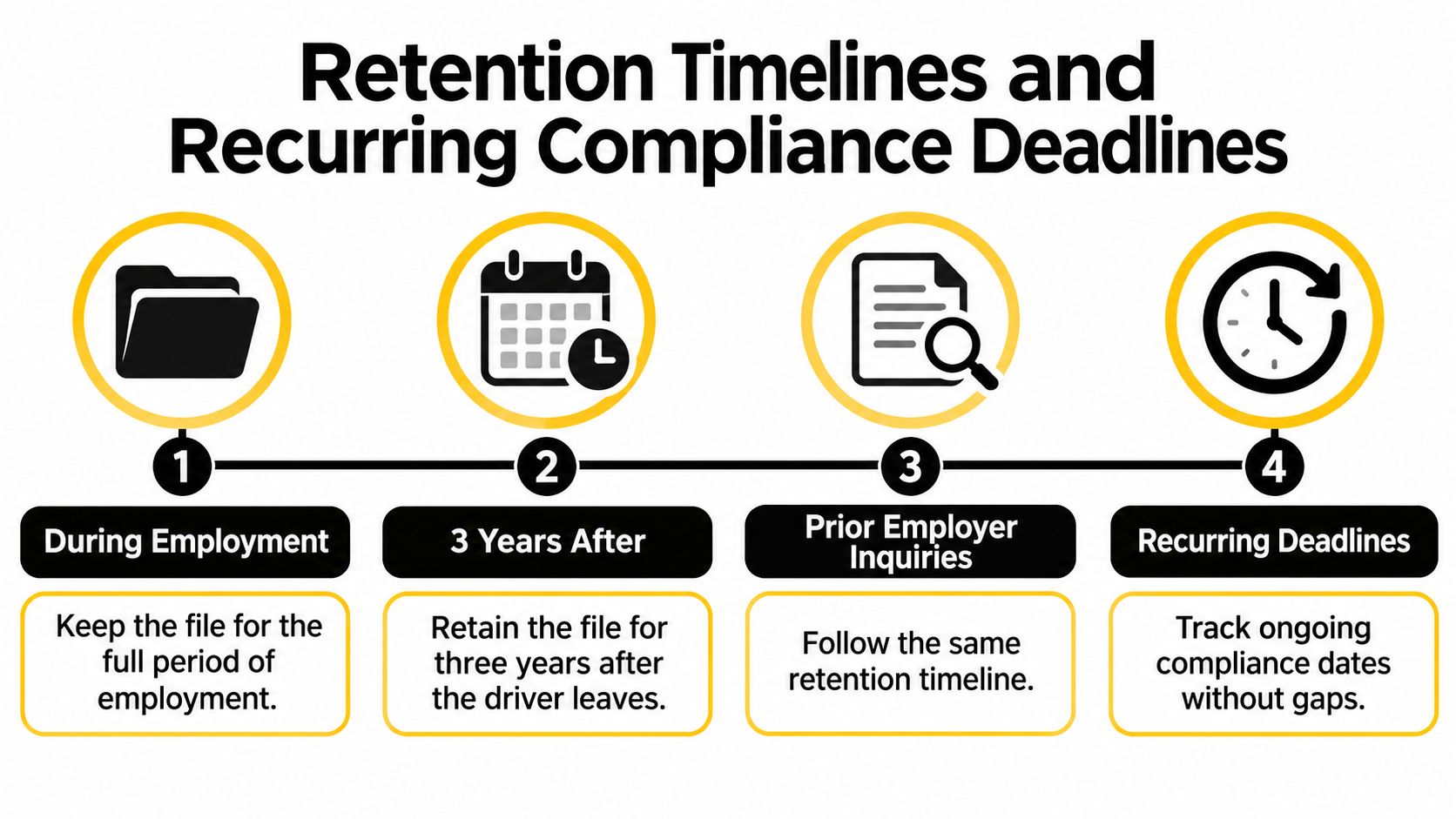
Retention fails when teams remember the general idea but not the driver-specific date. The control is a dated record; a memory of when someone thinks a task was done proves nothing in an audit. Build one expiration calendar per driver and make dispatch status depend on it.
The sequence below shows how the retention period and the recurring deadlines fit together.
Milestones for the driver calendar
| Milestone | Deadline | Retention period |
|---|---|---|
| Employment application and hiring records | Before the driver operates a route | Employment plus 3 years |
| Initial MVR placed in the file | Within 30 days after employment begins | Employment plus 3 years |
| Prior-employer safety inquiry | At hire, with attempts documented | Employment plus 3 years |
| Annual MVR inquiry and written review | At least every 12 months | Employment plus 3 years |
| Medical examiner's certificate and verification record | Generally every 24 months for drivers who must be medically certified | Employment plus 3 years |
| Clearinghouse query | Before hire and annually | 3 years from the query date |
| Driver leaves the carrier | Start of the three-year retention clock | 3 years after departure |
Start the calendar at hire, not at the first annual review. Enter the application date, the initial MVR placement date, prior-employer inquiry dates, road-test date, medical expiration, and the first annual review target. Then set alerts early enough for the driver to complete an exam, sign a violations list, or correct a record before the deadline becomes a dispatch problem.
The medical line deserves two entries, not one. The certificate expiration is the visible deadline. The verification trail is the quieter one: the National Registry check, or the state electronic status check where that applies, carries its own date and belongs in the calendar so the record stays provable. A card with no verification behind it reads as current until an auditor asks who confirmed the examiner's status.
Annual items need their own anniversary logic. If you pull the annual MVR late one year, don't push every future year later without a reviewer seeing the drift. The calendar should show the required cycle, the actual completion date, and any overdue status in plain language a supervisor can't misread.
None of this changes because the driver is non-CDL. A box-truck driver hired on a valid license and a clean driving record still generates inquiry dates, review anniversaries, and a retention clock. The calendar doesn't care which license class sits on the front of the file.
For departures, close the file deliberately. Record the last employment date, calculate the retention end date, restrict editing, and keep the file retrievable for the full post-employment period. Don't delete "old" annual reviews or inquiry logs during a system cleanup just because the driver is inactive.
Calendar discipline: Every expiration needs an owner, an alert date, and a dispatch consequence. A reminder nobody owns is just decoration.
The same discipline runs through broader logistics documentation, because qualification files sit inside a wider record system. Route paperwork, inspections, and delivery records have their own controls, but the principle holds: name the record, date it, assign it, and make it findable.
Review the calendar weekly for active drivers. Sort by the next expiring item across the whole roster rather than alphabetically by driver. That view exposes the medical renewal due next Tuesday and the annual review that slipped last month, which is exactly what a coordinator needs before routes are built.
Common Compliance Failures and How to Fix Them
Most cited failures aren't exotic. A required record exists, but it's late, unsigned, expired, or filed outside its window. Timing is the weakness, so the fixes have to control dates and signatures rather than telling people to be careful.
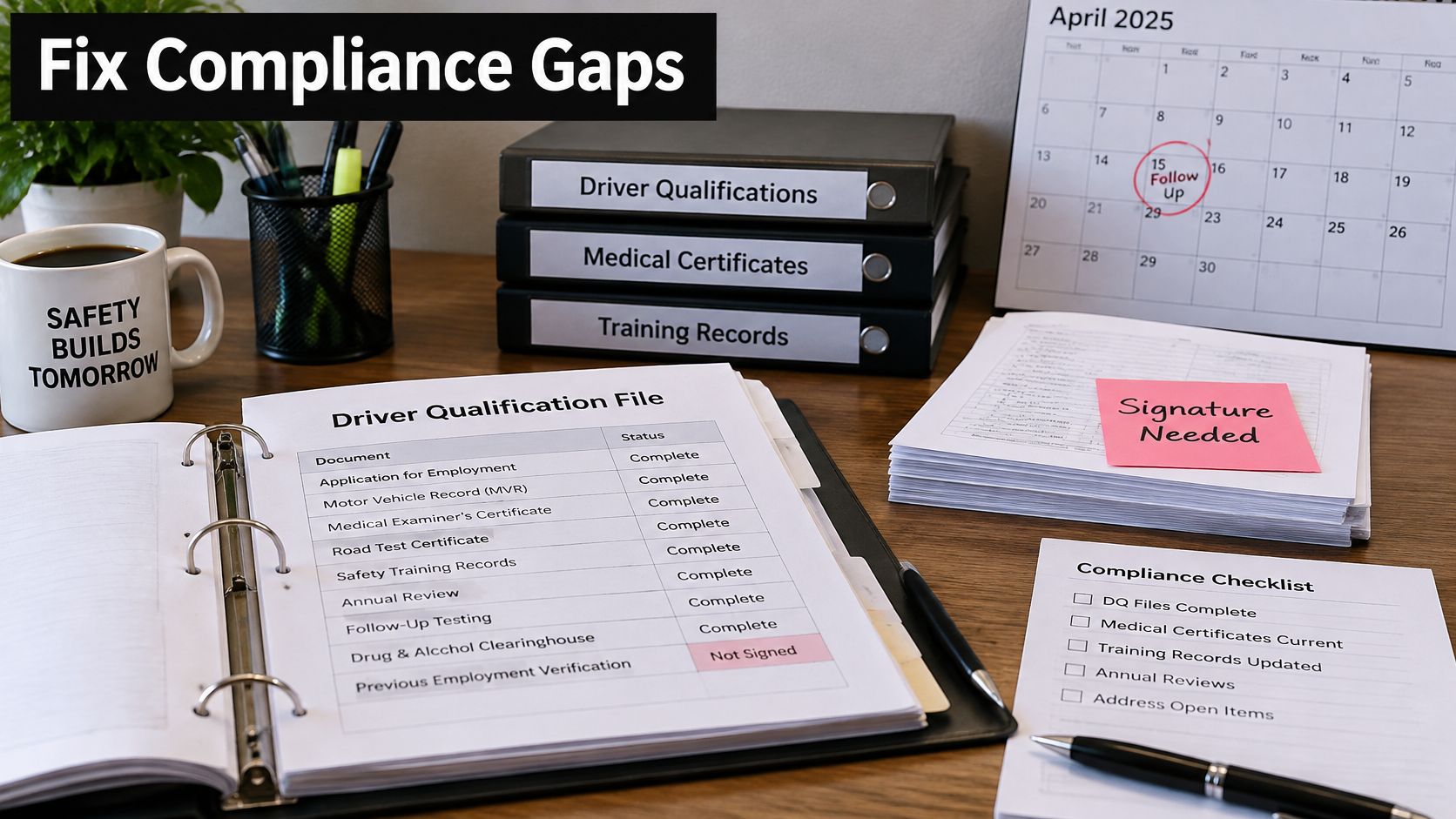
This desk setup shows the basic tools that keep those dates visible, a driver file, a checklist, and a calendar in one place.
Failure patterns and controls
| Failure | Why it is cited | Fix |
|---|---|---|
| Annual MVR review missing or unsigned | Annual cycle lapsed without a written review | Expiration calendar with alerts and a dated, signed review per driver |
| Expired medical certificate in the file | Driver operated after the expiration date | Expiration dashboard and dispatch block until a current certificate is on file |
| Prior-employer inquiry with no attempt log | No proof of a good-faith inquiry | Dated request log with follow-ups and the name of the person contacted |
| Initial MVR placed after 30 days | Late placement of a required hiring record | Hire-stage checklist that gates release until the MVR is filed |
| Road-test certificate missing or unsigned | No evidence the driver was tested | Retain the original signed certificate or accepted equivalent |
| Driver records mixed with personnel files | Records cannot be produced on request | Per-driver qualification index linking each required record |
| Electronic medical status accepted without check | Reliance on an unverified state record | Verify the state licensing record before dispatch and document the check |
The expired medical certificate deserves a hard stop. If the expiration date has passed, the driver doesn't run while someone "checks on it" during the shift. Pull the driver from dispatch, verify current status through the correct record for that driver class, and document the decision. A short route disruption is cheaper than defending a dispatched run with an expired qualification.
The annual MVR without a written review is subtler. Pulling the record proves you obtained it. The dated review proves a person evaluated it and decided the driver remained qualified. Auditors cite the gap because the file can't show who made that judgment or when.
The video below is a useful visual walk-through to pair with your own checklist, especially when training a new coordinator on how the pieces fit together.
For mixed personnel files, don't reorganize by moving paper around and hoping. Create a per-driver qualification index that lists each required item, its date, its location, and its next due date. Then test retrieval. Ask someone who didn't build the file to produce the road test, current medical evidence, latest annual review, and prior-employer log. If they can't do it quickly, the system fails even if the documents technically exist.
Cited deficiencies appear in your audit results, so treat each fix as a standing control. A one-time cleanup before an expected review may repair old files, but it won't stop the next annual review from slipping. Gates, dashboards, attempt logs, and dispatch blocks are what keep the same citation from coming back.
Audit Checklist and Pre-Route Release Steps
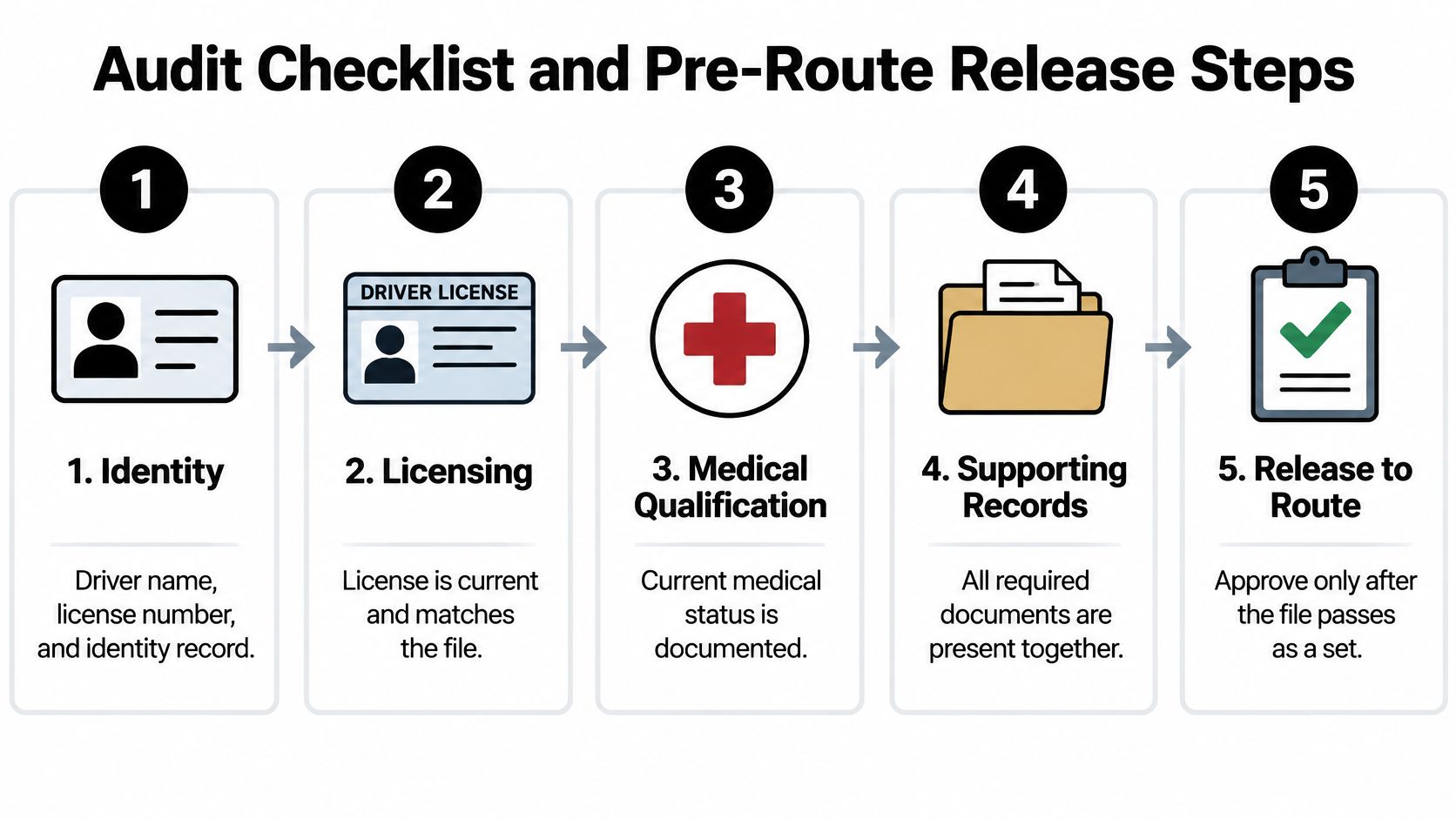
Auditors test each file as a set. They don't grade your intentions, and they don't average a strong application against a missing annual review. Work the file in the same order a reviewer will, identity first, then hiring, qualification, recurring items, and retention.
The checklist graphic below mirrors that sequence from identity and licensing through final route release.
Five review groups
1. Identity. Confirm the driver's name, license number, and date of birth match across the application, MVR, road-test certificate, medical evidence, and violations lists. A middle initial mismatch may be harmless, but a different license number stops the review until you explain it in writing.
2. Hiring. Check that the application is complete and signed, prior-employer inquiries show responses or dated attempts, and the initial MVR was placed within the required window after hire. Look for gaps between the hire date and the first dispatch date. If the driver operated before the packet was approved, the file should not pretend otherwise.
3. Qualification. Verify the signed road-test certificate or accepted equivalent is present and matches the vehicle type assigned. Confirm medical qualification is current, the examiner's National Registry status is documented, and any variance or SPE record is current where it applies.
4. Recurring items. Line up each annual MVR, dated written review, and annual violations list or certificate by year. Missing one year in the middle is still missing, even if the most recent year is perfect. Check that reviews are signed by an identifiable reviewer, not stamped with a department name.
5. Retention. Confirm the file is labeled with employment dates, departure date where applicable, and the retention end date. Then test production speed. A complete file that takes hours to assemble from separate systems is operationally weak.
Pre-route release steps
- Check the file item by item against the required-documents table for that driver's classification.
- Confirm every date against the milestone calendar, including the next annual review and medical expiration.
- Verify medical status against the National Registry documentation and, where applicable, the state licensing record.
- Sign and date the release decision with the reviewer's name, and record any exception that blocks dispatch.
- Enter every expiration date in the calendar with alerts set before annual reviews and medical renewals.
- Re-run the check at each annual cycle and after any license-class change, suspension, medical-status change, or move to a new licensing state.
For our Truck Driver, Box Truck role, the release decision also sits beside job-specific readiness. The role requires a valid driver's license, a clean driving record, pallet jack operation, and overnight availability, and box truck experience is preferred. We provide paid training on our safety standards, routes, equipment such as pallet jacks, and company procedures. Training signoffs don't replace qualification records, but they should align with the same driver record so a supervisor sees one coherent readiness picture.
Approve the driver only after the file passes as a set. A route assignment is not evidence of qualification.
Run sample self-audits on a regular cycle. Pull a mix of new hires, long-tenure drivers, non-CDL drivers, and anyone who recently changed licensing states or medical examiners. If the same item fails in several files, fix the intake or renewal process rather than patching files one at a time. A file that passes this sequence without explanation is the standard. Anything else depends on someone being available to explain it, and that person may not be there when the auditor asks.
If you're a box-truck driver who wants predictable overnight routes with a carrier that treats qualification, training, and documentation as part of the job rather than paperwork after the fact, visit Peak Transport to see current W-2 opportunities in the Twin Cities area. You'll find paid training, structured dispatch, and clear expectations before your first route, not surprises after it.