Equipment Reliability for Box Truck Fleets
Equipment reliability for box-truck fleets: the MTBF, MTTR, and uptime numbers that keep Minnesota overnight lanes on time.
October 29, 2026

A completed preventive-maintenance schedule doesn't prove a box truck is reliable. The useful test is whether it completes its assigned overnight route without an unplanned stop, roadside repair, or out-of-service order, and whether repeat defects and missed handoffs decline.
A Twin Cities truck can look ready at dispatch, then fail a lamp or brake check after the driver's on the clock. The maintenance record may show the service was completed on time, but the lane still needs a replacement truck, the driver's hours are already ticking, and the hub connection is at risk. That's why equipment reliability is route availability, not shop paperwork.
What Equipment Reliability Means on an Overnight Run
Equipment reliability is the chance that one identified truck completes its assigned middle-mile trip without an unplanned stop, roadside repair, or out-of-service order. A dispatcher can act on three practical equipment states: safe and available, degraded but still legal, or down. The first can take the lane, the second needs a documented decision and due date, and the third can't be dispatched.

A fixed overnight lane is less forgiving than flexible daytime work. If a defect surfaces just before a hub handoff, the truck may lose its appointment, the driver may spend hours waiting or recovering freight, and dispatch may need to send a spare across the metro. The defect can be small; the disruption isn't.
In 2025, 67% of surveyed maintenance organizations reported taking a reactive approach to maintenance, according to L2L's downtime survey as reported by RapidEye Inspections. A calendar sticker can coexist with breakdowns when service tasks don't address the failure mode or the repair doesn't hold. A closed preventive-maintenance work order is evidence that work was recorded, not that the truck will complete its route.
Reliability means a result the dispatcher can use
A useful scorecard ties maintenance to lane outcomes: whether trucks were available and safe, which components repeatedly failed, how long repairs stayed open, and whether roadside defects or repair time are rising. The scorecard should also help answer a practical dispatch question: Can this specific truck take tonight's run safely, or should the lane get a spare?
The maintenance test is whether scheduled care leads to fewer failures and less route downtime, not whether every planned service was checked off. Predictive alerts are useful only when they lead to a clear decision before departure. Inspection findings must make it to maintenance, repairs must be verified, and unresolved safety defects must keep the truck out of service.
For planners, the first move can be simple: post a weekly scorecard with the out-of-service rate, the worst-performing subsystem, and the oldest deferred repair. That gives dispatch and maintenance a shared view of equipment readiness before the next wave.
The Metrics That Show a Box Truck Is Reliable
| Metric | What it measures | Benchmark | If it slips |
|---|---|---|---|
| Uptime | Scheduled hours the truck is available and safe, divided by scheduled hours | Compare with the lane's own recent baseline | Cover the lane with a spare and find the missed-night cause |
| MTBF | Miles or engine hours between failures of one subsystem | Track brakes, tires, lamps, liftgate, and emissions separately | Investigate the subsystem with the shortest interval |
| MTTR | Clock time from defect report to a passed post-repair check | Safety defects cleared before the next dispatch; noncritical items inside the gap between waves | Pre-stage parts or swap the truck |
| Vehicle out-of-service rate | Out-of-service inspections divided by inspections | Cited national average 21.2%; a weak review example reached 40.5% | Treat a rising rate as a maintenance-system failure |
| Repeat defects by component | Same fault returning on the same truck or subsystem | Falling count after the repair | Redo fault isolation before another part swap |
| Deferred-repair age | Days a noncritical defect stays open | Due before the next overnight wave | Escalate, and block dispatch if it becomes safety-critical |
| Roadside defects per 10,000 miles | Defects found outside the shop, scaled to mileage | A falling quarter-to-quarter trend | Audit the last pre-trip and the repair record |
The formulas matter because they point to different actions. Uptime is scheduled hours when the truck is both safe and available divided by scheduled hours; if a truck misses one night of a five-night lane, that's a 20% hit to its weekly lane availability. MTBF should be calculated by subsystem, not as one blended fleet number. A high average can hide a recurring lamp failure that keeps one truck from leaving the yard.
For a practical explanation of how to calculate mean time between failures, use this guide to measuring equipment reliability with MTBF. Keep the unit consistent for each subsystem, such as miles for tire failures or engine hours where that better reflects component use. MTTR should run from the electronic defect report to a passed post-repair check, not just the technician's hands-on time. A repair completed quickly but waiting for parts, verification, or dispatch clearance still keeps the truck unavailable.
Treat roadside results as a maintenance signal
FMCSA's Vehicle Maintenance BASIC guidance covers requirements under 49 CFR Parts 392, 393, and 396, including brakes, lamps, reflectors, tires, load securement, and correction of mechanical defects. In one FMCSA compliance review, inspectors found maintenance violations on 10 of 11 inspected truck-tractors and out-of-service violations on 8. The carrier's vehicle out-of-service rate was 40.5%, compared with a cited national average of 21.2%.
That's why roadside performance is best treated as a lagging indicator of maintenance-system quality, not just a compliance score. Defects that accumulate between inspections can turn into a roadside repair, a missed handoff, or a safety exposure.
Block dispatch whenever a safety-critical defect remains open. Give noncritical items a dated repair commitment before the next overnight wave. In the weekly review, check the out-of-service rate first, then the subsystem with the shortest MTBF, then the oldest deferred repair.
How to Test Whether Maintenance Prevents Failures
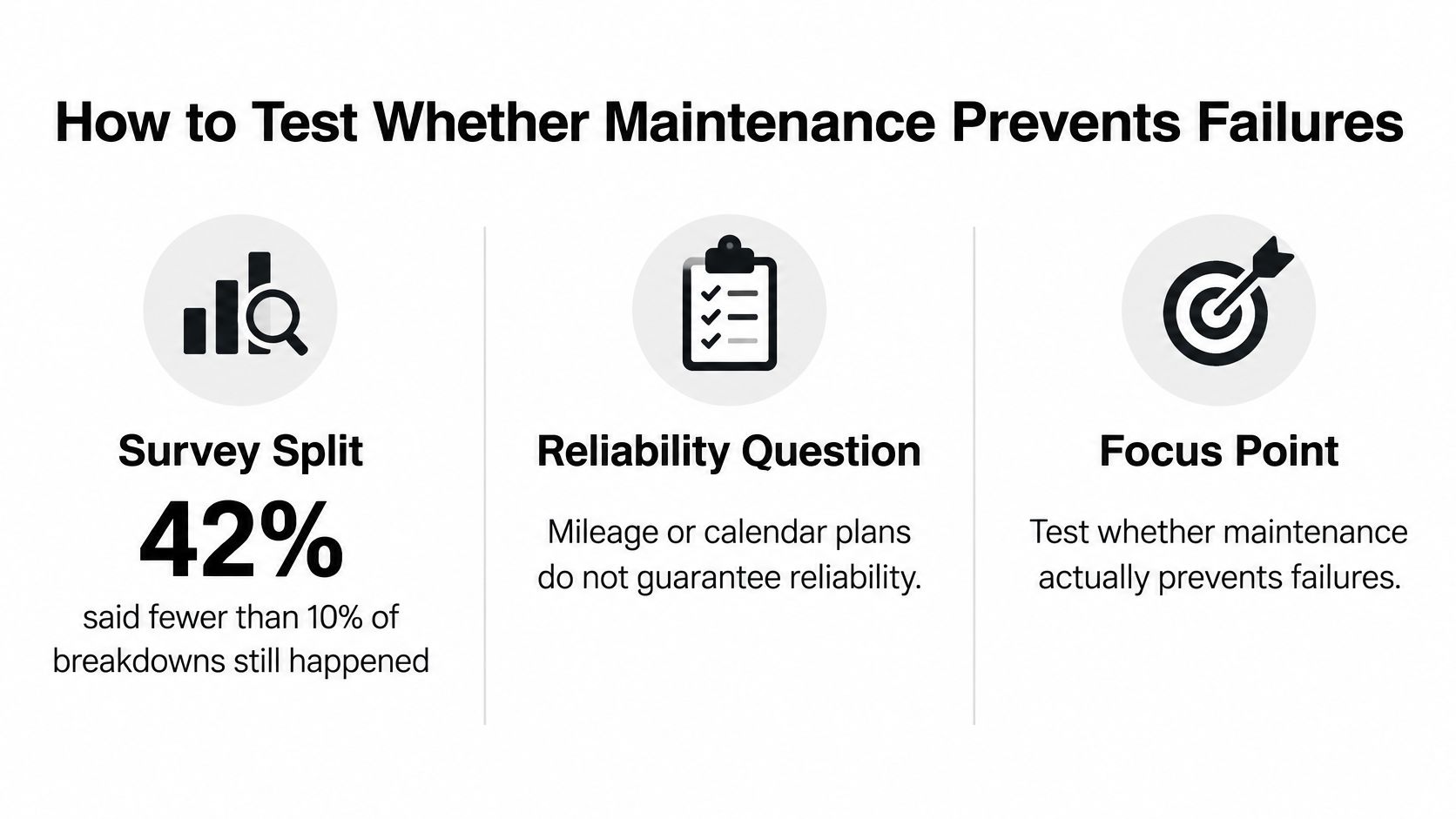
On-time preventive maintenance doesn't automatically mean breakdowns are being prevented. In a recent fleet survey, 42% of respondents said fewer than 10% of breakdowns occurred despite maintenance efforts, while 36% said 10–59% still happened and 20% said more than 60% occurred despite regular upkeep, according to the fleet survey published by FreightWaves. The under-10% band is the only result in that split that supports calling the maintenance program effective at preventing failures.
Test the route outcome, not the work-order total
Use a compact set of measures alongside the scorecard: failure recurrence, unscheduled-repair rate, downtime per scheduled route, repeat fault codes, and whether the truck passed a functional check after repair. Those measures show whether maintenance changes what happens to a truck after it leaves the shop.
The same survey reported that 36% of fleets had 6–15% of vehicles down at any time, while only 4% could return a failed vehicle to service within one hour. For an overnight box truck, a tire, brake, lamp, or emissions fault found at dusk can cancel a lane, strand driver hours, and require a recovery trip the next morning. A shop completion percentage misses that chain.
For each inspection finding or telematics alert, record whether the route was completed, swapped, or missed. If a lamp defect leads dispatch to swap a spare and the original truck returns only after a verified circuit repair, the record should preserve both the defect and the route outcome. If the same fault returns, the repair didn't prove that the underlying problem was fixed.
Test the outcome: “Well maintained” should mean fewer disruptions, not just completed service entries.
If unscheduled repairs stay above 10% after services are completed on time, change the maintenance interval or investigate the failure mode. Don't respond by buying more schedule compliance. Ask whether the interval matches actual use, whether the technician isolated the cause, and whether the post-repair check tested the component under the conditions that triggered the defect.
How to Close the Inspection to Repair Loop
A defect report is useful only if it leads to a verified repair and a dispatch decision. For a lighting fault found before an MSP-area overnight handoff, use a same-shift process rather than leaving the report for the morning crew.
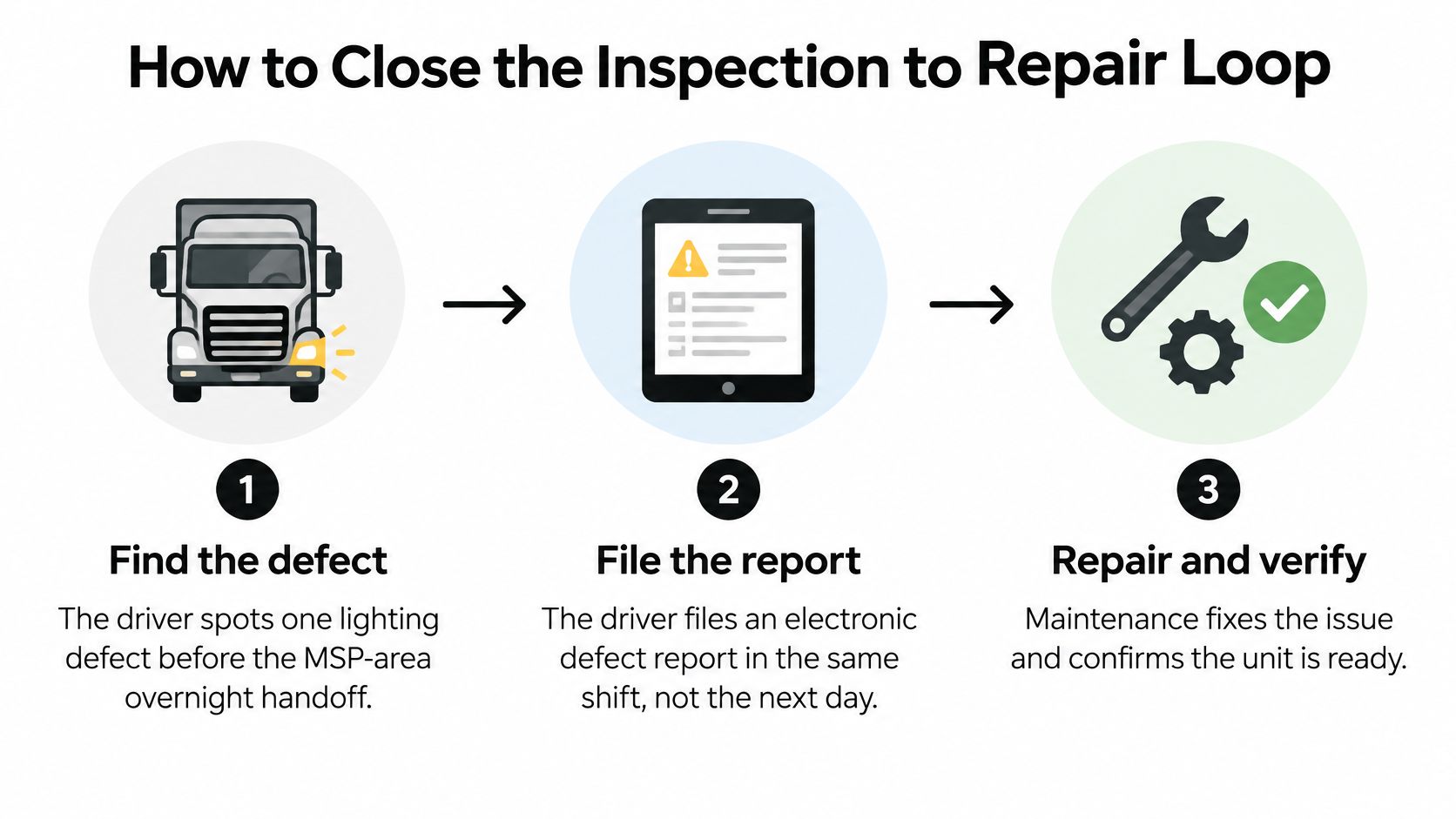
Driver files the defect in the same shift. The report should identify the truck and describe which lamp or circuit failed. The driver shouldn't rely on a verbal handoff to dispatch or the shop.
Maintenance triages before the next dispatch. Mark the issue safety-critical or noncritical with a specific due date. If the truck can't safely take the lane, dispatch assigns a spare rather than treating a repair plan as clearance.
The technician isolates the fault. Check the circuit and likely connection points before replacing a lamp or other part. A part swap that doesn't address the failure can send the truck back with the same defect.
Record parts against the vehicle. The parts history helps the next technician identify whether the same component or fault has returned.
Verify the repair. Test the circuit and document that it works before offering the truck to dispatch again.
Keep a repair record that supports analysis. Store the vehicle ID, mileage or engine hours, defect code, component, failure mode, repair action, technician, parts used, and post-repair test result. That information lets managers calculate subsystem MTBF and identify recurring lighting, tire, brake, refrigeration, or liftgate problems.
Keep federal deadlines as the floor
FMCSA's roadside-inspection guidance requires a driver to deliver a roadside inspection report to the motor carrier within 24 hours. If the vehicle is declared out of service, the defect must be corrected before it operates again, and the carrier must sign and return the completed report within 15 days. Federal guidance also requires a periodic inspection at least once every 12 months for each commercial vehicle.
Those are regulatory deadlines, not an overnight fleet's ideal response time. Set tighter internal targets: same-shift electronic reporting, maintenance triage before the next dispatch, and documented verification after repair. For practical guidance on vehicle inspection requirements, make sure the driver's inspection process and the shop's repair record connect rather than living in separate systems.
| Item | What to check | Urgency | Dispatch rule |
|---|---|---|---|
| Brakes | Stopping ability, leaks, warning lamp, and obvious defects | Safety-critical | Block dispatch until a functional check passes |
| Lamps and reflectors | Headlamps, stop, turn, markers, and reflectors | Safety-critical | Swap a spare for that wave and prove the circuit before return |
| Tires | Tread, inflation, damage, and mismatches | Safety-critical | Don't send the lane on that truck |
| Load securement | Doors, locks, and cargo restraint | Safety-critical if the load can shift | Correct before departure |
| Liftgate | Full cycle, leaks, and controls | Noncritical unless the freight needs it | Date the repair before the next night or swap |
In the lamp example, dispatch swaps a spare for that night's handoff; the original stays down until the circuit passes its functional check. The fault then feeds the truck's lighting history and subsystem MTBF. Repeat defects often point to incomplete fault isolation, lost parts history, or a missing functional test. A truck with an open safety defect isn't a spare.
When a Predictive Alert Should Change the Dispatch
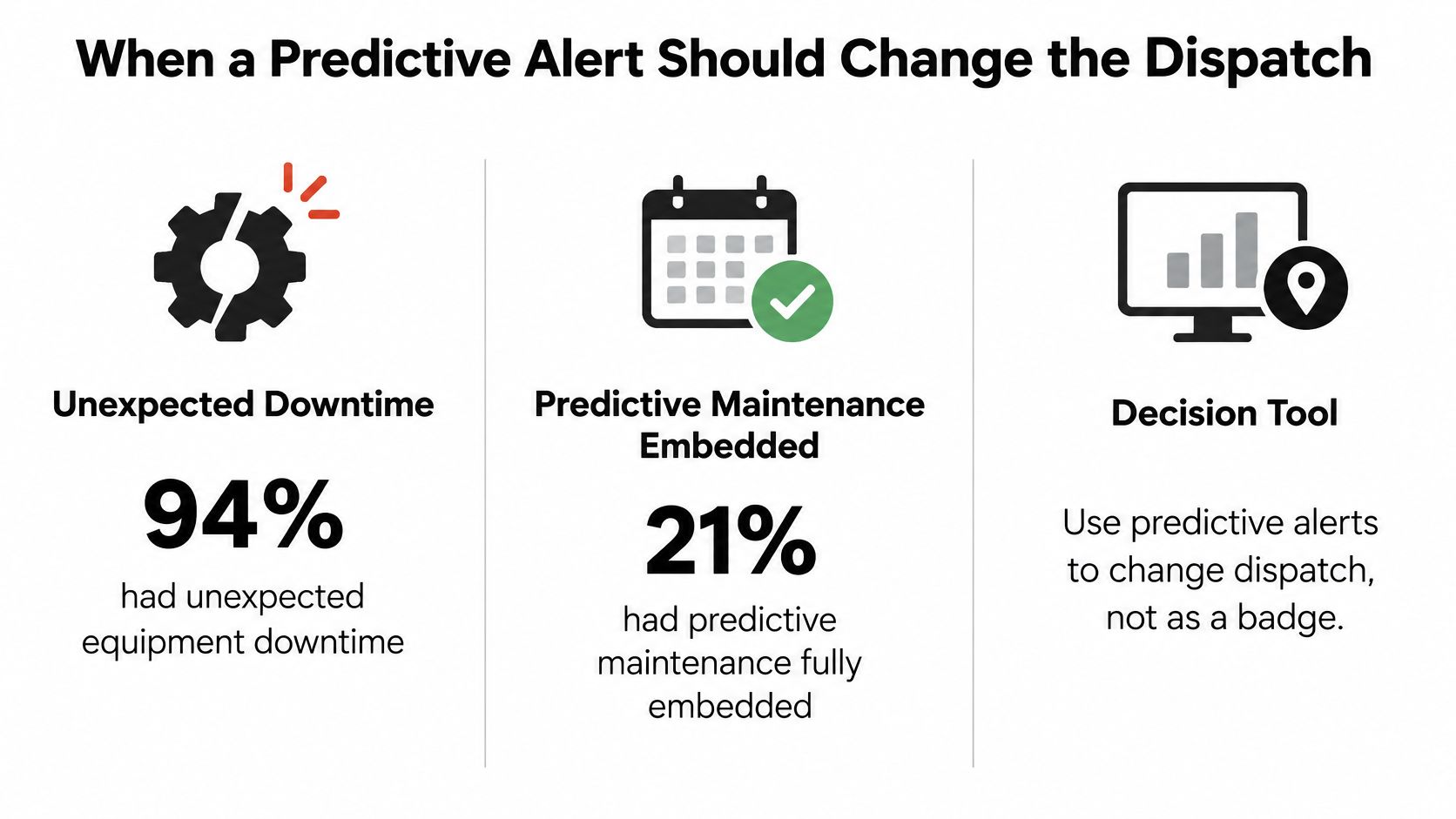
A predictive alert isn't proof that a truck should be pulled, and installing sensors isn't proof that the fleet can act on what they report. Manufacturing research published for 2025 found that 94% of manufacturers had experienced unexpected equipment downtime, while 21% had predictive maintenance fully embedded and optimized and 63% had only partial or limited deployment, according to the 2025 State of Service in Manufacturing report. The operating question is what dispatch and maintenance do after the alert.
The ATA Technology & Maintenance Council's Winter 2025 survey ranked reliability sixth among maintenance concerns, while root-cause analysis, technician staffing, standard repair times, and vendor reliability also appeared among the top concerns. A warning has little value if the shop can't confirm it, get the part, and make a dispatch decision before the truck leaves.
Make the alert answer a dispatch question
When an alert arrives, work through five checks:
- Confirm the fault. Compare the code with the driver's inspection and the truck's current symptoms.
- Set urgency. Decide whether it's safety-critical or can be deferred with a documented due date.
- Check repair capacity. Confirm a technician and the required part are available before departure.
- Protect driver hours. Don't let troubleshooting consume the time needed to complete a safe, legal trip.
- Choose repair or swap. If the repair won't fit before the wave, send a ready spare.
False positives create alert fatigue. If a lamp or battery warning repeatedly triggers unnecessary holds, staff may start ignoring alerts, including a real brake warning. Act automatically only on failure modes already on the repeat-defect list; require a human inspection for new or noisy codes.
Compare the two exposures in route terms. Holding the truck costs a covered lane and an idle asset; gambling on a suspected failure risks a roadside stop, an out-of-service order, and a missed hub. The data foundation can stay simple: a stable vehicle ID, mileage or engine hours, and a closed repair record that links the alert to what the technician found. Connected-vehicle technology is useful when it supports that workflow, not when it adds warnings nobody can action.
What Downtime Costs Versus Planned Maintenance
There's no single maintenance strategy that buys reliability for every fault. The choice depends on the failure pattern, the time available before the wave, and what a missed connection does to the freight plan.
| Approach | What you pay now | What still goes wrong | Choose it when |
|---|---|---|---|
| Reactive repair | Little until the truck fails | Tow, missed handoff, lost hours, possible out-of-service order | Almost never on a dedicated overnight lane |
| Calendar preventive maintenance | Planned shop time and standard parts | Failures continue if the interval doesn't match real wear | Components are stable and unscheduled repairs are already rare |
| Condition-based replacement | Parts changed from mileage, hours, or repeat codes | Needs a clean defect history | Tires, brakes, batteries, or liftgates show a known wear pattern |
| Spare box truck | Capital or lease that sometimes sits | Protects the lane only if dispatch will actually swap | One missed hub costs more than a shift of idle equipment |
| Predictive tool stack | Sensors, licenses, and someone to judge alerts | Alert fatigue when the shop can't act before departure | The inspection-to-repair loop already closes inside a shift |
Reactive repair looks inexpensive only until a failure lands during a wave. The practical cost can include a tow, wasted driver hours, a missed appointment, and an out-of-service exposure. Calendar maintenance is sensible for components whose wear is stable and whose service interval matches actual use, but a completed service won't stop a defect that the schedule doesn't address.
Condition-based replacement fits components with visible wear patterns or repeated fault history. It can help with tires, brakes, batteries, or liftgates when records show that mileage, hours, or a recurring code points to a developing failure. A spare is a different kind of reliability spend: it buys a way to protect the lane when repair can't be completed in time.
Match the spend to the failure pattern
If unscheduled repairs are already rare and MTTR fits between waves, don't add software just to add more alerts. If the same code returns after on-time service, spend first on root-cause work and parts traceability. If a safety defect is still open at dispatch, put a spare on the lane; more preventive-maintenance checkmarks won't make that truck safe.
A full predictive tool stack makes sense only when maintenance can validate and act on alerts before departure. Otherwise, the fleet pays for signals it can't turn into decisions. Compliance and route reliability also meet at roadside inspections: brakes, lamps, and tires that reach an inspector as defects can become both a safety record and a missed run.
For a grounded maintenance budget discussion, review box-truck maintenance costs alongside the operational cost of a disrupted handoff. Before buying a tool, compare one missed night with one spare shift. That comparison makes the trade-off visible without pretending every lane or failure has the same cost.
Set a Minnesota Overnight Reliability Standard
Twin Cities box trucks face winter conditions that make a generic inspection routine too easy to rush. Salt, freeze-thaw pavement, and departures in the dark put extra pressure on lamps and reflectors, brakes, tires, and liftgates. Give those items an additional look before every wave from November through March, and make the check part of dispatch readiness rather than an occasional shop task.
Short hub connections leave little time to repair a truck after a defect appears at the dock. If a driver finds a safety issue before the overnight run, dispatch should swap the truck for that wave. Repair the original off the clock, verify the fix, and return it to service only when it's ready.
The annual periodic inspection remains the legal floor, not a substitute for a pre-trip process that catches current defects. An open safety defect should never be offered as a spare. Drivers need a clear route to file findings before departure, and dispatch needs a written rule that makes the truck's status easy to act on.
A shipper or distribution-center manager can ask for three things this week: the current vehicle out-of-service rate, the worst subsystem mean time between failures, and the oldest deferred repair. Ask for the written dispatch rule too: an unsafe truck doesn't leave. That turns equipment reliability into a route-readiness conversation rather than a promise that maintenance is being done.
Peak Transport runs Minnesota middle-mile box-truck operations connecting distribution centers and Amazon Relay nodes, with maintained equipment, driver inspections, and documented safety workflows. If your overnight lanes need a partner that treats dispatch readiness as part of reliable execution, visit Peak Transport to discuss your middle-mile needs.