How to Build Customer Trust in Middle-Mile Logistics
Learn how to build customer trust in middle-mile logistics with SLAs, proactive exception alerts, data transparency, and scorecards shippers can verify.
October 23, 2026

Most advice on how to build customer trust starts with being reliable, collecting testimonials, and communicating clearly. That's not wrong, it's incomplete. In middle-mile logistics, nobody renews a contract because twenty ordinary overnight runs went fine. They renew, or they walk, based on the one run that didn't. Trust isn't a reputation you claim between disruptions. It's the record you produce during them, when a driver calls out, a dock backs up, or a scan goes missing and someone has to decide what to tell the customer, and how fast.
Why Customer Trust Is Won or Lost in Operations
Shippers don't judge a middle-mile partner on smooth nights. They judge you on the missed pickup, the late linehaul, the damaged shipment, and the proof-of-delivery record that doesn't match what the receiving dock says happened. Routine performance gets you on the roster. Recoverability keeps you there.
That's the contrarian point most trust advice misses. A promise of zero disruptions isn't credible to an operations manager who's lived through winter weather, equipment defects, and driver-hours constraints. What is credible is a partner that surfaces a problem early, contains it, explains what changed, and shows the preventive action afterward. Admitting a specific failure, paired with ownership and a timeline, builds more confidence than a polished guarantee.
The commercial stakes are plain. PwC's 2025 Customer Experience Survey found that 52% of consumers stopped buying from a brand after a bad product or service experience, and 29% stopped because of poor customer experience. The same survey recommends detecting failures early, giving staff the support to fix them quickly, and pairing empathy with tangible corrective value. A shipper behaves the same way a consumer does, just with a scorecard and a tender to reassign.
Trust as an Operating System
Treat trust as something auditable. That means three things working together: promises written as measurable service standards, exceptions disclosed through a defined protocol, and evidence a customer can inspect without asking twice. If any one of those is missing, you're asking the customer to take your word for it.
A carrier earns trust when a customer can verify performance from records, not when a sales deck says the word reliable often enough.
There's useful broader thinking on building a trustworthy business reputation, and the reputational principles travel well. In freight, though, reputation has to survive contact with a dispatch log. The practices that follow, on service standards, recovery, safety visibility, and data handling, are the ones you can apply to your own operation or use to audit a carrier this quarter. None of them require a rebrand. They require discipline on ordinary nights so the bad night doesn't become the story.
Turn Customer Promises Into Measurable Service Standards
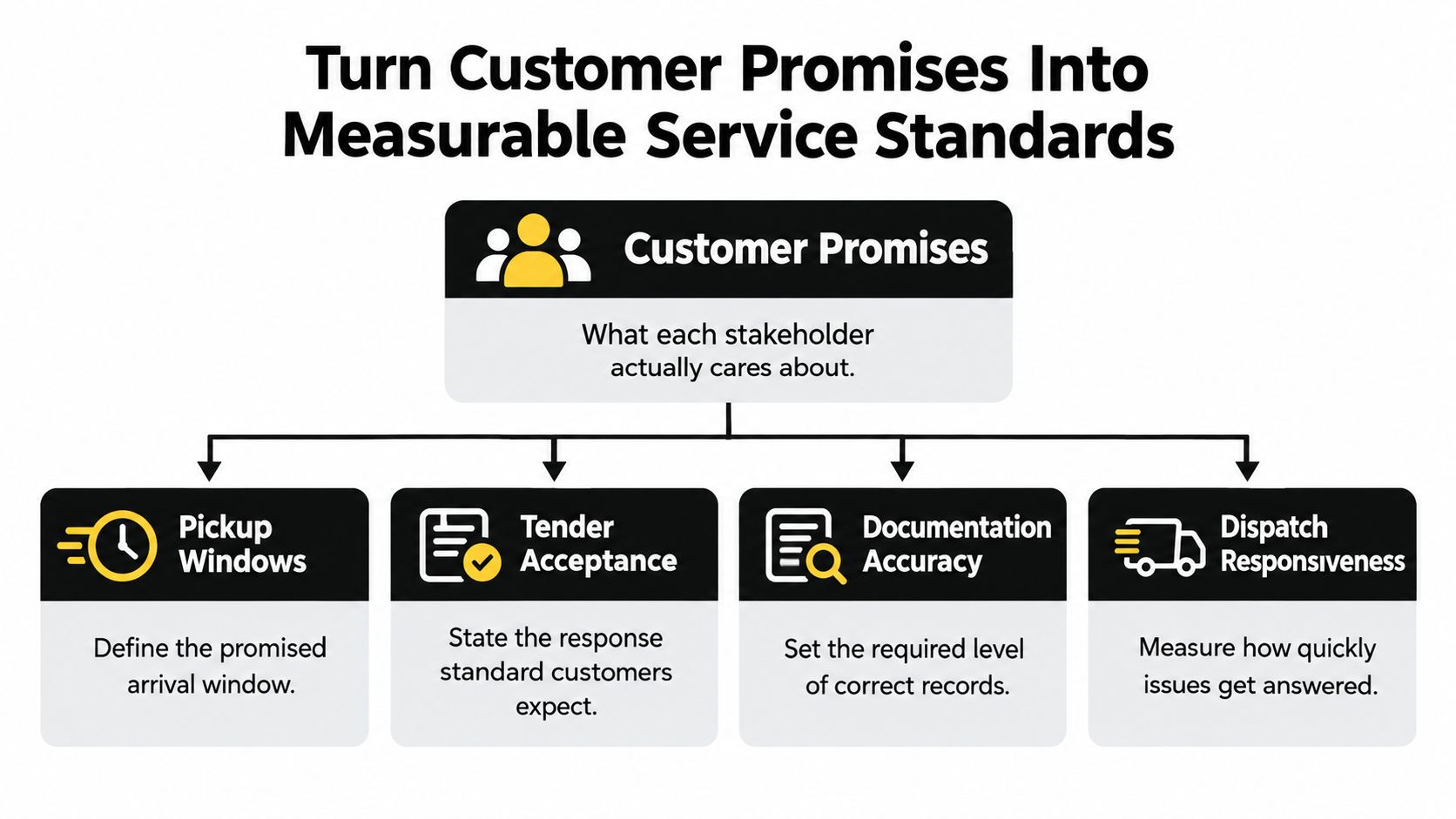
Start by listing the promises each stakeholder cares about, in their language. A distribution-center manager cares about pickup windows and tender response. A compliance coordinator cares about documentation accuracy. A driver cares about predictable schedules. Writing these down separately matters, because a single vague commitment to service excellence hides the trade-offs between them.
Then convert each promise into an indicator with four parts: a definition, a denominator, a measurement window, and a named owner for corrective action. On-time pickup percentage means nothing until you state which pickups count, over what period, and what exclusions apply. If weather delays are excluded, say so in the document, not in the argument afterward.
A Starter Set of Indicators
- On-Time Pickup and Delivery: Share of stops arriving inside the agreed window, reported by lane rather than as one blended network figure.
- Tender Acceptance Rate: Share of offered loads accepted within the response standard the customer expects.
- Documentation Error Rate: Bills, scan records, and route paperwork requiring correction, divided by total shipments handled.
- Dispatch Response Time: Time from a customer or driver exception report to a substantive reply, not an automated acknowledgment.
- Routes Completed Without Unplanned Mileage: A useful signal that planning, not improvisation, is driving the night.
For Amazon Relay and similar hub relationships, these indicators map cleanly onto appointment discipline and handoff accuracy. The customer already measures you this way internally. Publishing your own version, with matching definitions, removes the monthly argument about whose numbers are right.
This matters more in a low-trust climate. The 2025 Edelman Trust Barometer surveyed more than 33,000 people across 28 countries and found that 61% reported a moderate or high sense of grievance, with high-grievance respondents rating business substantially lower on ethics and competence. Broad assurances land poorly with a skeptical audience. A scorecard with denominators lands differently.
Rules for a Verifiable Scorecard
Publish on a fixed cadence and include unfavorable periods. A scorecard that only appears after good months teaches customers to discount every number in it. State exclusions up front, keep definitions stable across periods, and attach a corrective-action owner to every miss so the customer sees a person, not a department. Review lane-level performance weekly, and investigate every missed commitment within one business day while GPS timestamps, scan records, and dispatch logs are still easy to pull.
If you're formalizing this for the first time, structured service-level agreements give you the contract language to hold the definitions steady. The test for every line is simple. Could the shipper verify this claim independently from their own records? If not, rewrite it until they can.
Handle Exceptions With a Proactive Recovery Protocol
Standards tell a customer what you intended. The exception protocol tells them who you are when intention isn't enough. At this point, how to build customer trust stops being a marketing question and becomes an operations design question, because the protocol has to work at two in the morning with whoever is on dispatch.
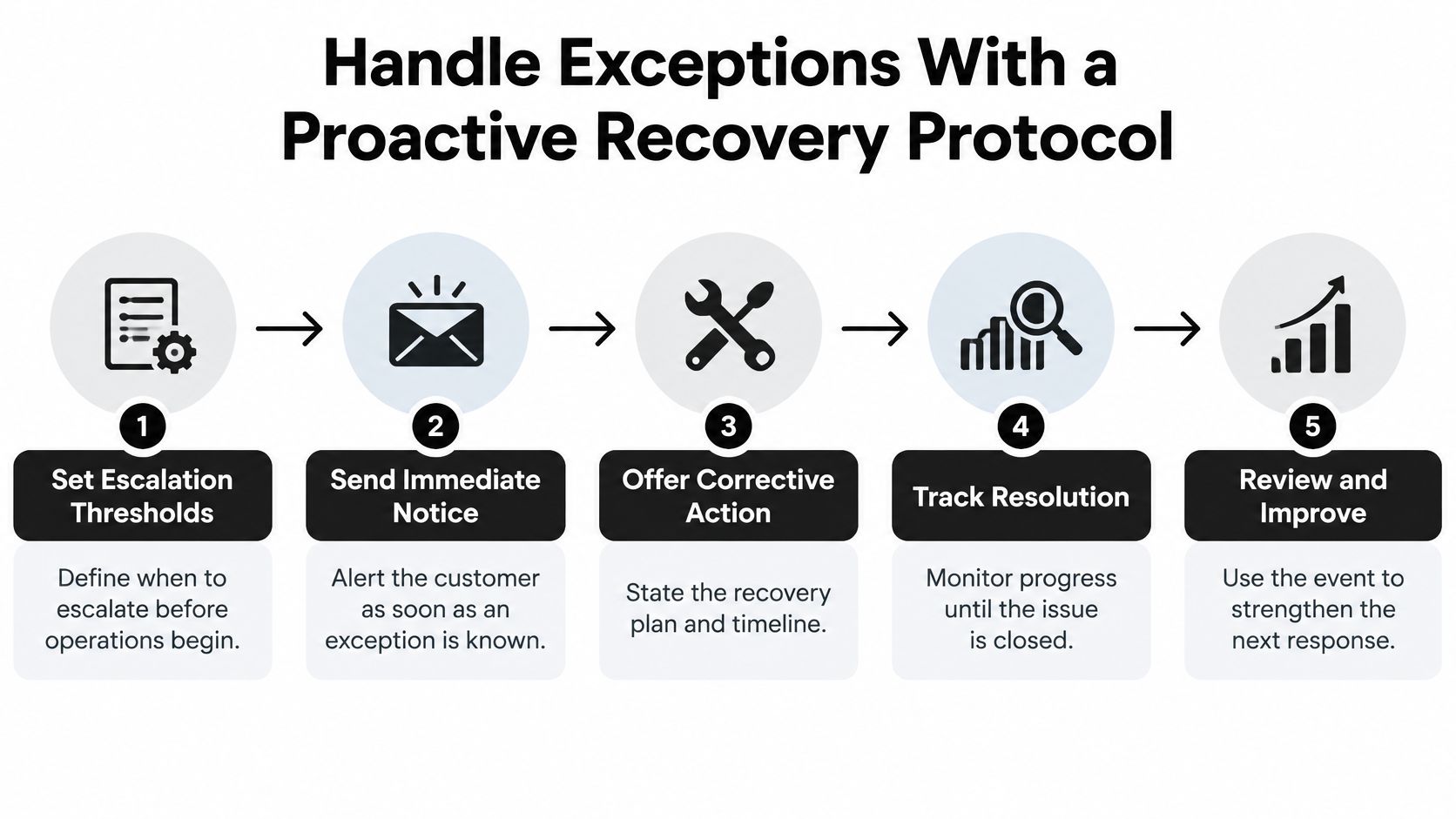
Use five steps, defined before the freight moves.
- Set Escalation Thresholds: Decide in advance what triggers an alert. A predicted delay threatening a delivery appointment, a safety issue, a missing scan, an equipment defect, or a driver-hours problem should escalate immediately, without a dispatcher weighing whether it might resolve itself.
- Send a Structured Alert: Name the affected load or lane, current status, estimated impact, your confidence level, the next update time, and the contingency owner. Confidence level is the field most often skipped, and it's the one that separates an honest early warning from a guess dressed as a fact.
- Offer Options, Not Just the Problem: Alternate equipment, resequencing stops, a hub handoff, a revised appointment, or a safe hold. A customer who gets options can make a decision. A customer who gets only bad news can only wait and worry.
- Update at Fixed Intervals Until Closure: Keep the cadence even when there's no new information. A short message confirming the plan is unchanged beats silence, because silence reads as either confusion or concealment.
- Deliver a Post-Incident Report: Cover root cause, service impact, recovery result, and preventive action. Keep it concise. The point is accountability, not a novel.
How This Plays Out on a Threatened Appointment
Say a tractor issue surfaces mid-route and the revised arrival now threatens an Amazon delivery appointment. The weak version is familiar. Dispatch hopes the swap goes fast, tells nobody, and the customer learns about the miss from their own system. The protocol version looks different. Dispatch verifies facts with the driver, sends the structured alert with a revised ETA and a stated confidence level, and offers a resequenced handoff or a revised appointment request. One person owns the ETA from that point, so the customer doesn't get one time from dispatch and another from a supervisor. After closure, any proof-of-delivery correction is documented, and the customer gets confirmation the record is clean.
The credibility environment makes this essential. The 2025 Edelman Trust Barometer, summarized by the Australian Institute of Company Directors, reported that 68% of respondents distrusted business leaders and 68% believed leaders deliberately mislead people. Your alert is being read by someone primed to suspect you're softening the truth. Specifics, timestamps, and a named owner are how you prove otherwise.
Where Recovery Efforts Usually Break
Teams overpromise recovery times to end an uncomfortable call. They hide uncertainty instead of labeling it. They let two people send contradictory updates. Worst of all, they treat silence as neutral, when the customer experiences silence as the carrier protecting itself. Measure the protocol itself through exception-notification lead time, complaint recurrence, repeat tender rate, and post-incident satisfaction. Testimonials won't tell you if your recovery works. Those measures will.
Keep Safety Training and Compliance Visible
Ask a hub operations leader what they inspect during a carrier review and you won't hear much about mission statements. They ask who trained the driver, what the onboarding covered, whether the equipment inspection records are current, and how dispatch handled the last hours-of-service conflict. Safety paperwork is where reliability stops being a claim.
A short look at a supervisor walking a team through procedures shows the texture of this better than a policy binder does.

Paid training and documented onboarding matter because they show the carrier invests before the first revenue mile. A driver who's been trained on your documentation standards, your dock procedures, and your escalation rules makes fewer improvisational decisions at a facility gate. That consistency is something a shipper feels in cleaner handoffs and fewer calls from their own receiving team.
Employment structure is part of the same signal. W-2 employment rather than contractor churn means the carrier controls training standards, schedule discipline, and accountability directly. It also means the driver answering for a route tonight is likely the driver who ran it last month, which is how lane knowledge accumulates. Modern, maintained equipment supports the same point. Maintenance records that a customer can request and read are worth more than any statement about a safety-first culture.
Evidence a Shipper Can Request
- Driver-Hours Discipline: Records showing schedules built to protect legal hours, not patched after violations.
- Maintenance and Inspection Records: Current, complete, and tied to specific units running the customer's lanes.
- GPS Timestamps and Scan Records: The raw material for verifying any on-time or handoff claim.
- Route Documentation: Accurate, consistent paperwork that matches what happened on the night.
The video below is worth watching for how structured safety communication looks in practice, with clear expectations stated before work begins rather than after an incident.
Driver-side transparency reinforces all of this. A carrier that publishes clear rules for pay, schedules, benefits eligibility, and training, and communicates changes before they affect a paycheck, is demonstrating the same candor a shipper wants applied to freight. Customers notice when a company's internal honesty and external honesty match. For a deeper treatment of the compliance side, transportation safety and compliance practices show how these records fit together into an inspectable system. The practical test is whether a carrier produces these artifacts promptly when asked, or needs a week to assemble them.
Show Customers How You Handle Their Data
Most logistics trust content stops at freight visibility. It rarely answers the question shippers are starting to ask directly. What happens to our operational data after the delivery closes? Route histories, facility access details, driver records, delivery documentation, and performance data all sit inside your dispatch and tracking tools. A customer deserves to know who can see that information, how long you keep it, and whether it's shared with third parties or fed into automated systems.
The concern isn't hypothetical. Deloitte's 2025 Connected Consumer study found concern about data privacy and security rose from 60% to 70% in one year, and only 20% of respondents said technology providers were very clear about collected data or how it was used. PwC separately found that 93% of consumers said mishandling their data would cause them to lose trust, as noted in that same body of research coverage. Shippers bring the same expectations to a carrier review that consumers bring to a technology purchase.
Build a Plain-Language Data Trust Sheet
Transparency alone isn't sufficient. Customers need control, proportional collection, retention limits, and a plain explanation of human oversight when software influences routing, service scores, or exception prioritization. A one-page data trust sheet, written without legal padding, covers this better than a privacy policy nobody reads. You can anchor the details in your formal privacy policy while keeping the sheet itself readable in two minutes.
| Trust Sheet Field | What to Disclose | Why It Builds Trust |
|---|---|---|
| Data Collected | Route, scan, facility, driver, and delivery records you actually gather | Shows collection is deliberate, not indiscriminate |
| Purpose | The operational reason for each category | Lets customers judge proportionality |
| Access Roles | Which roles can view or export each record type | Replaces vague security claims with named limits |
| Retention Period | How long records are kept and what triggers deletion | Answers the indefinite-retention worry directly |
| Security Controls | Practical safeguards on accounts, devices, and transfers | Gives compliance teams something concrete to assess |
| Correction and Deletion | How a customer requests a fix or removal, and who owns it | Proves control runs both ways |
| Automated Tools | Whether software recommends or decides, and who can override | Clarifies human accountability for machine output |
Two fields deserve special care. First, automated tools. If software merely recommends a route sequence and a dispatcher decides, say exactly that. If a system auto-prioritizes exceptions, say who reviews that ordering. Second, driver data. Employment records and operational telemetry involve your own people's privacy, and drivers who trust how their information is handled cooperate more fully with the documentation discipline customers depend on.
A focused mid-size carrier can publish this sheet faster than a large competitor can route it through committees. That's a genuine differentiator, earned by being specific where others stay generic.
Avoid the Habits That Quietly Kill Customer Trust
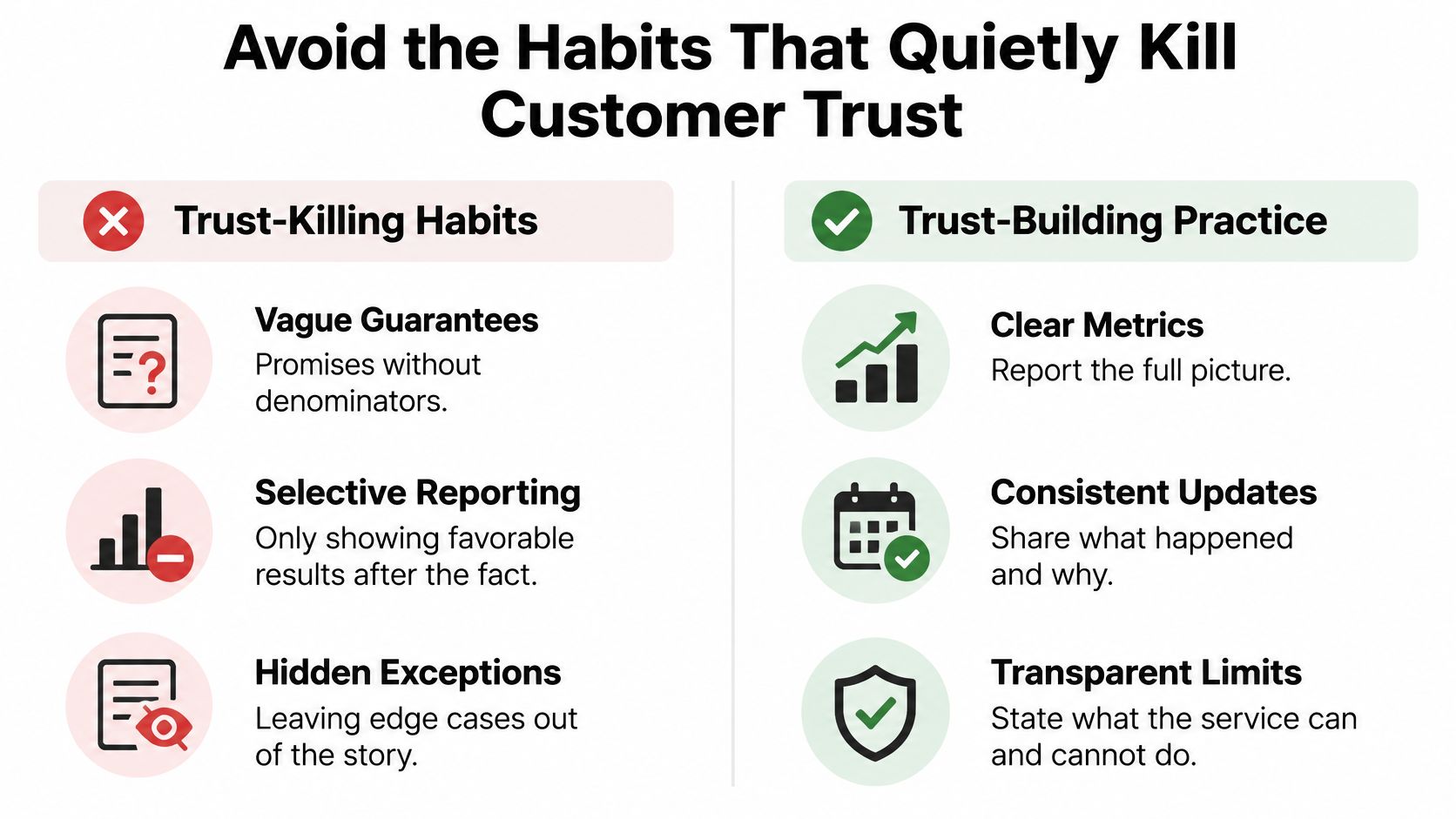
Trust rarely dies in one dramatic failure. It erodes through small habits that teach a customer your numbers need discounting and your updates need verifying. Each habit below has a corrective practice that costs discipline rather than money.
The Habits and Their Fixes
- Vague Guarantees: A blanket reliability promise with no denominator can't be checked, so it won't be believed. Replace it with a lane-level scorecard that names its measurement window.
- Selective Reporting: Showing only favorable periods after the fact trains customers to assume the missing months were bad. Publish on schedule, including the rough stretches, with the corrective action attached.
- Hidden Exclusions: An on-time figure that drops weather or facility delays without disclosure is a number waiting to be caught. State exclusions in the document where the claim appears.
- Blame Shifting: Pointing at the driver or the customer's dock for a system failure tells the customer you'll protect yourself first. Report the operational cause and what your operation is changing.
- Optimistic Recovery Times: An ETA chosen to end a tense call creates a second miss when it slips. Give the honest estimate with a confidence level and a next update time.
- Contradictory Updates: When dispatch and leadership send different stories, the customer stops trusting both. Assign one owner per incident and let everyone else route through them.
- Strategic Silence: Going quiet during a disruption doesn't buy calm, it buys suspicion. Update at fixed intervals even when the update is that nothing has changed yet.
Practical rule: If a claim would embarrass you when the customer checks it against their own records, don't make the claim. Fix the operation or narrow the promise.
Notice what these fixes share. None require new software or a larger team. They require deciding, in advance, that the customer's version of events will be built from the same facts as yours. That decision, repeated on unremarkable nights, is what makes your word worth something on the night everything goes sideways.
Choose a Partner That Proves Its Promises
If you're evaluating a middle-mile carrier, or auditing the one you have, skip the capability deck and ask for artifacts. The criteria below separate partners who can prove performance from partners who can only describe it.
What to Ask For
- Published Service Standards: Indicators with definitions, denominators, measurement windows, and stated exclusions you can verify against your own tender and appointment records.
- Exception-Notification Lead Time: How early, on average, the carrier warns you before a threatened commitment fails, and a sample alert showing the format.
- Documentation Error Rates: Correction frequency for bills, scans, and delivery records, reported by lane.
- Evidence on Request: GPS timestamps, dispatch logs, scan records, and maintenance records produced promptly, not assembled over days.
- Safety and Training Practices: Documented onboarding, paid training, and driver-hours discipline you can inspect during a review.
- A Data Trust Sheet: Plain-language disclosure of collection, access, retention, and automated-tool oversight.
The gap these requests expose is well documented. PwC reported in 2024 that 40% of consumers had stopped buying from a company because they did not trust it, while 67% considered hearing how companies protect personal data a top priority and only 32% of executives said their organizations disclosed data-privacy policies. Partners whose internal practices match their public claims are rarer than their marketing suggests, which is exactly why verification favors the disciplined ones.
Compare two finalists side by side on these artifacts and the decision usually gets easier. One carrier sends a scorecard with exclusions stated and a post-incident report from a recent miss. The other sends testimonials. Testimonials tell you someone was happy once. The scorecard tells you how the operation behaves every week, including the weeks it would rather forget.
Peak Transport applies the framework in a specific way worth using as a comparison point. It runs structured dispatch with weekly lane-level performance reviews, investigates missed commitments within one business day, employs drivers as W-2 staff with paid training, and builds operations around documentation accuracy across Twin Cities and Amazon Relay lanes. Whether you choose that model or another carrier's, hold every candidate to the same evidence standard.
Your next step is concrete. Request a lane-level scorecard and a data trust sheet from your current carrier this quarter, before renewal pressure arrives. A partner that welcomes the request is telling you something. So is a partner that stalls.
If you're ready to work with a middle-mile partner that treats trust as something documented rather than declared, Peak Transport runs overnight box-truck lanes across the Twin Cities with structured dispatch, trained W-2 drivers, and documentation you can review. Bring us a lane and ask for the scorecard behind it. Start the conversation at Peak Transport and judge us the way this article suggests judging anyone, by the evidence.