Transportation Safety and Compliance for Box-Truck Fleets
A practical guide to transportation safety and compliance for middle-mile box-truck carriers, covering FMCSA rules, ELDs, HOS, audits, and driver qualification
October 19, 2026
The dispatch board looks workable at the start of an overnight shift. Then a box truck waits at a regional hub, a facility handoff runs late, and a driver returning toward the Twin Cities reaches the end of the available on-duty window before the planned loads are complete. The ELD flags the problem, the driver can't legally continue, and morning dispatch has to rebuild the schedule around a truck and driver that aren't where the plan expected.
That kind of disruption rarely starts with a missing form. It starts when dispatch, route design, driver hours, equipment condition, and facility timing stop matching. Transportation safety and compliance works best as an operating system: one that makes safe, legal work the normal way to run the lane, not an emergency correction after something goes wrong.
Why Middle-Mile Box-Truck Compliance Is an Operations Problem
Most compliance trouble I've seen in overnight middle-mile work traces back to decisions made at a desk, not behind the wheel. The driver gets written up, but the route itself was built to fail.
For property-carrying operations, a driver may drive no more than 11 hours after 10 consecutive hours off duty, and can't drive beyond the 14th consecutive hour after coming on duty. Time spent waiting at a dock burns that 14-hour window without adding a single mile. Federal hours-of-service rules make this distinction central to overnight dispatch: a route has to fit the elapsed work window, not just the estimated time behind the wheel.
There's a second clock the ELD doesn't measure. A driver can be fully legal at 3:30 a.m. and still be running through the lowest point of the circadian cycle, when reaction time and judgment degrade whether or not the logbook shows green. A compliance program that only verifies hours treats legality as the finish line.
The fix lives upstream of the driver. Dispatch builds routes around real facility dwell times, not posted ones. Handoff windows carry slack for the queue that always forms. Pre-trip defects get reported and taken off the board before departure. When a route changes mid-shift, the documentation already exists to explain what happened and why.
The World Health Organization counted 1.19 million road-traffic deaths worldwide in 2021 (WHO's Global Status Report on Road Safety); for a fleet, that figure raises a blunt question about whether daily dispatch decisions make the safe option the easy one.
A workable definition of compliance is broader than "the files are complete." It's the connected set of dispatch, driver, vehicle, and recordkeeping decisions that lets a carrier finish a route safely, legally, and with a defensible record when a Compliance Review asks what happened.
The Federal and State Regulatory Map for Box-Truck Carriers
“DOT compliance” isn't one rulebook, and a box truck's appearance doesn't tell you by itself which requirements apply. Start by mapping the operation: where the vehicle runs, what it carries, its weight and configuration, whether it crosses state lines, and whether any special conditions such as placarded hazardous materials apply. Those details determine which requirements to verify for the carrier, vehicle, and driver.
At the federal level, the Federal Motor Carrier Safety Administration (FMCSA) administers safety rules for covered motor carriers, including hours of service, driver qualification, and vehicle inspection and maintenance. State departments of transportation may also handle registration, intrastate authority, vehicle credentials, and state-specific requirements. When a carrier operates across state lines, federal rules are central; intrastate operations may be governed by state rules that adopt, modify, or add to federal requirements.
Don't treat a USDOT number and an MC number as interchangeable. A USDOT number identifies a motor carrier for safety oversight and recordkeeping. Operating authority is a separate question, and requirements depend on the operation. Before launching or changing a lane, confirm the carrier's authority and registration obligations with the relevant agencies rather than relying on a general “we're a trucking company” assumption.
The same careful approach applies to driver and vehicle rules. Part 391 covers driver qualification, Part 396 covers inspection, repair, and maintenance, and Part 395 covers hours of service. Whether a particular requirement applies depends on the operation and regulatory thresholds, including vehicle weight, passenger capacity, and hazardous-materials status. For a Twin Cities carrier, Minnesota requirements may overlay federal rules, especially for intrastate work and state registration. Verify the actual route and vehicle configuration before deciding which rules govern.
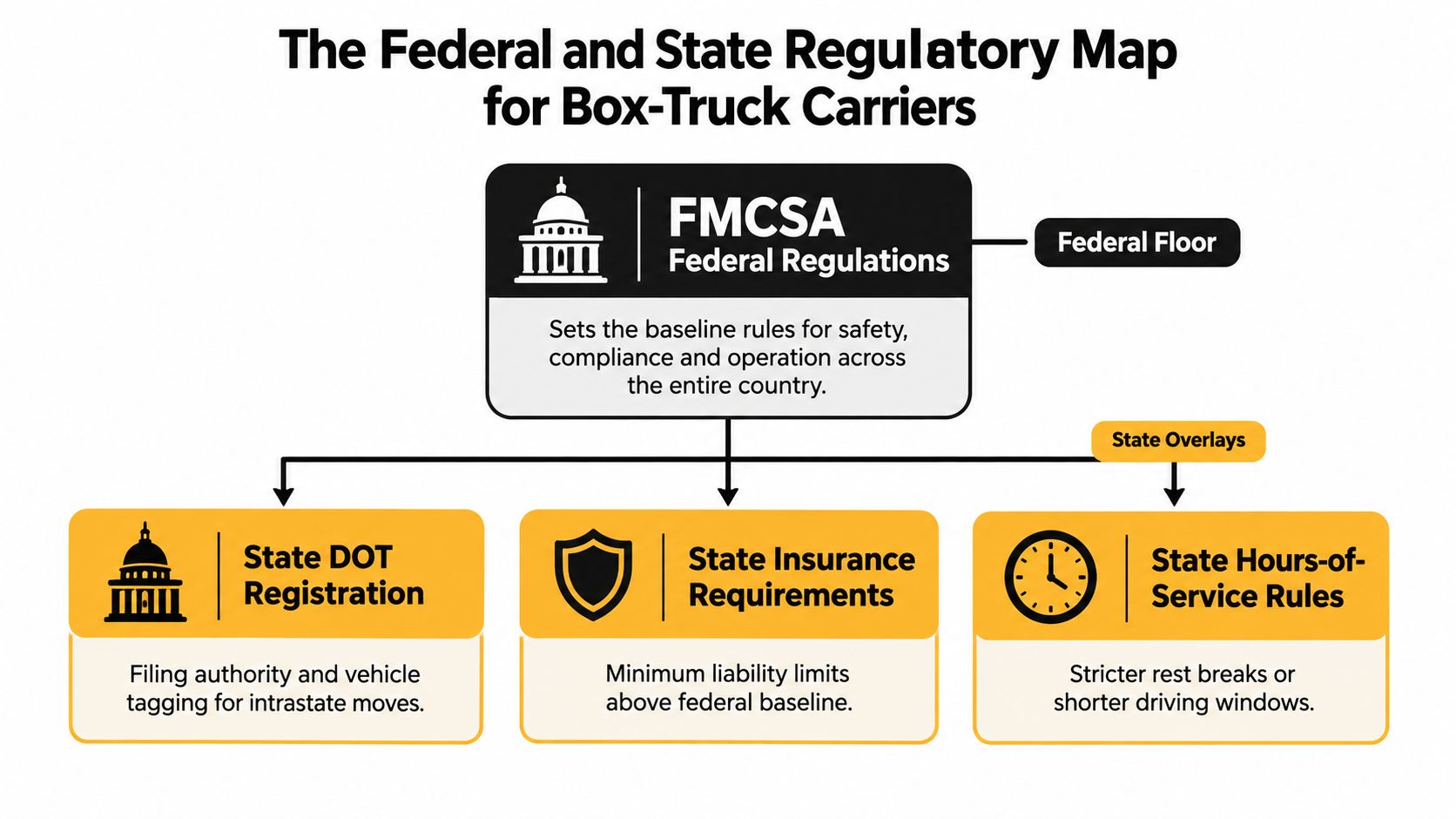
A practical way to manage the map is to assign an owner and record for each recurring obligation: dispatch checks duty status, maintenance tracks defects and repairs, and the compliance coordinator confirms credentials and required filings. Carriers reviewing the customer-facing side of delivery operations may also find these courier pricing and packaging tips useful context when coordinating service expectations with shipping partners.
Hours-of-Service Rules Designed Into Overnight Routes
A 2:40 a.m. queue can leave a driver with drive time remaining and no duty window remaining. That is the failure mode dispatch has to design out: the log stays technically clean while the route becomes physically impossible to finish inside the day.
The earlier regulatory map set the limits; the operating question is how much of the duty window the plan consumes before the wheels move. Treat non-driving work as a first-class cost. Dock wait, fueling, pre-trip and post-trip inspections, scale checks, yard moves, weather slowdowns and a handoff that slips all burn the same window that determines whether the return is legal.
| Plan element | What dispatch should test | Failure it prevents |
|---|---|---|
| Release and appointment times | Whether the outbound can clear the yard before the window tightens | A driver launched into a delay that cannot be absorbed |
| Facility dwell history | Typical queue versus promised turn time | Legal arrival followed by an illegal return |
| Recovery option | A named reassign, drop, or stop authority | A driver improvising past the safe and legal point |
Dispatch rule: Build the route to the duty window, then prove the planned driving fits inside it with slack for the work that does not show up as miles.
Before assigning a lane, check recent on-duty exposure across the week as well as the current day. A reset can clear fatigue on paper while the same driver still carries short sleeps, late recoveries and repeated night starts. I have seen carriers win the log argument and lose the safety argument because no one asked whether the same lane had drifted later several nights in a row.
Compliance also needs an escalation path that works at highway speed. Decide who can reassign the load, which customer commitments can be broken, and when the driver must park. Federal research plans point toward combining duty logs, telematics, crash and incident records, inspection violations and driver demographics to study schedule risk; operators do not need to wait for that work to look for the same pattern. Review start-time consistency, recovery opportunity, unplanned extensions, near misses and fatigue reports beside the formal record. A route that is legal on paper but repeatedly hard to execute is a design problem, not a driver problem.
Electronic Logging Devices as an Operational Control System
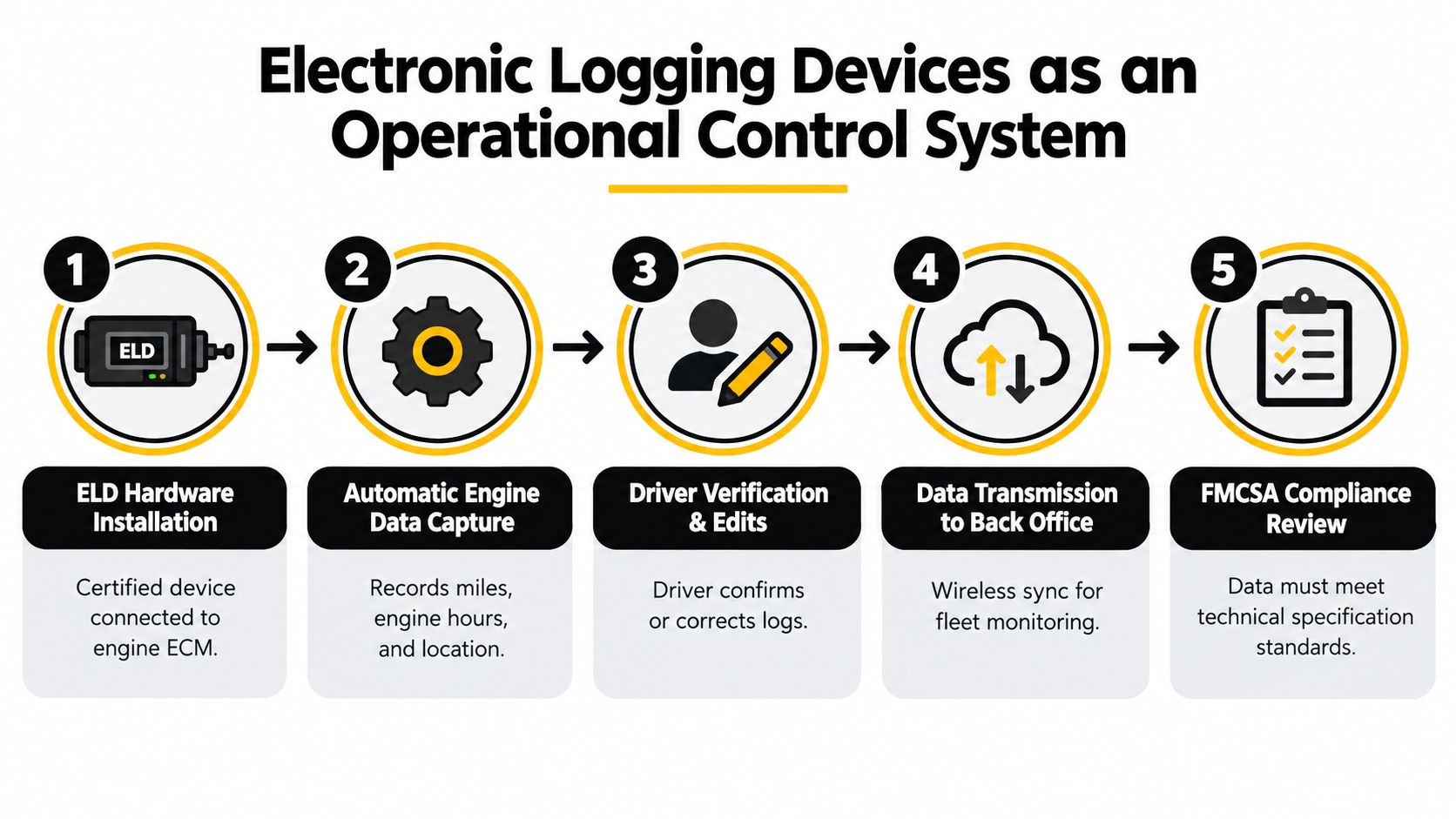
An ELD is more than a timecard. FMCSA's technical requirements call for the device to capture or support records such as motion status, vehicle miles, engine hours, vehicle position, VIN, and UTC-based date and time. It must make current-day and prior-seven-day data available and support transfer to inspectors or investigators. The FMCSA ELD technical presentation also specifies that a device must become functional within one minute after receiving engine power, and that a carrier must correct, repair, replace, or service a malfunctioning unit within eight days.
Those requirements are useful only if dispatch and safety staff act on the information. A practical review process can follow the route from plan to closeout:
- Compare movement with the plan. Check ELD movement against dispatch timestamps, facility arrival records, and yard-entry scans. A mismatch may reflect a legitimate reroute, a missed scan, or a record that needs clarification.
- Review exceptions with the driver. Require documented annotations when a status needs correction. A clear explanation protects the driver and gives the carrier a record of why the log changed.
- Connect the ELD to other operating records. Compare movement and dwell against fuel events, pre-trip inspection reports, bills of lading, and handoff records. Look for unexplained movement or delays that recur on the same lane.
- Use a malfunction workflow. Record when the device failed, notify the appropriate people, follow the required repair timeline, and ensure duty-status records remain complete while the device is being addressed.
Reviewing exceptions before the next dispatch cycle is more useful than discovering a pattern during an audit. It gives the carrier time to correct a route assumption, clarify a facility process, or address a driver's question before another shift repeats the same problem. The 2025 International Roadcheck results show why the operational details matter: 6.1% of 54,953 inspections resulted in a driver being placed out of service, and hours-of-service violations accounted for 32.4% of driver out-of-service violations. FMCSA also recorded 6,823 false driver-record-of-duty-status violations through August 29, 2025. A consistent exception process helps identify whether mismatched records stem from dispatch pressure, facility delays, device problems, or driver conduct.
Driver Qualification Files Built to Survive a Review
A driver qualification file should tell a consistent story: who the driver is, whether the carrier checked the required background and qualifications, and whether the carrier continues to review the driver's record. For a W-2 fleet, centralizing the file under the carrier's control makes it easier to standardize onboarding and respond to a Compliance Review. Contractor arrangements don't remove the carrier's need to confirm that required records are present and current.
Build the file through a defined onboarding sequence. The application should capture the driver's employment and driving history. Obtain and review the motor vehicle record, document a road test or accepted equivalent, confirm medical qualification, complete required prior-employer inquiries, and perform applicable drug-and-alcohol Clearinghouse checks. Then calendar recurring reviews, including the annual MVR review and expiration tracking for documents that must remain valid.
Gaps often come from timing and ownership, not obscure rules. A medical certificate may expire without anyone noticing. A previous employer verification may be requested but never filed. A Clearinghouse query may be completed after the driver starts rather than at the required point in the hiring process. Assign one person to verify each item and prevent dispatch from treating an incomplete file as an administrative detail.
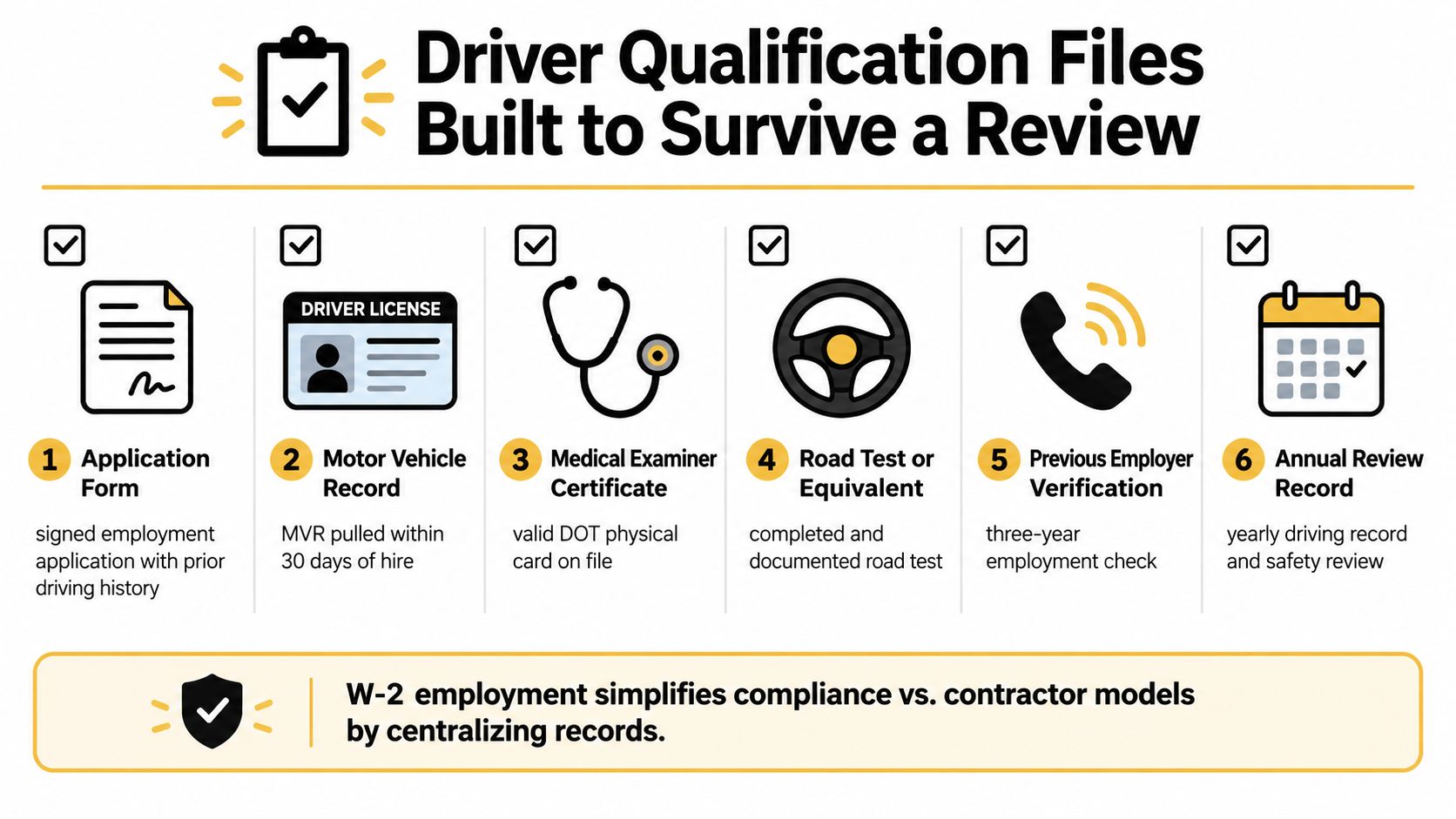
A compact file index can make routine checks easier:
- Application and driving history: Confirm the application is signed and complete.
- Motor vehicle record: Save the record and document the review.
- Medical qualification: Track validity and follow-up requirements.
- Road test or equivalent: Retain the completion record.
- Prior-employer and Clearinghouse checks: Keep proof of required inquiries.
- Recurring reviews: Record annual MVR review and any follow-up action.
For a practical reference on organizing driver file essentials for safety managers, use a checklist that names both the required record and the person responsible for keeping it current. A broader compliance documentation workflow can also help teams make file retrieval part of ordinary operations rather than a scramble before an audit.
Understanding CSA Scores and What Actually Triggers Intervention
Compliance, Safety, Accountability (CSA) is often discussed as though a score were a simple grade. For carriers, it's more useful to treat the system as a way inspection and crash information can surface patterns that attract attention. FMCSA organizes safety performance into seven BASICs, or Behavior Analysis and Safety Improvement Categories. For an overnight box-truck operation, the areas that deserve close operational attention include Hours-of-Service Compliance, Driver Fitness, Vehicle Maintenance, and Unsafe Driving.
A single citation can matter, but recurring problems are harder to dismiss as isolated mistakes. Repeated hours-of-service documentation issues may point to unrealistic dispatch planning or poor log review. A cluster of maintenance findings can indicate that defects are being reported without being resolved, or that preventive maintenance isn't matching how the trucks are used. In either case, the corrective action should address the process that produced the pattern, not just the last driver or vehicle involved.
Carriers should monitor their inspection and crash data through FMCSA's Safety Measurement System and confirm that records are accurate. If an inspection is recorded incorrectly, follow the appropriate data-review process and preserve the supporting documents. Don't assume that a low or improving score proves the operation is safe, and don't wait for a warning letter to investigate repeated defects.
When regulators intervene, the carrier needs more than a written policy. It should be able to show that managers identified the risk, communicated expectations, corrected the underlying cause, and checked whether the fix worked. For a maintenance trend, that might mean a documented repair process and follow-up inspection. For HOS concerns, it may mean reviewing route design, dispatch changes, and duty-status records together.
Treat CSA information as an early warning, not a report card. The useful question isn't only “What's the score?” It's “Which operating decision is creating the repeated finding, and what evidence shows we changed it?”
A Safety Management System That Holds Up to an Audit
A safety management system isn't a binder assembled when a review is scheduled. It's the daily operating routine that connects policy to what dispatchers, drivers, and maintenance staff do. If the written procedure says drivers report defects before departure, but dispatch sends a truck out with an unresolved issue, the paper doesn't protect the carrier. The gap between policy and execution is where an auditor will ask for evidence.
Build the system around a small number of linked controls:
- Written procedures: State how dispatch assigns work, how drivers report concerns, and who can stop a vehicle or route.
- Driver management: Keep qualification files current, document training, and follow up on performance or safety issues.
- Vehicle condition: Require pre-trip and post-trip inspections, record reported defects, and retain proof of completed repairs.
- Route and hours planning: Verify available hours before dispatch and define how staff respond to late-running lanes.
- Data and incident review: Compare ELD records, facility timestamps, inspection findings, and incident reports to identify inconsistencies and patterns.
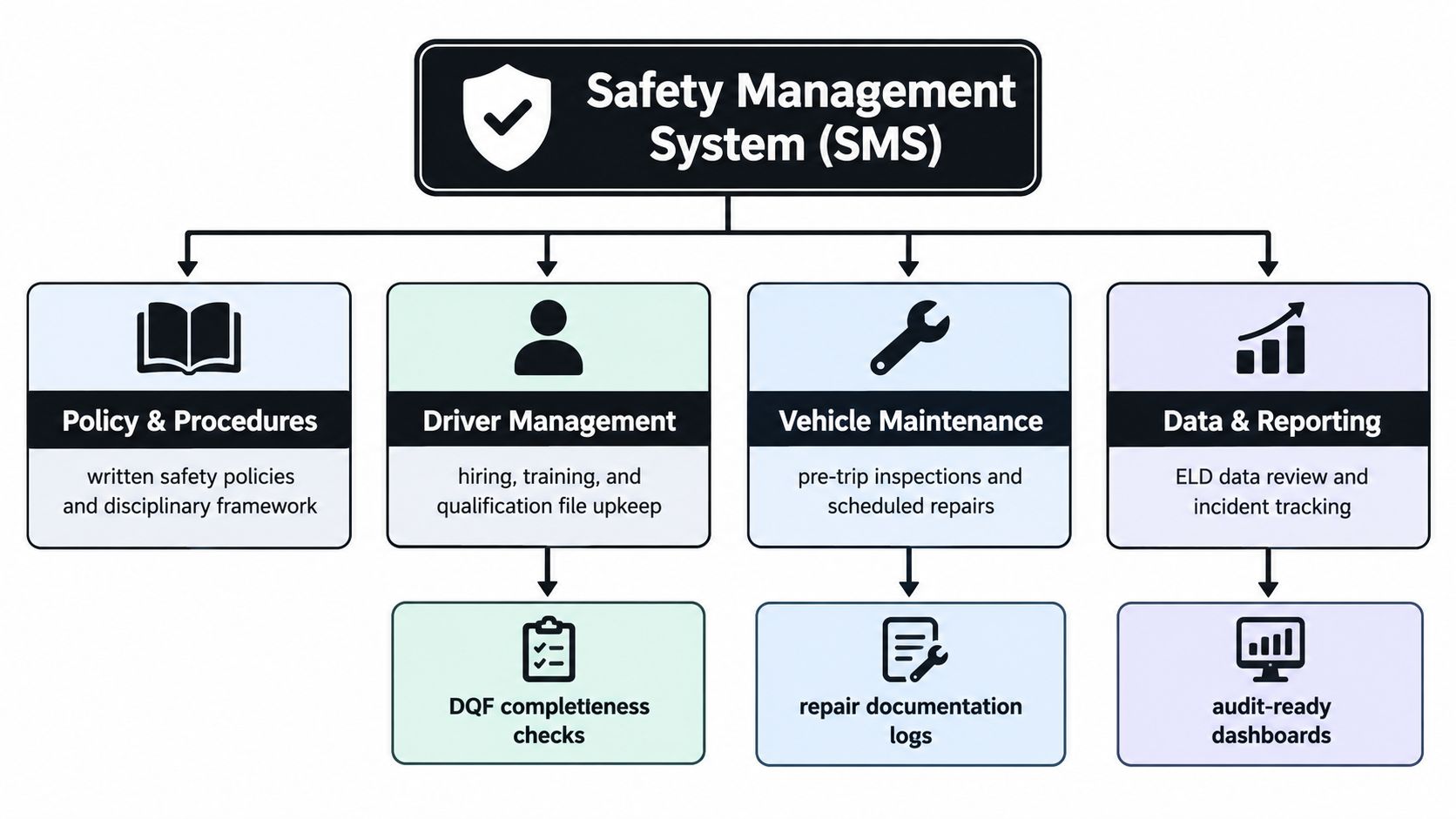
Keep records organized around the questions an investigator is likely to ask: Is the driver qualified? Was the vehicle inspected and maintained? Did the route fit the driver's available hours? What did the carrier do after a defect, violation, or incident? A manager should be able to retrieve the relevant file and trace the answer through supporting records without relying on someone's memory.
Training belongs in the system because policies are only useful when employees understand how to apply them. Short, practical refreshers can cover defect escalation, safe winter driving, handoff documentation, and how to report fatigue or a near miss. Teams that need help making safety instruction clear and usable can review these effective OSHA compliance videos as one resource for training design.
Peak Transport, a Minnesota-based middle-mile carrier, describes a model built around W-2 drivers, structured dispatch, documented handoffs, ELD and HOS monitoring, and vehicle-maintenance processes. Those are operating controls, not audit-day props. A related overview of safety monitoring systems can help managers think through how to connect routine observations and records.
Incident Investigation and Continuous Improvement
Say a driver clips a cone backing into a dock at 4:40 a.m. after a late trailer handoff pushed the run behind schedule. No injury, no claim. A paper-first carrier logs the near miss, coaches the driver, and closes the file. An operations-first carrier asks a harder question: why did the schedule have zero slack at the exact hour when alertness bottoms out?
Preserve the records first: inspection paperwork, ELD data, dispatch messages, route changes, vehicle inspection reports, and facility timestamps. Record what happened while details are fresh, and mark the difference between confirmed facts and assumptions.
Then examine the operation around the event. Did the driver get a last-minute route change? Did a facility queue or detour cause a late return? Had the defect shown up in earlier inspection reports? Was the handoff unclear, or did dispatch lack a reliable escalation point? Looking only at driver behavior misses the conditions that shaped the decision.
Take the dock clip above. Traced back, the cause was a recurring late trailer release that dispatch kept absorbing instead of flagging. The corrective action was a dispatch rule, not a reprimand: once a handoff slips past a set threshold, dispatch resequences the lane rather than letting the driver eat the delay into the worst circadian hours.
Every corrective action needs an owner and a way to verify completion. Follow-up should check whether the change altered the relevant records and whether a similar event recurred. If the cause stays in place, the paperwork can be complete while the risk sits untouched.
The schedule-risk research noted earlier points the same way: legal limits and biological difficulty can diverge on overnight lanes. Carriers can apply that principle now by comparing HOS records against route extensions, near misses, and post-route fatigue reports.
Make the loop repeatable: investigate, document, change the operation or the training, then verify the next cycle of data. For added perspective on incident prevention practices, focus on controls that surface risk before the next shift repeats it.
Peak Transport connects distribution centers, Amazon Relay nodes, and regional hubs through overnight box-truck operations in the Twin Cities and surrounding areas, with structured dispatch and safety-focused execution. If you're seeking a middle-mile partner or a W-2 driving role with predictable overnight work, visit Peak Transport to learn more.