How to Plan Route with Multiple Stops the Smart Way
Learn how to plan route with multiple stops using proven sequencing, time-window logic, and KPIs. A practical guide for safer, on-time middle-mile operations.
October 8, 2026
You've got a box truck loaded at an MSP-area node, two regional drops on the manifest, and a return-to-yard commitment before the morning shift. The map offers a clean-looking sequence, but the first facility has a dock queue, the second receiver has a narrow appointment window, and the third stop has no reliable place to park a box truck. By the time the driver reaches the final drop, the route that looked shortest has become the least dependable option.
That's the practical challenge behind how to plan a route with multiple stops. A usable route must coordinate geography, service time, vehicle capacity, driver availability, delivery windows, legal access, and recovery options. Mileage matters, but reliability is the operating target.
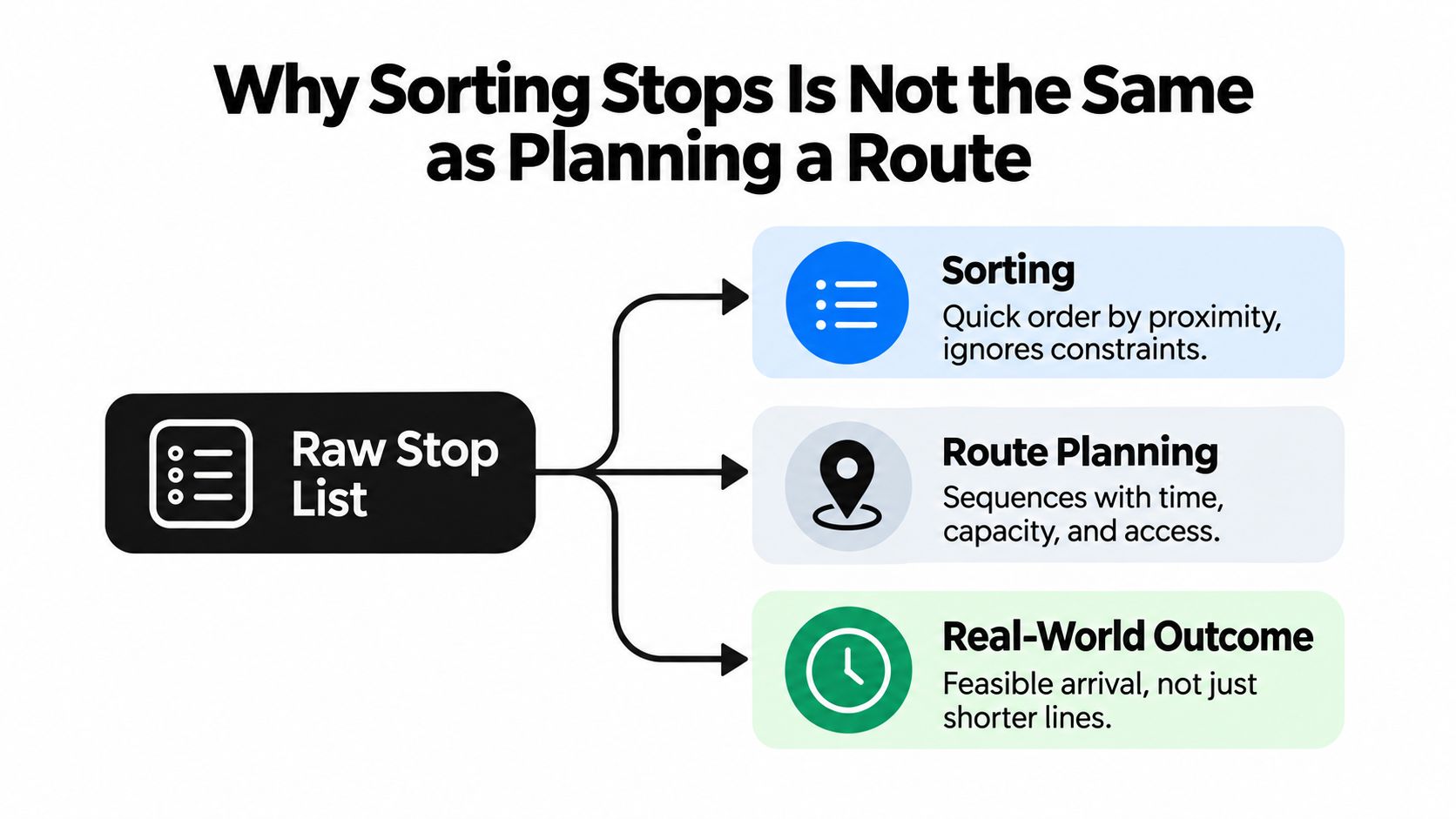
Why Sorting Stops Is Not the Same as Planning a Route
A proximity sort can draw a tidy line between addresses, yet still send a driver to a closed dock, an unusable curb, or a stop outside its appointment window. It also says nothing about whether the freight can be delivered in that order or whether the driver has enough duty time to return to the yard.
A multi-stop tour is a capacitated Vehicle Routing Problem with Time Windows, or VRPTW. The plan must fit vehicle capacity, arrival windows, service requirements, access rules, driver hours, and the return commitment. Distance is one objective, not the whole decision. Vehicle-routing research traces the formal foundation of fleet route planning to George Dantzig and John Ramser in 1959. Later work expanded the problem to cover capacity, time windows, pickup and delivery, mixed fleets, and changing operating conditions (Vehicle Routing Review of Benchmark Datasets).
Define a good route correctly
For an overnight middle-mile lane, a workable route must meet several conditions:
- The sequence is feasible: The driver can reach each stop within its window.
- The load remains legal and usable: Capacity and stop order keep the required freight accessible.
- The service time is realistic: Loading, unloading, check-in, paperwork, and queues are included.
- The access plan works: The vehicle can reach the receiving point legally and safely, including the available curb or parking space.
- The driver can finish: Duty hours, return requirements, and relief options remain protected.
- The route can recover: Dispatch has a response when a dock, road, or receiver creates delay.
A shortest-mile sequence may reach a time-critical facility too early, arrive late, or bury its freight behind later deliveries. A longer route with usable buffer can perform better when it reduces missed appointments and last-minute parking decisions.
Manual enumeration becomes impractical quickly. In the symmetric traveling-salesperson problem, the number of distinct tours is (n-1)!/2, producing 60 possible round trips for 6 stops and more than 60 quintillion for 20 stops (IEEE overview of traveling-salesperson problems). Use software or structured heuristics to create candidate sequences, then reject any route that fails operational checks.
The map supplies mileage. The dispatcher must also verify curb access, dock timing, freight position, and recovery choices before dispatch.
Building a Stop Master File Before You Sequence Anything
Don't start with the map. Start with the data.
A stop master file gives every facility one consistent record, whether the information comes from a TMS export, dispatch software, an Amazon Relay appointment, a customer email, or a dispatcher's site notes. Without it, planners rely on memory and drivers discover critical constraints after departure.
Capture the fields that change the route
Each stop should have a verified address and geocoded coordinates, but location alone isn't enough. Add the operating details that determine whether the stop is feasible:
- Appointment window: Record the earliest and latest acceptable arrival, plus whether early arrival is allowed.
- Service duration: Estimate unloading, check-in, paperwork, staging, and expected queue time.
- Freight requirement: Record pallets, cases, weight, volume, pickup additions, and delivery sequence requirements.
- Vehicle constraints: Note dock height, box-truck access, turning limitations, gate procedures, and vehicle-size restrictions.
- Access conditions: Include one-way approaches, designated staging areas, legal loading zones, pedestrian routes, and time-of-day restrictions.
- Communication details: Store facility contacts, escalation procedures, check-in instructions, and proof-of-delivery requirements.
For an MSP-area route, the record might distinguish the facility entrance used by a box truck from the address that a consumer navigation app geocodes. It should identify where the driver checks in, whether the dock requires an appointment reference, and whether the receiving team expects a trailer-style approach or a smaller vehicle at a particular door.
Separate fixed facts from planning assumptions
Some fields are confirmed. Others are estimates. Label both.
A confirmed appointment time should not sit in the same category as an assumed unload duration. If a warehouse usually takes longer during a particular shift, record that as an operating assumption and compare it with actual results after the run. That distinction helps dispatchers adjust the model without altering facts in the manifest.
The standard Solomon benchmark models 100 customers around a central depot with vehicle-capacity limits, delivery time windows, and total route-time constraints across 56 instances in clustered, random, and mixed geographic patterns (Solomon benchmark description). The lesson for a smaller overnight lane is the same: structured stop data lets you test different geographic patterns instead of treating every address as an interchangeable point.
Keep one current version of the file available to dispatch and the driver. When a dock moves, a curb rule changes, or a receiver updates its appointment process, revise the master record rather than burying the change in a text message.
Sequencing Stops With Anchors, Clusters, and Local Improvements
A six-stop overnight lane can look efficient on a map and still fail after dispatch. The workable sequence starts by fixing the commitments that cannot move, then testing only the arrangements that respect them.
Lock mandatory anchors first. These may include the load-out appointment, a hard delivery window, a required return to the yard, or a facility that accepts freight through one specific entrance. Anchors divide the route into workable segments. Flexible stops can then be arranged around those commitments instead of competing with them.
For an overnight MSP lane, group geographically compatible facilities by direction, while keeping any hard appointment in its required position. Clustering reduces backtracking and unnecessary crossings, but it does not justify missing a receiver that closes at a fixed time. The parking and curb layer also belongs in this decision. A nearby stop is a poor choice if the driver usually spends extra time finding legal loading space or walking freight to the door.
Build a seed sequence with nearest-neighbor or savings logic. Nearest-neighbor selects the next practical location largely by proximity. Savings logic compares the cost of combining stops on one route with serving them separately. Both approaches create a useful starting point, not a dispatch-ready answer.
Improve the candidate instead of chasing perfection
For a six-stop overnight lane, a dispatcher can evaluate a handful of anchor-locked candidates. Fixing the load-out appointment and return-to-yard commitment first narrows the choices to sequences that local changes can realistically improve.
Apply local changes to each seed route:
- 2-opt: Remove two route connections and reconnect the segments to reduce crossing or backtracking.
- Relocate: Move one stop to another position, then verify that the schedule still works.
- Swap: Exchange two stops when the change improves distance, window compliance, load position, or recovery options.
- Revalidate: Recalculate arrival, departure, capacity, and return-to-yard conditions after every meaningful change.
A route can be shorter and still fail two stops later. Serving the nearest regional facility first may consume the delivery window at a farther stop, especially when the first facility has a queue or lengthy check-in. Compare candidates by total distance, lateness exposure, vehicle count, schedule resilience, and the driver's ability to recover from an ordinary delay.
The algorithm also lacks local operating knowledge. A receiver may reject early arrivals, a dock may be awkward for a box truck, or a curb may be unusable during the planned arrival period. Dispatcher review catches those conditions before the route becomes a driver problem. The route planning and optimization guide from Peak Transport provides additional context for combining automated sequencing with operational review.
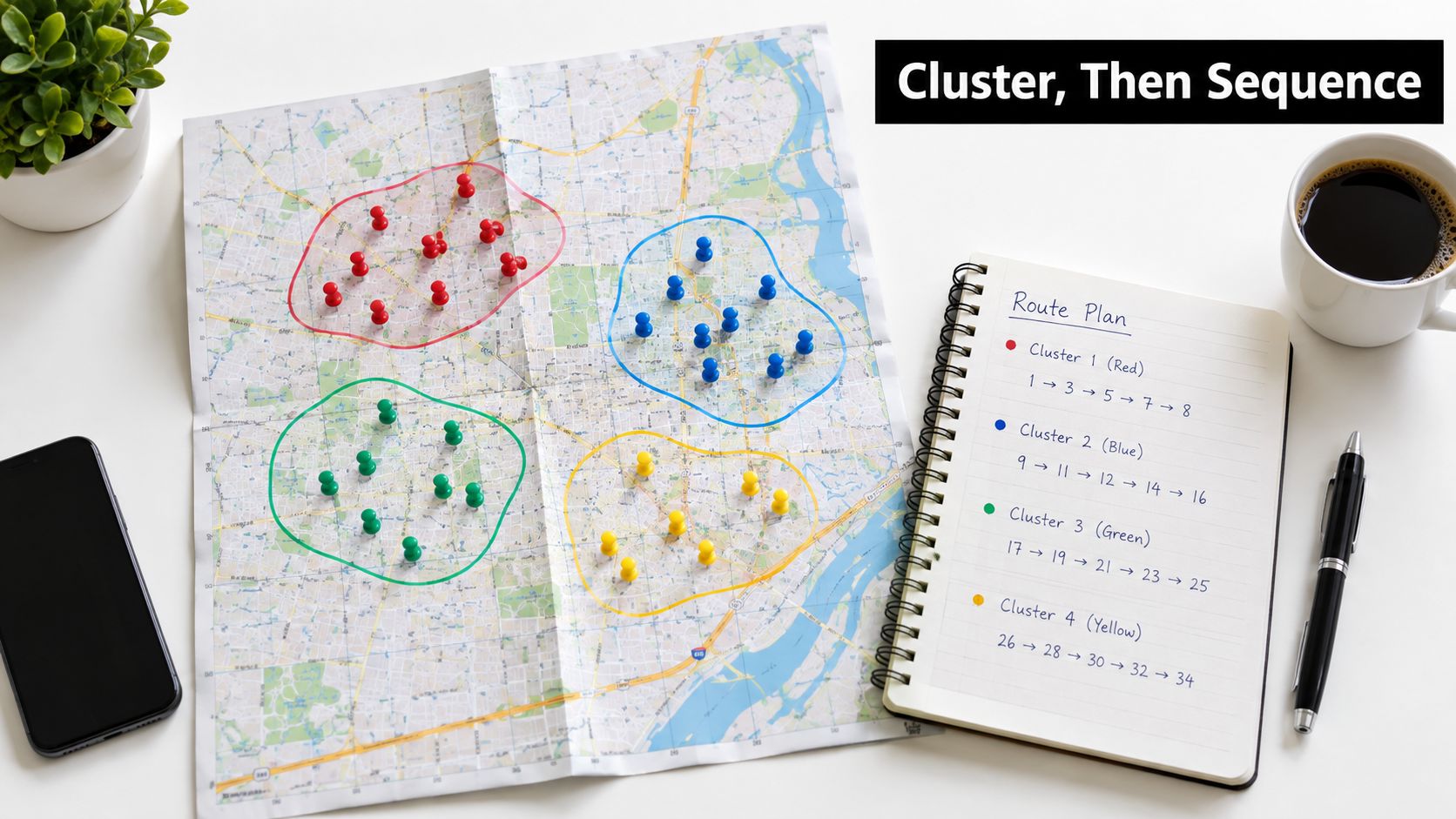
The final output should be a reviewed route version, with anchor decisions and manual exceptions visible to dispatch, rather than an unexplained software result.
Time Windows, Dwell, and the Hidden Parking Layer
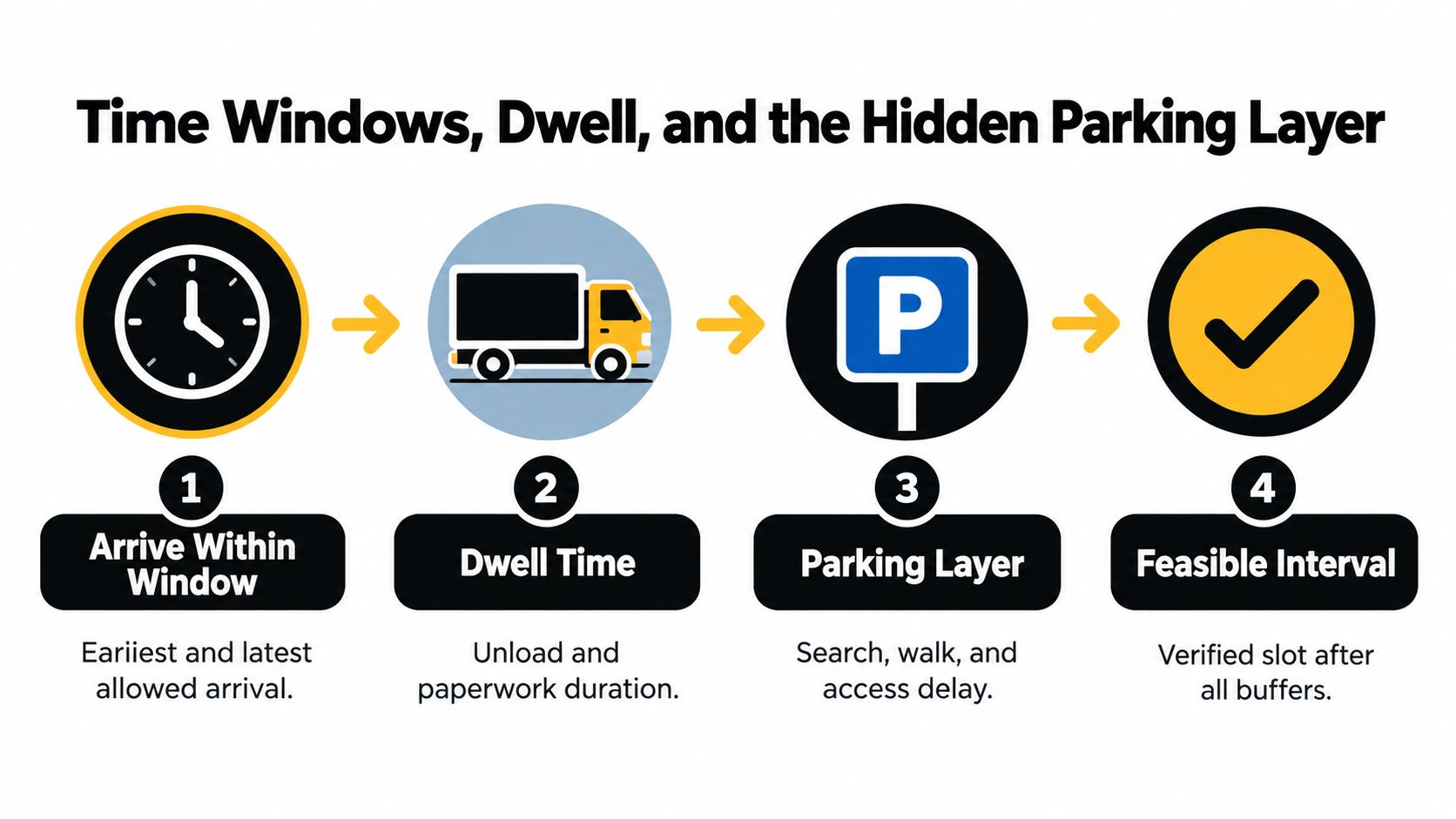
A box truck can reach the next address on time and still miss the delivery window. In an overnight MSP lane, the failure often starts with a receiver queue, a blocked loading zone, or a driver walking freight farther than the plan allowed. Treat the route as a Vehicle Routing Problem with Time Windows, where travel, service, access, and legal stopping space all constrain the sequence.
For each stop, calculate the earliest feasible arrival from the previous departure and travel time. Set departure only after adding check-in, parking search, unloading, signatures, inspection, paperwork, queue time, and any walk from the truck to the receiving point. The resulting schedule should show door-to-door time, not road time alone.
Waiting has a purpose only when it protects a later appointment or avoids a known access problem. Sitting outside a receiver that will not accept early freight consumes driver hours and the buffer needed after dispatch. If the wait is unavoidable, assign it explicitly and test whether the remaining windows still hold.
Model the stop, not just the address
A usable stop record should capture the conditions that create dwell:
- Truck access: Can the box truck reach the dock or curb without a difficult turn, restricted approach, or unsafe maneuver?
- Parking probability: Is legal loading space normally available during the planned arrival period?
- Walking distance: Will the driver carry freight from the vehicle to the receiving point?
- Dwell components: How much time belongs to check-in, unloading, signatures, inspection, and paperwork?
- Time-of-day risk: Do curb restrictions, congestion, queues, or building access change during the route?
Urban Freight Lab research found that parking delays represented about 33% of total delivery-tour duration. Including expected parking delays reduced planned tour duration by 3.4% on average, or 17.4 minutes, and reduced parking-delay time by 11% (Urban Freight Lab curb-management research). The finding exposes the weakness of driving-only estimates. A route can look efficient between road points while failing at the curb.
Seattle sensor data found that nearly 80% of parking in commercial vehicle load zones was occupied by unauthorized users, as summarized by the same research. For dispatch, an arrival window is feasible only when the driver has a legal, safe stopping plan close enough to complete service.
This short explainer visualizes how route logic interacts with operational timing:
Practical rule: Compare routes by total door-to-door time and access risk, not mileage alone.
Driver Eligibility, Hours, and Load Consolidation Rules
A route can fail before the first turn if the assigned driver lacks the hours, authorization, or equipment to finish it. Before dispatch, compare the full plan with the driver's available duty period, required breaks, start condition, return requirement, and company restrictions. Include travel, waiting, parking searches, fueling, inspections, and service time in that review.
That standard applies to W-2 employees and contractors. Employment status does not replace accurate hours records, fatigue controls, vehicle inspections, or a clear escalation process. If the schedule leaves no lawful recovery option, change the plan before the truck leaves.
Load consolidation also needs a stop-by-stop check. A truck may depart below capacity, collect a pickup midway, and lose room for later freight. Recalculate after each delivery and pickup, including volume, weight, equipment needs, and any required separation between loads.
Use this dispatch review:
- Match the vehicle: Confirm dimensions, capacity, equipment, and access suitability against the stop records.
- Recalculate remaining capacity: Update the load after every planned delivery and pickup.
- Test the complete duty period: Account for driving, dwell, parking search, waiting, fueling, inspections, breaks, and return-to-yard time.
- Verify driver eligibility: Confirm current training, authorization, and documentation for the assigned freight. Regulated materials may require a dangerous goods driver licence or other qualification, depending on the freight, jurisdiction, vehicle, and employer program.
- Set the recovery point: Before departure, identify where dispatch will reassess, reassign freight, use a relief driver, or escalate the route if hours or capacity disappear.
The hours-of-service rules guide from Peak Transport can support a review of driver-hour controls. Treat the route as unready if completing it requires exceeding available hours, skipping a safety check, or relying on an unverified dock.
Document the decision in the route record. After dispatch, record changes to duty time, load condition, and authorization status so the next planner sees the actual constraint, not only the original sequence.
Contingency Planning for a Real MSP Overnight Lane
Consider a representative overnight lane: a load-out at one MSP-area node, two regional drops, and a return to the yard before the morning shift. The manifest is clean, the freight is staged, and the first plan uses the geographically shortest sequence.
That plan still needs three tests.
Baseline run
The baseline schedule uses confirmed appointments, expected service times, normal road conditions, and the planned return requirement. Dispatch records the stop order, arrival targets, access instructions, contact list, and route version. The driver receives one consistent plan rather than a sequence scattered across texts, email, and a navigation app.
The baseline isn't a promise that conditions will remain normal. It's the reference used to identify where the route has spare capacity and where one delay will force a decision.
Peak-delay simulation
Add congestion, weather disruption, dock variance, and parking delay to the plan. If the first drop runs late, determine whether the second stop can still be reached within its window. If not, dispatch should already know whether to resequence, hold freight, contact the receiver, use a fallback location, or return to the yard.
Minneapolis is testing a data-driven curb-management project along Nicollet Avenue using lidar, smart cameras, sensors, and a digital twin. Seattle launched 25 sensor-equipped commercial vehicle load zones with a public map showing where and when loading is permitted (University of Minnesota CTS report on curb-management projects). These examples show why access conditions belong in route governance. A mathematically efficient sequence can fail when a loading zone is restricted, occupied, or unsuitable for the vehicle.
Missed-window response
If the second regional drop is missed, the driver shouldn't improvise a new sequence without dispatch visibility. Dispatch confirms the receiver's next acceptable option, checks the remaining load and hours, and decides whether to continue to the fallback location or return freight.
Version the route whenever the sequence changes. Record the time, reason, affected stop, new instruction, and person who approved it. That documentation protects the driver and gives the post-trip review enough detail to improve the next plan.
KPIs That Make Multi-Stop Planning a Repeatable System
A route screenshot doesn't improve the next dispatch. Actual operating data does.
Track planned versus actual drive time for every leg. A repeated variance may indicate poor travel assumptions, a bad geocode, a restricted approach, or a recurring road condition. Review it by lane and stop rather than treating the whole route as one number.
Dwell time deserves its own measurement. Compare planned and actual time for check-in, parking, unloading, paperwork, and departure. If a facility repeatedly consumes more time than the master file allows, update the stop record instead of adding unexplained buffer to every route.
Use a compact review set
A middle-mile operation can build a practical scorecard around these measures:
- Window performance: Record whether each stop arrived within the committed window and why a miss occurred.
- Mileage variance: Compare planned and actual miles, then investigate detours, access failures, and unplanned repositioning.
- Exceptions per route: Count late appointments, blocked access, missing paperwork, load discrepancies, and dispatch interventions.
- Driver-hour utilization: Compare planned hours with actual duty time while protecting safety and compliance.
- Return reliability: Track whether the vehicle reached the yard as planned and what caused any deviation.
Don't burden the driver with a long survey after every run. Pull timestamps, navigation traces, proof-of-delivery records, dispatch messages, and exception codes where possible. Ask the driver for targeted context when the data shows a meaningful variance, especially around parking, dock access, or unsafe approaches.
The review loop should update three things: the stop master file, the route-generation assumptions, and the contingency playbook. A facility with recurring queues needs a better service-time profile. A curb with unreliable access needs a fallback. A route that repeatedly finishes close to the driver's limit needs a different sequence, vehicle assignment, or departure plan.
For a broader measurement framework, use Peak Transport's logistics performance metrics guide. The objective is not to reward the route with the fewest miles at any cost. It is to build a system that delivers reliably, documents exceptions, protects driver hours, and gets more accurate with every completed lane.
Peak Transport applies structured planning to overnight box-truck lanes across the Twin Cities and surrounding areas, balancing stop sequence, access conditions, driver availability, and return requirements. If you need a dependable middle-mile partner or you're a Minnesota box-truck driver looking for consistent W-2 overnight work, visit Peak Transport to discuss the operation and available opportunities.