How to Read a Bill of Lading: A Field-by-Field Guide
Learn how to read a bill of lading field by field, verify it before dispatch, and sign delivery receipts without creating freight disputes.
November 12, 2026
The dock lights are on, the trailer doors are open, and the paperwork in your hand says 10 pallets. You can see two. The driver is already holding out a pen, and the clock on the wall says 1:50 a.m. That gap between what the document states and what's physically in front of you is the entire reason a bill of lading exists. Read it loosely, or sign it fast, and a two-minute counting error becomes a shortage claim, a chargeback, or a proof-of-delivery argument that drags on for weeks.
A BOL isn't a receipt you initial on the way out the door. It's the record that decides who pays when freight goes missing or arrives crushed. Learning how to read a bill of lading properly means reading it as a risk-control document, and once you do, the fields stop looking like paperwork and start reading like a list of everything that can go wrong between two docks.
Bill of Lading Fields at a Glance
Two jobs sit on one page. The bill of lading is the carrier's receipt for what was loaded and the contract that governs how it moves, so every block answers one question about who, where, what, how much, who pays, and who signed. Scan the table below once and you can work any form: a one-page short-form truck bill, a household goods bill, or a multi-page international consignment note.
| Field | Where to Find It | What It Tells You | What to Check |
|---|---|---|---|
| Shipper | Top block | Who tendered the freight | Matches pickup paperwork and purchase order |
| Consignee | Top or delivery block | Who must receive the freight | Name and address match the appointment |
| Carrier | Header | Who is responsible in transit | Matches the carrier on the dispatch record |
| BOL number | Header | Document reference | Same number on pallet labels and the receipt |
| Origin and destination | Route block | Pickup and delivery points | Matches appointment and route |
| Marks and numbers | Item block | Identifies the goods | Matches labels on cartons or pallets |
| Number of packages | Item block | Piece count | Counted physically at pickup and drop |
| Description | Item block | Commodity and handling needs | Matches what is loaded, with no vague entries |
| Weight | Item block | Gross weight and who weighed it | Names the carrier or shipper as the weighing party |
| Freight class | Item block | NMFC class used for LTL pricing | Matches the rate or tariff being billed |
| Freight terms | Charges block | Prepaid, collect or third party | Matches the invoice terms |
| Special instructions | Notes block | Handling, temperature or timing needs | Acted on before departure |
| Seal number | Notes block | Security of the load | Matches the seal on the trailer |
| Signatures | Bottom block | Acknowledgment of receipt | Legible name, date, time and any exceptions noted |
Three rows cause most of the arguments: number of packages, weight, and freight class. They share one failure mode. Someone copies a figure from the shipper's order system without counting cartons or weighing a pallet, and every reader downstream inherits it as fact.
The rule that ends the discussion at the dock: if any row can't be matched to the freight in front of you, the document isn't ready for a signature. Either the entry gets corrected or the difference gets written down.
Five fields give you the fastest read on a load: consignee, piece count, weight, seal number, signature. If those five hold up against the freight, the rest of the form usually does too. If one of them fails, stop and work the whole document.
An Annotated Sample BOL, Line by Line
A numbered form annotated against real freight sticks better than a list of definitions, so here's a sample built the way a fulfillment center fills one out.
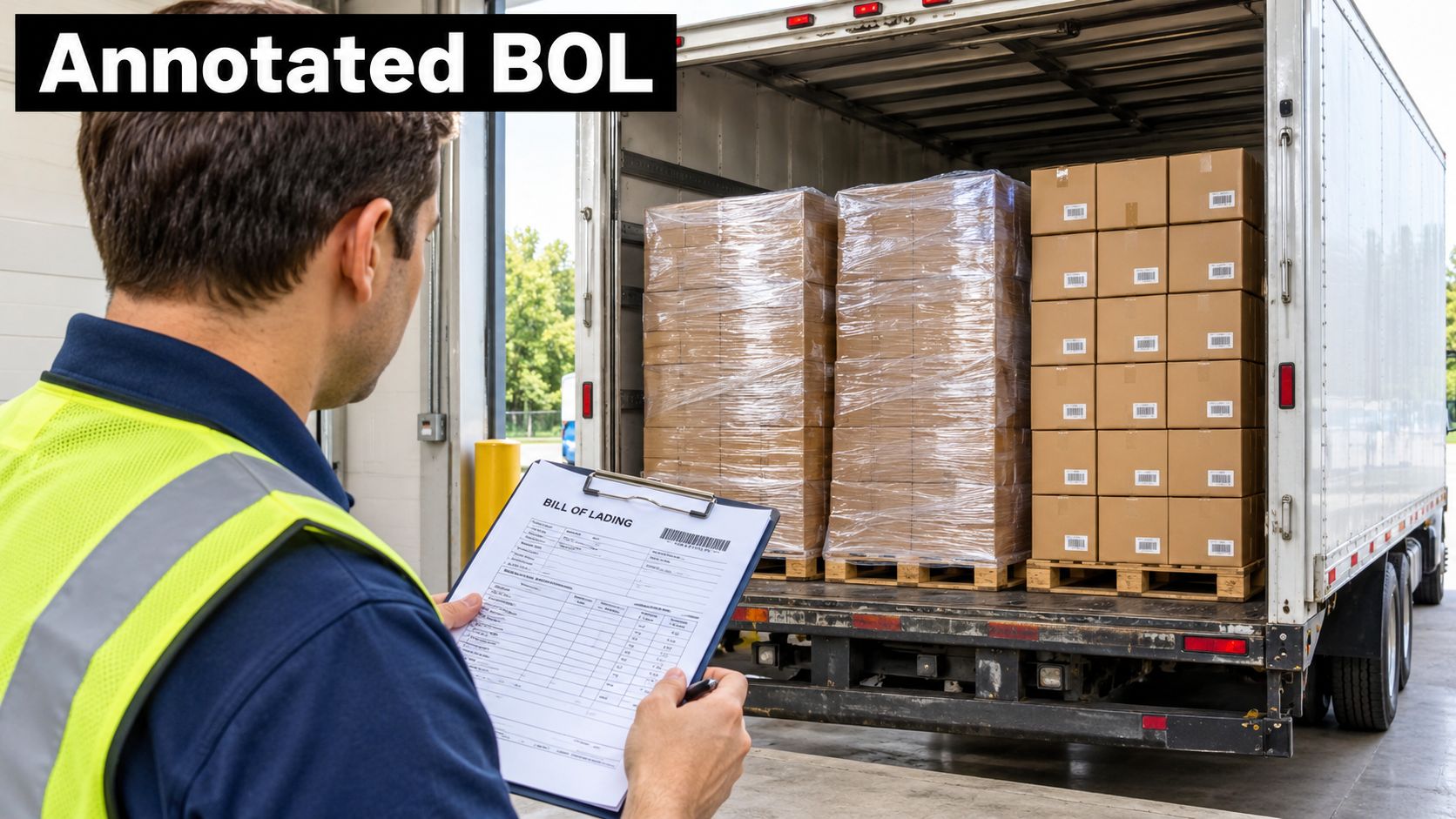
The header carries BOL 4471-2088, carrier name and SCAC, and a pickup date of 10 November. Below it, the shipper block names the fulfillment center in Rogers and the consignee block names the regional hub, with the appointment reference typed under the route line. That reference is the field a driver can check against their dispatch text without calling anyone.
The item block is where this document goes wrong. It reads 10 PLT, general merchandise, 1,240 LB, copied from a master order that covered a full trailer. The loading record for this truck shows 2 pallets and 18 cartons. A driver who signs the line as printed certifies ten pallets and delivers two.
The corrected line looks like this: 2 PLT (18 CTN), STC general merchandise, gross 1,240 LB, shipper weighed, seal 668412. The freight terms box stays marked prepaid. The seal entry matches the trailer.
Why "said to contain" earns its place
STC is the qualified notation for contents the driver can't verify through shrink wrap and a sealed trailer. It doesn't weaken the document. It tells the truth about what the carrier saw: two pallets, eighteen cartons per the shipper, contents unverified. Without it, a short carton inside an intact pallet becomes the carrier's problem.
The signature block is last and it isn't ceremonial. Legible printed name, date, time, and any exception written beside the affected line before the pen touches paper.
Copy this checklist onto your next pickup: header number, consignee address, appointment reference, piece count, gross weight and weighing party, freight term, seal number, exception language. Test it on one real BOL this week and you'll find at least one field nobody verified.
How to Verify a BOL Before Dispatch
Verification is a sequence, not a gut feeling. Run four passes in order and a normal load clears in a few minutes, while a bad one surfaces before the truck leaves the yard.
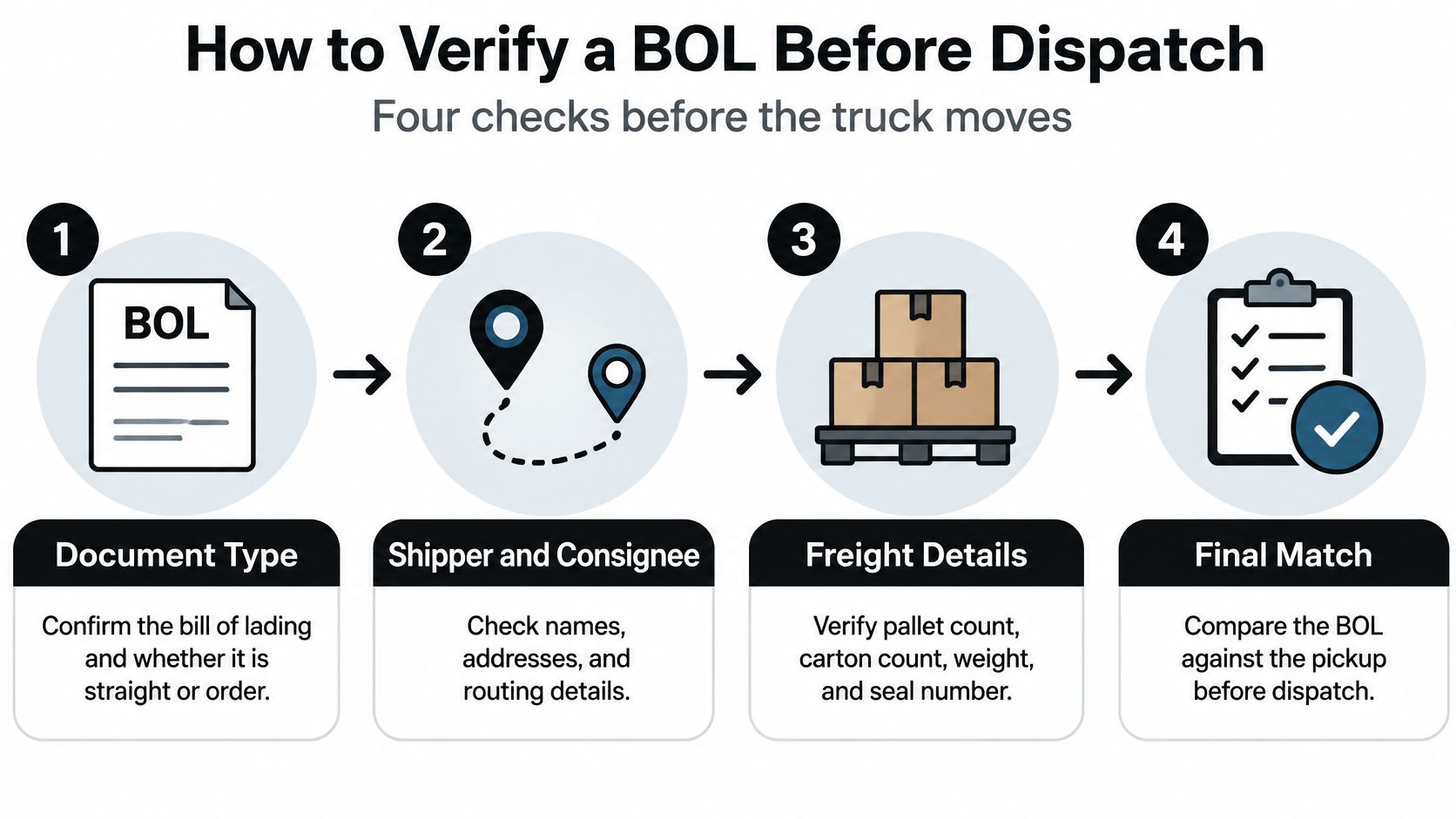
- Identify the document type and the controlling terms. Confirm you're holding a bill of lading rather than a packing slip, and check whether it behaves as a straight bill or an order bill. The federal household goods BOL requirements spell out how much must appear on the document itself, including issuing carrier, payment terms, pickup date, vehicle identification, valuation provisions and ordered accessorial services. The common slip is assuming the terms on page two match the terms everyone agreed to on page one.
- Validate parties, locations, dates and shipment identifiers. Compare the consignee name, delivery address, appointment window and BOL number against the dispatch record and the purchase order. A shipper name can match perfectly while the destination is one facility over from where the truck is going.
- Reconcile the freight against the physical load. Walk the pallets. Compare each quantity and identifier, not just the shipper name, to the pallet labels, seal number, appointment and loading record. Wet cartons, crushed corners, torn shrink wrap and resealed trailers are easy to miss under sodium lights at two in the morning, which is when they need writing down.
- Complete exception documentation at pickup and delivery. Photograph the freight, record the seal, and get the names of the people involved. A clean signature confirms receipt of the shipment condition stated on the page. It should never be used to accept a discrepancy.
If you want to tighten the front end of this process, browse pre-shipment inspection steps for a staged check addressing the same ground before a vehicle ever backs into a dock.
The three-way match that actually settles disputes
The control that holds up under a claim is a match among three things: the BOL, the warehouse scan or loading record, and the freight physically on the truck. Two out of three agreeing is not agreement. When they disagree, escalate immediately rather than logging a mental note, because the trailer pulls away whether or not the paperwork is right.
Don't sign until every row matches the load. Keep the original record intact. When a count or a seal can't be confirmed, write the qualified exception and escalate before the truck moves.
Freight Terms, Class and Weight Notations
The freight term decides who gets the bill, and it's the field to confirm before anything else, because a dispute about money starts with a dispute about who owes it.
| Freight Term | Who Pays the Carrier | Who Gets Billed | Check on the BOL |
|---|---|---|---|
| Prepaid | Shipper | Shipper | Charges box marked prepaid |
| Collect | Consignee | Consignee at delivery | Charges box marked collect |
| Third party | Named third party | Account named on the BOL | Named account matches the invoice |
Freight class sits underneath the price. LTL freight is rated on the NMFC scale, which runs from class 50 for dense, durable goods up to class 500 for light, bulky items, so a wrong class changes the invoice even when the freight itself is perfect. A pallet of dense machine parts quoted at class 70 instead of its real bracket gets reweighed, reclassified, and billed with an inspection fee attached. If you're unsure which bracket a product lands in, a NMFC code lookup beats a guess that shows up on an invoice six weeks later.
Weight is the next trap, and it's subtler. Federal statute requires the bill to state the number of packages, or the quantity or weight, and to make clear whether the figure is the carrier's weight or the shipper's weight, as set out in 46 U.S.C. § 30703. The same statute identifies the marks needed to identify goods, which is why "10 pallets" is an operationally weak entry unless the pallet count, carton count, gross weight and weighing party all appear.
Picture a line reading 3,180 LB with no weighing party anywhere on the form. The receiving team can't tell whether a scale produced that number or someone estimated it from a quote. Ask for the scale ticket before dispatch, and if the driver can't see a scale, write "shipper's stated weight" beside the figure rather than leaving it ambiguous. That one qualifier separates a transit shortfall from a pre-existing paperwork error, and it decides which party the claim lands on.
Qualified notation is not suspicion. "Said to contain" simply records that the carrier couldn't open a shrink-wrapped pallet. It protects the shipper's count too, because nobody is accused of losing freight they never saw.
The document's legal character matters as much as its numbers. A straight bill names one consignee and is not negotiable, so the freight goes to that party and the bill can't be transferred by endorsement. An order bill, marked "Negotiable," can be endorsed onward, and whoever holds the original can claim the goods, which means the carrier releases only against that original. Federal rail and water rules distinguish the two. Routine box truck middle-mile bills are almost always straight, but confirm the designation in the header or terms before dispatch, because a negotiable bill changes who may claim the freight at delivery and who must surrender an original to get it.
When you're buying the cartons and tape that make a count legible in the first place, these bulk carton and tape buying tips save money without weakening the packing.
Signing for Freight Without Creating a Dispute
Two in the morning at a hub dock. The driver counts two cartons short and the trailer seal number doesn't match the number printed on the BOL. The receiving clerk wants the paperwork signed so the shift can close out. This is the moment the document was written for.
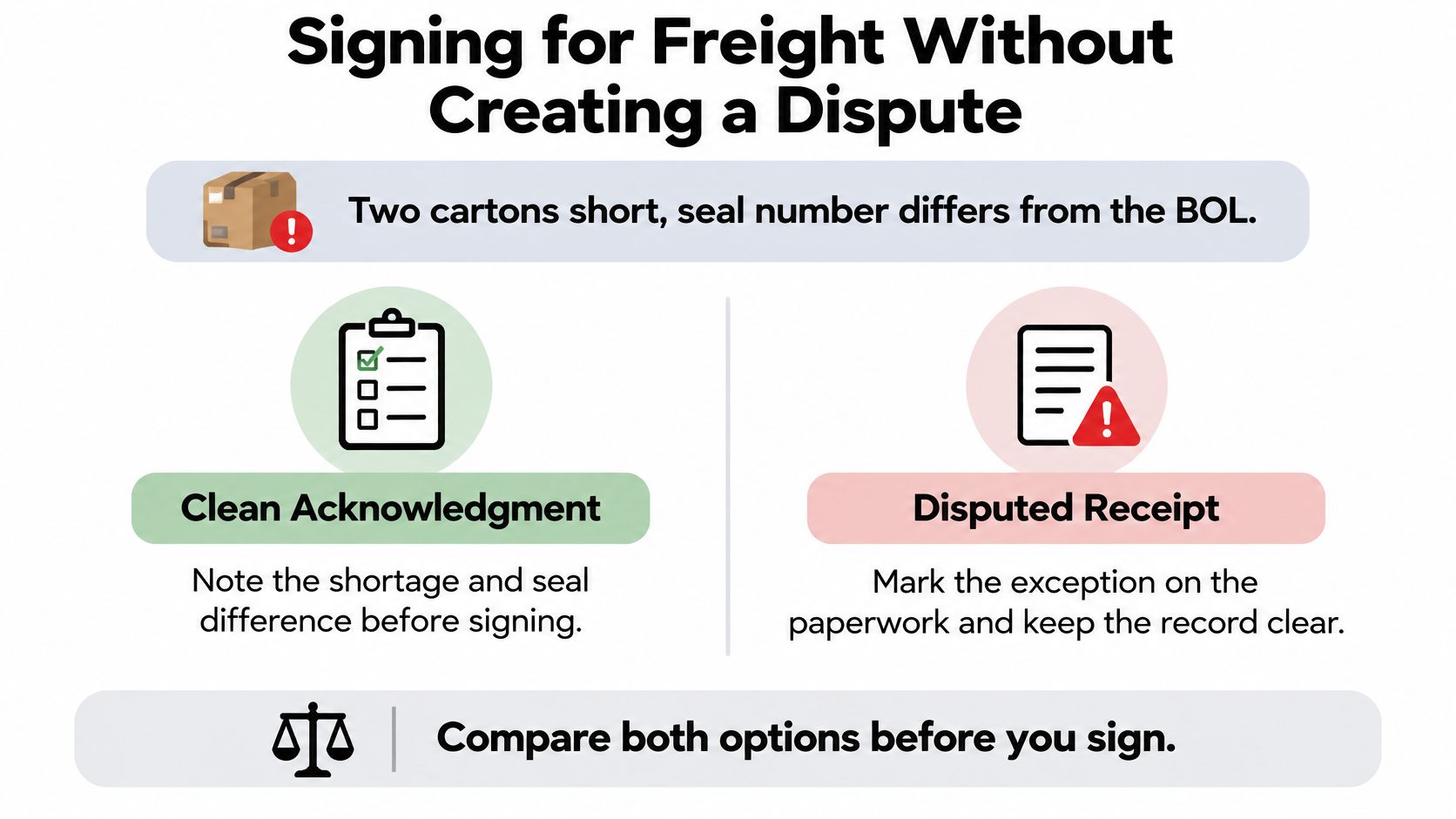
A clean acknowledgment accepts the stated count, condition and seal with no notation. It's fast, and it confirms every line as received. A qualified acknowledgment writes the exception beside the affected line. It costs about two minutes at the dock and keeps the claim clear for everyone. The practical guidance on bill of lading examples makes the same point from the claims side: an undocumented mismatch converts a correctable delivery variance into a disputed shortage, a damage claim, an invoice problem, or a failed proof of delivery.
| Discrepancy | Write on the BOL | Notify |
|---|---|---|
| Short count | "BOL shows 12 CTN, received 10, shortage noted at dock, photographed" | Dispatcher and shipper |
| Crushed corner | "Carton 7 crushed corner, contents unverified, photographed" | Dispatcher and consignee |
| Wet carton | "Water staining on 3 cartons, photographed" | Dispatcher and receiving supervisor |
| Seal mismatch | "Trailer seal [number] found, BOL shows [number], seal not broken, photographed" | Dispatcher, shipper and security |
| Unexplained received | Do not sign a bare "received" when a count or condition is in doubt | Escalate before leaving the dock |
Vague words cost money. "Damaged" and "received" both start arguments, because neither says what, where, or how many. "Carton 7 crushed corner, contents unverified, photographed" ends one.
A signature is evidence that the carrier accepted the shipment as described. It isn't conclusive proof that every stated quantity and condition was verified, which is why the notation matters more than the ink. Our box truck drivers load and unload with pallet jacks, document deliveries, and run pre- and post-trip inspections, so the count and condition check sits inside the job rather than bolted on at the end. That's also why photographing a damaged unit before it moves matters more than describing it from memory an hour later.
One rule holds without exception: never alter the shipper's original entry. Preserve the original paper or electronic record and append a dated carrier notation beside it. Rewriting someone else's line, even to correct an obvious error, destroys the chain of custody you're trying to protect. If a pallet shows impact damage from a forklift during unloading, note it on your copy too, because forklift damage during receiving is a common source of claims that get pinned on the wrong party. More on preventing that in this guide to cargo damage prevention.
Electronic Bills of Lading and Who Controls Them
A shipper emails a PDF labeled bill of lading, the truck arrives, and the receiving dock asks a reasonable question: who holds the original? The answer decides whether the freight releases.
An electronic bill of lading is not just a PDF. A transferable document requires a system that maintains control, integrity, and endorsement history, and that prevents duplicate originals from circulating, as the UNESCAP work on electronic bills of lading outlines. A scanned image in an email meets none of these criteria.
Run a short decision sequence. Identify whether the record is a non-transferable electronic receipt or a transferable title document. Verify the platform and which users are authorized on it. Confirm that the receiver, the bank, the insurer and any customs authority involved will accept the electronic version. Then agree a paper fallback before the truck leaves, not after it's at the gate.
Adoption is real but uneven, so acceptance can't be assumed. In 2024, 49.2% of respondents reported using electronic bills of lading either exclusively or alongside paper, up from 33.0% in 2022, according to the International Chamber of Commerce and FIT Alliance survey. The same survey work found 41.7% used both formats in 2024, compared with 28.0% in 2022, per the ICC's reporting, while 71% of organizations with more than 250 employees reported using electronic bills in some capacity, according to the FIT Alliance Electronic Bill of Lading Survey. Large shippers are ahead of the docks that receive their freight.
That gap is why the essential check stays simple. If any party in the chain can't accept the electronic version, print the paper original before the truck moves. Keeping both records aligned is the same discipline that makes digital record keeping useful rather than decorative.
Peak Transport runs overnight middle-mile box truck routes across the Twin Cities metro and surrounding areas, moving freight between distribution centers and regional hubs with documentation that holds up at 2 a.m. If your lanes need carriers who count, photograph, and note exceptions before signing rather than after a claim lands, visit Peak Transport to talk through coverage. Drivers in the Minneapolis and St. Paul area looking for consistent overnight work with W-2 benefits and paid training can apply through the same site.