Cargo Damage Prevention for Box Truck Operations
Learn practical cargo damage prevention for middle-mile box trucks, from pallet building and securement to inspections, handoffs, route planning, and claim
October 21, 2026
You're two stops into an overnight run, the dock is waiting, and the receiver is already asking why a pallet that looked fine at pickup arrived leaning with crushed cartons underneath. That moment isn't usually caused by one bad strap or one careless forklift pass. It's the visible end of decisions made at origin, during loading, in transit, and at every handoff in between. Treating cargo damage prevention as a custody and handling system gives you a chance to catch those decisions while they're still correctable.
Why Cargo Damage Prevention Starts Before the Truck Moves
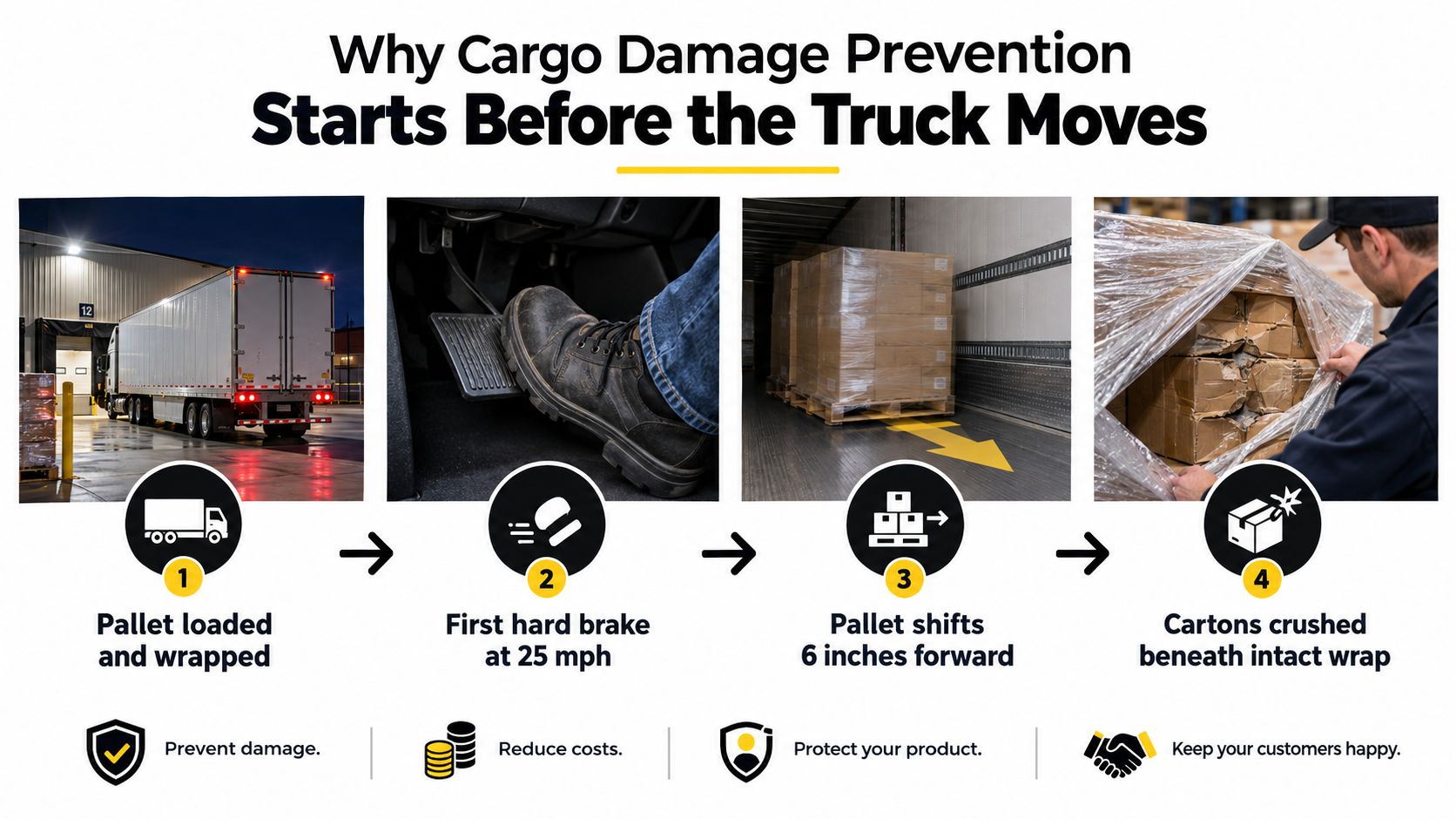
The pallet looked acceptable under the dock lights. The wrap was intact, the label faced out, and nobody flagged a lean. Then the driver braked hard for a changing light on the first leg out, felt the load settle forward, and found at delivery that lower cartons had buckled while the outer film still looked clean.
That sequence is common on overnight box truck work because damage rarely announces itself at the moment it happens. The receiver opens the wrap and discovers failure that started earlier, with a weak carton, a layer that wasn't square, a void nobody filled, or a pallet that shouldn't have stayed in service. By then, everyone is arguing from memory.
The four steps below show how a load that passes a casual glance can still fail under the first real force it meets.
Damage is only one kind of loss
Crushed product is the easiest loss to see, but it isn't the only one. A preventable incident can also mean a short count, a broken seal, freight exposed during an unplanned stop, or a claim nobody can prove because origin condition was never recorded. Prevention has to cover theft exposure and weak documentation alongside physical mishandling, because stolen or disputed freight creates the same downstream scramble for inventory, service, and claims staff.
The scale justifies that wider view. Documented losses rose from $223,096,368 in 2022 to $331,965,445 in 2023, an increase of approximately 48.8%, in a 2024 Federal Maritime Commission report citing CargoNet estimates. Those figures describe theft, not crushed cartons, but the operating lesson overlaps. Controlled handoffs, verified identities, and immediate exception reporting protect both the product and the record of who had it.
Practical rule: If a condition could change responsibility later, capture or correct it before departure, not after the receiver finds it.
That principle is the thread through everything that follows. Packaging and securement can't be judged separately, because a strong strap can't rescue a pallet that was built unstable, and a perfect pallet can still fail if it's loaded against a void. You need to know the freight, the route, the touches, and the evidence plan before you choose equipment or blame a driver. Most preventable incidents begin with something visible earlier.
Map Cargo Damage Exposure Across the Trip
Dispatch often compares lanes by miles and price because those numbers are easy to pull. Damage risk doesn't follow that math. A short lane with repeated transfers, long dwell on an open dock, and a reload by a crew that didn't build the pallet can expose freight more than a longer lane where the same sealed load stays put.
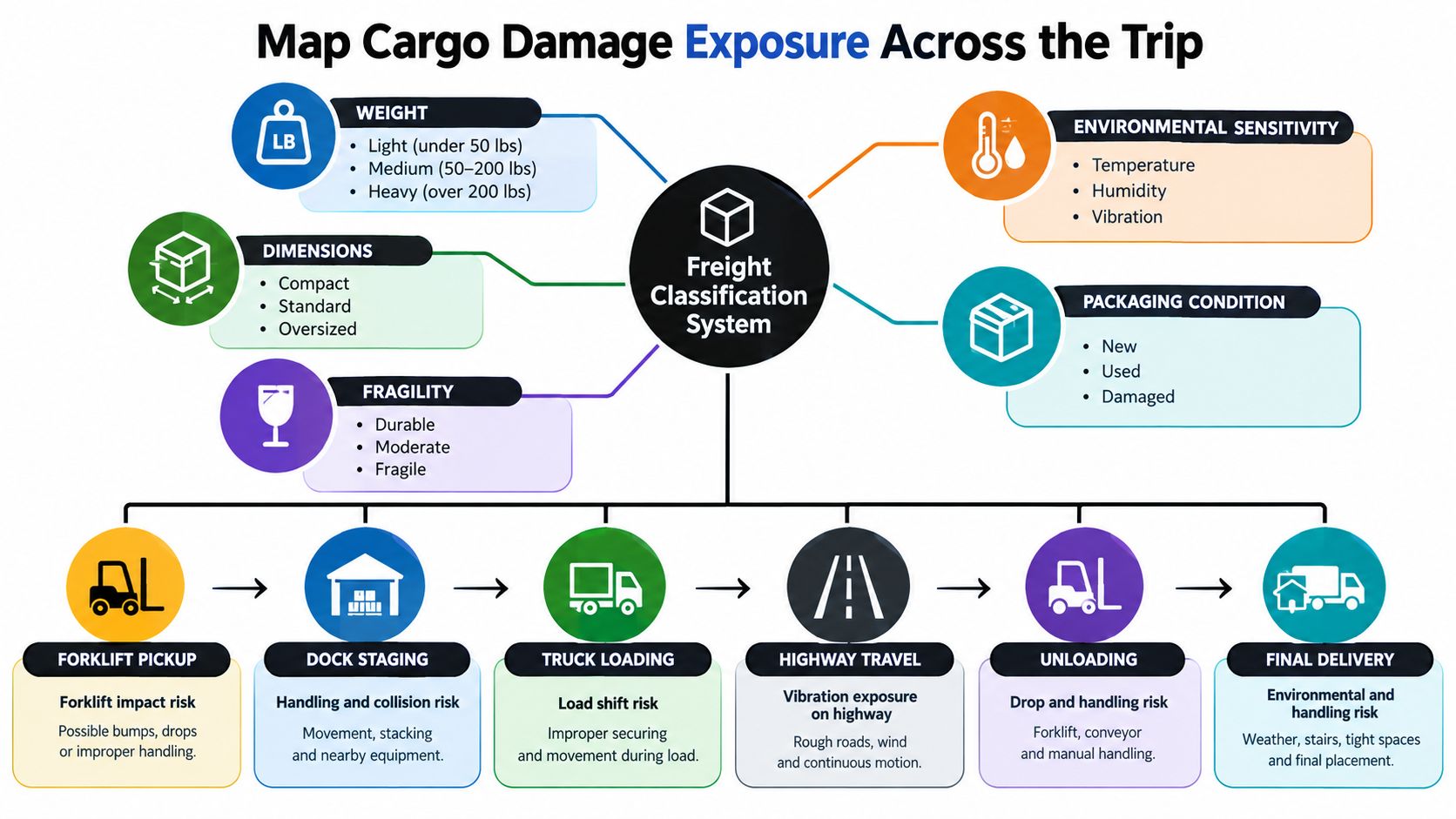
Start by classifying what you are moving. Weight and geometry decide where a case can sit and whether it can bear stacking. Fragility and environmental sensitivity decide how much vibration, compression, or moisture the product tolerates. Packaging condition at tender decides whether you are accepting a sound unit or inheriting someone else's failure.
The map below connects those classifications to the points where freight is handled along a trip.
Count the touches, not just the miles
Walk the trip on paper before the truck rolls. List origin loading, outbound staging, any hub transfer, trailer reloading, secure parking, and final delivery. For each point, ask who has custody, what equipment touches the pallet, how long it sits, and what scan or photo proves its condition there.
- Origin loading: Fork entry, layer compression, and placement against other freight set the baseline.
- Outbound staging: Dwell invites accidental bumps, double stacking, and exposure to dock moisture.
- Hub transfer and reloading: A new crew rebuilds securement without knowing the original load plan.
- Final delivery: Tight receiving windows pressure crews to unload before anyone inspects.
That touch count is worth tracking as a leading indicator. Industry research cited a 1.24% LTL damage or loss rate, approximately one shipment in 80, compared with a 0.81% damage and missing item rate across 851,978 shipments in a flow-through model with fewer handling points, as summarized in freight damage claim statistics compiled from shipper research. That comparison doesn't prove every flow-through design wins. It does suggest that handling intensity belongs on the same scorecard as carrier claims history.
Turn the map into a dispatch decision
Once you see the touches, you can price them fairly. A cheaper itinerary that adds a cross-dock may still be the right call for durable, low value freight in strong packaging. It may be the wrong call for fragile cartons on a tight replenishment window, where one damaged pallet costs more in lost sales and claim labor than the lane saved.
The trade-off runs both ways. Cutting touches only helps if the remaining facilities run disciplined scans, load plans, and securement standards. A direct lane handled casually can damage freight faster than a transfer lane handled well. Score each lane on touch count, dwell time, custody quality, and evidence at transfer, then decide where extra wrap or a better strap helps and where you're asking materials to compensate for handling you should remove.
Build and Load a Stable Unit Load
Treat each pallet as an engineered unit, not a stack of boxes that happens to fit. The carton, pallet, stacking pattern, and film work as one system, and the weakest interaction decides how it survives braking, vibration, and forklift handling.
Inspect before you build
Start with the pallet itself. Reject broken boards, protruding fasteners, warped decks, and any base that rocks or leans before product goes on it. A damaged pallet left in service turns every later control into guesswork, because the foundation shifts under load even when the cases above it are sound.
Check inbound packaging at the same time. Look for crushed corners, wet corrugate, punctures, and cartons that have already lost compression strength. If you're receiving a built pallet for an overnight leg, verify pallet integrity, visible lean, film tension, and signs of moisture before loading, and note exceptions while the tendering party is still present.
The inspection below is the habit to standardize, gloved, close, and hands on the base rather than a glance from the dock door.

Build square, aligned, and contained
Place heavy cases low and keep each layer square and vertically aligned so weight travels through carton walls instead of across unsupported spans. Keep similar package dimensions within a layer, eliminate overhang, and fill internal voids so cases can't walk inward under vibration. Protruding cases catch on door frames, other pallets, and forklift tines, and they lose the protection of the pallet footprint.
Add separators or stiffeners where mixed case sizes or weak layers need support. Then apply stretch film to restrain the finished unit, anchored to the pallet and tensioned enough that the load moves as one piece. Film that merely covers a loose stack for appearance does nothing when the truck brakes.
This matches what stability testing shows. Dynamic pallet stability research identifies packaging design and load formation as primary controls, while common failures include unsuitable corrugated board, missing separators, inadequate stretch wrapping, protruding cases, and non-perpendicular pallet geometry, as detailed in peer reviewed research on dynamic pallet stability. Product type matters too. Flat, surface sensitive goods need different thinking from boxed freight, which is why guidance on shipping protection for original posters is a useful reminder to match protection to the item's surface and rigidity rather than defaulting to one material for everything.
Do not cheapen one component in isolation
The common pitfall is cutting material cost without testing the complete pallet. Thinner board, a lighter pallet, or fewer film revolutions can each look fine in a static warehouse check. Combined with a new stacking pattern, temperature swings, and real handling forces, the unit can fail even though individual cartons passed inspection.
Validate changes under conditions that resemble your actual route and handling sequence. Controlled vibration, compression, and incline impact testing will tell you more than a supervisor pushing the top case by hand. When a test fails, change the system, not just the film tension, and record which packaging revision was approved for which product family.
A pallet that needs extra wrap to stand up straight on a still dock is not ready for a moving truck.
Finish with a short exception code and photographs at origin. That record makes the next section's securement check meaningful, because the driver can confirm the unit loaded is the unit that was built and approved.
Secure Cargo Against Real Vehicle Forces
Securement fails when it's based on how tight a load looks. A strap can feel snug at the dock and still allow movement once the truck brakes, turns, or crosses rough pavement and the load settles into gaps nobody controlled.
Design against measurable forces instead. FMCSA performance criteria call for cargo securement systems to withstand 0.8 g forward deceleration, 0.5 g rearward acceleration, and 0.5 g lateral acceleration, with an aggregate working load limit of at least one-half the weight of the secured article or group, under the FMCSA cargo securement rules. You don't need to lecture drivers on regulation. You do need a routine that respects those forces every load.
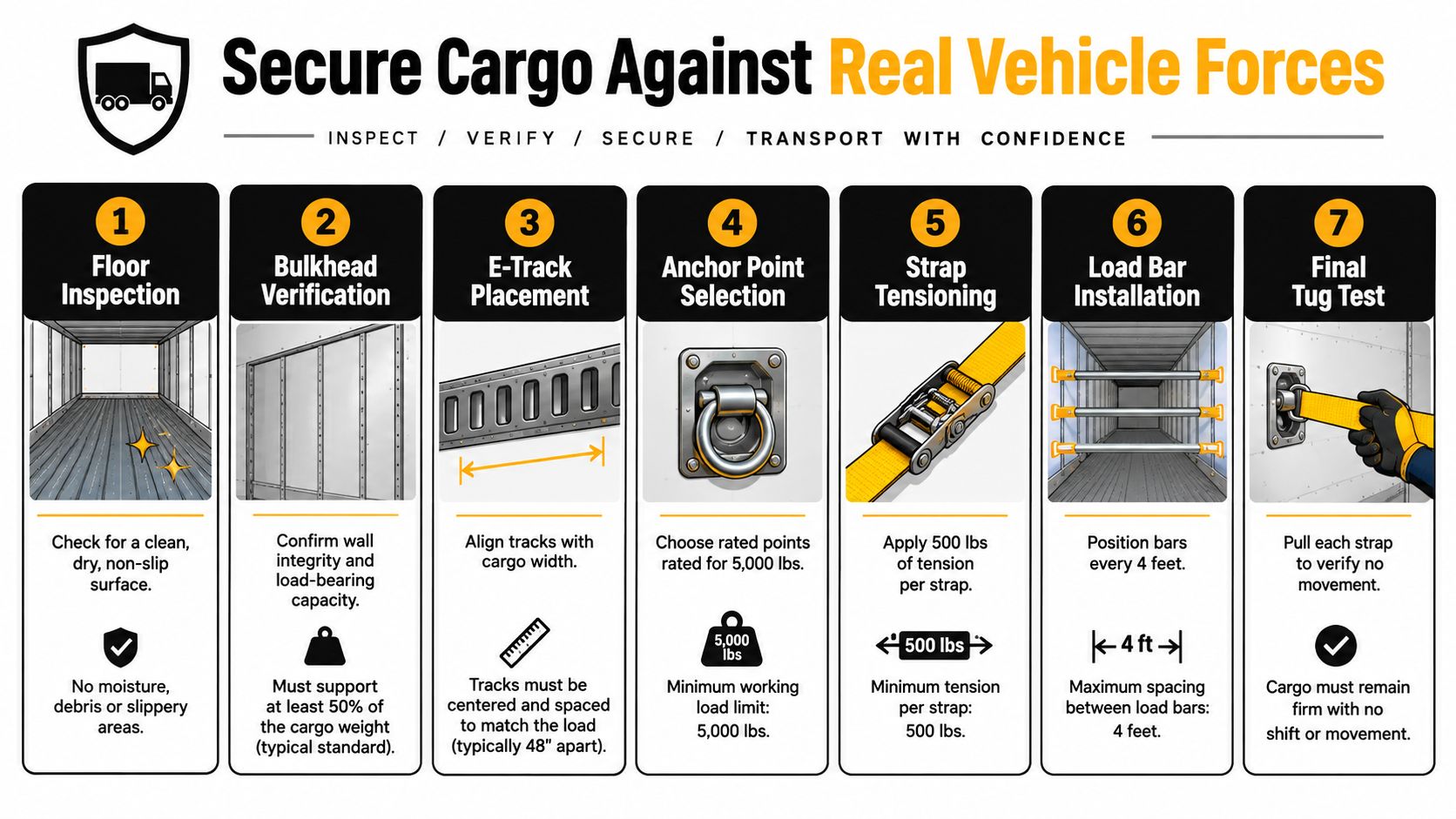
The checklist below lays out that routine as a sequence drivers can repeat without improvising.
A repeatable box truck routine
Begin before freight enters the box. Inspect the floor for debris and damage, confirm the bulkhead is sound, and check E-track, anchor points, straps, bars, airbags, and dunnage for wear that reduces performance. Equipment that looks serviceable but has frayed webbing, bent fittings, or a damaged ratchet doesn't belong in the system. Reviewing box truck requirements for equipment readiness alongside your inspection keeps vehicle condition and securement hardware in the same conversation.
Load dense freight low and evenly across the axle span so weight doesn't concentrate where it hurts handling. Prevent pallet to pallet contact where unsupported faces can rub or crush, and eliminate voids with blocking, bracing, or airbags sized to the gap. An unfilled void is travel distance. The farther a pallet can move before it hits something, the harder it hits.
Apply the required tiedowns to rated anchor points and tension them evenly. Don't rely on stretch film as the sole restraint, because film holds a unit together, it doesn't hold that unit to the vehicle. High value and surface sensitive freight makes the distinction clearer. The care described in Colorado Art Services on art protection shows why contact points, padding, and restraint method have to suit the object, not just the available strap.
Check, then check again after movement
Finish with a pre-departure tug and visual check of every restraint, bar, and blocked gap. Then recheck after the first substantial braking event or stop. Settling creates new slack and new voids, and the first miles are when a marginal load reveals itself while correction is still easy.
The walkthrough below is useful for showing new drivers what that physical check looks like in practice.
Common failures are predictable. Crews mix irregular freight without gap control, exceed what a marginal pallet can tolerate, or leave damaged pallets in the load because the dock is behind. Each shortcut transfers force to the product. If the recheck finds movement, fix the cause, refill the void, retension or add restraint, and log the exception so dispatch knows the lane or load pattern needs attention. A quiet fix with no record guarantees the next driver inherits the same problem.
Plan Routes and Parking Around Handling Risk
Miles are a weak proxy for risk. Two routes with similar distance can produce very different outcomes depending on road surface, stop frequency, weather exposure, how long freight sits unattended, and whether anyone has a safe place to recheck securement.
That doesn't mean the shortest route is wrong or that a longer route is safer by default. It means dispatch should weigh nominal mileage against touches, dwell, custody quality, and the driver's ability to stop, inspect, and document without creating a new hazard.
What dispatch should weigh before departure
Ask practical questions while the plan can still change. Does the route force repeated hard braking in dense traffic with a tall, marginal load? Will the driver need to park unattended, and is that parking controlled and well lit? Does weather threaten moisture at an open dock or extended dwell that nobody scheduled?
- Stop conditions: A safe recheck point early in the trip is worth planning, not hoping for.
- Dwell and custody: Freight sitting between scans is freight nobody can account for.
- Facility discipline: A transfer point with sloppy staging can undo careful origin work.
- Communication path: The driver needs a fast way to flag a shift, delay, or route change.
Building those factors into route optimization for logistics planning keeps risk visible instead of treating the route as a line on a map. You're optimizing for delivered condition and driver hours together, not distance alone.
When a direct lane earns its price
A lower priced itinerary that adds cross-docks, reloading, or unclear handoffs shifts cost rather than removing it. Each extra handling point consumes labor, adds dwell, and creates another crew that must rebuild securement correctly under time pressure. For fragile or time sensitive freight, a dedicated or tightly controlled middle mile lane can create more value than the cheaper multi-touch option once damage, claims work, and missed replenishment are counted.
For durable freight in proven packaging, the multi-touch option may be perfectly sound. The point is to decide deliberately. Flag facilities that repeatedly produce exceptions, set triggers that require a call before reloading or rerouting, and communicate changes early enough that the driver isn't documenting a problem from a shoulder. Don't make unsupported promises about any road or facility. Make the decision process explicit, record why the lane was chosen, and review that choice when damage patterns say it was wrong.
Verify Handoffs and Document Exceptions
Concealed damage is where good operations get exposed. Cartons look intact at pickup, the receiver signs clean to keep the dock moving, and damage surfaces during unpacking when nobody can show where custody changed or what the pallet looked like at each step.
More photos alone don't solve that. Evidence has to be standardized, searchable, and tied to a specific custody event, or it's just a camera roll nobody can use during a claim.
A fast inspection that crews will actually do
Keep the routine short enough to survive a tight overnight window. At pickup and receipt, capture timestamped condition evidence linked to the shipment and pallet ID. Cover all visible pallet sides, labels, pallet bases, top protection, and handling markings in the same order every time so missing views are obvious.
Record the exceptions that matter in plain codes your team uses consistently.
- Wrap or seal status: Intact, torn, rewrapped, or seal number mismatch.
- Structural signs: Lean, broken boards, punctures, crushed corners, loose cartons.
- Environmental signs: Wetness, staining, or moisture softened corrugate.
- Count discrepancies: Cases short, extra, or separated from the unit.
A receiver who suspects concealed damage should note the visible condition and exception on the receipt before signing, photograph the unit as received, and preserve packaging until unpacking confirms what's inside. Signing clean and calling later weakens everyone's position, including the receiver's.
Verify who is handing freight to whom
Documentation also controls loss, not just damage. Confirm pickup and delivery identities, match seal and shipment records to the physical freight, and report exceptions immediately while the other party is still reachable. Accurate records shorten investigations because the discrepancy gets isolated to one custody segment instead of the whole trip. Aligning those steps with your logistics documentation practices prevents each facility from inventing its own version of proof.
Turning the routine into a written procedure drivers and dock crews follow the same way is where many teams stall. A tool such as a sop creator can help convert a demonstrated inspection into a step by step document new hires can follow, provided operations leaders review it against real dock conditions. The format matters less than consistency. One standard, used at origin, transfer, and delivery, beats three detailed standards nobody completes.
On roadside documentation: Never trade safety for evidence. If a load shifts en route, the driver moves to a safe location first, then records condition and notifies dispatch.
That balance matters on overnight runs. Rapid handoffs and limited receiving windows make informal verbal reports unreliable, but an unsafe stop creates a worse problem than a late photo. Build the routine so the safe action and the documented action are the same action.
When evidence is consistent, a carrier can distinguish packaging failure from loading or transit damage by comparing origin photos, securement notes, and delivery condition. Without it, responsibility defaults to whoever touched the freight last, which teaches crews to defend themselves instead of fixing causes.
Track Damage Trends and Close the Root-Cause Loop
Total claims tell you that money left the building. They don't tell you what to fix. A single claims number blends weak cartons, unstable pallets, a bad transfer dock, a rough lane, and a receiver's forklift into one undifferentiated cost, so the loudest incident gets attention while the repeatable cause keeps running.
Break the data down until a pattern points to an owner and a correction.
Measure by failure mode, not just by count
Track damage and loss by lane, facility, product family, packaging revision, consignee, handling point, and failure mode. Then review the full record together, origin evidence, departure condition, securement exceptions, transfer scans, delivery photos, and any packaging test results for that revision.
Useful indicators stay close to operations:
| Indicator | What it reveals |
|---|---|
| Damage or loss rate per shipment | Whether overall exposure is rising or falling on a lane |
| Incidents by failure mode | Whether crushing, puncture, moisture, or shortage dominates |
| Exceptions documented per load | Whether crews are capturing condition or signing clean |
| Repeat cause frequency | Whether the same facility, product, or pattern keeps failing |
| Corrective action closure | Whether assigned fixes actually get completed and verified |
A lane with rising punctures at one transfer point needs handling or equipment attention there. A product family that crushes across several lanes after a packaging revision needs the revision retested, not drivers retrained. Segmentation is what separates those two responses.
Classify the cause and assign the fix
For each incident, classify the most likely cause in operational terms. Was it packaging failure, unstable load formation, loading technique, securement, transfer handling, a route or driving event, receiving handling, or theft? Some incidents will stay uncertain, and that's fine. Recording uncertainty plainly is more useful than forcing blame onto the last person who touched the freight.
Assign each corrective action an owner and a verification step. If the fix is a new stacking pattern, who tests it and who approves it for which products? If the fix is removing a transfer, who reprices the lane and confirms the remaining facility can hold the standard? If the fix is retiring damaged pallets at one origin, who audits the pallet pool next month?
That loop is where cargo damage prevention becomes a system instead of a poster. Drivers report shifts because they see load patterns change. Warehouse teams document exceptions because the data protects good work and isolates bad inputs. Dispatchers adjust lanes because touch counts and failure modes are visible before the next tender, not after the next claim.
Keep the rhythm simple and regular. Review exceptions with drivers, warehouse leads, dispatch, and receiving contacts on a set cadence, close old actions before opening new ones, and feed every confirmed cause back into the origin build, the securement routine, or the lane plan. The goal isn't a perfect record. It's a network where each incident makes the next load measurably harder to damage, lose, or dispute.
If your overnight freight keeps arriving with preventable damage, disputed handoffs, or claims nobody can trace to a cause, Peak Transport can help you run middle mile box truck lanes with disciplined load checks, documented custody, and route planning built around handling risk. Our Minnesota based team connects distribution centers and regional hubs on consistent overnight schedules, so your freight moves with fewer surprises and clearer accountability. Visit Peak Transport to discuss a lane, request capacity, or explore driving opportunities with structured dispatch support.