Logistics Coordination Guide for Middle-Mile Operations
Learn how logistics coordination works in middle-mile operations: roles, KPIs, dispatch steps, ELD compliance and overnight box-truck lanes.
November 6, 2026
It's 10:40 p.m. and your trailer still isn't sealed. The driver is in the yard, the receiving hub has already staffed its dock, and nobody can tell you who is supposed to confirm the new departure time. The truck, the freight and the people are all present. What failed is the handoff between them.
That's the work this guide covers. You'll learn how to assign ownership, run one clean overnight cycle, measure whether it's working, and keep the data behind each handoff usable when systems or people slip.
What Logistics Coordination Means in Middle-Mile Work
Logistics coordination is the planning, synchronizing and communicating that moves a shipment through every handoff on schedule, separate from the driving itself. Think of a conductor. A conductor doesn't play each instrument, but keeps many players in time so the piece doesn't fall apart.
The middle mile sits between a distribution center and a regional hub or delivery node. The distance is often short, but the lane has many hands. There's the shipper's appointment, the carrier's dispatch, the driver's available hours and the receiving dock's slot, and each one can move without the others knowing.
What coordination actually controls
Coordination controls three things at once:
- When freight moves: cutoff times, departure windows and arrival windows that every party agrees on.
- Who owns each handoff: one named person responsible for sending the next update or confirmation.
- What information travels with the load: seal numbers, counts, documents and exception notes that arrive before the truck does.
On-time arrival is therefore a result of the whole chain, not a driver-only score. That logic sits behind the World Bank's Logistics Performance Index, first published in 2007, which scored 139 countries in its 2023 edition on six connected capabilities including tracking and tracing and how often consignments reach consignees within scheduled time. Timeliness is judged alongside shipment organization and service quality, because a late arrival usually started earlier.
Practical rule: If you can't name the owner, the window and the document for a handoff, you don't have a plan for that handoff yet.
Three moments show where this breaks. A trailer misses its cutoff and nobody resets the window. A dock closes without notice and dispatch learns from the driver. A driver reaches a hub close to the hours limit with no margin left for unloading. Each one is fixable, but only if someone owns it before the truck is moving.
Who Coordinates What and Where Handoffs Break
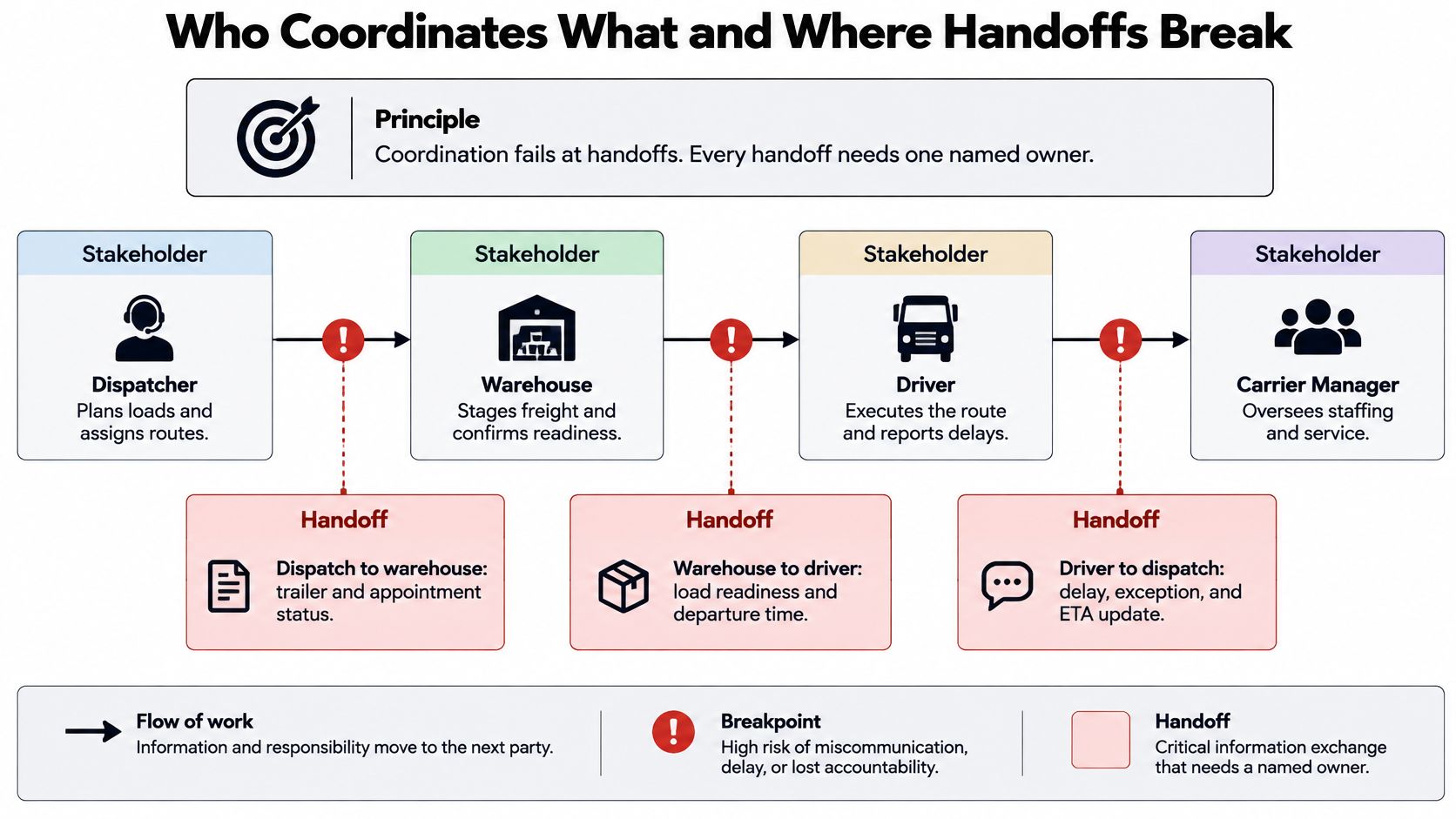
Coordination fails at handoffs, and every handoff needs one named owner. Not a team, not a shared inbox. One person who sends the confirmation, logs the exception or makes the call when the plan changes.
The map below shows how those handoffs connect, and where breakpoints appear when ownership is vague.
| Role | Owns | Key handoff | Where it breaks |
|---|---|---|---|
| Brand or shipper planner | Inbound volume forecast and appointment requests | Confirmed appointment to the DC | Late volume changes with no notice |
| DC operations lead | Trailer staging, load readiness and cutoff | Loaded, sealed trailer to the carrier | Trailers not sealed or documented at cutoff |
| Middle-mile dispatcher | Route assignment, exceptions and overnight updates | Driver assignment to the receiving hub | Delays reported after the hub has planned its shift |
| Driver | Pre-trip inspection, load check and delivery documentation | Signed arrival to the hub | Missing proof of delivery or unscanned stops |
| Receiving hub supervisor | Dock slot, unload and discrepancy report | Received count back to dispatch | Discrepancies reported days later |
| Compliance coordinator | Hours-of-service checks, documentation accuracy and audit trail | Verified records to the shipper | Records reconciled only after a complaint |
The minimum viable control tower
You don't need a wall of screens. You need a short list of milestones that must always be captured, a named owner for each exception, and a fixed way for dispatch to communicate delays overnight. Teams format that communication in advance, much like the structured approach in our guide to dispatch communication protocols, so a 2 a.m. update looks the same every night.
The gap between buying visibility and having it is wide. In a 2025 survey of 1,000 U.S. supply-chain professionals, 91% believed their organizations were equipped to provide accurate supply-chain visibility, yet only 33% consistently achieved accurate, 360-degree, real-time inventory visibility. Disciplined procedures close that gap faster than another dashboard.
Say a trailer at 10:40 p.m. isn't sealed at cutoff. The DC lead confirms seal status and documents why. The dispatcher sets a recovery window and tells the hub before it staffs the dock. The driver holds or departs on that revised window, and the dispatcher records the outcome in the exception log.
A lane can add or merge roles, but it can't leave a handoff ownerless. Draw your lane's handoffs on paper and mark the owner of each. The usual failure isn't a missing tool. It's a person waiting for information nobody was assigned to send.
How to Run One Overnight Dispatch Cycle
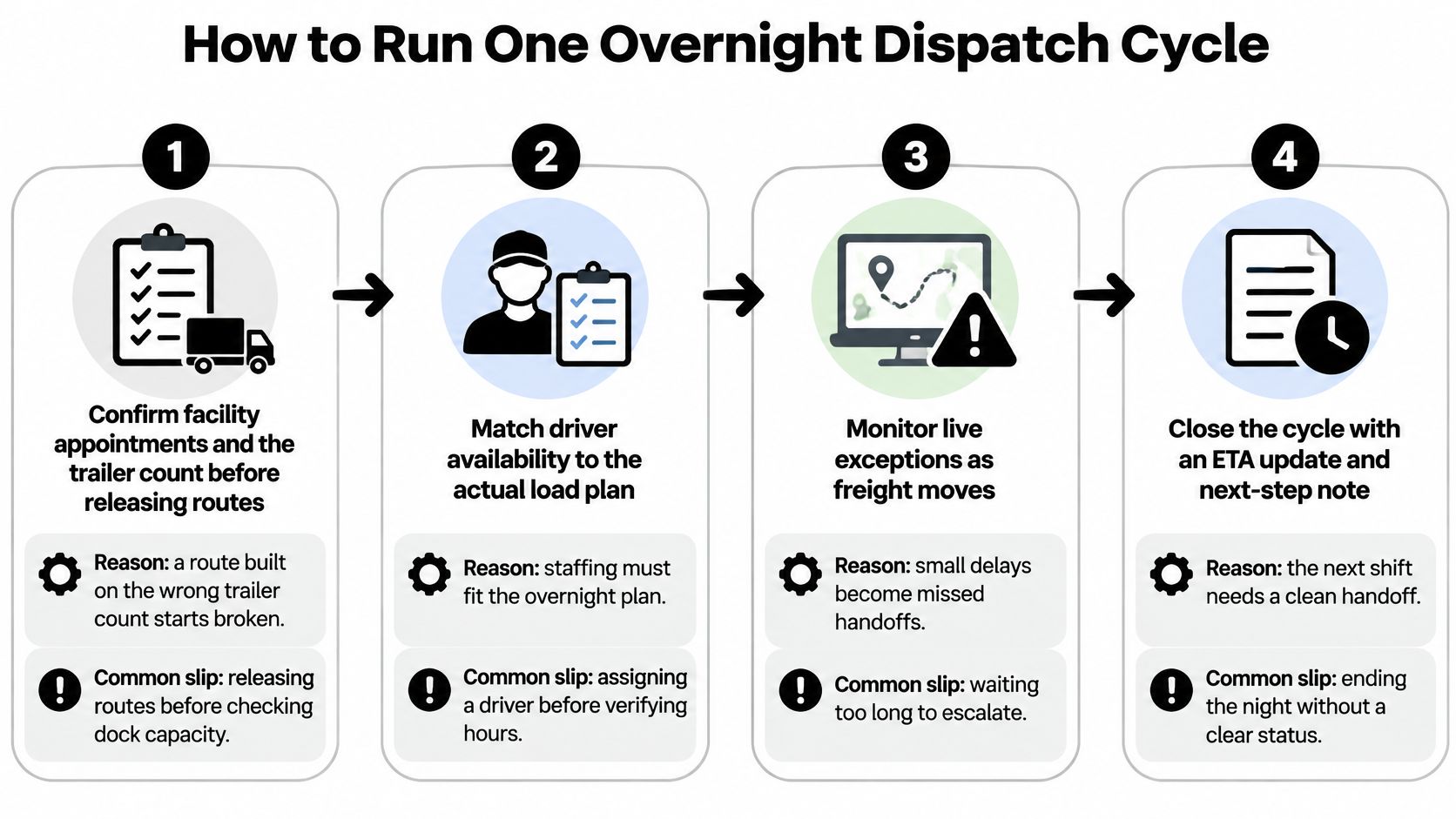
A dispatch cycle is one full pass of a load from route release to exception closure. It works like a relay with seven baton passes: each step hands the next something usable, and a dropped baton usually surfaces hours later as a missed arrival window rather than as a visible mistake.
The planning work happens before the first engine turns. Group shipments by destination hub and cutoff window so each trailer carries one destination cluster, and reject any route that adds a stop without a matching cutoff. Load by stop sequence, with first-delivery pallets nearest the door, so the driver doesn't unload freight to reach the first stop. Route planning takes the modeled stop sequence and drive time from your route modeling tool, with a congestion buffer set before release. The diagram below summarizes the cycle from confirmation to closure.
The seven steps
- Confirm appointments and trailer count before releasing routes. A route built on stale appointments is wrong before the driver leaves. The common slip is releasing routes before checking dock capacity.
- Assign a driver whose hours cover the whole job. Driving, stops, inspection and buffer all count. Hours checked after dispatch become forced stops later.
- Complete the pre-trip inspection and load check. At Peak Transport, box truck drivers load and unload with pallet jacks, document deliveries, and perform pre- and post-trip inspections. Record the trailer seal number in the load documentation before the doors close, on any carrier's lane. The common slip is loading without recording the seal, which leaves nothing to check the load against at the far end.
- Release in the scheduled window and send the first status event. A late departure shifts every later handoff, so the hub needs that first event immediately, not at the next checkpoint.
- Monitor at each checkpoint and escalate early. Escalate when a stop passes its planned dwell threshold, for example 30 minutes, or when projected arrival would consume the remaining hours margin. Don't wait for the driver to call.
- Scan arrival and departure at the hub and reconcile the count on the spot. Compare the received count against the manifest while the driver is still there. Discrepancies found the next day cost more to resolve and often can't be verified.
- Hold a short post-trip exception review. Compare planned and actual times, record each exception with its owner, and close what you can within the shift.
A clean cycle ends with exceptions closed, no unscanned stops, and planned versus actual times that differ by minutes rather than hours.
Every step produces a record the next step depends on. Step three's seal entry is what step six reconciles against. Step five's escalation is what turns a late arrival into a managed one instead of a surprise. Strip the records out and the seven steps become seven phone calls with nothing to compare afterward.
Two steps absorb most of the operational risk: appointment confirmation at the front and count reconciliation at the back. Both happen at a dock, both depend on someone other than the driver, and both fail when the dock is busy. Build the cycle around those two and the middle steps mostly run themselves.
If the cycle is new to your lane, run all seven steps in order for two weeks before adding tools or dashboards. The sequence is the system. Software only makes a sequence you already follow easier to see.
KPIs That Show Whether Coordination Works
Start with three questions. Is the lane arriving on time, where is freight waiting, and where is the handoff chain creating extra work? Each metric below answers one of them, and our overview of transportation key performance indicators shows how teams typically group them.
| KPI | How to calculate | What a decline usually signals |
|---|---|---|
| On-time delivery (OTD) | Deliveries arriving inside the agreed window ÷ total deliveries | Appointment or route plan problems |
| Dwell time | Minutes from arrival to departure at each facility | Dock congestion or unclear unload ownership |
| Touchpoints per shipment | Count of handoffs and status updates for each movement | Too many manual relays between parties |
| Detention minutes per stop | Minutes beyond free time at each stop | Facility scheduling or appointment buffers that are too tight |
| Schedule changes per driver | Route or shift changes per driver per week | Planning instability and driver frustration |
| Exception closure time | Hours from exception logged to exception resolved | Unclear exception ownership |
Reading the metrics together
On-time delivery is the outcome of the whole chain, so read it alongside dwell and touchpoints to find where delay starts. If OTD falls while dwell rises at one facility, you have a dock problem, not a driving problem. If touchpoints keep climbing, people are relaying information by hand because the planned handoffs aren't trusted.
Detention deserves special attention because it hits service and staffing at once. Reporting citing American Transportation Research Institute research found every additional 30 minutes of average detention per stop was associated with a 5.4-percentage-point increase in driver turnover, while an additional $5,000 in annual pay improved turnover by 2.9 percentage points. Pay matters, but it isn't the only lever, and it may not be the fastest one.
That changes how you prioritize fixes. Cutting detention at one congested dock can protect both tonight's arrival window and next quarter's roster. Schedule changes per driver works the same way. It's a planning metric and a retention signal in one number.
Build a four-week baseline before changing anything, then review weekly by lane. Split results by facility so you can separate planning errors from dock delays. Choose three KPIs to start, and name the owner of each one. A metric without an owner gets reported. A metric with an owner gets fixed.
Technology and Data Practices That Keep Handoffs Visible
Visibility comes from consistent data, not from owning one dashboard. The harder problem is operational data quality. You need consistent milestones, accurate arrival estimates, exception ownership, and shared definitions for departure, arrival, detention, misload and proof of delivery, so two systems don't use the same word for different events.
| System | What it records | Coordination use |
|---|---|---|
| Transportation management system (TMS) | Shipments, routes, appointments and driver assignments | One planned-versus-actual record for the lane |
| Electronic logging device (ELD) | Driving time, location and duty status | Hours-of-service feasibility and escalation triggers |
| Route modeling tool | Stop sequence, drive time and mileage | Less wasted mileage and realistic buffers |
| Scanner or event feed | Arrival, departure and proof-of-transfer timestamps | Auditable chain of custody |
| Dispatch exception log | Delays, misloads and detentions, each with an owner | Clear ownership and post-trip review |
The minimum fields every event needs
Independent systems can stay separate if each event carries standardized links. The NIST traceability framework recommends standardized links that securely connect independent supply-chain events while allowing each record's detailed data to remain in industry-specific formats. Applied to a middle-mile lane, every movement event should carry:
- Shipment or route identifier: globally unique, so two systems can't create colliding records.
- Location and event type: where it happened and what happened, using shared definitions.
- Source system and event time: which system created it and when, so duplicates can be reconciled.
Keep the original source record, and expose status changes through an API or structured file exchange. Where advance shipping notices feed older systems, it helps to automate ASN ingestion into legacy ERPs so appointment and shipment data arrive in the same format every time instead of being rekeyed. Our roundup of supply chain visibility tools covers how these pieces typically fit together.
Test before go-live for missing events, duplicate scans, clock discrepancies and delayed transmissions, because each one breaks dwell and schedule calculations. A scanner clock that's off by a few minutes makes an on-time arrival look late, and your team will argue about the data instead of fixing the lane.
When the technology fails
APIs and scanners will fail some night. Keep a low-tech fallback ready:
- Paper seal log: seal number, trailer and time, signed at the dock.
- Phone confirmation: logged by dispatch with a timestamp and the name of who confirmed.
- Same-shift reconciliation: paper records entered and matched before the next cycle starts.
Check your own systems against the minimum fields above. If any system can't produce them, that's your first fix, ahead of any new purchase.
Safety, Compliance and Staffing for Overnight Box-Truck Lanes
Say a driver starts the night with a comfortable hours buffer. One dock runs late, a second stop waits for a forklift, and the driver reaches the hub with no margin left. Nothing unsafe happened on the road. The plan spent the buffer without anyone deciding to.
The photo below shows the kind of schedule review that should happen before release, not after the shift.
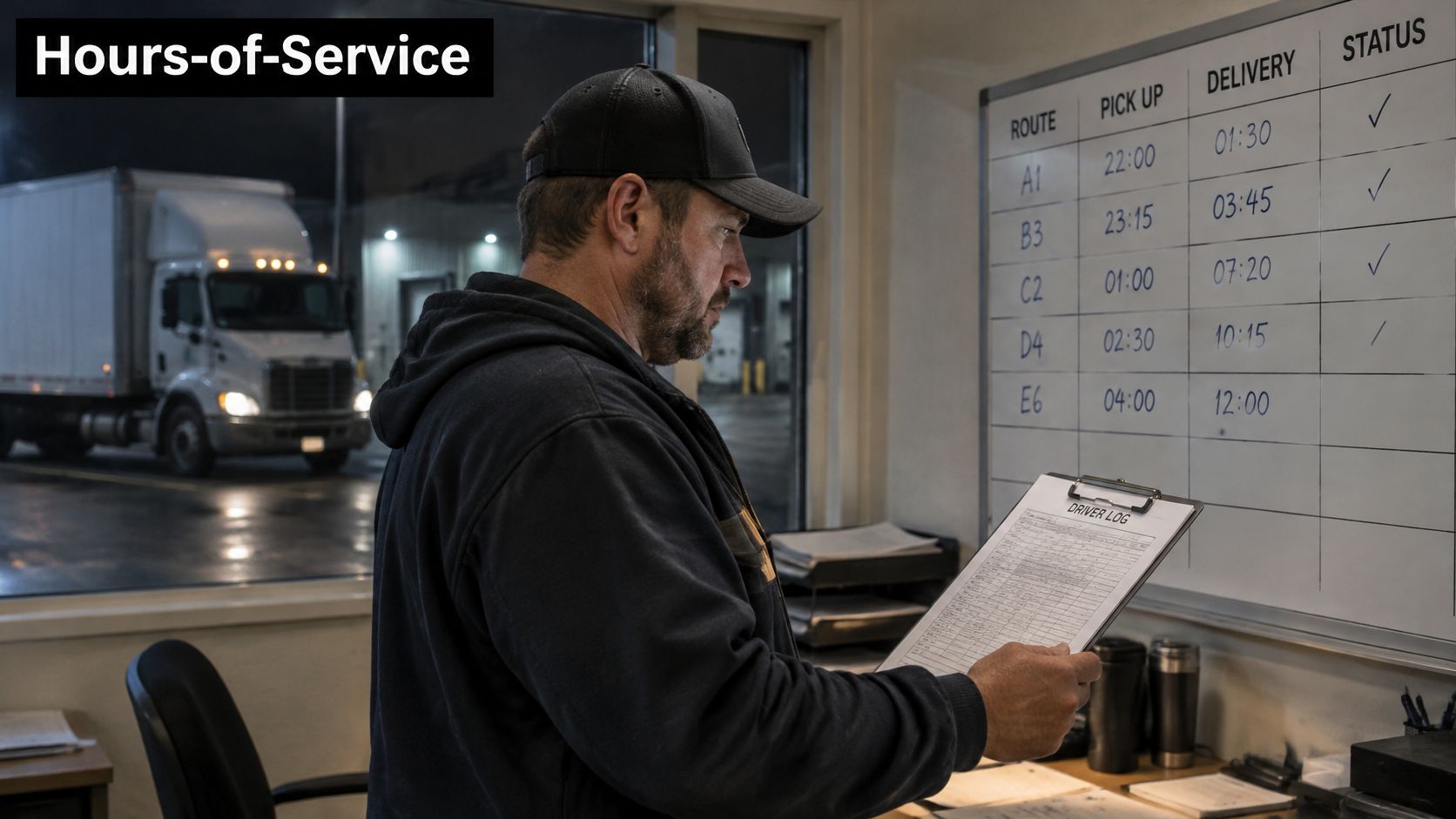
Hours-of-service feasibility belongs in dispatch planning, not in a post-trip audit. Before assigning a driver, calculate scheduled driving, loading, fueling, yard movement, congestion buffer, inspection time and the legally available on-duty margin. If the route only works when everything goes perfectly, it doesn't work.
The ELD is the coordination tool that keeps that calculation honest. The FMCSA electronic logging device rule requires recording date, time, location, engine hours, vehicle miles, and driver, vehicle and carrier identification, with location generally recorded at 60-minute intervals while the vehicle is moving. FMCSA also reports an estimated annual effect of ELD adoption of 1,844 crashes avoided, 562 fewer injuries and 26 lives saved.
Accurate duty-status data is therefore a safety mechanism and a reliability tool. Preventing an hours overrun also prevents forced unscheduled stops, missed hub cutoffs and last-minute reassignments. Use the ELD feed during the night to trigger escalation, not just to file records afterward.
The short video below walks through how duty-status records support safer dispatch decisions.
Staffing works the same way. Our middle-mile work is local, so drivers are home after their shift and do no long-haul overnight trips. Predictable schedules, usable equipment and paid training on safety standards, routes, equipment such as pallet jacks, and company procedures aren't perks bolted onto the operation. They're reliability controls, because a trained driver on a stable route catches problems earlier.
Close each route plan with a short checklist:
- Hours margin: calculated per route, with buffer intact.
- Escalation owner: named for each trigger.
- Equipment check: completed before release.
- Shift time: reviewed per driver, not assumed.
How Peak Transport's Engineered Lane Handles Common Pain Points
An overnight box-truck lane between distribution centers and regional hubs tends to fail in familiar places. Trailers run late at cutoff. Detours add mileage nobody planned. Driver hours run short at the hub, proof of delivery goes missing, and escalation depends on whoever happens to answer the phone.
Say a trailer is 40 minutes late at an 11 p.m. cutoff. Here is how an engineered lane responds, step by step, instead of improvising.
The response, control by control
Planned routes absorb the slip. Peak Transport's driver routes are scheduled routes between facilities, planned in advance, not random residential stops. Because those routes are planned ahead, dispatch can see which later handoffs the late trailer touches before the driver leaves the dock.
Route modeling protects the recovery. Peak Transport's Route Optimization uses data modeling to reduce mileage and cut fuel consumption. The revised plan removes unnecessary miles instead of asking the driver to hurry, which keeps the hours margin from turning into a safety problem.
Driver-side controls make the handoff clean. Box truck drivers load and unload with pallet jacks, document deliveries, and perform pre- and post-trip inspections. At the hub, that means the receiving team gets a trailer that was checked, a delivery that was recorded, and fewer surprises at the dock door.
Training gives the exception a trained owner. Peak Transport provides paid training on safety standards, routes, equipment such as pallet jacks, and company procedures. Training on routes and equipment gives drivers a standard way to handle the handoff, so exceptions surface through a known procedure instead of a guess.
Engineering a lane means deciding the response before the exception happens, so the night shift executes a plan instead of inventing one.
What should a partner look for in a lane built this way? Ask who owns each exception, what the update looks like at 2 a.m., and how last month's exceptions changed this month's plan. For Peak Transport, the visible controls are scheduled routes planned in advance, pre- and post-trip inspections, pallet-jack loading, documented deliveries, and paid training on routes and procedures. A coordinated carrier can show those controls in practice. An improvised one describes them in general terms.
This is one way to engineer a lane, not the only way. The test is whether the response is written into the route plan, the inspection routine, and the delivery record before the late trailer arrives.
Decide Whether a Coordinated Lane Fits Your Operation
The right next step depends on whether you're a brand moving freight or a driver looking for stable overnight work. Use the checklist that matches your situation.
For brands and operations leaders
- Lane volume and cutoffs: you can state nightly volume and fixed cutoff windows.
- Advance appointments: your facilities can confirm appointments before routes are released.
- Shareable events: shipment events can be shared in a standard format with consistent identifiers.
- Exception ownership: you can name who owns each exception on your side of the handoff.
For drivers
- License and record: the Truck Driver, Box Truck role requires a valid driver's license and a clean driving record.
- Overnight availability: you're available for overnight shifts and can operate a pallet jack.
- Experience: box truck experience is preferred, but not always required.
Shift times vary by route and we review them with applicants during hiring, so ask about the specific route you're considering. Our Middle Mile Logistics service is the link between distribution centers and hubs, and our drivers work scheduled local routes and return home after each shift. Questions before you apply or book a lane conversation? Call our office at 612-230-1292.
Review your checklist. If most boxes check out, a coordinated lane will likely outperform the improvised version you're running now, and the gaps that remain tell you exactly what to fix first.
If your overnight lane needs confirmed appointments, named exception owners and documented handoffs instead of improvised dispatch, Peak Transport runs scheduled middle-mile box-truck routes between distribution centers and hubs with that structure built in. Drivers get predictable local routes and home-after-shift schedules, and brands get a lane they can measure. Visit Peak Transport to discuss your lane or apply for a driving role.