Logistics Infrastructure: A Practical Guide for 2026
Understand logistics infrastructure in 2026 — physical and digital components, middle-mile operations, KPIs, costs, and how to choose the right regional
October 18, 2026
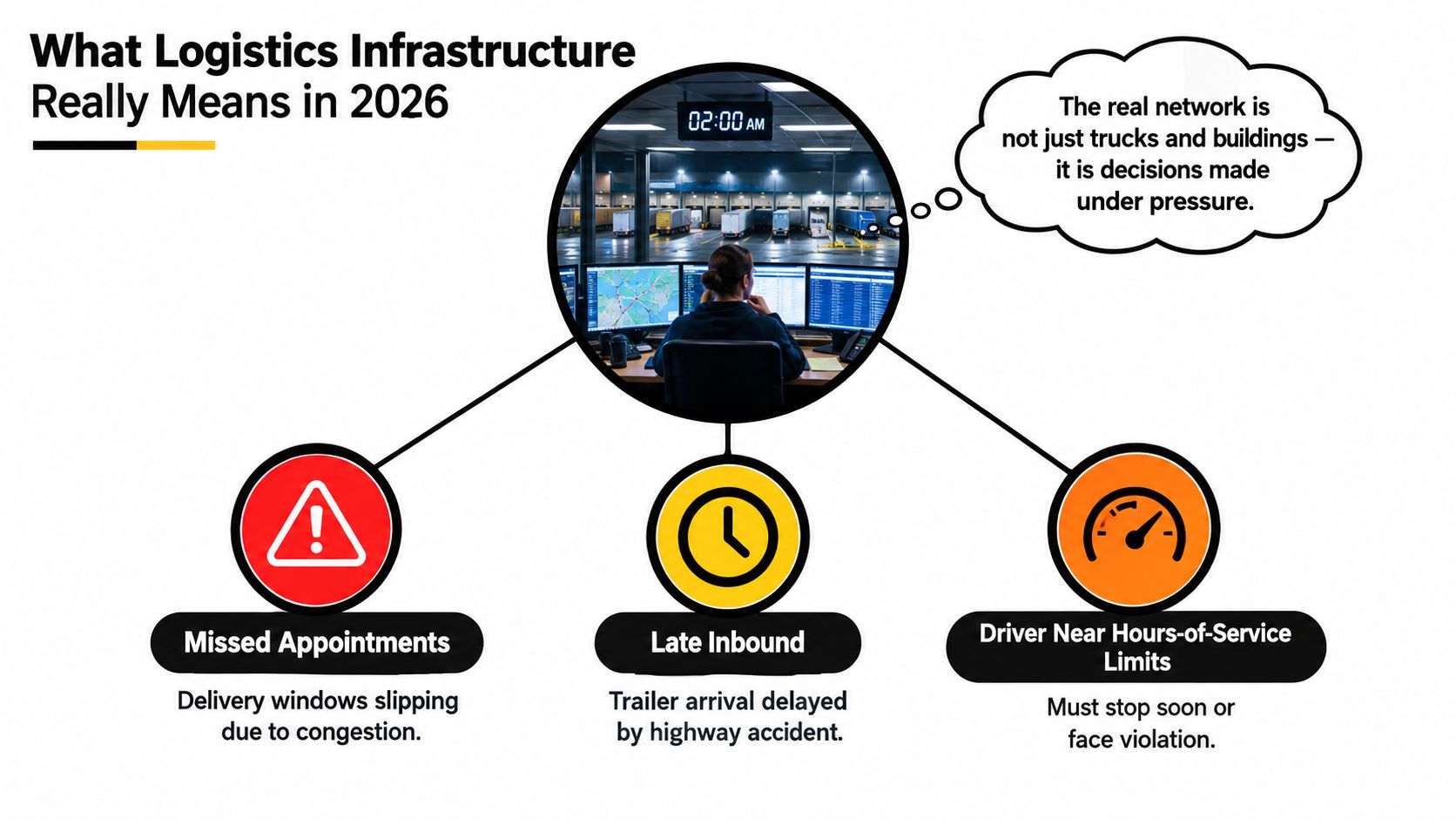
It's the middle of the night at a regional distribution center. Dispatch is watching a late inbound, a slipping delivery appointment, and a driver running short on available hours. Another truck won't necessarily fix any of it. The constraint might be an occupied dock, a slow facility entrance, or a receiving window nobody updated when the inbound schedule changed.
That's the practical meaning of logistics infrastructure. For an overnight box-truck network, it isn't just buildings and highways. It's the combination of assets, systems, and operating rules that lets freight move through each decision point without relying on last-minute improvisation.
What Logistics Infrastructure Really Means in 2026
Logistics infrastructure is the integrated physical and digital network that turns freight movement into a repeatable, schedulable service. Physical assets provide capacity. Digital systems coordinate that capacity. Operating procedures tell warehouse teams, dispatchers, and drivers what to do when the plan changes.
The World Bank treats infrastructure as one of six measurable foundations of logistics performance, alongside customs, international shipments, logistics competence, tracking and tracing, and timeliness; its 2023 assessment covered 139 countries, drawing on 652 logistics professionals across 115 countries, according to its Logistics Performance Index release.
That framework is useful because it doesn't equate good pavement with good service. A regional operator should apply the same discipline at a smaller scale: evaluate whether the available infrastructure supports the promised departure, arrival, and handoff.
The overnight dispatch problem makes those dependencies visible.
Define the network by its decisions
Start with the freight's path, not an asset inventory. Identify where someone must authorize movement, allocate space, confirm readiness, or accept custody. Each location becomes an infrastructure node with an owner, an expected operating condition, and an observable outcome.
- Physical nodes include distribution centers, warehouses, hubs, yards, roads, rail terminals, and ports. They determine where freight can move and wait.
- Digital nodes include transportation management systems, warehouse management systems, telematics, appointment tools, and visibility platforms. They determine who knows what and when.
- Operating controls connect them through release criteria, escalation procedures, documented facility approaches, and dispatch authority.
A dock camera belongs in this definition when staff use it to verify availability or investigate an unsafe approach. Appointment software belongs when it governs access to receiving capacity. Neither deserves investment because it produces another screen.
Practical rule: If an asset or system can change whether a load clears its next cutoff, treat it as part of the operating infrastructure.
The useful question isn't whether a facility looks modern. It's whether the people running it can make consistent decisions under pressure. A plain building with clear release rules can support a better overnight operation than an elaborate site where dispatch can't confirm freight readiness.
The Physical Layer of a Regional Network
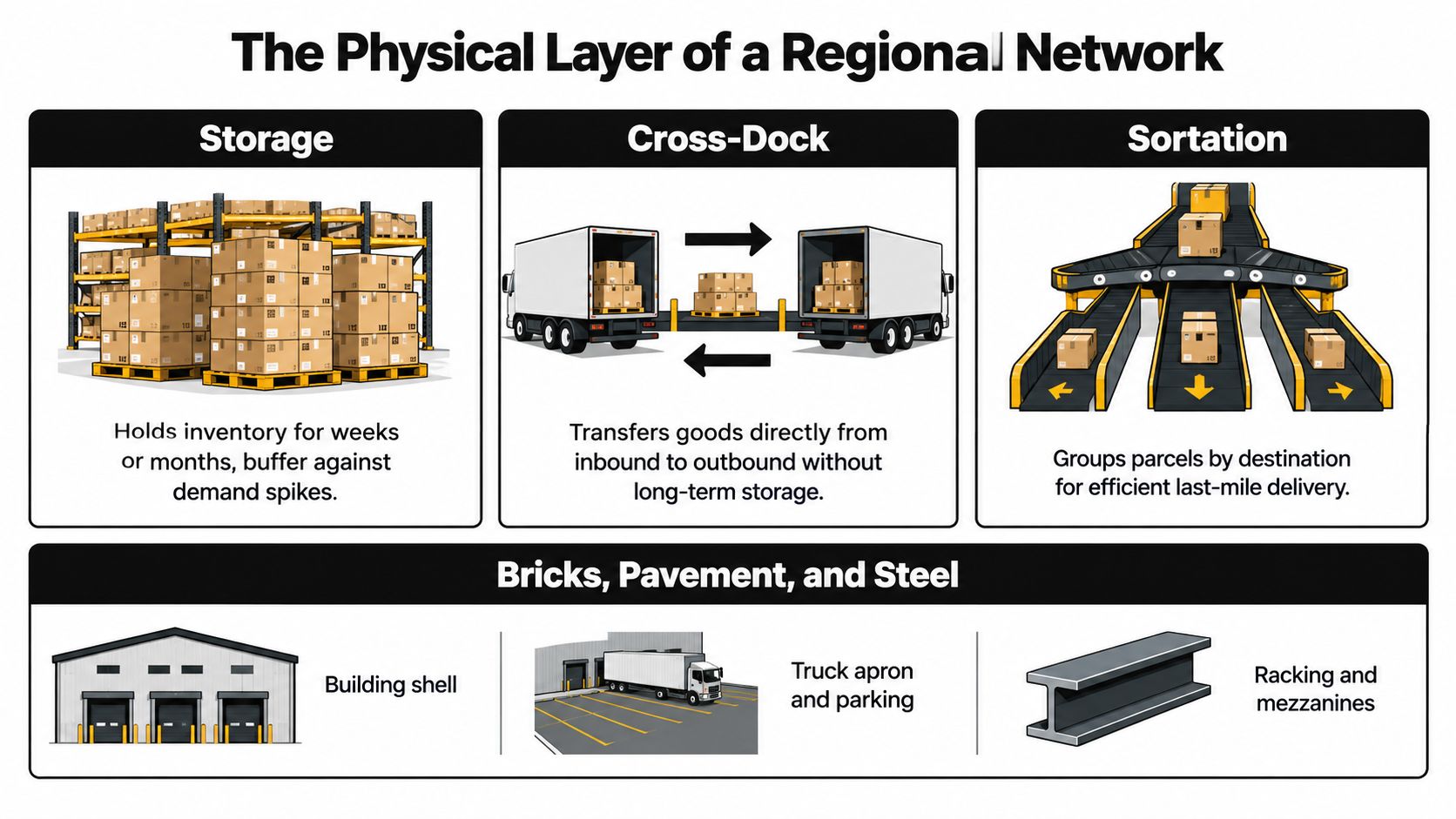
A facility can have plenty of floor space and still be a poor middle-mile node. The important distinction is between storage capacity and transfer capacity. Overnight operations need freight accessible, staged correctly, and ready to move through the building's actual loading constraints.
A storage warehouse holds inventory. A cross-dock transfers freight between inbound and outbound equipment without extended storage. A sortation operation groups freight by destination, while a returns operation needs room to inspect, segregate, and redirect goods. Mixing those functions without protecting outbound staging space creates avoidable competition at departure time.
Use the physical layout to identify which job each area must perform.
Inspect the path from entrance to departure
Walk the route a driver takes through the property. Check gate access, driveway geometry, pedestrian crossings, backing space, staging locations, and the exit. A highway-adjacent site loses much of its advantage if trucks queue across its entrance or drivers must make an awkward departure maneuver.
- Dock capacity means usable doors supported by labor, handling equipment, and clear staging space. An unstaffed door isn't dependable loading capacity.
- Yard capacity must accommodate waiting vehicles without blocking active movements. Parking and circulation need separate treatment.
- Supporting facilities should keep check-in, supervision, and operational administration out of freight-handling areas.
For a concrete facility reference when considering supporting workspace, see this modular logistics facility from Pacific Mobile Structures, Inc. Evaluate such options against the site's workflow rather than assuming additional building space resolves a loading constraint.
Connect the site to the wider network
Ports and rail terminals influence inbound availability even when the regional carrier never visits them. Linehaul carriers move consolidated freight between major nodes, less-than-truckload carriers serve shared networks, and box-truck operators handle regional transfers. Their equipment, availability, and service boundaries must match the facility's operating requirements.
Transport infrastructure is capital-intensive: in 2022, private infrastructure commitments in low- and middle-income countries reached $91.7 billion across 263 projects, including $66.2 billion across 85 transport projects, according to the World Bank's private infrastructure investment release.
Regional planners don't control that entire investment sector. They do control which facilities they use and how they connect them. A hub-and-spoke distribution design should therefore be tested against real transfer capacity, not just the apparent efficiency of lines on a map.
The Digital Layer That Makes the Physical Layer Work
A dispatcher needs more than a truck's location. They need to know whether the freight is released, the receiving facility can accept it, and the driver can complete the assignment safely. A map without those conditions is visibility without control.
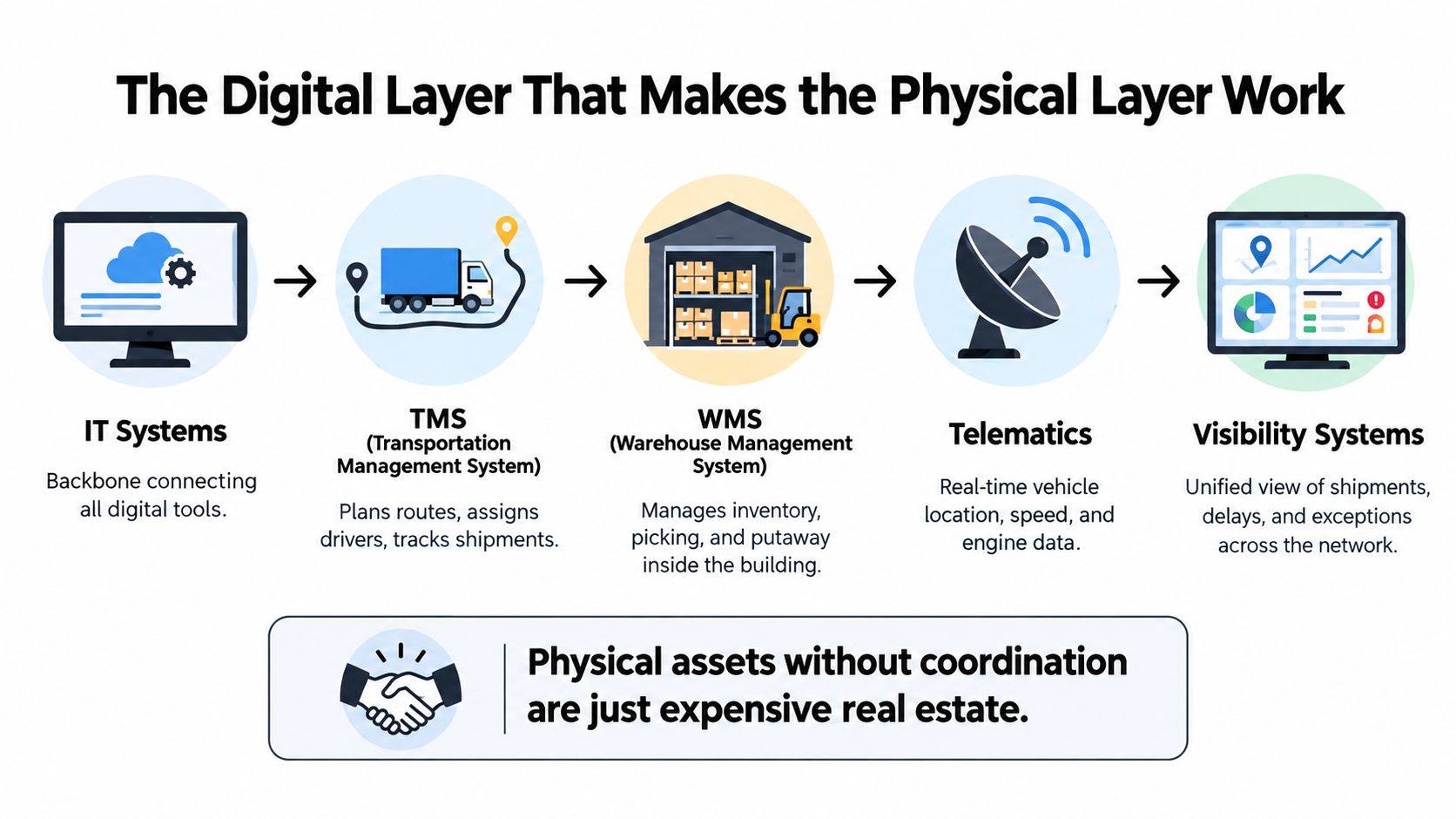
The digital layer should connect planning, warehouse execution, vehicle status, and exception handling. The relationships between those systems matter more than the number of applications purchased.
Give each system a clear responsibility
A transportation management system, or TMS, supports load planning, route assignment, and shipment execution. A warehouse management system, or WMS, manages inventory and warehouse work. Appointment and yard-management tools coordinate access and equipment movements, whether integrated into those platforms or operated separately.
Telematics contributes vehicle location and operating information. A visibility platform assembles relevant events into a shared shipment view. For implementation planning, a freight management systems framework helps distinguish planning functions from execution and exception management.
- Agree on event definitions. Arrival at the property, check-in, dock assignment, loading completion, and departure are different events.
- Preserve shipment identity. Warehouse, dispatch, and customer records should refer to the same load without manual reinterpretation.
- Assign exception ownership. A late-inbound alert should identify who must contact receiving, revise the plan, or authorize a fallback.
The World Bank's digitalization findings referenced earlier reinforce the importance of coordination. They are not a promise that a regional operator will achieve the same outcomes by buying software.
A useful alert tells an accountable person what changed and which decision is now required.
Choose action over dashboard volume
Integration failures often appear as disagreements between screens. The warehouse marks freight complete, dispatch sees it as pending, and the driver receives an assignment that isn't ready. Resolve the underlying event and ownership problem before adding predictive analytics.
This video provides an additional visual reference for the digital discussion.
Before approving a tool, ask the vendor to demonstrate an exception from detection through resolution. If the demonstration ends with a colored dashboard tile, the operational design is unfinished. The network needs a documented response, not merely a notification.
How Infrastructure Enables Middle-Mile Operations
Consider an overnight box-truck movement from a major distribution center to a regional hub. Its success depends on a sequence of releases: freight ready, vehicle ready, driver available, origin access confirmed, and destination acceptance protected. Dispatch should validate those conditions before treating the lane as executable.
At origin, warehouse staff stage freight against the load plan. The appointment process establishes when the vehicle can enter, while dock allocation governs where loading occurs. Dispatch then uses current conditions and historical travel-time information to choose an approved route and confirm that the receiving window remains achievable.
Design the lane around constraints
Shortest distance isn't the same as dependable travel time. The Federal Highway Administration estimated approximately 243 million truck-hours of annual delay across assessed freight bottlenecks, including about 25 million truck-hours at signalized urban freight intersections and 66 million on steep grades, in its freight bottleneck assessment.
Those are historical assessment figures, not a current forecast for an individual lane. Their operational value is the distinction between mileage and recurring capacity constraints. A signalized intersection near the destination can deserve as much planning attention as a highway segment.
- Protect the receiving cutoff. Plan backward from acceptance requirements rather than forward from the preferred origin departure.
- Document facility approaches. Approved entrances and alternate approaches belong in the route instructions.
- Match buffers to the bottleneck. Use observed delay patterns rather than adding the same padding to every lane.
- Select compatible recovery capacity. Trailer pools can buffer trailer-based operations; a straight box-truck lane needs recovery arrangements suited to its equipment.
Measure each handoff
The World Bank's logistics performance framework connects infrastructure quality with timeliness, tracking, connectivity, and reliability. At regional scale, that supports measuring both road movement and facility transitions.
Core Middle-Mile KPIs and What They Reveal About Infrastructure
| KPI | What it measures | Infrastructure signal |
|---|---|---|
| Facility dwell percentile | Time spent at a facility across the dwell distribution | Whether routine processing or occasional queues threaten departures |
| Appointment-to-departure variance | Difference between the planned departure tied to an appointment and actual departure | Whether scheduling assumptions match facility execution |
| Handoff scan completeness | Presence of required custody and shipment events | Whether transfer records support reliable exception handling |
| Route-level on-time percentage | Completed arrivals within the agreed service window | Whether the lane design supports its commitment |
| Exception frequency | Recurrence of defined disruptions | Where repeated intervention is needed |
| Delay hours per vehicle-mile exposure | Delay normalized against distance operated | Whether route changes improve performance beyond mileage reduction |
Keep KPI definitions stable. Separate gate waiting from loading time, and distinguish arrival from acceptance so managers don't argue over incompatible measurements.
For an external reference relevant to data discussions, review BatchData's case study for e-commerce logistics teams. Any proposed data approach still needs testing against your own shipment records, facility rules, and dispatch decisions.
Where to Invest First for the Most Reliable Network
Don't rank infrastructure investments before identifying the failure they're supposed to prevent. Extra dock capacity, an alternate hub, and better shipment visibility solve different problems. Their reliability value depends on the lane, the disrupted transfer point, and the available recovery options.
A 2025 survey of 950 supply-chain executives found average disruption-related revenue losses of 3.9%, compared with less than 1% among resilience leaders, according to the resilience executive summary. That difference supports taking resilience seriously, but it doesn't establish which investment will work at your depot.
Compare interventions against a failure mode
| Investment | Appropriate use | Important trade-off |
|---|---|---|
| Extra dock capacity | Freight repeatedly waits for staffed, usable doors | More doors won't resolve unavailable freight or insufficient labor |
| Alternate hub | A primary transfer site becomes inaccessible or cannot process freight | Detours, duplicate handling, and readiness costs |
| Trailer pool | Compatible operations need to separate loading from departure | Yard space, equipment expense, and asset control |
| Route redundancy | A recurring road constraint threatens the receiving window | Additional mileage or less predictable alternate access |
| Shipment visibility | Staff discover exceptions too late to respond | Integration effort and the need for accountable decision-makers |
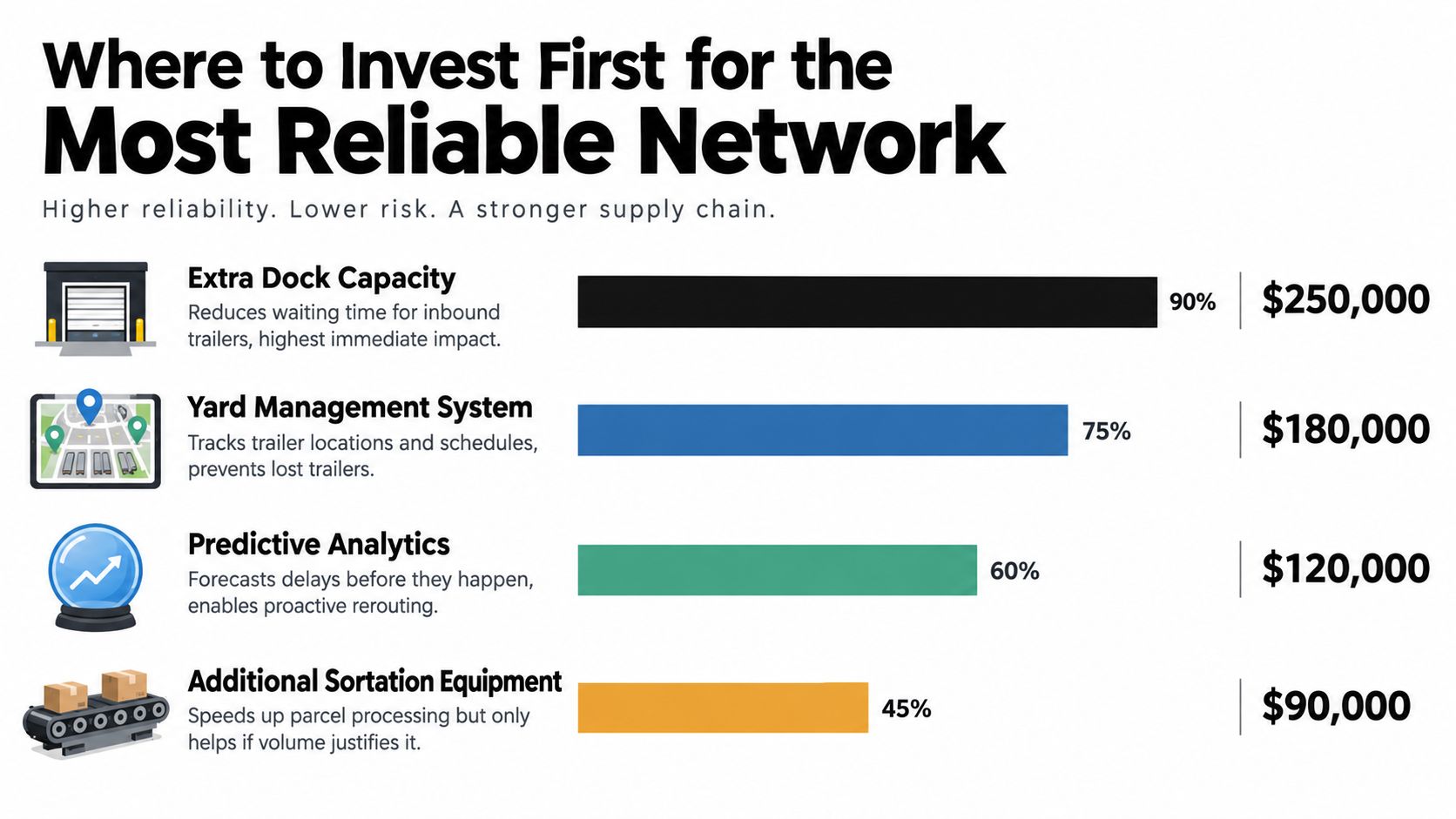
The following graphic is a conceptual comparison, not a validated cost estimate or universal investment ranking. Its displayed values shouldn't be used for budgeting.
Build a defensible spending case
Start with the documented consequence of failure. Include missed cutoffs, recovery transport, empty repositioning, driver-hour exposure, and time spent restoring the schedule. Keep confirmed costs separate from estimates and describe assumptions openly.
Then compare the proposed intervention with a lower-capital operating change. Revised release rules might address the same missed departure as a building project. An approved fallback route might provide useful recovery without relocating the hub.
Budget test: Name the failure, explain how the investment prevents or contains it, and identify the measurement that will prove it worked.
Capital expansion becomes defensible when process corrections can't remove the constraint. If staffed docks remain saturated during the required transfer window, additional capacity may be necessary. If departures slip because freight is released inconsistently, more square footage is a distraction.
Treat resilience as recoverable service capacity, not spare assets. An alternate hub has little value if nobody has confirmed access, receiving procedures, equipment compatibility, or dispatch authority before disruption occurs.
Designing Infrastructure for Safety, Compliance, and Electrification
An electric box truck can fit a route's nominal distance and still fail its overnight schedule. Depot power, charger access, return timing, weather, and departure clustering must work together. The unit of analysis is the completed node-to-node service, not the vehicle specification sheet.
Infrastructure delivery also has practical friction. Complex policies, regulations, and permitting were identified as the leading implementation challenge at 39%, while more than one in ten large-scale projects faced significant delays or cancellations, according to Deloitte's infrastructure research.
Test the depot before committing the fleet
Build the charging plan from actual vehicle return and departure patterns. Confirm electrical-service availability with qualified specialists, then test whether the charging arrangement can support overlapping vehicle requirements. Don't assume public charging will provide the same scheduling control as terminal infrastructure.
- Energy requirement should reflect the intended route, payload, seasonal conditions, and reserve policy.
- Charging capacity should account for usable dwell, simultaneous demand, and charger availability.
- Site design must preserve circulation, safe cable placement, and access for maintenance.
- Recovery arrangements need clear triggers for equipment substitution, charging failure, or an unplanned extended route.
Calculate total cost per completed overnight route using your own inputs, including energy, demand-related utility charges where applicable, equipment, site work, and recovery. A practical electric vehicle logistics assessment should connect those costs to service feasibility rather than treating electrification as an isolated procurement decision.
Make safety controls part of dispatch
Driver qualification files, hours-of-service records, inspection documentation, and maintenance release status should inform assignment decisions. A record archive isn't enough if dispatch can assign a vehicle with an unresolved defect or a driver without suitable available hours.
Physical security requires similar operational integration. For a warehouse-focused reference, see Wisenet Security Ltd's advice while assessing access control and monitoring needs; site-specific design still needs to reflect local conditions and qualified guidance.
Dispatch protocols should state who can stop an assignment, how a defect is escalated, and how the customer receives a revised plan. Drivers shouldn't have to negotiate those decisions while backing into a congested yard.
Safety compliance isn't spare capacity that managers can spend to recover a late load. If the schedule depends on bypassing inspection, rushing a maneuver, or exhausting available driver hours, redesign the schedule.
Choosing a Middle-Mile Partner That Treats Infrastructure Seriously
Ask a prospective carrier to explain a disrupted run, not just describe its normal service. Request the sequence of decisions after a late inbound: who detects it, who contacts receiving, who checks driver availability, and who authorizes the revised assignment. Specific answers reveal whether dispatch operates from documented procedures.
The carrier should be able to show how its people, equipment, and records support execution. A polished presentation doesn't substitute for a route instruction that a driver can safely follow at night.
Examine evidence behind the promise
- Dispatch systems should retain assignments, status changes, and escalation records. Ask how warehouse updates reach the dispatcher.
- Route documentation should identify facility entrances, check-in requirements, restricted movements, and approved alternatives.
- Employment arrangements need clarification. Ask whether drivers are W-2 employees or contractors, then examine training, supervision, and accountability separately.
- Maintenance standards should include defect reporting, repair verification, and vehicle release procedures. Equipment age alone doesn't establish condition.
- Safety culture becomes visible when a driver reports a problem. Ask how leadership handles an assignment that can't be completed safely.
Peak Transport is one regional option: its Minnesota overnight box-truck operations connect major distribution centers and regional hubs using W-2 drivers, structured dispatch, paid training, and detailed route documentation. Those are relevant operating characteristics to examine alongside other carriers' coverage, capacity, and service fit.
Separate operating consistency from sales language
Request a sample communication cadence for departure, exception, arrival, and completion. Confirm who receives each update and what happens when a required event is missing. Customer visibility should survive a dispatcher change or driver substitution.
Appointment adherence also needs an agreed definition. Ask whether the carrier measures arrival at the gate, check-in, unloading start, or accepted delivery. Without that agreement, apparently strong performance reports may describe a different service outcome from the one your hub needs.
Finally, evaluate continuity. A dependable partner should explain how qualified replacement drivers receive route information and how maintenance substitutions preserve equipment compatibility. The goal is repeatable execution without making the customer rebuild the plan whenever staffing changes.
Putting It All Together and Choosing Your Next Move
Logistics infrastructure becomes manageable when you stop treating it as a broad investment category and start treating it as a set of service constraints. A useful project should improve reliability, protect driver hours, or reduce the consequences of disruption. If its sponsor can't explain that connection, the project isn't ready for approval.
The practical next move is a focused operating test. Choose a recurring failure you can observe and influence this quarter. Don't begin with the most impressive technology or the largest capital request.
Turn a constraint into an accountable improvement
- Define the variable. Select facility dwell, appointment variance, recovery readiness, or driver-hour exposure.
- Establish a baseline. Use consistent event definitions and record the operating conditions behind each result.
- Assign an owner. Give a named person authority to coordinate the change across warehouse, transport, and receiving teams.
- Test an intervention. Change a specific control and compare outcomes under reasonably similar conditions.
Review the result with the people who execute the lane. A reduction in origin waiting isn't a win if drivers queue longer at destination. Check whether the change improved the completed service rather than shifting the delay to someone else.
Keep successful controls in route documentation and dispatch procedures. Revise unsuccessful ones before expanding the approach. That discipline makes improvement usable across shifts instead of dependent on a particular manager being present.
Middle-mile reliability is earned at the transfer points. The facility entrance, freight release, receiving appointment, and recovery decision deserve the same scrutiny as the truck. Measure the constraint you can change, then make the resulting operating rule repeatable.
Peak Transport offers structured overnight box-truck service between distribution centers and regional hubs in the Twin Cities and surrounding areas. Visit Peak Transport to discuss your lane requirements, facility handoffs, and dispatch expectations, or explore W-2 driving opportunities with consistent overnight schedules and paid training.