Freight Management Systems: A Practical Guide
Learn how freight management systems work, what features matter, and how to evaluate them for middle-mile box-truck operations like Peak Transport.
October 14, 2026
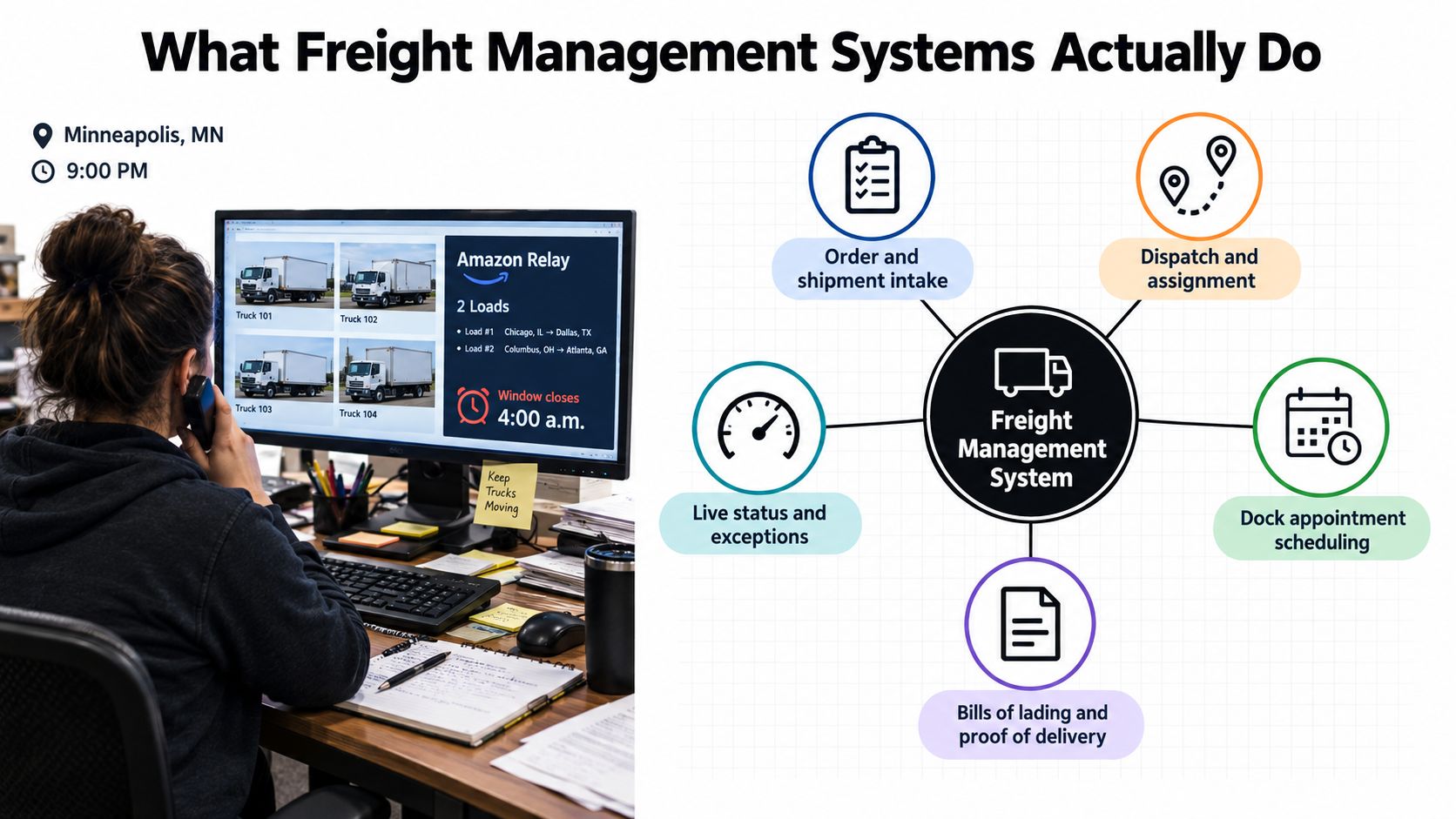
At 9 p.m. in Minneapolis, a dispatcher may be watching four box trucks, two Amazon Relay loads, several driver-hour balances, and a delivery window that closes at 4 a.m. A late departure from one distribution center can affect a hub handoff, a return move, and the next driver assignment before anyone has time to rebuild the plan manually.
That is the environment where freight management systems earn their keep. The useful question isn't whether a platform has the longest feature list. It's whether the system can help a dispatcher make a feasible assignment, preserve an accurate shipment record, surface an exception early, and prove what happened after delivery.
What Freight Management Systems Do
A freight management system is the operating layer between freight orders and physical execution. It brings shipments, vehicles, drivers, appointments, documents, status events, and financial records into one working record, so an overnight dispatcher is not reconciling email, spreadsheets, carrier portals, and phone calls to answer one question.
Working definition: A freight management system turns freight data into an operational decision, then records the decision and its outcome.
That scope extends beyond route optimization. Route planning identifies a path for the truck. An FMS also identifies the shipment, checks whether the driver can complete the move within practical and legal limits, tracks the facility appointment, attaches the right documents, records arrival, and supports billing.
A TMS manages transportation execution, including tendering, routing, carrier coordination, tracking, and freight cost records. A WMS manages warehouse activity, including receiving, inventory movement, picking, packing, and dock operations. For a plain-language explanation of warehouse workflows, see this guide to how WMS software works.
An FMS often brings those transportation workflows together with shipment administration, documentation, visibility, exception handling, and communication with partners. The product names overlap, so evaluate the workflow rather than the label.
For a middle-mile carrier running box-truck lanes around the Twin Cities, the required record is practical: load details, assigned truck, driver, facility window, status history, and proof of delivery. A broad platform may include forwarding, customs, or procurement functions that the operation never uses. The system still needs to preserve the load history and expose the constraints that determine whether the move can be completed.
The technology grew from the shift away from paper administration. The Transportation Data Coordination Committee was established in 1968, ANSI chartered Accredited Standards Committee X12 in 1978, and the United Nations established UN/EDIFACT in 1988. These standards support electronic messages for shipment tenders, status updates, invoices, manifests, and delivery confirmations, as described in this history of electronic data interchange.
An operation likely needs an FMS when dispatchers repeatedly reconcile conflicting shipment statuses, retype appointment information, search for delivery documents, or decide whether a driver can finish a route with incomplete duty-status information. Data governance and usable ELD inputs often determine whether the system works in practice. Where those problems are limited, a focused TMS and disciplined procedures may be enough.
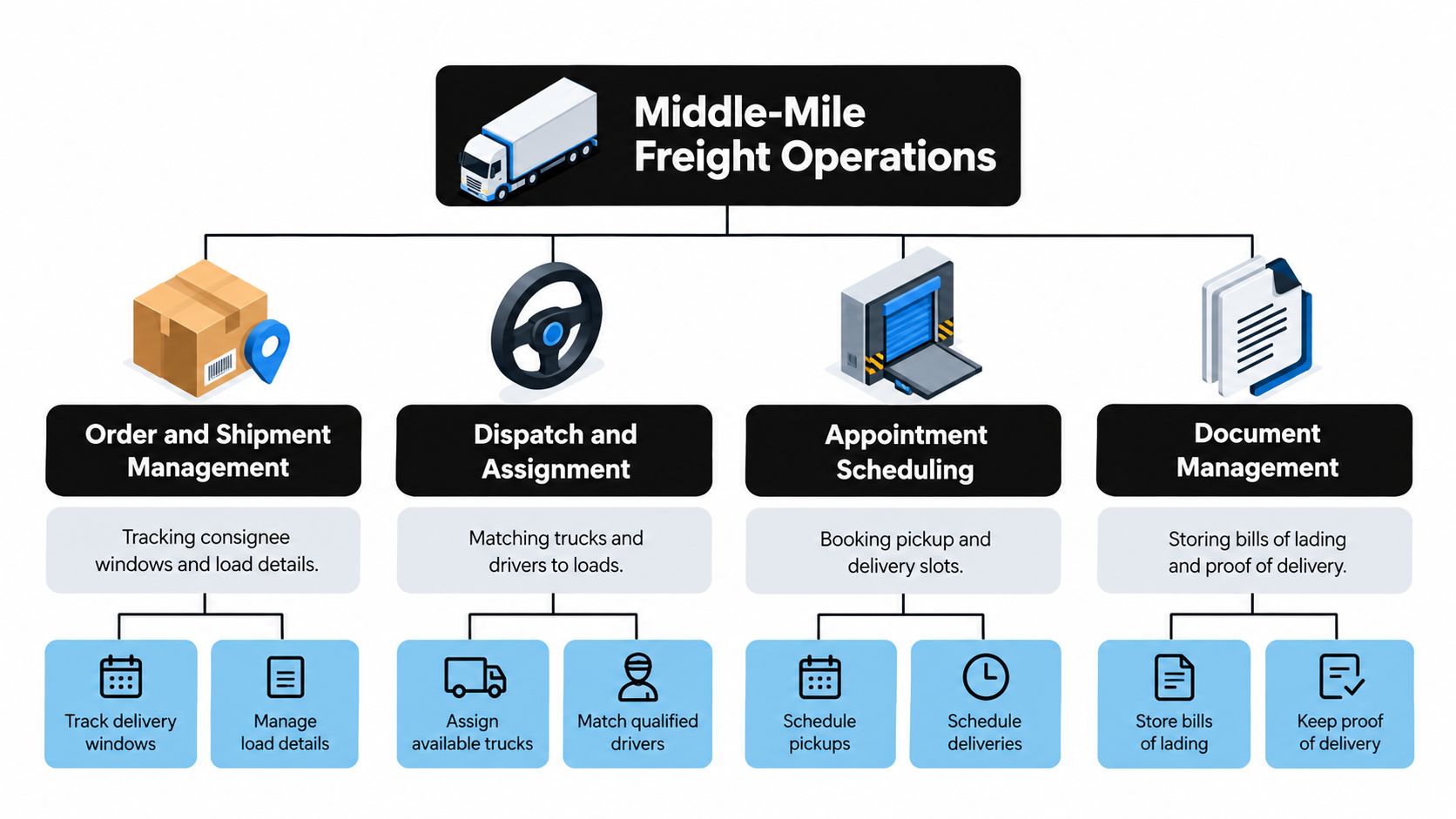
The Modules That Matter for Middle-Mile Operations
A box-truck dispatcher doesn't experience an FMS as a collection of modules. The dispatcher experiences it as a series of decisions made during a busy evening.
The first record usually comes from order and shipment management. The system should hold the origin, destination, load details, appointment window, shipment-unit identifiers, customer requirements, and delivery documents in one place. If a load changes after tender, the revised information must replace the working instruction without destroying the original history.
At assignment time, dispatch and driver management become central. The dispatcher needs to compare the available truck, equipment condition, driver status, expected travel time, loading requirements, and return obligations. A route that looks short on a map may be infeasible once dock dwell, repositioning, and remaining hours are included.
Appointment scheduling is equally important on overnight lanes. The system should distinguish a requested appointment from a confirmed appointment, show cutoff constraints, and alert the dispatcher when the planned arrival no longer fits the facility window. A calendar that merely displays times isn't enough. It must influence assignment and replanning.
The history of electronic freight exchange shows why these functions became operational controls rather than clerical conveniences. By the early 2000s, electronic freight information supported appointment coordination, proof of delivery, driver-hour planning, exception management, and customer reporting for middle-mile and regional truckload operations, as described by the National Academies.
What the dispatcher needs during the shift
Document management should attach bills of lading, delivery instructions, accessorial evidence, and proof of delivery to the shipment record. Drivers shouldn't have to search through unrelated messages to find the right paperwork, and customer service shouldn't need to call dispatch for a document that already exists.
Exception management is where many systems either help or create noise. Useful alerts identify the owner and the required action. Examples include a truck that hasn't departed within the expected window, a missed check-in, a growing arrival delay, an appointment conflict, or a missing delivery confirmation. An alert that only says “late” without distinguishing freight, vehicle, facility, or data delay doesn't improve execution.
Rate, invoicing, and reporting can follow. They matter, but a smaller operation can often defer advanced rating logic or complex analytics if the shipment, dispatch, appointment, document, and exception workflows are sound. It can't safely defer accurate shipment records or a usable dispatch audit trail.
The modules should connect to the systems that supply warehouse events, vehicle data, ELD records, driver updates, billing information, and customer-facing status. That integration boundary is where a practical FMS either becomes a shared operating record or turns into another isolated screen.
ELD Data as an Operational Constraint
ELD data belongs in the dispatch decision before a load is assigned. Carriers that use it only as a post-trip compliance record miss the operational risk built into each assignment.
For an overnight box-truck lane between Twin Cities distribution centers, the FMS should ingest engine power status, vehicle-motion status, miles driven, engine hours, and the driver's available hours-of-service information. FMCSA's technical rule represents engine-hour values in 0.1-hour increments. Carriers whose drivers must maintain records of duty status are generally required to use certified and registered ELDs, according to the FMCSA ELD FAQ.
Consider a simple assignment gate. A driver has 6.2 hours remaining. The planned move requires 5 hours of driving, followed by 1.5 hours of dwell and reload. The plan therefore needs 6.5 hours before any further delay, making the assignment infeasible as planned. The FMS should flag that condition before tender or dispatch, while the truck is still at the origin.
Fixed overnight lanes need more than a static route estimate. A late departure can consume the margin that made the assignment workable. Loading delay can create a hub-arrival problem even when the vehicle's mileage remains unchanged. The system should recalculate planned driving, loading, unloading, repositioning, appointment windows, and remaining availability as conditions change.
The dispatch decision gate
A practical workflow uses ELD information at four decision points:
- Before assignment, test whether the driver has enough available time for the full operational plan.
- Before departure, confirm that actual status still matches the plan.
- During the run, alert dispatch when delay exposure threatens the appointment or return move.
- After a change, record the reason for reassignment, relay planning, or route revision.
Practical rule: If a dispatcher can't see the data that constrains a route, the system isn't planning the route. It's documenting a gamble.
The audit trail should connect dispatch changes to the relevant ELD event and protect drivers from pressure to exceed available hours. FMCSA prohibits harassment based on ELD or connected-technology data, so performance workflows must distinguish legitimate safety intervention from unsafe instructions.
A practical transportation compliance solutions workflow gives dispatchers enough context to decline an infeasible assignment early and record why. That standard matters more than a polished dashboard.
The relationship between engine status, motion, duty status, location, and assignment can be summarized visually:
A short video can reinforce the difference between passive logging and active dispatch control:
How FMS Connects to TMS, WMS, and Telematics
Follow one overnight box-truck move through the systems, and each application has a different responsibility. A WMS or ERP creates or updates the shipment. If you need a refresher on how WMS software works, start with the warehouse transaction itself. A TMS plans and tenders transportation. Telematics and ELD systems report vehicle movement and driver conditions. The FMS links the commercial, operational, and documentary events into a record that dispatch and operations can use.
A warehouse system may mark a logistics unit ready. The TMS may create a tender and assign a vehicle. Telematics may report movement, while a driver application captures a delivery signature. The FMS should retain each event and its source, rather than flattening everything into one status such as “in transit.”
GS1's transport framework provides identifiers that keep these records distinct. GLN identifies locations, GIAI identifies vehicles or transport equipment, SSCC identifies logistics units, and EPCIS records what happened, when, where, and why. Standardized EDI transport-status messages can communicate milestones between trading partners, as described by GS1's transport-management framework.
| Identifier | What It Identifies | Example in Twin Cities Middle Mile | Who Maintains It |
|---|---|---|---|
| GLN | A facility or business location | An origin distribution center or regional hub | Facility or network master-data owner |
| GIAI | A vehicle or transport equipment item | An assigned box truck | Fleet or equipment owner |
| SSCC | A logistics unit | A pallet, container, or shipment unit | Shipping operation or trading partner |
| EPCIS | An event record | Loaded, departed, arrived, transferred, or delivered | Event source and integration owner |
One load, several accountable events
A box-truck shipment leaves a Twin Cities origin for a regional hub. The origin records “loaded” and “departed.” The hub later records “arrived” and “transferred.” Telematics shows movement between those events, while the driver's ELD supplies the duty-status context.
Receiving must distinguish “departed origin” from “arrived at hub.” Dispatch must distinguish a shipment delay from a vehicle delay. A truck that reached the hub but lacks a freight scan requires a different response from a truck that never reached the facility. Manual status overwrites remove that distinction.
Validation should reject an event missing a timestamp, location, shipment-unit identifier, or vehicle reference. The history should remain available instead of being replaced by the latest update. A cloud-based TMS platform can connect dispatch work with partner and facility data when integration rules are explicit.
The design also needs a source-of-truth policy. Define which system controls the appointment, which source controls vehicle location, who may correct a delayed scan, and how offline events are reconciled. API availability helps, but assigned data ownership keeps an integration from distributing incorrect information faster.
Why Data Governance Matters More Than the Platform
A feature-rich platform can't repair an incorrect facility cutoff. It can only distribute that error faster.
The Transportation Research Board evaluates data management across 15 areas, including architecture, security, integration, master data, business intelligence, and data quality. That scope is much broader than checking whether a vendor offers routing, visibility, or artificial intelligence. ASCM also emphasizes centralized, reliable data from vendors, warehouses, and transportation providers, together with cross-functional alignment and employee training, as summarized in the TRB data-management guidebook.
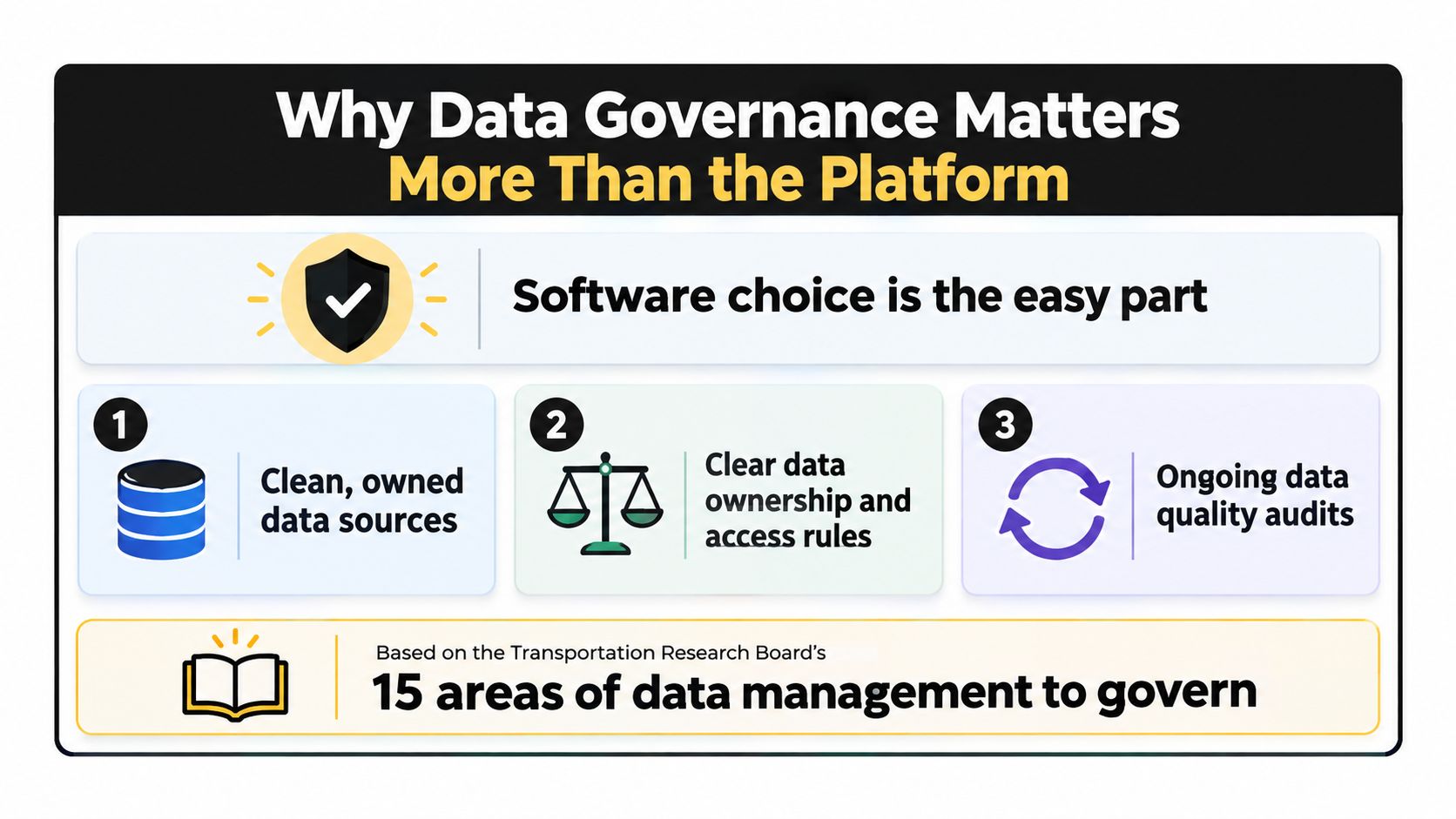
Take a common overnight failure. A facility's master record contains the wrong receiving cutoff. The route planner builds a feasible-looking assignment against that time. Dispatch sends the truck, the facility rejects or delays the arrival, and the hub misses its planned handoff. The problem isn't a missing feature. It's an unmanaged data change that affected planning, execution, and reporting.
The minimum operating model
A middle-mile operation needs clear ownership for at least these records:
- Facilities and appointments: who maintains addresses, dock rules, cutoff times, and appointment status.
- Lanes and routes: who approves changes to planned paths, stops, and operating assumptions.
- Vehicles and equipment: who confirms vehicle identity, availability, restrictions, and maintenance status.
- Drivers and hours: who manages availability and reviews exceptions without compromising safety.
- Shipment units and documents: who corrects missing identifiers, delivery evidence, or instructions.
- Exceptions: who decides whether a late event reflects the facility, vehicle, driver, shipment, or system.
The rules should cover conflicting updates, late scans, offline events, manual overrides, and correction history. Measure data completeness alongside on-time performance. A high on-time result built on missing appointment, proof-of-delivery, or exception data isn't a trustworthy operating result.
The contrarian conclusion is practical: a smaller platform with disciplined master data can outperform a broader platform fed by inconsistent facility, carrier, and lane records. Software selection matters, but governance determines whether the decisions are credible.
A Vendor Selection Checklist You Can Actually Use
Vendor demonstrations often reward polished screens. Middle-mile operations need proof that the screens support real decisions at 9 p.m., when trucks, drivers, windows, and exceptions are moving at the same time.
Start with the assignment workflow. Ask the vendor to show a dispatcher assigning a box truck while the driver's available hours, appointment window, expected dwell, and return obligation are visible. Then change the departure time and watch whether the platform recalculates feasibility, raises an exception, and records who changed the plan.
The essential checklist should include:
- ELD and HOS integration: The system must use driver-hour data in planning, not store it in a disconnected compliance view.
- Identifier discipline: It should support consistent facility, vehicle, shipment-unit, and event identifiers.
- Appointment control: Dispatchers need confirmed windows, cutoff logic, and alerts when a plan no longer fits.
- Exception ownership: Alerts should identify the issue, responsible team, next action, and escalation path.
- Dispatch auditability: The platform should preserve changes to assignments, routes, appointments, and statuses.
- Document access: Bills of lading and proof of delivery should remain tied to the shipment record.
- Role-based access: Drivers, dispatchers, customers, finance, and administrators shouldn't all edit the same fields.
- Data portability: Documented APIs and usable exports should be available without treating operational data as a hostage.
Industry coverage identifies more mature APIs and standardized data flows as a 2026 development, while emphasizing that integration roadmaps, governance, and data integrity determine value, not the purchase alone, as discussed in transportation technology trends.
| Criterion | Single-Fleet Operator | Multi-Fleet 3PL | Brand Shipper |
|---|---|---|---|
| ELD and HOS integration | Essential for assignment feasibility | Essential across connected fleets | Important for contracted-carrier oversight |
| Appointment scheduling | Core dispatch requirement | Core across customers and facilities | Core for distribution-center coordination |
| Multi-party access | Simple role separation | Strong tenant and customer controls | Broad partner and internal access controls |
| API and export capability | Needed for ELD, billing, and customer data | Needed for carrier and client integrations | Needed for WMS, ERP, TMS, and portal connections |
| Audit trail | Needed for safety and service review | Needed for claims, customer reporting, and disputes | Needed for accountability across providers |
| Advanced analytics | Useful after operational data is stable | Useful for carrier and lane comparisons | Useful for network and provider decisions |
Disqualify a platform that can't explain what happens when GPS, warehouse scans, dispatch updates, and customer portals disagree. Also be cautious if data export is a paid add-on, APIs are undocumented, or the vendor can't demonstrate recovery from a delayed or duplicated event.
Implementation Roadmap and Change Management
A reliable rollout starts with the operating data, not the software tour. A phased 90-day implementation gives dispatchers and drivers room to test the workflow against real overnight conditions.
Phase one establishes the working record
Validate facility addresses, dock rules, cutoff times, lane definitions, vehicle identifiers, driver records, shipment-unit identifiers, and document requirements against actual routes. Ask dispatchers to identify the exceptions they handle manually today. Those observations should shape the configuration.
Schedule training time on the clock. If people are expected to learn a new dispatch workflow between live calls and late arrivals, adoption will be superficial.
Phase two pilots one overnight lane
Connect ELD data, appointment workflows, status events, document handling, and exception alerts on a single representative lane. Use real departure variance, dwell, and handoff conditions. Write a short SOP for each common exception, including who owns the decision and when the issue escalates.
The system should show whether an automated ETA disagrees with the facility's actual condition. Dispatchers need a clear way to correct the record while preserving the reason for the correction.
Phase three expands with feedback
Extend the workflow to remaining lanes only after the pilot has produced usable dispatch instructions, driver-facing documentation, and correction rules. Hold regular feedback sessions with dispatchers and drivers, then update the SOPs instead of relying on informal workarounds.
After launch, good looks like this:
- Dispatchers can see assignment feasibility before tender.
- Drivers receive consistent instructions and documents.
- Facility events distinguish departure, arrival, transfer, and delivery.
- Exceptions have owners and escalation paths.
- Dispatch changes remain auditable.
- Operations leaders trust the data enough to act on it.
Peak Transport applies structured dispatch, route planning, documentation, and safety-focused middle-mile execution to overnight box-truck operations across the Twin Cities and surrounding areas. If your network needs dependable distribution-center and Amazon Relay connectivity, visit Peak Transport to discuss a practical operating model built around feasible routes, clear communication, and accountable delivery records.