Logistics Solutions for Ecommerce: A Middle-Mile Guide
Learn how logistics solutions for ecommerce work in the middle mile: route optimization, overnight box-truck lanes, partner criteria and the KPIs to track.
November 19, 2026
The 10 p.m. departure is two pallets short, the dock door is blocked by an inbound trailer, and the appointment window at the regional hub closes at 12:30. Nobody on the floor is talking about delivery speed. They're talking about whether the truck can leave on time and still unload inside the window with a driver who has hours left on the clock.
That's the shape of logistics solutions for ecommerce. Online volume is now large enough that it moves on schedules, not favors. U.S. retail e-commerce reached $300.2 billion in the first quarter of 2025, or 16.2% of total retail sales, growing 6.1% year over year while total retail grew 4.5%, according to the Census Bureau's quarterly e-commerce release. Volume at that scale can't run on expedited recovery moves and heroics at the dock.
The delivery promise also keeps getting more expensive to keep. In 2025, 86% of retailers said offering free delivery and returns improved sales, based on the DHL e-commerce trends survey of businesses. Free delivery pushes cost upstream into the lanes that connect facilities. That's where this guide lives.
Logistics Solutions for Each Leg of Ecommerce Freight
Match each freight leg to the solution that fits it, then stop paying for the wrong one. Ecommerce freight breaks into three legs: inbound into the fulfillment center, middle mile between distribution centers, regional hubs, stores and parcel points, and last mile to homes and pickup locations. Each leg has a different cost driver, and picking a solution built for one leg and running it on another is where budgets break.
The middle mile is the conveyor belt between the warehouse and the local hub. It runs on a fixed rhythm whether or not anyone ordered something unusual that day, and its job is to hit windows, not to be fast.
| Solution | Best For | Typical Cadence | Main Trade-Off |
|---|---|---|---|
| Parcel carrier | Single orders delivered to homes | Daily pickup | High cost per parcel at volume |
| 3PL fulfillment center | Storing, picking and packing brand orders | Continuous | Fixed storage and labor fees |
| Middle-mile box-truck lane | Recurring transfers between distribution centers, hubs and stores | Fixed overnight schedule | Needs steady lane volume and advance planning |
| Amazon Relay load | Added or surplus lane capacity | Load by load | Capacity tracks posted loads and carrier availability |
| Ad hoc same-day recovery move | Missed loads and emergency stockouts | On demand | High cost per mile and disruption to planned routes |
Start with inbound. Freight from overseas suppliers carries duty and landed-cost variables that change the whole economics of the network before a single pallet moves, so it's worth using a tool to model shipping costs and customs duties before you commit to lane volumes. Get that wrong and every downstream decision inherits the error.
Parcel carriers price per parcel, which is fine at low volume and punishing at high volume. A 3PL buys you storage, pick and pack, and labor flexibility in exchange for fixed fees. A scheduled box-truck lane buys reliability, but only if you can feed it steady volume every night.
A brand shipping 40 pallets a night from one distribution center to two hubs doesn't have a parcel problem. It has a lane-design problem, and parcel service will bill it accordingly.
Destinations have multiplied too. Nearly 3 in 10 shoppers already send deliveries to out-of-home locations, and almost 4 in 10 want the ability to redirect a delivery to a locker or store, according to DHL's e-commerce trends research. Every one of those pickup points is a middle-mile stop with its own cutoff.
To find your own bottleneck, count the transfers that repeat every week and set them against the ones that only happen when something breaks. Recurring transfers belong on fixed lanes. Breakage belongs in a contingency line, not in the plan.
How to Choose a Middle-Mile Partner
A partner should show lane data before showing a price. If the first conversation is about rate per mile and the second is about facilities, you're buying capacity blind. Ask which facilities they serve, what time they depart each night, and how many stops sit on a typical run.
On-time performance measured by facility matters more than a company-wide average, because a 96% average can hide a 71% record at the one dock that feeds your highest-volume market. Ask for recent months, by location.
Then examine the planning method. A serious operator measures planned versus actual miles, dwell time and arrival variance, and feeds those observations back into route design each week. Routes built by hand and never reviewed drift toward habit. If you're still deciding whether an outsourced fulfillment partner or a dedicated carrier fits the gap, this explanation of outsourced ecommerce fulfillment draws the line between warehouse-side work and transportation work.
| Criterion | What to Verify | Red Flag |
|---|---|---|
| Lane fit | Facilities served, departure times and stop counts | Quote without lane details |
| On-time performance | On-time arrival rate by facility over recent months | No historical data offered |
| Route planning | Planned versus actual miles and a feedback loop into routes | Routes built by hand with no review |
| Driver qualification | Valid licenses, clean driving records and hours-of-service logs | Unclear driver hours or qualification records |
| Equipment safety | Pre-trip and post-trip inspection logs | Inspections undocumented or unavailable |
| Documentation | Bills of lading, proof of delivery and dock check-in times | Paper-only or delayed records |
| Contingency capacity | Surge plan and backup trucks or drivers | Single truck and no backup plan |
Driver qualification deserves its own conversation. Ask who drives, whether they're employees or contractors, and how hours are tracked. A carrier that can't produce clean hours-of-service records on request is a liability you inherit at the dock.
Contract questions to settle before signature
- Minimum volume: What weekly volume triggers the rate, and what happens in a soft month?
- Term length: How much notice do you need to exit a lane that stops working?
- Pricing basis: Is the rate per mile, per stop or per route? Per-route pricing rewards efficient design, per-mile pricing rewards distance.
- Detention and missed appointments: Who pays when a trailer sits four hours at a dock, and who eats the cost of a blown appointment window?
Before you send anything to a provider, read up on how to evaluate a carrier beyond the rate sheet. Then send three questions in writing: which lanes, which cutoff times, and which records will be shared each week.
Send this before the call: "List the five lanes closest to our facilities, the departure time for each, and the on-time percentage at the destination dock for the last 90 days."
Compliance, Safety and Carbon Checks for Box-Truck Lanes
A box-truck lane is workable only if its schedule fits facility windows and driver rules. Check the exact vehicle and planned route, rather than assuming every truck or shift has the same requirements.
Licensing depends on the vehicle. Federal rules set a weight-based CDL threshold, which should be checked against the exact vehicle assigned to the lane. Where a specific route or vehicle requires a CDL, Peak Transport states this in the job posting. Confirm the requirement before assigning the lane, since a vehicle's rating can differ across a fleet.
Driving time needs to fit the schedule. Federal rules limit driving time, require rest breaks, and set duty-period requirements. A lane that appears feasible by distance can fall behind when a facility misses its appointment window or loading takes longer than planned. Build the schedule around fixed facility windows and the driver's available hours, then keep accurate records of duty time and breaks.
| Rule | Check |
|---|---|
| CDL threshold | Check the weight-based threshold against the exact vehicle and route |
| Driving time | Confirm the planned schedule fits federal limits on driving time and duty periods |
| Rest breaks | Include required breaks in the route schedule |
| Equipment checks | Keep pre-trip and post-trip inspection logs for every vehicle and shift |
Load securement and accurate paperwork matter at both ends of the lane. A bill of lading that does not match the load can trigger a dispute, while clear delivery records help establish what moved and when. Set a process for checking documents before departure and recording delivery at the receiving facility.
Carbon accounting also needs to include more than last-mile vans. Amazon reported a 39% reduction in emissions per unit shipped by the end of 2025 compared with 2019, and its reporting counts middle-mile and long-haul transportation in the value chain, as described in Amazon's carbon intensity reporting. For a lane-level view, measure emissions per case or parcel, count empty miles, and compare direct runs with consolidation. Consolidation may reduce empty mileage, but the schedule still has to meet each facility's receiving window.
Peak Transport vehicles are inspected regularly for safety and reliability. For further detail on transportation safety and compliance, review the standards that apply to the lane, vehicle, and driver.
Overnight Box-Truck Lanes and Distribution Center Integration
Walk one night end to end. A distribution center sets a 6 p.m. cutoff for orders that must move that night. The trailer is staged by 9 p.m., doors closed and paperwork matched. The box truck departs at 10 p.m. for a regional hub, arrives inside its dock appointment window, gets unloaded with pallet jacks, and every delivery is documented before the driver heads back. The truck is empty, the paperwork is signed, and the driver is home after the shift.
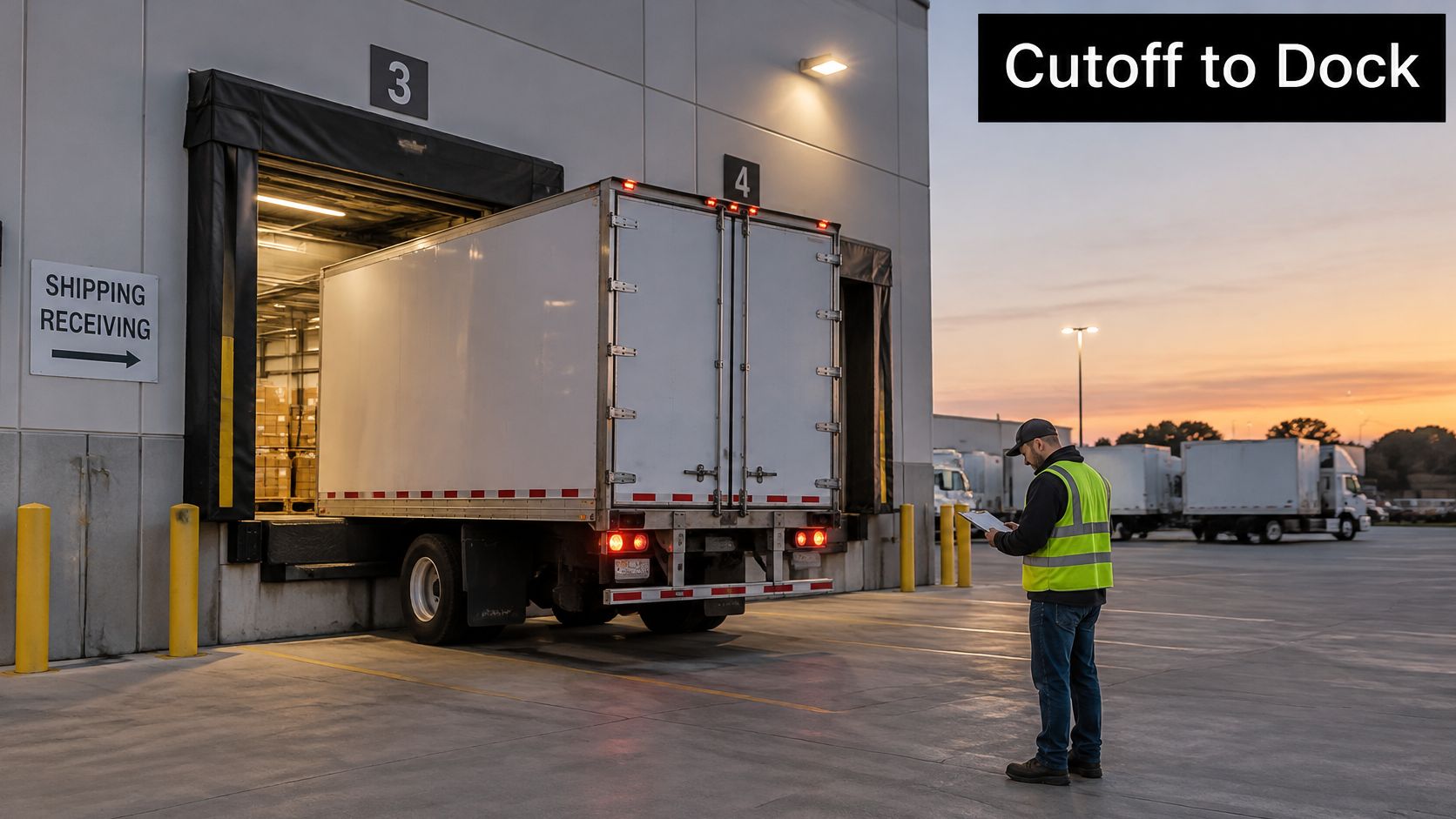
That lane works because it's local and repeatable. Our primary fleet is box trucks running middle-mile routes between warehouses, hubs and distribution centers. The work is local, drivers are home after their shift, and nobody is doing a long-haul overnight run. Routes are scheduled between facilities and planned in advance, not improvised from a residential stop list.
Integration is where these lanes succeed or fail, and it comes down to four checkpoints. Confirm the cutoff and the appointment window before each departure, not after loading starts. Align trailer staging with the dock schedule so the truck isn't waiting on a door. Record check-in and check-out times at both ends. Log pre-trip and post-trip inspections every shift, every vehicle.
Where a lane runs through Amazon Relay, confirm the load and the appointment before the truck leaves the yard. A late trailer should trigger a plan change, not a surprise at the destination dock.
Scale makes this essential. Seasonally adjusted online retail sales reached $316.1 billion in the fourth quarter of 2025, up 1.7% from the third quarter and 5.3% from the fourth quarter of 2024, at 16.6% of total retail sales, per the Census Bureau's fourth-quarter 2025 release. Peak season doesn't reward flexibility invented on the night. It rewards capacity planned in September.
What to agree with the dock before the first run
Three items, in writing: the cutoff time for freight to be ready, the appointment window at the receiving facility, and who signs the proof of delivery at each end. If your warehouse management system and the carrier's dock schedule don't talk to each other, that gap becomes the operational argument. Teams comparing platforms for that job can start with this guide to choosing distribution warehouse software.
Route Optimization That Protects Cost and Driver Hours
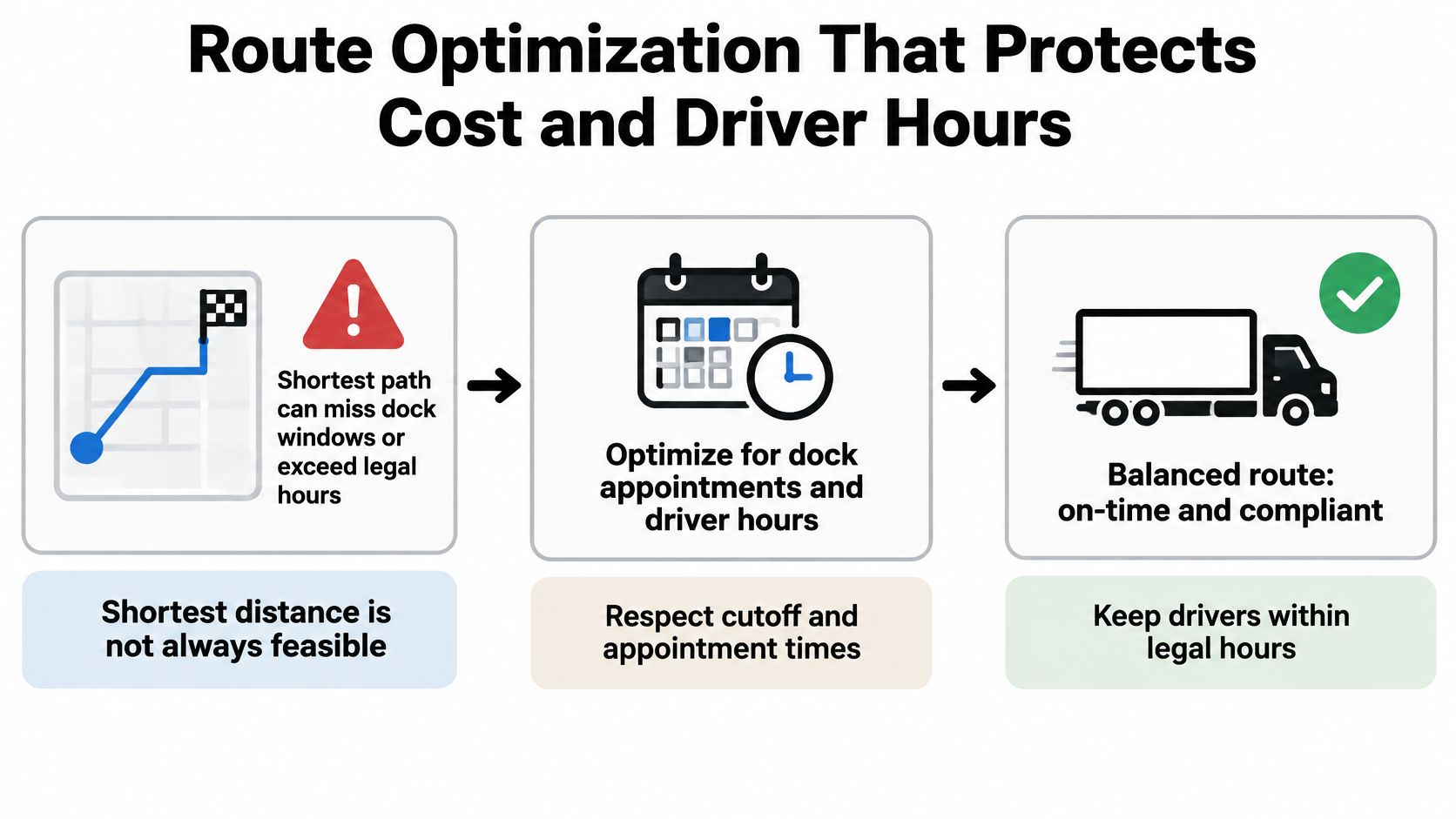
Shortest-path thinking fails because the shortest route isn't the feasible one. A path that saves distance can arrive after a dock window closes or push a driver past legal hours, and then the saving turns into a missed slot, a reattempt and an unhappy receiving team. Routing research treats this as a constrained vehicle-routing problem, where capacity, depot assignment, time windows, driver-hour limits and service times all bind at once, as published work on routing with operational constraints sets out. That research also notes a practical split: sequence geographic zones first using historical travel-time and cost data, then optimize stop order inside each zone.
The six-step planning cycle
- Pull three to six months of lane history. Travel time, cost and dwell time by lane. Without a baseline, every "optimized" route looks like an improvement.
- Sequence zones, not stops. Group facilities into geographic zones and order them using what your trucks did, not what a map suggests.
- Optimize stop order within each zone. Local refinement handles the last few decisions that global sequencing can't see.
- Set a weighted objective. Transportation cost plus lateness penalties plus excess driver hours. Minimizing mileage alone produces routes that are cheap on paper and expensive at the dock.
- Review planned versus actual every week. Miles, dwell time, arrival variance and route deviations, by lane.
- Feed the observations back into the next cycle. Planning that doesn't consume last week's actuals is just repetition.
Here's the failure mode in concrete terms. A route saves 12 miles but arrives at 2:15 a.m., after a dock's 2 a.m. window closes. The truck waits, the receiving crew has gone home, and the load gets reattempted in daylight. The 12 miles cost more than they saved.
Our route optimization uses data modeling to reduce mileage and cut fuel consumption, which only works because the model runs against real lane history rather than a clean theoretical network.
The test I apply to any optimized route is simple. Does it still hit every facility window, with every driver inside legal hours, on a day when the trailer was ten minutes late leaving? If the answer depends on perfect conditions, the route isn't optimized. It's optimistic.
KPIs That Prove Your Logistics Network Works
A routing plan can hit its mileage target and still miss a facility window. Measure each lane against its own baseline, then check whether the schedule holds within legal driver hours. A published routing simulation involving 300 ecommerce users reported roughly 15% lower average delivery time and 20% lower cost than its comparison approach, landing within 0.25% of the theoretical optimum. These are simulation results, not operating guarantees, especially for networks that do not account for dock windows.
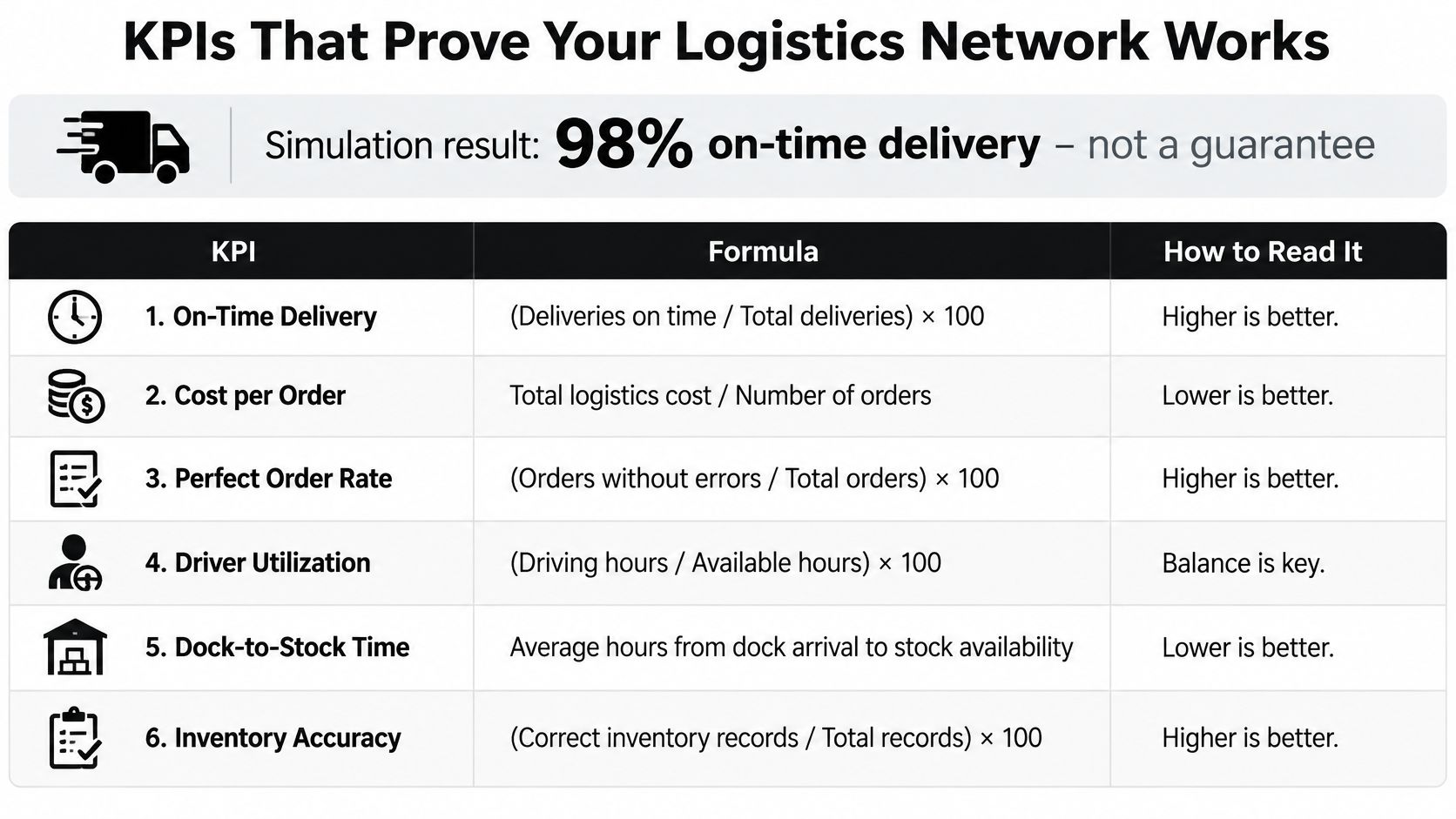
Compare each lane with its own four-week baseline rather than relying on a network-wide headline figure. Use exact optimization to design recurring overnight lanes, then a heuristic layer to handle daily exceptions such as a late trailer, dock congestion or weather. The trade-off is stability versus flexibility: a fixed plan supports reliable facility windows, while controlled adjustments account for what happens on the night.
| KPI | How to Calculate | How to Read It |
|---|---|---|
| Cost per route | Total route cost divided by routes run | Compare to a four-week baseline per lane |
| Miles per shipment | Total miles divided by shipments | Falling values show better route density |
| On-time arrival | Arrivals inside window divided by total arrivals | Set a target for each facility |
| Empty-mile percentage | Empty miles divided by total miles | Falling values with stable on-time arrival |
| Dwell time | Minutes from arrival to departure at each facility | Rising dwell points to dock or staging problems |
| Schedule overrides | Count of driver-hour or safety overrides | Zero or falling counts |
Decision rule: keep a routing change only if cost per route falls and on-time arrival holds or improves. A cheaper route that drops on-time performance transfers cost into service failures rather than creating a saving.
Track empty-mile percentage and miles per shipment as early warnings. They can shift before customer complaints reveal service problems, giving planners time to review lane design. Schedule overrides are the safety signal: a rising count suggests the plan is relying more often on exceptions to meet its schedule within driver-hour and safety limits.
Review the figures monthly, one line per lane, with baseline and current results side by side. For calculation approaches and KPI definitions, see this guide to key performance indicators for middle-mile fleets.
Pick Your Middle-Mile Path and Take the Next Step
Brands and drivers need different next steps, so take yours.
If you run a brand or a distribution center, scope before you shop. List every lane with its origin and destination facilities, the cutoff and appointment window for each, weekly volume per lane, and the records you need back every week, including proof of delivery and dock check-in timestamps. Then ask any provider for lane-level KPI reports built on the measures above, and confirm that on-time figures are reported by facility rather than blended into an average.
If you drive in the Twin Cities, the structure matters as much as the route. Our drivers are W-2 employees, not 1099 contractors, with benefits that include 401(k) matching, health insurance, paid sick time, paid training and room to grow. The box truck role calls for a valid driver's license, a clean driving record, pallet jack operation and overnight availability, with box truck experience preferred. Pay, benefits and training details change, so confirm the current terms directly with us rather than relying on a guide.
Assign yourself one action. Brands: send your lane list to Peak Transport through the company website and ask for a scoped overnight plan. Drivers: check open Twin Cities routes on the same site and ask about shift options and the role's terms before applying.
Peak Transport runs scheduled overnight box-truck lanes between distribution centers, hubs and Amazon Relay nodes across the Twin Cities metro, with planned routes, documented deliveries and drivers who are home after every shift. If your network needs middle-mile capacity that hits facility windows inside legal driver hours, bring us your lane list and we'll scope it against your cutoffs and appointment times. Visit Peak Transport to start the conversation or to see open overnight driving roles in Minneapolis, St. Paul and the surrounding metro.