Safety Monitoring Systems for Box Truck Fleets
Learn how safety monitoring systems help box-truck fleets cut crashes, improve KPIs, and integrate with ELD and dispatch workflows.
September 24, 2026
At 2 a.m., the lane is familiar, the truck is loaded, and the driver knows every interchange between the hub and the distribution center. Then the dock queue backs up past the gate. A dispatcher asks for an update, the arrival window is tightening, and the driver rolls through the yard faster than conditions allow. Nothing happens until a pedestrian steps from behind a parked trailer and the driver brakes hard enough to send a tote sliding forward.
That near-miss is the kind of event that changes a fleet review. The route wasn't unusual, and the driver wasn't reckless by reputation. The failure came from a combination of fatigue, congestion, routine, and pressure that traditional inspections rarely capture. Safety monitoring systems provide the missing layer, combining telematics, video, alerts, and analytics to identify risky patterns while a shift is still underway.
Why Overnight Box Truck Fleets Need Safety Monitoring Systems
At 2 a.m., an overnight box-truck lane may look predictable. The same interchanges, stops, and dock procedures repeat, yet fatigue, a crowded receiving yard, or a dispatcher pressing for an arrival update can change the risk within minutes. Darkness also limits what a supervisor can observe from the terminal.
That combination creates failure modes generic fleet policies often miss. A driver who manages the highway safely may rush the final approach, follow too closely after a delayed departure, or skip a seat belt during a short yard move. A repeatable route reduces navigation demands, but it can also make warning signs easier to dismiss.
A useful program identifies the pattern before it becomes a crash or claim. Repeated harsh braking at one gate may point to congestion or poor sight lines. Distracted-driving alerts after a missed break may indicate fatigue. Speeding that appears only near the distribution center may reflect dock pressure rather than a general driving habit.
Safety monitoring systems connect those events to their operating context. Telematics records speed, braking, acceleration, location, and other vehicle movements. Video can show whether a hard brake followed a cut-in, debris, a pedestrian, or driver inattention. That distinction supports targeted coaching and helps dispatchers address a hazardous gate or unrealistic timing instead of treating every alert as misconduct.
Operational reality: A familiar route reduces navigation complexity, but it does not remove fatigue, congestion, or decision pressure.
Weather should be part of the same review. Dispatchers using weather data for smarter dispatch can set more realistic arrival expectations and avoid labeling a weather-related delay as a performance failure. Separating conditions from conduct gives supervisors a fairer basis for intervention.
The European Agency for Safety and Health at Work report on smart digital monitoring systems describes the wider use of sensors, cameras, wearables, and software for continuous occupational-risk monitoring. In commercial vehicles, a Virginia Tech review cites prior research estimating that video-based driver monitoring could prevent 112 to 293 fatalities, 4,740 to 12,371 injuries, and 19,389 to 50,604 property-damage-only crashes each year. For an overnight fleet, that supports earlier review of risk that one supervisor cannot observe across every route and dock.
The Core Components of a Modern Safety Monitoring Stack
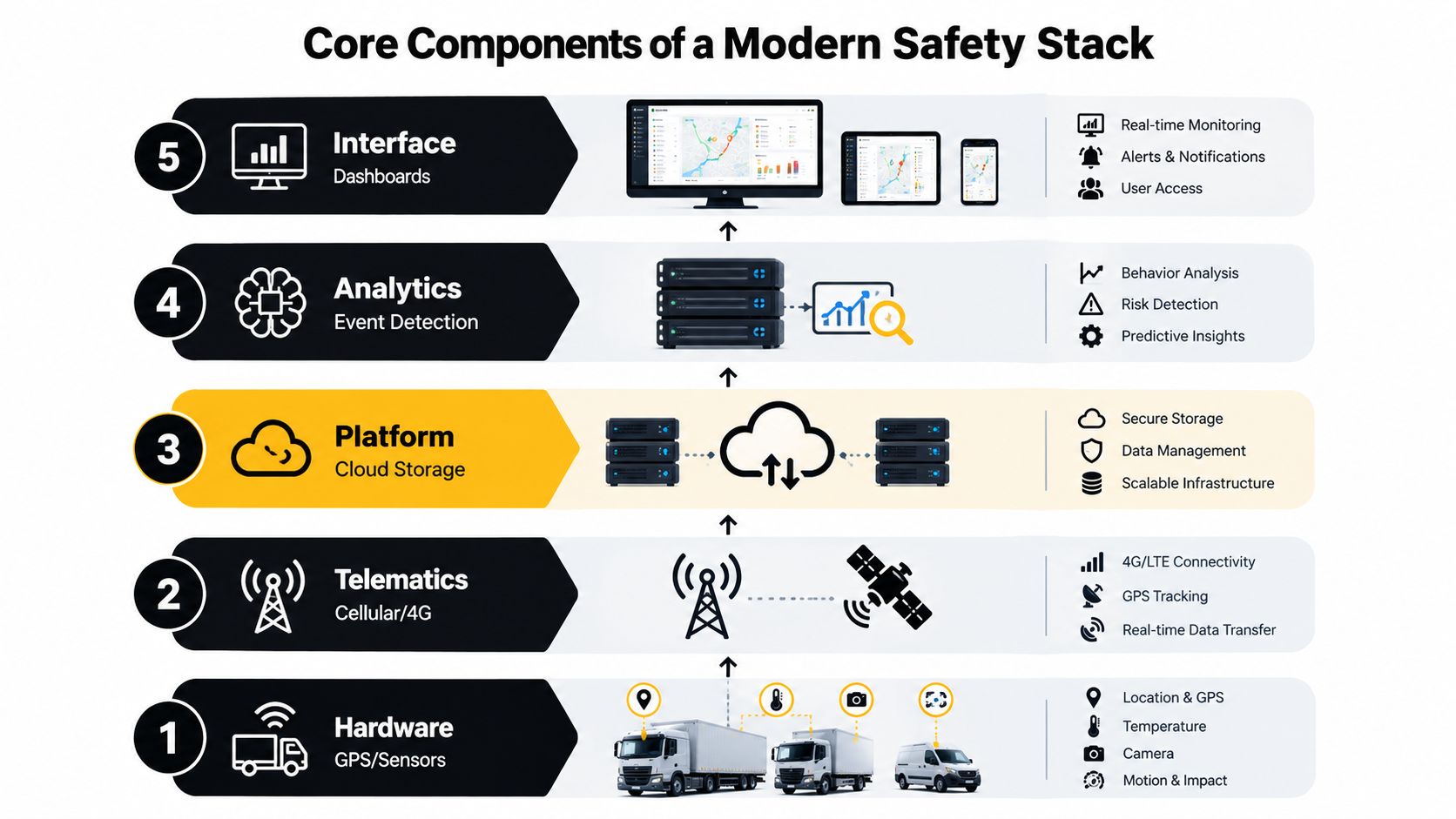
Overnight box-truck operations expose a familiar weakness: a repeatable route can still produce a dangerous event at 2 a.m. Fatigue, crowded docks, and dispatch pressure require a stack that connects vehicle movement, road conditions, driver behavior, and follow-up work.
Start with vehicle data
Telematics hardware provides the base layer. It records GPS position, speed, acceleration, braking force, and cornering behavior. For a box truck, those readings tie an event to a route segment, geofence, yard, or dock approach. Telematics-only devices generally capture vehicle-network data and accelerometer events. Video-enabled systems add road and driver footage, as described in published reviews of onboard safety monitoring architectures that distinguish telematics-only devices from video-enabled systems.
The forward-facing dashcam supplies context around a hard brake, merge, impact, or disputed claim. A clip may show a cut-in, debris, or a pedestrian entering the lane. That distinction helps a supervisor coach the right behavior instead of treating every event as driver fault.
An inward-facing camera adds information about phone use, drowsiness cues, distraction, and seat-belt use, depending on its configuration. Overnight drivers may spend hours alone in the cab, so privacy controls must be explicit. Define the camera's purpose, provide clear notice, limit access, and state when monitoring stops.
Turn events into decisions
The fourth layer is real-time alerting. In-cab audio or haptic warnings give a driver time to correct a behavior before it becomes a supervisor call. Dispatch should receive only alerts that require operational action, such as a serious risk event or a problem at a congested facility. Sending every minor deviation to dispatch increases noise during the busiest parts of the night.
The analytics platform stores footage, groups related alerts, scores risk, and assigns coaching tasks. A supervisor should see the timestamp, location, relevant clip, driver context, and follow-up action together. If reviewing one event requires searching across several systems, consistent coaching will not last.
The stack works when each layer feeds the next. Sensor data detects the event, video checks the circumstances, alerts support immediate correction, and analytics identifies repeat patterns. That workflow matters on repeat lanes, where the same dock entrance, late-night merge, or compressed dispatch window can produce recurring risk. More hardware without connected review steps creates another inbox for the safety team.
Safety KPIs Middle-Mile Operators Actually Track
At 1 a.m., a box truck can make the same lane it ran yesterday and still produce a different safety risk. Fatigue, a rushed dock arrival, or a late dispatch change may turn a familiar merge or yard entrance into a hard-braking event. A weekly review should therefore ask what behavior is changing, where does it happen, and can a supervisor act before an incident?
Hard-braking events per 1,000 miles can indicate short following distances, late reactions, cut-ins, or a route feature that repeatedly surprises drivers. Following-distance violations measure spacing more directly. Distracted-driving minutes show whether phone use or attention loss clusters during long, low-traffic stretches. Unbuckled events need their own view because short yard and shuttle movements often create different habits from highway driving.
Break speeding into bands and time windows. A driver exceeding the limit on an open highway presents a different coaching issue from one accelerating into a congested dock approach. On overnight lanes, review activity near final arrival, gate entry, trailer staging, and any period when dispatch pressure compresses the schedule.
The categories below support practical management. Set targets from local policy, equipment, road design, and legal requirements rather than copying another carrier's thresholds.
| KPI | Type | Target | Overnight Driver Behavior Tracked |
|---|---|---|---|
| Hard-braking events per 1,000 miles | Leading | Downward trend with reviewed exceptions | Following distance, late reactions, cut-ins |
| Following-distance violations | Leading | No unresolved repeat pattern | Space management on highway and approach roads |
| Distracted-driving minutes | Leading | Zero tolerated policy events | Phone use, visual distraction, attention loss |
| Unbuckled events | Leading | Zero policy events | Seat-belt use during yard and shuttle movements |
| Speeding by time of day | Leading | No repeated high-risk band | Fatigue, dispatch pressure, dock-arrival urgency |
| Near-miss reports | Leading | Consistent reporting and review | Hazard recognition and recovery behavior |
| Post-trip scorecard completion | Process | Every flagged event assigned and closed | Coaching-loop discipline |
Near misses deserve close review because they expose hazards before injury or property damage occurs. Supervisors should compare the vehicle signal with available video context before labeling an event a behavior problem. A hard brake at a crowded dock entrance may show defensive driving, while the same signal on a clear road may warrant coaching.
Pair these measures with a documented fatigue risk management process. The scorecard should start a conversation, not become a permanent label. A driver who receives a warning at 1 a.m. and corrects the behavior needs a different response from one who repeats the same event across several shifts. Review the pattern, record the action, and close the coaching loop.
Telematics Versus Video-Based Monitoring
Telematics-only systems are a sensible backbone for fleets that need route visibility, event detection, and a manageable installation process. They use GPS and accelerometer data to identify harsh braking, speeding, cornering, and related vehicle-dynamics signals. They can correlate an event with dwell time, route progress, and hours-of-service information without adding a camera inside the cab.
Their weakness is context. A sensor can detect a hard brake, but it can't reliably explain whether a driver avoided a pedestrian, responded to traffic, or entered a rough yard surface. It also can't confirm phone use, drowsiness, seat-belt status, or the behavior that preceded the event.
Video-enabled monitoring adds that validation layer. Road-facing footage can support the driver during disputed claims, while inward-facing systems can surface risky behavior that vehicle data only implies. Computer-vision systems are also being used in logistics environments to flag PPE violations, pedestrian and equipment proximity, restricted-zone breaches, and housekeeping hazards, with alerts sent to safety leaders for earlier intervention, as described by Voxel's overview of safety management software for logistics.
| Capability | Telematics-Only | Video-Based |
|---|---|---|
| GPS and route compliance | Strong | Strong |
| Harsh braking and cornering | Strong | Strong |
| Road context for claims | Limited | Strong |
| Phone and distraction detection | Limited | Strong |
| Driver privacy concerns | Lower | Requires clear policy |
| Review workload | Lower | Higher |
| Installation complexity | Usually simpler | More hardware and configuration |
The decision often depends on the failure mode a fleet needs to address. If the primary issue is route compliance or dwell visibility, telematics may cover the need. If the operation is dealing with contested claims, distraction, drowsiness, or recurring near misses, video earns its place. A broader view of connected vehicle technology can help teams map that choice to the rest of their fleet architecture.
Integrating Safety Monitoring With ELD and Dispatch
Safety data fails when it lives in a separate dashboard that nobody opens during a busy overnight shift. Dispatchers already manage arrival windows, dock assignments, driver messages, and exceptions. The monitoring system should add context to those workflows, not create another manual queue.
Connect the event to the shift
Start with the ELD event feed. When a harsh event occurs, the platform should associate it with the driver's current duty status, hours-of-service position, vehicle, route, and timestamp. That doesn't prove fatigue caused the event, but it gives the supervisor a relevant operating context. A driver close to an hours limit needs a different conversation from a driver who made the same maneuver early in a well-rested shift.
Next, connect geofences to the dispatch workflow. A hard brake at a known dock entrance, a speeding event during a yard approach, or excessive dwell near a gate should attach to the relevant movement or exception. The dispatch console should show the event without requiring a supervisor to search by truck number across multiple products.
The Peak Transport safety compliance resource reflects the broader need to keep compliance status and safety events organized rather than scattered across files and messages. The exact implementation will depend on the carrier's ELD, TMS, and video vendor, but the operating principle is consistent.
Build the handoff automatically
The integration should support four practical touchpoints:
- ELD event feed: Match duty status and hours information to the safety event.
- Geofence dwell data: Connect location behavior to dock, gate, and yard conditions.
- Video retrieval: Pull the relevant clip using the same vehicle and timestamp.
- Scorecard synchronization: Send the reviewed event into the driver's coaching record.
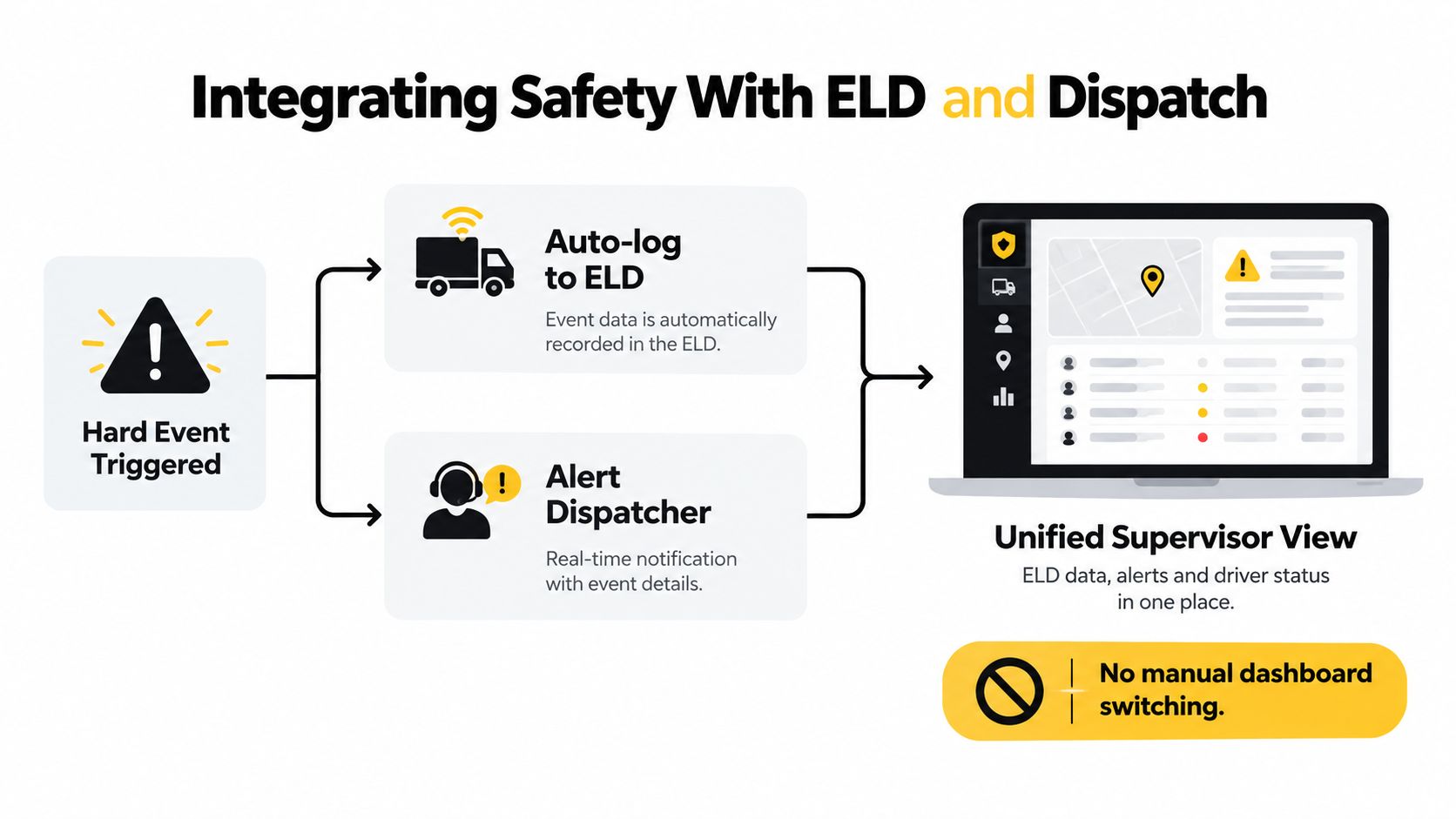
Use APIs for scheduled data exchange and webhooks for events that need immediate attention. Role-based access should control who can view driver-facing footage, who can edit event classifications, and who can close a coaching task.
Practical rule: If a safety event doesn't attach a relevant clip, timestamp, location, and follow-up task to the dispatch record, supervisors will eventually ignore it.
Cutting Through Alert Fatigue and False Positives
Alert fatigue isn't a configuration footnote. It's a program failure that develops when drivers hear warnings that don't match the conditions around them and supervisors receive more events than they can review. On a repetitive dock-to-dock lane, a driver can trigger multiple alerts through normal yard maneuvers, tight turns, traffic compression, or a camera misreading a face position.
The answer isn't to disable alerts. It's to make each alert more credible.
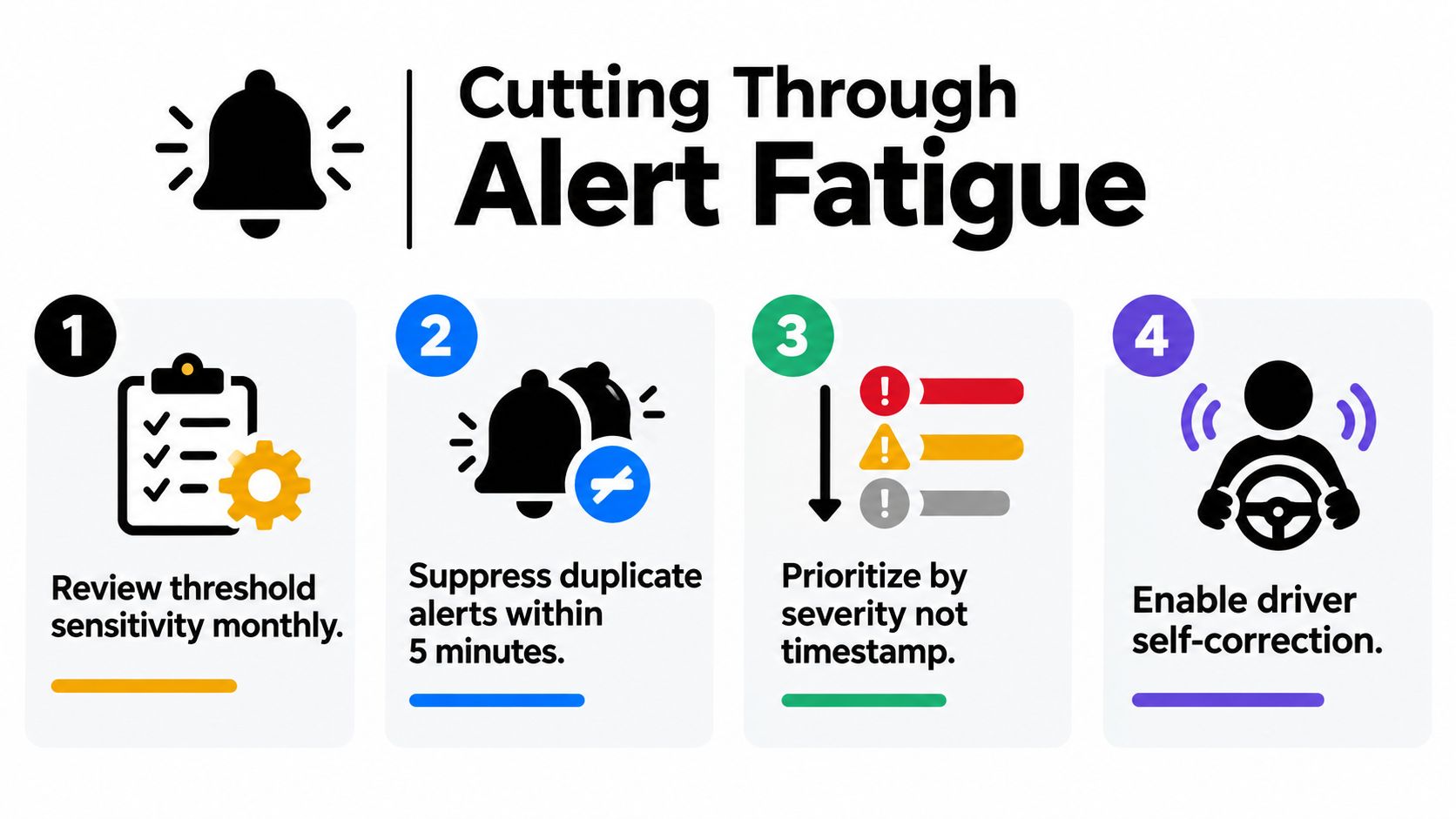
A fleet can begin with explicit operating rules such as a 65 mph speed cap, a 0.35 g braking trigger, suppression of alerts during the first two minutes after a yard or dock geofence exit, and a daily event cap that sends the driver to manager review instead of generating another notification. Those are configuration examples, not universal safety standards. Each carrier should validate them against its equipment, roads, policy, and regulatory obligations before deployment.
Tune the signal
Use severity tiers. A confirmed phone-use event, an unbuckled driver, and a harsh brake at a marked pedestrian crossing shouldn't appear in the same queue as a minor speed fluctuation. Suppress duplicate events that belong to one continuous episode, and let the driver self-correct before escalating a lower-severity event to dispatch.
The World Journal of Advanced Research and Reviews discussion of monitoring-system limitations highlights the operational problems created by siloed systems, weak context, and excessive false alarms. The lesson for fleet leaders is straightforward. More alerts don't equal more safety if supervisors can't distinguish urgent events from noise.
Review the system every week
A weekly calibration meeting should include the safety lead, a dispatcher, and a driver representative. Review the previous week's false positives, identify conditions that confused the system, adjust thresholds where justified, and document every change. The team should also track the ratio of alerts that become reviewed coaching items. If that ratio keeps falling, the system is asking for attention without earning it.
A short demonstration of event review can help dispatchers and drivers understand the intended workflow:
Choosing a Vendor for a Box Truck Operation
Vendor selection should start at the truck, not the sales presentation. A 26-foot straight truck may have different wiring access, camera placement, and installation constraints from a sleeper cab. For an overnight carrier, every installation delay can affect the next departure, so ask for a documented install procedure, expected vehicle downtime, and support for lease-return equipment.
Put privacy in writing
Drivers will ask where the inward-facing camera points, whether audio recording is enabled, when recording starts, and how off-duty privacy works. A vendor should support clear controls and provide documentation that managers can explain during onboarding. Avoid policies that leave drivers guessing about who can watch footage or whether clips are being reviewed continuously.
Data ownership requires the same precision. Confirm who owns raw footage, event metadata, and scorecards; how long each is retained; whether the carrier can download incident footage; and whether retrieval carries a per-clip fee. A system that looks affordable until a claim requires multiple exports creates avoidable friction at the worst time.
Test the operating workflow
Require a trial on representative overnight lanes. The trial should include a congested dock, a rural stretch with weak cellular coverage, a yard movement, and a normal highway segment. Test not only detection, but also what happens after detection.
Score each vendor against these criteria:
- Integration depth: Confirm ELD feeds, TMS APIs, webhooks, SSO, and role-based access.
- Alert controls: Check severity tiers, geofence suppression, duplicate handling, and driver self-correction.
- Coaching workflow: Verify that supervisors can assign, discuss, document, and close an event.
- Evidence access: Test clip retrieval, download rights, timestamps, and retention controls.
- Fleet fit: Ask for references operating comparable box-truck routes and overnight schedules.
| Criterion | What to Look For | Red Flag |
|---|---|---|
| Installation | Clear truck-specific procedure and support window | Vague downtime estimate |
| Driver privacy | Camera controls, notices, and off-duty policy | No written privacy model |
| Data ownership | Export rights and transparent retention | Per-clip charges or unclear ownership |
| Dispatch integration | API, webhook, and unified event view | Manual duplicate entry |
| Alert tuning | Configurable thresholds and suppression | Fixed settings only |
| Coaching | Assigned tasks and documented outcomes | Event list without workflow |
| Coverage | Tested cellular performance on actual lanes | Generic coverage claims |
| Contract | Pilot, exit terms, and support commitments | Long commitment before trial |
The vendor should earn a longer contract by working in the carrier's real environment. A short pilot with defined acceptance criteria protects the fleet from paying for features that look impressive but don't survive an overnight dispatch desk.
Building a Safety Culture Around Monitoring Data
Drivers support monitoring when they believe it helps them do the job and protects them from unfair blame. They resist it when every clip becomes a disciplinary file, when false alerts go uncorrected, or when management asks for safer driving while dispatch continues to reward late arrivals.
The supervisor's language sets the tone. Review a clip as a shared problem: What happened, what did the driver see, what did the system miss, and what route or schedule change would reduce the exposure? A coaching conversation should identify one behavior, agree on a correction, and record the follow-up. It shouldn't become a vague lecture built around a composite score.
Make the review routine
A weekly safety huddle can surface two or three teachable clips, recognize a driver who made a strong defensive decision, and review route conditions that affected the shift. Near-miss reporting belongs in the same conversation. Drivers should see that the program captures good recoveries and useful warnings, not only errors.
Use the data to improve the operation around the driver. If several drivers brake sharply at the same dock entrance, examine lighting, pedestrian flow, staging, and appointment pressure before concluding that every driver needs discipline. The ILO issue paper on occupational safety and health monitoring emphasizes the need for better hazard-exposure data and stronger monitoring systems. For a fleet, that means keeping records that are consistent enough to compare sites and useful enough to guide action.
Give drivers a reason to participate
Recognition can include preferred routes, home-time bidding, public acknowledgment, or other incentives that fit the carrier's policies. The important point is that safe performance needs a visible upside. Drivers should also have a practical way to challenge a false event, request camera repositioning, and ask how footage is used.
Quarterly town halls close the trust loop. Share aggregate findings, explain policy changes, and show which dispatch or scheduling decisions changed because drivers reported a hazard. A system becomes part of the safety culture when drivers can see the organization learning from the data rather than collecting it.
For a regional carrier, the practical standard is simple: monitor less for punishment and more for timely support. Choose the architecture that matches the failure modes, connect events to the workflow supervisors already use, tune alerts until they deserve attention, and measure whether coaching closes the loop.
Peak Transport can support brands and distribution teams that need structured, safety-first overnight middle-mile execution, with clear dispatch communication, documented operations, and data-informed route planning. If you're evaluating a dependable box-truck partner or looking for a W-2 overnight driving role in Minnesota, visit Peak Transport to learn more.