What Is Cross Docking in Logistics? a Practical Guide
What is cross docking in logistics? Learn how freight moves through a cross-dock, the main types, benefits, drawbacks and KPIs to track.
November 15, 2026
A trailer booked for 21:00 backs into the door at 22:40. Its pallets are tagged for three different routes. The first departure locks at 23:30, because the driver's hours and a store opening both depend on it. Someone has to decide which load gets scanned first.
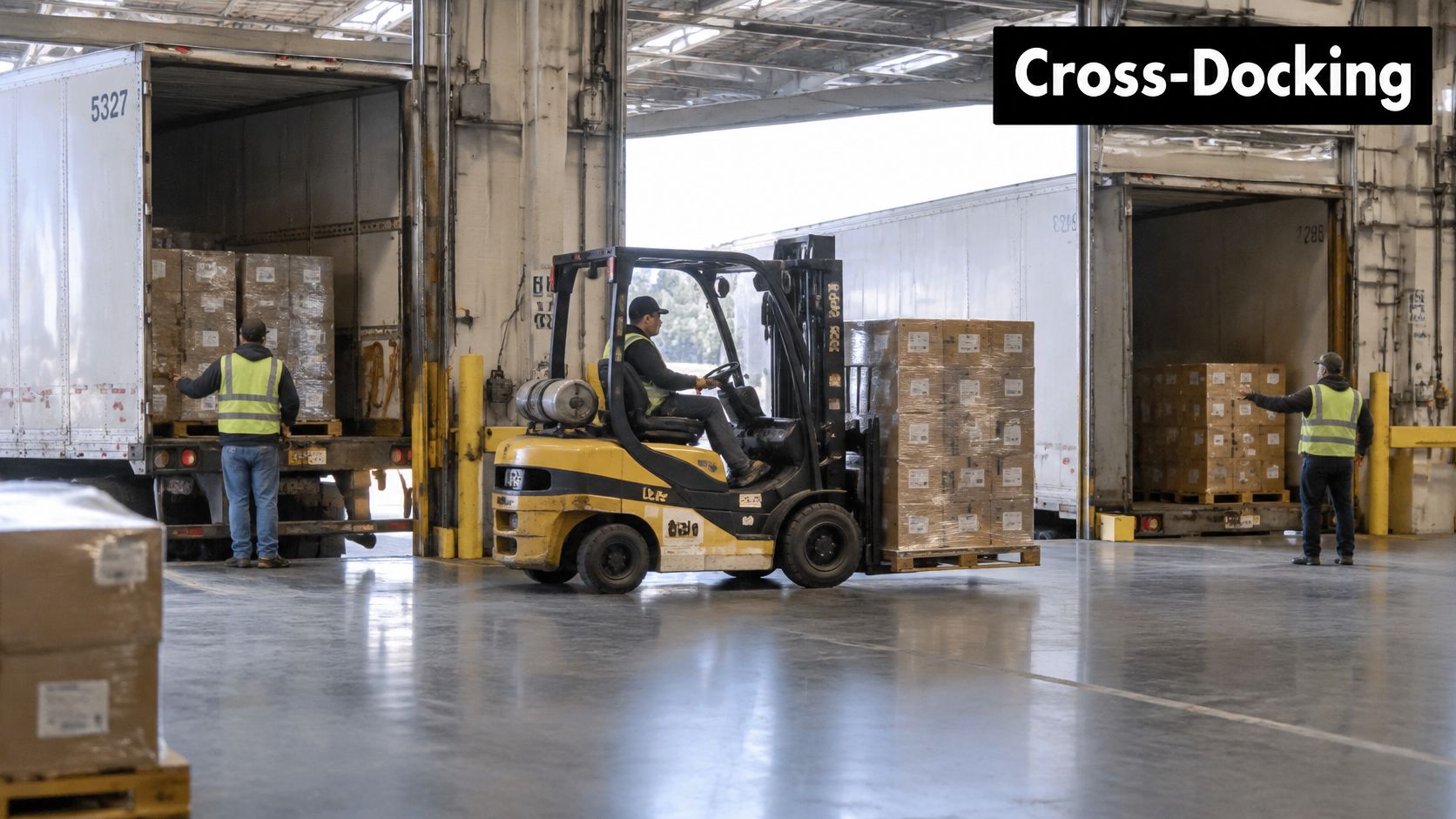
Cross-docking moves freight from an inbound truck straight onto an outbound truck with little or no warehouse storage. The standard design keeps product on the dock only briefly, usually within a single operating shift, before it leaves. Nothing goes into a rack. Nothing waits for a pick list.
That night decides whether the operation works, and it has very little to do with how fast anyone walks. Cross-docking is a flow-design decision. Door assignment, the manifest, the appointment time, and the route plan matter more than the concrete floor. Operators who treat it that way move freight with fewer touches than the ones who just push harder. The largest gains usually come from scheduling, layout, and clean manifests, not from faster physical handling.
Cross-Docking Defined in Plain Terms
You land at a hub, walk to the next gate, and board a second flight an hour later. Your bag moves behind the scenes. You never leave the terminal for a hotel. Freight through a cross-dock follows that same connection. The trailer is the arriving flight, the dock door is the gate, and the outbound route is the connecting flight. The schedule, the door layout, and a clean manifest decide whether that connection holds. Faster walking between doors does not repair a late appointment or a mixed manifest.
A cross-dock is a transfer point. The standard definition of cross-docking draws the boundary this way: products move from inbound transportation to outbound transportation with little or no warehouse storage, and a facility unloads, sorts, consolidates and reloads freight, often within the same operating shift. A warehouse runs receive, put away, store, pick, ship. A cross-dock runs unload, sort, consolidate, reload. Handling speed only helps after each pallet already has a destination and a departure time.
The operating pattern is old, which is why the rules feel settled. U.S. less-than-truckload trucking used it in the 1930s, the U.S. military adopted it in the 1950s, and retail turned it into a competitive method in the late 1980s when Walmart replenished stores from distribution centers this way. The retailer relied heavily on cross-docking so goods could move from those centers toward stores without sitting in storage.
The storage test: if inbound freight waits for a customer order before it ships, it's being stored. If it leaves on a scheduled outbound vehicle within hours, it's being cross-docked.
How Freight Moves Through a Cross-Dock
A reserved door is already waiting when the trailer arrives, and each pallet already has a departure tied to it. The run works like a relay baton passed between vehicles, not a warehouse shift spent putting freight away. Freight is unloaded, sorted or consolidated by destination, and transferred to outbound vehicles with little or no intermediate storage. In an LTL-to-FTL design, shipments that share a destination get combined so trailers run fuller and the number of dispatches drops, as this study of cross-dock terminal operations describes.
Faster handling on the floor is the smaller lever. The larger one is flow design: a schedule that holds the door, a layout that shows which lane belongs to which truck, and a clean manifest that matches the freight before anyone moves a pallet.
The seven-step version looks like this at the dock floor.
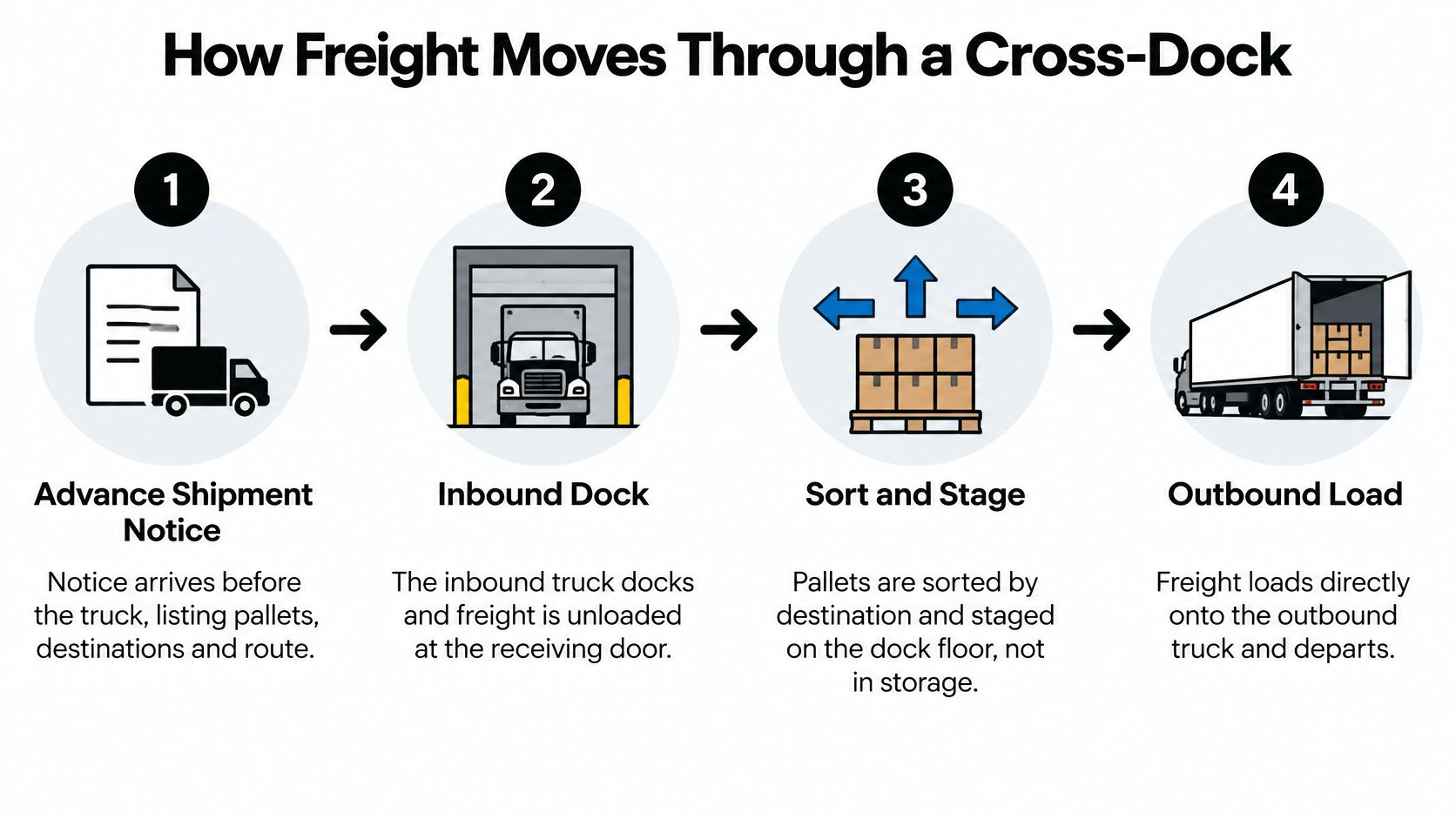
- Advance shipment notice. Before the trailer arrives, the dock receives a list of pallets, destinations, and the route each load belongs to. Without that list, doors get assigned to whoever calls first, and the schedule collapses into a queue.
- Inbound docking at a reserved door. The truck backs into a position held for its arrival window, so two trailers do not fight over one dock plate.
- Scan and sort by destination. Every pallet is scanned against the notice and sorted to a store, hub, or route. Scanning catches a mislabel while the freight is still on the floor.
- Consolidation. Freight bound for the same destination is merged onto a shared lane or pallet, so the outbound trailer leaves full instead of light.
- Stage in marked lanes, not racks. Staged loads sit in painted floor lanes tied to a specific departure. A supervisor can see the load that is about to miss its truck.
- Load against the route plan. The outbound trailer is loaded in delivery sequence and checked against a documented manifest. The driver can work stops in order instead of reshuffling at the curb.
- Depart on schedule. The trailer pulls out inside its window, and the door it used becomes available for the next arrival.
Where the handoffs break
Box truck drivers at Peak Transport load and unload with pallet jacks, document deliveries, and perform pre- and post-trip inspections. Each of those jobs is a handoff where paperwork and freight have to agree. Most errors surface there, not in transit. A driver who arrives to a staged load that does not match the manifest is the last check before a wrong pallet reaches a customer's dock.
Skip the advance notice and the rest of the sequence fails in order. Doors go to the first caller, two trailers contest one plate, and a pallet sits while someone decides where to store it. The dock looks busy. It is no longer cross-docking.
The sequence below is what those handoffs look like when the notice, the lane, and the manifest agree.
The trace-a-pallet test: pick one pallet and follow it from dock door to departure. If you find a point where it waited for a storage decision rather than a truck, you are looking at a warehouse process wearing a cross-dock label.
Four Cross-Dock Types and Where Each Fits
The category is big money. Mordor Intelligence estimated the global cross-docking market at USD 240.38 billion in 2024 and projected it would reach USD 250.92 billion in 2025, which is a lot of freight moving through buildings that all carry the same name and do quite different jobs.
Distribution cross-docks sort inbound freight by store or route and reload it for fast replenishment. This is the retail pattern Walmart pushed at scale from the late 1980s, and it rewards predictable store demand more than anything else.
Consolidation cross-docks take smaller shipments headed for the same destination and combine them onto fuller trailers. This LTL-to-FTL design is the one most middle-mile networks live on, because it turns a dozen half loads into a handful of dense ones.
Pre-distribution cross-docks resize or resequence shipments before they reach the next stage, so what rolls out matches a downstream vehicle, a store layout or a delivery window. The dock is doing engineering, not sorting.
Post-distribution cross-docks handle goods that were held briefly and now need splitting by destination before dispatch. They suit operations that keep a little stock and then fan it out.
| Cross-dock type | What the dock does | Best fit |
|---|---|---|
| Distribution cross-dock | Sorts inbound freight by store or route and reloads it for fast replenishment | Retail and store replenishment networks |
| Consolidation (LTL to FTL) | Combines smaller shipments bound for the same destination onto fuller trailers | Middle-mile and less-than-truckload freight |
| Pre-distribution | Resizes or resequences shipments before they reach the next stage | Multi-stage supply where shipment size must match downstream limits |
| Post-distribution | Sorts or reconfigures goods after storage and before dispatch | Operations that hold stock briefly, then split it by destination |
The type isn't a matter of taste. It follows from which job the dock performs most often, whether that's replenishing, consolidating, resizing or resequencing. Most facilities that feed a hub-and-spoke distribution network are running consolidation on one side of the building and replenishment sequencing on the other, which is why naming your type by asking one question beats copying someone else's layout.
Benefits and Drawbacks Depend on Your Freight
Cross-docking is a fit, not a default. Its value depends on demand predictability, shipment synchronization, handling requirements and the quality of operational coordination, and a recent empirical study of a Chinese supermarket network shows both sides of that. The research tracked product-level data from 71 stores supplied through one warehouse and a cross-docking station and found distribution-center inventory fell by as much as 93.68% for certain products, with system-wide inventory down an average of 25.86% (published study summary).
Where it pays off
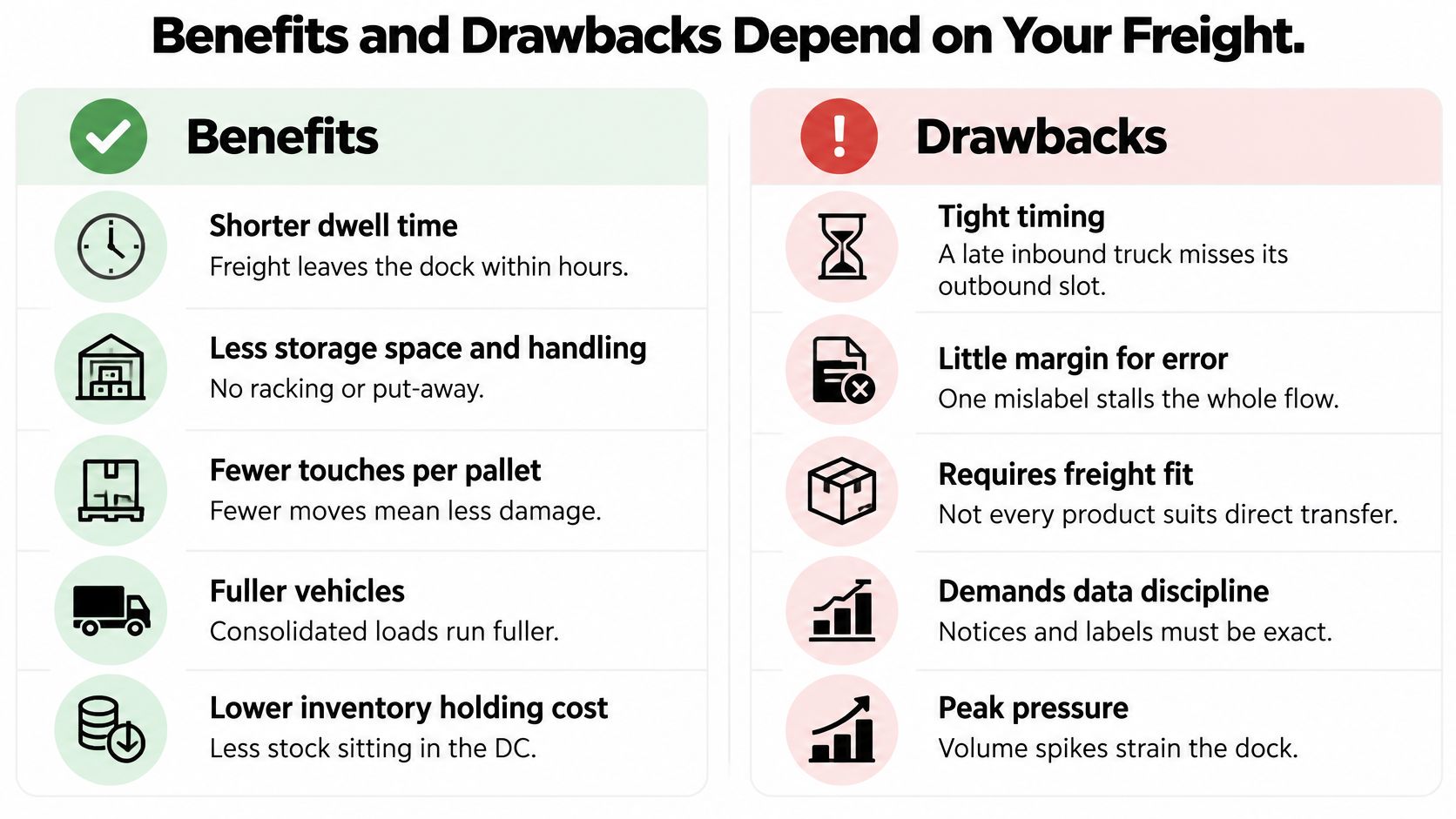
- Dwell time collapses. Freight that would sit for days leaves the same night, which frees dock space for the next arrival.
- Storage and handling costs drop. No racking, no put-away, no pickers walking aisles to build orders.
- Fewer touches per pallet. Every avoidable move is another chance to damage a carton or misplace a label.
- Trailers run fuller. Consolidated loads cut the number of dispatches on the same lane.
- Inventory sits closer to demand. Stock moves downstream without the distribution center carrying it.
Where it bites
The same supermarket study found the store-level picture was not a clean win. Cross-docking didn't consistently reduce on-hand inventory at stores and was associated with more days of stockouts on average, with outcomes varying by demand characteristics. Products with lower demand or greater demand variability could show lower on-hand inventory at the store, while higher-demand or higher-variability products could see fewer stockout days under some operating conditions. That's a warning against assuming the dock fixes the shelf.
Two operational drawbacks matter just as much. Late, mislabeled or wrongly sequenced inbound freight creates congestion rather than speed, and a missed connection can't be buffered because nothing is sitting in reserve. A warehouse absorbs a bad night. A cross-dock passes it straight to the customer.
Screen any lane with three questions: is demand predictable enough to pre-build the outbound load, can inbound and outbound appointments be synchronized, and will the advance data match the freight that actually shows up?
Metrics to Track for Cross-Dock Performance
The constraint that decides whether a dock works isn't floor space. It's time-window coordination across suppliers, the cross-dock and the outbound hub, and research models the operation as a truck-scheduling problem that minimizes makespan, the elapsed time from unloading the first scheduled inbound truck to loading the last scheduled outbound truck, while also counting dock capacity, transportation schedules, lot sizes and inventory cost, as this analysis of cross-dock scheduling sets out.
The cause and effect is direct. Tighter synchronization cuts dwell and storage requirements. Poor sequencing or late arrivals produce staging backups, missed outbound departures, extra handling and higher transport cost. FEMA's distribution guidance uses the same principle when it moves freight between vehicle types, holds fewer trailers and reconfigures shipment sizes to match downstream constraints.
| KPI | What it shows |
|---|---|
| Dwell time | Hours between unloading and outbound loading |
| Makespan | Elapsed time from first inbound unload to last outbound load |
| On-time outbound departure | Share of trucks leaving at the scheduled time |
| Dock appointment adherence | Share of inbound trucks arriving within their window |
| Advance shipment data accuracy | Share of arrivals whose labels and manifests match the notice |
| Misrouted or re-sorted freight | Share of pallets that need manual re-sorting after unloading |
Three controls a supervisor can run this week
Appointment discipline. Publish arrival windows and hold carriers to them, because a dock that accepts any arrival time has no schedule at all. Real-time arrival visibility lets you re-sequence doors before a late trailer becomes a missed departure rather than after. Explicit priority rules for freight tied to fixed overnight departures stop the argument at the dock plate, since everyone already knows which loads cannot slip.
Reliable performance rests on repeatable dispatch data, accurate manifests, safe dock procedures and route plans that protect driver hours. If you want a broader set of measures to pair with these, this guide to logistics performance metrics covers the operational side of the same picture.
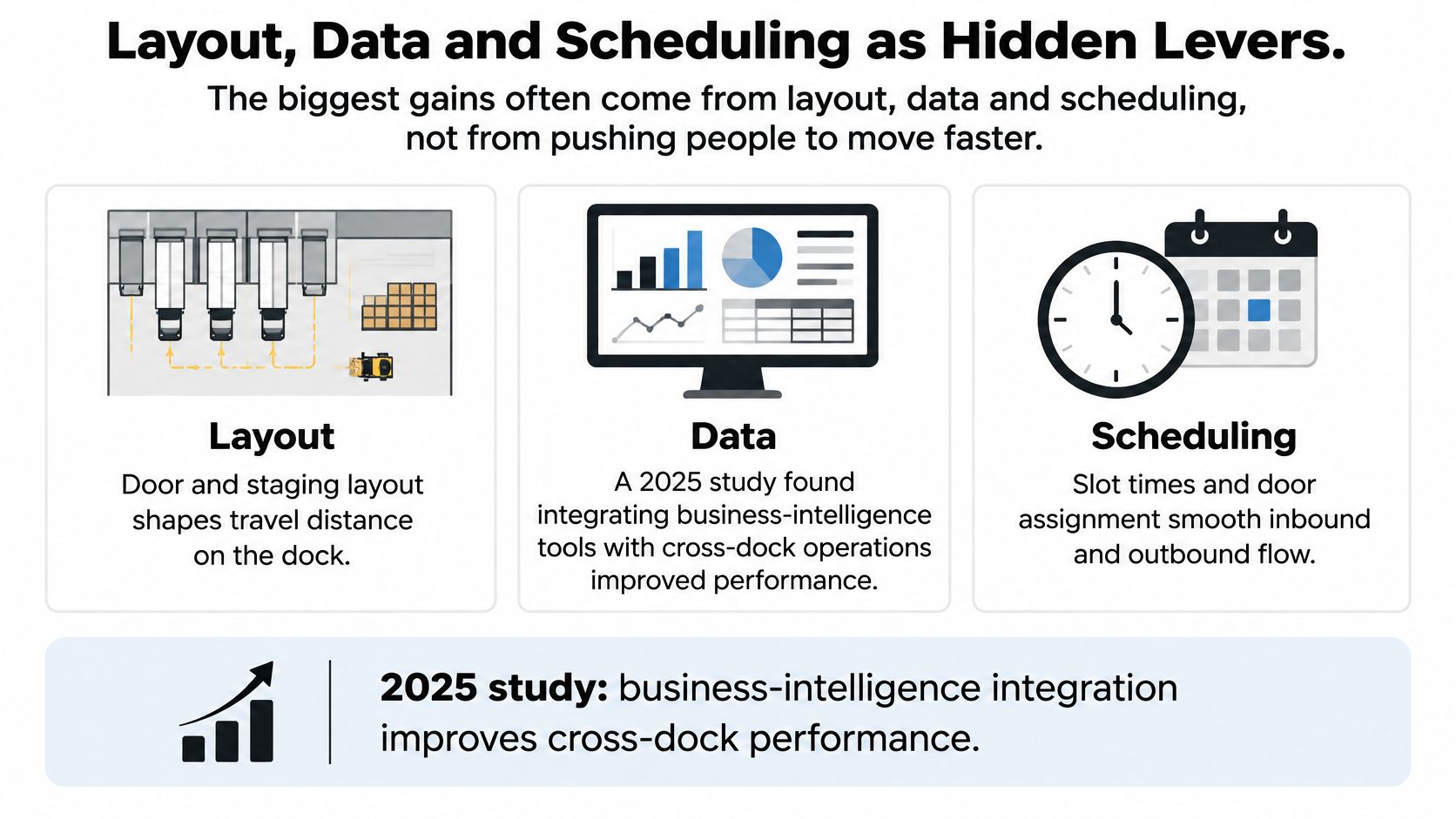
Layout, Data and Scheduling as Hidden Levers
A pallet jack rolling the long way across a dock works like a grocery run planned in the wrong aisle order. The shopper still collects the same items and wastes the trip. Door assignment, synchronized appointments, clean manifests, standardized exception handling, and fewer unnecessary touches decide that trip before anyone asks a crew to move faster.
Combining business-intelligence tools with historical cross-dock data and layout visualization can shorten warehouse travel distance. Once those three sit in one picture, information quality and spatial design stop being soft preferences and start showing up as shorter paths between doors.
Researchers modelled performance across inbound and outbound doors, transportation, inspection, staging, automation, digitization, resilience, and sustainability. They reported a 36% efficiency increase from combining pre-distribution and post-distribution policies and an 18% increase from eliminating redundant transportation movements, both documented in this review of cross-dock performance research.
Handling each pallet twice looks busy and still loses the night to re-sorting. The engineering is ordinary on paper. Assign doors by destination cluster so adjacent lanes feed adjacent doors. Hold appointments to the minute. Fix labels at the source rather than at the dock. Write exception rules so a short shipment does not stall a full lane.
Skipped scanning only relocates the error. Speed from improvised staging pushes the mistake to the next stop, where a re-sort costs more than the minute saved on the dock.
Layout decisions get easier once the data is clean. Teams reworking the floor can browse warehouse design solutions from Material Handling USA, which treats layout as an output of data rather than a floor-plan drawing exercise. The same logic governs distribution center logistics, where door and staging choices ripple into every outbound route.
Three questions separate a real cross-dock from a warehouse that only changed its sign. Is arrival data reliable enough to plan against? Do outbound departures carry recovery buffers? Do route plans account for dock congestion at peak?
Middle-Mile Example on Overnight Twin Cities Routes
Take one lane instead of a dock tour. A trailer leaves a regional distribution center at 19:40 carrying freight timed to an Amazon Relay node or an MSP-area hub. The inbound target is 20:15, the sort-and-stage window runs to 21:30, and the outbound departure is locked at 22:10 because the box truck has to hit four facilities before dawn.
Between 20:15 and 21:30, every pallet gets scanned, matched to a destination node, and rolled into a marked lane tied to that 22:10 truck. Nothing is stored. The lane label is the only thing standing between a smooth night and a re-sort.
Now run the failure. The trailer lands at 21:50 with one pallet labeled for the wrong node. The 22:10 departure either leaves short or waits, and if it waits, every stop behind it slides because the next facility has its own inbound targets and its own driver hours. There's no reserve stock to absorb the gap, so a single mislabel becomes a late morning for a customer two hops away.
The dispatcher's rule: lock the outbound departure first, then work backward to the latest inbound arrival that still leaves time to scan, sort and stage. The departure is fixed. The arrival is the variable you manage.
Our middle-mile routes are scheduled facility-to-facility runs planned in advance rather than residential stop lists, and because the work is local, drivers finish the shift at home instead of sleeping in a cab. That structure is what makes a 22:10 departure realistic in the first place, since the same driver who loads the lane also knows the route it feeds.
Decide Whether Cross-Docking Fits Your Freight
Cross-dock when three conditions hold at once: demand is predictable enough to pre-build the outbound load, inbound and outbound appointments can be synchronized, and advance shipment notices match the freight that arrives. Keep a storage step when demand swings hard, labels fail regularly, or trucks miss windows, because a cross-dock cannot buffer those misses in racks.
- Pick one live middle-mile lane. Not the whole network, one lane with a real customer behind it.
- Write down the fixed outbound departure. The time the truck must leave, not the time you'd like it to.
- Write down the latest inbound arrival that still leaves room to scan, sort and stage.
- Compare that gap with the dwell you measure today. If today's dwell is longer than the gap, the lane needs work before it goes cross-dock.
- If the gap fits, name the type from the four-type comparison and watch dwell time, makespan and on-time departure for a month.
Peak Transport already runs this pattern, with Middle Mile Logistics linking distribution centers and hubs on a box truck fleet under contracts with major brands, so the useful input for a planner is the lane time map rather than a facilities tour. The math is the same whether you run the dock or hand freight to someone who does.
Write those two clock times for one lane this week. One departure, one latest arrival. That single pair of numbers tells you more about whether cross-docking fits your freight than any layout diagram.
If your lanes need a middle-mile partner who treats cross docking as a scheduling problem rather than a building, Peak Transport runs overnight box truck routes between distribution centers, Amazon Relay nodes and MSP-area hubs across the Twin Cities metro, with documented manifests and pre-planned facility-to-facility routes. We're a Minnesota-based team on W-2 drivers, and our overnight schedules are built so freight clears the dock and leaves on time. Visit Peak Transport to talk through your lane times and see where our network fits.