What Is Logistics Strategy for Middle-Mile Freight
What is logistics strategy? Discover how to engineer reliable middle-mile networks, optimize overnight box-truck lanes, and balance cost with resilience.
October 12, 2026

Logistics strategy is the coordinated set of long-term decisions that plans, implements, and controls the flow of goods from origin to consumption, including transportation, storage, information, and customer requirements. Global logistics costs exceeded $11 trillion in 2023, representing approximately 10.6% of worldwide GDP, so the strategy is far more than a transportation budget or a software purchase.
The popular advice is usually wrong in a practical way. Buy a transportation management system, optimize the route, negotiate the lowest rate, and the network will perform. That approach ignores what happens at the dock at midnight, when a trailer is late, a driver reaches a legal-hours limit, a scan is missing, or a hub transfer depends on a departure window nobody documented.
A logistics strategy is an engineered operating model. It turns recurring demand into defined lanes, service commitments, capacity plans, dispatch rules, data standards, and recovery procedures. Software supports that model, but disciplined people and repeatable execution make it real.
Redefining Logistics Strategy Beyond the Software
A useful answer to what is logistics strategy starts with the whole flow, not the application used to manage it. The Federal Highway Administration's logistics definition describes it as the coordinated set of long-term decisions used to plan, implement, and control the efficient flow and storage of goods, services, and related information from origin to consumption while meeting customer requirements.
That definition matters because logistics includes more than transportation. It covers warehousing, inventory positioning, information systems, reverse logistics, service standards, and cost control. For a middle-mile operator, it also determines which facilities serve which markets, when routes depart, how capacity is reserved, what documentation follows the load, and how exceptions are escalated.
Buying a TMS before answering those questions puts the sequence backward. A system can optimize an approved plan, but it can't decide whether a fixed overnight lane should exist, whether a facility can consistently load within its appointment window, or how much recovery capacity a critical transfer needs. Those are management decisions.
Transportation is a business capability
Treating transportation as a line-item expense encourages short-term decisions. The cheapest available trip can create extra handling, missed hub transfers, unpredictable arrival times, and more work for dispatchers and warehouse teams. Those costs rarely appear on the freight-rate invoice.
A strategy instead connects transportation decisions to customer value. Predictable departures help distribution centers schedule labor and dock appointments. Reliable arrivals reduce downstream uncertainty. Accurate shipment information lets managers respond before a delay becomes a failed transfer.
A 2025 benchmark found that 49% of companies described transportation as a service differentiator, compared with 38% in 2024, while 31% called it a competitive weapon, compared with 22% in 2024. The figures are reported in Descartes' transportation management benchmark, and they reflect a shift practitioners can see on the floor. Transportation increasingly affects whether a network can keep its promises.
Practical rule: If the operating team can't explain the lane, the service window, the fallback plan, and the owner of each decision, the company doesn't yet have a logistics strategy.
The strongest plans are specific enough to run repeatedly. They define the origin, destination, cutoff, loading duration, equipment, driver requirements, handoff documentation, planned miles, contingency time, and performance measures. This is the difference between a route that exists in a dispatch screen and a lane that an organization can execute reliably.
For an integrated view of how transportation connects with broader operations, the supply chain integration resource is a useful reference. The central principle is simple: strategy should coordinate the network, not merely record its activity.
Core Components of a Middle-Mile Network
A middle-mile network sits between facilities that already have defined operating constraints. A distribution center may have a narrow loading window, a regional hub may require freight before a scheduled sort, and an overnight box-truck route may have little tolerance for dwell. The strategy has to join those constraints into one workable operating pattern.
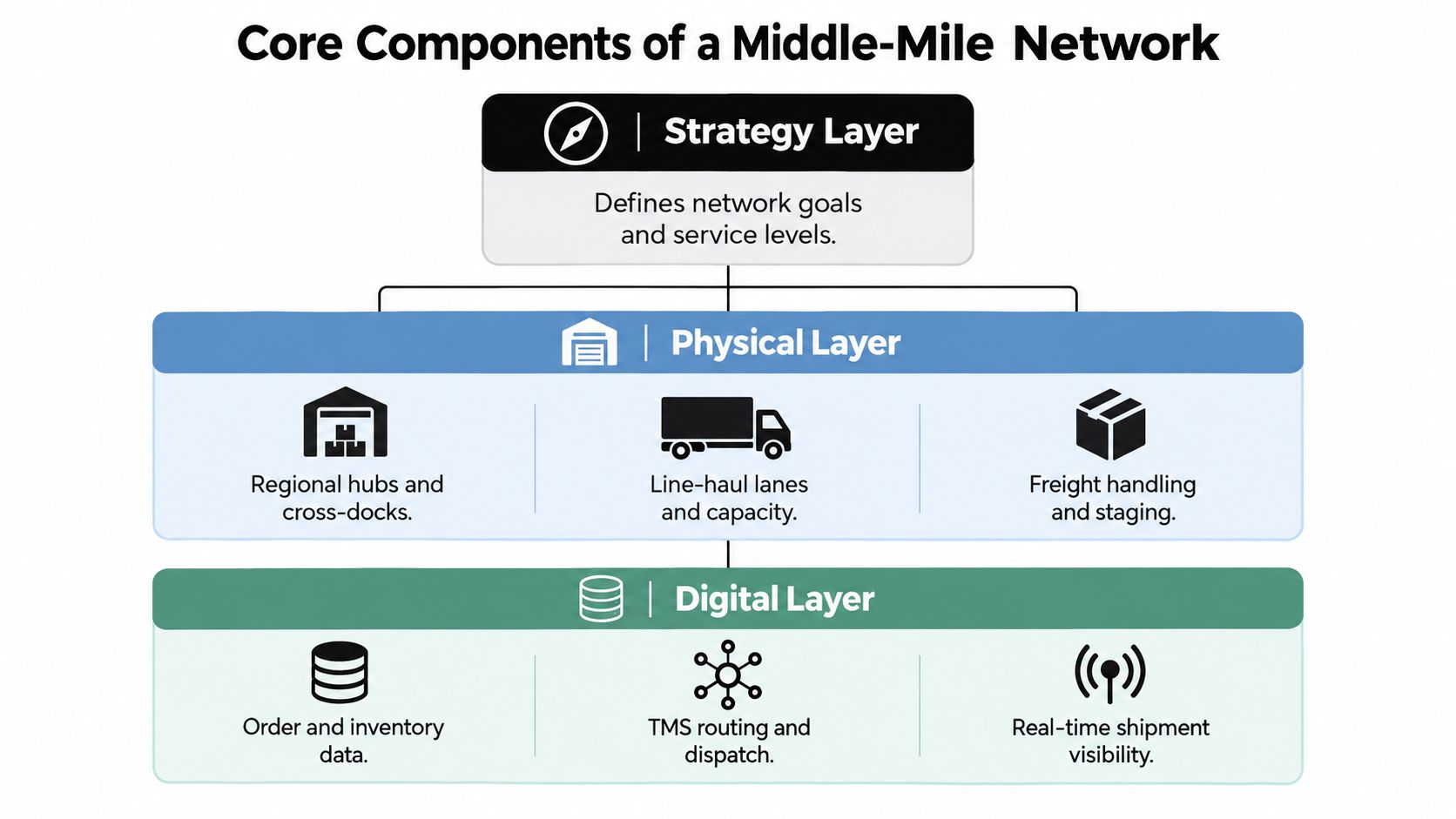
The economic context is substantial. Global logistics costs exceeded $11 trillion in 2023, equal to approximately 10.6% of global GDP, according to Statista's overview of the worldwide logistics industry. Even a regional middle-mile network therefore needs more than isolated trip decisions. It needs coordinated choices about physical assets, timing, information, and accountability.
The physical layer
Network design establishes which facilities serve which markets. A manager should map origins, destinations, cross-docks, regional hubs, appointment requirements, loading durations, and the likely flow of freight before selecting a routing configuration.
Capacity planning then aligns equipment and labor with recurring demand. A scheduled overnight lane needs the right vehicle type, a driver who can complete the work within legally available hours, and a dispatch plan that accounts for loading, travel, unloading, and documentation. Route density matters because concentrated freight can support repeatable lanes, while scattered demand may require flexible capacity.
Facility coordination is equally important. A route that looks efficient on a map can fail if the truck waits for a dock, arrives before freight is staged, or reaches the destination after its receiving window. Middle-mile strategy must therefore include staging standards, handoff ownership, and rules for reporting dwell.
The digital layer
The digital system should create a reliable operating record. That includes order and inventory data, dispatch instructions, planned and actual times, proof of delivery, exception codes, and status updates that the next facility can trust.
A TMS can assign routes and preserve documentation. Visibility tools can show where a shipment is. Neither tool fixes inaccurate timestamps or vague exception descriptions. If one dispatcher records “facility delay” and another records “freight not ready,” leadership can't distinguish a recurring staging problem from an isolated event.
The supply chain network design guide provides broader context for connecting facility choices with transportation decisions. In practice, the middle-mile version is hands-on: set the lane, define the appointment, assign the capacity, document the handoff, and make the result measurable.
A complete strategy joins the layers:
- Strategy layer: Define service windows, coverage, cost priorities, risk tolerance, and escalation ownership.
- Physical layer: Configure hubs, equipment, labor, staging, line-haul lanes, and backup capacity.
- Digital layer: Maintain orders, routing, dispatch, status events, proof of delivery, and exception records.
Engineered Lanes Versus Spot Market Capacity
The decision between scheduled lanes and spot capacity isn't a question of ideology. It depends on the freight profile, service consequences, and predictability of demand.
Spot capacity is useful when demand is irregular, a lane is temporary, or an internal fleet can't cover an unexpected surge. It gives a planner access to flexibility without committing the network to a permanent operating pattern. The weakness appears when teams use spot coverage for freight that repeats every night.
A scheduled lane creates an operating rhythm. Drivers learn the facilities, dispatchers understand the timing, warehouse teams can prepare freight consistently, and receiving locations know what to expect. The rate may not always be the lowest individual quote, but the total cost of a completed move includes planning labor, dwell, missed transfers, rehandling, communication, and service recovery.
The operating trade-off
| Operational Factor | Engineered Scheduled Lanes | Spot Market Capacity |
|---|---|---|
| Best fit | Predictable recurring freight and defined service windows | Irregular demand, temporary overflow, or unusual lanes |
| Planning | Standardized departure, arrival, loading, and handoff rules | Repeated sourcing and confirmation for each movement |
| Facility coordination | Familiarity supports consistent appointments and staging | Each provider may require new instructions and follow-up |
| Driver execution | Route knowledge and documented expectations develop over time | Experience with the lane can vary by assignment |
| Cost visibility | Total cost can be evaluated across recurring moves | The quoted trip rate is visible, while disruption costs may not be |
| Resilience | Requires a documented backup plan if primary capacity fails | Offers flexibility, but availability can change during an exception |
| Service risk | More predictable when volume and schedules are stable | Greater variation in timing, communication, and handoffs |
The right comparison isn't “contracted versus flexible.” It's controlled repeatability versus unmanaged variability. A recurring overnight transfer between distribution centers should generally be engineered around a defined departure window, planned miles, equipment requirements, and escalation rules. A one-off movement to an unfamiliar destination may not justify that structure.
What the lowest rate misses
A low spot quote can look attractive until the truck misses a hub cutoff. The downstream team may need to rework the sort, hold inventory, call customers, or purchase emergency capacity. None of those consequences improves the original rate comparison.
A scheduled lane also isn't automatically good. It can become wasteful if demand changes, equipment runs underused, or the schedule no longer matches facility operations. Managers should review route completion variance, empty miles, utilization, dwell, and exceptions rather than treating the original design as permanent.
The best lane is not the one with the lowest isolated price. It's the one that meets the service requirement at a repeatable total cost.
Use spot capacity as a deliberate tool, not as a substitute for planning. Define the freight that requires stable execution, reserve engineered capacity for it, and keep flexible providers available for genuine variability.
The Human Operating System and Data Governance
Technology doesn't create operational discipline. It exposes the discipline that already exists, or the lack of it.
A TMS can produce an elegant route plan, but a driver still has to inspect the vehicle, follow the dispatch instructions, confirm the load, document the handoff, and report an exception accurately. A visibility platform can display a status, but the status is only useful when people enter timely and consistent information. AI can recommend a change, but a dispatcher must understand the constraint before accepting it.
Gartner reports that 86% of supply-chain leaders use at least one mainstream logistics technology, while data quality and decision-making remain leading reasons organizations continue investing in digital capabilities. That combination is revealing. Adoption alone doesn't demonstrate maturity.

People make the data usable
A reliable human operating system has clear roles and repeatable standards:
- Drivers: Complete safety checks, follow route documentation, confirm freight counts, and record proof of delivery.
- Dispatchers: Monitor departures, interpret exceptions, protect legal hours, and communicate with facilities.
- Facility teams: Stage freight, meet appointment requirements, and record loading or unloading delays.
- Managers: Review patterns, correct process failures, and assign ownership for recovery.
A dedicated W-2 workforce can make those standards easier to formalize because the company controls training, scheduling, communication, and performance expectations. That doesn't mean flexibility has no value. It means leaders should recognize the trade-off between rapid access to capacity and consistent execution.
For readers building this broader management discipline, workforce operating system explained offers useful context on how people, processes, and accountability fit together. In logistics, the principle is practical: the system must tell each person what good execution looks like before the route begins.
Data governance starts at the handoff
Data quality is an operational responsibility, not an IT cleanup project. Teams should define standard exception codes, require complete proof-of-delivery records, and use the same meaning for departure, arrival, loaded, delayed, and delivered across facilities.
Pair technology measures with people measures. Review planned versus actual mileage, dwell time, route adherence, and exception-response time alongside training completion, documentation accuracy, safety compliance, absenteeism, and retention. If the route data improves but documentation remains inconsistent, the digital investment hasn't solved the execution problem.
The practical test is straightforward. Can a manager use the records from last night's route to explain what happened, who acted, which constraint caused the delay, and what should change before the next departure? If not, more software won't provide the missing operating discipline.
Designing Routes for Resilience and Recovery
Efficiency without recovery planning is a fragile form of optimization. A route may use fewer miles and less spare capacity, yet fail completely when a facility closes, a vehicle breaks down, a driver reaches a legal-hours constraint, or a departure window disappears.
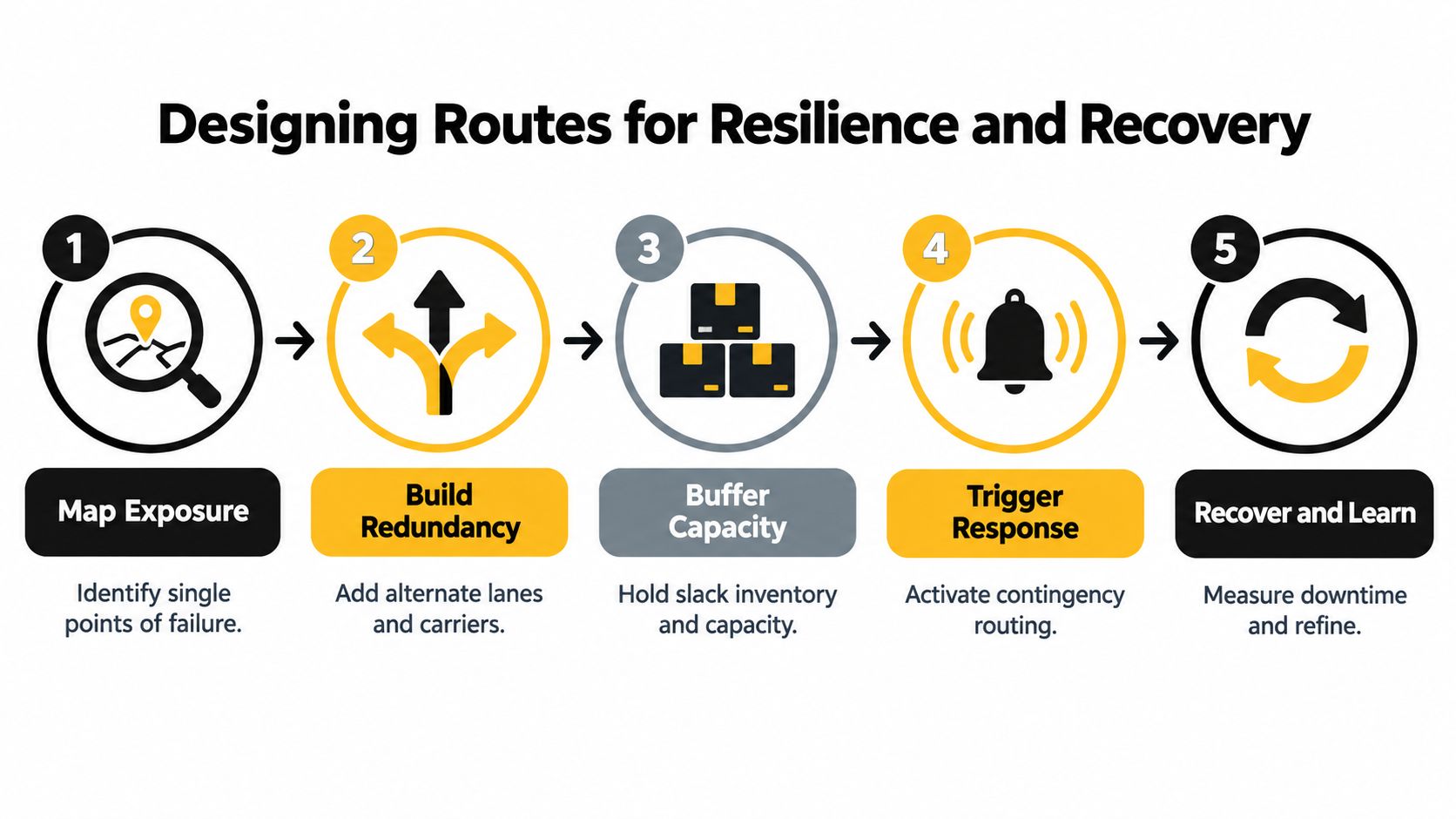
A resilient strategy accepts a measured amount of redundancy in exchange for continuity. A McKinsey survey found that 93% of supply-chain executives planned resilience actions, including network redundancy, regionalizing supply, and improving flexibility. For middle-mile operators, resilience becomes useful only when it is translated into lane-level instructions.
A five-step lane design
Map exposure. Identify single points of failure, including one facility, one departure window, one vehicle type, one driver assignment, or one undocumented handoff. Rank each exposure by the service consequence it creates.
Build redundancy. Predefine alternate facilities, substitute equipment, backup lanes, and qualified capacity. A backup isn't real if dispatch has to search for it during the disruption.
Buffer capacity. Decide where the network can carry slack. That might mean a spare vehicle, cross-trained dispatch coverage, an alternate departure window, or additional time between planned arrival and a critical cutoff.
Trigger response. Set escalation thresholds before the exception. Specify who contacts the facility, who reassigns the load, who updates the customer, and when the backup route activates.
Recover and learn. Record time to detect, time to recover, missed-load rate, dwell, and the percentage of volume with an approved backup path. Review the event after service is restored and revise the lane template.
Route planning is a constrained engineering problem. The plan must account for vehicle capacity, depot locations, stop sequence, time windows, labor availability, and legally available driving time. The shortest route can still be the wrong route if it causes late arrival, excessive dwell, or an unusable driver schedule.
For a related perspective on how routing tools support field operations, JobsiteStack's guide on field service routing provides useful examples of matching route decisions with real operating constraints. Middle-mile teams should apply the same discipline, while adding facility cutoffs, freight handoffs, and recovery ownership.
A contingency plan should be executable by the dispatcher on duty, not understood only by the strategist who designed it.
The objective isn't to eliminate every disruption. It is to limit improvisation, protect the most important service commitments, and learn enough from each exception to improve the next operating cycle.
Measuring Execution with Operational KPIs
A logistics strategy is working only when the daily operation proves it. Mileage is useful, but it doesn't tell a manager whether the route arrived within its window, whether the truck sat at a dock, or whether the lane consumed more capacity than planned.
Research on logistics optimization recommends evaluating route plans through cost per loaded mile, empty-mile percentage, vehicle utilization, route completion variance, on-time pickup and delivery, and exception frequency, rather than mileage alone. The logistics optimization research supports a balanced scorecard because cost and service can move in opposite directions.
The KPI set that belongs in the operating review
- Cost per loaded mile: Shows what the network spends on productive movement, rather than blending loaded and empty activity.
- Empty-mile percentage: Reveals whether lane design, backhauls, or repositioning decisions create avoidable travel.
- Vehicle utilization: Indicates whether equipment capacity matches the freight plan without hiding service failures.
- Route completion variance: Compares planned execution with actual completion and highlights unstable schedules.
- On-time pickup and delivery: Connects route performance to the service commitment promised to facilities and customers.
- Exception frequency: Shows how often the plan requires intervention, which helps distinguish normal variability from a broken process.
Managers should also examine dwell time, documentation accuracy, driver-hour usage, and response time during exceptions. Those measures explain why a lane missed its target instead of merely recording that it did.
Turn measurement into decisions
A weekly review should connect each KPI to an action. Rising empty miles may call for lane consolidation or a revised departure pattern. High dwell may require a facility staging change rather than a new routing algorithm. Repeated exception codes may show that the lane needs a different cutoff, equipment type, or backup rule.
Operational measurement also depends on workforce habits. A practical guide to operational efficiency for HR teams can help connect training, attendance, and accountability with process performance. Logistics leaders shouldn't separate those people measures from transportation results.
The key performance indicators resource can support a more structured review. The important point is consistency. Use the same definitions, review the same lane types, and make owners responsible for corrective actions.
A strategy earns credibility when stakeholders can see the chain from design to result: defined lane, assigned capacity, documented execution, measurable service, and a recovery plan when conditions change.
Peak Transport provides structured overnight box-truck operations, documented dispatch, and data-informed middle-mile route planning between distribution centers, regional hubs, and Amazon Relay nodes. If your network needs dependable lane execution rather than last-minute capacity decisions, visit Peak Transport to discuss your middle-mile requirements.