What Is Safety Inspection in Trucking? Essential Guide
What Is Safety Inspection. Learn what safety inspection means in trucking and middle-mile logistics, from pre-trip checks to DOT compliance and practical
September 18, 2026
A safety inspection is a systematic check of a commercial vehicle's critical components against regulatory standards, conducted before a trip, after a trip, and periodically by a qualified inspector, to confirm the vehicle is roadworthy and compliant before it enters service. In U.S. commercial vehicle compliance, every commercial motor vehicle must receive a periodic inspection at least once every 12 months, with records retained on the vehicle or in carrier files.
The counterintuitive part is that safety inspections aren't mainly about finding dramatic failures. They're about catching small defects before a driver is halfway through an overnight depot loop, a roadside officer identifies an out-of-service condition, or a truck returns too late to cover the next load. For middle-mile operators, an inspection is both a safety control and a dispatch-control mechanism.
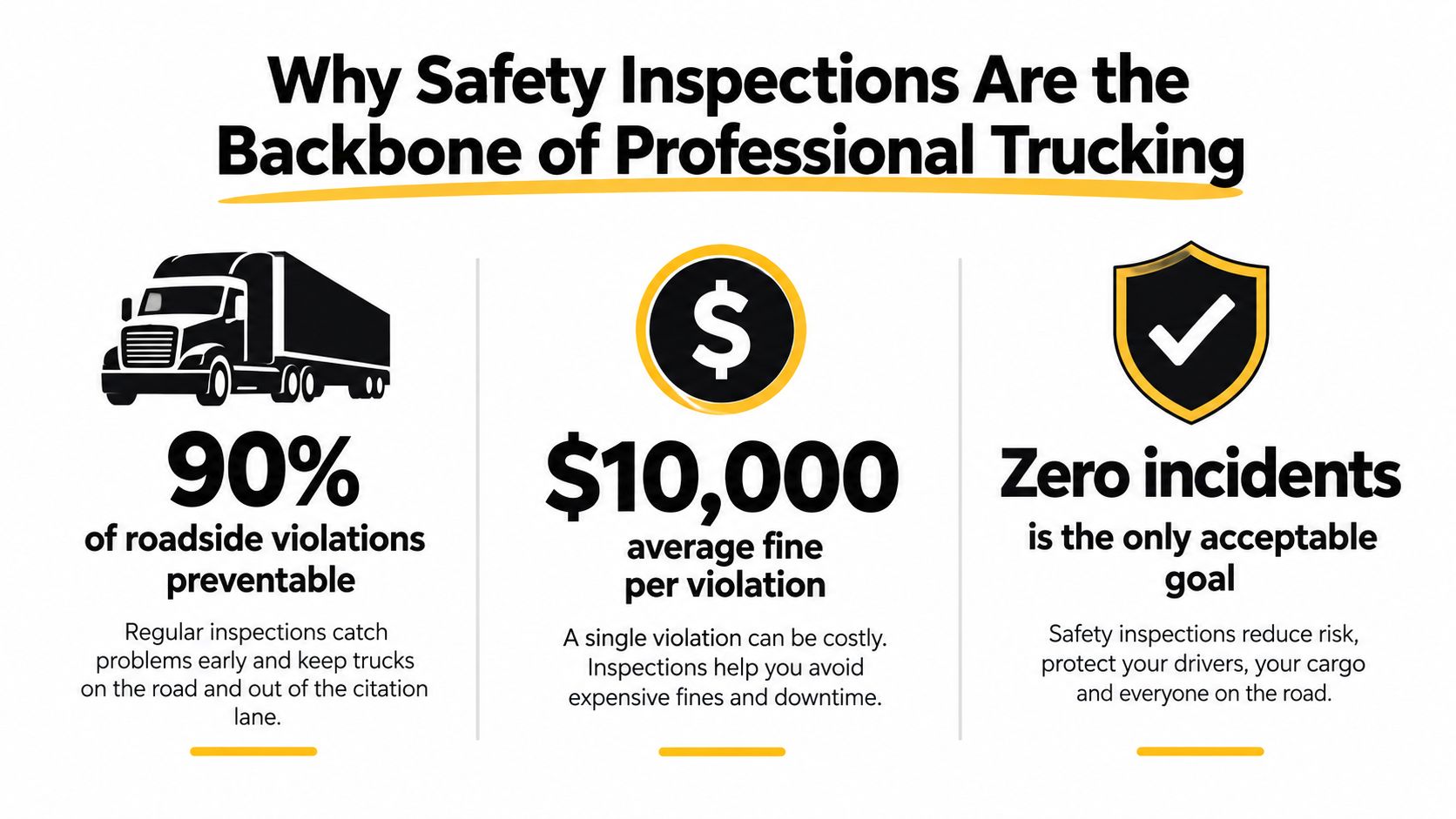
Why Safety Inspections Are the Backbone of Professional Trucking
Safety inspections are the backbone of professional trucking, not paperwork. OSHA's historical overview records a decline in U.S. workplace injuries from 10.9 incidents per 100 workers in 1972 to 3.6 per 100 in 2016, a 67 percent decrease, while worker deaths fell from about 38 per day in 1970 to 14 per day in 2016 (OSHA historical safety data). Those figures don't prove that one driver's walk-around prevents one specific crash, but they show why systematic safety controls became central to professional operations.
The Occupational Safety and Health Act was signed on December 29, 1970, and OSHA began operating on April 28, 1971. OSHA also notes that inspections are generally conducted without advance notice. That matters to a fleet manager because a vehicle must be ready in its ordinary working condition, not cleaned up for a scheduled visit or prepared only when management expects scrutiny.
The operating cost of a missed check
Consider an overnight box-truck route. A driver notices a weak lamp but leaves because the departure window is tight. Later, a brake warning appears, a tire develops damage, or a roadside inspection finds a serious defect. Dispatch then has to locate a replacement vehicle, move freight, contact the customer, and explain a delay that began with a missed observation at the depot.
A disciplined inspection routine gives the company a chance to act while the truck is still at the terminal. Maintenance can repair the vehicle, dispatch can reassign the load, and the driver can start with equipment that has been evaluated against defined requirements. The inspection doesn't eliminate every risk, but it moves decisions earlier, when the operator still has options.
Practical rule: A defect found before departure is a maintenance task. The same defect found on route can become a service failure, a compliance event, or a safety emergency.
Professional fleets also treat equipment-specific checks seriously. Where a truck uses hydraulic equipment or related systems, a resource on hydraulic compliance verification can help managers understand why technical verification belongs in a controlled maintenance process rather than an informal glance.
The professional difference is consistency. Drivers perform the checks, supervisors review exceptions, maintenance closes defects, and dispatch respects the result. A truck doesn't leave because the schedule is full. It leaves when the responsible people have enough evidence that it can operate safely and legally.
What Safety Inspection Actually Means in Trucking
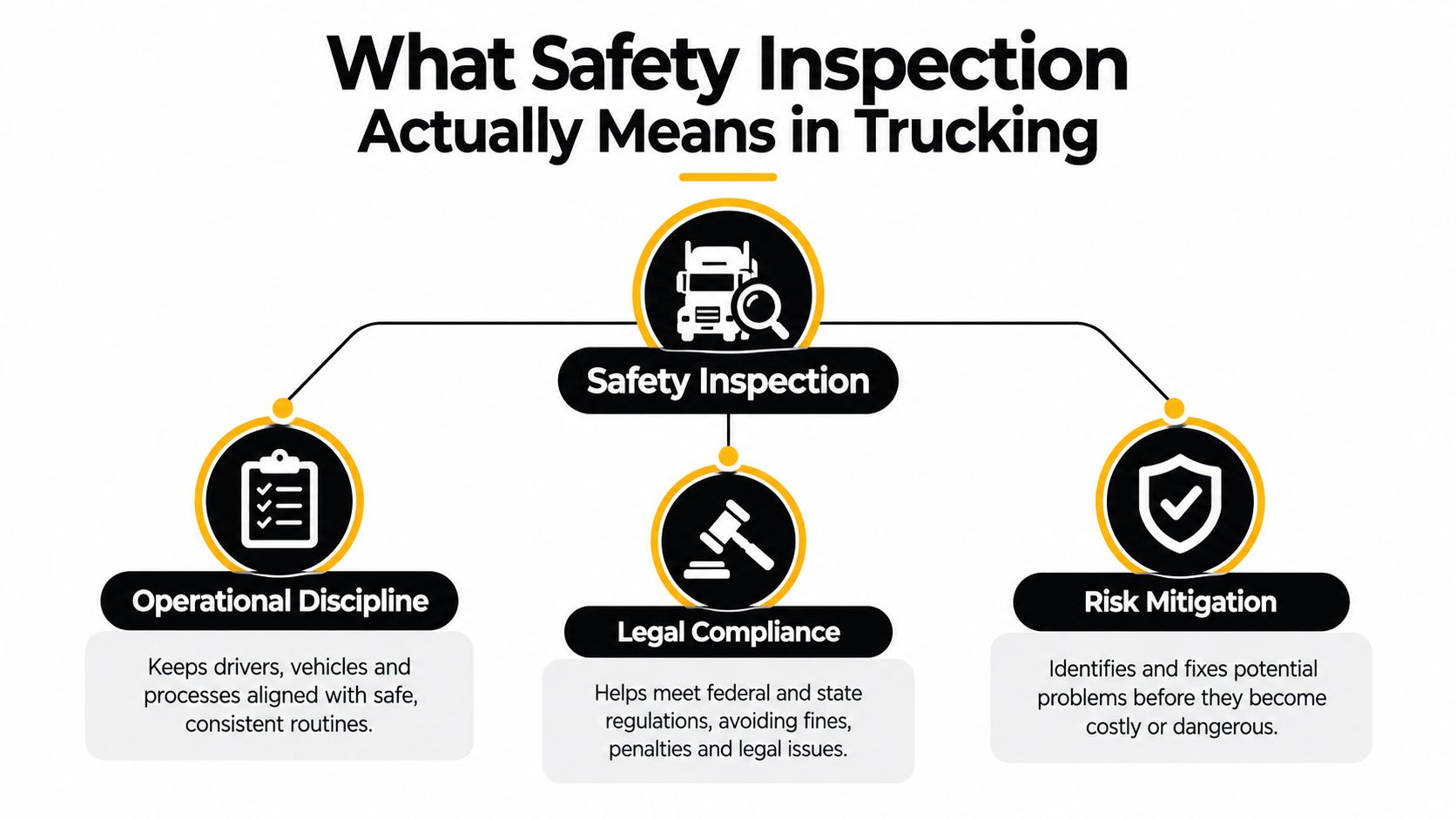
A safety inspection is the control point that decides whether a truck should enter service. In trucking, it is a structured evaluation of safety-critical vehicle components against applicable standards. The result confirms the vehicle's condition at a specific time and records what was checked, who checked it, and how the carrier handled any defect.
That record separates a formal inspection from a quick glance. A driver who spots a flat tire during a walk-around has made a useful observation. A working inspection program goes further. It defines the items to check, sets a method for classifying defects, routes the report to the right person, and establishes whether the truck is held, repaired, or released.
For a middle-mile operator, the process supports three connected responsibilities:
- Operational discipline: Drivers follow the same repeatable method before an overnight box-truck route or depot loop, rather than relying on memory.
- Legal compliance: The carrier can show that required checks and records exist.
- Risk mitigation: The team identifies conditions that may affect braking, steering, visibility, load stability, or vehicle control before they disrupt a tight delivery window.
Inspection is not the same as an audit
New logistics managers often use inspection, audit, and assessment interchangeably. Each examines a different part of the operation.
An inspection focuses on the truck and its safety-critical condition. It asks whether the lights work, tires are serviceable, brakes function properly, the load is secure, and coupling equipment is safe.
An audit examines the management system behind those checks. It can review written procedures, W-2 driver training records, inspection documentation, maintenance controls, and corrective-action follow-up. Guidance on safety gap analysis before an OSHA inspection explains why routine checks may look acceptable while programs or records remain incomplete.
The carrier needs both controls. The inspection supports the next trip. The audit tests whether the company's process keeps producing reliable inspections across drivers, vehicles, and repeat routes.
For managers connecting vehicle checks with broader transport responsibilities, safety compliance guidance provides a useful reference.
Types of Safety Inspections in Commercial Trucking
For a middle-mile operator, inspections form a handoff sequence rather than four unrelated events. Each check answers a different question: Is the truck ready to leave, what changed during the route, does it meet the scheduled compliance requirement, and how does it perform under enforcement review?
| Inspection type | When it occurs | Primary responsibility | Main purpose |
|---|---|---|---|
| Pre-trip | Before the vehicle enters service | Driver | Identify defects before departure |
| Post-trip | After the route or shift | Driver | Report damage and defects discovered during operation |
| Periodic or annual | At least once every 12 months | Qualified inspector or carrier | Verify required components and document certification |
| Roadside | During enforcement activity | Law enforcement officer | Evaluate the vehicle and driver during actual operation |
Pre-trip inspection
The pre-trip check is the final controlled opportunity to find a problem before a box truck leaves the depot. The driver examines lights, brakes, tires, mirrors, wipers, fluid conditions, emergency equipment, coupling devices, and the cargo area. A practical guide on how to run a pre trip safely can help turn these checks into a repeatable walk-around.
On an overnight route with a tight departure window, the driver should report a defect before accepting the load. Dispatch can then assign another vehicle, arrange a repair, or adjust the route before a missed hub connection becomes a larger disruption.
Post-trip inspection
The post-trip check records what changed during the shift. A driver may find a new body impact, warning light, damaged mirror, tire issue, or cargo-area problem that was absent at departure. Reporting it gives maintenance a starting point before the next W-2 driver takes the same truck on the next depot loop.
A useful handoff includes the defect, the vehicle, and the operating context. That information helps maintenance decide whether the truck can return to service or needs attention first.
Periodic or annual inspection
Under U.S. commercial vehicle rules, every commercial motor vehicle must undergo a periodic inspection at least once every 12 months. The inspection covers all items in 49 CFR Part 396 Appendix A, with documentation retained on the vehicle or in carrier records (FMCSA safety inspection requirements). This formal compliance event supports the fleet record, while daily driver checks address immediate trip readiness.
Roadside inspection
A DOT or FMCSA roadside inspection takes place away from the terminal while the vehicle is operating. An officer may identify defects requiring immediate correction or place the vehicle out of service. A consistent internal routine helps the operator find those conditions before they interrupt a load, delay a return loop, or create dispatch chaos.
How Safety Inspections Work in Practice
A useful inspection doesn't end with a driver checking boxes. It follows a decision process: observe the condition, compare it with the applicable standard, classify the defect, decide whether the vehicle can operate, document the result, and verify that corrective action is complete.
Start with critical systems
The inspector or driver should work through the vehicle systematically. Brakes, steering, suspension, lighting, tires, rims, coupling devices, and load securement all deserve focused attention because failures in these systems can affect stopping, directional control, visibility, or cargo stability.
Many inspection programs use explicit out-of-service criteria. Examples include audible air leaks, excessive pushrod stroke, an inoperative low-air warning system, defective service or parking brakes, insecure loads, and tire or rim damage. These findings are high-risk because they can directly reduce braking capacity, control, or load stability (commercial vehicle out-of-service criteria).
A visual check still matters, but the decision can't depend only on whether a component looks worn. The inspector must ask whether the condition has crossed a defined threshold.
A small defect isn't always a small operational issue. Its consequence depends on the component, the measured condition, and the applicable out-of-service rule.
Classify before releasing the truck
A fleet should define what happens after each finding. A low-risk observation may receive a repair deadline. A serious defect may require the vehicle to remain at the terminal until maintenance completes the repair. An out-of-service condition requires the operator to prevent the truck from continuing until the condition is addressed under the applicable process.
Documentation becomes operationally important. The record should identify the vehicle, inspection type, date, responsible person, findings, corrective action, and release decision. Missing documentation can create a compliance problem even when the truck appears roadworthy.
Safety equipment inside the cab also needs attention. If a driver reports difficulty with a restraint, managers should inspect stuck seat belt latches and address the problem before assigning the vehicle.
For a practical workflow covering the walk-around and defect follow-up, use the truck inspection checklist as a reference point, then adapt it to the vehicle types and routes in your fleet.
Implementing Safety Inspections at a Middle-Mile Operator Like Peak Transport
An overnight box-truck operation has a useful advantage: its routes often repeat. Drivers leave from familiar depots, travel predictable lanes, and return to a known terminal or hub. That structure lets managers place inspections into the workflow instead of treating them as interruptions.
At a company such as Peak Transport, the process can begin before dispatch assigns the route. The driver completes the pre-trip check, records any defect, and communicates the result through the company's operating channel. Dispatch then treats the inspection status as part of the vehicle assignment decision. If a critical defect appears, the truck isn't sent out because the load is waiting.
A practical depot rhythm
The driver's post-trip report becomes the maintenance team's input for the next service window. Maintenance can separate urgent defects from planned work, while supervisors can review repeated issues by vehicle or route. The periodic inspection schedule sits above this daily process and ensures that the formal annual requirement doesn't disappear inside routine dispatch activity.
W-2 drivers also give the employer a direct training and accountability structure. Managers can demonstrate the expected inspection method, observe performance, correct misunderstandings, and reinforce accurate reporting without leaving the process entirely to informal contractor practices.

The key is to close the loop. A driver reports a defect. A responsible person evaluates it. Maintenance repairs or escalates it. Someone verifies the repair. Dispatch releases the vehicle only after the record supports that decision.
Peak Transport operates as a Minnesota-based middle-mile carrier focused on overnight box-truck routes, structured dispatch, and documented safety compliance. That model illustrates a broader principle for logistics managers: predictable routes make inspection timing easier to plan, but only a clear ownership process keeps the routine reliable when a defect appears at an inconvenient hour.
The Operational Benefits of Rigorous Safety Inspection
A rigorous inspection program protects the route plan as much as the driver. On an overnight box-truck loop, one unresolved defect can disrupt the departure window, the next depot handoff, and the customer's scheduled delivery.
The first operational gain is earlier decision-making. A driver who reports a problem before departure gives dispatch workable choices: hold the vehicle, assign another truck, adjust the route, or explain a load delay before it becomes a roadside event. A defect found after departure leaves fewer options and can force a recovery during the tightest part of the schedule.
Inspections also prepare a carrier for recurring roadside enforcement. FMCSA inspection records show that roadside checks occur at substantial scale (FMCSA inspection data). For a fleet operator, that means inspection discipline should support everyday readiness, not only a response to a warning, complaint, or prior violation. Accurate pre-trip findings, repair records, and release decisions give managers a clear basis for deciding whether a truck should leave the depot.
What managers gain from consistency
- Fewer route interruptions: Drivers and technicians can address defects at the terminal before a breakdown strands a truck.
- More stable dispatch planning: Current inspection and maintenance records make vehicle availability easier to assess.
- Better audit readiness: Managers can show evidence of checks, repairs, and release decisions instead of rebuilding the history later.
- Clearer driver accountability: W-2 drivers receive consistent expectations, training, and escalation steps across shifts.
- Stronger maintenance decisions: Repeated reports can identify vehicles or components that need closer attention.
A missed periodic inspection creates a separate compliance and scheduling problem. The formal requirement follows a 12-month interval, so a carrier cannot treat it as optional. If the inspection is overdue or the documentation is unavailable, the vehicle may need to remain out of dispatch, putting pressure on load timing and replacement-vehicle availability. Managers should track the due date alongside route and maintenance planning rather than relying on memory.
A practical fleet maintenance management process connects driver reports with defect classification, repair completion, and verification. Each completed check then improves the next dispatch decision. For a middle-mile operator, that connection helps turn safety work into predictable departures, fewer out-of-service surprises, and less dispatch disruption.
Frequently Asked Questions About Safety Inspection in Trucking
Is a safety inspection the same as a safety audit?
No. An inspection checks safety-critical vehicle items and roadworthiness. An audit examines the broader safety system, including records, training, written programs, and corrective controls. A truck may pass its vehicle check while the carrier's documentation still has gaps.
Do personal or rented vehicles matter?
Yes. Any vehicle used for company work should be safe and fit for its assignment, whether the carrier owns it, rents it, or a driver provides it. For an overnight box-truck route, that means confirming the vehicle is suitable before dispatch, not assuming ownership determines responsibility.
What happens when a driver doesn't complete a required check?
The carrier lacks proof that the vehicle was evaluated before or after service. A manager should pause the assignment when necessary, document the omission, complete the required inspection, and address the training or supervision issue behind it. That record helps prevent one missed check from becoming a roadside violation or a delayed depot loop.
Peak Transport provides middle-mile transportation through overnight box-truck routes, documented dispatch practices, and W-2 driving roles in the Twin Cities. Visit Peak Transport for its services and opportunities.