Amazon Relay Trips: Requirements, Equipment and Workflow
Amazon Relay trips explained: eligibility rules, box-truck equipment, dispatch workflow and tips for on-time overnight middle-mile runs.
November 8, 2026
Amazon Relay handled more than 38 million loads across its load board and contracts in 2024, according to Amazon's transportation update. That scale makes Relay worth understanding, but it doesn't make every booking profitable. For an overnight box-truck operator, the difference between a workable trip and a losing shift often comes down to dwell, empty miles, legal driving time, and records that support payment.
What an Amazon Relay Trip Involves Today
A typical middle-mile assignment starts at a facility, not a customer's front porch. Say dispatch assigns a box truck to collect palletized freight at a fulfillment center and deliver it to a regional delivery node. The driver works against appointment windows, facility access procedures, and a documented handoff.
Amazon Relay trips are transportation assignments within a freight network, not random residential package routes. The truck's movement may look straightforward on a map, but the assignment includes check-in, waiting, loading, travel, unloading, and close-out.
The dock handoff is part of the job, not time outside the trip.
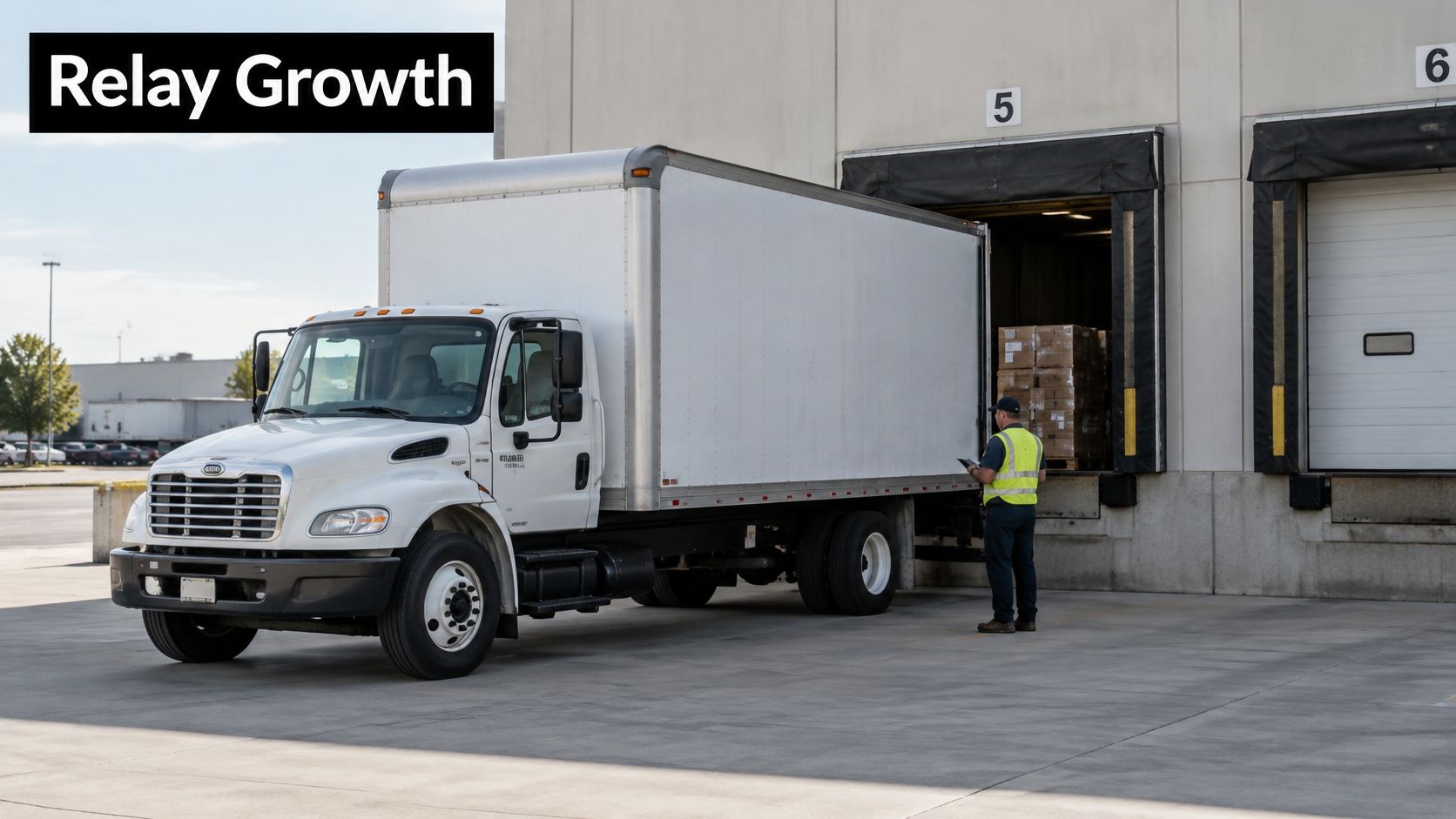
Where box trucks fit
Amazon reported more than 500,000 completed box-truck loads in the year referenced by its 2025 freight-expansion update, which also described thousands of box-truck loads available daily. Separately, FreightWaves reported in 2025 that freight volumes for Amazon Relay carriers were up 15% year over year.
A box truck occupies useful ground between a tractor-trailer and a last-mile van. It can move palletized freight between regional facilities without assigning tractor-trailer capacity to every transfer. That doesn't mean every load fits every body configuration or payload rating.
Carriers encounter this work through different booking arrangements:
- Open load-board bookings: Select available work that fits the truck's location, equipment, and legal operating window.
- Recurring lanes: Build repeatable assignments around familiar nodes and operating requirements.
- Contracted capacity: Commit equipment and staffing to an agreed operating schedule rather than relying entirely on individual bookings.
For dispatch, the distinction is commitment. An isolated booking can fill unused capacity; a recurring assignment needs dependable staffing, maintenance coverage, and a recovery plan.
Start your market assessment with a facility map. Mark reachable fulfillment centers, sort centers, delivery stations, and regional hubs, then compare available lanes with your equipment and shift boundaries. Network growth isn't evidence of local profitability. Public volume figures don't show your lane's dwell, empty repositioning, or net earnings.
Eligibility Rules Every Carrier Must Meet
Amazon Relay publishes its current carrier eligibility requirements in the Amazon Relay FAQ. Check that guidance before applying and again when requirements may affect your operating status. The FAQ is the reference for current thresholds; avoid relying on figures copied from older summaries.
Eligibility involves more than holding an active operating authority and a valid MC number. Carriers should review their FMCSA safety profile, including any applicable BASIC percentiles, and check driver and vehicle violation records. Requirements can change, so confirm the current criteria directly rather than treating an unverified table of numerical limits as policy.
Check the record behind the score
Start with the carrier's DOT number in the FMCSA Safety Measurement System. Review the displayed categories and the inspection and violation records behind them. A clean-looking summary is not a substitute for examining the underlying events.
Use a consistent review sequence:
- Confirm the carrier identity. Match the legal entity, DOT record, MC number, and operating-authority history.
- Review each applicable category. Don't rely on the overall profile alone.
- Read the underlying violations. Separate driver conduct, log problems, qualification issues, and equipment defects.
- Assign corrective action. Give each open issue an owner, a completion record, and a follow-up check.
A percentile is not a raw violation percentage. Don't substitute your own calculation for the measure Relay evaluates, or confuse BASIC percentiles with separate driver and vehicle violation rates. The public FAQ does not establish the specific thresholds sometimes repeated in summaries, so verify the current standard before making an eligibility decision.
Insurance belongs in the same review as authority and safety. Use this guide to review carrier insurance requirements as part of preparing the application. A complete insurance file does not correct an unacceptable safety profile.
Compliance rule: Fix the operating behavior behind the record, not just the paperwork describing it.
For dispatch, review log exceptions before assigning more work, and close maintenance defects before releasing equipment. Coaching without follow-up leaves the underlying risk in place. A repair entry without confirmation that the truck is serviceable does the same. Track corrective-action aging alongside on-time performance, so a busy schedule does not conceal unresolved issues. Those controls also protect trip profitability: dwell, deadhead, hours-of-service margin, and complete documentation can matter more than the rate displayed on a load board. Missed paperwork creates follow-up work, while deferred repairs can leave equipment unavailable when a scheduled trip is due.
Box Truck Equipment Rules and Lift Gate Checks
Accepted box-truck equipment and pre-dispatch checks, based on Amazon Relay's equipment guidance, separate platform specifications from practical load-matching and safety checks:
| Equipment Item | Requirement | Check Before Dispatch |
|---|---|---|
| 16-foot box truck | Accepted equipment | Functional tuck-under lift gate |
| 26-foot box truck | Accepted equipment | Functional tuck-under lift gate |
| Rental box truck | DOT number must be displayed | Confirm the DOT number is visible before the trip |
| Lift gate | Must operate safely | Test at dispatch and hold the vehicle if defective |
| Interior dimensions and payload | Match the lane's freight | Verify against the load specification |
| Tires and brakes | Vehicle in service condition | Inspect pre-trip and document any defect |
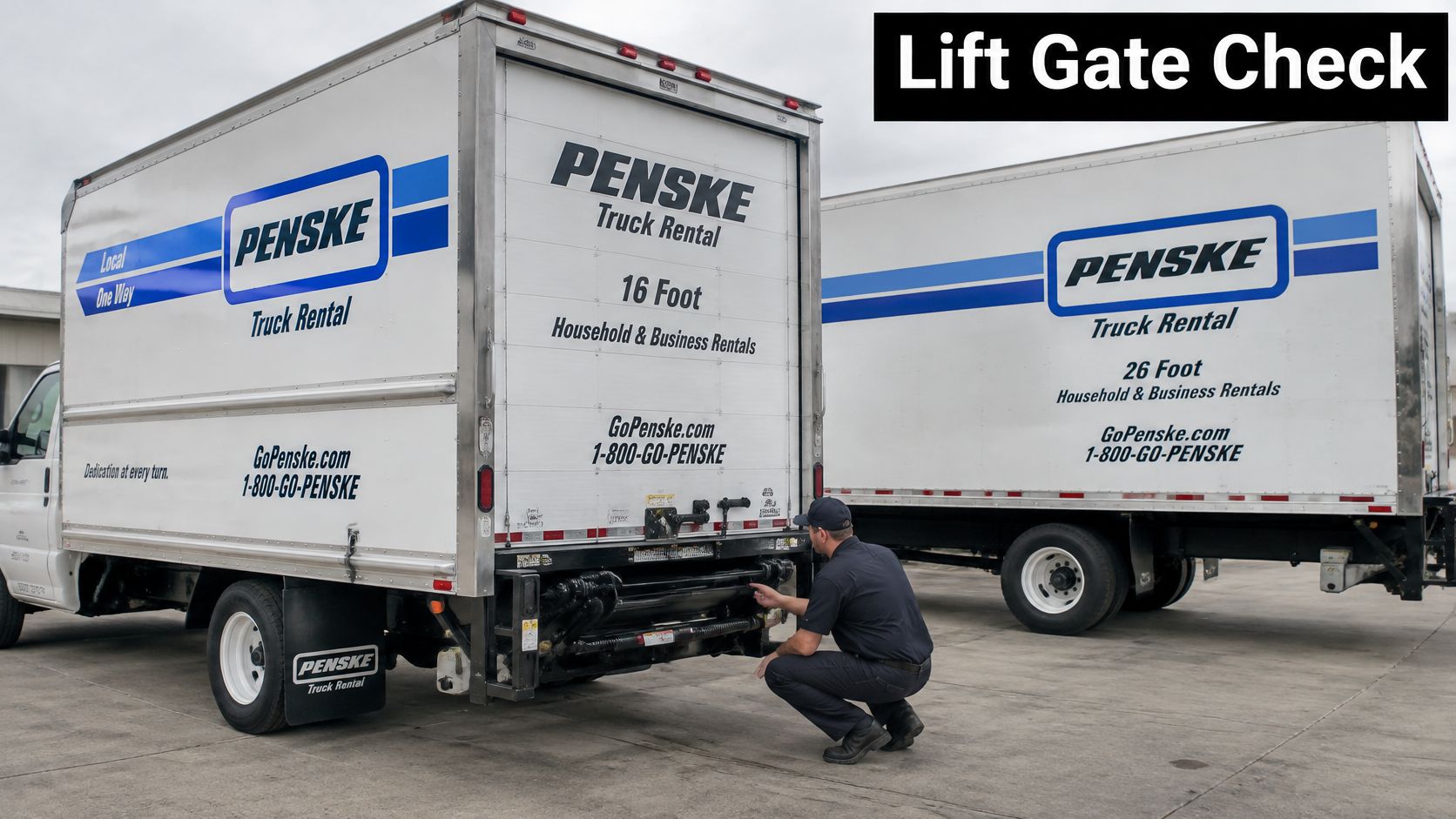
The tuck-under lift gate is a dispatch constraint, not an accessory. A truck can start, steer, and reach the facility while still being unable to complete a safe freight transfer.
Test the gate before the truck leaves the yard, using the manufacturer's operating procedure.
Build a route-specific equipment record
Keep more than a truck number in the dispatch system. Record body length, usable interior dimensions, certified payload, lift-gate capacity, inspection status, and available backup equipment. Include handling restrictions that affect whether a loaded pallet can move safely through the door and onto the platform.
At Peak Transport, our box-truck drivers load and unload with pallet jacks, document deliveries, and perform pre- and post-trip inspections. Those duties belong in equipment preparation: a suitable truck without a serviceable handling tool still creates an avoidable problem.
Before assigning a recurring lane:
- Match the freight envelope: Check pallet layout, door clearance, weight, and usable floor space.
- Inspect the handling system: Look for damage, leaks, unreliable controls, and unsafe platform movement.
- Close the defect record: Confirm the repair and release decision rather than relying on a verbal assurance.
A smaller accepted truck isn't automatically a substitute for a larger assigned configuration. If the freight won't fit safely, dispatch may need replacement equipment, a split movement, or a revised plan. Each option consumes time and can disrupt another assignment.
A truck that can drive isn't necessarily a truck that can complete the load.
Never solve a failed gate by improvising manual freight handling. Put the vehicle on maintenance hold, document the defect, and resolve equipment coverage before committing to a time-critical departure.
Running a Relay Trip From Dispatch to Close-Out
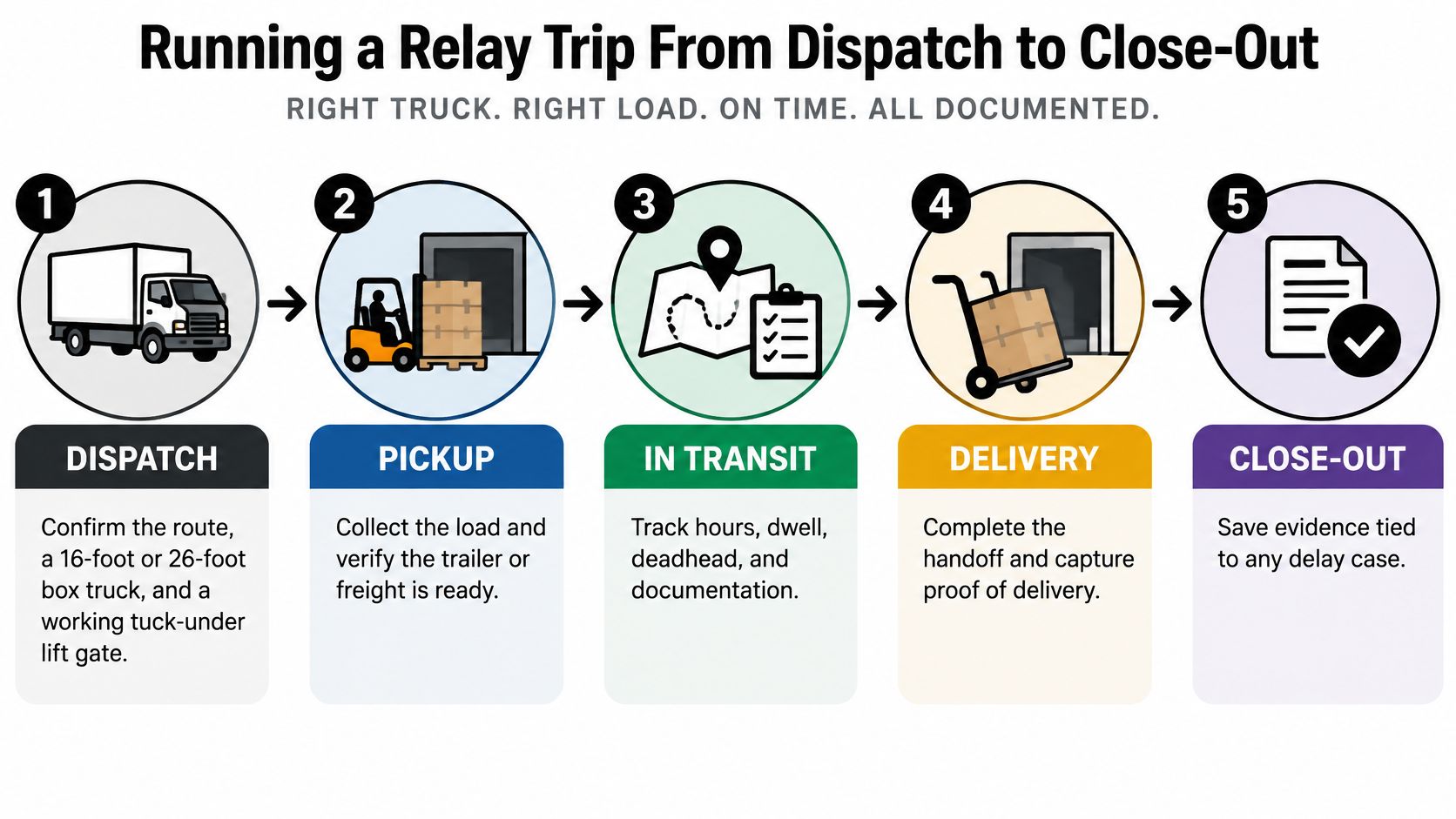
A reliable trip record should let someone who wasn't on the shift reconstruct what happened. That means connecting dispatch instructions, app events, facility timestamps, freight documents, and any exception to the same assignment.
At Peak Transport, our routes are planned in advance between facilities, not random residential stops. Planning gives the driver a defined assignment, but dispatch still needs to manage exceptions rather than assuming the published schedule will survive unchanged.
The operating flow should remain visible from assignment through reconciliation.
Keep the trip and its evidence together
The Relay Driver Guide explains that location tracking supports ETA and delay updates, drivers must report delays with a reason and expected restart time, and detention requests can be denied when location services are disabled. App compliance can affect your ability to substantiate a payment request, not just dispatch visibility.
Confirm the assignment before dispatch. Verify the route, facility instructions, assigned equipment, handling tools, and remaining hours of service. Read the actual load requirements rather than relying on the name of a familiar lane. Check where the truck will stage if it arrives before the facility can receive it.
Check tracking at departure. Keep location services enabled and confirm that the assigned trip is active in the app. A phone with a depleted battery or restricted background permissions can leave dispatch without useful updates. Resolve the device problem before it becomes an arrival-record problem.
Verify arrival capture. Use the designated facility entrance and check whether the app records arrival. If the geofence doesn't register, follow the support process and retain a timestamped check-in record. Don't assume crossing a property boundary produced a usable event.
Document freight handling. Follow the facility's pallet-jack and dock procedures, check freight count and condition, and verify seal information when applicable. Record door assignment and handling times. Report discrepancies before accepting a clean handoff record.
Report interruptions promptly. Enter the delay reason and expected restart time, then update dispatch when circumstances change. A private message alone may not complete the app's reporting requirement. Dispatch also needs to assess whether the next appointment remains achievable.
Preserve detention evidence. Keep arrival, wait-start, release, and departure records with the relevant facility documentation. Evidence supports review; it doesn't guarantee detention approval. Check the applicable trip terms rather than treating every wait as payable.
Reconcile at close-out. Match proof of delivery, exception notes, and trip status to the invoice record. Resolve missing signatures, inconsistent timestamps, and unresolved shortages while the driver can still explain them accurately.
Clear ownership matters throughout. Our guidance on logistics coordination helps frame who communicates a change, who confirms receipt, and who updates the operating plan.
Match each interruption to a record
Delay scenarios, app reports and evidence to keep
| Delay Situation | What to Report in the App | Evidence to Keep |
|---|---|---|
| Late arrival at a pickup node | Delay with reason and expected restart time | Timestamped location history |
| Snow or road closure | Delay with weather reason and new ETA | Route screenshot and dispatch message |
| Dwell beyond the planned window | Detention request with arrival and wait times | Arrival geofence record and gate log |
| Lift gate failure | Delay with equipment reason | Maintenance hold record and photo |
| Missed relay handoff | Delay with handoff time and expected restart | Dispatch and handoff confirmation |
Consider a hypothetical Twin Cities trip scheduled to reach a node at 2:00 a.m. A snow-related exit closure adds ninety minutes. The driver safely stops before updating the app, reports the weather interruption and revised ETA, and retains the route screenshot and dispatch message.
Dispatch then requests a revised downstream appointment and records whether the receiving facility accepts it. Sending a message isn't the same as securing a new window. That distinction determines whether the next driver or receiving crew is working from a confirmed plan or an unsupported assumption.
Missing records have direct costs: staff time reconstructing the trip, weaker support for detention, delayed reconciliation, and disputes over responsibility. Capture evidence when the event occurs, not from memory after the shift.
Middle-Mile Overnight Practices That Protect On-Time Trips
The displayed rate is only the revenue side of the decision. To judge a lane, dispatch needs the complete operating cycle: paid movement, waiting, empty repositioning, handling, and recovery. A higher-rate booking can be the weaker choice if it leaves the truck stranded away from its next useful assignment.
Use a lane-level checklist to keep those costs visible.
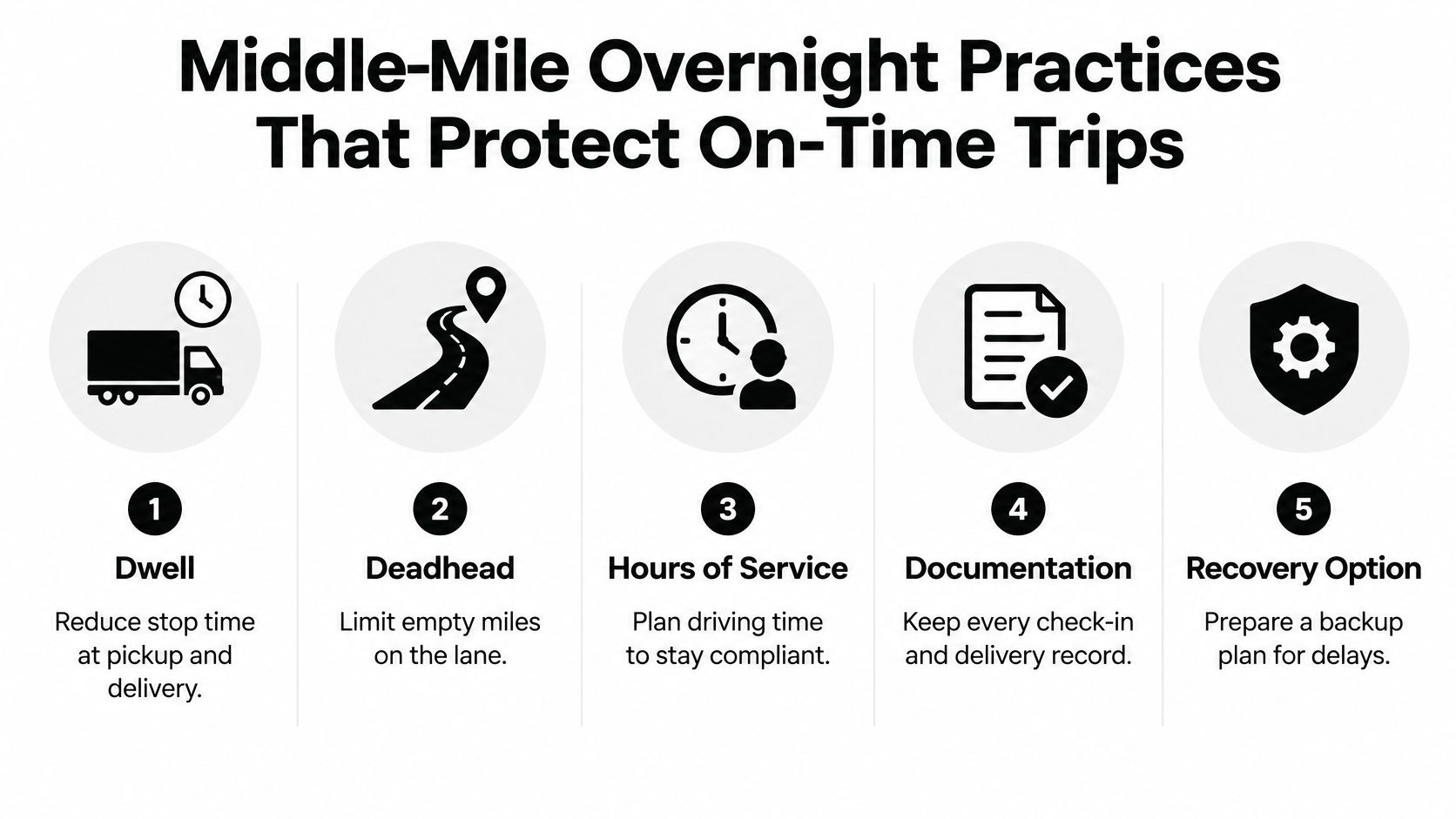
Plan for variation, not perfect conditions
- Allow facility buffer: Separate road travel from gate queues, staging, dock access, and freight release. A short drive doesn't guarantee a short assignment.
- Protect legal operating margin: Use the applicable hours-of-service rules to build a schedule that can absorb a delay without depending on unavailable driving time.
- Adjust for winter conditions: On Minneapolis–St. Paul lanes, review closures, yard access, and safe staging before departure. Never recover lost time by pressuring a driver to exceed safe conditions.
- Sequence empty moves carefully: Compare the delivery node with the next pickup and the eventual return point. A convenient outbound load can create an expensive repositioning problem.
- Name the recovery option: Identify the dispatcher responsible for replacement equipment, appointment changes, or a safe stop. “Call someone” isn't a recovery plan.
The right buffer isn't a universal allowance. Compare planned and actual arrival, door, release, and departure times over a trial period, then adjust each node separately. Keep weather disruption distinct from ordinary facility dwell so you don't conceal a recurring dock problem inside a general contingency allowance.
Dispatch judgment: Reject a schedule that only works when every handoff is immediate.
Deferred repairs create their own variance. An unresolved defect can turn a planned shop visit into roadside downtime, replacement-truck positioning, missed work, and claims administration. Protecting a departure by postponing a known repair can cost more than rescheduling the assignment.
Protect the driver's repeatable shift
Our Middle Mile work is local, so drivers return home after their shift and don't perform long-haul overnight trips. That creates an opportunity for a consistent sleep routine, but dispatch must avoid treating a local route as permission for an open-ended shift.
Use the video alongside a lane review, then compare the operating plan with actual shift records.
Judge the lane by its repeatability after disruptions, not its fastest completed run.
Decide Whether Relay Trips Fit Your Fleet or Career
Use a go-or-no-go decision, not enthusiasm about freight volume. A carrier is ready when its compliance profile qualifies, its assigned equipment matches the freight, and its staffing plan covers the complete operating cycle. If any of those conditions fails, booking more work increases exposure rather than useful capacity.
A driver should assess a different set of questions. Are overnight facility assignments compatible with your sleep routine? Are you comfortable handling palletized freight, documenting exceptions, and communicating changes before they affect another appointment?
Separate carrier responsibility from job fit
An independent carrier owns the authority, compliance, insurance, equipment, and commercial decisions behind accepting freight. An employee driver works within the employer's operating structure. Don't confuse qualifying for a driving role with qualifying a carrier business for Relay access.
Before making a decision:
- Carriers: Review the current safety record, unresolved defects, load compatibility, and actual lane costs. Correct the underlying problems before expanding commitments.
- Drivers: Compare employment status, shift expectations, physical duties, training, and benefits, not just the advertised pay description.
- Dispatch managers: Confirm who owns every exception from first report through invoice reconciliation.
If you're weighing local facility work against other driving paths, Find New Drivers lets you compare truck driving job options before choosing a role. Use that comparison to identify which schedule and responsibilities you can sustain.
At Peak Transport, we're hiring for full-time and part-time overnight shifts, and we review route-specific shift options with applicants. Our drivers are W-2 employees, with paid training, paid sick time, health insurance, a 401(k) with matching, and growth opportunities.
This week, make the decision concrete: pull the carrier record and equipment files, or write down your driver-role requirements and compare them with an available shift. Choose work you can execute consistently, not merely work you can accept.
Peak Transport offers planned overnight box-truck work between facilities in the Twin Cities area, with local routes that bring drivers home after their shift. Visit Peak Transport to explore current driver opportunities and apply in less than 5 minutes.