Dispatch Requirements for Middle-Mile Trucking Explained
Dispatch requirements for middle-mile box-truck routes: HOS limits, ELD records, vehicle readiness, communication standards and a quick-reference checklist.
November 23, 2026
In an FMCSA report covering 3,046,370 driver inspections run after the Commercial Vehicle Safety Alliance added ELD violations to its out-of-service criteria, 24,780 inspections produced a citation for operating without a required ELD or grandfathered automatic onboard recording device. That is less than 1% of all driver inspections, according to the FMCSA ELD fact sheet. Read that number the right way and it tells you where compliance breaks. Almost every truck on the road already has the hardware. What fails is the plan behind the route, the record that proves the plan, and the person who answers the phone when the plan falls apart at two in the morning.
Dispatch requirements are the operating system of a middle-mile fleet. They decide which truck moves, which driver takes it, how much legal time that driver has left, what gets written down, and who is accountable when a facility holds a truck for ninety minutes past its appointment. Get them right and the night runs smoothly. Get them wrong and the failure shows up weeks later as an audit finding or a driver who quits.
Dispatch Requirements at a Glance
Dispatch requirements are the rules and records that govern how a middle-mile route is assigned, released, tracked and closed for a U.S. property-carrying box truck. Federal limits set the ceiling. The dispatch plan has to sit below that ceiling with room to move, because a route that spends the last legal minute of a driver's day is one closed gate away from an hours violation.
Six areas carry the weight, and each one has its own obligations, its own records and its own failure mode.
| Requirement area | Core obligation | Covered in section |
|---|---|---|
| Records and retention | Keep ELD, inspection and supporting records for the required periods | Records Dispatch Must Keep for Every Trip |
| Hours of service | Plan every assignment within daily driving, duty-window and weekly limits | Hours-of-Service Limits Dispatch Must Plan Around |
| Route compliance buffer | Reserve time for dwell, fueling and delays before tendering a load | Planning Routes With a Compliance Buffer |
| Vehicle readiness | Block release of any unit with an unresolved safety-critical defect | Vehicle Readiness Checks Before Release |
| Communication and escalation | Define who responds to delays, defects and unsafe instructions, and how fast | Communication and Escalation Standards |
| Driver qualifications | Verify license, record and equipment competence before assignment | Driver Qualifications Behind Each Assignment |
Three working rules cut across all six areas, and they're the ones I'd put on the wall of any dispatch desk.
- Check remaining legal time before the load is tendered. Not after the driver accepts it. The check is the assignment.
- Leave a timestamp and a name on every release decision. A release without an accountable person is a story, not a record.
- Give every exception a route to a human being. Automation surfaces the problem; a person decides what to do about it.
Scan those six areas against last week's dispatch log and start with the weakest one. If a route is already running late or out of hours tonight, go straight to the failures section, because a symptom names its own fix.
Records Dispatch Must Keep for Every Trip
Federal ELD rules turned dispatch paperwork into audit evidence. Every trip needs a chain that links the plan, the driver's recorded status, the messages exchanged and the completed movement, and no dispatch software fixes a chain with a missing link.
| Record | What it proves | Retention or timing |
|---|---|---|
| ELD records of duty status and backup data | Hours of service actually worked | Retain 6 months |
| Post-trip Driver Vehicle Inspection Report | Defects found and certified repairs | Retain 3 months |
| Supporting documents (dispatch and trip records, bills of lading, itineraries, schedules, electronic communications, payroll) | Link between planned trip and completed movement | Up to 8 per 24-hour on-duty period |
| Records of duty status submitted by drivers | Driver status reported to the carrier | Submit within 13 days |
| Periodic commercial vehicle inspection | Unit meets periodic inspection requirement | At least every 12 months |
The retention clock is set by the federal rule. The FMCSA ELD rule timeline shows the rule published on December 15, 2015, effective February 16, 2016, with most covered carriers required to use an ELD or grandfathered device by December 18, 2017, and full compliance from December 16, 2019. It also requires carriers to retain ELD records of duty status and backup data for six months.
Supporting documents are where middle-mile operations get sloppy. Under the rule, carriers may need to retain up to eight supporting documents for each 24-hour period a driver is on duty, and covered drivers must submit their records of duty status and supporting documents to the carrier no later than 13 days after receiving them, as the FMCSA ELD fact sheet sets out. Federal requirements name dispatch records, trip records, bills of lading, itineraries, schedules, electronic communications and payroll records as examples. If your drivers sign proof of delivery requirements at each stop, that signature is part of the file, not a separate errand.
The audit test that actually matters
Pick one completed route from last week and try to trace it without calling anyone. You should be able to see the assignment, the hours available at tender, the release decision, the messages sent during the night, and the delivery timestamp, all in one place.
Practical rule: If reconstructing a trip takes a phone call, the record doesn't exist yet.
Every dispatch entry needs five fields as a minimum. The unit. The driver. The planned window. The actual start and end. The name of the person who released the trip. Anything less and you're rebuilding history from memory.
Hours-of-Service Limits Dispatch Must Plan Around
Planning a route inside the hours-of-service envelope is the core dispatch skill, and the ELD rule did not loosen a single limit. The federal envelope for property-carrying operations is fixed, and every assignment has to clear it.
| Rule | Limit | Dispatch control |
|---|---|---|
| Off duty before starting | 10 consecutive hours | Confirm rest completed before tendering the load |
| Driving limit | 11 hours of driving | Calculate remaining drive time from the actual start |
| Duty window | No driving after the 14th consecutive hour on duty | Measure the window from on-duty start, not planned start |
| Driving break | 30-minute non-driving interruption after 8 cumulative hours of driving | Schedule the break at a facility or during a planned wait |
| Weekly on-duty cap | 60 hours in 7 days or 70 hours in 8 days | Check the rolling weekly total before each assignment |
| Adverse-condition extension | Up to 2 additional hours on driving and the 14-hour window | Exception only; do not use as the planning baseline |
Those limits are the ones to hold in your head all night.
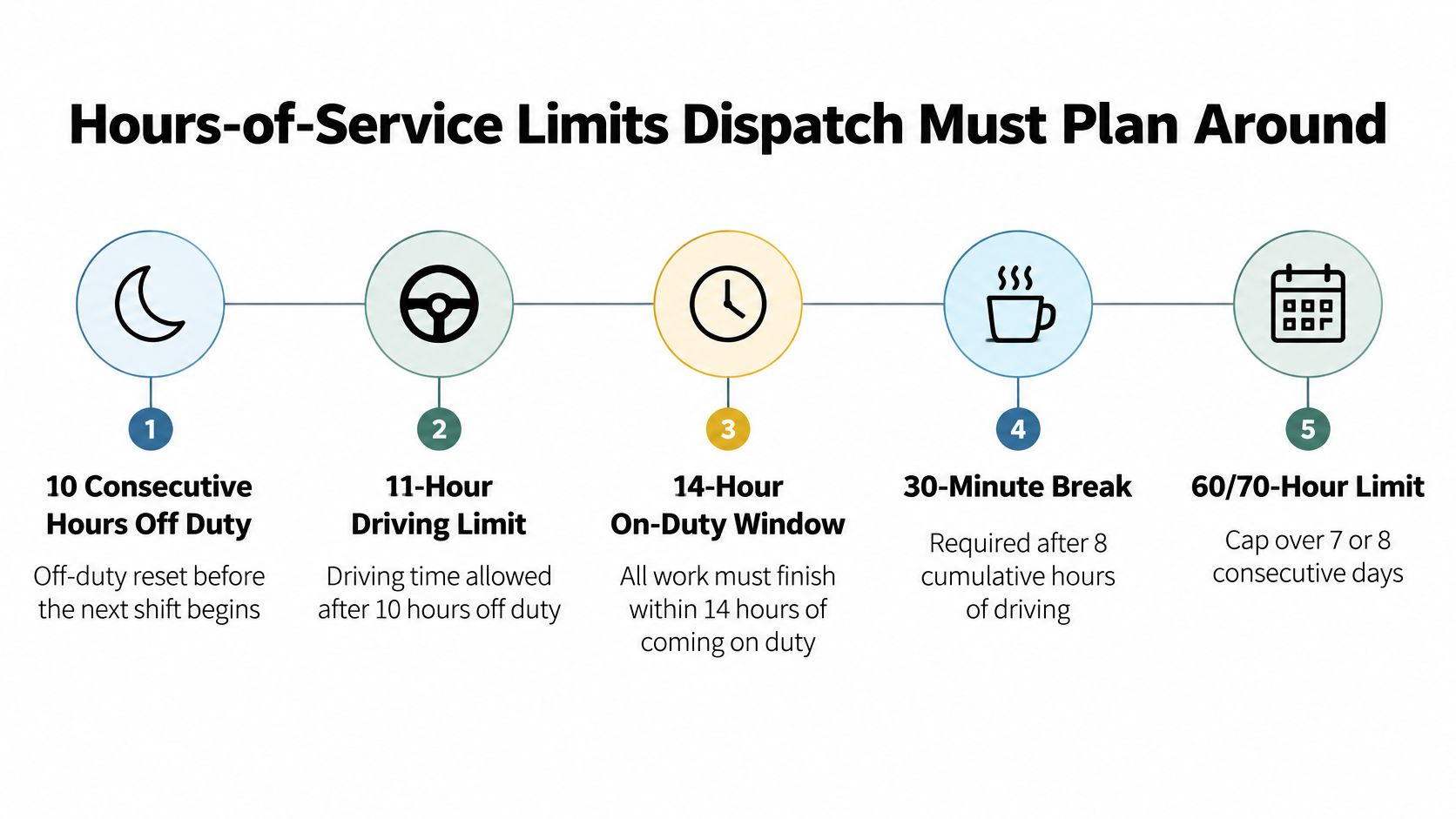
Run the checks in the order a dispatcher runs them
Start with rest. A driver who hasn't completed 10 consecutive hours off duty isn't available, no matter how clean the route looks on the board. Then calculate remaining drive time from the actual on-duty start rather than the planned one, because a driver who clocked in twenty minutes early has already begun spending the 14-hour window.
Confirm the driver has received the required 30-minute non-driving interruption after 8 cumulative hours of driving, and place that break where it does the least damage, at a facility dock or during a scheduled wait rather than in the middle of a tight appointment. Then check the rolling weekly total, 60 hours in 7 days or 70 hours in 8 days depending on the operating schedule, because a driver can be perfectly legal tonight and out of hours by Thursday.
The FMCSA hours-of-service guidance frames the practical control clearly: validate every assignment against both remaining daily hours and the driver's rolling weekly total before tendering the load, and trigger escalation when delays threaten the legal return or delivery window.
Practical rule: Escalate while the driver still has margin. A call at hour nine costs nothing. A call at hour fourteen is a violation waiting on a signature.
Adverse conditions can extend the driving limit and the 14-hour window by up to two hours, but that's an exception for unforeseen events, not a baseline for overnight route design. Build the plan on the standard limits and treat the extension as recovery room you hope never to use. Compare your lane plan against our own hours-of-service rules before you defend a schedule that only works on paper.
Planning Routes With a Compliance Buffer
On-time percentage is a terrible primary measure of dispatch quality. A route can arrive at the dock exactly on time, every night, by spending the driver's entire safety margin to get there, and the operation looks excellent right up until the night it doesn't.
The distinction that matters is between legal dispatching and operationally safe dispatching. Federal guidance is explicit that ELD use doesn't change hours-of-service rules, so fleets and drivers must plan routes and contingencies within the same limits, as the Federal Register notice on ELD requirements states. The open question is what a dispatcher does when a route that was legal at tender becomes unsafe at 11 p.m. because of a loading delay, weather, congestion or a missed appointment.
Middle-mile box-truck work makes this sharper than long-haul. Repeated distribution-center stops consume on-duty time even when mileage is modest, so a 40-mile night with four dock stops can burn more clock than a 150-mile run with one.

The four checks before a load moves
- Verify available drive and on-duty time before assigning the load. Not after the driver says yes.
- Add facility dwell and fueling time to the plan. Check-in, dock wait, pallet jack work, paperwork and fuel are on-duty time and belong in the duty window.
- Define escalation triggers in advance. A delay that consumes the buffer, a missed appointment window, or a facility that won't accept the freight are triggers, not judgment calls at midnight.
- Document every route change with a reason and an approver. No driver should ever be pushed to shave a limit, and no dispatcher should be asked to guess.
Good logistics automation helps here by surfacing remaining hours, appointment timestamps and exception flags before tender time, so the buffer conversation happens with data instead of instinct.
The compliance buffer is not wasted capacity. It's the part of the plan that absorbs the delays you already know will happen.
Track remaining buffer alongside on-time percentage. A lane that hits 98% on-time with eight minutes of buffer left at the final stop is a lane running on luck. Dispatch records, ELD data, appointment timestamps and exception notes together defend both safety and service, and they answer the only question a customer really asks after a bad night: what did you know, and when did you know it.
Vehicle Readiness Checks Before Release
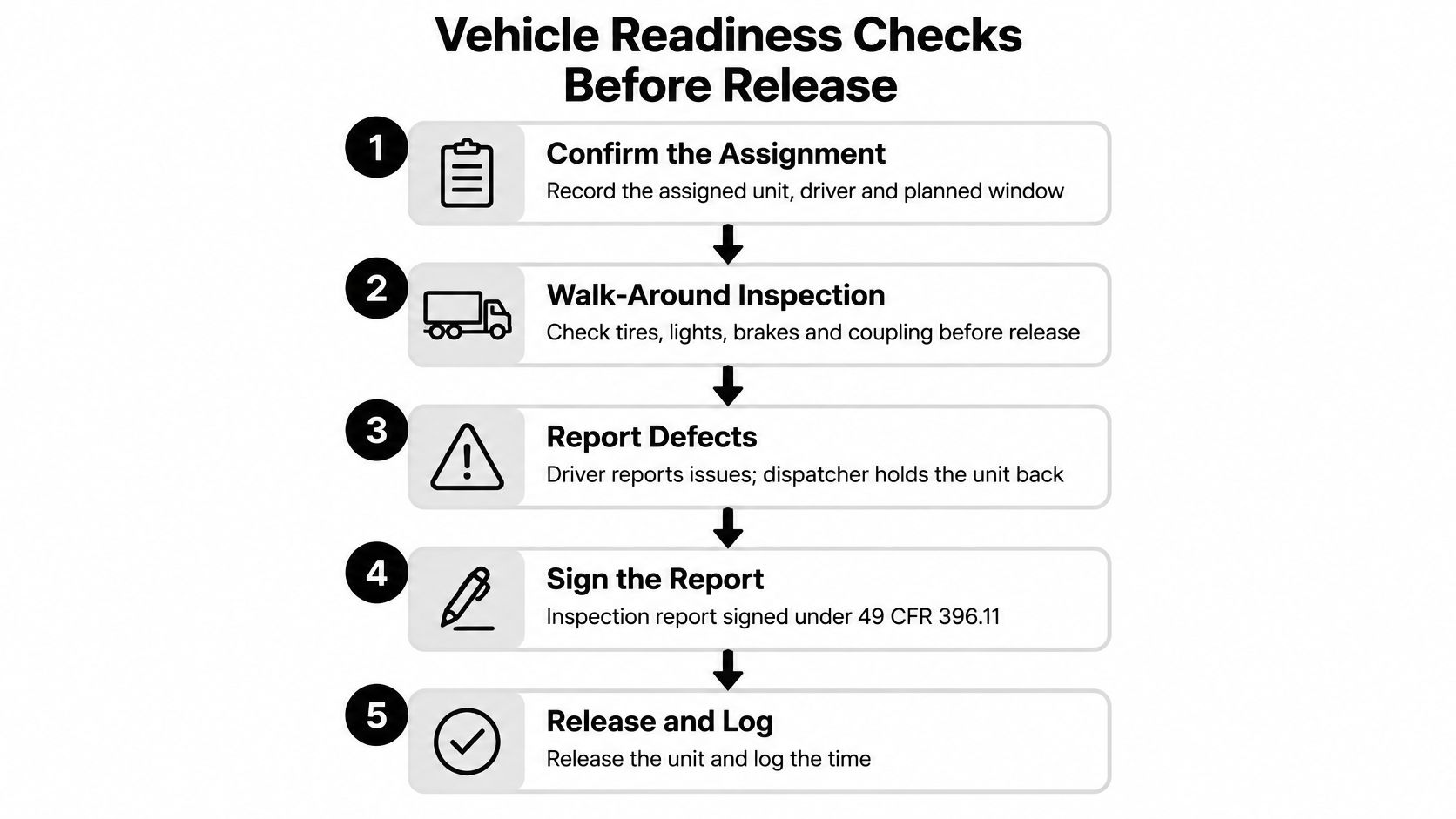
A truck with an unresolved defect affecting safe operation is a dispatch decision, not a maintenance conversation. Under 49 CFR 396.11, drivers complete a daily post-trip Driver Vehicle Inspection Report identifying defects that could affect safe operation or cause a mechanical breakdown, and the carrier must certify that listed defects were repaired or that immediate repair was unnecessary, as set out in the text of 49 CFR 396.11. The original report is retained for three months, and safety-critical defects are repaired before the unit operates again.
Each commercial vehicle also needs a periodic inspection at least every 12 months. Peak Transport's box truck drivers perform pre- and post-trip inspections on every route and load and unload with pallet jacks at each facility, so the inspection record and the load record usually come from the same person at the same stop. That overlap is an advantage: the driver who finds a soft brake line at the dock is the same one who signs the report that holds the truck.
The six checks in the release gate
- Assigned unit, driver and planned window are recorded. A release without them can't be matched to a trip later.
- The driver completed the pre-departure inspection. The dispatcher verifies the record rather than repeating the walk-around.
- The previous post-trip report shows no unresolved defect affecting safe operation. An open defect can't be worked around with a text message.
- Every listed defect carries a certification of repair or a documented no-repair-needed disposition. That certification is the carrier's obligation.
- The periodic inspection is current. An expired inspection can't be defended in an audit.
- The release authority and timestamp are logged. The release decision is itself audit evidence.
The defect loop closes after the trip. The post-trip report feeds the disposition, safety-critical repairs happen before the unit rolls again, and the original stays on file. A written sop for the gate removes the argument about whether a defect was serious enough to hold the truck, because the standard is written before the pressure arrives.
Treat that hold authority as part of the operating plan, not overhead. A truck released with an open defect borrows against the night's safety margin, and every later decision, reroutes, delays, a second run, draws on the same shrinking account. This matters most overnight, when limited maintenance availability and compressed facility appointments can turn a minor finding into a missed handoff or an unsafe continuation.
Communication and Escalation Standards
Driver survey reporting identifies accessibility and responsiveness as leading communication gaps, with drivers frustrated when they can't reach operations during a problem, according to the PDA and CIA spring driver survey. That's not a morale issue. It's a control failure, because a driver who can't reach dispatch during a closed gate or a wrong pallet is making a safety and hours decision alone.
Automation should speed up how fast a problem surfaces. It should never eliminate the accountable person who interprets the risk. A system can flag remaining hours, facility delays and defects. A human has to decide whether the revised plan is safe or whether the load waits.
Structured contact is uneven across the industry. In 2025, CarriersEdge surveyed 5,365 drivers and 63 fleets and found that 65% of surveyed companies held driver meetings quarterly, while only 13% held them in person, as TruckNews reported on the CarriersEdge survey. A quarterly cadence is better than nothing, but it doesn't help a driver at 3 a.m.
Routine updates versus escalation events
| Event | Required response | Record kept |
|---|---|---|
| Routine status update | Logged in the dispatch system, no escalation | Timestamped status entry |
| Facility delay or closed gate | On-call dispatcher responds; response window set by the team | Exception note with timestamp and decision |
| Safety-critical defect | Unit blocked from dispatch until repaired and certified | Defect disposition and release authority |
| Driver declines an unsafe route | Human review of the instruction; no penalty for refusal | Decision note with reviewer name |
| Appointment change outside office hours | Named after-hours responder decides the revised window | Revised plan with approval timestamp |
After-hours work is where this standard earns its keep. Closed gates, incorrect freight, trailer or vehicle defects and appointment changes all land outside office hours, and each one needs a named responder, a response window the team has agreed in writing, and a record of who decided what. Routing after-hours calls to a rotating on-call phone is a solved problem, and services such as SnapDial on routing after-hours calls handle the mechanics so the missed call never becomes the excuse.
Publish the standard to drivers. They should know that a status update gets logged, a facility delay gets an on-call response, and a refusal to run an unsafe assignment gets a human review with no penalty attached.
Driver Qualifications Behind Each Assignment
A route can be planned to the minute and still fail at the dock if the driver can't run a pallet jack or isn't available for the overnight window. The qualification check comes before the assignment, and it belongs to the same safety margin as the compliance buffer around hours.
The license baseline comes from the posting and the route. At Peak Transport, a CDL is not required for driver roles; a valid driver's license with a clean driving record is sufficient. When a specific route or vehicle does call for a CDL, the posting says so, and the dispatcher verifies it before assignment rather than assuming one license class covers every unit.
Four checks decide whether a driver fits a lane:
- Pallet jack operation. Drivers load and unload at each facility, so the equipment skill is part of the job.
- Overnight availability. The lane runs overnight, and a driver who can't work that window can't cover it.
- Box truck experience. Preferred, and we state it that way rather than turning a preference into a hard wall.
- Route type. Scheduled routes between facilities are planned in advance, and the work is local, so drivers finish their shift and go home instead of running long-haul overnight trips.
Two more checks close the loop. Confirm the driving record is still clean and current in the qualification file, and keep that file complete for every active driver, as our guide to driver qualification file requirements lays out. We provide paid training on our safety standards, routes, equipment including pallet jacks, and company procedures, so drivers learn the lane and the tools before they start.
Common Dispatch Failures and How to Fix Them
The most common failure is a route that finishes late every single night even though the mileage looks reasonable. That's almost never a traffic problem or a slow driver. The plan left out dock dwell and fueling, and the same fifteen minutes goes missing every night until somebody adds it to the duty window.
| Symptom | Likely cause | Fix |
|---|---|---|
| Routes finish late every night | Planned time leaves out facility dwell and fueling | Add dwell and fueling to the duty window before tendering the load |
| Legal route runs out of hours | On-duty start was not tracked against the plan | Validate remaining drive and duty time before each assignment |
| Drivers cannot reach dispatch after hours | No named responder or response window | Name an after-hours responder and publish the response standard |
| Audit cannot trace a completed trip | Trip, ELD, messages and exception notes are stored separately | Link each trip to its records and timestamps |
| Unit runs with an open defect | No release gate before dispatch | Block release until the defect is certified and disposed of |
Fixes don't all land at the same speed. A dwell adjustment takes effect on the next day's plan, and so does a change to the tender check. A named after-hours responder and a written response standard usually take a week or more to settle, because you're changing who answers the phone and what they're allowed to decide. The record rebuild for audits takes longest, since it means touching lanes that already ran.
Three records prove the fixes worked. A buffer log showing remaining drive and duty time at each stop tells you whether the plan had margin or only looked like it did. A linked trip file with assignment, release, messages and delivery timestamp in one place survives an audit without a phone call. A release log showing every unit with a certified defect disposition proves the gate is real.
Practical rule: A fix isn't in place until the record that proves it exists. The intent is not the fix.
Before the next overnight lane runs, check the five symptoms against your own operation. Any symptom still present is evidence that its fix isn't in place yet, and the lane should wait rather than launch with a known gap. Shippers comparing middle-mile providers can use the same five symptoms as interview questions, and the answers will separate teams that document from teams that improvise.
We're hiring for overnight shifts, full-time and part-time, across Minneapolis, St. Paul, Brooklyn Park, Shakopee, Woodbury and Eagan, Minnesota. If you want to talk through how these controls run on a real lane, our office line is 612-230-1292.
Peak Transport runs overnight middle-mile box-truck routes across the Twin Cities metro with W-2 drivers, paid training, and dispatch planning that validates hours, appointment windows and equipment condition before a load is ever tendered. If you want lanes built around the limits and records explained here, and not around a spreadsheet someone rebuilds at midnight, visit Peak Transport to see how we operate and where we're hiring.