Proof of Delivery Requirements: What Records to Keep
Proof of delivery requirements explained: required fields, exception evidence, retention periods and audit-ready records for billing disputes and claims.
November 22, 2026
It's 6:40 on a Tuesday morning and the first email of the day is a dispute. A customer says the load that left your dock at 11 p.m. arrived two cartons short, and the receiving clerk signed the driver's screen without writing anything down. Your driver remembers counting boxes at the dock. The customer remembers a signature. Both of you are now arguing about freight neither of you can see, and the record that was supposed to settle the question six hours ago is a squiggle on a tablet.
That gap is what proof of delivery requirements exist to close. A defensible POD isn't a signature or a timestamp standing on its own. It's an auditable chain of custody running from the bill of lading through dispatch, the stop itself, the receiver's disposition, any exception, and the driver's hours record for that day. Pull out one link and the rest stops proving anything.
What follows is a working standard: the fields every drop has to carry, the line between a delivery occurring and a delivery being accepted, the evidence each exception type demands, retention periods, the dispatch and hours linkage, and the controls that let an electronic record survive a dispute instead of dissolving in one.
"Minimum Fields Every Proof of Delivery Must Carry"
A proof of delivery is a data record that happens to contain a signature, not a signature with a few fields bolted around it. The difference shows up the first time someone asks a question the signature can't answer: who exactly took the freight, how many pieces, in what condition, and against which load.
The table below is the minimum field set for every drop, on paper or in a driver app.
| Field | What It Proves | Example |
|---|---|---|
| Shipment or load ID | Ties POD to dispatch, route and billing | Load number printed on every drop |
| Consignor and consignee | Names the parties to the shipment | Legal names matching the bill of lading |
| Authenticated receiver | Shows who accepted the freight | Name plus receiver code or ID check |
| Delivery location | Places the drop at the right facility | Facility code and GPS or dock reference |
| Date and time | Proves when delivery occurred | Device timestamp with UTC offset noted |
| Piece or package count | Shows quantity received | 24 cartons counted against 24 scanned |
| Disposition | Records accepted, short, damaged or refused | Accepted with remarks, or refused with reason |
| Driver and vehicle ID | Links the delivery to the driver's hours record | Driver ID and unit number |
Read the rows in order and the logic of the chain appears. Shipment or load ID is the spine, because it connects the stop to the trip record and the invoice. The consignor and consignee pair has to match the names on the bill of lading exactly, and if your team is still fuzzy on which party does what on that document, this guide to how to read a bill of lading is worth ten minutes before you rewrite a template.
Authenticated receiver is where most paper forms collapse. A name written in block letters proves that someone wrote a name. A name plus a receiver code, or a signed-in app session tied to a person, proves that a specific employee of the consignee took custody.
The middle rows carry the operational weight. Delivery location should name the facility and pin the dock, not just repeat the order address. Date and time comes from the device clock, and any capture made offline needs the UTC offset noted so the timestamp survives a time-zone argument. Piece or package count is a number compared against a number, 24 cartons counted against 24 scanned, never a checkmark.
Working rule: if a field can't be produced from the record six months later without phoning the driver, it isn't part of your proof of delivery. It's part of someone's memory.
A bare signature usually fails at least three rows at once. It doesn't identify the receiver in any verifiable way, it carries no piece count, and it defaults to "accepted" even when the freight arrived short or damaged. Disposition and driver and vehicle ID close the loop, one recording what happened to the freight and the other attaching the stop to a person and a unit number.
Pull your current template, walk it against those eight rows, and mark anything missing before the next shipment leaves. Most operators find two or three gaps on the first pass, and the piece count is almost always one of them.
"Delivery Occurrence Versus Delivery Acceptance"
Say a driver drops 24 cartons at a distribution center at 03:12 and the receiver signs for 22, saying two were never on the truck. If the POD captures one signature and one clock time, that record says a delivery happened and nothing more. It doesn't say the receiver took 22 of 24, doesn't say what happened to the other two, and gives nobody a disposition to work from.
UNECE guidance on electronic consignment notes separates the two events cleanly. First the consignee is authenticated as the receiving party, which is delivery occurrence. Then the consignee records whether the shipment is accepted, partially accepted, rejected or accepted with reservations, which is delivery acceptance, per the UNECE eCMR materials.
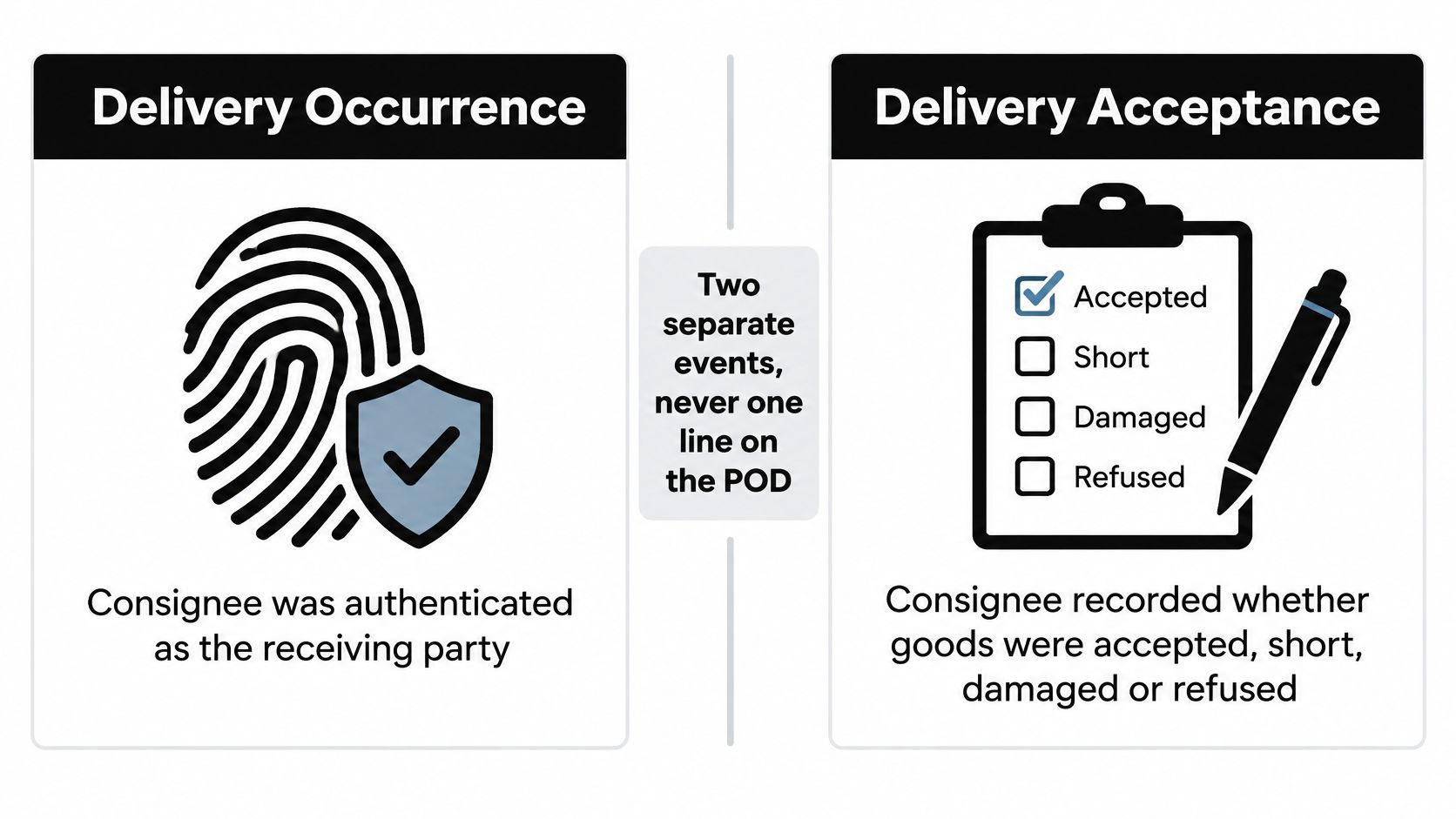
The four dispositions a driver records at the door
- Accepted. Every piece counted, packaging intact, receiver identified by code or verified name. This is the only disposition that should close a stop without further action.
- Accepted with reservations. The receiver takes the freight but states a concern in their own words at the moment of signature, and that wording travels with the record. Reservations written later, after the driver has left, carry far less weight.
- Short or damaged. The count or the condition differs from the load record. The shortfall is stated in pieces, not as "some missing", and the difference is quantified against what the truck left with.
- Refused. The receiver declines the freight outright and gives a reason on the record. A refusal with no stated reason is a return trip waiting to happen.
The trap sits between rows one and two. A driver who taps "delivered" because the receiver took the freight, when the receiver disputed two cartons, has just converted a short shipment into a clean delivery on paper. That record will be produced in a claims conversation six weeks later and it will be read as evidence that everything arrived.
A signed receipt with no disposition proves one thing: that somebody signed. It says nothing about whether the freight arrived whole, in the right quantity, or with the right person.
Capture the disposition at the door, before the wheels move, while the receiver is still standing there and the cartons are still countable. Once the truck pulls out, the only person who can describe the condition of that freight is the person who has already left the lot.
Each of those four outcomes needs its own supporting evidence, and the evidence differs by type. A policy that treats a refusal the same way it treats a clean signature will fail on the first short shipment it meets.
"Evidence Required for Short, Damaged and Refused Freight"
Most POD guidance stops at the signature. Sign it, file it, invoice it. That works until freight is short, damaged, refused, or accepted by somebody who doesn't work for the consignee, and then the signature turns out to prove exactly one thing: that a person held a stylus.
The distinction matters because a signature can show that a document was signed. It can't show that the signer had authority to accept freight, that all the pieces came off the truck, or that the cartons arrived undamaged, as the consolidated EU eFTI rules note when they require auditable, machine-readable records with authenticated access.

The working standard separates identity, authority, condition, quantity, time and location, then asks what evidence each exception type needs and who owns the burden of collecting it. That last question is the one operators skip. If nobody is named as the owner, the evidence gets collected by nobody and reconstructed later by whoever is answering the claim.
What each exception needs at the door
| Exception | Evidence to Capture | Escalate When |
|---|---|---|
| Short shipment | Piece count, count sheet, pallet photo, receiver initials | Receiver disputes the count |
| Visible damage | Timestamped photos of packaging, damage note on the POD | Damage affects the product or its contents |
| Concealed damage | Photos, time of discovery, note that damage was concealed | Found after opening, reported within the contract claim window |
| Refused freight | Refusal reason in receiver's words, time, facility contact | Freight needs return or re-delivery instructions before departure |
| Signed by non-consignee | Signer's name and role, authority confirmed by facility contact | Authority cannot be verified at the site |
| Broken or missing seal | Seal number, photo of seal and door | Seal number on the POD does not match the load record |
Work the rows in the order they happen. Short shipments are the most common exception and the cheapest to prove: a count taken at the dock, a photo of the pallet as it sat, and the receiver's initials on the variance. If the receiver won't initial the count, that refusal is itself information and belongs on the record.
Visible damage needs the packaging photographed before the carton moves, with the note written on the POD at the same time. A photo taken on the dock after the carton has been opened and re-stacked answers a different question than the one the claim will ask.
Concealed damage is the row that requires a written process, because it surfaces hours after the driver left. The note has to say the damage was concealed, record when it was discovered, and attach photos taken at discovery. Good cargo damage prevention practices start at loading, and the inspection habit that catches a crushed corner before the truck leaves is the same one that makes a concealed-damage claim defensible.
Non-consignee signatures are common at busy facilities, where a night-shift supervisor or a security desk signs for freight they didn't order. Get the signer's name and role, and confirm authority through a facility contact while the driver is still on site.
That handover takes place when a driver and a receiver work through a damaged carton together instead of leaving it for the claims desk.
Seals deserve their own line in the policy because failures can go unnoticed. Record the seal number at origin, photograph the seal and the door at destination, and compare the two. A seal number on the POD that doesn't match the load record means the freight was accessible in transit, and that conversation has to happen before the driver leaves.
Decide now who gathers each piece of evidence, the driver at the door or the dispatcher afterward, and write it into the exception workflow. Every minute between the dock and the record costs you evidence you can't rebuild.
"Retention Periods for Proof of Delivery Records"
A delivery record may need to answer a claim long after the shipment reaches its destination. Federal transportation rules set a one-year baseline for several records that document freight movement, including bills of lading, releases, shipping orders, records of freight received, forwarded and delivered, and notices of arrival and tenders of delivery. The eCFR text of 49 CFR Part 379 sets out these retention periods.
| Record | Federal Baseline | Keep With |
|---|---|---|
| Bills of lading, releases and shipping orders | 1 year | POD packet and delivery exceptions |
| Records of freight received, forwarded and delivered | 1 year | POD and dispatch record |
| Notices of arrival and tenders of delivery | 1 year | Shipment file and POD |
| Freight bills and supporting papers | 1 year | Billing dispute file |
| Unsettled freight bills and supporting papers | 1 year after disposition | Open claims file |
The unsettled-freight-bill rule has a different starting point: its one-year period begins after disposition, rather than when the invoice is issued. That distinction affects how long supporting papers must remain available when a billing issue stays open.
Why one year is a floor, not a ceiling
Retention means the record must remain retrievable. A POD in a filing cabinet or an unindexed shared drive may technically be kept, but it will be difficult to use when a dispute arises. Keep it searchable with its bill of lading, freight bill, exception notes and related correspondence so the shipment's record can be assembled as a whole.
Contracts, insurance terms and tax requirements may call for longer retention than the federal baseline. Apply the longest relevant period to each document, rather than deleting records as soon as the shortest period expires. A CloudOrbis guide to data retention explains how retention policies can distinguish active records, archives and records ready for disposal.
Consider a short-shipment dispute raised fourteen months after delivery. If the file was purged after one year, the POD and supporting evidence may no longer be available, leaving the parties with little more than conflicting recollections. The retention rule should account for the periods that apply to the shipment, not just the federal baseline.
Before your first purge: set a retention rule for each document type, identify the longest applicable period, and assign consistent retention dates to the POD, bill of lading and related shipment records.
"Linking POD to Dispatch and Driver Hours Records"
A proof of delivery becomes auditable at the moment it can be matched to the driver's day. Until then it's a document about a shipment that nobody can tie to a person, a route or a shift.
Federal rule 49 CFR 395.11 requires motor carriers to retain supporting documents generated or received in the normal course of business for each driver and each 24-hour period. The required categories include bills of lading, itineraries, schedules or equivalent documents showing trip origin and destination, dispatch or trip records, relevant expense receipts, electronic mobile communications sent through fleet-management systems, and payroll or settlement records showing driver payment, per the eCFR text of 49 CFR 395.11. Those documents must be organized so they can be effectively matched to the driver's record of duty status.
That last requirement is the one carriers under-read. It isn't enough to keep the paperwork. The paperwork has to be arranged so a human or a system can line it up against the hours record without guesswork.
The eight-document limit and what it actually says
When more than eight supporting documents exist for one driver's 24-hour period, the carrier generally need not retain more than eight, but it must preserve the documents carrying the earliest and latest time indications. The limit is a floor on what you keep, not permission to discard the delivery record that settles a dispute. A POD has independent value for billing and claims regardless of how many receipts are stacked behind it.
One delivery, four matching points
Walk a single stop through the chain. A driver delivers at 03:47 to a facility coded in the trip record, and the POD carries that time and facility. A dispatcher should be able to check four identifiers without leaving the record:
- Load number, which must match the trip record and the freight bill.
- Facility code, which must match the stop sequence on the route.
- Delivery time, which must fall inside the logged shift and inside the duty status for that day.
- Driver and vehicle, meaning the driver ID and unit number on the POD match who was dispatched.
A delivery time that lands outside the logged shift starts an argument nobody wins. Either the stop was later than the record shows, the duty status is wrong, or the POD was uploaded from a different day's data. Each of those is a compliance problem before it's a billing problem.
At Peak Transport, box truck drivers load and unload with pallet jacks, document deliveries and run pre- and post-trip inspections, so the stopping point and the driver's hours sit in the same operational flow rather than in two systems that never speak.
Matching rule: file a POD only after it matches its load and its driver. A delivery record that can't be reconciled to a duty status is a document waiting to be challenged.
Cover compliance in the same motion rather than chasing delivery evidence and driving-hour compliance separately. That single habit cuts most of the disputes before anybody writes an email.
"Electronic POD Controls for Audits and Disputes"
Electronic capture is now the norm rather than the exception in freight. In 2024, the logistics and transportation segment accounted for more than 35% of global electronic proof-of-delivery market revenue, according to Growth Market Reports. Most of those systems, though, are engineered as signature screens rather than controlled records.
An electronic POD fails in the same places a paper one does, plus a few new ones: an edit that erases the original entry, a driver account that can overwrite a dispatcher's correction, a device that uploaded hours later with no proof of when the stop happened.
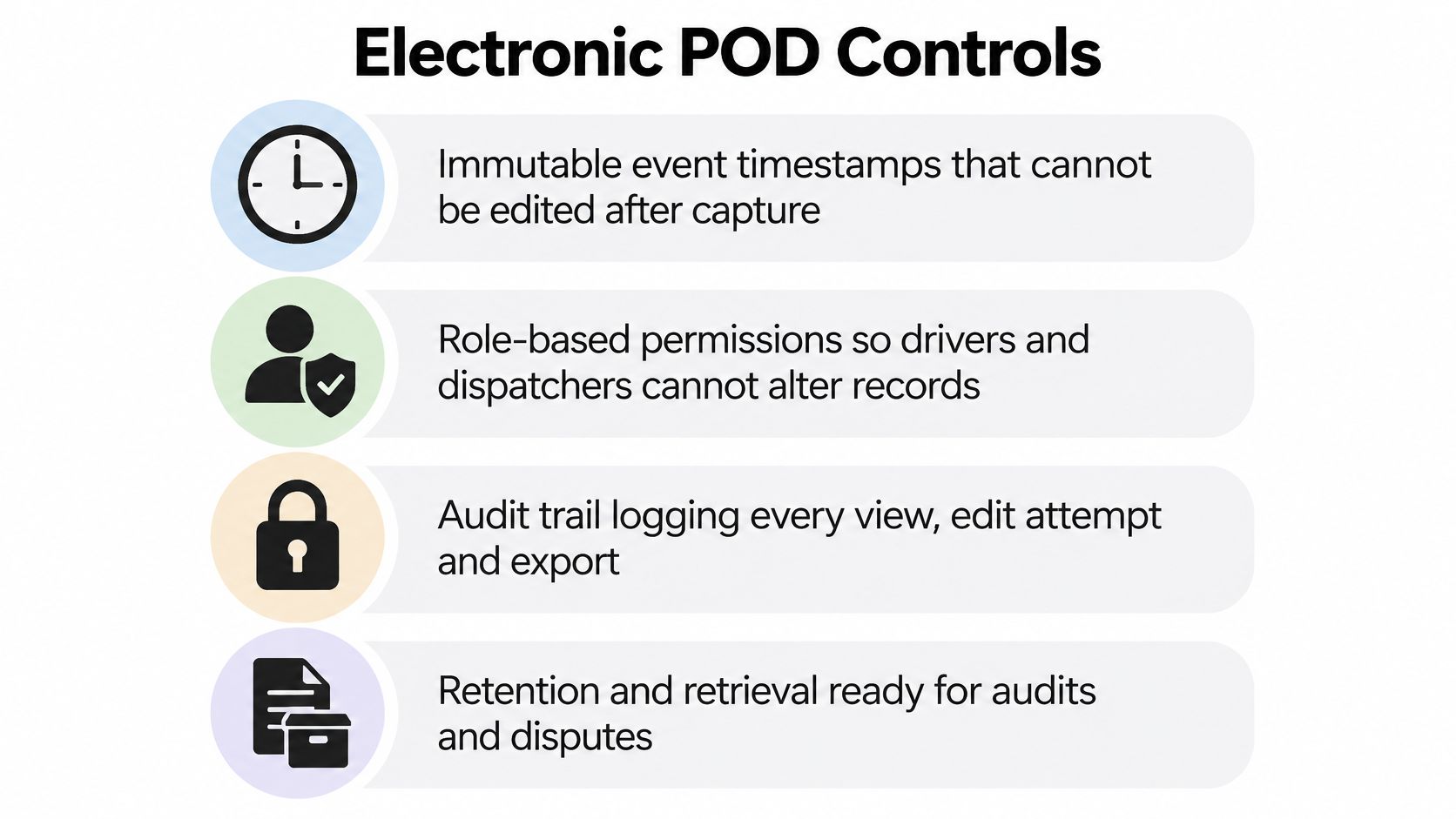
Under the eCMR framework, the contracting parties are expected to agree on procedures that preserve the electronic consignment note's integrity, demonstrate the entitled party's authority, confirm delivery, manage amendments and provide access to shipment information, as the UNECE eCMR guidance sets out. Four controls carry that obligation into a working system:
- Immutable event timestamps. The time of capture is set by the device and cannot be rewritten afterward, including by an administrator.
- Role-based permissions. Drivers, dispatchers and account managers see and do different things, so no one edits another person's entry.
- A permanent link to the load identifier. Every POD is welded to a shipment or consignment record, not floating as a photo in a folder.
- An audit trail on every correction. Any post-delivery amendment shows who changed what, when, and what the value was before.
Retrieval closes the loop. The sender should be able to pull the record and, on request, receive a cargo receipt or equivalent information identifying the shipment and giving access to the electronic version. The discipline is the same one used to document evidence handling in any investigation: every handoff gets a name, a time and an unbroken record.
Building the offline capture
Dead zones and steel-walled warehouses break more POD systems than disputes do. The workflow needs to record receiver identity, signature or code, location details that don't depend on GPS, photos, exception notes and device time while the driver is still at the dock. Once connectivity returns, the app syncs and preserves the original event data rather than stamping the moment of upload as the moment of delivery.
The correction case is the cleanest test of the whole system. A driver marks a delivery accepted, then changes it to short two hours later after the receiver calls. In a controlled record, the original accepted entry stays visible, the amendment is logged with user and timestamp, and the record locks after submission. In a signature screen, the first entry disappears and the record now claims the short was noted at the door.
Test your system once: change a disposition after submission and see whether the original survives. If it doesn't, you have a form, not a record.
These controls answer the three disputes that show up most: shortages, concealed damage and unauthorized recipients. They also make the same record usable for customer billing, claims investigation and service-level measurement, which is where storage discipline starts paying for itself. Teams still deciding how to structure that storage across systems will find the storage side covered in digital record keeping.
"Cross-Border and eFTI Requirements for Electronic POD"
A domestic signature screen stops at the border. When freight crosses into or within the EU, the receiving authority isn't asking whether the receiver signed. It's asking whether the record came from a compliant system, in a format it can read, over a connection it can authenticate.
The timeline matters. In January 2025, the European Commission said Member States could begin developing systems to check eFTI-compliant electronic freight information, with broader implementation scheduled to reach completion in 2027, per the European Commission's eFTI implementation announcement. Under that framework, authorities accept electronic regulatory information when it arrives through compliant systems, in machine-readable form, over an authenticated and secure connection, with logs and records kept accessible for audits.
For a carrier moving freight across a border, five checks belong on the pre-shipment list:
- Confirm which party's rules govern the consignment note. The applicable regime decides what the electronic record must contain and who may amend it.
- Export POD data in a machine-readable format. A PDF attachment is not machine-readable data, whatever its visual quality.
- Keep access and amendment logs retrievable. If you can't produce a log of who touched the record, you can't demonstrate integrity.
- Verify hosting and security against the authenticated-access requirement. Platform governance questions are compliance questions here.
- Check each receiving country's acceptance rules before relying on electronic POD alone. A record accepted on one lane may not satisfy the next authority.
The contrarian point is that paper versus electronic stopped being the interesting question years ago. Platform governance decides whether a POD is accepted across borders: who controls the data, who can amend it, where it sits, and whether an auditor can read it without a translation layer.
For shippers with customers in multiple jurisdictions, the practical step is to publish a short POD data policy covering required fields, exception workflows, retention, backup and outage handling, export format, and the rule for correcting an error without deleting the original. That document is what turns a plausible dispute into a settled one.
"Writing a Proof of Delivery Policy That Holds Up"
A written policy settles disputes faster because both parties read the same rules before the first exception arrives. It doesn't need to be long. It needs to be checkable, with named owners and no line that says "as required".
Write seven lines and keep each one testable:
- Required fields. Name the field set explicitly and identify which template carries it, so there's no ambiguity about whether a piece count is optional.
- Exception workflow. One rule and one owner for each exception type: short, visible damage, concealed damage, refusal, non-consignee signature, seal discrepancy.
- Retention. A stated period per record type, the longer period where a contract, claims window or tax rule requires it, and the date the whole packet inherits.
- Outage procedure. How offline captures are made, when they sync, and who checks the sync log at the end of each shift.
- Export format. Column names and date format spelled out, for example delivery_date as YYYY-MM-DD with the UTC offset in its own column, so a customer's system ingests the file without a manual pass.
- Correction rule. The original value stays visible and the amendment shows user and time. Deleting the first entry is prohibited in writing, not just discouraged.
- Authorized signers. The roles that may sign for freight, and the rule for verifying anyone outside the named consignee, which usually means a call to a facility contact while the driver waits.
The policy shouldn't depend on paper. A machine-readable export and an electronic capture path let the same rules apply whether a stop ends with a stylus, a receiver code or a printed sheet. If you want the policy to survive contact with operations, map the exception workflow the way you'd map any other process, and these business process mapping best practices show how to keep steps, owners and handoffs visible.
Publish it to customers too. A receiving manager who knows the disposition vocabulary in advance is far less likely to sign a clean receipt for freight that arrived short.
"Confirm Your POD Standard Before the Next Shipment"
A defensible proof of delivery links four records: what happened at the stop, whether the receiver accepted the freight, any exception, and the dispatch details for the load. A signature or timestamp alone cannot establish that full chain.
Before the next shipment, check whether your standard covers each link. Confirm that the delivery record identifies the load and records its disposition. Make sure exceptions have a documented process and an owner, and that any correction preserves the original entry. The goal is a record another person can follow without relying on the driver's memory.
If you use a carrier, ask how drivers document delivery and exceptions, and how corrections are recorded. Compare the answers with your own requirements for a complete, traceable delivery record. You can reach Peak Transport at 612-230-1292 to discuss how its overnight middle-mile operations handle delivery documentation.
Peak Transport runs overnight middle-mile box-truck routes across the Twin Cities metro and surrounding areas, connecting distribution centers and hubs. Its drivers are W-2 employees, and the company uses structured dispatch systems and detailed route documentation. Visit Peak Transport to learn more about its operations.
Set the standard before the shipment moves, and assign responsibility for maintaining the record. A clear chain of custody can make the difference between resolving a delivery question from documented events and relying on conflicting recollections.