Route Planning and Scheduling for Middle-Mile Lanes
Learn route planning and scheduling for middle mile: capacity, driver hours, dock windows, and on-time performance that maps alone miss.
November 21, 2026
The usual advice about route planning and scheduling is to find the shortest route, avoid traffic, and reduce fuel use. For overnight middle-mile freight, that order is backward. A truck can take the shortest highway route and still miss the sort because dispatch didn't budget for the gate queue, loading delay, or receiving handoff.
Start with the facility deadline and the driver's legal availability. Then choose the route that can reliably connect them. Miles matter, but only after the freight can make its next departure safely.
Why Middle-Mile Routes Fail Before the Highway
Say an overnight box truck leaves a distribution center for a Twin Cities hub. The map shows a straightforward highway run, and dispatch expects an easy arrival. But the driver waited for a dock assignment, the outbound freight wasn't ready, and the receiving team needed more time to accept the load.
The truck reaches the property without reaching the sort. Those are different milestones.

Planning assigns the work
Route planning means assigning trucks to known facilities, such as distribution centers, hubs, and relay nodes, while balancing capacity, travel time, appointment windows, driver availability, and a return or relief point. This is the vehicle-routing problem applied to repeatable freight lanes, not a consumer GPS trip or a residential delivery list.
The planner must decide which truck carries the freight, which facilities it visits, and where the driver finishes. A navigation app answers only part of that problem.
Scheduling puts the work on a clock
Scheduling establishes departure time, the arrival interval, expected dwell, breaks, and the freight handoff that feeds the next linehaul. The important deadline may be completion of unloading and acceptance, not entry through the gate.
A usable dispatch plan therefore needs:
- A legal-hours filter before assigning the driver.
- A capacity and dock-time budget before promising arrival.
- A repeatable build sequence that includes operating buffers.
- A scorecard that puts completed handoffs ahead of mileage savings.
An efficient route is one the driver can execute and the receiving facility can accept.
Miles and fuel count only after those conditions are satisfied.
Driver Hours That Make a Route Legal
Federal hours that bound a property-carrying route
The following baseline limits come from the FMCSA's hours-of-service guidance.
| Limit | Cap | When it starts or applies | What it does to the plan |
|---|---|---|---|
| Driving limit | 11 hours | After 10 consecutive hours off duty | Driving stops even if the duty window remains |
| Duty window | 14 consecutive hours | When the driver comes on duty | Off-duty time inside the window does not extend it |
| Required break | At least 30 minutes | After 8 cumulative hours of driving without a qualifying interruption | No further driving until the break is taken |
| Weekly, not daily operations | 60 on-duty hours | 7 consecutive days | Applies when the carrier does not operate every day |
| Weekly, daily operations | 70 on-duty hours | 8 consecutive days | Applies when the carrier operates vehicles every day |
Treat these as dispatch inputs, not post-trip audit questions. These are the U.S. federal property-carrying baseline; planners must also establish which rules and exceptions apply to the operation.
Driving time isn't the entire shift
The driving allowance is not a promise that every assigned driver has that much time available. Dispatch must check the driver's actual record, including prior work and remaining weekly availability.
The duty window creates a separate constraint. Inspections, loading, fueling, paperwork, and waiting can consume the elapsed window even when the truck isn't moving. Ordinary off-duty time within that window doesn't restart it.
Consider a hypothetical assignment using the driving duration discussed in the federal guidance: the highway portion looks feasible, but prolonged loading and receiving delays leave insufficient elapsed time to finish the final driving segment. The driver hasn't exhausted the driving allowance, yet cannot legally complete the route as assigned.
That distinction is where mileage-only plans fail.
Place the break and check the weekly budget
The qualifying driving break must be planned around cumulative driving, not inserted at the middle of a shift. A qualifying interruption may include non-driving time, so planners should examine its actual duration and duty-status treatment rather than assume every dock visit satisfies the requirement.
Weekly availability needs its own check. A driver can begin the night with enough daily driving time but insufficient remaining cumulative availability for the full assignment. Reassigning that driver to another truck doesn't solve the hours problem.
Before dispatch, compare driving, service, waiting, and buffer time with the driver's remaining budgets. Our guide to hours-of-service rules provides additional operational context.
A CDL requirement answers a different question: whether the driver has the credential required for the vehicle or assignment. For someone assessing that career path, HiredBySkill's no-degree trucking career roadmap is a useful starting resource. At Peak Transport, we state a CDL requirement in the job posting when a particular route or vehicle requires one.
The credential doesn't replace the duty clock. A qualified driver still needs enough legal time to execute the published work.
Capacity Windows and Dock Time
Treat the facility as the leading suspect when investigating schedule variance. On a repeatable overnight lane, gate access, freight readiness, and dock release can be less predictable than the highway segment. Confirm that with timestamps rather than assuming traffic caused every late handoff.
The objective is total operating cost under constraints, not minimum miles. A shorter route that creates waiting, requires a freight recovery, or misses the downstream departure can be the poorer operating choice.
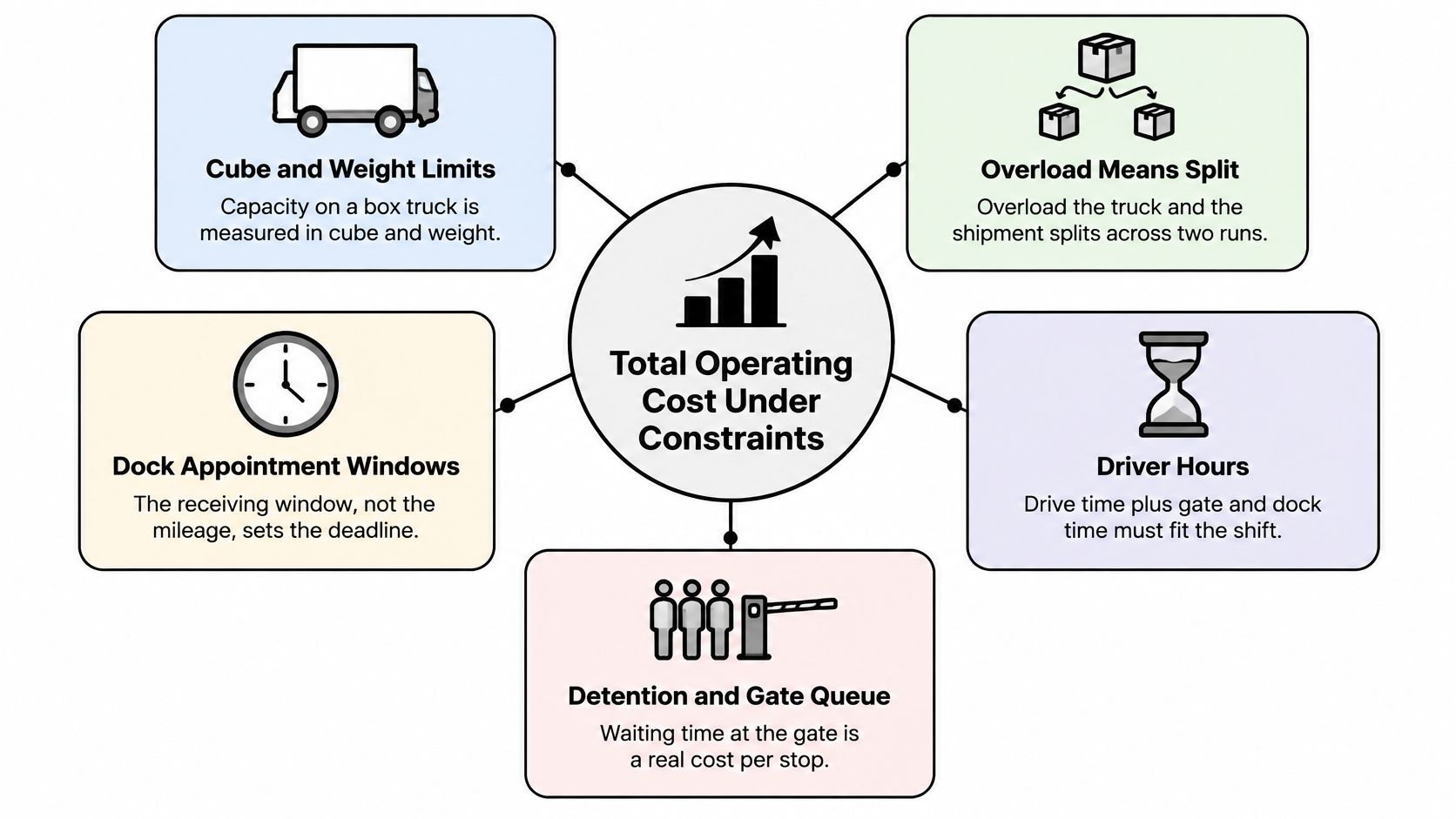
Constraints that change a middle-mile schedule
| Input | What it controls | Failure if ignored | Scheduling response |
|---|---|---|---|
| Vehicle capacity | Cube and weight between facilities | Overload or a split load discovered at the dock | Reassign freight before departure |
| Delivery window | Appointment or sort cutoff | Early idle time or a missed handoff | Penalize both early and late arrival |
| Dock dwell | Time at the facility beyond driving | A legal drive that still misses the sort | Facility buffer from history, not map time |
| Delay buffer | Typical conditions versus a slow operating case | A plan that works only on an average night | Reserve a history-based slow-case allowance before promising arrival |
| Next linehaul | The downstream departure this handoff feeds | A late truck disrupts later movements | Protect the next departure over saving miles |
Capacity starts with both cube and weight. Freight that fits by volume may still exceed the truck's allowable loading, and a weight-compliant load may not fit physically. Split or reassign it before dispatch instead of discovering the problem while the departure clock runs.
A facility window is an interval, not an invitation to arrive as early as possible. Early trucks need somewhere to wait; late trucks may miss receiving or sort acceptance. Confirm whether the appointment refers to gate arrival, dock presentation, or completed unloading.
Give dwell its own operating record
CDL Transportation Group's detention overview reports that average truck dwell increased from 1 hour 38 minutes in 2024 to 1 hour 49 minutes in 2025, and describes federally sponsored detention research drawing on as many as 80 carriers and 2,500 drivers. Those figures establish why dwell deserves attention, but they aren't a substitute for a particular dock's history.
Track planned service separately from appointment lateness, loading variability, and extended detention. Don't automatically classify every minute on the property as a facility failure: an early arrival or a carrier-caused missed appointment needs a different corrective action.
Assign each facility a reliability rating based on appointment adherence, dwell variability, and release predictability. Where freight transfers directly between inbound and outbound movements, understanding cross-docking in logistics helps identify which acceptance event releases the next movement.
Stress-test a late outbound load, a congested MSP-area corridor, and a delayed hub handoff separately. That exposes whether the remedy belongs at the origin, on the road, or at receiving.
Practical rule: Choose the lane that protects the next scheduled departure, even when the map offers a shorter alternative through an unreliable dock.
How to Build a Feasible Overnight Schedule
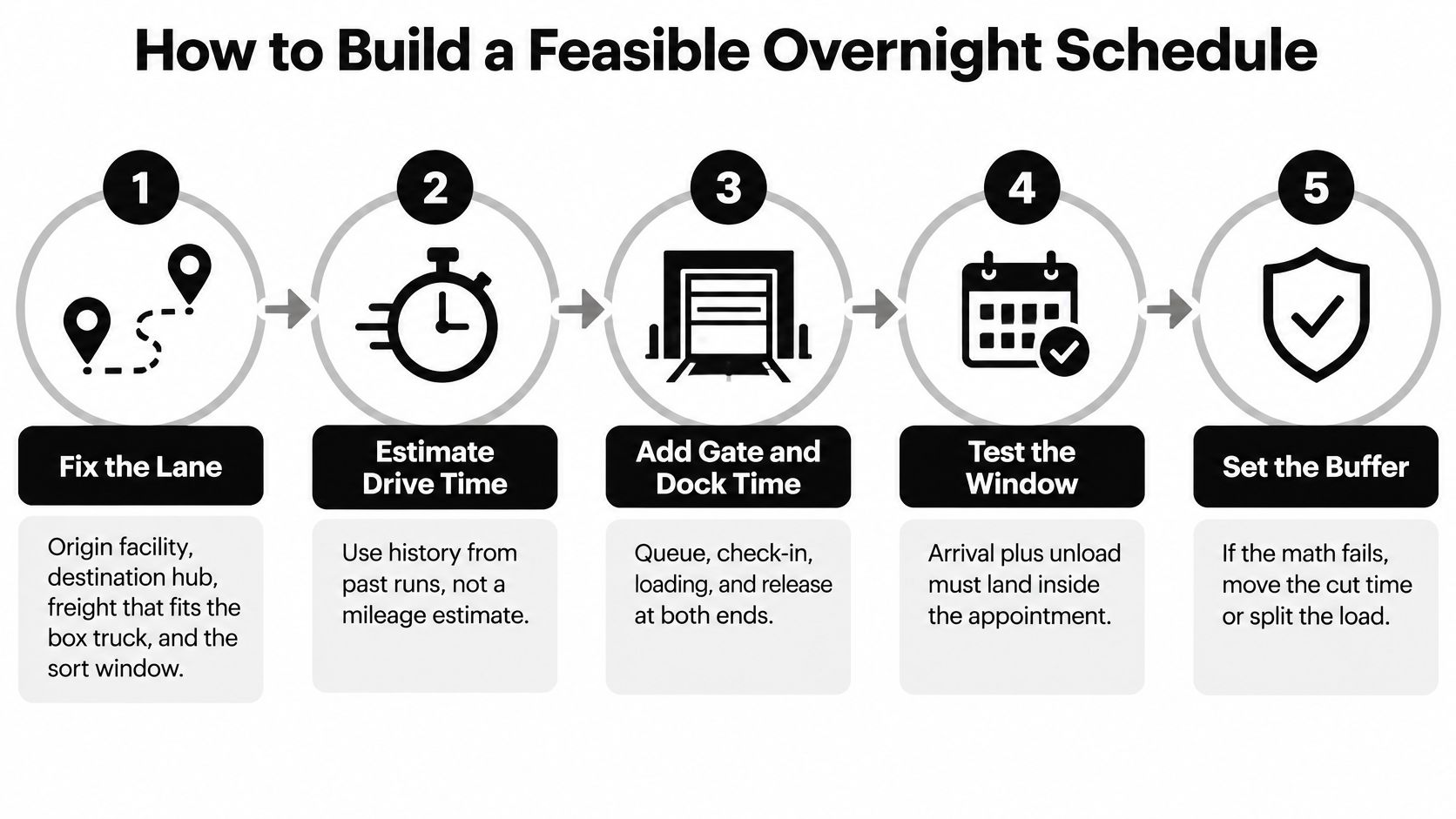
Build the dispatch plan backward from freight acceptance, then test it forward from the driver's start. Keep service, dwell, and contingency time separate so the planner can see which assumption changes when the schedule fails.
This visual summarizes the core planning flow.
Run the dispatch feasibility test
Fix the lane. Identify the origin, destination hub, freight assignment, usable truck capacity, and receiving or sort window. This prevents a routing calculation from solving the wrong freight movement.
Estimate drive time from history. Use comparable departures, road conditions, and operating nights rather than mileage alone. A broad average can hide the conditions that regularly affect an overnight run.
Add service work. Include pre-trip inspection, pallet-jack loading and unloading, yard movements, fueling, paperwork, and handoff activity. These tasks need real time even though they don't add highway miles.
Insert facility dwell and a delay allowance. Use the dock's operating record for expected waiting, then reserve additional time for the selected slow-case scenario. Keep the allowance distinct from planned work so dispatch can identify when it has been consumed.
Place the qualifying break. Check the cumulative-driving requirement and identify a practical stopping or non-driving opportunity before further driving would become prohibited. Don't rely on an uncertain queue to provide it.
Compare the complete plan with remaining hours. Add driving, service, dwell, breaks, and contingency time, then test driving availability, elapsed-window availability, and cumulative duty limits separately. Passing one test doesn't establish feasibility.
Repair the assignment if it fails. Negotiate an earlier facility appointment, reduce stop density, or establish a workable relay. These changes address the schedule rather than transferring the shortfall to the driver.
Publish the operating instructions. Give the driver a departure target, arrival interval, handoff requirements, and late-load escalation rule. Dispatch should know when to intervene before recovery becomes impossible.
Use the ELD as feedback, not a complete dock log
The Congressional Research Service's electronic logging device report describes devices recording engine power, motion, miles, engine hours, driver and vehicle identity, and duty status, with location generally recorded at 60-minute intervals while moving and at specified status or ignition events.
Pair those records with gate-in, dock assignment, loading completion, and gate-out timestamps. ELD information can establish vehicle activity, but a planner still needs facility events to distinguish waiting for freight from waiting for paperwork.
Use a cause code and an owner for each material variance. Carrier-controlled late departure or route deviation needs a different response from congestion or a receiving delay; excessive dwell needs investigation before assigning responsibility.
The accompanying video provides another visual reference for the scheduling discussion.
Repeated buffer consumption calls for redesign. Don't convert a contingency allowance into permanent, undocumented service time.
An Overnight Box-Truck Lane in Practice
A short route on the map can still miss the sort. In overnight middle-mile work, waiting at a gate or dock can create more schedule variance than highway miles, so plan the handoff before optimizing distance.
Consider a hypothetical Twin Cities facility-to-hub assignment, not a published Peak Transport timetable. The driver reports to the distribution center, inspects the box truck, checks the freight, and loads it with a pallet jack. Peak Transport routes are planned facility-to-facility assignments, not random residential stops. The operating plan also accounts for unloading, delivery documentation, and pre- and post-trip inspections.
Compare the baseline with the slow-night case
Use the 50th percentile as the baseline and the 90th percentile as the slow-case test as this guide's planning convention, not as a measured result or a method attributed to the FMCSA's ELD overview. Score feasibility first: can the driver complete the route legally and meet the handoff? Compare miles and fuel only after those conditions pass.
| Operating block | Baseline case | Slow-dock replay |
|---|---|---|
| Origin work | Freight is ready and loading follows the appointment | Outbound freight is released late |
| Highway segment | Travel follows the comparable-night baseline | Corridor congestion extends travel |
| Receiving | The hub accepts freight within the planned interval | Gate and dock waiting consume the contingency |
| Handoff result | Unloading finishes before sort acceptance closes | Freight reaches the property but misses acceptance |
| Dispatch decision | Publish the feasible assignment | Change departure, appointment, or relay arrangement |
The baseline works only if the full assignment fits, including receiving work and the local finish. Dock time belongs in the schedule just like driving time. A buffer that looks generous on the map can disappear while a truck waits for a door.
The slow-night replay misses the handoff deadline, even if the driver still has legal hours available. Hours compliance is necessary, but it does not guarantee an on-time transfer. Peak Transport's Middle Mile work is local, so drivers return home after their shift rather than taking long-haul overnight trips.
Recover without asking for a faster drive
If freight readiness caused the delay, an earlier report time may create more waiting. Dispatch can seek an earlier freight release or revise the downstream appointment. If neither is possible, a feasible relay or a different assignment may be needed.
Reliable communication helps dispatch act while the driver is safely stopped. Teams reviewing connectivity can consult this guide to mobile internet options for truckers, but a connection cannot replace an agreed escalation procedure.
A recovery plan should change the assignment, not the driver's safety margin.
If comparable trips consistently finish early, review the buffer rather than leaving the driver parked unnecessarily. Peak Transport shift times vary by route, and the company reviews shift options with applicants during hiring. This example does not promise particular hours.
How to Score a Route Beyond Miles
In Penske Transportation Solutions' survey of 255 U.S. transportation and logistics decision-makers, 70% of companies reported adopting AI solutions in 2025, up from 53% in 2024, according to NATSO's account of the Transportation Leaders Survey. Separately, 51% of U.S. logistics companies reported implementing route-optimization software in Tech.co's survey of 521 transportation and shipping professionals, as reported by IT Brief.
Adoption doesn't establish that an algorithm's preferred lane is operationally better. The planner still has to judge what the system optimized and which constraints it omitted.
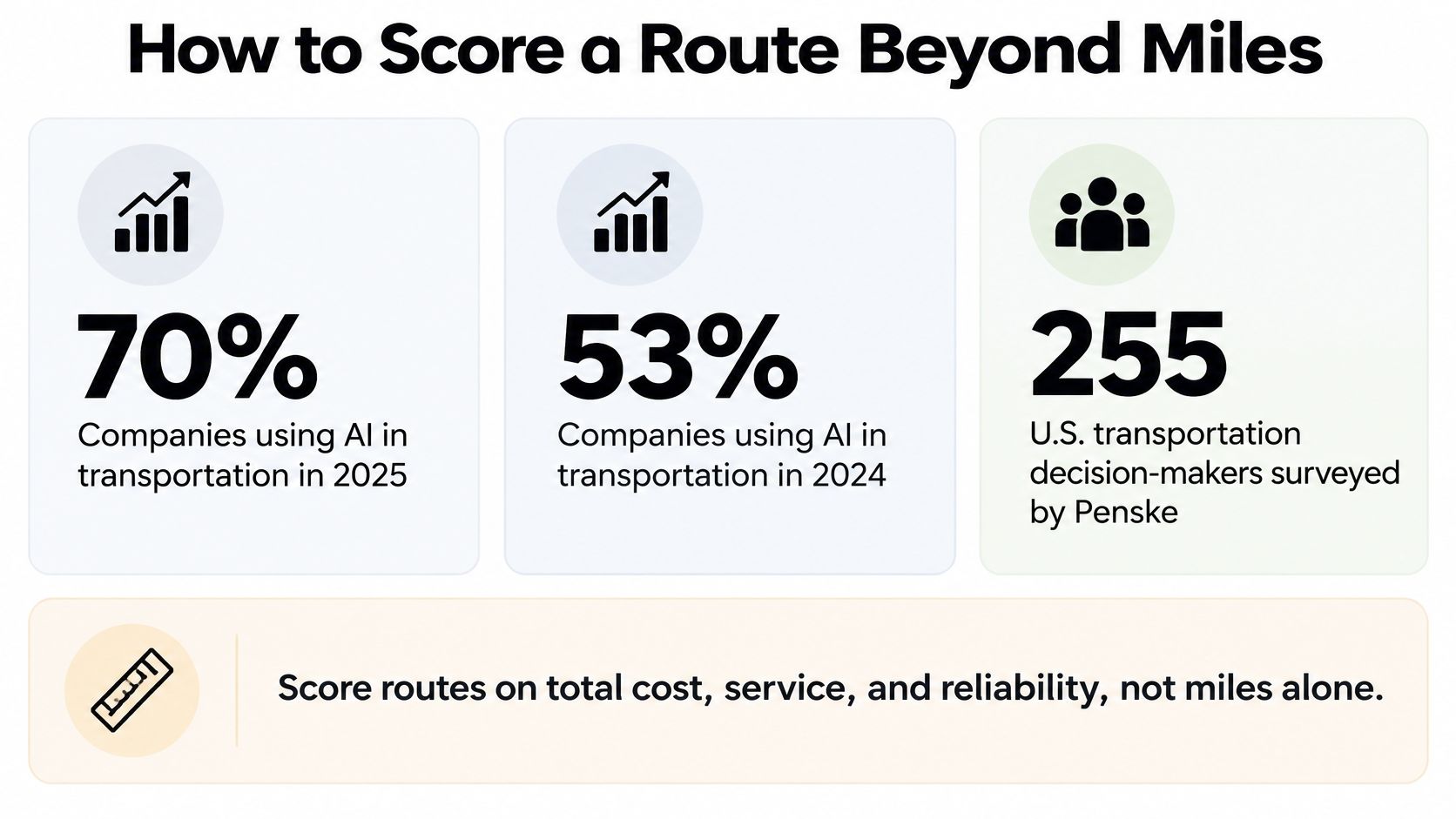
Make legality and service pass-or-fail gates
The World Economic Forum's intelligent transport report estimates that AI could reduce logistics emissions by up to 7% through route optimization and more efficient asset management. That potential doesn't authorize an assignment that conflicts with safe overnight driving, facility access rules, weather conditions, or remaining driver availability.
Outcomes that decide whether a route is better
| Outcome | What good looks like | When a longer route wins |
|---|---|---|
| On-time arrival | Inside the facility or sort window | It protects the handoff the short lane misses |
| Hours-of-service compliance | Driving and elapsed duty fit the driver's remaining legal budgets | The short lane exceeds remaining availability |
| Safety exposure | Speed, weather, and access conditions remain acceptable | The short lane conflicts with safe driving or local rules |
| Empty miles | Deadhead is limited after the handoff is secure | The complete movement avoids a recovery or unnecessary repositioning |
| Fuel | Consumption is evaluated on an executable plan | A modest fuel increase secures the required window |
| Schedule stability | Assignments remain predictable across operating nights | Constant reassignment would disrupt the established board |
| Driver workload | Breaks, dwell, and home time remain manageable | The shorter plan concentrates uncertainty on the driver |
Define the service event before scoring it. Our explanation of on-time delivery calculation helps distinguish a meaningful arrival measure from a timestamp that doesn't prove freight acceptance.
Keep a human accountable
Suppose the shorter road option approaches a hub through an access point unavailable during the receiving shift. A longer approved approach wins immediately, regardless of the mileage score.
Require an audit trail showing the binding constraint, the selected alternative, and the dispatcher's approval. Give dispatchers a human override when the model misses a dock rule or a driver's actual availability, and record why they used it.
For a W-2 overnight workforce, constant reassignment can undermine the predictability drivers expect. Safety and schedule stability must be optimization objectives, not problems drivers are expected to absorb after software publishes the route.
Test One Lane Before You Change the Network
Choose a live lane this week and keep the test small enough to explain at the dispatch desk. Use comparable operating records, not a network-wide average that mixes different facilities and freight patterns.
Build a lane control sheet
- Write the baseline duty total. Separate driving, service work, planned dwell, and breaks.
- Write the slow-case total. Add a defensible allowance for gate queues, weather, and handoff uncertainty without counting the same delay twice.
- Check the assigned driver. Compare both cases with actual remaining driving, elapsed-window, and cumulative availability.
- Record the acceptance result. Establish whether the freight completed the required handoff inside the facility window.
- Assign the cause. Distinguish carrier-controlled gate-out or route deviations from congestion and facility delays.
- Change repeated failures. Revise freight release, appointment timing, departure, or the lane structure rather than requesting faster driving.
For a gate-access integration project, Nimbio's gate access API is a resource for evaluating whether access controls can be connected to an operating workflow. Confirm the facility's permissions and actual integration requirements before treating access as automated.
Make a publish-or-redesign decision
At Peak Transport, our Route Optimization uses data modeling to reduce mileage and cut fuel consumption. Our drivers are W-2 employees, not independent contractors, so a sound dispatch decision must also support a workable employee schedule.
Keep an ELD-versus-plan comparison as a weekly control, supported by facility timestamps. Publish the assignment only when the driver, truck, facility window, and downstream handoff all fit. If they don't, redesign that lane before changing the rest of the network.
Peak Transport offers planned overnight middle-mile box-truck operations between distribution centers and hubs across the Twin Cities and surrounding areas. Visit Peak Transport to discuss your facility windows, dock assumptions, and recurring lane requirements, and identify what needs to be tested before the next dispatch.