Route Planning for Truck Drivers: A Step-by-Step Guide
Route Planning for Truck Drivers, step by step: build legal, reliable routes using HOS limits, truck restrictions, parking buffers and fallback plans.
November 13, 2026
The most common advice about route planning for truck drivers is to find the shortest truck-legal route and follow the navigation. That's not enough for an overnight metro lane. A short route can still leave a driver outside a locked gate, searching for parking, or running out of legal driving time before the final delivery.
Start with the appointment, the driver's available hours, and a dependable place to stop. Then choose the roads. Mileage matters only after the route works legally and operationally.
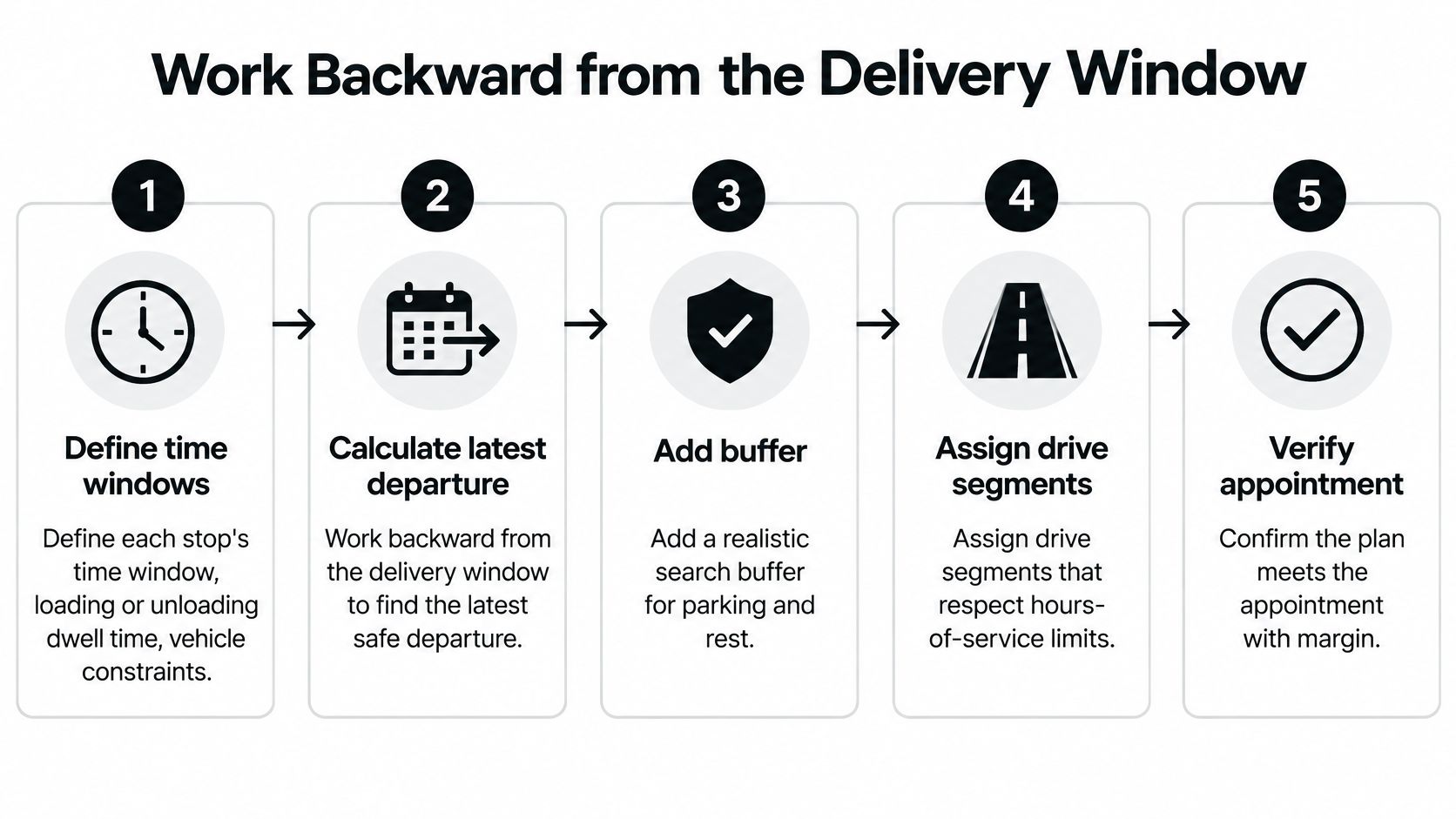
Work Backward from the Delivery Window
Build the timeline backward from the receiving appointment, not forward from the yard departure. The appointment tells dispatch when the truck must be ready for receiving, which may be different from when it reaches the property.
A navigation ETA usually ends at an address. Your operating schedule must account for gate check-in, staging, dock assignment, unloading, and delivery documentation.
Build the schedule before choosing the road
Define the stop requirements. Record each receiving window, expected loading or unloading duration, vehicle type, cargo dimensions, and arrival buffer. Confirm whether the appointment means arrival at the gate or readiness at the dock. That distinction changes the departure plan.
Calculate the driver's available legal capacity. Check the driver's actual duty status rather than assuming a fresh shift. For applicable property-carrying drivers, the FMCSA hours-of-service rules generally permit 11 driving hours after 10 consecutive hours off duty, prohibit driving beyond the 14-hour window, and require a 30-minute qualifying interruption after 8 cumulative driving hours. Use the available balance, not merely the maximum allowance.
Insert the fixed work. Put inspection, dispatch check-in, fueling, loading, yard queues, and paperwork on the timeline before optimizing the road sequence. Don't give the same block of time to both loading and inspection unless the work can happen that way.
Stress-test the departure. Ask what happens if construction closes the preferred ramp, snow slows the approach, or receiving holds the truck outside the gate. Assign a lane-specific delay allowance. If the schedule works only when every event goes perfectly, change the schedule before releasing it.
Issue a driver-facing route sheet. Include stop sequence, target arrival, appointment deadline, approved alternates, staging instructions, and escalation triggers. Write the receiving entrance and contact details clearly enough that the driver doesn't have to search messages while approaching the facility.
Use this workflow when turning the appointment into a dispatch plan.
Federal driving limits to plan around
The reference below combines the driving constraints above with the applicable 60- or 70-hour weekly on-duty limits described in the FMCSA ELD oversight report.
| Rule | Limit | Planning use |
|---|---|---|
| Driving time | 11 hours after 10 consecutive hours off duty | Cap total road time for each shift |
| On-duty window | 14 hours | Include loading, inspection, and waiting when checking available driving time |
| Mandatory break | 30 minutes after 8 cumulative driving hours | Place the qualifying break at a safe, known stop |
| Weekly on-duty total | 60 or 70 hours, depending on applicable rules | Check the weekly total before adding extra lanes |
These are general federal planning limits for applicable operations, not a determination that every box-truck assignment falls under identical requirements. Confirm applicability before assigning the lane, and don't treat an exception as routine scheduling capacity.
Dispatch rule: Non-driving time still belongs in the route plan. A parked truck doesn't automatically mean the driver's available work window has stopped.
At Peak Transport, our routes are scheduled movements between facilities, not random residential stops, and we plan them in advance. That makes backward planning useful even when the road sequence stays familiar: receiving requirements and available driver hours still need checking.
The metric to track is planned arrival reliability within legal limits, not miles eliminated.
Check Truck Dimensions and Restrictions Before Dispatch
A car navigation path isn't a validated box-truck route. Entering the destination correctly won't prevent the app from suggesting a road with an unsuitable clearance, a restricted turn, or an entrance the truck can't use.
Start with the actual vehicle configuration. Record height including roof equipment, width, overall length, loaded gross weight, axle configuration and spacing, ground clearance, and overhang. Don't substitute a remembered fleet specification for the truck assigned to the load.
The Federal Highway Administration's route-survey guidance calls for considering load dimensions and vehicle configuration because inadequate verification can lead to bridge strikes or trucks becoming lodged at highway-rail crossings.
Truck measurements and restrictions to verify
| Restriction | What to record or check | Risk if missed |
|---|---|---|
| Height | Actual height including roof equipment | Bridge strike or low-clearance stop |
| Width and length | Width, length, and any overhang | Inability to complete a tight turn or clear a constrained crossing |
| Gross weight and axles | Loaded weight and axle spacing | Blocked by weight-restricted roads |
| Turning and access | Turning radius and curb access | Stuck at an industrial gate |
| Seasonal closures | Winter and construction notices | Forced reroute mid-run |
Treat ground clearance as a separate crossing check. A route can pass the overhead-clearance screen and still be unsuitable where the road profile changes sharply at a rail crossing.
Screen the entire approach, not just the highway portion. Check posted bridge clearances, weight restrictions, narrow lanes, restricted turns, low-clearance crossings, seasonal closures, and facility gate instructions. The final industrial street can be the part that makes an otherwise usable route fail.
Verify the entrance and the fallback
Use truck-specific routing with the correct vehicle profile, then compare its instructions against current road notices and facility directions. A satellite view can help identify an entrance or turning area, but it doesn't establish clearance, legal access, or current gate availability.
Before departure, dispatch should check construction and weather notices and document an alternate route. The alternate needs its own restriction screen, not just a line on the map.
Keep a short verification record:
- Reviewer and date: Identify who checked the route and when.
- Vehicle assumptions: Record the dimensions and loaded configuration used.
- Known restrictions: Include gates, turns, crossings, and posted limits.
- Replanning conditions: Specify changes that invalidate approval, such as a different truck or closed entrance.
Our box-truck requirements guide provides context for drivers preparing for the role. A CDL isn't required for Peak Transport driver roles; a valid driver's license and clean driving record are required. That credential requirement doesn't replace vehicle-specific route verification.
Pick Routes by Reliability, Not Just Mileage
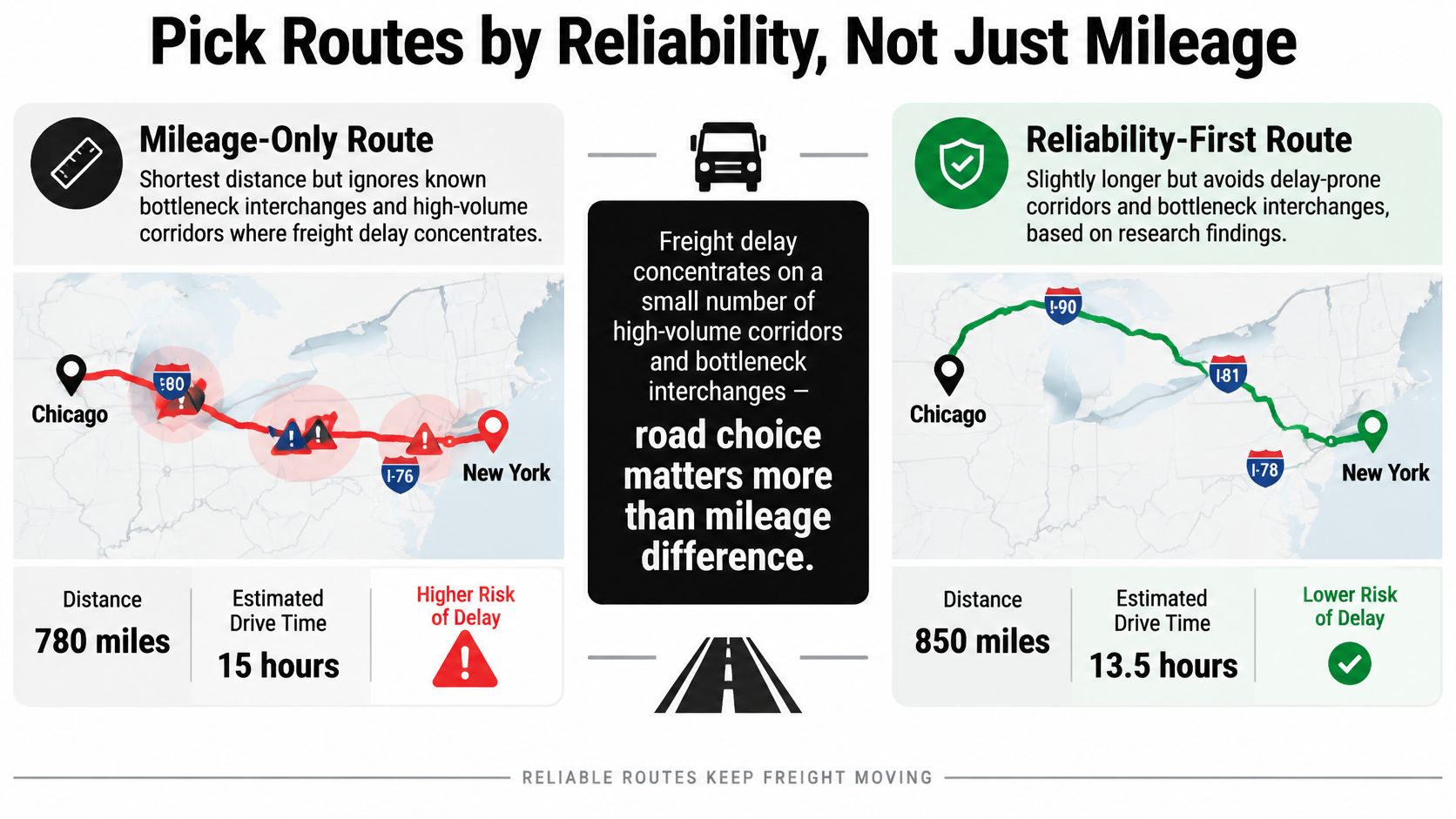
The shortest-route trap starts when dispatch treats every road mile as equally predictable. Freight delay concentrates on particular corridors and interchange bottlenecks, so the road selected can matter more than a modest mileage difference.
The Federal Highway Administration's freight congestion analysis reported that recurring peak-period congestion slowed traffic on more than 10,600 miles of the National Highway System in 2002, while interchange bottlenecks accounted for roughly 124 million truck-hours of delay in 2004. Those are historical findings, not current Twin Cities travel-time estimates, but they establish why mileage alone is a weak routing criterion.
Compare usable routes, not just map estimates
Evaluate time-of-day reliability, interchange performance, truck access, and delay around freight-heavy junctions. Compare conditions for the truck's expected passage through each location, not conditions when dispatch happens to open the map.
The following is a hypothetical overnight-lane comparison, not a measured Twin Cities route. Its times and mileage difference are illustrative planning assumptions.
Comparing two candidate routes for one overnight lane
| Criterion | Shortest route | Alternate, 4 miles longer | Decision rule |
|---|---|---|---|
| Time-of-day reliability | Congested during the assumed 5–6 a.m. peak | Steady through the morning | Keep the route with the steadier window |
| Interchange performance | Passes the lane's worst truck bottleneck interchange | Avoids that interchange | Don't depend on an unreliable interchange when a practical alternative exists |
| Truck-accessible roads | Includes an unverified low-clearance rail crossing | Uses verified truck-accessible arterials | Reject any route that fails the restriction screen |
| Delay at freight junctions | Approach overlaps a dock queue near a freight-heavy junction | Lighter freight traffic at the junction | Keep the route with the most arrival slack |
The shorter candidate must be rejected until its crossing is verified. A time saving never offsets an access failure.
If both routes pass the restriction screen, compare their remaining margin at the appointment. In this scenario, the longer alternate is preferable if it preserves arrival margin without consuming more usable driver time elsewhere.
This comparison shows the difference between minimizing distance and protecting the delivery.
Don't assume overnight means unobstructed
Overnight construction, ramp closures, and receiving queues still need a place in the decision. Check the timing of closures against the actual passage time, and use the route-planning weather guide when reviewing seasonal conditions.
Choose the route with the strongest usable arrival margin, not the most attractive mileage total.
Dispatch should make that comparison before the shift starts. Keep an approved alternate that avoids the primary route's vulnerable junction; an alternate that rejoins immediately before the same bottleneck offers little protection.
Plan Parking and Rest Stops Before You Need Them
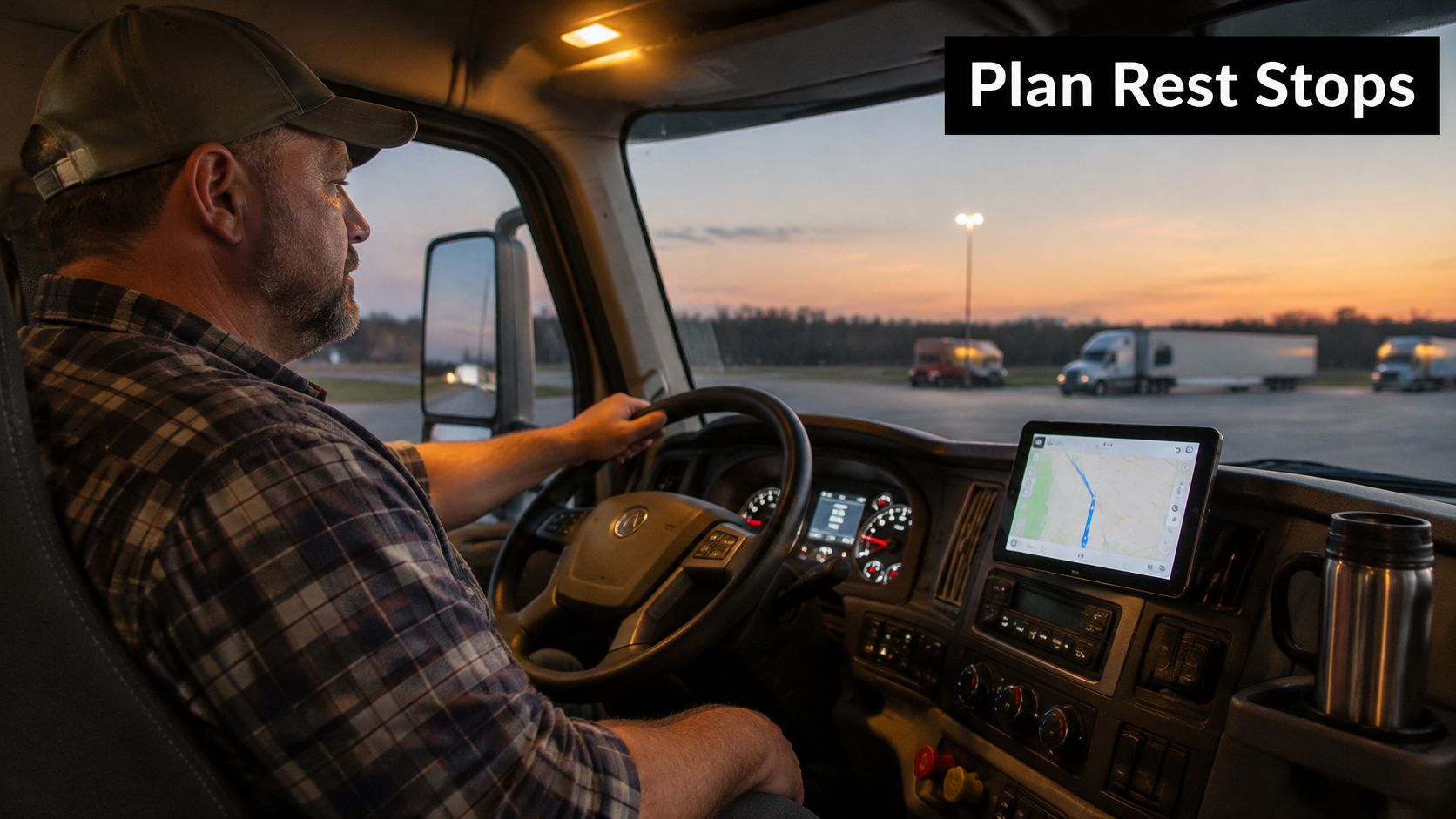
A parking location on the map isn't a parking plan. The useful question is where this driver should stop given remaining legal time, appointment timing, vehicle access, and the time needed to find an available space.
Review the stopping options before the truck leaves the yard.
Minnesota has 4,620 truck-parking spaces across 205 locations, with an estimated statewide deficit of 1,602 spaces, including 700 in the Twin Cities metro, according to the Minnesota Department of Transportation's truck-parking information.
A Wisconsin truck-parking study found that 98% of surveyed drivers had difficulty finding safe parking at some point and describes parking searches taking 15 to 45 minutes after drivers decide to stop. Budget that search into the plan the same way you budget drive time. Reaching the parking exit guarantees nothing about an open space.
Turn parking pressure into dispatch checks
| Pressure point | What dispatch should establish | Failure to avoid |
|---|---|---|
| Early facility arrival | Whether staging is permitted and where | Waiting on an unauthorized shoulder |
| Limited remaining hours | Latest safe arrival at the planned stop | Starting the parking search too late |
| Full primary location | Named, reachable backup locations | Circling without a destination |
| Overnight access | Gate hours and permission to enter | Reaching a closed lot |
| Driver leaving the cab | Lighting and a suitable pedestrian path | An unnecessary walk through an isolated area |
Calculate the latest legal arrival at the planned stop, leaving room for the search and any necessary repositioning. Name backup locations that remain reachable if the primary lot is unavailable, and verify overnight access where possible.
Don't assume a receiving facility permits early staging because it accepted a previous delivery. Put the permission and entry instructions on the route sheet.
This video walks through the same stop-planning checks from the driver's seat.
Set the decision point before the limit
Agree on when the driver must contact dispatch or move to the backup, using the applicable hours-of-service rules as a scheduling constraint. A trigger set at the legal limit leaves no room to act, so set it early enough that the driver can still reach the backup without rushing.
Any stop that involves leaving the cab should be authorized and well lit, with a clear pedestrian path to the entrance. A driver walking between the truck and a facility door after dark can review practical guidance on walking alone at night safely as part of break planning.
Our Middle Mile work is local, so drivers are home after their shift and don't make long-haul overnight trips. For this operation, the planning problem is local breaks, staging permission, and short searches inside the metro.
A slightly longer route with dependable parking can be the better operating plan.
Build a Sample Twin Cities Overnight Workflow
Build a representative loop before copying a schedule across recurring lanes. Use the following as a hypothetical planning exercise, not a Peak Transport shift schedule or a claim about actual facility appointments.
Assume the driver checks in at 9:30 p.m. and has a fresh applicable duty window. The calculated driving-window endpoint is 11:30 a.m. Use 11:00 a.m. as an earlier internal finish target, leaving a margin rather than scheduling work to the legal edge.
Sample Twin Cities overnight loop schedule
| Time | Event | Planning check |
|---|---|---|
| 9:30 p.m. | Check-in and pre-trip inspection | Confirm the actual duty-status record and window start |
| 10:00 p.m. | Planned yard departure following a 30-minute yard block | Count loading and inspection as work; extend the block if both won't fit |
| 11:00 p.m. | Stop 1 metro delivery | Named backup stop written on the route sheet |
| Before 8 driving hours | Planned qualifying 30-minute break, if required | Verified stop rather than relying on a public lot during an assumed 6–7 a.m. busy period |
| 4:30 a.m. | Stop 2 delivery window opens | Dispatch alerted if illustrative arrival slack falls under 60 minutes |
| 11:00 a.m. | Internal finish target | Finish driving, return tasks, and paperwork before the calculated 11:30 a.m. endpoint |
The yard block needs particular attention. If loading alone consumes the assumed block, inspection and check-in require additional time, and departure moves accordingly. Don't hide overlapping work inside a convenient timestamp.
Make the gaps explainable
The interval between deliveries isn't automatically available driving time. Assign every part of it to travel, receiving, authorized staging, a qualifying break, or another documented activity.
- Receiving window: Record when the facility opens and the actual appointment deadline.
- Backup access: Write the approved location's name and entrance, not “nearby parking.”
- Final completion: Include the return movement, post-trip inspection, and documentation.
- Arrival slack: Measure margin against the earliest binding constraint, whether that's the appointment or available legal driving time.
A schedule isn't complete until dispatch can explain both the moving time and the stopped time.
After a trial week, replace the assumptions with actual event timestamps. Keep the workable sequence, revise the weak allowances, and use that corrected lane as the template for comparable Twin Cities work.
Test Fallbacks and Run One Lane This Week
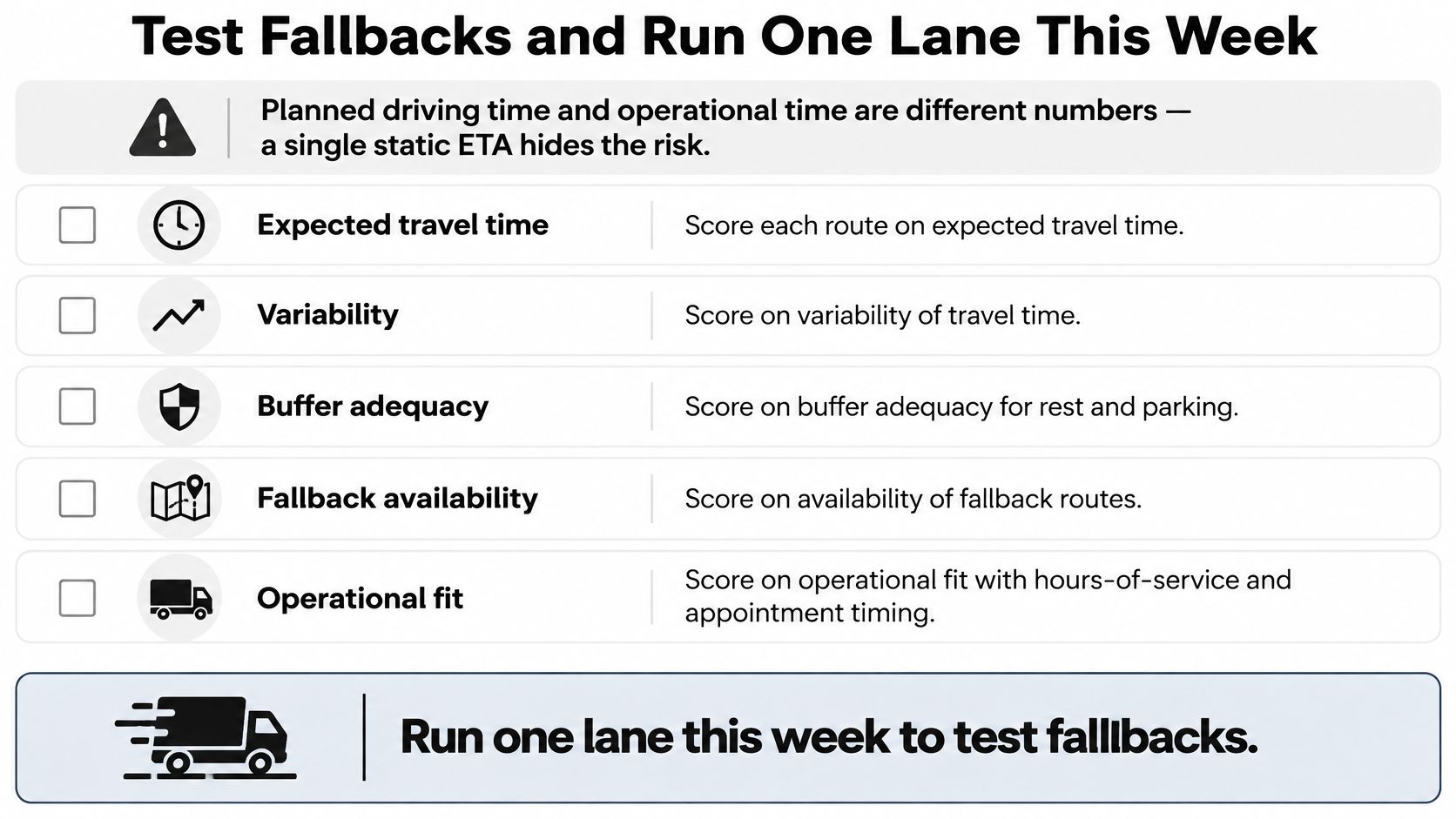
Planned driving time and total operating time are different numbers. A single map ETA won't tell dispatch whether the driver can clear receiving, reach approved parking, and complete the return work.
Score each candidate on expected arrival, travel-time variability, remaining legal-hours margin, parking fallback quality, and communication triggers. Use plain judgments such as acceptable, needs revision, or reject, with a reason attached.
Apply the intervention rules
Set buffers by lane and season. Give Twin Cities winter operations room for slower approaches and facility handling, rather than applying the same allowance to every route.
- Reroute early. Reassess the approved road option when remaining margin drops below the lane's operating buffer. Don't reroute if the alternate introduces an unverified restriction.
- Use the named backup. If the planned stop is full, follow the documented fallback rather than improvising a parking search.
- Notify receiving before the miss. Communicate when the forecast threatens the appointment, while the facility still has time to respond.
- Escalate before legal capacity runs out. Dispatch needs time to arrange a safe stop or revise the assignment.
Use this checklist before releasing the test lane.
Record what changes the next dispatch
Where ELD requirements apply, reconcile the available-hours record with the dispatch plan before departure. Keep the reason for each route change alongside the event timestamps.
For a trial this week, select a recurring lane, complete its restriction screen, compare road options, and document parking fallbacks. Record planned arrival, actual arrival, remaining legal-hours margin, facility dwell, and parking-search time.
Use those records to revise the buffer, but don't treat an uneventful trial as proof that winter or closure risk has disappeared. Release the next assignment only after the vehicle, appointment, driver capacity, and stopping plan pass the dispatch check.
Peak Transport offers local, scheduled overnight box-truck work with W-2 employment, paid training, health insurance, paid sick time, and a 401(k) with matching. If you have a valid driver's license, a clean driving record, overnight availability, and can operate a pallet jack, visit Peak Transport to explore roles built around planned facility-to-facility routes and clear dispatch communication.