Supply Chain Mapping a Practical Guide for Operators
Learn what supply chain mapping really does, how to build a usable map, and the KPIs that turn network diagrams into reliable middle-mile execution.
October 20, 2026
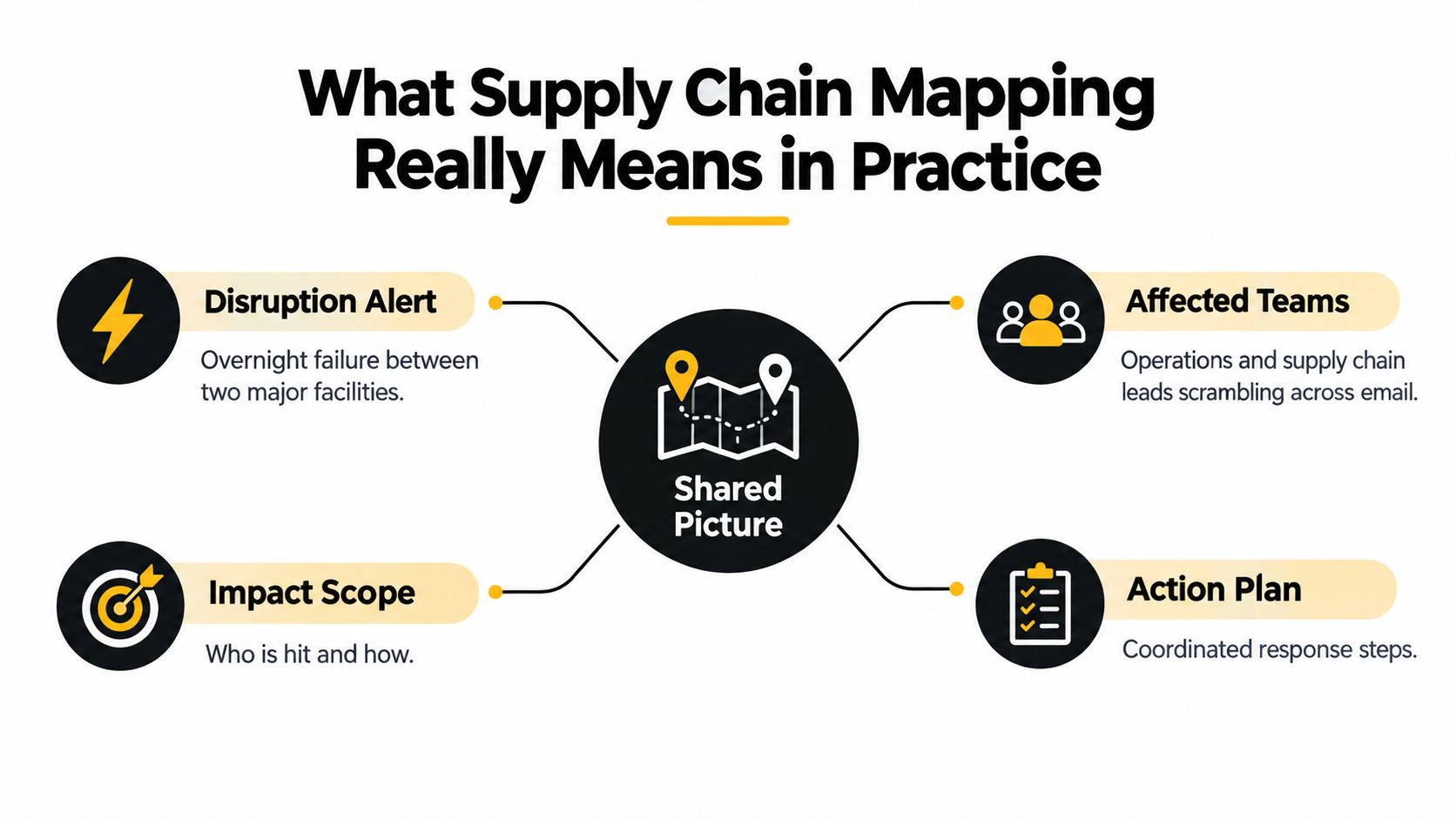
A loaded box truck is waiting at a distribution center, the receiving hub's cutoff is approaching, and dispatch has just learned that the scheduled handoff won't happen. The facility contact is buried in an email thread. Someone knows an alternate dock, but nobody can confirm whether it can accept the freight or whether the driver has enough available hours to reach it safely.
That's the moment a network diagram either becomes useful or gets ignored. Supply chain mapping should give dispatch a shared, defensible picture of what's affected, what's still possible, and who can authorize the next move. For overnight middle-mile operations, that matters more than how polished the diagram looks.
What Supply Chain Mapping Really Means in Practice
Supply chain mapping is a structured representation of the organizations, facilities, geographic locations, and relationships involved in moving goods. In a middle-mile network, the working unit isn't just a supplier. It's a facility connected to another facility through a lane, a schedule, and an accountable handoff.
Start with the operating question: If this departure fails, what else becomes impossible? To answer it, the map must connect the origin to the receiving hub, the freight committed to that movement, and the downstream departures that depend on its arrival. A list of addresses can't establish those dependencies.
Separate the network from the shipment
Mapping describes the network; traceability follows a particular product or material lot through it. Operationally, keep the lane structure separate from the shipment events that pass through it. Otherwise, a temporary load change can get mistaken for a permanent network change.
For example, the connection between a distribution center and a regional hub belongs in the map. The departure scan and delivery confirmation for tonight's load belong in the shipment record, linked to that connection.
- Show physical dependencies. Identify where freight originates, transfers, waits, and enters the next operation.
- Show operating dependencies. Record which departure requires an earlier arrival or completed loading activity.
- Show decision authority. Make clear who can approve a diversion, revised appointment, or freight hold.
Practical rule: A dispatcher should be able to use the map without calling its author to interpret it.
Keep the overview readable. Dispatch needs to see affected connections quickly, while planners need access to the supporting detail. Use a simple network view backed by structured records, rather than squeezing every instruction onto a crowded diagram.
Why Most Maps Stop Being Useful Too Soon
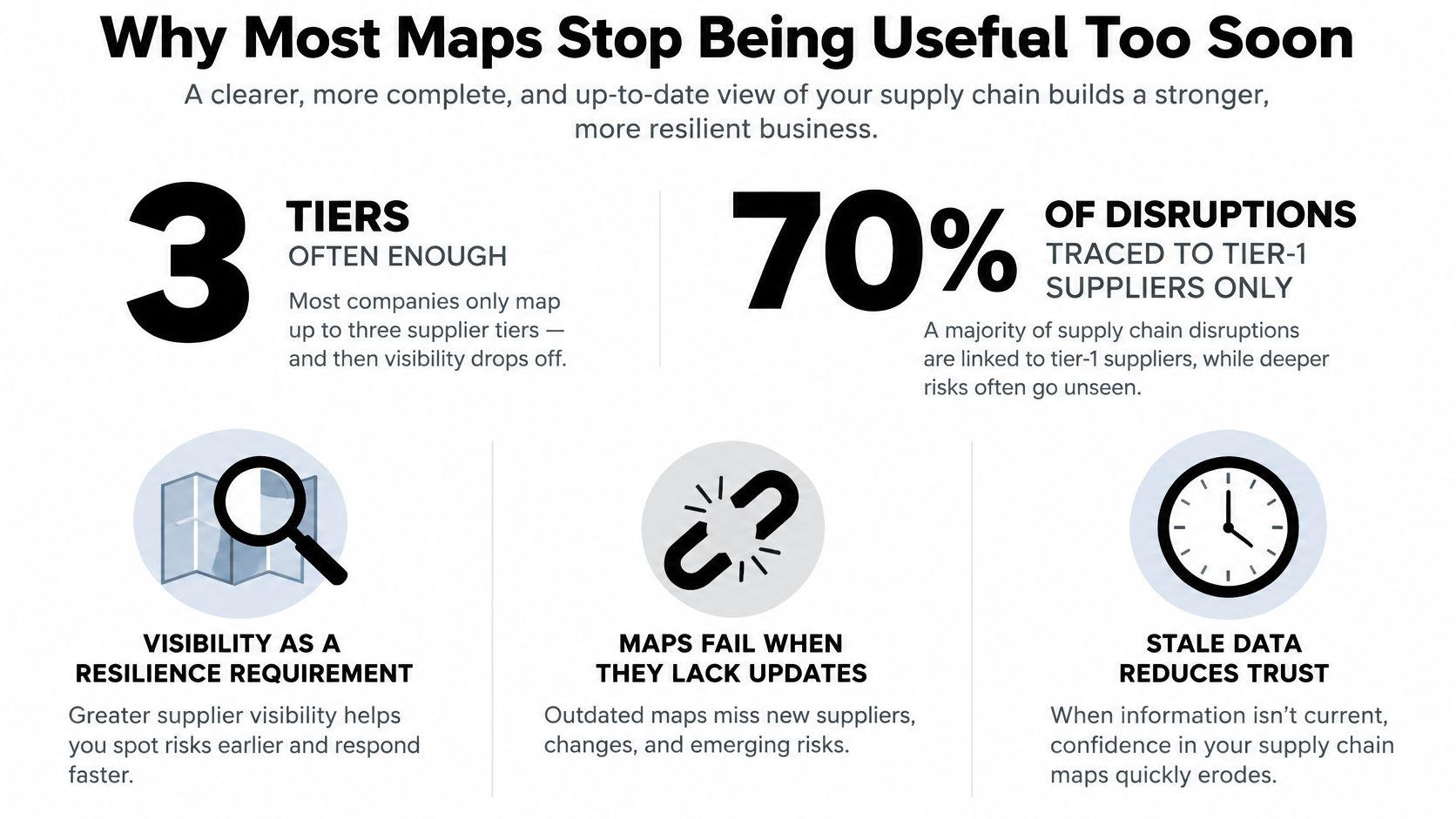
More tiers don't automatically produce better visibility. A broad map assembled from unconfirmed submissions may be less useful during an overnight exception than a narrower network whose critical connections have been checked.
The gap between ambition and usable information isn't new. In a worldwide survey of 623 supply-chain professionals across 17 countries, conducted in 2016 for a 2017 report, end-to-end visibility rose from the sixth-ranked priority in 2015 to third in 2017, yet only 6% reported full visibility and 77% had no visibility or a restricted view, according to the worldwide supply-chain transparency survey.
Judge evidence, not coverage alone
Treat these as distinct operational states:
- Unknown. A dependency exists, but the team lacks enough information to plan around it.
- Reported. A partner or internal team has supplied the information, but nobody has checked it.
- Verified. An accountable person has checked the relevant details against supporting evidence.
- Operationally tested. The team has exercised the connection or contingency under documented conditions.
These are recommended working labels, not a universal industry standard. Apply them to individual attributes when necessary: a facility address might be verified while its after-hours receiving arrangement remains only reported.
A map also loses value when procurement and transportation maintain separate assumptions about critical relationships. For procurement-side context, ATEK Distribution's resource on mission-critical procurement partners offers a useful starting point for that discussion. Translate the discussion into explicit transport dependencies rather than assuming a supplier relationship guarantees overnight receiving access.
Don't expand coverage faster than you can maintain trust in the data. Prioritize the facilities and connections whose failure would leave dispatch with the fewest workable choices.
Building Blocks of a Decision-Ready Map
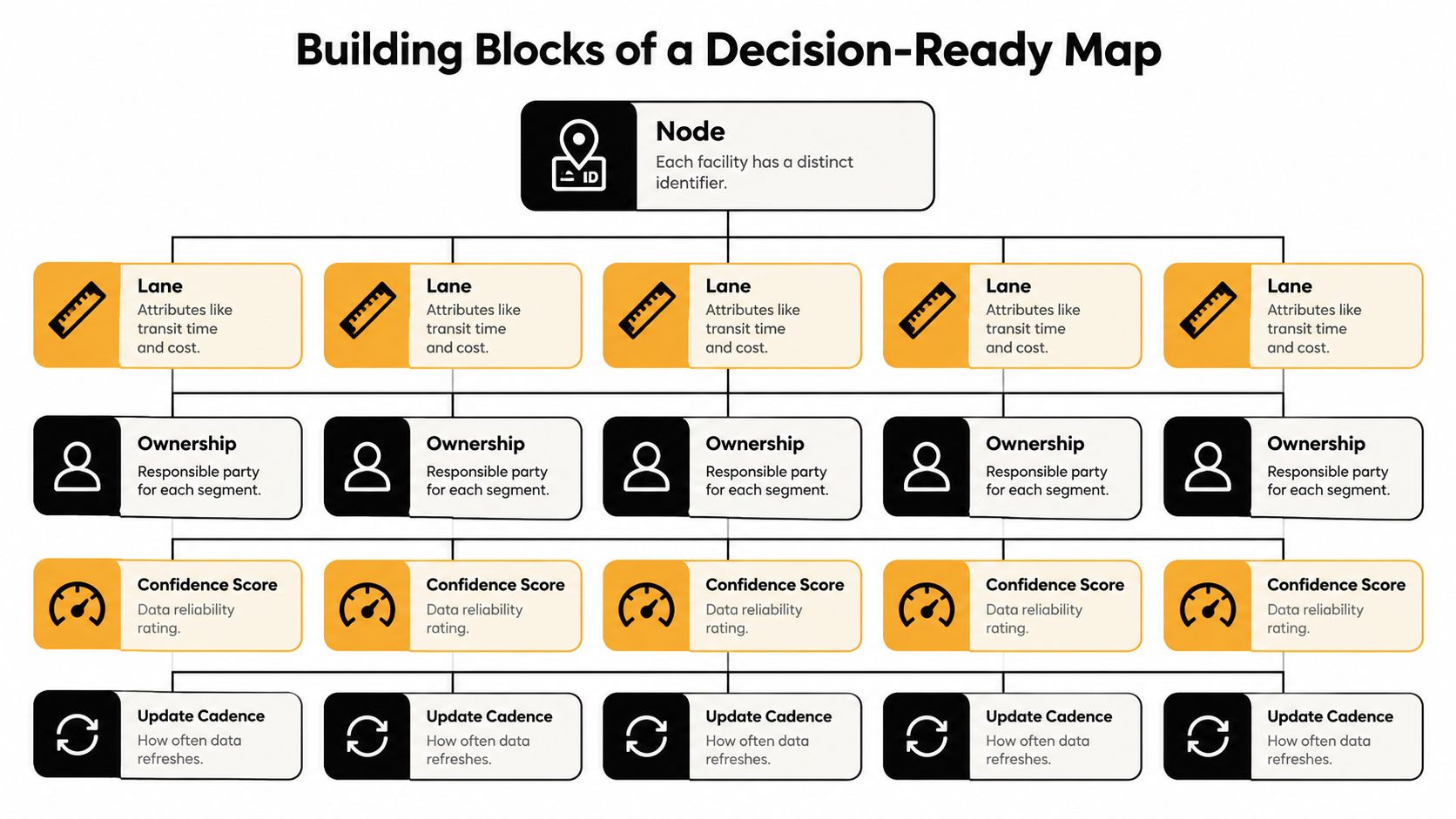
Build the dataset before polishing the diagram. OECD guidance on mapping and traceability describes connected supply-chain entities and emphasizes mapping's role in identifying where information must be gathered for due diligence and risk management. For an operator, that means every important connection needs supporting information, not just a line between boxes.
Define the records behind the view
| Record | Essential attributes | Operational purpose |
|---|---|---|
| Node | Unique identifier, physical address, entrance, facility type, receiving contact | Prevent facility and access-point confusion |
| Lane | Origin and destination identifiers, planned miles, transit allowance, departure window, equipment requirements | Establish a feasible movement |
| Handoff | Responsible parties, acceptance condition, appointment requirement, transfer location | Clarify when responsibility changes |
| Evidence | Information source, verification date, confidence status, unresolved discrepancies | Show what dispatch can rely on |
| Ownership | Record owner, escalation contact, review trigger | Keep corrections accountable |
Consider an illustrative Amazon relay connection feeding a regional hub overnight. The node record should distinguish the truck entrance from the mailing address. The lane record should carry the departure cutoff, receiving appointment, box-truck capacity requirements, expected dwell exposure, and historical service exceptions.
Keep design assumptions visible
Separate planned values from observed results. If a planner changes the expected transit time, preserve the previous assumption and the reason for the revision. Otherwise, the team can't tell whether service improved or the standard became easier.
Use a confidence rating with written criteria rather than an unexplained score. A record supported by recent operating evidence should be distinguishable from an unconfirmed partner submission, and unresolved conflicts should remain visible.
The wider supply chain network design establishes where facilities and connections should sit. The operating map documents how those connections can be executed. Keep those purposes aligned without treating a proposed lane as an approved dispatch instruction.
Data Sources That Feed a Living Map
No single feed should settle every question. GPS can support a location history, but it doesn't establish that a receiving team accepted the freight. An appointment record can establish an agreed window, but it doesn't prove the vehicle arrived.
Choose the source according to the attribute you're validating. First-party operating records are strong evidence for observed movements; partner records are necessary for commitments and access rules. External feeds support contingency decisions, not proof that a particular load moved.
Comparing Common Map Data Sources
| Source | Signal Type | Refresh Cadence | Confidence |
|---|---|---|---|
| GPS and electronic logging records | Vehicle movement and driving activity | As operating events become available | Strong for recorded activity, subject to device and assignment checks |
| Proof-of-delivery and scan records | Documented shipment milestones | At capture and reconciliation | Strong when matched to the correct load and location |
| Appointment systems | Scheduled receiving or loading commitments | When bookings change | Useful for agreed plans, not actual completion |
| Partner facility records | Cutoffs, dock rules, contacts, load plans | On change and scheduled confirmation | Depends on ownership and verification |
| Incident logs | Exceptions, explanations, corrective actions | Following an event | Depends on documentation quality |
| Weather, traffic, and construction feeds | Potential route constraints | As advisories change | Advisory until checked against lane conditions |
Resolve disagreements explicitly
Suppose GPS indicates arrival while the facility record shows a missed appointment. Don't overwrite either event to make the dashboard consistent. Check whether the vehicle reached the property, the correct gate, or the assigned dock, then document the explanation.
A timestamp is evidence of a recorded event, not automatic proof that the intended handoff occurred.
Start with the systems already used by dispatch. Evaluate supply chain visibility tools against unresolved operating needs, such as matching facility aliases or exposing missing milestones. Adding another platform won't resolve unclear event definitions.
Keep driver reporting focused. Ask for information that changes a decision or closes an evidence gap, and collect it through safe, established communication procedures.
Mapping Middle-Mile Lanes Between Distribution Centers and Hubs
For overnight box-truck work, test the lane backward from the receiving requirement. Establish when freight must be accepted, what unloading conditions apply, and which upstream activities must finish before departure remains feasible.
Don't confuse awareness of a partner with knowledge of its dependencies. McKinsey's supply-chain risk survey reported that 95% of surveyed organizations had visibility into Tier 1 risks, while 42% extended visibility to Tier 2 or beyond; fewer than half of those with mapped Tier 2 suppliers maintained regular direct contact. In middle-mile planning, the equivalent question is whether someone has confirmed the receiving operation behind the facility name.

Evaluate the whole move
- Cutoff feasibility. Include loading completion, paperwork release, yard exit, travel, and receiving access.
- Equipment compatibility. Confirm payload, usable capacity, dock configuration, and unloading requirements for the assigned box truck.
- Yard movement. Document check-in instructions, staging restrictions, and the correct approach to the receiving door.
- Driver availability. Evaluate the assignment against the driver's actual available hours and applicable requirements.
- Alternate readiness. Confirm that the destination can accept this freight under the proposed arrangement.
A shorter route isn't automatically the better assignment. If it creates an unreliable handoff or requires an unconfirmed receiving exception, dispatch may be trading visible mileage for hidden service risk.
Dispatch test: An alternate isn't ready because it appears on the map. It's ready when the receiving arrangement, equipment fit, and driver assignment have been confirmed.
Keep unlike transport services separate. A relocation coordinator researching auto shipping options for Florida relocation from National Car Transport is evaluating a different service from scheduled hub-to-hub freight. Don't treat a provider in an adjacent category as substitute middle-mile capacity without verifying the operating fit.
KPIs That Prove the Map Is Working
Measure whether the map improves decisions, not whether the team has added more records. Use a compact set of operating measures, with clear definitions and an owner who can investigate changes.
Pair service results with data quality
| KPI | Working definition | What to investigate |
|---|---|---|
| Lane on-time performance | Eligible arrivals meeting the agreed receiving requirement | Repeated misses tied to a particular departure or handoff |
| Node exception frequency | Documented exceptions relative to activity at that facility | Recurring access, loading, or acceptance problems |
| Transfer-point dwell | Time between consistently defined arrival and release events | Unplanned waiting and unclear handoff responsibility |
| Miles per completed load | Actual movement miles relative to completed loads | Detours, repositioning, and unsuccessful movements |
| Driver-hour utilization | Productive assignment time considered alongside waiting and available hours | Plans that depend on unrealistic availability |
| Confidence currency | Share of critical records reviewed within their assigned review period | Decisions resting on unconfirmed information |
Set targets from your operating baseline and service commitments. Don't import a benchmark without checking whether its event definitions, equipment, and freight patterns match yours.
Turn trends into action
Review results by lane and node, not only across the whole network. An acceptable overall result can conceal a connection that repeatedly requires manual intervention. A sustained change should trigger a review of the relevant assumptions, not just a request for dispatch to work harder.
Use logistics performance metrics to align definitions before comparing teams. Preserve the original service requirement when recording an approved exception so that rebooking doesn't erase the underlying miss.
For consumer-goods teams, Reddog Consulting Group's inventory velocity guide for CPG brands provides adjacent planning context. Keep inventory outcomes separate from transport execution measures so managers can identify which intervention belongs to which team.
Two Workflows From Mapped Exception to Executed Lane
The following workflows are illustrative operating scenarios, not reported customer cases. Their purpose is to show what dispatch should confirm before releasing a revised assignment.
A missed cutoff at a relay node
An origin supervisor advises dispatch that loading won't finish before the planned departure. The dispatcher identifies the receiving hub and the downstream freight commitment associated with that movement, then checks the documented recovery options.
The alternate facility appears suitable, but dispatch doesn't send the driver yet. The receiving contact must accept the freight, the revised appointment must be confirmed, and the assignment must remain feasible for the driver and equipment.
- Authorize the change. Obtain approval from the person responsible for the service exception and any additional movement.
- Issue the revised assignment. Replace superseded instructions and give the driver the confirmed entrance, contact, and acceptance details.
- Close the loop. Record acceptance evidence and notify the downstream team of the revised freight status.
Weather between a Twin Cities hub and a regional hub
Dispatch receives a weather advisory affecting the planned corridor. The dispatcher reviews the affected movement with the driver through established communication procedures and checks whether a documented alternate remains suitable under current conditions.
A mapped alternate is an option, not an instruction to keep driving. If safe execution can't be confirmed, the appropriate response may be a hold, delayed departure, or cancellation. Dispatch then notifies the receiving operation and records the decision, revised plan, and required arrival documentation.
The distinction between activity and completion matters. A report examining supply-chain-management challenges during the pandemic found that 67% of surveyed firms undertook additional mapping, while 86% claimed to have mapped strategic suppliers and 80% claimed full completion. For operations, apply a stricter completion test: the exception remains open until the receiving team confirms the outcome and dispatch reconciles the documentation.
Common Pitfalls and a Practical Refresh Checklist
The most damaging mapping failures are easy to overlook during routine service. Facility aliases create duplicate records, a contact changes roles, or dispatch starts using an unofficial workaround that never reaches the approved instructions. The diagram still looks complete.
Don't solve this by adding fields indefinitely. Remove information nobody uses, retain the evidence behind consequential decisions, and make ownership explicit. A smaller maintained dataset is preferable to an elaborate record that dispatch no longer trusts.
Run a practical quarterly review
- Reconcile the active network. Compare mapped facilities and connections with recent completed movements, including subcontracted legs and temporary transfers.
- Check changed attributes. Confirm entrances, receiving arrangements, equipment restrictions, and operating contacts where changes have occurred.
- Resolve ownership gaps. Assign unresolved records to named people with authority to obtain corrections.
- Challenge confidence ratings. Look for records still marked verified despite conflicting incidents or missing supporting evidence.
- Exercise critical alternatives. Rehearse a recovery movement through a documented dispatch exercise, and distinguish that from a physically executed test.
- Retire obsolete instructions. Archive superseded routes and make the current approved version unambiguous.
Update after events, not just calendar reminders
A quarterly review is a backstop, not permission to leave known errors untouched. A changed receiving rule, failed contingency, or new facility should prompt an immediate record review by the responsible owner.
Finish by asking a dispatcher who didn't build the map to work through a plausible disruption. Note where they hesitate, what they have to look up elsewhere, and which approvals remain unclear. Those gaps are the next maintenance tasks.
The standard is executable clarity: someone covering the shift should be able to make a safe, authorized decision without relying on undocumented knowledge.
Peak Transport provides structured overnight box-truck service connecting distribution centers, Amazon Relay nodes, and regional hubs across the Twin Cities and surrounding areas. Visit Peak Transport to discuss your recurring lanes, receiving constraints, and handoff requirements with a team focused on documented, safety-first middle-mile execution.