Transportation Planning and Technology: A Modern Guide
Explore how transportation planning and technology modernize middle-mile operations. Learn to leverage tools for reliability, safety, and efficiency.
October 3, 2026
44% of shippers were already using AI in transportation planning and optimization in 2026, and the mobility-technology market was projected to reach $45.56 billion by 2030. In middle-mile operations, that kind of growth only matters if the systems behind it are connected, clean, and reliable.
At 2 a.m. in the Twin Cities, a box-truck driver can leave one Amazon Relay node on time, hit a last-minute construction slowdown near a regional hub, and still be expected to make the next handoff without drifting into overtime or unsafe driving. That is the test of transportation planning and technology, not whether the software looks modern, but whether dispatch, routing, compliance, and driver communication work together when the route gets messy.
The Reality of Modern Middle-Mile Logistics
A normal overnight run in Minneapolis-St. Paul doesn't look dramatic from the outside. Inside the cab, it's a sequence of tight windows, dark loading docks, and handoffs that depend on the next person being ready when the truck backs in. If one stop slips, the schedule starts eating itself.
Why predictability matters more than speed
In middle-mile box-truck work, the goal usually isn't to race the clock. It's to keep the route stable enough that dispatch can trust the plan, the driver can stay within hours, and the customer can count on the handoff. That's especially true in metro networks where a late unload at one facility can ripple through the rest of the night.
A good plan has to survive ordinary problems, not just ideal conditions. Traffic changes, dock delays, weather, and missed appointment times are normal enough that the routing process has to assume they'll happen. When the plan doesn't leave room for those realities, drivers end up improvising, and improvisation is where safety and service both start to erode.
Practical rule: if a route only works when every stop runs perfectly, it's not a plan, it's a guess.
What drivers feel first
Drivers notice bad planning before managers do. They feel it as repeated “just make it work” instructions, unclear stop sequences, or a dispatch board that keeps changing after wheels are already rolling. A box truck can absorb some chaos, but it can't absorb it every night without cost.
The safest fleets usually share a simple trait, they remove avoidable uncertainty. That means consistent route structures, accurate stop information, and communication that doesn't leave drivers guessing at a dock door in the middle of the night. In a business built on overnight reliability, the quiet route is usually the profitable one.
From Historical Planning to Digital Optimization
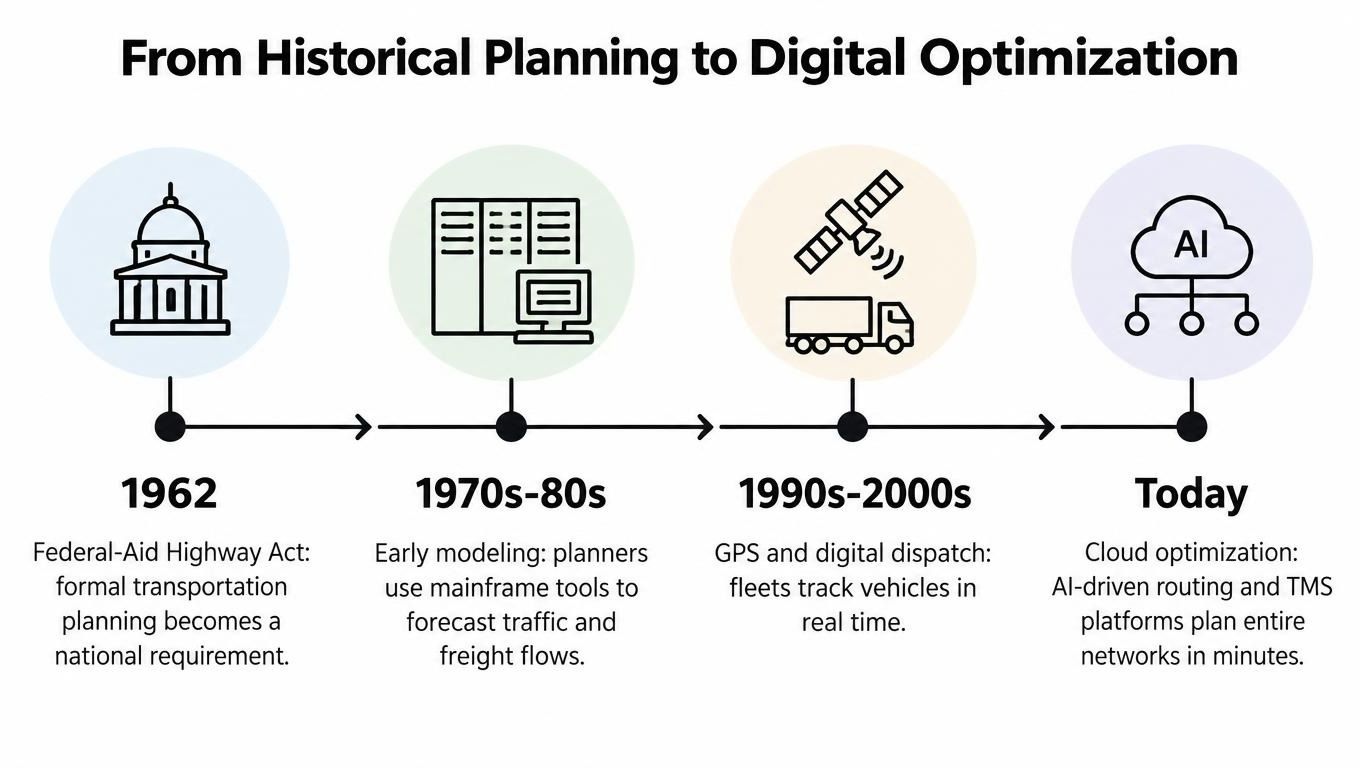
Modern logistics didn't start with apps, dashboards, or AI. It started when transportation planning became a formal process rather than a series of isolated road projects, and that shift still shapes how fleets think about routes, corridors, and network design. The Federal-Aid Highway Act of 1962 created the federal mandate for urban transportation planning, and Congress required metropolitan areas above 50,000 people to have a planning process in place by 1965. That was a real change in how systems were built and managed, not just where pavement was laid.
The same era also pushed planning toward prediction. The Chicago Area Transportation Study began in 1955, and by 1962 it had become one of the first major metropolitan efforts to use analytical methods for forecasting travel demand, which is a direct ancestor of the route models and demand tools fleets rely on now. A little later, policy ideas like traffic pricing and demand management helped broaden the view from moving vehicles to managing behavior and network pressure.
Why that history still matters to fleets
For a regional middle-mile operator, the lesson is simple. Good route design has always been about coordinating constraints, not chasing the shortest line on a map. Today's TMS platforms, telematics feeds, and route engines just automate the discipline that planners were forced to build by hand.
That's why interoperability matters so much. If the planning stack can't move cleanly between dispatch, compliance, live tracking, and customer reporting, the technology is just a bundle of separate screens. The strongest systems keep the same basic promise that early planners tried to deliver, which is a shared picture of demand, capacity, and timing across every party involved.
Planning moved from pavement to process
The older model treated roads as the main output. The modern model treats decisions as the output. That includes how a route gets sequenced, how a driver is informed, how exceptions are logged, and how the next night's plan gets refined from the last one.
The shift is especially obvious in overnight freight, where the margin for error is thin. A route that looks efficient in a spreadsheet can still fail if it ignores dock readiness, dwell time, or the handoff chain between facilities. That's why practical operators care less about flashy features and more about whether the system supports real control.
For a deeper look at how route logic is built into planning, see Peak Transport's overview of route optimization using machine learning.
Essential Technologies for Box-Truck Operations
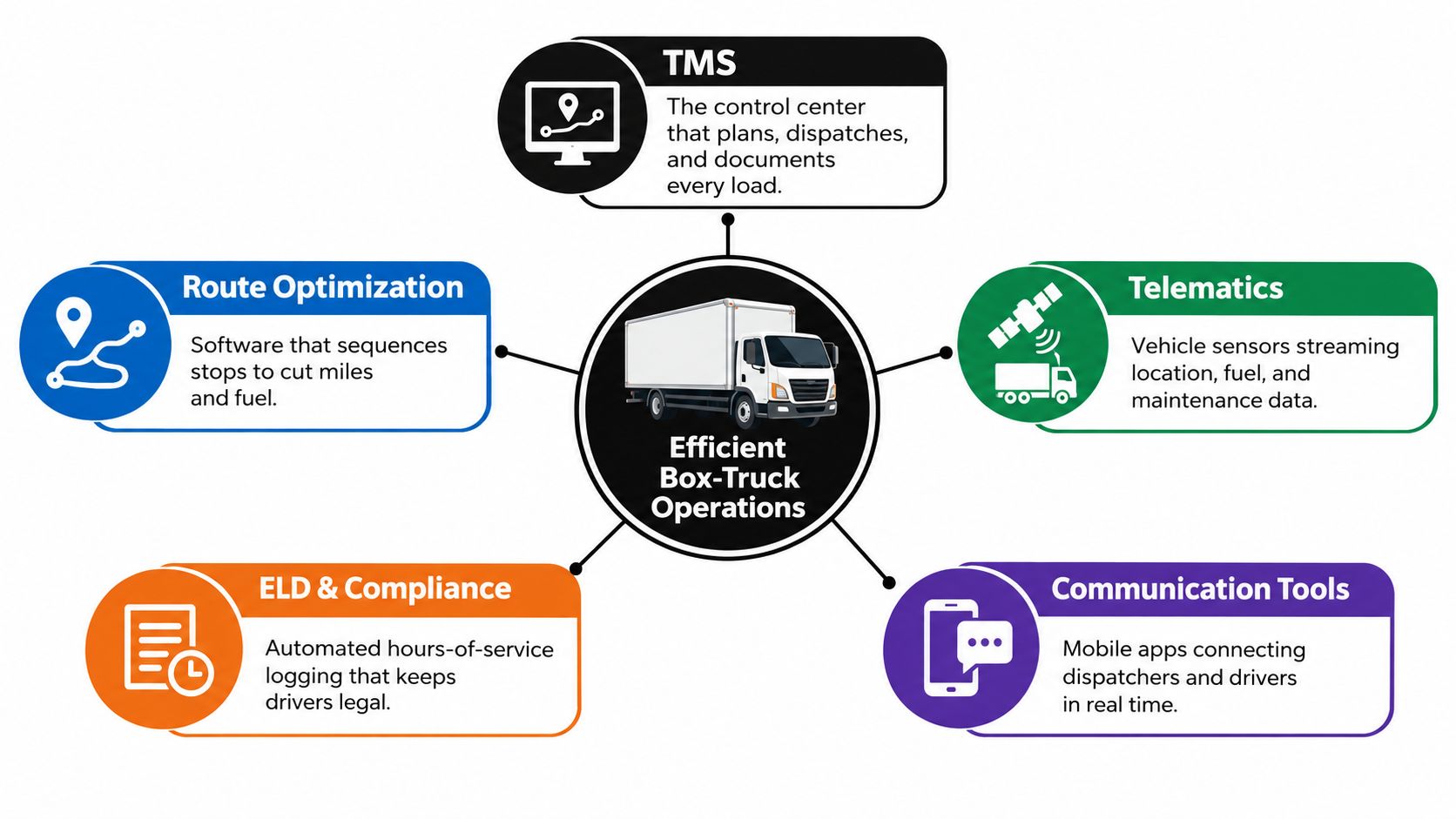
The right stack for a box-truck fleet isn't one giant system. It's a set of tools that each solve a different operational problem, then share enough data to keep the whole night moving. A Transportation Management System acts like the control center, route optimization decides how the work gets sequenced, telematics shows what the truck is doing, and ELDs keep hours-of-service records straight.
A simple way to think about it is this, the TMS plans the move, telematics verifies the move, and compliance tools prove the move was legal. When those pieces are disconnected, dispatch spends the night reconciling mismatched records instead of managing freight. When they're connected, the team can focus on exceptions instead of chasing basic facts.
What each system actually does
TMS software organizes loads, assigns stops, and documents what happened. In practical terms, it turns route knowledge into repeatable process instead of depending on one dispatcher's memory. If you want to see how that structure looks in a fleet setting, Peak Transport's cloud-based TMS software guide is a useful reference point.
Route optimization cuts the wasted moves between stops. In middle-mile work, that matters because every extra mile adds fuel, driver time, and another chance for the schedule to slip. The point isn't perfection, it's choosing a sequence that holds up under real dock conditions.
Telematics gives operators a live picture of location, vehicle behavior, and maintenance signals. That's where the data becomes operational, because a route isn't just where the truck should go, it's where the truck went. For teams evaluating connected fleet infrastructure, mobility IoT for IT leaders is a practical resource on how device data can be managed across systems.
ELDs handle hours-of-service logging without relying on manual reconciliation. That removes a common source of friction between drivers and dispatch, especially when the route changes midshift.
Communication tools tie the whole thing together. Drivers need route updates, exception handling, and stop changes in a format they can use quickly, not buried in a chain of phone calls and text messages.
What works in practice
The best implementations keep the stack boring in the right way. Drivers should know where to look for their next instruction, dispatch should know which data is current, and compliance should never depend on someone remembering to update a spreadsheet. That's the difference between software that supports freight and software that just records chaos after the fact.
Clean handoffs beat clever features when the truck has to leave on time.
How Technology Boosts Reliability and Safety
Reliability starts with better information, not more screen time. When planning tools combine GPS traces, traffic sensors, smartphone signals, and vehicle telemetry, they reduce uncertainty in travel-time estimates and make schedules less fragile. That matters most in overnight work, where one missed dock window can force a driver into a chain of avoidable delays.
The same data layer also improves safety. If planners can see live route status, vehicle behavior, and stop timing together, they can spot pressure points before they turn into rushed driving, bad handoffs, or hours-of-service problems. That's why the strongest systems don't treat safety as a separate add-on, they build it into the plan itself.
Better routing under real disruption
Freight routing research has moved beyond shortest-distance thinking toward models that weigh cost, time, reliability, and emissions together. That approach matters because a slightly longer route can be the safer and more dependable one if it avoids unstable bottlenecks or repeated late arrivals. In middle-mile operations, the lowest-mile option is often not the lowest-risk option.
A route engine should help dispatch answer questions like, can this stop sequence hold if one facility runs behind, and which alternative keeps the driver within a safe schedule? Those are operational decisions, not academic ones. They're also where technology earns its keep, because the system can compare feasible paths faster and more consistently than a person can under pressure.
Safety is a planning outcome
Safety monitoring only works when someone acts on it. If telematics flags harsh driving but dispatch never changes the route structure or timing pressure that caused it, the alert becomes noise. If the plan is adjusted to reduce rushed pickups, impossible turnarounds, or late-night congestion exposure, the same data becomes useful.
For overnight box-truck work, the ideal outcome is fewer forced decisions in the cab. Drivers still need judgment, but they shouldn't have to compensate for a poorly sequenced route every night. Peak Transport's safety monitoring overview fits into that philosophy because it treats safety as part of daily operations, not just post-trip reporting.
Evaluating Technology for Carriers and Shippers
The hardest problem in transportation planning and technology isn't buying tools. It's making them work together across teams that already use different systems, different definitions, and different priorities. Recent industry coverage says 40% of transportation organizations still struggle with siloed data, 84% say poor data management affects project delivery, and 45% cite security and privacy as the top barrier to interoperability. Those numbers point to a familiar operational failure, technology gets added faster than governance gets built.
That's why evaluating software by feature list alone usually backfires. A routing engine can look excellent in a demo and still fail in production if it can't ingest clean stop data, sync with dispatch, or push consistent updates to drivers and customers. For carriers and shippers, the central question is whether the tool reduces handoffs or creates more of them.
Compare fit before sophistication
A simple framework usually beats a long wish list.
- Data governance first: Confirm who owns route data, stop data, and exception data, and how corrections get made.
- Shared definitions next: Make sure everyone uses the same meaning for on-time, arrived, departed, delayed, and complete.
- Integration discipline matters: Ask how the system handles TMS, telematics, ELD, and customer reporting without manual re-entry.
- Operational fit wins: Choose tools that match the actual cadence of overnight middle-mile work, not a generic enterprise workflow.
That order matters because many technology stacks fail at the seams, not in the core feature set. The best software for a regional box-truck network is often the one that makes the fewest assumptions about perfect inputs.
AI should earn its place
There's a lot of talk about AI in logistics, but the practical question is whether it reduces exceptions without adding confusion. In 2026, 44% of shippers were already using AI in transportation planning and optimization, 86% expected it to significantly affect planning and optimization, and 45% of transportation organizations planned to increase investment in transportation management technology. Even with that momentum, data quality remained the leading barrier to scaling AI for 45% of logistics service providers and 33% of shippers, which is a strong signal to fix the foundation before expanding automation.
That's also where bounded tools can outperform ambitious ones. A targeted system that improves ETA visibility or route stability can be more valuable than a broad platform that promises full autonomy but leaves dispatch uncertain. For middle-mile operators, dependable execution usually beats impressive complexity.
A Practical Roadmap for Technology Adoption
The best adoption plans start with the mess on the floor, not the roadmap on the wall. If a fleet is missing stop-level visibility, fighting duplicate entry, or losing time to manual invoice cleanup, that's where the first investment should go. A clean implementation usually looks modest at the start because it fixes one bottleneck at a time.
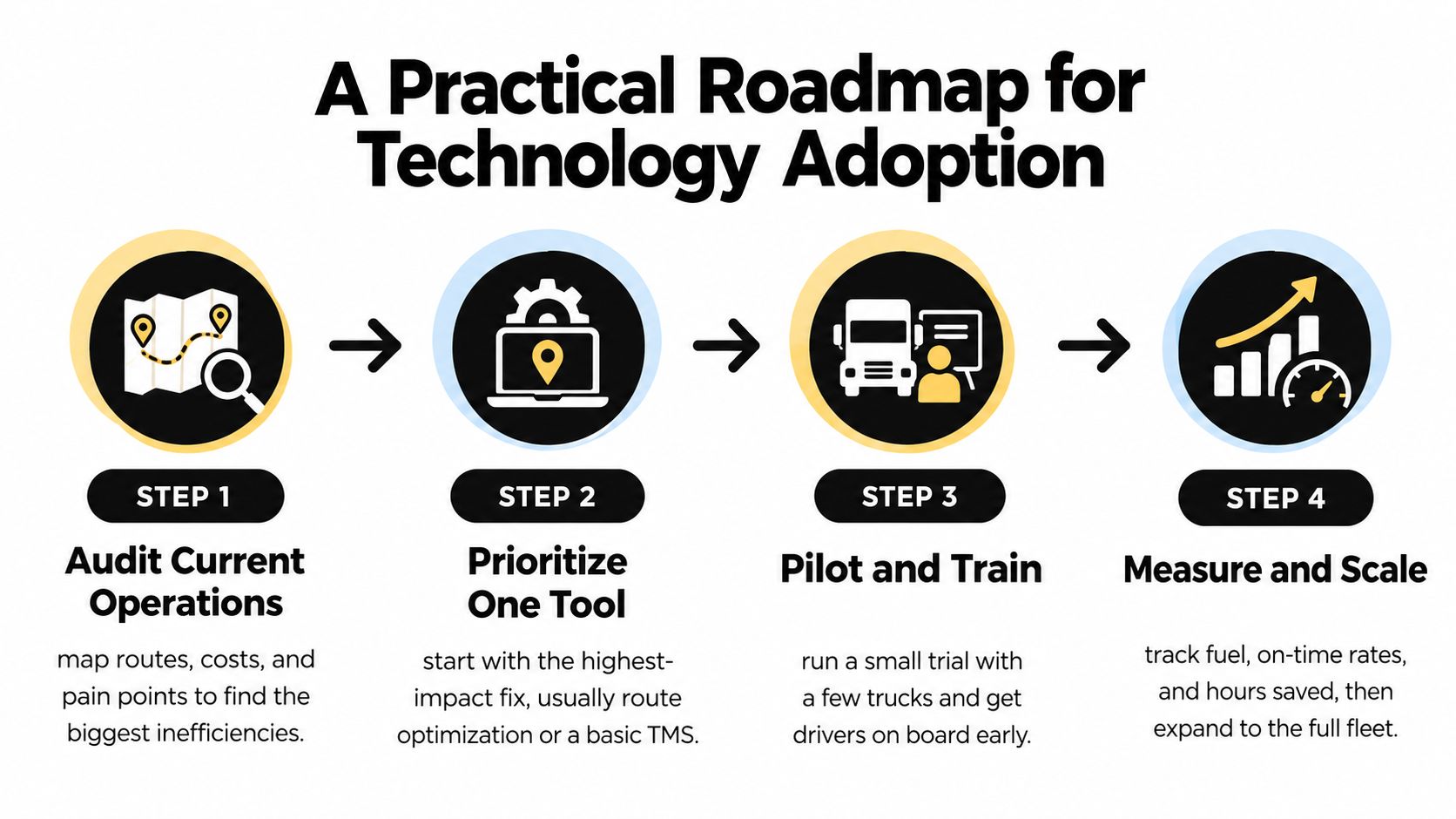
Start with the current workflow
Map the actual route creation, dispatch, driver communication, and closeout process. That audit usually shows where time is being lost, where data is being retyped, and which steps depend on one person knowing the unwritten version of the process.
Then pick the first problem with the highest operational cost. For many fleets, that's either route optimization or a basic TMS layer that gives dispatch one place to manage loads, updates, and records.
Pilot before you scale
A small pilot tells you more than a vendor demo ever will. Use a few trucks, a realistic overnight lane, and the same conditions your team faces every week. If drivers can't understand the workflow quickly, the technology isn't ready for full rollout.
That's also the right time to clean up messy paperwork. If your operation still loses time to invoice mismatches or manual document matching, cut invoice errors with OCR can show how document automation fits into a broader logistics process without turning every problem into a software migration.
Measure what matters
Track the signals that shape the night, not vanity metrics. On-time handoffs, fuel use, hours saved, and fewer route exceptions tell you whether the system is actually helping.
A phased approach also makes training easier. Drivers learn one new habit at a time, dispatch gets stable workflows, and managers can see whether the tool improved the operation before they expand it. That's how technology becomes part of the route instead of an extra layer on top of it.
The Future of Engineered Middle-Mile Logistics
The future of transportation planning and technology won't be decided by who has the flashiest AI label. It'll be decided by who can turn fragmented data into reliable nightly execution. The fleets that win will be the ones that treat software as infrastructure for decision-making, not as a substitute for it.
That matters because middle-mile networks are built on trust. Drivers need routes that make sense, dispatch needs current information, and customers need handoffs that happen when promised. When those pieces align, the operation feels calm, even when the night is busy.
The old planning mindset still applies, just with better tools. Build for coordination, not improvisation. Build for data quality, not dashboard volume. Build for predictable movement through real-world conditions, because that's what keeps box-truck networks safe, compliant, and usable day after day.
If you're building a middle-mile operation that has to perform overnight without guesswork, Peak Transport can help with structured route execution, clear dispatch communication, and safety-first box-truck service across the Twin Cities metro. Visit Peak Transport to see how a predictable, data-informed operation supports brands and drivers alike.